
Comparing Different Cognitive Paradigms with a Virtual Laboratory
Proceedings of the Eighteenth International Joint Conference on Artificial Intelligence. Pages 1635-1635.
© 2003 International Joint Conferences on Artificial Intelligence
Abstract
A public virtual laborator y is presented, where animats are contro ll ed by mechanisms from different cognitive paradigms. A brief description of the characteristics of the laboratory and the uses it has had is given. Mainly, it has been us ed to contrast philosophical ideas related with the notion of cognition, and to elucidate debates on "proper" paradigms in AI and cognitive science.
- Braitenberg, V. (1984). Vehicles: Experiments in Synthetic Psychology. MIT Press.
- Gershenson, C. (2002). A Comparison of Different Cognitive Paradigms Using Simple Animals in a Virtual Laboratory, with Implications to the Notion of Cognition. Unpublished MSc Thesis. University of Sussex
- Gershenson, C. (2003). On the Notion of Cognition. Submitted to IJCAI'03.
- Gershenson, C., P. P. Gonzalez, and J. Negrete (2000). Thinking Adaptive: Towards a Behaviours Virtual Laboratory. In Meyer, J. A. et. a!. (Eds.), SAB2000 Proceedings Supplement. Paris, France. ISAB Press.
- Maes, P. ( 1990). Situated agents can have goals. Journal of Robotics and Autonomous Systems, 6 (I &2). References
- Anderson, M. L.; Okamoto, Y.; Josyula, D.; and Perlis, D. 2002 . The use-mention distinction and its importance to HCI. In Proceedings of the Sixth Work- shop on the S emantics and Pragmatics of Dialog.
- Elgot-Drapkin, J., and Perlis, D. 1990. Reasoning situ- ated in time I: Basic concepts. Journal of Experim ental and Theoretical Artificial Int elligence 2(1):75-98.
- Elgot-Drapkin , J.; Kraus, S. ; Miller , M. ; Nirkhe, M. ; and Perlis , D. 1993. Active logics: A unified for- mal approach to episodic reasoning. Technical Report UMIACS TR # 99-65 , CS-TR # 4072 , Univ of Mary- land, UMIACS and CSD.
- Perlis , D. ; Purang, K.; and Andersen, C. 1998. Con- versational adequacy: mistakes are the essence. Int. J . Human-Computer Studies 48:553-575 .
- Saka, P. 1998. Quotation and the use-mention distinc- tion. Mind 107:113-135.
- Traum , D.; Andersen, C.; Chong, Y.; Josyula , D.; O'Donovan-Anderson , M.; Okamoto , Y.; Purang, K.; and Perlis, D. forthcoming. Representations of di- alogue state for domain and task independent meta- dialogue. Electronic Transactions on Artificial Int elli- gence.
References were extracted automatically from the PDF and may contain errors.
Full text extracted automatically from the PDF; figures, tables and equations may differ. The PDF is the version of record.
1. Introduction
Virtual laboratories have been used in very different areas with different purposes. They are especially useful when they simulate situations which are difficult to reproduce, control, or observe. Cognitive science studies phenomena that fall in this category.
A virtual laboratory has been developed for the comparison of different cognitive paradigms. Experiments carried out in this virtual laboratory were used as "opaque thought experiments" for discussing the notion of cognition (Gershenson, 2003). Detailed information about the virtual laboratory can be found in Gershenson (2002).
2. A Virtual Laboratory
Following the ideas presented in Gershenson, Gonzalez, and Negrete (2000), a virtual laboratory was developed for testing the performance of animats controlled by mechanisms proposed from different perspectives in a simple virtual environment. . Programmed in Java with the aid of Java3D libraries, this software is available to the public, source code and documentation included, at h ttp :!/student. vub. ac.be/~cgershen/cogs/keb/. The software allows the user to create and repeat controlled experiments for comparing the different animats in different situations in a friendly and informative fashion.
In the virtual laboratory, the user can create different phenomena, such as rocks (grey cubes), food sources (green spheres), rain (blue semitransparent cylinders), lightnings
(black cylinders), and spots of different colours (circles): randomly or in specific positions . These also can be generated randomly during the simulation at a selected frequency. Lightnings turn into rain after ten time steps, and rain turns into food after fifty time steps.
All the animats have an energy leve l, which decreases when their hunger or thirst are high, and is increased when these are low. An ani mat dies if its energy is exhausted. Eating food decreases their hunger . They can decrease their thirst by drinking under rains . Hunger and thirst are increased if they attempt to drink or eat "incorrect" stimuli. They Jose energy if they touch lightnings or rocks. Basically, an animat in order to survive needs to eat when hungry, drink when thirsty, and avoid lightn ings and rocks . We can say that they are cognitive systems if they are successful, because they would know how to survive (Gershenson, 2003). The animals can leave a coloured trail in order to observe their trajectories.
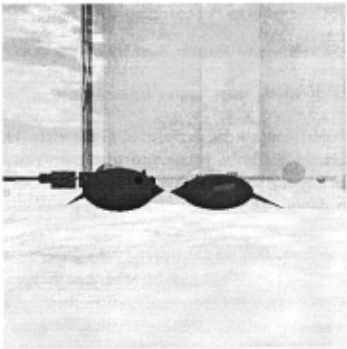
There are many models that would solve the problem of surviving is such an environment, but it was decided to implement representative models of different paradigms in order to observe their differences and s im iii tudes. These models are as follows : a rule-based system typical of traditional knowledge-based and expert systems; Maes' (1990) action selection mechanism , an already class ical behaviourbased system; an original architecture of recursive concept development (Gershenson, 2002) as an ex amp Je of the novel concept-based approach; a simple feed-foiWard artificial neural network; and a Braitenberg-style architecture (Braitenberg, 1984). All the animats survive fairly well in the simple environment. A short description of each mechanism follows:
- The rule-based animats have a set of rules (if. .. then). These receive information from "cheater" sensors, i.e. with meaning given by the programmer (e.g. food perceived, hungry, obstacle close, etc.), and produce behaviours (e.g. explore, approach food, eat, avoid obstacle, etc.), with which a motor system has to deal.
- The behaviour-based animats also have "cheater" perceptual and motor systems, but the control is determined by a network of behaviours (e.g. approach food, eat, avoid obstacle, etc.) which inhibit and excite according to the types of connections they have.
- The concept-based ani mats only have basic sensors (e.g. redness, hardness, flavour, etc.), and they develop recursively concepts that they associate by reinforcement learning with predetermined behaviours.
- The neural animats have three sensor pairs and two motors. Each sensor perceives if a phenomenon (food, rain, or rock) is left or right of the animat. These signals, and signals from the internal medium (hunger and thirst) are inputs to a three-layered feed-forward neural network with fixed weights. The outputs go straight to the motors.
- The Braitenberg animats also have six sensors and two motors, but they are directly connected: food and rain sensors to the inverse motors (left to right, right to left), and rock sensors to the corresponding motors (left to left, right to right).
3. Comparison
Several experiments were performed in the virtual laboratory to compare the different properties of the architectures that control each type ofanimat (Gershenson, 2002). The reader is invited to download the virtual laboratory and compare the different architectures as well.
We could see that we can describe the different animats in the same terms, because it can be said that they perform the same behaviours, independently on how these were implemented. Also, distinguishing which architecture contro Is which type of animat is not possible for a naive observer.
We observed that there is no general "best" architecture for the simple task of surviving in the virtual environment. We can say that each animat is better in different situations. Yet it seems that this is more a consequence of the particular implementation than of the paradigm on which it stands, because the models can be adjusted and refined to any desired degree of detail. In order to judge which architecture is better, we need to refer to a particular context. Their performance cannot be generally measured, but only relatively to specific tasks.
Some models were very easy to implement in software code, others not so much, but occasionally it is a different story if we want to implement an architecture in a real robot. Moreover, if a model works in a simulation and/or robot , it does not mean that animals function in the same way. Some models are very robust. Others would break up quite easily. Some models are quite good if we have just practical purposes, and this also depends on the experience ofthe engineer. Still , if we are interested in using them as explanatory models, the simplicity of their implementation might be secondary. Also, if we would like to increment the systems, for example to include more environmental stimuli and internal variables, some would need to be redesigned, others could be easily extended. Some models would have more ease in adapting to changes of their environment than others, but this does not mean that we cannot adjust different architectures in order to obtain the desired behaviour.
We can say that different models, architectures, and paradigms, study different aspects of cognition. Will we find ever a "best" model? It depends on our purposes and our con text. Generally speaking, we can say that all approaches are useful, since they illustrate different aspects of cognition.
The observations in the virtual laboratory were useful for discussing and illustrating ideas related to the notion of cognition (Gershenson, 2003), and to clarify debates concerning the "proper" paradigm for studying cognition (Gershenson, 2002).
4. Conclusions
Virtual laboratories allow us to explore different avenues than physical laboratories . This virtual laboratory was useful for illustrating questions such as "what makes a system cognitive?". It helped in showing that the observer plays a great deal in the cognition of the system, and that cognition is independent of the implementation of the system.
References
- Braitenberg, V. (1984). Vehicles: Experiments in Synthetic Psychology. MIT Press.
- Gershenson, C. (2002). A Comparison of Different Cognitive Paradigms Using Simple Animals in a Virtual Laboratory, with Implications to the Notion of Cognition. Unpublished MSc Thesis. University of Sussex
- Gershenson, C. (2003). On the Notion of Cognition. Submitted to IJCAI'03.
- Gershenson, C., P. P. Gonzalez, and J. Negrete (2000). Thinking Adaptive: Towards a Behaviours Virtual Laboratory. In Meyer, J. A. et. a!. (Eds.), SAB2000 Proceedings Supplement. Paris, France. ISAB Press.
Maes, P. ( 1990). Situated agents can have goals. Journal of Robotics and Autonomous Systems, 6 (I &2).
Towards domain-independent, task-oriented, conversational adequacy
Darsana P. Josyulal, Michael L. Anderson 2 , and Don Perlis 1 · 2
(1) Department of Computer Science (2) Institute for Advanced Computer Studies University of Maryland, College Park, MD 20742
{darsana, mikeoda, perlis}@cs.umd.edu
Humans are often able to communicate effectively to solve a joint task, even when they do not speak much of a common language, for instance, when buying a train ticket in a foreign country. Although the conversation might not be fully fluent and error-free, the commu nication does not break down; instead, through clari fications, confirmations and inferences, the dialog can proceed towards solving the common task. Key to this is the ability to note an error (or miscommunication), assess it, and address it. We believe that these prin ciples of human dialog repair can be used to enhance the conversational abilities of task oriented interactive systems, allowing them to interact more smoothly with human users (Perlis, Purang, & Andersen 1998). To this end, we are developing an agent that can act as an interface between the user and a task-oriented system, providing a bed for dialog correction and repair.
Our agent, ALFRED (Active Logic for Reason En hanced Dialog) is built on a time-tracking, logical framework called active logic (Elgot-Drapkin et al. 1993; Elgot-Drapkin & Perlis 1990). Active logic works by combining inference rules with a constantly evolving measure of time (a "Now") that can itself be referenced in those rules. As an example, from Now(t)- the time is now "t"-one infers Now(t+1). Special rules govern ing the persistence of formulas in the database, includ ing rules for disinheriting direct contradictions, along with a quotation mechanism which allows formulas to refer to one another, give active logic the expressive and inferential power to monitor its own reasoning, al lowing it to watch for errors (such as mismatches be tween conveyed and intended meanings), note tempo ral conversational cues such as pauses that may signal a turn change, and to exert reasoned control over its past and upcoming inferential processes, including re examination and alteration of beliefs and inferences.
Capabilities
Some of the capabilties that ALFRED currently has are as follows.
- Understanding the use-mention distinction
Copyright © 2003, American Association for Artificial In telligence (www.aaai.org). All rights reserved.
ALFRED is sensitive to whether a word is being used or mentioned, and interprets the relevant utterance accordingly. Following (Saka 1998), we have chosen to characterize the use-mention distinction in terms of the possible ostensions of words. That is, we con sider X is being "used", if the speaker intends to di rect the thoughts of the audience to the extension of X; and X is being "mentioned", if he intends to direct the thoughts of the audience to some item associated with X other than its extension. See (Anderson et al. 2002) for more details. The features that ALFRED uses to make this distinction are context, cues and meta-dialog.
- Using meta-dialog
ALFRED is capable of engaging in meta-dialog with the human user when necessary, in order to identify miscommunication problems and perform dialog re pairs.
- Learning new words
ALFRED can learn new names that refer to already existing objects in the domain. It can also learn new ways to accept known commands. This feature can allow a given user to negotiate a more comfortable vocabulary for interaction, and helps to increase the vocabulary of the system as a whole. We are working on methods of structuring and manipulating concep tual relations to allow ALFRED to learn genuinely new objects and concepts.
- Maintaining context
ALFRED maintains the context of the ongoing con versation by keeping track of user intentions (inter pretations of past utterances), needs and expecta tions. A "need" is created when there is some re quirement (like determining the meaning of a word) that has to be met before the system can interpret a user utterance. An "expectation" is created when the system expects a particular kind of response from the user.
- Identifying miscommunication
ALFRED recognizes miscommunication problems by looking for contradictions in its interpretations of the user's intentions (Traum et al. forthcoming).
- Connecting to different domains
ALFRED functions as a kind of translator between human natural language and the specialized language of the task-oriented domain, and enhances the per formance of the original system interface by incor porating a suite of dialog error detection and repair strategies. These can allow a dialog to continue even in the presence of various kinds of miscommunica tions.
The upshot of this is that ALFRED can act as a nat ural language interface between a user and any task oriented system as long as the specialized language of the task-oriented system is specified explicitly to ALFRED. This specialized language can vary from menu driven commands in the simplest case to nat ural language-like commands in a more complicated scenario. However, since the same principles and rea soning strategies are being used in each case to en hance the dialog, orienting ALFRED to a different domain is as easy as changing the files specifying the specialized language for that domain.
Example
Consider a task-oriented system whose domain is de fined by the following objects and commands.
- Domain objects train: Metroliner, Northstar, Bullet; city: Baltimore, Richmond, Buffalo
- Domain commands send: [send train city]
A stepwise example of command translation and in tentional discernment follows :
- User types "Send Metro to Baltimore"; the parser sends output to ALFRED
- Since it is a request for an action, ALFRED first checks whether it is a command for the domain or for itself.
- Since it is a domain command, ALFRED will get the structure of the command from the domain com mands knowledge base. In this case, the command structure is send - [send train city].
- ALFRED then tries to disambiguate the object ref erences in the user utterance by finding the mapping from these object references to known domain objects of the types specified in the structure.
- Since there is no direct mapping between "Metro" and any existing train in the domain, ALFRED now "needs" the meaning of the word "Metro". This "need" causes ALFRED to temporarily stop further interpretation of the utterance until this "need" gets satisfied.
- This "need" then causes ALFRED to introspect (to examine its existing knowledge base or try to reason) about the meaning of the word "Metro". Since it does not get an answer after introspection, it asks the
user : "What does 'Metro' mean?", and "expects" the user to provide the answer. This "expectation" helps in keeping track of the context of the conversation, which is essential for understanding the dialog state, and has particular use in helping distinguish whether a word is being used or mentioned in an utterance.
- The user says "Metroliner". The expectation, above, helps ALFRED to interpret this elliptical utterance as " 'Metro' means Metroliner". Hence ALFRED would learn this meaning so that at any later point in time, if the user says "Metro", ALFRED would be able to identify the correct referent by introspection.
- Once ALFRED gets the meaning of "Metro", the "need" created above is satisfied, which in turn causes the further interpretation of that user utterance.
Conclusion
ALFRED can enhance the interactive capability of a task-oriented computer system by adding the abili ty to detect and recover from miscommunication problems, including ambiguous references , incompatible or con tradictory user intentions (Traum et al. for thcoming) , and the use of unknown words.
This technology can already be usefully applied to current application domains , such as home-control soft ware, and we expect that the techniques employed can be refined and extended to handle more sophisticated domains.
@inproceedings{ijcai2003p287,
  title     = {Comparing Different Cognitive Paradigms with a Virtual Laboratory},
  author    = {Gershenson, Carlos},
  booktitle = {Proceedings of the Eighteenth International Joint Conference on
               Artificial Intelligence, {IJCAI-03}},
  publisher = {International Joint Conferences on Artificial Intelligence},
  editor    = {Georg Gottlob and Toby Walsh},
  pages     = {1635--1635},
  year      = {2003},
  url       = {https://ijcai.org/proceedings/2003/287},
}
TY - CPAPER TI - Comparing Different Cognitive Paradigms with a Virtual Laboratory AU - Gershenson, Carlos T2 - Proceedings of the Eighteenth International Joint Conference on Artificial Intelligence, IJCAI-03 PB - International Joint Conferences on Artificial Intelligence PY - 2003 SP - 1635 EP - 1635 UR - https://ijcai.org/proceedings/2003/287 ER -Copied
Machine-readable versions of this paper, for tools and AI agents:





