
Automatically Personalizing User Interfaces
Proceedings of the Eighteenth International Joint Conference on Artificial Intelligence. Pages 1613-1618.
© 2003 International Joint Conferences on Artificial Intelligence
Abstract
Todays computer interfaces are one-size-fits-all. Users with little programming experience have very limited opportunities to customize an interface to their task and work habits. Furthermore, the overhead induced by generic interfaces will be proportionately greater on small form-factor PDAs, embedded applications and wearable devices. Automatic personalization may greatly enhance user productivity, but it requires advances in customization (explicit, user-initiated change) and adaptation (interface-initiated change in response to routine user behavior). In order to improve customization, we must make it easier for users to direct these changes. In order to improve adaptation, we must better predict user behavior and navigate the inherent tension between the dynamism of automatic adaptation and the stability required in order for the user to predict the computers behavior and maintain control. This paper surveys a decade's work on customization and adaptation at the University of Washington, distilling the lessons we have learned.
- [Anderson eta!. , 2001a] C. R. Anderson, P. Domingos, and D. S. Weld. Adaptive web navigation for wireless devices. JJCAI-01, Aug 2001. IJCAI
- Anderson eta!., 2001
- C. R. Anderson, P. Domingos, and D. S. Weld . Personalizing web sites for mobile users. WWW-01, May 2001.
- [Anderson eta!., 2002] C. R. Anderson, P. Domingos, and D. S. Weld . Relational Markov models. KDD-02, Aug 2002.
- [Cypher, 1993] Allen Cypher, editor. Watch what 1 do: Pro- gramming by demonstration. MIT Press, 1993.
- [Dent eta!., 1992] L. Dent, J. Boticario, J. McDermott, T. Mitchell, and D. Zabowski. A personal learning ap- prentice. AAAJ-92, pages 96-103, July 1992.
- [Eisenstein eta!. , 2001] J. Eisenstein, J. Vanderdonckt, and A. Puerta. Applying model-based techniques to the de- velopment of Uls for mobile computers. lUI 2001, pages 14-17, 2001.
- [Etzioni and Weld, 1994] Etzioni and D. Weld. A softbot- based interface to the Internet. C. ACM, 37(7):72-6, 1994.
- [Etzioni eta!., 1997] Etzioni, K. Golden, and D. Weld. Sound and efficient closed-world reasoning for planning. Artificial Intelligence, 89(1-2): 113-148, January 1997.
- [Foley eta!., 1989] J. Foley, W. C: Kim, S. Kovacevic, and K. Murray. Defining interfaces at a high level of abstrac- tion . IEEE Software, Jan 1989.
- [Friedman eta!., 1999] N. Friedman, L. Getoor, D. Koller, and A. Pfeffer. Learning probabilistic relational models . JJCAJ-99, Aug 1999. IJCAI
- [Golden and Weld, 1996] K. Golden and D. Weld. Repre- senting sensing actions: The middle ground revisited. KR- 96,pages 174-185,1996.
- [Horvitz, 1999] Eric Horvitz. Principles of mixed-initiative user interfaces. CHJ-99, pages 159-166. ACM Press, May 1999.
- [Lau eta!. , 2000] Tessa Lau, Pedro Domingos, and DanielS. Weld . Version space algebra and its application to pro- gramming by demonstration. ICML-00, pages 527-534, June 2000.
- [Lewis and Reiman, 1993] C. Lewis and J. Reiman. Task- Centered User Interface Design: A Practical Introduction. University of Colorado, Boulder, CO, 1993.
- [Lin and Landay, 2002] J. Lin and J. A. Landay. Damask: A tool for early-stage design and prototyping of multi- device user interfaces. 8th International Conference on Distributed Multimedia Systems, pages 573-580, 2002.
- [Mackay, 1991] W. Mackay. Triggers and barriers to cus- tomizing software. CHI-91, pages 153-160. ACM Press, 1991 .
- INVITED SPEAKERS [Maes and Kozierok, 1993] Pattie Maes and Robyn Kozierok. Learning interface agents. AAAJ-93, pages 459-465, 1993.
- [McGrenere eta!., 2002] J. McGrenere, R. M . Baecker, and K. S. Booth. An evaluation of a multiple interface design solution for bloated software. CHJ-02 , 2002.
- [Mitchell, 1982] T. Mitchell. Generalization as search. Arti- ficial intelligence, 18:203-226, 1982.
- [Nichols eta!., 2002] J. Nichols, B. A. Myers, M. Higgins, J. Hughes, T. K. Harris, R. Rosenfeld, and M. Pignol. Gen- erating remote control interfaces for complex appliances. U/ST-02, pages 161-170, 2002 .
- [Norman, 1998] D. Norman. The invisible Computer. MIT Press, 1998.
- [Perkowitz and Etzioni, 1997] M. Perkowitz and 0. Etzioni. Adaptive web sites: an AI challenge. JJCAJ-97, Aug 1997. IJCAI
- [Perkowitz and Etzioni, 2000] M . Perkowitz and 0 . Etzioni. Towards adaptive web sites: Conceptual framework and case study. Artificial intelligence, 118:245-276, 2000.
- [Popescu eta!., 2003] A. M . Popescu, 0 . Etzioni, and H. Kautz. High precision natural language interfaces to databases: a graph theoretic approach. /U/-03, Jan 2003 .
- [Puerta, 1996] A. Puerta. The MECANO project: Compre- hensive and integrated support for model-based interface development. CADUJ'96, pages 19-36, June 1996.
- [Sanghai eta!., 2003] S. Sanghai, P. Domingos, and D. S. Weld. Dynamic probabilistic relational models. IJCAJ-03, Aug 2003. IJCAI
- [Schreiber, 1994] S. Schreiber. Specification and generation of user interfaces with the boss-system. EWHCJ-94, pages 107-120, 1994.
- [Szekely eta!., 1993] P. Szekely, P. Luo, and R. Neches. Beyond interface builders: Model-based interface tools. INTERCH/-93, pages 383-390. ACM Press, 1993.
- [Weld, 1996] D. Weld. Planning-based control of software agents. A/PS-96, May 1996.
- [Wolfman eta!., 2001] Steven A. Wolfman, Tessa Lau, Pe- dro Domingos, and Daniel S. Weld. Mixed initiative in- terfaces for learning tasks: Smartedit talks back. /U/-01, pages 167-174, Santa Fe, USA, January 2001.
- [Yates eta!., 2003] A. Yates, 0 . Etzioni, and D. Weld. Reli- able natural language interfaces to household appliances. IU/-03, 2003.
References were extracted automatically from the PDF and may contain errors.
Full text extracted automatically from the PDF; figures, tables and equations may differ. The PDF is the version of record.
1 Introduction
Today's software is mass produced with a plethora of features designed to satisfy every user. But since different peopl~ are working on different tasks with different styles, there IS no way to organize features in a way that makes essential func tionality convenient for everyone. Consider word processing, for example; most people will never use automatic line num bering, but legal secretaries couldn't survive without it. .
The shift away from the desktop and towards pervasive computing greatly exacerbates the problem of "Steelcase In spired" software for several reasons. First, the shift.from quiet office to ubiquitous use introduces complex environmental factors that increase the differences between the usage pat terns of distinct individuals; indeed, a single user will require different features depending on context. Second, the form factor of mobile devices is enormously more variable than that of desktop machines - for example, the ratio of large to small desktop display size is about four, but it varies by a factor of 625 between a cell-phone and a liveboard.
·current address: Google Inc, 2400 Bayshore Parkway, Moun tain View, CA, 94043
tcurrent address: IBM TJ Watson Research Center, P.O. Box 704, Yorktown Heights, NY 10598
The wisdom of user-centered design have been well doc umented [Lewis and Reiman, 1993]. However, as user needs and device characteristics diverge, the traditional de sign methodology of intensive user studies becomes unseal able. While each user deserves a personalized interface, de signed for the device at hand and providing simple access to the commands and features they need, there aren't enough ethnomethodologists and designers to manage, interpret, and respond to so many studies. Indeed, the only resources that scale with the number of users are the users themselves and the computing devices they are using.
We use the term adaptation to denote personalization which is automatically performed by the interface without explicit user directives. By customization we mean person alization which is directly requested by the user. Our argu ment, thus, is that adaptivity and customization are the only scalable approaches to personalization. Interfaces should au tomatically adapt to the capabilities of the device at hand, to network connectivity, and to the individual user's activi ties, location, and context; users should be able to guide and control adaptation through a variety of customization mecha nisms.
1.1 Customization and Adaptation
Of course, many existing desktop applications allow limited customization by letting the user ( 1) select which menus are visible, (2) add buttons to toolbars, (3) define macros, and (4) even add custom functionality via scripting languages such as Visual Basic. While customization is important, most users fail to customize effectively. Few users are comfortable with macros, regular expressions, or scripting languages, and e.ven programmers are often too busy to invest the necessary time now in order to speed future sessions. Thus, the challenge is to create improved methods for users to direct their inter face, rearrange functionality as well as appearance, and re cover from inappropriate adaptations.
Similarly, many systems support limited adaptation, but users don't always appreciate it. Defaults that remember the last option or directory selected are simple and can be help ful, but Microsoft's smart menus disorient, while the Office Assistant's guesses fall far from the mark. The danger of adaptivity is its potential to create confusing inconsistency and rob the user of control. Thus, the challenge is to develop datamining algorithms that can accurately predict a user's be havior and to navigate the tension between too rapid adap tation (disorienting) and too little (inefficient), and to seek interface metaphors that increase user control.
1.2 Deep Deployment
Successful customization and adaptation methods will max imize their benefit when used by a broad range of applica tions. Ideally, there will be deep deployment: a uniform layer at the operating systems level that records clickstream data across applications, and supports ubiquitous personaliza tion. For this to work, the interfaces themselves must be de scribed using declarative representations like those developed by the model-based interface community [Foley eta!., 1989; Puerta, 1996]
Deploying personalization methods at the OS layer will bring several advantages. The first is consistency of behavior amongst applications. Second, knowledge of a user's activ ity with one application may improve adaptation of another's interface. Third, cross-application personalization may offer the highest benefit to users, since many common tasks involve patterns connecting two or more programs.
1.3 Outline
In the rest of this paper, we describe a sequence of our projects which are making progress on this vision. The under lying techniques range along a continuum ofuser-involvment, and our expository progression follows this vector from cus tomization towards pure adaptation. Along the way we com pare related endeavors and summarize lessons learned.
2 Customization by Command
The Internet Softbots project [Etzioni and Weld, 1994] marked the genesis of work on Intelligent User Interfaces at the University of Washington. By acting as a personal as sistant, the softbot supported a qualitatively different kind of human-computer interface. Users were able to make high level requests, and the softbot used search [Weld, 1996], in ference [Etzioni eta!., 1997], and knowledge to determine how to satisfy the request. Furthermore, the softbot was able to tolerate and recover from ambiguity, omissions, and errors in these requests.
At its core, the softbot could handle goals specified in an expressive subset of first-order logic with modal operators for handling time and for distinguishing information gathering goals from those that requested state changes [Golden and Weld, 1996]. We labeled the softbot a goal-oriented inter face, because human requests specified what the user wanted; the softbot was responsible for deciding how and when to sat isfy the request. Since most users are uncomfortable with logical notation, we provided a forms-oriented interface front end. Unfortunately, we found the forms approach to be un scalable, and goal-specification was a challenge for many users. In response, we investigated two research directions: reliable natural-language interfaces [Popescu et a!., 2003;
Yates eta!., 2003] and programming by demonstration [Lau eta!., 2000].
3 Programming by Demonstration
If it's too hard for users to specify goals, then a natural ob jective is the design of an interface that can watch a user's normal behavior and help as appropriate. In the case of repet itive tasks, this amounts to programming by demonstration (PBD). Of course, PBD has been studied extensively [Cypher, 1993 ], but most previous systems were heuristic and domain specific. We sought a domain-independent approach, suit able for deep deployment, that offered the expressiveness of a scripting language and the ease of macro recording, with out a verbatim recorder's accompanying brittleness. · While our PBD interface resembles a keystroke-based macro inter face, it generalizes from the demonstrated actions to a robust program which is more likely to work in different situations.
It is useful to think of a PBD-interface as having three com ponents: 1) segmentation determines when the user is execut ing an automatable task, 2) trace induction predicts what the user is doing from a prefix of her activity trace, and 3)facili tation manages user interaction to aid the user in completing her task. The focus of our work was on the trace induction phase.
We formalized PBD trace induction as a learning problem, as follows. A repetitive task may be solved by a program with a loop, where each iteration solves one instance of the task. The PBD system must infer the correct program from a demonstration of the first few iterations. Each action (e.g. , move, select, copy, paste, ... ) the user performs during this demonstration causes a change in the state of the application (e.g., defines a mapping between editor states). Therefore, we modeled this problem as one of inferring the function that maps one state to the next, based on observations of the state prior to and following each user action.
PBD presents a particularly challenging machine learning problem, because users are extremely reluctant to provide more than a few training instances. Thus the learner must be able to generalize from a very small number of iterations. Yet in order to be useful, a wide range of programs must be learnable. Thus the problem combines a weak bias with the demand for low sample complexity. Our solution, called version-space algebra, lets the application designer combine multiple strong biases to achieve a weaker one that is tailored to the application, thus reducing the statistical bias for the least increase in variance. In addition, the learning system must be able to interact gracefully with the user: presenting comprehensible hypotheses, and taking user feedback into ac count. Version-space algebra addresses this issue as well.
3.1 Version-Space Algebra
Originally developed for concept learning, a version space is the subset of a hypothesis space which is consistent with a set of training instances [Mitchell, 1982]. If there is a partial order over candidate hypotheses, one may represent the ver sion space implicitly (i.e., with boundary sets) and manage updates efficiently. Version space algebra defines transforma tion operators (e.g., union, join, etc.) for combining simple version spaces into more complex ones. We also ?ev~loped a probabilistic framework for reasoning about the hkehhood of each hypothesis in a composite version space. .
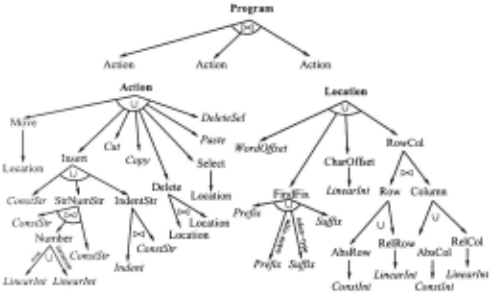
After constructing a library of reusable, domam independent component version spaces, ~e comb in~~ a set of primitive spaces to form a bias for learnmg text-ed1tmg pro grams (Figure 1), which was used in the SMARTEDIT PBD implementation.
3.2 The SmartEdit Implementation
We verified the utility of version-space algebra for PBD with SMARTEDIT, an Emacs-like editor. When a user notices that she is about to perform a repetitive task, she clicks a button to start the PBD recorder. After completeing one instance of the task she clicks another button to mark the first demon stration.' SMARTED IT initializes the version space using the recorded state sequence as the first training example. _As the user continues to type, SMARTEDIT updates the versiOn space with every action. In parallel, SMARTEDIT ~isplays what action it thinks the user will next perform, and Its con fidence in the prediction. These probabilities are calculated by voting the version space. When the user is confide?t that SMARTEDIT has learned her procedure, she may let It exe cute in single-step or fully autonomous mode. We explored a number of ways of structuring the user's dialog with the learner, including decision-theoretic control [Wolfman eta/., 2001], but many aspects offacilitation require furt~er study.
Version-space algebra provides SMARTEDIT with sev~ral benefits: efficient methods for incremental update and votmg, without explicit enumeration of the version sp~ce [Lau et ~/., 2000], and flexibility. By varying the algebraic formulatiOn for the hypothesis space, we experimented with several other version spaces for learning single-loop programs from traces with varying amounts of segmentation information, as well as learning programs with multiple nested loops.
3.3 Experiments and Observations
Empirical studies validated our approach on a r~nge of text editing scenarios (e.g., bibliographic reformattmg, HTML to ~TEX conversion, information extraction, etc.). We show that a program that generalizes correctly for each of these scenarios can be learned quickly in as few as one or two training examples. An informal user study confirmed SMARTEDIT's usability and usefulness, and showed that even novice SMARTEDIT users perform tasks more quickly and concisely with PBD than without.
However, we learned a negative lesson when we started widespread distribution - despite incorporation within Emacs, relatively few people used SMARTEDIT frequently. From this we conclude that the overhead of a macro recorder interface is relatively high. Since most repetitive tasks are short it is often easier to do them manually and avoid the cognitive load of complex customization. Others have found similar results - users customize relatively little [Mackay, 1991]- perhaps because customization facilities are com plex themselves [McGrenere et a/., 2002]. We. conjecture that widespread PBD adoption requires automatic segmen tation, and the adaptation mechanisms, described in the next section, may provide this capability.
4 Adapting to User Behavior
The AI community has a long-standing interest in adaptive in terfaces. The Calendar's Apprentice [Dent eta/., 1992] used machine learning to predict meeting location and durations. This research and similar work on email classification [Maes and Kozierok, 1993] led to an important principle about the incorporation of imperfect behavioral predictions in an inter face: defaults are an effective way to minimize the cost to the user of (inevitable) poor predictions. Horv_itz's d~~ision t~e oretic framework [Horvitz, 1999] resulted m additional pnn ciples: graceful degradation of service pre~iction, expe~ted utility of disambiguation dialogs as a functwn of user time and attention), and the use of timeouts to minimize cost of prediction errors. 1 . . .
Our work on adaptive interfaces focussed Imtially on web site design [Perkowitz and Etzioni, 1997] and led to al gorithms for datamining web logs t~ disco~er aggr_egate patterns, which powered the automatic creatiOn of mdex pages [Perkowitz and Etzioni, 2000]. Later we _concentrated on mining individual behavior patterns, generatmg personal ized sites for display on small, wireless devices [Anderson et al., 200lb]. Our emphasis was on "information-goal seek ing" behavior, common to wireless internet use, rather than general browsing or surfing. The PROTEUS syst~m mod eled adaptation as search through ~he space ~f p~ss1~le web sites. Site modification operators mcluded h1ghhghtmg text, adding shortcut links, and eliding parts of pages. We adopted the decision-theoretic approach, guiding search with expected utility calculations based on a model of the cost of manipu lating the small PDA screen and fetching pages over the slow wireless connection.
A small user study revealed two important lessons. For the most part, the adaptations were good ones; PROTEUS sug gested useful shortcuts and the elided content was al~ost_ al ways useless to the user. However, the cost o~ deletmg _u:n portant parts of a page was very high. Rewei~htmg ou: utility function would have led to more conservative behaviOr, but the problem of accurate behavior prediction is central to in terface adaptation; we discuss it in the next section.
1 It is ironic that the Office Assistant violates most of Horvitz's principles, which were developed at Microsoft Research.
A second problem stemmed from the fact that frequently users didn't find a shortcut link, even though PROTEUS had added it in the appropriate place. Shortcut-naming was usu ally to blame, and this raised the general issue of saliency, which we discuss in section 4.2.
4.1 Predicting User Behavior
High-quality adaptation requires the ability to learn an ex tremely accurate model of user behavior. Our comparison of existing techniques showed that a mixture of Markov mod els had the best predictive power [Anderson et a/., 200 I a]. (Shortcuts generated by the mixture model saved users up to 40% of their navigational effort.) But all models performed poorly when data was sparse; hence none of these models would work well for situations where a user is exploring new parts of the interface- even if she is performing a task which is similar to one she has performed frequently in another con text (e.g., shopping cart checkout at a new store). To rem edy this problem, we developed relational Markov models (RMMs), a generalization of Markov models that overlays relational structure on the states [Anderson eta/., 2002].
Intuitively, RMMs do for Markov models what Prob abilistic Relational Models (PRMs) do for Baysian net works [Friedman et a/., 1999]. RMMs generalize Markov models by partitioning the states into classes; each class has an associated k-ary relation, R, and members of the class cor respond to R instantiated with distinct ground values. The domain of each variable can be hierarchically structured, and a smoothing techniqued called shrinkage is carried out over the cross product of these hierarchies. RMMs make it pos sible to generalize beyond the observed states. For example, suppose a user surfing through an e-commerce Web site goes from a page about Nirvana's "Nevermind" CD to a page con taining a biography of Nirvana. An ordinary Markov model can infer nothing from this about what the user will do when visiting a page about a Pearl Jam CD, but an RMM would be able to infer that the user might next go to a Pearl Jam bi ography. RMMs make effective learning possible in domains with very large and heterogeneous state spaces, given only sparse data. Experiments on academic and e-commerce web sites show that RMMs trained on only ten instances perform as well as Markov models which were trained on ten thousand instances [Anderson eta/., 2002]. We are currently extending RMMs by incorporating structure in the same way that dy namic Bayes nets extend Markov models; see [Sanghai eta!. , 2003].
4.2 Partitioned Dynamicity
As our experience with unnoticed shortcuts showed; saliency is essential - any adaptive mechanism that introduces new commands or options to an interface, must ensure that the user finds them. Furthermore, the mechanism must take care not to obscure important existing functionality.
One way to increase saliency, while minimizing the cogni tive dissonance associated with adaptivity, is to partition dy namism - to segregate dynamic and static areas of an inter face. Indeed, a number of well-designed adaptive interfaces exhibit this property. For example, the news stories and ad vertisements on Yahoo change continuously, but because the layout is fixed, the adaptation causes little distress to users. In contrast, the automatic menu shortening feature of Microsoft Office 2000 violates partitioned dynamicity, since the loca tion of commands in the menus changes unpredictably.
Powerpoint XP's "Insert Symbol" command provides an other example. Previous versions required a long sequence of clicks to select the correct font and navigate to the desired symbol, but the dialog box in the XP version has a "Recently used symbols" area.
We conjecture that partitioned dynamicity is a useful general principle for adaptation in interfaces. Because users become accustomed to changes in the dynamic area, these changes don't disturb their conceptual model [Norman, 1998]. And because existing navigational patterns remain un changed, users maintain control even if adaptation is unhelp ful. The alternative, dual-interface approach of [McGrenere et at. , 2002] shares many benefits with partitioned dynamic ity, but trades convenience for screen real estate.
4.3 Example: Adapting Desktop Dialogs
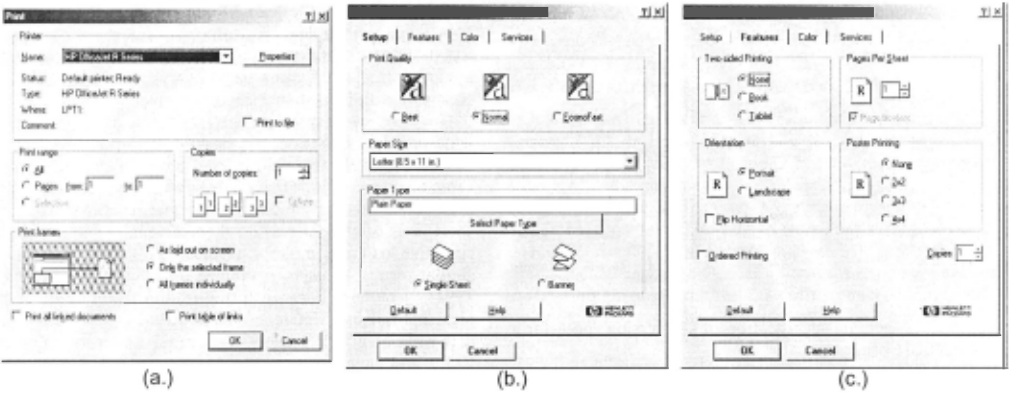
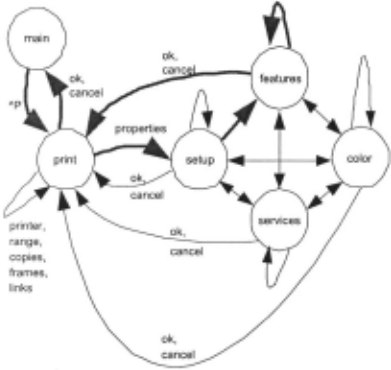
We believe that the PROTEUS architecture, developed for adaptive websites, would be even more useful in a desk top application setting. As a story-board example, suppose that a user wishes to print a Word document, doublesided. As Figures 2 and 3 show this requires six user actions. 2 First, the user presses ctrl-P to print the current docu ment. Next, she must click on "Properties ... " which yields "Setup" options. Clicking on the "Features" tab uncovers two sided printing options; another click selects book-style duplex. Then "Ok" must be clicked twice, once to close the Properties window and the other to confirm printing. 3 How ever, if an individual user executes this pattern hundreds of times, always choosing duplex printing, the system should recognize this and provide a shortcut.
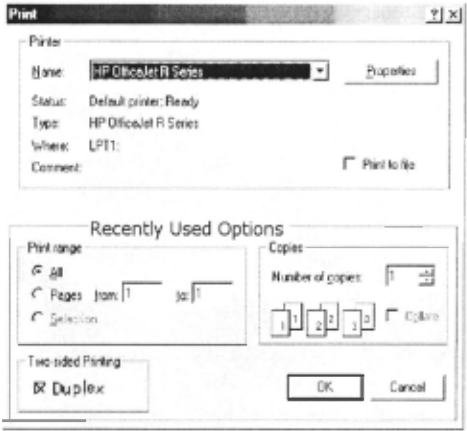
Figure 4 shows one possible result, where the main screen has partitioned dynamicity, and the duplex options (with a new default value) have been added. In this example, we as sume that the user had never chosen the "tablet" duplex value. For the shortcut, therefore, the system deleted the value, cast ing the duplex variable into a Boolean. As a result, the duplex option could be rendered with a simple, space-efficient check box. Of course, if the user later desired the tablet format, they could find it unchanged on the "Features" tab. 4
2 Using Windows ME, Office XP, and a HP R80 printer.
3 0 f course, one can quibble with the design of this particular interaction, but it is a result of today's software engineering pro cess, and many similar designs exist - that's why adaptation is so promi sing
Restricting a state variable's set of valid values and type casting are just two representative transformations; many more exist. Note that it is only possible to perform these transformations when the interface is represented in an ab stract, declarative language. The next section discusses addi tional benefits from such a representation.
5 Adapting to Device Characteristics
The trend towards mobile and ubiquitous computing has re sulted in an morass of device form factors and input mech anisms, and it is nearly impossible for a designer to tar get each of these manually. Furthermore, as shown in pre vious section, some parts of the interface may be gener ated dynamically in response to the particular usage pat terns. Hence, we are building an automated solution, called SUPPLE. Others researchers have laid useful foundations. Starting with [Foley et at., 1989], the model-based UI com munity has developed declarative, interface-representation languages; SUPPLE uses an extension of the representation developed for PEBBLES [Nichols eta!., 2002].
Researchers have explored many methods for "compil ing" a declarative UI representation into concrete form for use on a specific target device. For example, PEBBLES uses a hand-constructed decision tree for this task; other approaches include hierarchical templates [Szekely et a!., 1993 ], stylesheets [Schreiber, 1994 ], and tools for facilitating manual design [Eisenstein eta!., 2001]. Yet another method is based on a higher-level encoding of the design in terms of design patterns [Lin and Landay, 2002].
4 Some might argue that this problem could be simply solved by using a MRU default for options like duplex, without restructuring the dialogs. But changing defaults is very dangerous unless they are visible to the user.
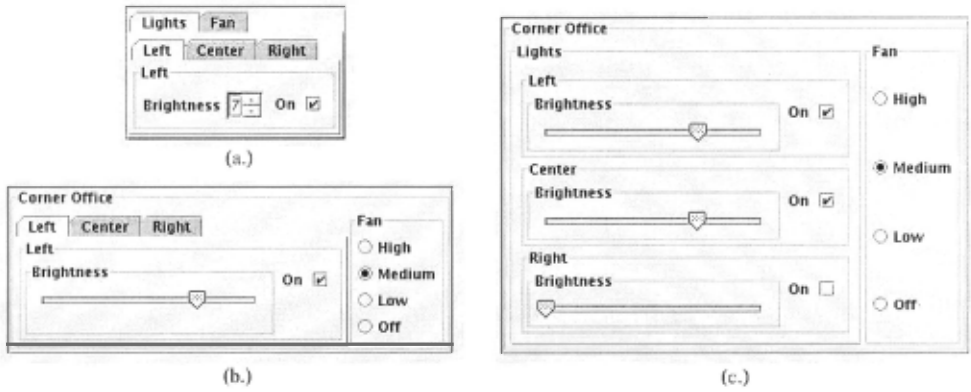
In contrast, we adopt the decison-theoretic framework and search for the design with the highest expected utility among those that satisfy the device constraints. Our SUPPLE pro totype focusses on screen-size constraints and uses a utility function that models the expected ease of interface opera tions for each widget. If multiple interface actions are nec essary to complete a task (e.g., if tabs must be selected, panes navigated, or confirmation buttons pressed) the costs are com bined linearly. Figure 5 shows three different interfaces (from amongst the 3,888,000 possible) which were generated by SUPPLE and deemed optimal for differing amounts of avail able screen space.
While the current SUPPLE implementation accepts as in put an arbitrary probability distribution over command usage, our framework supports user-based adaptation as described in the previous section. For example, at present SUPPLE makes an independence assumption regarding command use, but in practice people use commands in sequence and human de signers recognize this by colocating the corresponding wid gets. By computing the expected utility of an interface rela tive to a recorded trace of individual user commands, SUPPLE should be able to automatically duplicate this form of design optimization, but in a personalized manner.
6 Conclusions
Effective personalization requires improved methods for both adaptation (change based on implicit user behavior) and cus tomization (change guided by explicit user requests). Inter faces should automatically adapt to the capabilities of the de vice at hand, to network connectivity, and to the user's activi ties, location, and context. If they wish to provide customiza tion guidance, users should be able to control the adaptation process at any level.
This paper has briefly surveyed some of the projects at the University of Washington, which are investigating these is sues, and codified several emerging principles:
- Because users find it hard to specify their prefences and goals, it is often more effective to induce them from user behavior. Version-space algebra allows an application designer to combine multiple strong biases to achieve a weaker one that is tailored to the application, thus reduc ing the statistical bias for the least increase in variance.
- Many benefits of model-based Ul design have been long recognized [Foley eta/., 1989], but it is increasingly ap parent that these declarative models are essential to a set of transformations (e.g., Currying and casting) that fa cilitate adaptation.
- Since adaptive mechanisms are imperfect, the cost to users of errors must be considered alongside the advan tages. Decison theory provides a powerful framework for such analysis [Horvitz, 1999], and the requisit utili ties can be learned from user behavior or derived from device models.
- Certain interface mechanisms, such as defaults and au tomatic timeouts, can minimize the cost of errors and so increase the value of adaptation. Partitioned dynamicity offers a way to manage adaptivity while minimizing a user's cognitive load.
- Another way to enhance the user experience by improv ing prediction of user behavior. Because RMMs smooth, based on an abstraction lattice defined by the relational structure, they are exceptionally accurate when predict ing sequential behavior (e.g., a user's next action) from sparse data.
Acknowledgments
We thank James Landay for helpful discussions. This re search was funded in part by Office of Naval Research Grants NOOOI4-98-1-0147 & N00014-02-1-0932, National Science Foundation Grants IRI-9303461, IIS-9872128, DL-9874759, and a CAREER Award.
@inproceedings{ijcai2003p282,
  title     = {Automatically Personalizing User Interfaces},
  author    = {Weld, Daniel S. and Anderson, Corin R. and Domingos, Pedro M. and Etzioni, Oren and Gajos, Krzysztof and Lau, Tessa A. and Wolfman, Steven A.},
  booktitle = {Proceedings of the Eighteenth International Joint Conference on
               Artificial Intelligence, {IJCAI-03}},
  publisher = {International Joint Conferences on Artificial Intelligence},
  editor    = {Georg Gottlob and Toby Walsh},
  pages     = {1613--1618},
  year      = {2003},
  url       = {https://ijcai.org/proceedings/2003/282},
}
TY - CPAPER TI - Automatically Personalizing User Interfaces AU - Weld, Daniel S. AU - Anderson, Corin R. AU - Domingos, Pedro M. AU - Etzioni, Oren AU - Gajos, Krzysztof AU - Lau, Tessa A. AU - Wolfman, Steven A. T2 - Proceedings of the Eighteenth International Joint Conference on Artificial Intelligence, IJCAI-03 PB - International Joint Conferences on Artificial Intelligence PY - 2003 SP - 1613 EP - 1618 UR - https://ijcai.org/proceedings/2003/282 ER -Copied
Machine-readable versions of this paper, for tools and AI agents:





