
Automated Reasoning: Past Story and New Trends
Proceedings of the Eighteenth International Joint Conference on Artificial Intelligence. Pages 1607-1611.
© 2003 International Joint Conferences on Artificial Intelligence
Abstract
We overview the development of first-order automated reasoning systems starting from their early years. Based on the analysis of current and potential applications of such systems, we also try to predict new trends in first-order automated reasoning. Our presentation will be centered around two main motives: efficiency and usefulness for existing and future potential applications. This paper expresses the views of the author on past, present, and future of theorem proving in first-order logic gained during ten years of working on the development, implementation, and applications of the theorem prover Vampire, see [Riazanov and Voronkov, 2002a]. It reflects our recent experience with applications of Vampire in verification, proof assistants, theorem proving, and semantic Web, as well as the analysis of future potential applications.
- Afshordel et al., 2001) B. Afshordel, T. Hillenbrand, and C. Wei - denbach. First-order atom definitions extended. In R. Nieuwenhuis and A. Voronkov, editors, LPAR 2001 , volume 2050 of LNAI, pages 309-319. Springer Verlag, 200 I.
- Appel, 2001)
- A.W. Appel. Foundational proof-carrying code. In LICS 200/, pages 247-258, 2001.
- Baader and Schulz, 1996) F. Baader and K.U. Schulz. Unification in the union of disjoint equational theories: Combining decision pro- cedures. Journal of Symbolic Computations, 21:211-243, 1996.
- Bachmair and Ganzinger, 1994a) L. Bachmair and H. Ganzinger. Rewrite-based equational theorem proving with selection and sim- plification. Journal of Logic and Computation, 4(3) :217-247, 1994.
- Bachmair and Ganzinger, 1994b) L. Bachmair and H. Ganzinger. Rewrite techniques for transitive relations. In LICS'94. IEEE Com- puter Society Press, 1994.
- Bachmair and Ganzinger, 2001) L. Bachmair and H. Ganzinger. Resolution theorem proving. In A. Robinson and A. Voronkov, edi- tors, Handbook of Automated Reasoning, volume I, chapter 2, pages 19-99. Elsevier Science, 2001.
- Bachmair et at., 1993)
- L. Bachmair, T. Chen, and I.V. Ramakrish- nan. Associative-commutative discrimination nets. In M.-C. Gaudel and J.-P. Jouannaud, editors, TAPSOFT'93, volume 668 of LNCS, pages 61-74. Springer Verlag, 1993.
- Baumgartner, 2000)
- P. Baumgartner. FDPLL-a first-order Davis- Putnam-Logemann-Loveland procedure. In D. McAIIester, editor, CADE-17, volume 1831 of LNAI, pages 200-219. Springer Verlag, 2000.
- Brand, 1975)
- D. Brand. Proving theorems with the modification method. SIAM Journal of Computing, 4:412--430, 1975.
- de Nivelle et al., 2000) H. de Nivelle, R.A. Schmidt, and U. Hus- tad!. Resolution-based methods for modal logics. Logic Journal of the IGPL, 8(3):265-292, 2000.
- de Nivelle, 2000) H. de Nivelle. Bliksem 1.10 User's Manual. MPI fiir Informatik, Saarbriicken, 2000.
- Degtyarev and Voronkov, 2001) A. Degtyarev and A. Voronkov. Equality reasoning in sequent-based calculi . In A. Robinson and A. Voronkov, editors, Handbook of Automated Reasoning, volume I, chapter 10, pages 611-706. Elsevier Science, 2001.
- Degtyarev et al., 2002) A. Degtyarev, R. Nieuwenhuis, and A. Voronkov. Stratified resolution. Journal of Symbolic Computa- tions, pages 1-24, 2002. to appear.
- Denzinger and Fuchs, 1999) J. Denzinger and D. Fuchs. Coopera- tion of heterogeneous provers. InT. Dean, editor, ?roc. (/JCAI-99), volume 1, pages 10-15, 1999. IJCAI
- Denzinger et at., 1997) J. Denzinger, M. Kranenburg, and S. Schulz. DISCOUNT -a distributed and learning equa- tional prover. Journal of Automated Reasoning, 18(2):189-198, 1997.
- Ganzinger et al., 2001)
- H. Ganzinger, R. Nieuwenhuis, and P. Nivela. The Saturate system. Max-Planck Institute fiir Infor- matik, 200 I.
- Gordon and Melham, 1993)
- M. Gordon and T. Melham. Introduc- tion to HOL. Cambridge University Press, 1993.
- Graf, 1996)
- P. Graf. Term Indexing, volume 1053 of LNCS. Springer Verlag, 1996. [Hahnle, 200 I)
- R. Hahn! e. Tableaux and related methods. In A. Robinson and A. Voronkov, editors, Handbook of Automated Reasoning, volume I, chapter 3, pages 100-178. Elsevier Science, 2001.
- IEEE SUO-KIF project, 2002) IEEE SUO-KIF project. Standard upper ontology knowledge interchange format, 2002.
- Knuth and Bendix, 1970)
- D. Knuth and P. Bendix. Simple word problems in universal algebras. In J. Leech, editor, Computational Problems in Abstract Algebra, pages 263-297. Pergamon Press, Ox- ford, 1970.
- Letz and Stenz, 2001) R. Letz and G. Stenz. Model elimination and connection tableau procedures. In A. Robinson and A. Voronkov, editors, Handbook of Automated Reasoning, volume II, chapter 28, pages 2015-2114. Elsevier Science, 2001.
- Lusk, 1992)
- E.L. Lusk. Controlling redundancy in large search spaces: Argonne-style theorem proving through the years. In A. Voronkov, editor, LPAR'92., volume 624 of LNAI, pages 96--106, 1992.
- McCune and Padmanabhan, 1996) W. McCune and R. Padmanab- han. Automated Deduction in Equational Logic and Cubic Curves, volume 1095 of LNAI. Springer Verlag, 1996.
- McCune, 1994)
- W.W. McCune. OTTER 3.0 reference manual and guide. Technical Report ANL-94/6, Argonne National Laboratory, 1994.
- McCune, 1997)
- W. McCune. Solution of the robbins problem. Jour- nal of Automated Reasoning, 19(3):263-276, 1997.
- McMath et at., 2001) D. McMath, M. Rozenfeld, and R. Sommer. A computer environment for writing ordinary mathematical proofs. In R. Nieuwenhuis and A. Voronkov, editors, LPAR 200I, volume 2050 of LNAI, pages 502-511. Springer Verlag, 2001.
- Moser et at., 1997)
- M. Moser, 0. Ibens, R. Letz, J. Steinbach, C. Goller, J. Schumann, and K. Mayr. SETHEO and E-SETHEO- the CADE-13 systems. Journal of Automated Reasoning, 18:237- 246, 1997.
- M.P. Bonacina, 1994) W.W. McCune M.P. Bonacina. Distributed theorem proving by peers. In A. Bundy, editor, CADE-12, volume 814 of LNAI, pages 841-845, 1994.
- Necu1a and Lee, 2000)
- G.C. Necula and P. Lee. Proof generation in the Touchstone theorem prover. In D. McAIIester, editor, CADE-I7, volume 1831 of LNAI, pages 25-44. Springer Verlag, 2000.
- Nelson and Oppen, 1979) G. Nelson and D.C. Oppen. Simplifica- tion by cooperating decision procedures. ACM Transactions on Pro- gramming Languages and Systems, 1(2):245-257, 1979.
- Nieuwenhuis and Rubio, 2001) R. Nieuwenhuis and A. Rubio. Paramodulation-based theorem proving. In A. Robinson and A. Voronkov, editors, Handbook of Automated Reasoning, volume I, chapter 7, pages 371-443. Elsevier Science, 2001.
- Nieuwenhuis et al., 2001) R. Nieuwenhuis, T. Hillenbrand, A. Ri- azanov, and A. Voronkov. On the evaluation of indexing techniques for theorem proving. In R. Gore, A. Leitsch, and T. Nipkow, edi- tors, /JCAR 200/, volume 2083 of LNAI, pages 257-271. Springer Verlag, 200 I.
- Paulson, 2002)
- L.C. Paulson. The Isabelle Reference Manual. Cam- bridge University, 2002.
- Pfenning and Schuermann, 1998) F. Pfenning and C. Schuermann. Twelf User's Guide, 1998.
- Riazanov and Voronkov, 2002a) A. Riazanov and A. Voronkov. The design and implementation of Vampire. AI Communications, 15(2- 3):91-110, 2002.
- Riazanov and Voronkov, 2002b) A. Riazanov and A. Voronkov. Limited resource strategy in resolution theorem proving. Journal of Symbolic Computations, pages 1-14, 2002. to appear.
- Robinson and Wos, 1969) G. Robinson and L.T. Wos. Paramodu- lation and theorem-proving in first order theories with equality. In B. Meltzer and D. Michie, editors, Machine Intelligence, volume 4, pages 135-150. Edinburgh University Press, 1969.
- Robinson, 1965)
- J.A. Robinson. A machine-oriented logic based on the resolution principle. Journal of the Association for Computing Machinery, 12(1):23-41, 1965. Reprinted as [Robinson, 1983).
- Robinson, 1983)
- J.A. Robinson. A machine oriented logic based on the resolution principle. In J. Siekmann and G. Wrightson, edi- tors, Automation of Reasoning. Classical Papers on Computational Logic, volume 1, pages 397-415. Springer Verlag, 1983. Reprinted from (Robinson, 1965).
- RueB and Shankar, 2001)
- H. RueB and N. Shankar. Deconstructing Shostak. In L/CS 200I, pages 19-28, 2001.
- Schulz, 2001)
- S. Schulz. System abstract: E 0.61. In R. Gore, A. Leitsch, and T. Nipkow, editors, /JCAR 2001, volume 2083 of LNA1, pages 370-375. Springer Verlag, 2001.
- Schumann and Fischer, 1997) J. Schumann and B. Fischer. NORA/HAMMR: Making deduction-based software component retrieval practical. In Proc. Automated Software Engineering (ASE-97), pages 246--254. IEEE Computer Society Press, 1997.
- Sekar et at., 2001)
- R. Sekar, LV. Ramakrishnan, and A. Voronkov. Term indexing. In A. Robinson and A. Voronkov, editors, Handbook of Automated Reasoning, volume II, chapter 26, pages 1853-1964. Elsevier Science, 2001.
- Shostak, 1984)
- R.E. Shostak. Deciding combinations of theories. Journal of the Association for Computing Machinery, 31 (I): 1-12, 1984.
- Slaney et at., 1994)
- J.K. Slaney, E.L. Lusk, and W. McCune. SCOTT: Semantically Constrained Otter (system description). In A. Bundy, editor, CADE-12, volume 814 of LNAI, pages 764-768, 1994.
- Stickel et at., 1994)
- M. Stickel, R. Waldinger, R. Lowry, T. Press- burger, and I. Underwood. Deductive composition of astronomical software from subroutine libraries. In A. Bundy, editor, CADE-12 , volume 814 of LNA/, pages 341-355, 1994.
- Stickel et at., 2001)
- M.E. Stickel, R.J. Waldinger, and V.K. Chaudhri. A Guide to Snark. SRI, 2001. (Sutcliffe and Suttner, 1998) G. Sutcliffe and C. Suttner. The TPTP problem library -CNF release v. 1.2.1. Journal of Automated Rea- soning, 21(2), 1998.
- Sutcliffe et at., 2002)
- G. Sutcliffe, C.B. Suttner, and F. J. Pelletier. The IJCAR ATP system competition. Journal of Automated Rea- soning, 28(3):307-320, 2002.
- T. Tarnmet. Gandalf. Journal of Automated Reason- ing, 18(2): 199-204, 1997.
- The Coq Development Team, 2001) The Coq Development Team. The Coq Proof Assistant Reference Manual. Version 7.2. INRIA, 2001.
- Voronkov, 1995) A. Voronkov. The anatomy of Vampire: Imple- menting bottom-up procedures with code trees. Journal of Auto- mated Reasoning, 15(2):237-265, 1995.
- Weidenbach et at., 1996)
- C. Weidenbach, B. Gaede, and G. Rock. SPASS & FLOTTER. Version 0.42. In M.A. McRobbie and J.K. Slaney, editors, CADE-13, volume 1104 of LNCS, pages 141-145, 1996.
- Zhang and Malik, 2002) L. Zhang and S. Malik. The quest for effi- cient boolean satisfiability solvers. In A. Voronkov, editor, CADE- 18, volume 2392 of LNAI, pages 295-313, 2002.
References were extracted automatically from the PDF and may contain errors.
Full text extracted automatically from the PDF; figures, tables and equations may differ. The PDF is the version of record.
1 Theorem Proving in First-Order Logic
The idea of automatic theorem proving has a long history both in mathematics and computer science. For a long time, it was believed by many that hard theorems in mathematics can be proved in a completely automatic way, using the ability of computers to perform fast combinatorial calculations. The very first experiments in automated theorem proving have shown that the purely combinatorial methods of proving first order theorems are too week even for proving theorems re garded as relatively easy by mathematicians.
Provability in first-order logic is a very hard combinato rial problem. First-order logic is undecidable, which means that there is no terminating procedure checking provability of formulas. There are decidable classes of first-order formulas but formulas of these classes do not often arise in applica tions. Due to undecidability, very short formulas may tum out to be extremely complex, while very long ones rather easy. Sometimes first-order provers find proofs consisting of sev eral thousand steps in a few seconds, but sometimes it takes hours to find a ten-step proof. The theory of first-order rea soning is centered around the completeness theorems while in practice completeness is often not an issue due to the intrinsic However, despite the complexity of theorem proving in first-order logic, an impressive progress in the area has been achieved in recent years. This progress is due to several fac tors: development of theory, implementation techniques, and experience with applications. Modem theorem provers are very powerful programs able to find in a few seconds very complex combinatorial proofs which would require several man-month to be solved by mathematicians. Many ideas de veloped in theoretical papers in this area are on their way to implementation. There is extensive research on aspects of theorem proving vital for applications, such as proof checking and interfacing with proof assistants. The next gen eration of theorem provers will incorporate some of these ideas and become even more powerful tools increasingly used for applications which are currently beyond their reach.
*Partially supported by a grant from EPSRC.
The aim of this paper is to give a brief overview of first order provers and point out new trends in theorem proving which are likely to be implemented in theorem provers of the next generation.
Currently, theorem provers are used in the following way. The user specifies a problem by giving a set of axioms (a set of first order formulas or clauses) and a conjecture (again, a first-order formula or a set of clauses). If the input is given by first-order formulas, the prover should check whether the conjecture logically follows from the axioms. If the input is given by a set of clauses, the prover should check whether the set of clauses is inconsistent. In either case, for many appli cations it is desirable that the prover output a proof, if the log ical consequence or inconsistency has been established. The proofs should either be human-readable (for example, when the provers are used for proving theorems in mathematics), or machine-checkable (for example, when provers are used as subsystems of proof assistants or verification systems).
2 Applications
The main application area of theorem provers has been, and continues to be, verification of software and hardware. Full applications of this kind usually cannot be directly repre sented in the first-order form, so provers are normally used to prove subgoals generated by other systems, for example VHDL-to-first-order transformation systems or proof assis tants based on higher-order logic or type theories. There are too many papers on this subject to be mentioned here. Finite state model checkers and interactive proof assistants are cur rently prevailing in verification, but with the growing com plexity of hardware first-order logic and its extensions are likely to play an increasingly important role.
Theorem proving in mathematics has been the first appli cation area for theorem provers. Provers are not very good at working in structured mathematical theories but they are very efficient in fields of mathematics where combinatorial rea soning is required, for example, in algebra. Applications of provers in algebra are numerous. The monograph [McCune and Padmanabhan, 1996] gives an example of how algebra can be developed with the help of a theorem prover.
Symbolic computation and computer algebra systems need help from theorem provers, for example, when side condi tions for applying a simplification rule have to be checked. However, these systems are already very complex and either do not use provers at all or use very primitive ones. Inter facing theorem provers and symbolic computation systems is becoming an important application of theorem provers.
Knowledge bases play a significant role in the semantic web project. Some of these knowledge bases use first-order logic or its simple extensions, see, for example, [IEEE SUO KIF project, 2002].
Teaching logic and mathematics is an area where first order provers can serve as valuable tools. The first experi ments in teaching mathematics using first-order provers are reported in [McMath et al., 2001].
Other application of first-order provers include retrieval of software components [Schumann and Fischer, 1997], reason ing in non-classical logics (e.g., [de Nivelle eta/., 2000]), and program synthesis [Stickel et a/., 1994]. First -order theorem provers are in practice used much more than it is reported in the literature, since many companies and organizations do not disclose proprietary use of provers.
3 Modern Theorem Provers
The main currently supported systems are given in Figure 1. Among these systems, Setheo is based on model elimination, while other provers are based on resolution. In the rest of this paper we will overview resolution theorem provers only.
In the early papers, e.g., [Robinson, 1965; Robinson and Wos, 1969] resolution is defined as a logical system consist ing of several inference rules operating on clauses, for exam ple, resolution and paramodulation:
where mgu denotes the most general unifier. Since these rules are local, i.e., their applicability is identified only by a small number of clauses and the result of a rule application does not change the previously generated clauses, resolution is imple mented using saturation algorithms.
These algorithms operate on a set of clauses S, initially the set of input clauses. Roughly speaking, they are based on the following loop.
- Apply inferences to clauses in S, adding to S the con clusions of these inferences.
- If the empty clause 0 is proved, terminate with success. If no inference rule is applicable, terminate with failure .
The set S is the current search space. However, a simple implementation of this loop would hardly solve even some of the problems considered trivial by modern theorem provers due to the fast growth of the search space. Already in the first paper on resolution [Robinson, 1965] it was noted that some clauses can be removed from the search space without losing completeness.
More precisely, it has been observed that clauses sub sumed by other clauses can be removed from the search space without losing completeness and thus regarded as redundant. Later, several other notions of redundancy were discovered. For example, [Brand, 1975] proved that the function reflexiv ity inferences and paramodulation into a variable are redun dant. Modern theorem provers use many redundancy criteria to prune the search space. These criteria can be divided in two categories: redundant inferences and redundant clauses. Many useful notions of redundancy are based on simplifica tion orders introduced in [Knuth and Bendix, 1970]. These orders are orders >- on terms which can be extended to literals and clauses. An example of an inference which is redundant due to the orderings restrictions is a paramodulation inference
for which te >- se. In the 1970s-1980s many notions of redundant inferences and clauses were investigated. In the 1990s a general theory of redundancies was described in [Bachmair and Ganzinger, 1994al. Nearly all state-of-the-art resolution theorem provers are based on this theory. Reso lution with redundancy is based on the following saturation algorithm.
- Apply all non-redundant inferences to clauses in S, adding to S those conclusions of these inferences that are non-redundant.
- If the empty clause 0 is proved, terminate with success. If no inference rule is applicable, terminate with failure.
- Remove all clauses that become redundant due to the addition of these conclusions of inferences.
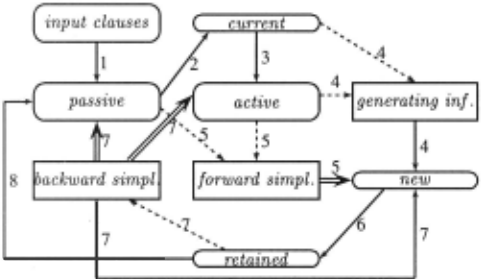
In addition to standard inference rules, these algorithms also operate with simplifications. An inference is called a simpli fication if it makes at least one clause in S redundant. Many modern provers implement an eager search for simplifying inferences, while ordinary generating inferences are applied ~~ .
In modern provers inference selection is performed v1a clause selection. For this reason saturation algorithms im plemented in such provers are called the given clause algo rithms. There are two main concretisations of the saturation algorithm based on the clause selection: the Otter algorithm [Lusk, 1992; McCune, 1994] and the Discount algorithm [Denzinger et at., 1997]. These algorithms are described and analyzed in more detail in [Riazanov and Voronkov, 2002bl. The simple description of these algorithms given above may create an illusion of their simplicity, but in fact, some of these algorithms are extremely complex, and problems related to the memory management for these algorithms have not been properly solved. For example, one of the given clause algo rithms of Vampire is schematically shown in Figure 2 (taken from [Riazanov and Voronkov, 2002a]).
| prover | affiliation | references |
|---|---|---|
| General-purpose provers | ||
| Otter Setheo Spass Vampire Gandalf SCOTT E Snark Bliksem | Argonne National Laboratory Munich University of Technology Max-Planck Institute University of Manchester Tallinn University of Technology Australian National University Munich University of Technology SRI Max-Planck Institute | LMcCune, 1994 J [Moser et al., 1997] [Weidenbach et at., 1996] [Riazanov and Voronkov, 2002a] [Tammet, 1997] [Slaney et at., 1994] [Schulz, 2001] [Stickel et at., 2001] [de Nivelle, 2000] |
Even proof-search in inference systems with redundancy creates enormously large such spaces. For example, storing 10 6 clauses is not unusual. Of these clauses 10 5 can par ticipate in inferences. Some operations on clauses are very expensive if implemented naively. For example, subsumption on multi-literal clauses is NP-complete and must ideally be performed between each pair of clauses in the search space. It is difficult to imagine an implementation able to perform 10 12 operations in reasonable time.
In the state-of-the-art theorem provers all expensive op erations are implemented using term indexing [Graf, 1996; Sekar et at., 2001]. The problem of term indexing can be formulated abstractly as follows. Given a set L of indexed terms or clauses, a binary relation R over terms or clauses (called the retrieval condition) and a term or clause t (called the query term or clause), identify the subset M of L that con sists of the terms or clauses l such that R( l, t) holds. A typical retrieval condition used in theorem proving is subsumption: retrieve all clauses in L subsumed by t. In order to support rapid retrieval of candidate clauses, we need to process the in dexed set into a data structure called the index. Modem the orem provers maintain several indexes to support expensive operations. For example, Vampire [Riazanov and Voronkov,
2002a] uses fiatterms in constant memory for storing tempo rary clauses, code trees [Voronkov, 1995] for forward sub sumption, code trees with precompiled ordering constraints for forward simplification by unit equalities, peifectly shared terms for storing clauses, shared terms with renaming lists for backward simplification by unit equalities, path index with compiled database joins for backward subsumption and some other indexes.
Serious work with theorem provers requires extensive ex periments. Every simple modification to a prover should be tested both for bugs and for efficiency. A typical experiment with Vampire consists of running it for several hours on over 5,000 TPTP problems in a number of modes on a network of around 50 computers. Such experiments require good infras tructure, both software and hardware, to facilitate debugging and evaluation, so Vampire is augmented by a number of pro grams intended for performing large-scale experiments. The necessity of having such programs and interfacing them with Vampire adds to the complexity of the system.
4 History of Development
Since the early work on automated theorem proving, the area witnessed an impressive progress. This progress is due to several factors described below:
- Development of theory, both of the saturation-based theorem proving with redundancy, see [Bachmair and Ganzinger, 2001; Nieuwenhuis and Rubio, 2001], and of the tableau and model elimination proof-search, see [Hiihnle, 2001; Letz and Stenz, 2001; Degtyarev and Voronkov, 200 1].
- Development of implementation techniques (term index ing, new algorithms) [Graf, 1996; Sekar et al., 2001; Nieuwenhuis et al., 2001].
- Growing experience, including experiments with appli cations, the development of TPTP [Sutcliffe and Suttner, 1998], and the annual competitions of theorem provers CASC [Sutcliffe et at., 2002].
Even a naively implemented theorem prover may be powerful enough to solve many problems collected in the TPTP library or created automatically by proof assistants. However, there have been a considerable progress in solving difficult prob lems. Every ten years enhancements in the theory and implementation techniques resulted in a large number problems which could be solved several orders of magnitude faster than by the previous generations of theorem provers. Provers im plemented around 1970 were very inefficient, especially for equality reasoning. In 1980 the paramodulation rule has been generally adopted and the general architecture of saturation based provers understood. By 1990 provers started to use routinely simplification orderings and term indexing. The provers used in 2000 employ the general theory of resolution with redundancy, and in particular literal selection functions. The provers of 20 I 0 are likely to benefit from a better clause selection, built-in theories, and maybe from parallel or con current architectures.
5 Future Generation Theorem Provers
Theorem proving is a very hard problem. The next gener ation of theorem provers will incorporate new theory, data structures, algorithms, and implementation techniques. Their development will be driven by the quest for flexibility and ef ficiency. Flexibility is required to adapt provers to new appli cations. Efficiency can be reformulated as controlling redun dancy in large search spaces [Lusk, 1992].
It is unreasonable to expect future theorem provers to be much faster on all possible problems. However, if we can increase performance of provers by several orders of magni tude for a large number of problems coming from applica tions, many of these problems will be routinely solved, thus saving time for application developers. The development of next generation provers will require:
- development of new theory;
- addition of new features;
- development of new algorithms and data structures;
- understanding how the theory developed so far can be efficiently implemented on top of the existing architec tures of theorem provers;
This development is impossible without considerable imple mentation efforts and extensive experiments.
There is a large number of research areas to be pursued in automated reasoning in the near future, let me mention some of them.
Built-in theories. Already in the case of equality the naive addition of equality axioms is too inefficient for solving even very simple problems. Development of superposition-based equality reasoning resulted in an impressive improvement of theorem provers. There are important theories other than equality which arise in many applications. Development of specialized reasoning methods for these theories will be a central problem in theorem proving. This problem is dif ferent from the problem of designing decision procedures for theories such as Presburger arithmetic because relations and functions used in these theories could be used together with other relations and functions and arbitrary quantifiers. Procedures for the combination of decision and unification algorithms can be of some help [Nelson and Oppen, 1979; Shostak, 1984; Baader and Schulz, 1996; Ruel3 and Shankar, 2001].
The following built-in theories arise in many application and are likely to attract attention in automated reasoning.
- AC (the theory of associative and commutative func tions) . These axioms occur in axiomatizations very of ten. There are many results related to building-in AC in theorem provers but implementation techniques, in cluding term indexing modulo AC, are still in their in fancy. Associativity and commutativity were built in the EQP theorem prover [McCune, 1997] with a consider able success but essentially without term indexing. Term indexing modulo AC was considered in [Bachmair et at., 1993] but only for a very special case.
- Theories of transitive relations and orders [Bachmair and Ganzinger, 1994b].
- Various first-order theories of arithmetic.
- Term algebras and other constructor-based structures.
As a first step toward building-in important theories one can consider creation of libraries of axioms/theorems about commonly used data types. An example of such a project is the Standard Upper Ontology [IEEE SUO-KIF project, 2002]. One can also enhance theorem provers by constructs for specifying built-in theories, for example, by constraints or by additional inference rules.
Inductively defined types. In many applications of inter active proof assistants one has to deal with inductively de fined types and functions on these types. The proof assis tants such as Isabelle [Paulson, 2002], HOL [Gordon and Melham, 1993], COQ [The Coq Development Team, 2001], Twelf [Pfenning and Schuermann, 1998] have facilities to de fine data types and functions inductively. First-order theo rem provers have no such facilities. The work on building-in inductively defined types can be developed in the following directions:
- First-order reasoning on data types given by inductive definitions.
- First-order reasoning on functions defined over such data types.
- Limited forms of inductive reasoning.
Working with large axiomatizations. Very often theo rem provers must work with large axiomatizations contain ing many irrelevant axioms. This is typical for applica tions such as reasoning with ontologies, assisting proof assis tants, and verification using hierarchically defined theories. Recognition of irrelevant axioms is one of the most impor tant problems in theorem proving. Many of these axioms are definitions of relations and functions in various forms . Recognition of the most typical definitions and efficient work with them play a major role in the future provers. The first steps in this direction are reported in [ Ganzinger et at., 200 I; Afshordel et at., 2001; Degtyarev et al., 2002].
Ontology-based knowledge representation. First-order formulations of many applied problems, if not created man ually, often refer to large axiomatizations. This situation is common for knowledge-base reasoning, proof assistants, and theorem proving in mathematics. Using these large axiom atizations and trying to extract only a small number of rele vant axioms can be a hopeless task. The problem arises of structuring these large axiomatizations in a such a way that a relevant subset of them could be easily extracted automati cally and that particular properties of the axiomatization can be exploited by provers. For example, provers could use a fact that a subset of axioms axiomatize properties of a rela tion in terms of other relations. Development of knowledge representation formalisms suitable for representing large ap plied theories and adaptation of provers to such formalisms could become an important problem in automated reasoning.
Proof checking. Strangely enough, modern theorem provers are not always good at producing proofs. Some of them print detailed resolution and paramodulation proofs but none gives a proof of the preprocessing steps, such as skolemisation. Without proof-checking one cannot use provers in verification and in assisting proof assistants. We expect that in the near future proof-checking components will be added to all major first-order provers. We conjecture that the main approaches to proof-checking will be similar to those used in proof-carrying code [Necula and Lee, 2000], so that a proof is built using a number of inference rules, and foundational proof-carrying code [Appel, 2001], so that a proof will given in a system whose language is rich enough to prove even the preprocessing steps, such as HOL.
Reasoning with nonstandard quantifiers, such as those specifying restrictions on the number of elements satisfying a relation, for example, :3::;n (there exists at most n). Such quantifiers are familiar to the description logic community. One can translate formulas with such quantifiers into first order logic with equality but the translation will create for mulas of a prohibitive size. It is interesting to develop special ways of reasoning with such quantifiers, although this is not an obvious task.
Distributed and other non-standard architectures. It has been observed that cooperating heterogeneous theorem provers can perform much better than the mere sum of their components [M.P. Bonacina, 1994; Denzinger and Fuchs, 1999]. However, modern theorem prover architectures are not suited for cooperative or distributed theorem proving.
Non-resolution inference system. The recent rapid progress of the DPLL-based satisfiability checkers [Zhang and Malik, 2002] suggests that non-resolution systems could also play a significant role in first-order theorem proving. The first implementation of first-order DPLL [Baumgartner, 2000] was not very encouraging, but so were the first imple mentations of resolution. To be more generally applicable, non-resolution system musts find an efficient solution to the problem of built-in theories [Degtyarev and Voronkov, 2001].
Satisfiability-checking and model building. For many applications it is desirable to be able to establish satisfiability of sets of clauses and build models for satisfiable sets. Sat isfiability of first-order is conceptually a much harder prob lem than unsatisfiability. The set of satisfiable formulas is not recursively enumerable, which means that there is no semi decision procedure for satisfiability-checking.
Other features. There are other features required of the next generation first-order theorem provers. For example, for the naive users who do not know (and usually do not want to know) much about theorem proving, theorem provers must have a strong auto-mode which will try to select automati cally a strategy or strategies best suited for solving the given problem. For more advanced users, there should be options to specify term orderings, literal selection, and clause selection.
@inproceedings{ijcai2003p281,
  title     = {Automated Reasoning: Past Story and New Trends},
  author    = {Voronkov, Andrei},
  booktitle = {Proceedings of the Eighteenth International Joint Conference on
               Artificial Intelligence, {IJCAI-03}},
  publisher = {International Joint Conferences on Artificial Intelligence},
  editor    = {Georg Gottlob and Toby Walsh},
  pages     = {1607--1611},
  year      = {2003},
  url       = {https://ijcai.org/proceedings/2003/281},
}
TY - CPAPER TI - Automated Reasoning: Past Story and New Trends AU - Voronkov, Andrei T2 - Proceedings of the Eighteenth International Joint Conference on Artificial Intelligence, IJCAI-03 PB - International Joint Conferences on Artificial Intelligence PY - 2003 SP - 1607 EP - 1611 UR - https://ijcai.org/proceedings/2003/281 ER -Copied
Machine-readable versions of this paper, for tools and AI agents:





