
Towards Pervasive Robotics
Proceedings of the Eighteenth International Joint Conference on Artificial Intelligence. Pages 1553-1553.
© 2003 International Joint Conferences on Artificial Intelligence
Abstract
Pervasive robotics will require, in a near future, small, light and cheap robots that exhibit complex behaviors. These demands led to the development of the M2-M4 Macaco project- a robotic active vision head. Macaco is a portable system, capable of emulating the head of different creatures both aesthetically and functionally. It integrates mechanisms for social interactions, autonomous navigation and object analysis.
- [Brooks, 1999] Rodney A. Brooks. Cambrian Intelligence. MIT Press, 1999.
- [Arsenio, 2003] Artur M. Arsenio. A Robot in a Box. Ac- cepted to IEEE 2003 Int. Conf on Advanced Robotics.
References were extracted automatically from the PDF and may contain errors.
Full text extracted automatically from the PDF; figures, tables and equations may differ. The PDF is the version of record.
1 Motivation
One approach of AI is the development of robots whose em bodiment and situatedness in the world evoke behaviors that obviate constant human supervision [Brooks, 1999]. With this in mind, we developed the M2-M4 Macaco project, which is described in this paper. M2-M4 Macaco is a robotic active, modular and compact system. This creature was de signed to fi tdifferent mobile robot platforms or act as a stand alone system. Another design goal was the portability of both the mechanical and electronic devices and its brain. Macaco characteristics make it a portable, fully operational robotic head whenever not assembled to a mobile platform, able to act as a social agent. A simple communications interface en ables operation onboard mobile platforms, turning the robot into an autonomous, sociable machine.
Research robots are enclosed most of the time at lab facil ities in which they are developed, most often operating just for demonstration goals. We expect in a near future to have both the robotic head and its brain physically present at ex hibitions/seminars, interacting socially. This new approach with complex, portable research robots will lead to commer cial applications and increasing synergy among roboticists. Eventually, pervasive robotics - robots present everywhere to perform a variety of tasks- will be possible as smaller, lighter and cheaper robots become available.
1.1 The Robotic creature
This robotic mechanism was designed to resemble a biolog ical creature, exploiting several features of an evolutionary design, but adding others (such as a thermal camera for hu man detection and night vision) for improved performance.
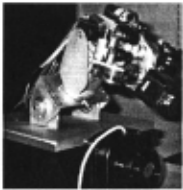
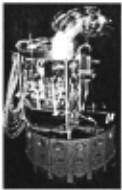
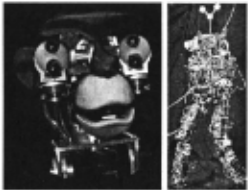
The replacement of a few M2-M4 Macaco's aesthetic com ponents allows for the metamorphosis of a dog-like (M4 - see Figure 1) into a chimpanzee-like (M2 - see Figure 2) robot. The weight of the head, including motors, gears and gyro, is"' l.6Kg. The hardware consists of nine small CPU boards with Pentium III at 800MHz, all modules connected by an Ethernet network. Four cameras and a total of nine framegrabbers are used for video acquisition.
2 Implementation
Security is one possible operational scenario for this ac tive head. For this class of applications, Macaco robot was equipped with a behavioral system capable of searching for people or faces, and to further recognize them. In addition, human gaze direction might reveal security threats, and thus a head gaze detection algorithm was developed. Probable tar gets for such gazings are other people and mostly important, explosives and/or guns. Therefore, salient objects situated in the world are processed for 3D information extraction and texture/color analysis. Current work is also underway for ob ject and scene recognition from contextual cues.
Another scenario includes search and rescue missions by a mobile robot, which requires additional navigation capa bilities in rough terrain. Finally, real world applications are often characterized by strong light variations or the absence of light. This is taken into account through thermal image processing for people detection and for night navigation.
2.1 Visual Pre-Attentive System
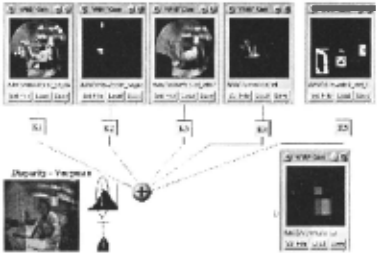
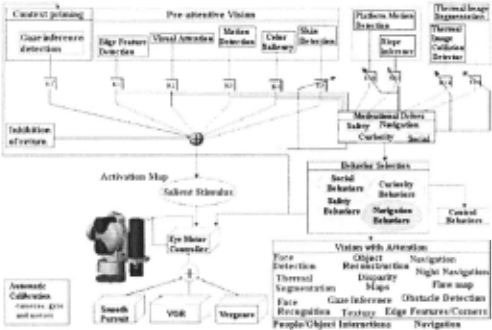
Although the real world does not avail precise or singularly adequate perceptual information, unique interpretations of the world can be constructed using an attentional mechanism. A logpolar attentional system was developed to select rele vant information from the cameras output, and to combine it in a saliency map (see Figure 3). This map is segmented into three regions of stimuli saliency - the attentional focus.
I I
I
Macaco's robotic eyes are equipped with a set of basic movements made by frontal eyed, foveal animals: Ballistic movements are executed without visual feedback; Vergence to a target is maintained by a disparity signal from stereo im ages; and Vestibulo-ocular-refu x (VOR) stabilizes the cam eras using data from the inertial sensor.
2.2 Post-Attentional Vision
The brain for the M2-M4 Macaco robotic head consists of a fu xible, modular and highly interconnected architecture that integrates social interaction, object analysis and func tional navigation modules, as shown in Figure 4 - the post attentional modules are described in detail in [Arsenio, 2003],
- Object Analysis: Texture and Color Segmentation algo rithms run in parallel, and are integrated with 3D object reconstruction to obtain a rendered object model.
- Social Mechanisms: For the robot to achieve a convinc ing social role, the vision system is equipped with face detection and recognition modules, together with an al gorithm for the detection of human gaze direction.
- Navigation: Although 3D information is lost with low visibility, the platform is still able to operate thanks to
,,,,., ..·. .·.. ,.,.,,,,,.,,,,,, ·
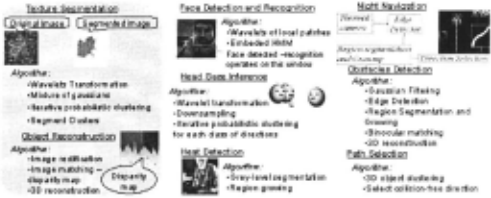
- a thermal camera. A navigation algorithm based on monocular cues runs at frame-rate, for night navigation.
2.3 Architecture
The software architecture includes, besides the Visual At tention system, releasers from body sensors and motiva tional drives that modulate attentional gains. Action is de termined by competing behaviors, which also share resources to achieve multi-behavior tasking.
... ·
3 Conclusions
We presented the project of a portable robotic head, mod ular at the mechanical, hardware and software levels. Al though equipped with a complex cognitive system, its small weight and compact size allows it to be incorporated into mul tiple mobile platforms, and also to be used as a portable au tonomous sociable robotic creature.
Acknowledgments
Work funded by DARPA project 'Natural Tasking of Robots Based on Human Interaction Clues", contract DABT 63-00-C-10102. Au thor supported by Portuguese grant PRAXIS XXI BD/15851 /98.
@inproceedings{ijcai2003p269,
  title     = {Towards Pervasive Robotics},
  author    = {Arsénio, Artur M.},
  booktitle = {Proceedings of the Eighteenth International Joint Conference on
               Artificial Intelligence, {IJCAI-03}},
  publisher = {International Joint Conferences on Artificial Intelligence},
  editor    = {Georg Gottlob and Toby Walsh},
  pages     = {1553--1553},
  year      = {2003},
  url       = {https://ijcai.org/proceedings/2003/269},
}
TY - CPAPER TI - Towards Pervasive Robotics AU - Arsénio, Artur M. T2 - Proceedings of the Eighteenth International Joint Conference on Artificial Intelligence, IJCAI-03 PB - International Joint Conferences on Artificial Intelligence PY - 2003 SP - 1553 EP - 1553 UR - https://ijcai.org/proceedings/2003/269 ER -Copied
Machine-readable versions of this paper, for tools and AI agents:





