
A Logic-based Algorithm for Image Sequence Interpretation and Anchoring
Proceedings of the Eighteenth International Joint Conference on Artificial Intelligence. Pages 1408--1.
© 2003 International Joint Conferences on Artificial Intelligence
Abstract
This paper describes a logic-based framework for interpretation of sequences of scenes captured by a stereo vision system of a mobile robot. An algorithm for anchoring and interpretation of such sequences is also proposed.
- [Coradeschi and Saffiotti, 2000] S. Coradeschi and A. Saf- fiotti. Anchoring symbols to sensor data: Preliminary re- port. In Proc. of AAAI, pages 129-135, Austin, U.S., 2000.
- [Randell eta!., 1992] D. Randell, Z. Cui, and A. Cohn. A spatial logic based on regions and connection. In Proc. of theKR,pages 165-176,Cambridge, U.S., 1992.
- [Santos and Shanahan, 2002] P. Santos and M. Shanahan. Hypothesising object relations from image transitions. In Frank van Harmelen, editor, Proc. of ECAI, pages 292- 296, Lyon, France, 2002.
- [Shanahan, 1996] M. Shanahan. Robotics and the common sense informatic situation. In Proc. of ECAI, pages 684- 688, Budapest, Hungary, 1996.
References were extracted automatically from the PDF and may contain errors.
Full text extracted automatically from the PDF; figures, tables and equations may differ. The PDF is the version of record.
1 Introduction
In this work we extend the logic-based spatial reasoning sys tem for scene interpretation proposed in [Santos and Shana han, 2002] and develop an algorithm that encodes the inter pretation process. This algorithm also accounts for the pro cess whereby mappings between logical symbols and sensor data are built up and maintained over time. This is an aspect of the so-called symbol anchoring problem [Coradeschi and Saffiotti, 2000].
This paper assumes a stereo vision system embedded in a mobile robot as the source of data about the world. A sym bolic representation of the sensor data from the vision system is constructed assuming a horizontal slice of each snapshot. A horizontal slice is, in effect, a 2D depth profile of the scene before the robot, taken at a particular height. Within these depth profiles, peaks occur that are caused by nearby objects or collections of objects, these peaks are called depth peaks. The size and disparity values of single depth peaks, the dis tance between pairs of peaks and the transitions that occur in these attributes through consecutive pairs of profiles are the building blocks for our spatial reasoning theory.
Within this framework scene understanding is understood as a process of hypothesising the existence and the dynamic relationships between physical objects (and between physi cal objects and the observer) assuming temporally ordered se quences of depth profiles. This process recalls sensor data as similation as abduction first proposed in [Shanahan, 1996]. In fact the initial motivation for the present research was to pro pose a new qualitative background theory about space-time within this framework by using notions from qualitative spa tial reasoning theories such as [Randell et al., 1992].
· Supported by CAPES.
2 Depth Profiles
This work assumes sequences of depth profiles as temporally ordered snapshots of the world. A sketch of a depth profile is shown in Figure 1 b.
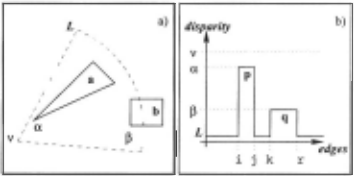
Figure 1: a) Two objects a, b noted from a robot's viewpoint v; b) Depth profile (relative to the viewpoint v in a) repre senting the objects a and b respectively by the peaks p and q.
The axis disparity in depth profiles is constrained by the furthest point that can be noted by the robot's sensors, this limiting value is represented by L in these charts (Figure I b). In fact, L is determined by the specification of the robot's sensors.
Differences in the size (and/or disparity) of peaks and tran sitions of the size (disparity) of a peak in a sequence of pro files encode information about dynamical relations between objects in the world and between the objects and the observer. This is the initial insight upon which the scene interpreta tion system proposed in this paper is based. The next section presents some relations that represent transitions in depth pro files.
3 Relations on Depth Profile Transitions
This work assumes a relation peak_of(p, b, v), p_o(p, b, v) for short, representing that there is a peak p assigned to the physical body b with respect to the viewpoint v. In this work we are dealing with the viewpoint of a single robot, therefore we abbreviate p_o(p, b, v) to p_o(p, b) . The relation p_oj2 plays a similar role of the predicate grounding relation de fined in [Coradeschi and Saffiotti, 2000].
Assuming that the symbols a and b represent physi cal bodies, p and q depth peaks, and t a time point, the following relations are investigated in this paper: extending(p_o(p, b), t), states that the disparity value of a peak p is increasing at time t; shrinking(p_o(p, b), t), states that the disparity value of a peak p is de creasing at time t; approaching(p_o(p, a),p_o(q, b), t), represents that two peaks p and q are approaching each other at timet; receding(p_o(p,a),p_o(q,b),t), states that two peaks p and q are receding each other at timet; coalescing(p...o(p,a),p_o(q,b),t), states that two peaks p and q are coalescing at time t; splitting(p...o(p, a),p_o(q, b), t), states the case of one peak splitting into two distinct peaks p and q at timet. These rela tions are hypotheses assumed to be possible explanations for transitions in the attributes of a peak (or set of peaks).
Similarly to [Santos and Shanahan, 2002], the relations de scribed above can be connected to descriptions of transitions on sensor data and, further, to relations about changes in the robot environment by means of sets of axioms. Due to space restrictions, however, we do not present axioms for these re lations.
Informally, coalescing(p...o(p, a),p_o(q, b), t) and splitting(p_o(p, a),p_o(q, b), t) can be related, respectively, to the event of an object a occluding an object b and of a appearing from behind b. Therefore, once a hypothesis on peak transition has been obtained, a relative hypothesis on objects in the world can be inferred from the appropriate ax iom stating this connection. This is a central idea underlying our solution for anchoring. In fact, this solution assumes processes of explanation and expectation as described in the following sections.
4 Sensor Data Assimilation
Following the ideas proposed in [Shanahan, 1996] and [San tos and Shanahan, 2002], the task of the abductive process for sensor data assimilation is to infer the relations described in Section 3 as hypotheses given a description (observation) of the sensor data in terms of depth peaks transitions. More for mally, assuming that']! is a description (in terms of depth pro files) of a sequence of stereo images, and~ is a background theory comprising axioms connecting the relations in Section 3 to sensor data transitions and to changes in the robot's envi ronment, the task of assimilation as abduction is to find a set of formulae A, such that
5 Expectation
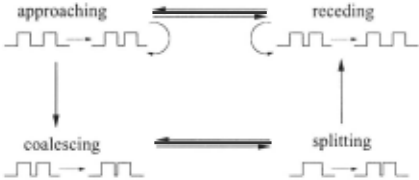
Expected peak transitions are suggested by the conceptual neighbourhood diagram (CND) of the relations described in Section 3, shown in Figure 2 1 .
Given an abduced explanation for a transition on a pair of peaks, the expected future relations involving these peaks are the neighbours of this transition in the diagram in Figure 2. As this process generates multiple competing expectations, only those that are verified by further sensor data lead to the generation of new predictions. In practice, prediction in this work is, thus, reduced to a table look-up procedure.
1 For brevity, we are omitting from this diagram the relations extending/2 and shrinking/2.
6 Image segmentation
From a practical point of view, horizontal slices defining depth profiles are comprised of a sequence of measure ments made by the considered off-the-shelf vision system. Each horizontal slice is then segmented into peaks and backgrounds via a simple threshold mechanism on disparity values. This segmentation procedure outputs a sequence of first-order terms of the form: peak (Lb, Disp, Size) and background( (Lbl, Lb2), Displ,Sizel), where Lb, Lbl and Lb2 are variables for p_o/2 terms labelling peaks. In particular Lbl and Lb2 are the labels of the peaks bound ing the background segment; Disp and Size are the values of disparity and size of the peak Lb; and, Displ and Sizel are the disparity and size values of the background segment labelled (Lbl, Lb2). If it is the case that a background is bounded by one of the end points of a depth profile (borders of the field of view), a corresponding symbol is assigned to compose its label. In other words, in such cases, either the symbol borderLeft or borderRight are part of the pair defining the label of a background segment.
Subsequent pairs of horizontal-slice descriptions are input to an algorithm that provides the appropriate interpretation in terms of the dynamic relations discussed in Section 3. This algorithm is summarised in the next section.
7 The anchoring and interpretation algorithm
This section describes an algorithm for interpretation and an choring, so called A&! algorithm, that works by matching peak segments in consecutive pairs of profile descriptions that are depicting the same object in the world. Each profile description is comprised of a finite number of segments peak and background, which are provided by the segmentation routine described in the previous section.
In order to describe the A&! algorithm let P; and Pi+l be one consecutive pair of profiles, we assume that P; has n seg ments and Pi+1 has m. In this section we denote a segment r in a profile k by sk,r. thus, Pi and Pi+1 can be denoted as:
and
Let P RED and I NT be initially empty lists containing, respectively, a set of predictions and a set of interpretations for the profile pair (P;, Pi+d· We assume also a symbol o denoting a physical body.
For every subsequent pair of profile descriptions (P;, Pi+l), the algorithm's task is to match pairs of segments (s;,j,Si+t ,r) in (P;,Pi+l) that depict the same object in the world. The segments are considered from left to right in the profile descriptions, starting with the first pair of segments (s;,1, s;+1,1). The algorithm is summarised as follows.
Begin: (A&/ algorithm)
While (P; and Pi+1 are non-empty)
- if s; ,j and Si+t,r are peak segments; then
- (a) if s; ,j is bound to a term p_o(j, o), then assign the term p_o(r, o) to the label of s;+l,r;
- (b) else, create two new terms p_o(j, o) and p_o( r, o) and assign them respectively to the labels of s;,j and Si+l,r;
- (c) compare the size and disparity measurements in both segments and put into I NT the appropriate interpretation according to the relations extending and shrinking, in Section 3;
- (d) from these interpretations and the conceptual neighbourhood diagram in Figure 2 obtain the pre dicted predicates and insert them into P RED;
- (e) return the next pair of segments: (si,j+l, Si+t ,r+t);
- if S; ,j and Si+l,r are background segments; then
- (a) unify their labels;
- (b) compare the sizes of s;,j and Si+l,r and consider the difference between these values, which gives the difference in the distance between the two peaks bounding Si,j and Si+l,r;
- (c) interpret this difference in terms of the relations approaching and receding, and insert the appro priate interpretation into I NT;
- (d) from this interpretation and the CND in Figure 2 insert the relative predictions into P RED;
- (e) return the next pair of segments: (si,i+l, si+I,r+t);
- if Si,j is a background segment and Si+l,r is a peak segment then check in the prediction set P RED whether the two peaks bounding s;,j have been expected to be coalescing or splitting,
- (a) if so, assume this expectation as explanation for Si,j and Si+I,r, inserting it into INT. Execute the ap propriate unifications on peak variables and terms p_o/2 as explained in step I a and 1 b. Then, ob tain the predicted predicates, inserting them into P RED. Return the pair (s;,j, Si+t,r+I) to be con sidered for interpretation;
- (b) else explain away the peak Si,j as noise and assume the pair (si,j+l, Si+t,r) for interpretation;
- if Si,j is a peak segment and Si+l,r a background seg ment then proceed analogously to the previous case.
End while.
- If P; is empty, get the next pair of profile descriptions (Pi+t,Pi+2) .
- else, if Pi+i is empty but P; is not, then explain away the remaining peak segments in P; and consider the next pair of profile descriptions (Pi+1 , Pi+2).
The while loop above is repeated until there are no more depth profile descriptions.
End.
Informally, the algorithm above considers consecutive pairs of depth profile descriptions as lists. Pairs of elements from these lists are compared and a match for peak segments is obtained according to the expected transitions in depth pro files. The result of this process is the interpretation of peak transitions, which are related to changes in the objects de picted by peaks.
The algorithm main processing is the while loop that con siders, in pairs, every segment in the depth profile descrip tions. The running time of this algorithm is, thus, linear on the size of the list containing these descriptions. However, as the number of segments in these lists is related to the num ber of objects depicted by the considered depth profiles, and there are only a finite number of objects in each scene, the asymptotic upper bound of this algorithm is 0(1).
8 Conclusion
This paper presents a new step towards an abductive frame work for sensor data interpretation of sequences of stereo vision images obtained by a mobile robot's vision system. We proposed a symbolic representation of the stereovision data based on depth profiles obtained from horizontal slices of snapshots of the world. These profiles encode information about objects in the world as peaks. Each profile was, then, segmented into first-order statements that were input of anal gorithm whose task was to unify pairs of segments, providing the interpretation for the occurred transition in depth peaks.
Further research has to consider two main open issues in this framework. First, we have to develop of a qualitative the ory about object's shape from multiple horizontal slices of a scene. This theory would enhance the representation of the environment and, therefore, improve the capabilities of the reasoning system. A second issue is the development rea soning modules capable of explaining away noise patches in the image sequences according to common-sense knowledge about the world and about the sensor's limitations.
@inproceedings{ijcai2003p218,
  title     = {A Logic-based Algorithm for Image Sequence Interpretation and Anchoring},
  author    = {Santos, Paulo E. and Shanahan, Murray},
  booktitle = {Proceedings of the Eighteenth International Joint Conference on
               Artificial Intelligence, {IJCAI-03}},
  publisher = {International Joint Conferences on Artificial Intelligence},
  editor    = {Georg Gottlob and Toby Walsh},
  pages     = {1408---1},
  year      = {2003},
  url       = {https://ijcai.org/proceedings/2003/218},
}
TY - CPAPER TI - A Logic-based Algorithm for Image Sequence Interpretation and Anchoring AU - Santos, Paulo E. AU - Shanahan, Murray T2 - Proceedings of the Eighteenth International Joint Conference on Artificial Intelligence, IJCAI-03 PB - International Joint Conferences on Artificial Intelligence PY - 2003 SP - 1408 EP - -1 UR - https://ijcai.org/proceedings/2003/218 ER -Copied
Machine-readable versions of this paper, for tools and AI agents:





