
The Power of Suggestion
Proceedings of the Eighteenth International Joint Conference on Artificial Intelligence. Pages 127-131.
© 2003 International Joint Conferences on Artificial Intelligence
Abstract
User feedback is vital in many recommender systems to help guide the search for good recommendations. Preference-based feedback (e.g. "Show me more like item A ") is an inherently ambiguous form of feedback with a limited ability to guide the recommendation process, and for this reason it is usually avoided. Nevertheless we believe that certain domains demand the use of preference-based feedback. As such, we describe and evaluate a flexible recommendation strategy that has the potential to improve the performance of case-based recommenders that rely on preference-based feedback.
- [Bridge, 2001] D. Bridge. Product Recommendation Sys- tems: A New Direction. In D. Aha and I. Watson, editors, Workshop on CBR in Electronic Commerce at The Interna- tional Conference on Case-Based Reasoning ( ICCBR-01 ), 2001. Vancouver, Canada.
- [Burke, 2000] R. Burke. Knowledge-based Recommender Systems. Encyclopedia of Library and Information Sys- tems, 69(32), 2000.
- [Konstan et al., 1997] J.A. Konstan, B.N Miller, D. Maltz, J.L. Herlocker, L.R. Gorgan, and J. Riedl. GroupLens: Applying collaborative filtering to Usenet news. Commu- nications of the ACM, 40(3):77-87, 1997.
- [McGinty and Smyth, 2002] L. McGinty and B. Smyth. Comparison-Based Recommendation. In Susan Craw, editor, Proceedings of the Sixth European Conference on Case-Based Reasoning (ECCBR-02), pages 575-589. Springer, 2002. Aberdeen, Scotland.
- [McGinty and Smyth, 2003] L. McGinty and B. Smyth. The Role of Diversity in Conversational Recommender Sys- tems. In D. Bridge and K. Ashley, editors, Proceedings of the Fifth International Conference on Case-Based Rea- soning (ICCBR-03). Springer, 2003. Troindheim, Norway.
- [McSherry, 2002] D. McSherry. Diversity-Conscious Re- trieval. In Susan Craw, editor, Proceedings of the Sixth Eu- ropean Conference on Case-Based Reasoning (ECCBR- 02), pages 219-233. Springer, 2002. Aberdeen, Scotland.
- [Shardanand and Maes, 1995] U. Shardanand and P. Maes. Social Information Filtering: Algorithms for Automating "Word of Mouth". In Proceedings of the Conference on Human Factors in Computing Systems (CHI '95), pages 210-217. ACM Press, 1995. New York, USA.
- [Shimazu, 2001] H. Shimazu. ExpertClerk : Navigating Shoppers' Buying Process with the Combination of Ask- ing and Proposing. In Bernhard Nebel, editor, Proceed- ings of the Seventeenth International Joint Conference on Artificial Intelligence (/JCAI-01), pages pages 1443-1448. IJCAI
- Morgan Kaufmann, 2001. Seattle, Washington, USA.
- [Smyth and McClave, 2001] B. Smyth and P. McClave. Sim- ilarity v's Diversity. In D. Aha and I. Watson, editors, Pro- ceedings of the International Conference on Case-Based Reasoning, pages 347-361. Springer, 2001.
References were extracted automatically from the PDF and may contain errors.
Full text extracted automatically from the PDF; figures, tables and equations may differ. The PDF is the version of record.
1 Introduction
At last year's European Case-Based Reasoning conference (ECCBR 2002) in Scotland, delegates were treated to a whiskey tasting. A range of different whiskeys were sam pled, each accompanied by a feature-based description (e.g. distillery, age, alcohol content, cask, peatiness, sweetness, palette, etc.). However, the value of these descriptions was limited as most of us had little or no understanding of the features, nor could we reliably reconcile individual f~atures with the taste of a particular whiskey. Nevertheless VIrtually everyone could chose a favourite whiskey by the end of the session (after a lot of sampling it has to be said!). This exam ple corresponds to a challenging problem for developers of recommender systems, for reasons that will become clear.
Normally the success of case-based recommenders de pends on two important domain properties: (1) the items need to be described using well-defined features; and (2) users must have some understanding of these features and how they relate to their requirements. For example, restau rants are readily described using features such as cuisine, lo cation and price, and most people have a reasonable under standing of their needs in relation to these features. When the above characteristics are present content-based recommenda tion strategies can be combined with different forms of user feedback, such as value elicitation (e.g. "I want an expensive, Asian restaurant") [Bridge, 2001], or critiquing (e.g. "Show me more like Rolly's Bistro but less formal"), to good effect [Burke, 2000] . However, if these properties are not present then other strategies are needed. For example, if item de scriptions are not available, collaborative filteri.n~ can be u~ed to recommend items that have been rated positively by sim ilar users [Burke, 2000; Shardanand and Maes, 1995]. The whiskey recommendation scenario above is different. The availability of item descriptions suggests case-based recom mendation, but the lack of user expertise limits the use of feedback strategies such as value elicitation or critiquing.
*The support of the Informatics Research Initiative of Enterprise Ireland is gratefully acknowledged
Indeed the whiskey domain is not unique in this respect. In many domains users are able to express a prefere~ce wit~o~t necessarily understanding individual item properties. This IS especially true in domains where a specialised v ~abulary al ready exists to describe items (e.g. fashion, jewellery, art, mu sic, etc.). Consider a recommender system designed to help a bride-to-be to choose her ideal dress. Individual dresses are described using specific features (e.g. caul-back, scoop-cut, georgian-style, etc.) but most of these terms are meaningless to the average bride, and yet the typical bride-to-be is capable of recognising what she likes when she sees it. This problem is more than the user being unaware of the correct vocabulary to use during recommendation. The point is that even if they were presented with the appropriate vocabulary terms, they would not be in a position to use or appreciate these terms.
One form of feedback that could be used is preference based feedback; the user simply expresses a preference for an item (e.g. "Show me more like dress 2"). This has been largely avoided by researchers - it is assumed to be too limited to efficiently guide the recommendation process. Nevertheless in our research we are interested in looking at how to make this a practical form of feedback in these chal lenging domains. Incidentally, unlike other feedback types, preference-based feedback also benefits from minimal inter face needs, and so is particularly relevant for recommenders designed for use with the current generation of mobile de vices, such as WAP phones and PDAs.
In this work we describe a way to improve the perfor mance of recommenders that use preference-based feedback. Our novel adaptive selection method mirrors how real-life sales assistants adapt their recommendation strategies in re sponse to user feedback by balancing the importance of sim ilarity and diversity during each recommendation cycle. Dra matic improvements in recommendation performance have been observed (e.g. reductions in dialog length of up to 80%).
2 Comparison-Based Recommendation
Comparison-based recommendation is a content-based (or case-based) recommendation strategy [Burke, 2000; McGinty and Smyth, 2002], as opposed to a collaborative recommendation strategy [Burke, 2000; Konstan et al., 1997; Shardanand and Maes, 1995]. The notion of comparison based recommendation was introduced by [McGinty and Smyth, 2002] to emphasise the role of feedback in content based recommenders, and to allow for an analysis of preference-based feedback in particular. The focus was on how query modification methods might be used with preference-based feedback to produce efficient recommenda tion dialogs without richer forms of feedback like value elic itation or critiquing. We briefly review this earlier work, de scribing the basic comparison-based recommendation frame work and some successful query modification strategies.
2.1 The Basic Algorithm
Comparison-based recommendation (Figure 1) is an iterative recommendation algorithm that presents the user with a se lection of k items as recommendations during each of a se quence of n recommendation cycles. During each cycle the user expresses a preference for one of the suggestions and this feedback is used to revise the query for the next cycle; in the vocabulary of Shimazu, it is a type of navigation by propos ing [Shimazu, 2001]. The recommendation dialog terminates when the user is presented with an acceptable suggestion.
2.2 Simple Selection: More Like This
The simplest approach to comparison-based recommendation is to recommend the k most similar items to the current query, and use the newly preferred item as the query for the rec ommendation next cycle. This more like this (MLT) method is a facility often provided by Web search engines; although it should be noted that search engines rarely rely upon this method, primarily focusing instead on query elicitation and term-based search. The MLT method is flawed by a ten dancy to follow so-called false-leads as it overfits to the cur rent preference, and this results in protracted recommenda tion dialogs. Using each preferred item as the next query is problematic if some of its features are not relevant to the user. For example, a user may indicate a preference for a whiskey that is oak-aged, sweet, and peaty. But if the preference was largely a result of the peatiness and independent of, or even at odds with, the sweetness or the aging, then blindly focusing the next selection on sweet and oak-aged whiskeys, as well as peaty ones, may ~esult in poor recommendations.
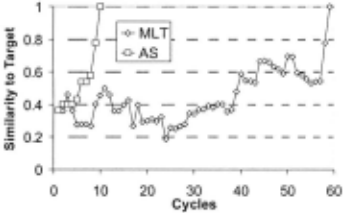
Figure 1 shows the scope of this problem by graphing the similarity of the preference to the target in a sample recom mendation dialog. Instead of an increasing similarity pro file, we find sustained decreases in similarity as MLT follows false-leads. Between cycle 3 and 11, target similarity falls from 0.46 to as low as 0.26 as the user is forced to accept poor recommendations, and again between cycle 11 and 40 there is a noticeable similarity trough. Indeed it is only after cycle 38 that MLT finally begins to focus on the target region and similarity rises.
2.3 Query Modification Strategies
Query modification techniques can relieve the false-lead problem, and have been shown to improve recommenda tion efficiency, reducing MLT dialogs by 30% on average [McGinty and Smyth, 2002]. The central idea is to identify features in the preference case that are likely to be the rea son for the user's choice, and those features that are likely to be irrelevant. Only relevant features are transferred to the new query. Returning to the whiskey example above, if the rejected cases are also very sweet then sweetness may irrel evant to the user. Hence, one query modification strategy, partial MLT (pMLT) only includes preference features in the query that are not found in any of the rejected cases.
[McGinty and Smyth, 2002] also propose more sophis ticated query modification strategies that weight preference features in the query according to how likely they are to be reliable. One strategy computes a weight for a preference feature based on the proportion of rejected items that also contain that feature. If 3 cases are recommended to the user, and if the preference and just one of the rejected items are oak-aged and then this feature is transferred to the new query with a weight of0.5 (50% of the rejected items are oak-aged).
3 Adaptive Case Selection
So far we have assumed the use of similarity-based selection during each cycle. However, in the real-world two selection strategies can be observed in the dialogs that take place be tween customers and sales assistants. If a customer is unsure of their exact needs the sales assistant will tend to present a diverse range of alternatives, based on a preliminary set of requirements, to focus in on a promising region of a product space. A good sales assistant can recognise when the cus tomer sees something that they genuinely like and uses this as a cue to switch their strategy to one that tries to refine sub sequent recommendations in the region of the preference by selecting similar items.
In this paper, instead of using query modification methods to improve recommendation efficiency, we propose an alter native called adaptive selection. It adapts the way that new items are selected for recommendation and is motivated by the above observation that different selection strategies are appropriate at different times in the recommendation process.
3.1 Similarity vs Diversity
Our observation about real-life recommendation scenarios is partly echoed by recent research that has questioned the ap parent over-emphasis on similarity in content-based recom menders, with diversity forwarded as an important additional selection constraint. A number of strategies for improving recommendation diversity have been suggested. [Shimazu, 2001] proposes the recommendation of three items or cases, i1> i2 and i3, per recommendation cycle: i1 is the most simi lar case to the query; i 2 is maximally dissimilar from i 1 ; and ii3 is maximally dissimilar from i1 and i2. By design these items are maximally diverse, but similarity to the query may be compromised as there are no guarantees that i 2 and i 3 will be very similar to the query.
Other researchers have proposed alternative diversity en hancing mechanisms with a more manageable balance be tween item diversity and query similarity [Bridge, 2001; McSherry, 2002; Smyth and McClave, 2001]. Although all of these techniques introduce diversity into selection in a uni form way, they do not fully reflect the strategy switching seen in real-world scenarios. Moreover, while increasing diversity may improve the efficiency of of a recommender by allowing it to cover more of the item-space per recommendation cy cle, it may also lead to new types of inefficiencies. Diversity enhancing methods pass over items that might otherwise be selected and the target item may be one of these.
A more flexible mechanism for introducing diversity must be adopted based on whether or not the recommender has fo cussed on the correct region of the item space. If there is evi dence that it is correctly focused then a pure similarity-based selection method can be used to refine the recommendations and safe-guard against passing over the target item. If the recommender is not correctly focused, then diversity is intro duced in order to maximise the coverage of the item space in the next cycle, and so help to refocus the recommender by offering the user contrasting recommendations.
3.2 Preference Carrying
Unfortunately it is not immediately obvious how to judge whether the recommender is correctly focused; the target item is unknown and user requirements are typically vague. Adap tive selection solves this by evaluating whether the recom mendations made in the i th cycle are an improvement on those in the i - 1 th cycle before choosing a selection strat egy for the i + 1 th cycle.
This is achieved by carrying the preference item from the previous cycle to the current cycle. If the user selects the car ried preference in the current cycle it must mean that they are unhappy with the k - 1 new alternatives in that cycle. These new items must have failed to improve upon the recommen dations made during the previous cycle, and so the recom mender must not be correctly focussed. If the user ignores the carried preference and selects one of the newly recommended items then the recommender must be correctly focused. Thus, by carrying the preference item, and monitoring whether or not the user reselects it, we can implement a switching mech anism between two alternative selection strategies: a refine strategy that emphasises similarity; and a refocus strategy that balances similarity and diversity for improved recommenda tion coverage.
In theory carrying the preference may lead to new ineffi ciencies because the carried preference takes up a valuable slot in each cycle, thus limiting recommendation coverage. However, this is easily compensated for because carrying the preference helps protect against against false-leads . If none of the k - 1 new cases are relevant then by reselecting the carried preference the user is at least maintaining the previ ous best recommendation rather than being forced to accept a lower quality false-lead. In practice, this on its own can offer a substantial improvement to recommendation efficiency.
3.3 Refine & Refocus
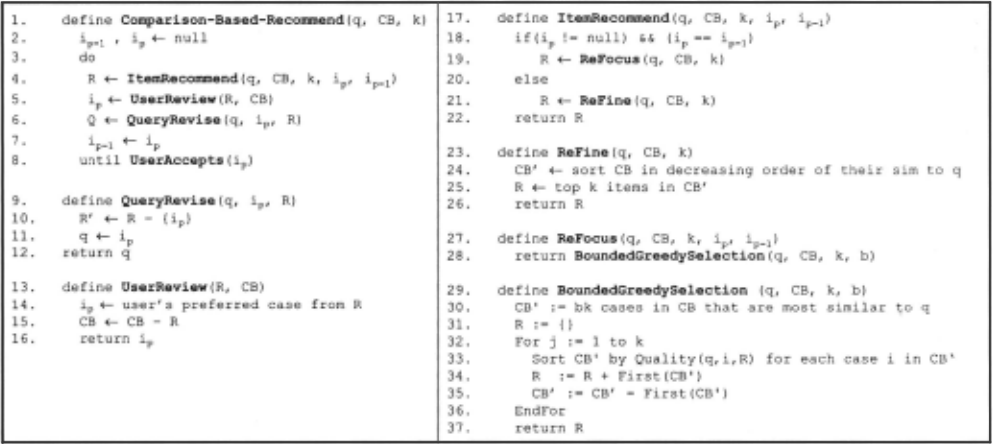
As mentioned above, the refine strategy makes use of a stan dard similarity-based selection method, picking k - 1 new items that are maximally similar to the current query. The refocus strategy uses the bounded-greedy diversity technique proposed by [Smyth and McClave, 2001]; see Figure 2.
Very briefly, the bounded-greedy technique involves two basic phases. First, the bk most similar items to the query are selected (where b is typically an integer between 2 and 5). During the second phase, the set (R) of selected items is built incrementally. During each step of this build the remainder of the bk items are ordered according to their quality and the highest quality item added toR. The quality of a item i is pro portional to the similarity between i and the current query q, and to the diversity of i relative to those items so far selected, R = { r1, ... , r m}; see Equations 1 & 2.
The first case to be selected is always the most similar to the query and in subsequent iterations, the chosen case has the highest quality relative to the query and diversity and cases selected so far. Note, we set b = 3 and a = 0.5 to balance similarity and diversity during refocusing.
4 Evaluation
In this section we evaluate the performance of adaptive se lection focusing on the average number of cycles and unique items that must be presented to a user in a typical recommen dation dialog. The shorter the dialog, the more successful the recommender is likely to be, and we demonstrate that adap tive selection delivers dramatic reductions in dialog length.
4.1 Setup
A case-base of 585 unique Scotish whiskey cases (Figure 3) is used to compare two comparison-based recommenders us ing preference-based feedback: MLT uses the standard MLT strategy; MLT +AS implements adaptive selection. We use a leave-one-out methodology for testing using 200 randomly selected cases as test cases. Each test case (base) is removed from the case-base and used in two ways.
First it serves as the basis for a set of queries made by tak ing random subsets of features. Second, it is used to identify a maximally similar (target) case. Thus, the base is the ideal query for a user, the generated query is the initial test query given to the recommender, and the target is the best case for the user given their ideal. During each recommendation cy cle 3 cases are recommended to the user, and the most sim ilar to the target is chosen as a preference, thus simulating a user that is capable of correctly selecting the best preference item in each cycle; we relax this assumption in Section 4.3. A query is satisfied when the target is returned in a cycle, thereby simulating the situation where the user is seeking a specific case; once again, we relax this condition in Section 4.4. In total1250 queries are generated and divided into three groups based on their difficulty; where difficulty is based on the number of recommendation cycles required by MLT.
4.2 Recommendation Efficiency
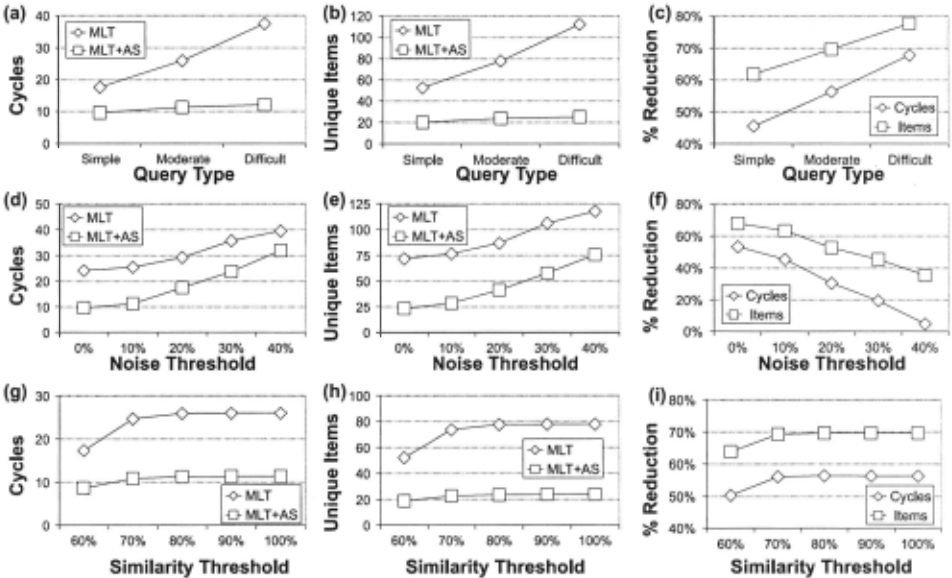
Basic recommendation efficiency can be measured in terms of the average number of cycles (or unique cases or items) that a user must work through before being presented with their ideal target. The leave-one-out method outlined above is used by the two recommenders for each of the 1250 queries and and the mean number of cycles and unique items presented to the user are measured. The results are shown in Figure 4(a-b) as graphs of mean cycles and items for each algorithm and query group. The benefits of MLT +AS should be clear for both measures. For example, we see that MLT requires 17.5 cycles (and 52.5 items) for simple queries, but MLT-AS needs only 9.5 cycles (and 20 items), a relative reduction of 45% in terms of cycles, and 62% in terms of items.
We see similar results for the other query sets. In fact, the relative reductions enjoyed by MLT-AS increase with query difficulty. The recommendation dialogs associated with more difficult queries include more false-leads than the dialogs for simpler queries, and so offer adaptive selection an even greater opportunity for dialog reduction. This trend is clearly seen in Figure 4(c), which graphs the percentage reduction in cycles and items due to MLT-AS, relative to MLT. For cycles, the relative reduction grows from 45% (simple) to 68% (diffi cult) and for unique items it grows from 62% to 78%. These results clearly show a dramatic benefit for adaptive selection. Indeed this benefit is so great that MLT-AS is capable of satis fying the most difficult queries far more efficiently than MLT takes to satisfy even the simplest queries.
4.3 Preference Noise
In this experiment we re-evaluate our recommenders by re laxing the assumption that the user always prefers the most similar item to the target to test whether benefits are found with sub-optimal preferences. The above experiment is re peated except that noise is introduced into the preference se lection by perturbing the similarities between each recom mended item and the target by some random amount within a set noise limit. A 10% noise means that each similarity value can change by up to +/-10% of its actual value. This will po tentially change the internal ordering of recommended items during each cycle resulting in the selection of a preference that may not be the most similar to the target. This approach mimics the situation where users are likely to make prefer ence mistakes more frequently if there is little difference be tween the target similarities of the recommended items.
Figure 4(d&e) graph the mean number of cycles and items presented to the user versus the noise limit for moderate queries. As expected, introducing preference noise has a neg ative impact on the ability of each recommender to locate the target item. MLT dialogs increase from 24 cycles at 0% noise to 39 cycles at 40% noise, and MLT-AS dialogs increase from 11 cycles to 37 cycles. The number of items required is also seen to increase in a similar manner. However, the benefits of MLT-AS remain across all levels of noise (see Figure 4(f)) al though the magnitude of these benefits is seen to fall as noise increases. For example, the MLT-AS benefit, in terms of unique items, falls from 68% at the 0% noise level to 36% at the 40% level. Nevertheless, adaptive selection once again of fers significant improvements in recommendation efficiency even when users make imperfect preference selections. While the results presented here focus only on moderate queries, for reasons of brevity, it is worth noting that qualitatively simi lar results are found for simple and difficult queries. Once again the MLT-AS benefits increase with query difficulty; for example, in terms of unique items, at the 40% noise level, a 27% MLT-AS benefit is observed for simple queries, and a 43% MLT-AS benefits for difficult queries.
4.4 Target Noise
Our second key assumption is that users are interested in a single target item during recommendation, and that the dia log only terminates when this item is returned. It is perhaps more realistic to assume that the user will be satisfied by any one of a group of items that are similar to the optimal target. We re-evaluate our recommenders under this more relaxed termination condition by repeating the basic efficiency exper iment except that we terminate each dialog once an item has been recommended that is within some pre-defined similarity of the target. A similarity threshold of 70% means that the dialog terminates when an item that is at least 70% similar to the targer has been recommended.
Figure 4(g-i) presents the results in a number of ways. First Figures 4(g&h) graph the mean number of cycles and items presented to the user versus the similarity threshold for mod erate queries. As expected, relaxing the termination condi tion results in shorter recommendation dialogs for MLT and MLT-AS. For example, MLT dialogs reduce from just under 26 cycles at the 100% similarity threshold (where the optimal item must be recommended) to just over 17 cycles at 60% similarity. MLT-AS dialogs reduce from 11 cycles to just un der 9 cycles across the same similarity range. The number of items required is also seen to reduce in a similar manner. However, positive MLT-AS benefits are maintained across all similarity thresholds (see Figure 4(i)). In fact, as the threshold increases, and the termination condition becomes more rigid, we find increasing benefits for MLT-AS in terms of cycles and items. For example, the MLT-AS benefit, in terms of unique items, grows from 54% at the 60% similarity threshold to just under 70% at the 100% threshold. Once again, adaptive se lection delivers significant improvements in recommendation efficiency across a variety of termination conditions.
4.5 Preference-Based vs Critiquing
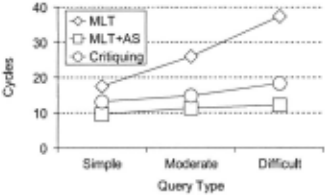
Finally, it is worth briefly considering the impressive dialog reductions observed for adaptive selection with preference based feedback in the context of a much richer form of feedback, namely critiquing [Burke, 2000; McGinty and Smyth, 2003]. Figure 5 presents an efficiency comparison (in terms of average recommendation cycles) between our two preference-based recommenders and an equivalent rec ommender that implements critiquing; briefly, during each cycle feedback corresponds to a preference case plus a cri tique that constrains a selected feature value.
On the face of it we expect critiquing to produce more effi cient dialogs than preference-based feedback. And so it does for all query types when compared to standard preference based feedback. However, the surprise is that combining preference-based feedback and adaptive selection produces recommendation dialogs that are consistently and signifi cantly shorter than even those produced by critiquing. For example, relative to MLT-AS, critiquing requires 37% more cycles for simple queries and 52% more cycles for the diffi cult queries.
5 Conclusions
To date preference-based feedback has been largely ignored by recommender systems. It is an inherently ambiguous form of feedback with a limited ability to efficiently guide the recommendation process. Nevertheless, we believe that this form of feedback is useful, and perhaps even vital, in cer tain recommendation domains where other forms of feedback cannot be used, perhaps because of limited user expertise or even basic device restrictions.
We have described how preference-based feedback can be made more efficient using the adaptive selection technique, which modifies its recommendation strategy depending on whether or not the recommender is correctly focused on the right region of the recommendation space. Using this method we have demonstrated dramatic performance improvements over standard preference-based feedback, across a variety of experimental conditions, with reductions in dialog length of up to nearly 80o/d. Indeed, adaptive selection is so effective that it is capable of using simple and cheap preference-based feedback to produce recommendation dialogs that are even more efficient than those available with richer forms of feed back such as critiquing.
In this paper we have presented evaluation results from one recommendation domain, Whiskey. This domain is especially interesting because of its dependency on preference-based feedback (as discussed in Section 1). We have also tested our technique on more traditional domain datasets (i.e. Travel, PC) and have found similar results [McGinty and Smyth, 2003]. We believe that these results have the potential to change the perception of simple preference-based feedback, facilitating its practical use in a variety of recommendation scenarios. Indeed adaptive selection is in no way limited to preference-based feedback. In our future research we intend to investigate if similar performance benefits can be achieved by integrating this technique in recommenders that use other forms of feedback (e.g. critiquing and rating-based).
@inproceedings{ijcai2003p18,
  title     = {The Power of Suggestion},
  author    = {Smyth, Barry and McGinty, Lorraine},
  booktitle = {Proceedings of the Eighteenth International Joint Conference on
               Artificial Intelligence, {IJCAI-03}},
  publisher = {International Joint Conferences on Artificial Intelligence},
  editor    = {Georg Gottlob and Toby Walsh},
  pages     = {127--131},
  year      = {2003},
  url       = {https://ijcai.org/proceedings/2003/18},
}
TY - CPAPER TI - The Power of Suggestion AU - Smyth, Barry AU - McGinty, Lorraine T2 - Proceedings of the Eighteenth International Joint Conference on Artificial Intelligence, IJCAI-03 PB - International Joint Conferences on Artificial Intelligence PY - 2003 SP - 127 EP - 131 UR - https://ijcai.org/proceedings/2003/18 ER -Copied
Machine-readable versions of this paper, for tools and AI agents:





