
Knowledge Extraction from Local Function Networks
Proceedings of the Seventeenth International Joint Conference on Artificial Intelligence. Pages 765-769.
© 2001 International Joint Conferences on Artificial Intelligence
Abstract
Extracting rules from RBFs is not a trivial task because of nonlinear functions or high input dimensionality. In such cases, some of the hidden units of the RBF network have a tendency to be “shared” across several output classes or even may not contribute to any output class. To address this we have developed an algorithm called LREX (for Local Rule EXtraction) which tackles these issues by extracting rules at two levels: hREX extracts rules by examining the hidden unit to class assignments while mREX extracts rules based on the input space to output space mappings. The rules extracted by our algorithm are compared and contrasted against a competing local rule extraction system. The central claim of this paper is that local function networks such as radial basis function (RBF) networks have a suitable architecture based on Gaussian functions that is amenable to rule extraction.
- [Andrews and Geva, 1999] R. Andrews and S. Geva. On the effects of initialising a neural network with prior knowl- edge. In Proceedings of the International Conference on Neural Information Processing (ICONIP'99), pages 251- 256, Perth, Western Australia, 1999.
- [Bishop, 1995] C. Bishop. Neural Networks for Pattern Recognition. Oxford University Press, 1995.
- [Craven and Shavlik, 1997] M. Craven and J. Shavlik. Us- ing neural networks for data mining. Future Generation Computer Systems, 1997.
- [Lowe, 1991] D. Lowe. On the iterative inversion of RBF networks: a statistical interpretation. In Proceedings of the International Conference on Artificial Neural Networks, pages 29-33, Bournemouth, UK, 1991.
- [McGarry et al., 1999] K. McGarry, S. Wermter, and J. Mac- Intyre. Hybrid neural systems: from simple coupling to fully integrated neural networks. Neural Computing Sur- veys, 2(1):62-93, 1999.
- [Moody and Darken, 1989] J. Moody and C. J. Darken. Fast learning in networks of locally tuned processing units. Neural Computation, pages 281-294, 1989.
- [Omlin and Giles, 1994] C. W. Omlin and C. L. Giles. Ex- traction and insertion of symbolic information in recurrent neural networks. In V.Honavar and L.Uhr, editors, Artifi- cial Intelligence and Neural Networks:Steps Towards prin- cipled Integration, pages 271-299. Academic Press, San Diego, 1994.
- [Shavlik, 1994] J. Shavlik. A framework for combining sym- bolic and neural learning. Machine Learning, 14:321-331, 1994.
- [Sun, 2000] R. Sun. Beyond simple rule extraction: the ex- traction of planning knowledge from reinforcement learn- ers. In Proceedings of the IEEE International Joint Con- ference on Neural Networks, Lake Como, Italy, 2000.
- [Thrun, 1995] S. Thrun. Extracting rules from artificial neural networks with distributed representations. In G.Tesauro, D. Touretzky, and T. Leen, editors, Advances in Neural Information Processing Systems 7. MIT Press, San Mateo, CA, 1995.
References were extracted automatically from the PDF and may contain errors.
Full text extracted automatically from the PDF; figures, tables and equations may differ. The PDF is the version of record.
1 Introduction
Neural networks have been applied to many real-world, largescale problems of considerable complexity. They are useful for pattern recognition and they are robust classifiers, with the ability to generalize in making decisions about imprecise input data [Bishop, 1995]. They offer robust solutions to a variety of classification problems such as speech, character and signal recognition, as well as functional prediction and system modeling where the physical processes are not understood or are highly nonlinear.
Although neural networks have gained acceptance in many industrial and scientific fields they have not been widely used by practitioners of mission critical applications such as those engaged in aerospace, military and medical systems. This is understandable since neural networks do not lend themselves to the normal software engineering development process. Knowledge extraction by forming symbolic rules from the internal parameters of neural networks is now becoming an accepted technique for overcoming some of their limitations [Shavlik, 1994; Sun, 2000].
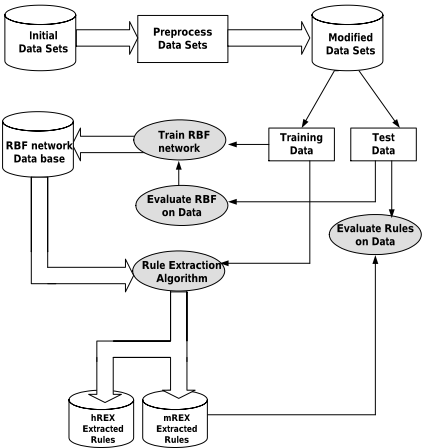
In this paper we describe our method of extracting knowledge from an RBF network which is classed as a local type of neural network. That is, its internal parameters are limited to responding to a limited subset of the input space. We also compare and contrast our technique with a specialized local type neural architecture. The extracted rules are examined for comprehensibility, accuracy, number of rules generated and the number of antecedents contained in a rule.
The paper is structured as follows: section two describes the motivations for performing knowledge extraction. Section three describes why the architecture of the radial basis function network is particulary suitable for knowledge extraction. Section four outlines how our knowledge extraction algorithm produces rules from RBF networks and section five explains the results of the experimental work. Section six discusses the conclusions of the experimental work.
2 Knowledge Extraction
In this section we discuss motivations, techniques and methodology for knowledge extraction from RBF networks. RBF networks provide a localized solution [Moody and Darken, 1989] that is amenable to extraction, which section three discusses in more detail. It is possible to extract a series of IF..THEN rules that are able to state simply and accurately the knowledge contained in the neural network. In recent years there has been a great deal of interest in researching techniques for extracting symbolic rules from neural networks. Rule extraction has been carried out upon a variety of neural network types such as multi-layer perceptrons [Thrun, 1995], Kohonen networks and recurrent networks [Omlin and Giles, 1994]. The advantages of extracting rules from neural networks can be summarized as follows:
- AF The knowledge learned by a neural network is generally difficult to understand by humans. The provision of a mechanism that can interpret the networks input/output mappings in the form of rules would be very useful.
- AF Deficiencies in the original training set may be identified, thus the generalization of the network may be improved by the addition/enhancement of new classes. The identification of superfluous network parameters for removal would also enhance network performance.
- AF Analysis of previously unknown relationships in the data. This feature has a huge potential for knowledge discovery/data mining and possibilities may exist for scientific induction [Craven and Shavlik, 1997].
In addition to providing an explanation facility, rule extraction is recognised as a powerful technique for neuro-symbolic integration within hybrid systems [McGarry et al., 1999].
3 Radial Basis Function Networks
Radial basis function (RBF) neural networks are a model that has functional similarities found in many biological neurons. In biological nervous systems certain cells are responsive to a narrow range of input stimuli, for example in the ear there are cochlear stereocilla cells which are locally tuned to particular frequencies of sound [Moody and Darken, 1989]. Figure 2 shows a network trained on a noisy Xor data set for illustration. This network has two input features, two output classes and four hidden units.
The RBF network consists of a feedforward architecture with an input layer, a hidden layer of RBF "pattern" units and an output layer of linear units. The input layer simply transfers the input vector to the hidden units, which form a localized response to the input pattern. Learning is normally undertaken as a two-stage process. The first stage consists of an unsupervised process in which the RBF centres (hidden units) are positioned and the optimum field widths are determined in relation to the training samples.
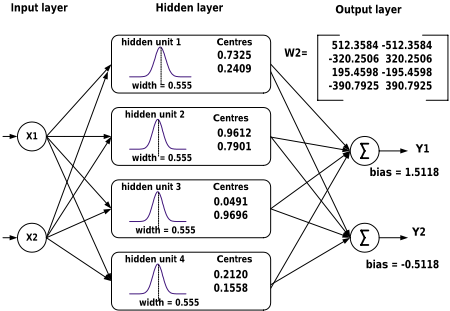
The second stage of learning involves the calculating the hidden unit to output unit weights and is achieved quite easily through a simple matrix transformation.
The radial basis functions in the hidden layer are implemented by kernel functions, which operate over a localized area of input space. The effective range of the kernels is determined by the values allocated to the centre and width of the radial basis function. The Gaussian function has a response characteristic determined by equation 1.
The response of the output units is calculated quite simply using equation 2.
where:
W = weight matrix, Z = hidden unit activations, x = input vector, AM = n-dimensional parameter vector, AR = width of receptive field.
3.1 RBF training
The first stage was to train RBF networks to an acceptable level of accuracy on all data sets. The specific level of accuracy varied with each data set, the literature was examined to provide guidance on what accuracy levels could be achieved. The accuracy levels stated in the tables are the best out of up to 10 test runs. Training of the RBF networks required the setting of three parameters, the global error, the spread or width of the basis function and the maximum number of hidden units. The value assigned to the global error setting may result in fewer hidden units being used than the maximum value. If the error value is not reached, training will terminate when the maximum number of hidden units has been assigned. The training and test data for the construction of the RBF networks were generally split 75/25.
3.2 Data Sets
In order to allow good benchmarking and comparison we used a mixture of well known benchmark data as well as two new vibration data sets for our tests. The data sets were selected from various sources but mainly obtained from the collection maintained by the University of California at Irvine (UCI). The vibration data sets were produced as part of two large projects which were concerned with the monitoring the health of industrial machinery. The data sets represent a variety of synthetic and real world problems of varying complexity (i.e. number of examples, input features and classes).
| Data Set | Ex | O/P | I/P | C | D | M |
|---|---|---|---|---|---|---|
| Xor(binary) | 4 | 2 | 2 | No | Yes | No |
| Xor(continuous) | 100 | 2 | 2 | Yes | No | No |
| Iris | 150 | 3 | 4 | Yes | No | No |
| Vowell(Peterson) | 1520 | 10 | 5 | Yes | Yes | No |
| Vowell(Deterding) | 990 | 11 | 11 | Yes | Yes | No |
| Protein(yeast) | 1484 | 10 | 8 | Yes | No | No |
| Protein(ecoli) | 336 | 8 | 8 | Yes | No | No |
| Credit(Japanese) | 125 | 2 | 9 | Yes | Yes | Yes |
| Credit(Australian) | 690 | 2 | 15 | Yes | Yes | Yes |
| Diabetes(Pima) | 768 | 2 | 8 | Yes | No | No |
| Monks1 | 556 | 2 | 6 | No | Yes | No |
| Sonar | 208 | 2 | 60 | Yes | No | No |
| Vibration 1 | 1028 | 3 | 9 | Yes | No | No |
| Vibration 2 | 1862 | 8 | 20 | Yes | No | No |
Table 1 gives details of the data sets. The columns indicate the number of examples, the number of ouput features or classes, the number of input features, whether the data set contains continuous data or discrete data and the last column indicates if any data is missing.
4 LREX: Rule Extraction Algorithm
The development of the LREX algorithm was motivated by the local architecture of RBF networks which suggested that rules with unique characteristics could be extracted. In addition, there was little published work on extracting rules from ordinary RBF networks [Lowe, 1991]. Therefore our work fills a substantial gap in rule extraction research.
The LREX algorithm is composed of two modules: the mREX module extracts IF..THEN type rules based on the premise that a hidden unit can be uniquely assigned to a specific output class. Therefore, by using the centre locations of the hidden units an input vector could be directly mapped to an output class. Experimental work performed on the simpler data sets tended to reinforce this belief. However, hidden unit sharing occurs within networks trained on non-linear or complex data. This phenomena reduces rule accuracy as several hidden units may be shared amongst several classes. The second module, hREX was developed to identify which hidden units are shared between classes. Analysis of how each hidden unit contributes provides information to determine a class. The extracted rules are IF..THEN type rules where any given hidden may appear across several classes. The next two sections describe how the mREX and hREX modules provide the user with complimentary types of extracted rules that explain the internal operation of the original RBF network.
4.1 mREX: Input-to-output mapping
The functionality of mREX algorithm is shown in figure 3.
Input: Hidden weights AM (centre positions) Gaussian radius spread AR Output weights CFBE Statistical measure S Training patterns Output: One rule per hidden unit Procedure: Train RBF network on data set Collate training pattern "hits" for each hidden unit For each hidden unit Use CFBE correlation to determine Class label Use "hits" to determine S Select S format CUD1CXD2BND1CPDCBN D7D8CSBND1CTCPD2BND1CTCSCV For each AM CX CG D0 D3DBCTD6 BP AM CX A0 AR CX A3 CB CG D9 D4D4CTD6 BP AM CX B7AR CX A3 CB Build rule by: antecedent BP CJCG D0 D3DBCTD6BN CG D9 D4D4CTD6CL Join antecedents with AND Add Class label Write rule to fileThe first stage of the mREX algorithm is to use the W2 weight matrix (see figure 2) to identify the class allocation of each hidden unit. The next stage is to calculate the lower and upper bounds of each antecedent by adjusting the centre weights AM using the Gaussian spread AR . The lower and upper limits are further adjusted using a statistical measure S gained from the training patterns classified by each hidden unit. S is used empirically to either contract or expand each antecedents range in relation to the particular characteristics of these training patterns.
The entire rule set for the Iris domain is presented in figure 4. Note that there are four extracted rules, one for each RBF hidden unit.
Rule 1 : IF (SepalLength AL 4.1674 AND AK 5.8326) AND IF (SepalWidth AL 2.6674 AND AK 4.3326) AND IF (PetalLength AL 0.46745 AND AK 2.1326) AND IF (PetalWidth AL 0.53255 AND AK 1.1326) THEN..Setosa Rule 2 : IF (SepalLength AL 5.2674 AND AK 6.9326) AND IF (SepalWidth AL 1.9674 AND AK 3.6326) AND IF (PetalLength AL 3.1674 AND AK 4.8326) AND IF (PetalWidth AL 0.46745 AND AK 2.1326) THEN..Versicolor Rule 3 : IF (SepalLength AL 5.9674 AND AK 7.6326) AND IF (SepalWidth AL 2.3674 AND AK 4.0326) AND IF (PetalLength AL 5.0674 AND AK 6.7326) AND IF (PetalWidth AL 1.4674 AND AK 3.1326) THEN..Virginica Rule 4 : IF (SepalLength AL 4.8674 AND AK 6.5326) AND IF (SepalWidth AL 1.6674 AND AK 3.3326) AND IF (PetalLength AL 4.1674 AND AK 5.8326) AND IF (PetalWidth AL 1.1674 AND AK 2.8326) THEN..Virginica4.2 hREX: Hidden unit analysis
A different approach to rule extraction is taken by the hREX algorithm which uses quantization and clustering on the network parameters (weights and activation levels) to form an abstraction of its operation. The number of extracted rules is determined by the user who can place an upper limit on the rules extracted for each class. This is a useful feature since it enables a tradeoff to be made between rule size and rule comprehensibility. This is achieved by three important parameters:
- AF AB which determines the minimum weight value (postive) to be quantized as a "one", weights below this cutoff point are quantized to A01 and do not participate in rule extraction.
- AF AC which determines the minimum hidden unit activation level. Hidden units with activation levels below this cutoff point will not be quantized and will play no further part in rule extraction.
- AF N determines the maximum number of clusters that the training set (for each class) is divided into. This process abstracts the input space into a number of distinct regions which will require a separate rule to identify.
These parameters are determined empirically for a satisfactory arrangement. Figure 5 shows the algorithm in detail. Note that valid rules consist of both a positive quantized weight (QW2) and a positive quantized activation (AQZ) level. A rule consists of one or more hidden units which must all be active for the class lable to be satisified.
Input: Output weights CFBE Hidden unit activations CI (training data) Output weights quantization modifier AB Hidden unit activation quantization modifier AC Maximum Cluster number N Training patterns by sorted by class T Intermediate information: Quantized W2 weights QW2 Quantized hidden unit activations QZ Average Quantized hidden unit activations AQZ Output: One rule per cluster Procedure: Quantize W2 weights with AB Quantize hidden unit activations CI with AC Separate training patterns by class T For each class Partition QZ up to NC Clusters For each N Cluster Identify Positive QZ activations Calculate Average AQZ value for cluster Identify Positive QW2 weights attached to QZ Build rule by: IF AQZ==Positive AND QW2 ==Positive Hidden unit H belongs to rule Join Hidden Units with AND Add Class label Write rule to fileSome hRules rules extracted from the ecoli domain are presented in figure 6. For instance, for Rule 4 to "fire", each antecedent must be satisfied so hidden units 5, 19, 20, 24, 25, 26, 28 and 31 must all be active. It can be seen that hidden unit 20 participates in both class 3 and class 4.
hREX rules are useful for identifying the internal structural relationships formed by the hidden units. This is demon-
Rule CL9 Class: 3 IF((H5 BPBP TRUE) AND (H19 BPBP TRUE) AND (H20 BPBP TRUE) AND (H24 BPBP TRUE) AND (H25 BPBP TRUE) AND (H26 BPBP TRUE) AND (H28 BPBP TRUE) AND (H31 BPBP TRUE)) THEN Class: 3 Rule CL10 Class: 4 IF((H12 BPBP TRUE) AND (H20 BPBP TRUE) AND (H22 BPBP TRUE) AND (H23 BPBP TRUE) AND (H32 BPBP TRUE)) THEN Class: 4strated on those RBF networks that have a poor performance on certain classes. These RBF networks produce hREX rules which exhibit a large degree of hidden unit sharing or in the worse cases fail to generate any hREX rules for these classes.
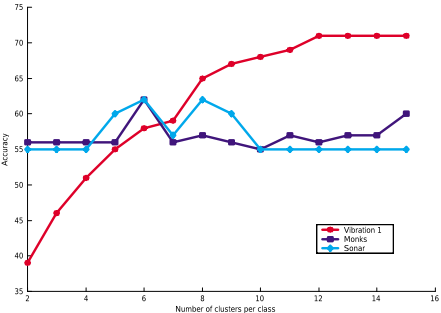
Figure 7 shows the accuracy of the hREX rules against the rule size (comprehensibility) for RBF networks trained on the Vibration 1, Monks and Sonar data sets. The Vibration shows a steady increase in accuracy with each additional rule until it levels off at a cluster size of 12. The rules extracted from Sonar actually lose accuracy beyond a certain point before the accuracy reaches a steady value. Generating additional rules for the Monks after the optimum cluster size is reached produces an oscillating effect where the accuracy does not level off.
5 Analysis of Results
The performance of the RBF rule extraction algorithm was compared with a related system called MCRBP/RULEX which was developed by Andrews and Geva [Andrews and Geva, 1999]. MCRBP builds RBF-like networks with specialized activation functions. Once the networks are trained, the RULEX algorithm can then be used to extract IF..THEN rules with boundaries. The rules extracted by RULEX are in a very similar format to those produced by the author's system. Table 2 shows the results of the experimental work. The first column identifies the data set. The second column presents the mREX accuracy alongside the original RBF accuracy. The third column details the hREX accuracy next to the original RBF accuracy and the fourth column shows the Rulex accuracy Table 3 shows the number of rules generated by the three systems. The rule set size quoted for LREX is based on the unmodified basic version.
| Data set | mREX | hREX | Rulex |
|---|---|---|---|
| Xor(binary) | 100/100 | 100/100 | 100 |
| Xor(continuous) | 96/100 | 100/100 | 100 |
| Iris | 93/96 | 93/96 | 100 |
| Vowell(Peterson) | 43/86 | 22/86 | - |
| Vowell(Deterding) | 9/62 | 20/62 | 38 |
| Protein(yeast) | 26/57 | 66/57 | 28 |
| Protein(ecoli) | 49/87 | 72/87 | 88 |
| Credit(Japanese) | 73/93 | 66/93 | 93 |
| Credit(Australian) | 66/71 | 64/71 | 88 |
| Diabetes(Pima) | 65/76 | 70/76 | 69 |
| Monks1 | 79/83 | 60/83 | 72 |
| Sonar | 57/95 | 58/95 | - |
| Vibration 1 | 56/73 | 69/73 | 61 |
| Vibration 2 | 73/94 | 72/94 | - |
RULEX extracts highly compact rule sets compared with LREX. The majority of the domains can be represented with as few as 3-5 rules. Unfortunately, RULEX completely failed to generate rules for three of the domains. This problemwas tracked down to the initial MCRBP network, as it was unable to form a viable classifier on the training data. Therefore, any rules extracted would be invalid. RULEX also failed to provide rules to cover a specific class in the vibration 1 domain. Training the MCRBP networks took fewer attempts to reach acceptable accuracies than the equivalent RBF networks (typically 2-3 runs).
MCRBP/RULEX could not form a viable network on the vowel, sonar and vibration 2 domains. It is likely that the specialized architecture cannot cope with the large number of input features present in these data sets. However, by using non-overlapping local functions the MCRBP/RULEX algorithm can form a rule from each function that is specific to a class. This requires fewer rules to form a classifier.
| Data set | mREX | hREX | Rulex |
|---|---|---|---|
| Xor(binary) | 4 | 4 | 4 |
| Xor(continuous) | 4 | 4 | 4 |
| Iris | 4 | 4 | 5 |
| Vowell(Peterson) | 30 | 80 | - |
| Vowell(Deterding) | 200 | 110 | 11 |
| Protein(yeast) | 120 | 24 | 9 |
| Protein(ecoli) | 35 | 24 | 9 |
| Credit(Japanese) | 50 | 6 | 2 |
| Credit(Australian) | 50 | 20 | 5 |
| Diabetes(Pima) | 300 | 11 | 3 |
| Monks1 | 20 | 24 | 3 |
| Sonar | 20 | 10 | - |
| Vibration 1 | 30 | 25 | 2 |
| Vibration 2 | 100 | 32 | - |
The hREX algorithm produces fewer rules than the mREX algorithm and are generally more accurate. A smaller rule set enables a better understanding of the internal operation of the RBF network. further analysis of the hREX rules proved to be interesting as several of the RBF networks have up to 3540% of their hidden units shared between the various output classes. Such results tend to occur with those RBF networks that have lower accuracies and may implie that the original settings of the internal parameters during training were not optimal e.g. a badly chosen value for the width of the basis function can be a source of error.
6 Conclusions
The work described in this paper has tackled the difficult issue of knowledge extraction from RBF networks which has been avoided in the literature because of the problems with overlapping neurons. The rules extracted by the LREX algorithm provide information about the original RBF network in two forms; an input to output mapping and information regarding those hidden units that participate in classification. The knowledge extracted by the mREX algorithm transforms the original RBF network into a rule based classifier. This makes the input to output mapping of the RBF network transparent and open to scrutiny. However, the number of rules produced is dependent on the number of hidden units and therefore a large number of rules may obscure the comprehensibility. This problem is partially solved by the hREX algorithm which can generate a maximum number of rules determined in advance by the user. The tradeoff is rule size (and generally accuracy) versus comprehensibility. Some RBF networks may naturally be described by small rule sets that are accurate but still allow a good understanding of their internal structure. Other RBF networks may have modeled complex functions and their hidden units are used by several classes, in which case the hREX algorithm will provide useful information regarding the extent of this activity.
@inproceedings{ijcai2001p104,
  title     = {Knowledge Extraction from Local Function Networks},
  author    = {McGarry, Kenneth and Wermter, Stefan and MacIntyre, John},
  booktitle = {Proceedings of the Seventeenth International Joint Conference on
               Artificial Intelligence, {IJCAI-01}},
  publisher = {International Joint Conferences on Artificial Intelligence},
  editor    = {Bernhard Nebel},
  pages     = {765--769},
  year      = {2001},
  url       = {https://ijcai.org/proceedings/2001/104},
}
TY - CPAPER TI - Knowledge Extraction from Local Function Networks AU - McGarry, Kenneth AU - Wermter, Stefan AU - MacIntyre, John T2 - Proceedings of the Seventeenth International Joint Conference on Artificial Intelligence, IJCAI-01 PB - International Joint Conferences on Artificial Intelligence PY - 2001 SP - 765 EP - 769 UR - https://ijcai.org/proceedings/2001/104 ER -Copied
Machine-readable versions of this paper, for tools and AI agents:





