
Domain-Dependent Single-Agent Search Enhancements
Proceedings of the Sixteenth International Joint Conference on Artificial Intelligence. Computer Game Playing. Pages 570-576.
© 1999 International Joint Conferences on Artificial Intelligence
Abstract
AI res ea rch has developed an extensive collection of methods to so lv e state-space probl ems. Using the challenging domain of Sokoban, this p ape r studies the e ffec t of search enh a ncem ents on program performance. We show that th e c urrent sta te of the art in AI genera ll y requir es a large programming and research effort int o dom ain-depe nd e nt m et hods to solve even moderately comp lex problems in such difficult domain s. The application of dom ain-sp ec ifi c kn ow ledge to exploit pr ope rti es of the search space can r es ult in large re du ct ions in th e size of the sea rch tree, often several orders of magnitude per search enh anceme nt . Understanding the e ffect of these e nhan cements on the search leads to a n ew taxonomy of sea rch e nhan cements , and a new fram ework for developing single-agent search applications. This is used to illustrate the large gap betw ee n what is portrayed in the liter at ure versus wha t is n ee ded in practice.
- Culberson and Schaeffer , 1996) J . Culberson and J. Schaeffer. Searching with pattern databases . In G. McCalla, editor, Advances in Artificial Int elligence, pages 402-416. Springer-Verlag, 1996.
- Culberson, 1997)
- J. Culberson. Sokoban is PSPACE- complete. Technical Report TR97-02 , Dept. of Computing Science, University of Alberta, 1997. ftp.cs. ualberta.cafpub /TechReports/ 1997 /TR97 -02. Link
- Dor and Zwick, 1995) D. Dor and U. Zwick. SOKOBAN and other motion planning problems , 1995. At : http:/ /www.math .tau.ac.il;-ddorit. Link
- Junghanns and Schaeffer, 1998a) A . Junghanns and J. Schaeffer . Relevance cuts: Localizing the search. In The First Intemational Conference on Computers and Games, pages 1-13, 1998. To appear in: Lecture Notes in Computing Science, Springer Verlag.
- Junghanns and Schaeffer , 1998b) A. Junghanns and J . Schaeffer. Single-agent search in the presence of deadlock. In AAAI, pages 419-424, 1998.
- Junghanns and Schaeffer, 1998c) A. Junghanns and J. Schaeffer. Sokoban: Evaluating standard single- agent search techniques in the presence of deadlock . In R. Mercer and E. Neufeld , editors, Advances in Ar- tificial Intelligence, pages 1-15. Springer Verlag, 1998.
- K autz and Selman, 1996) H . Kautz and B. Selman. Pushing the envelope: planning , propositional logic and stochastic search. In AAAI, pages 1194-1201 , 1996.
- Korf, 1997)
- R.E. Korf. Finding optima l solutions to Rubik's Cube using pattern databases. In AAAI, pages 700-705 , 1997.
- Manzini, 1995)
- G. Manzini. BIDA *: An improved perimeter search algorithm. Artificial Intelligence, 75:347-360, 1995.
- McDermott , 1998) Drew McDermott. Using regression- match graphs to control search in planning , 1998. Un- published manuscript.
References were extracted automatically from the PDF and may contain errors.
Full text extracted automatically from the PDF; figures, tables and equations may differ. The PDF is the version of record.
1 Introduction
The AI research community has developed an impres sive suite of techniques for solving state-space problems. These techniques range from general-purpose domain independent methods such as A*, to domain-specific en hancements. There is a st rong movement toward devel oping domain-independent methods to solve problems. While these approaches require minimal effort to spec ify a problem to be solved, the performance of these solvers is often limited , exceeding available resources on even simple problem instances. This requires the devel opment of domain-dependent methods that exploit addi tional knowledge about the search space. These methods can greatly improve the efficiency of a search-based pro gram, as measured in the size of the search tree needed to solve a problem instance.
This paper presents a study on solving challenging single-agent search problems for the domain of Sokoban .
Sokoban is a one-player game and is of general interest as an instance of a robot motion planning problem [Dor and Zwick, 1995]. Sokoban is analogous to the problem of having a robot in a warehouse move specified goods from their current location to their final destination, sub ject to the topology of the warehouse and any obstacles in the way. Sokoban has been shown to be NP-hard [Culberson , 1997; Dor and Zwick, 1995].
Previously we reported on our attempts to solve Sokoban problems using the standard single-agent search techniques available in the literature [Junghanns and Schaeffer, 1998c]. When these proved inadequate, solv ing only 10 of a 90-problem test suite, new algorithms had to be developed to improve search efficiency [Jung hanns and Schaeffer , 1998b; 1998a]. This allowed 47 problems to be optimally solved, or nearly so. Addi tional efforts have since increased this number to 52. The results here show the large gains achieved by adding application-dependent knowledge to our program Rolling Stone. With each enhancement, reductions of the search tree size by several orders of magnitude are possible.
Analyzing all the additions made to the Sokoban solver reveals that the most valuable search enhance ments are based on search (both on-line and off-line) by improving the lower bound. We classify the search enhancements along several dimensions including their generality, computational model, completeness and ad missibility. Not surprisingly, the more specific an en hancement is , the greater its impact on search perfor mance.
When presented in the literature, single-agent search (usually IDA*) consists of a few lines of code. Most text books do not discuss search enhancements, other than cycle detection. In reality, non-trivial single-agent search problems require more extensive programming (and pos sibly research) effort. For example , achieving high per formance at solving sliding tile puzzles requires enhance ments such as cycle detection, pattern databases, move ordering and enhanced lower bound calculations [Culber son and Schaeffer, 1996]. In this paper, we outline a new framework for developing high-performance single-agent search programs.
This paper contains the following contributions:
1. A case study showing the evolution of a Sokoban solver's performance, beginning with a domain independent solver and ending with a highly-tuned, application-dependent program.

- A taxonomy of single-agent search enhancements.
- A new framework for single-agent search, including search enhancements and their control functions.
2 Sokoban
Figure 1 shows a sample problem of Sokoban. The goal is simple: use the man to push all the stones in the maze to the shaded goal squares. Only one stone can be pushed at a time. These rather simple rules bely the difficulty of Sokoban problems, especially with respect to computer solutions. We identified several reasons why Sokoban is so difficult [Junghanns and Schaeffer, 1998c] :
- The graph underlying Sokoban problems is directed; some moves are not reversible. Consequently, there are deadlock states from which no solution is reach able. Deadlocks represent a challenge for anytime algorithms: when committing to a move, how can we make sure that no deadlock is introduced?
- The combination of long solution lengths (up to 67 4 stone pushes in the test set) and potentially large branching factors make Sokoban difficult for conven tional search algorithms to solve. 20 x 20 Sokoban offers the challenge of a large search space (~ 10 98 ).
- Sokoban solutions are inherently sequential; only limited parts of a solution are interchangeable. Sub goals are often interrelated and thus cannot be solved independently.
- A "simple", effective lower bound on the solution length of a Sokoban problem remains elusive. The best lower bound estimator is expensive to calculate, and is often ineffective.
None of the above obstacles are found in the "stan dard" single-agent test domains, such as N x N -puzzles and Rubik's Cube.
3 Application-Independent Techniques
Ideally, applications should be specified with minimal ef fort and a "generic" solver would be used to compute the solutions. In small domains this is attainable (e.g., if it is easily enumerable) . For more challenging domains , there have recently been a number of interesting attempts at domain-independent solvers (e.g., black box [Kautz and Selman , 1996]). Before investing a lot of effort in de veloping a Sokoban-specific program, it is important to understand the capabilities of current AI tools. Hence, we include this information to illustrate the disparity be tween what application-independent problem solvers can achieve, compared to application-dependent techniques.
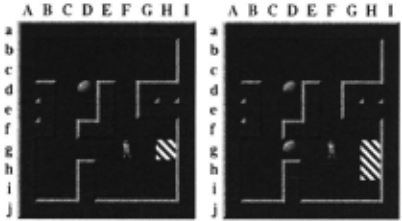
The Sokoban problems in Figure 2 [McDermott , 1998] were given to the program blackbox to solve. Blackbox was the winner of the AIPS'98 fastest planner competi tion. The first problem was solved within a few seconds and the second problem was solved in over an hour .
Clearly, domain-independent planners, like blackbox, have a long way to go if they are to solve the even sim plest problem in the test suite (Figure 1) . Hence, for this application domain we have no choice but to pursue an application-dependent implementation.
4 Application-Dependent Techniques
As reported in [Junghanns and Schaeffer, 1998c], we implemented IDA* for Sokoban. We gave the algo rithm a fixed node limit of 1 billion nodes for all ex periments (varying from 1 to 3 hours of CPU time on a single 195 MHz processor of an SG I Origin 2000). After adding an enhancement, Rolling Stone was run on 90 test problems (http:/ jxsokoban.lcs.mit.edu/xsokoban.html) to find out how many could be solved and how much search effort was required to do so.
Figure 3 presents the experimental results for differ ent versions of Rolling Stone. Version RO is the program using only IDA* with the lower bound; RA contains all the search enhancements. The logarithmic vertical axis shows the number of search nodes needed to solve a prob lem. The horizontal axis shows how many problems can be solved (out of 90), ordering the problems by search tree size. The performance lines in the figure are sorted from left to right with an increasing number of search enhancements.
Lower Bound (0 solved): To obtain an admissi ble estimate of the distance of a position to a goal, a minimum-cost, perfect bipartite matching algorithm is used . The matching assigns each stone to a goal and re turns the total (minimum) distance of all stones to their goals. The algorithm is O(N 3 ) in the number of stones N. IDA* with this lower bound cannot solve any of the test problems within one billion search nodes.
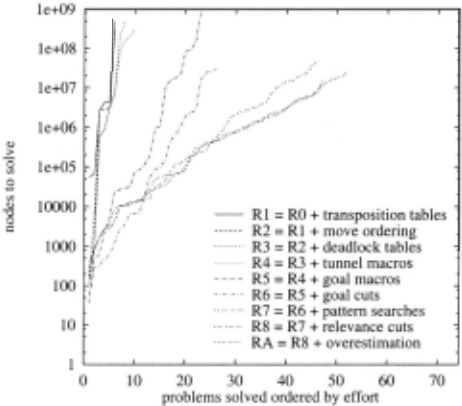
Transposition Table (6 solved): The search space of Sokoban is a graph, rather than a tree, so repeated positions and cycles are possible. A transposition table was implemented to avoid duplicate search effort. Posi tions that have the same stone locations and equivalent man locations (taking man reachability into account) are treated as the same position. Transposition tables re duces the search tree size by several orders of magnitude, allowing Rolling Stone to solve 6 problems.
Move Ordering (6 solved): Children of a node are ordered based on their likelihood of leading to a solution. Move ordering only helps in the last iteration. Even though move ordering results in no additional problems being solved, less search effort is used to solve each prob lem.
Deadlock Table (8 solved): The pattern database is a recent idea that has been successfully used in the NxN-puzzles [Culberson and Schaeffer , 1996] and Ru bik 's Cube [Korf, 1997]. An off-line search enumerated all possible stone/wall placements in a 4x5 region and searched them to determine if deadlock was present . These results are stored in deadlock tables. During an IDA* search, the table is queried to see if the current move leads to a local deadlock. Thus , deadlock tables contain search results of partial problem configurations and are general with respect to all Sokoban problems.
Tunnel Macros (10 solved): A Sokoban maze often contains "tunnels" (such as the squares Kh, Lh, Mh and Nh in Figure 1) . Once a stone is pushed into a tunnel, it must eventually be pushed all the way through. Rather than do this through search, this sequence of moves can be collapsed into a single macro move. By collapsing several moves into one, the height of the search tree is reduced. Tunnel macros are identified by pre-processing.
Goal Macros (23 solved): Prior to starting the search, a preliminary search is used to find an appropri ate order in which to fill in the goal squares. In many cases this is a non-trivial computation, especially when the goal area(s) has several entrances. A specialized search is used to avoid fill sequences that lead to a dead lock. The knowledge about the goal area is then used to create goal macros, where stones are pushed directly from the goal area entrance( s) to the final goal square avoiding deadlocks. For example, in Figure 1, square Gh is defined as the entrance to the goal area; once a stone reaches it, a single macro move is used to push it to the next pre-determined goal square. These macro moves significantly reduce the search depth required to solve problems and can dramatically reduce the search tree size. Whenever a goal macro move is possible, it is the only move considered; all alternatives are forward pruned.
Goal Cuts (26 solved): Goal cuts effectively push the goal macros further up the search tree. Whenever a stone can be pushed to a goal entrance square, none of the alternative moves are considered. The idea behind these cuts is that if one is confident about using macro moves, one might as well prune alternatives to pushing that stone further up in the search tree.
Pattern Search ( 46 solved): Pattern searches [Junghanns and Schaeffer, 1998b] are an effective way to detect lower bound inefficiencies. Small, localized conflict-driven searches uncover patterns of stones that interact in such a way that the lower bound estimator is off by an arbitrary amount (even infinite, in the case of a deadlock) . These patterns are used throughout the search to improve the lower bound. Patterns are specific to a particular problem instance and are discovered on the fly using specialized searches . Patterns represent the knowledge about dynamic stone interactions that lead to poor static lower bounds, and the associated penalties are the corrective measures.
Pattern searches lead to dramatic improvements of the search: many orders of magnitude vanish from the search tree size and 20 more problems can be solved. Note that tree sizes reported include the pattern search nodes.
Relevance Cuts ( 4 7 solved): Relevance cuts [J ung hanns and Schaeffer, 1998a] are an attempt to cut down the branching factor using forward pruning. If moves are "inconsistent" to the previous move history, they are pruned . This heuristic is unsafe, since it has the poten tial to prune solution paths. However , it does decrease search tree sizes, and can be a beneficial trade-off.
Overestimation (52 solved): Given the difficulty of solving Sokoban problems, any solution, even a non optimal one, is welcome. The patterns that Rolling Stone discovers indicate when potentially "difficult" sit uations arise. To ensure admissibility, some patterns that match are not always used to increase the lower bound. Overestimation allows every pattern to add to the lower bound. In principle, this can be interpreted as the program "avoiding" difficult situations. We pre fer to describe it as a knowledge-driven postponement of search: the additional penalty only postpones when the search will explore a certain part of the tree, it will not cut branches indefinitely. In this respect , this method preserves completeness, but not solution optimality.
I
I I
The performance gap between the first and last ver sions of Rolling Stone in Figure 3 is astounding. For ex ample, consider extrapolating the performance of Rolling Stone with transposition tables so that it can solve the same number of problems as the complete program (52) . 10 50 (not a typo!) seems to be a reasonable lower bound on the difference in search tree sizes.
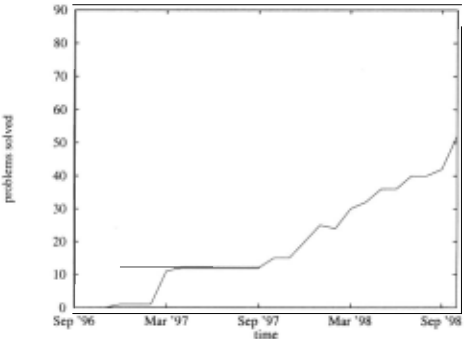
The preceding discussion closely corresponds to the order iri which enhancements were initially added to Rolling Stone (although most enhancements have been continually refined) . Figure 4 shows how these results were achieved over the 2-year development time. The development effort equates to a full-time PhD, a part time professor, a full-time summer student, and feed back from many people. Additionally, a large number of machine cycles were used for tuning and debugging. It is interesting to note the occasional decrease in the number of problems solved, the result of (favorable) bugs being fixed. The long, slow, steady increase is indicative of the reality of building a large system. Progress is incremen tal and often painfully slow.
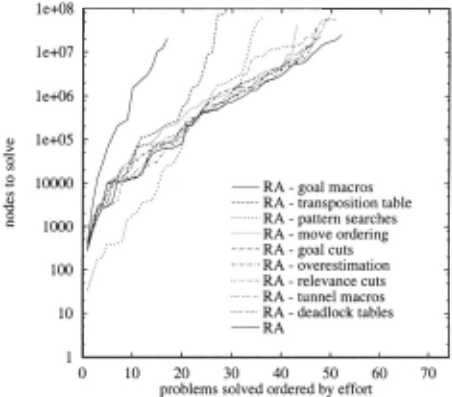
The results in Figure 3 may misrepresent the impor tance of each feature. Figure 5 shows the results of tak ing the full version of Rolling Stone and disabling sin gle search enhancements. In the absence of a particular method, other search enhancements can compensate to allow a solution to be found. Most notably, while the lower bound function alone cannot solve a single prob lem, neither can the complete system solve a single prob lem without the lower bound function .
Figure 5 shows that turning off goal macros reduces the number of problems solved by 35, more than 66%! Turning off transposition tables loses 23 problems. Turn ing off pattern searches reduces the number of solved problems by 16. Other than the lower bound function , these three methods are the most important for Rolling Stone; losing any one of them dramatically reduces the performance. While other enhancements don't have as dramatic an effect, turning any one of them off loses at least one problem.
5 Knowledge Taxonomy
In looking at the domain-specific knowledge used to solve Sokoban problems, we can identify several different ways of classifying the knowledge:
Generality. Classify based on how general the knowl edge is: domain (e.g., Sokoban), instance (a par ticular Sokoban problem), and subtree (within a Sokoban search).
Computation. Differentiate how the knowledge was obtained: static (such as advice from a human ex pert) and dynamic (gleaned from a search).
Admissibility f Completeness. Knowledge can be: admissible (preserve optimality in a solution) or non-admissible. Non-admissible knowledge can ei ther preserve completeness of the algorithm or ren der it incomplete. Admissible knowledge is neces sarily complete.
Figure 6 summarizes the search enhancements used in Rolling Stone. Other enhancements from the literature could easily be added into spaces that are still blank, e.g. perimeter databases [Manzini, 1995] (dynamic, admissi ble, instance). Note that some of the enhancement clas sifications are fixed by the type of the enhancement . For example, any type of forward pruning is incomplete by definition, and move ordering always preserves admissi bility. For some enhancements, the properties depend on the implementation. For example, overestimation tech niques can be static or dynamic; goal macros can be admissible or non-admissible; pattern databases can be domain-based or instance-based.
It is interesting to note that, apart from the lower bound function itself, the three most important program enhancements in terms of program performance (Figure 5) are all dynamic (search-based) and instance/subtree specific. The static enhancements, while of value, turn out to be of less importance. Static knowledge is usually rigid and does not include the myriad of exceptions that search-based methods can uncover and react to.
| Classification | II Domain | I Instance | I Subtree | |
|---|---|---|---|---|
| Static | admissible | lower bound | tunnel macros | move ordering |
| complete | ||||
| mcomplete | relevance cuts | goal cuts | ||
| Dynamic | admissible | deadlock tables | pattern searches | |
| transpos1- tion table | ||||
| complete | overest1- mation | |||
| mcomplete | goal macros | |||
6 Control Functions
There is another type of application-dependent knowl edge that is critical to performance, but receives scant attention in the literature. Control functions are intrin sic parts of efficient search programs, controlling when to use or not use a search enhancement. In Rolling Stone numerous control functions are used to improve the search efficiency. Some examples include:
Transposition Table: Control knowledge is needed to decide when new information is worth replacing older information in the table. Also, when read ing from the table, control information can decide whether the benefits of the lookup justify the cost.
Goal Macros: If a goal area has too few goal squares, then goal macros are disabled. With a small number of goals or too many entrances, the search will likely not need macro moves, and the potential savings are not worth the risk of eliminating possible solutions.
Pattern Searches: Pattern searches are executed only when a non-trivial heuristic function indicates the likelihood of a penalty being present . Executing a pattern search is expensive, so this overhead should be introduced only when it is likely to be cost ef fective. Control functions are also used to stop a pattern search when success appears unlikely.
Implementing a search enhancement is often only one part of the programming effort. Implementing and tun ing its control function(s) can be significantly more time consuming and more critical to performance. We esti mate that whereas the search enhancements take about 90% of the coding effort and the control functions only 10%, the reverse distribution applies to the amount of tuning effort needed and machine cycles consumed.
A clear separation between the search enhancements and their respective control functions can help the tuning effort . For example, while the goal macro creation only considers which order the stones should be placed into the goal area, the control function can determine if goal macros should be created at all. Both tuning efforts have very different objectives: one is search efficiency,
IDA*() { } I** Compute the best possible lower bound **I lb = ComputeLowerBound(); lb += UsePatterns(); I** Match Patterns **I lb += UseDeadlockTable(); lb += UseOverestimate( Cntr/Overestimate() }; if( cutoff ) return; I** Preprocess **I lb += ReadTransTable(); if{ cutoff} return; PatternSearch{ CntrlPatternSearch() }; lb += UsePatterns(}; if( cutoff) return; I** Generate searchable moves **I movelist = GenerateMoves(); RemoveDeadMoves( movelist ); ldentifyMacros( movelist }; OrderMoves{ movelist }; for( each move ) { } if{ Irrelevant{ move, Cntrllrrelevent() )) next; solution= IDA*(); if( solution) return; if( Goa/Cut() ) break; UpdateLowerBound(); I** Use New Patterns **I if{ cutoff} return; I** Post-process **I Save Trans Table( Cntr/Trans Table() ) ; return;the other risk minimization. Separating the two seems natural and convenient.
7 Single-Agent Search Framework
As presented in the literature, single-agent search con sists of a few lines of code (usually IDA*). Most text books do not discuss search enhancements, other than cycle detection. In reality, non-trivial single-agent search problems require a more extensive programming (and possibly research) effort.
Figure 7 illustrates the basic IDA* routine, with our enhancements included (in italics). This routine is spe cific to Rolling Stone, but could be written in more gen eral terms. It does not include a number of well-known single-agent search enhancements available in the litera ture. Control functions are indicated by parameters to search enhancement routines . In practice, some of these functions are implemented as simple if statements con trolling access to the enhancement code.
Examining the code in Figure 7, one realizes that there are really only three types of search enhancements:
- Modifying the lower bound (as indicated by the up dates to lb). This can take two forms: optimally increasing the bound (e.g. using patterns) which re duces the distance to search, or non-optimally (us ing overestimation) which redistributes where the search effort is concentrated.
- Removing branches unlikely to add additional infor-
I
for( each domain ) { I** Preprocess **I } BuildDeadlockTable( Cntr/Deadlock Table() ) ; for( each instance ) { } I·· Preprocess **I FindTunneiM a eros(); FindGoa/Macros( Cntr/Goa/Macros() ); while( not solved ) { } SetSearchParamaters(); IDA*(); I·* Postprocess **I SavePatterns( CntrlSavingPatterns() );mation to the search (the next and break statements in the for loop). This forward pruning can result in large reductions in the search tree, at the expense of possibly affecting the completeness.
- Collapsing the tree height by replacing a sequence of moves with one move (for example, macros).
Some of the search enhancements involve computa tions outside of the search. Figure 8 shows where the pre-search processing occurs at the dc.nain and instance levels . Off-line computation of pattern databases or pre-processing of problem instances are powerful tech niques that receive scant attention in the literature (chess endgame databases are a notable exception). Yet these techniques are an important step towards the au tomation of knowledge discovery and machine learning. Preprocessing is involved in many of the most valuable enhancements that are used in Rolling Stone.
Similar issues occur with other search algorithms. For example, although it takes only a few lines to spec ify the alpha-beta algorithm, the Deep Blue chess pro gram's search procedure includes numerous enhance ments (many similar in spirit to those used in Rolling Stone) that cumulatively reduce the search tree size by several orders of magnitude. If nothing else, the Deep Blue result demonstrated the degree of engineering re quired to build high-performance search-based systems.
8 Conclusions
This paper described our experiences working with a challenging single-agent search domain. In contrast to the simplicity of the basic IDA* formulation, building a high-performance single-agent searcher can be a com plex task that combines both research and engineering. Application-dependent knowledge, specifically that ob tained using search, can result in an orders-of-magnitude improvement in search efficiency. This can be achieved through a judicious combination of several search en hancements. Control functions are overlooked in the lit erature, yet are critical to performance. They represent a significant portion of the program development time and most of the program experimentation resources.
Domain-independent tools offer a quick programming solution when compared to the effort required to de velop domain-dependent applications. However, with current AI tools, performance is commensurate with ef fort. Domain-dependent solutions can be vastly superior in performance. The trade-off between programming ef fort and performance is the critical design decision that needs to be made.
9 Acknowledgements
This research was supported by a grant from the Natural Sciences and Engineering Research Council of Canada. Computational resources were provided by MAC!. This paper benefited from interactions with Yngvi Bjornsson, Afzal Upal and Rob Holte.
@inproceedings{ijcai1999p82,
  title     = {Domain-Dependent Single-Agent Search Enhancements},
  author    = {Junghanns, Andreas and Schaeffer, Jonathan},
  booktitle = {Proceedings of the Sixteenth International Joint Conference on
               Artificial Intelligence, {IJCAI-99}},
  publisher = {International Joint Conferences on Artificial Intelligence},
  editor    = {Thomas Dean},
  pages     = {570--576},
  year      = {1999},
  note      = {Computer Game Playing},
  url       = {https://ijcai.org/proceedings/1999/82},
}
TY - CPAPER TI - Domain-Dependent Single-Agent Search Enhancements AU - Junghanns, Andreas AU - Schaeffer, Jonathan T2 - Proceedings of the Sixteenth International Joint Conference on Artificial Intelligence, IJCAI-99 PB - International Joint Conferences on Artificial Intelligence PY - 1999 SP - 570 EP - 576 UR - https://ijcai.org/proceedings/1999/82 ER -Copied
Machine-readable versions of this paper, for tools and AI agents:





