
Risk Control in Multi-agent Coordination by Negotiation with a Trusted Third Party
Proceedings of the Sixteenth International Joint Conference on Artificial Intelligence. Distributed AI. Pages 500-504.
© 1999 International Joint Conferences on Artificial Intelligence
Abstract
In multi-agent coordination, the uncertainty may come from two major sources: the moves of the nature agent and the unpredictable behavior of other autonomous agents. The uncertainty may affect the expected payoff and the risk of an agent. A rational agent would not always play the strategy that gives the highest expected payoff if the risk is too high. To tackle the uncertainty in multi-agent coordination, a risk control mechanism is necessary in multiagent decision making. We assume agents may have different risk preferences, e.g. risk-averse, riskneutral, and risk-seeking, and separate the risk preference from the utility function of a given strategy. Taking agent's risk preference into account extends the notions of the dominant strategy, the Nash equilibrium, and the Pareto-efficiency in traditional game th eory. We show how the risk control can be carried out by a negotiation protocol using communication actions of asking guarantee and offering compensation via a trusted third party.
- [Axelrod, 1984] R. Axelrod, The Evolution of Cooperation, Basic Books Inc., New York, 1984.
- [Brafman and Tennenholtz, 1997] R.I. Brafman and M. Tennenholtz, Modeling Agents as Qualitative Decision Makers, Artificial Intelligence, Vol.94, pp217-268, 1994
- [Bernoulli, 1954] D. Bernoulli, Exposition of a New Theory of the-Measurement of Risk, Econometrica, Vol. 22, pp. 23-36.
- [Durfee et al., 1993] E.H. Durfee, J. Lee, and P.J. Gmytra- siewicz, Overeager Reciprocal Rationality and Mixed Strategy Equilibria, In Proceedings of the Eleventh Na- tional Conference on Artificial Intelligence (AAAI-93), pp.225-230, 1993.
- [Fabrycky, 1980] W.J. Fabrycky and G.J. Thuesen, Economic Decision Analysis 2nd ed. 1980.
- [Gmytrasiewicz et al., 1991] P.J. Gmytrasiewicz, E.H. Dur- fee and O.K. Wehe, The Utility of Communication in Co- ordinating Intelligent Agents, in Proceedings of the Ninth National Conference on Artificial Intelligence (AAAI- 91), pp.166-172, 1991.
- [Haynes and Sen, 1996] T. Haynes and S. Sen, Satisfying User Preferences while Negotiating Meetings, in Pro- ceeding of the Second International Conference on Multi- Agent Systems (ICMAS-96), 1996.
- [Hertz, 1983] D. B. Hertz, Risk Analysis and its Applica- tions, Chichester, John Wiley & Sons, 1983.
- [Koller and Pfeffer, 1997] D. Koller and A. Pfeffer, Repre- sentations and Solutions for Game-theoretic Problems, Artificial Intelligence, Vol.94, pp 167-215, 1997.
- [March and Shapira, 1992] James G. March and Zur Sha- pira, Variable Risk Preferences and the Focus of Atten- tion, Psychological Review, 99(1), pp. 172-183, January, 1992.
- [Mor and Rosenschein, 1995] Y. Mor and J. S. Rosen- schein, Time and the Prisoner's Dilemma, In Proceeding of the First International Conference of Multi-Agent Sys- tem (ICMAS-95), pp.276-282, 1995.
- J. F. Nash, Non-cooperative Games, Ann. of Math. 54, pp.286-295, 1951.
- Rasmusen 1989
- E. Rasmusen, Games and Information: An Introduction to Game Theory, Basil Blackwell, Oxford, 1989.
- [Rosenschein and Genesereth, 1985] J.S. Rosenschein, M.R. Genesereth, Deals among Rational Agents, in Proceed- ings of the ninth international conference on Artificial Intelligence(JJCAI-85) , pp.91-99. 1985. IJCAI
- [Rosenschein and Zlotkin, 1994] J .S. Rosenschein and G. Zlotkin, Rules of Encounter, MIT Press, Cambridge, 1994.
- [Sandholm and Lesser, 1995] T.W. Sandholm and V.R. Lesser, Issues in Automated Negotiation and Electronic Commerce: Extending the Contract Net Framework, in Proceedings of the First International Conference on Multi-Agent Systems (ICMAS-95), pp.328-335, MIT Press, 199 5.
- [Shehory and Kraus, 1998] Shehory and S. Kraus, Methods for Task Allocation via Agent Coalition Forma- tion, Artificial Intelligence, Vol.l 0 I, pp.l65-200, 1998.
- M. Tennenholtz, On Stable Social Laws and Qualitative Equilibria, Artificial Intelligence, Vol.l02, pp.1-20, 1998.
- [Vidal and Durfee, 1995] J.M. Vidal and E.H. Durfee, Re- cursive Agent Modeling using Limited Rationality, in Proceedings of the First International Conf erence on Multi-Agent Systems (ICMAS-95), pp. 376-383, MIT Press, 1995.
- Wu and Soo, l998a] S. Wu, V. Soo, Escape from a Prison- ers' Dilemma by Communication with a Trusted Third Party, in Proceeding of the Tenth International Confer- ence on Tools with Artificial intelligent (ICTAI'98), pp.58-65, 1998.
- [Wu and Soo, 1998b] S. Wu, V. Soo, A Fuzzy Game Theo- retic Approach to Multi-Agent Coordination, Pacific Rim international workshop of on Multi-Agent (PRIMA'98), 1998.
- [Wu and Soo, 1999] S. Wu, V. Soo, Game Theoretic Rea- soning in Multi-agent Coordination by Negotiation with a Trusted Third Party, in Proceeding of the Third Interna- tional Conference on Autonomous Agents (Agents'99), Seattle, Washington, 1999.
References were extracted automatically from the PDF and may contain errors.
Full text extracted automatically from the PDF; figures, tables and equations may differ. The PDF is the version of record.
1 Introduction
Multi-agent coordination is necessary for a multi-agent community to prevent anarchy or chaos. Negotiation is a way to coordinate rational agents under a game theoretical deal-making mechanism [Rosenschein and Genesereth, 1985; Rosenschein, 1994, Haynes and Sen, 1996, Wu and Soo, 1998a, 1999]. The underlying assumption is that agents model each other as rational agents [Axelrod, 1984; Brafman and Tennenholtz, 1997; Koller and Pfeffer, 1997; Shehory and Kraus, 1998; Tennholtz 1998]. If there are different types of agents, a recursive modeling method may help in decision making [Gmytrasiewicz et al. , 1991 ; Durfee et al. , 1993;Vidal and Durfee, 1995]. Fuzzy theory is a way to deal with uncertainty in a fuzzy game [Wu and Soo, 1998b ]. However, the issues on the risk in an uncertain game are rarely addressed.
Von-Wun Soo
Department of Computer Science National Tsing Hua University Hsin-Chu City, 30043 Taiwan, R.O.C. soo@cs.nthu.edu. tw
In multi-agent coordination, the uncertainty may come from two major sources: the nature agent moves and the unpredictable behavior of other autonomous agents. The uncertainty may affect the expected payoff and the risk that an agent can seek. According to the rationality assumption of a traditional game theory, it is assumed that rational agents will try to play a strategy that gives the highest ex pected payoff. But in an uncertain game, human agents may not always play the strategy that .gives the highest expected payoff if the risk is too high to be accepted. This kind of behavior seems to violate the rationality assumption of agents and deserves further investigation. One of possible reasons is that people may have different risk preferences. Conservative people tend to accept no risk, no matter how high the expected payoff is.
Although the risk preferences in principle can be included in the utility function of an agent, it is difficult to be en coded. We treat risk taking as a separated dimension of de cision making from that of seeking the highest expected payoff. There are psychological justifications of how agents might want to take risk in terms of danger, slack, the aspira tion level, assimilation and self-confidence [March and Shapira, 1992]. Risk measurement is quite a difficult task. The risk that a person feels in a game situation depends not only on the expected payoff in the game but also on the total amount of ones possession [Bernoulli 1954]. However, to model the detailed and the precise risk function of psy chological parameters is not the purpose of this paper. We simplify the risk model into a measurable and comparable quantity in terms of payoff loss, so the agents can reason it.
In game theory, rational agents will try to reach Nash equilibrium, which is a stable outcome for each agent. All rational agents will not leave the Nash equilibrium they have reached, because whoever leaves alone will get a less payoff. However, the unique Nash equilibrium point maybe not always exists, even it does, it may not be the optimal solution. If the risk is taken into account other than the ex pected payoff, the stable outcome will be different, there fore, be more complicated to find the Nash equilibrium. In order to coordinate both agents in an uncertain game, the risk needs to be controlled in addition to the expected pay off in a game.
Wu and Soo proposed two communication actions of asking guarantee and offering compensation that can help to coordinate rational agents [Wu and Soo, 1998a, 1999]. The mechanism is involves a trusted third party into the conven tional game. The guarantee communication action can pre vent an agent from playing strategies that will lead to a worse result for other agents. If P doesn't want Q to play strategies that will lead to a less payoff result for P. P may ask Q to deposit some guarantee at a trusted third party to ensure the strategies that lead to undesirable states will not be played. If Q keeps his commitment, the guarantee will be returned. The compensation communication action, on the other hand, is used to persuade an agent to play certain strategy that can lead to a desirable state. P may offer some compensation to Q in order to persuade him play certain strategy toward a better state for P. The compensation is deposited at a trusted third party and will be sent to Q if Q does play the strategy asked. With this negotiation protocol, Wu and Soo showed that rational agents can reach a Pareto efficient and Nash equilibrium in all possible games.
In this paper, we extend the two communication actions to the new notion of the risk control under uncertain games. These communication actions also require involving a trusted third party in the game to coordinate the two agents.
In section 2, we introduce the new notion of the risk model in the game theory and then use it to redefine the strategy dominance, the Nash equilibrium and the Pareto efficiency concepts in traditional game theory. In section 3, we develop negotiation procedures with a trusted third party that allows agents to control the risk and expected payoff at the same time. We make discussion in section 4 and conclu sion in the final section.
2 Risk Models in the Game Theory
Supposed that in a game, there are two strategies for an agent to play that give the same expected payoff. If the agent plays the first strategy, he will get a payoff of 5 with probability 0.5 and a payoff of 15 with probability 0.5, then the expected payoff is 10. If the agent plays the second strategy, he may get a payoff of 1000 with probability 0.0 I and a payoff of 0 with probability 0.99, then the expected payoff is also I 0. The two strategies are indifferent to a ra tional agent who makes decision based merely on the ex pected payoff. However, the risk-averse agent will play the first strategy even if the second strategy can give the highest payoff with probability 0.01. Suppose a risk-averse agent will always play the conservative strategy even if other strategies may give higher expected payoff. On the other hand, a risk-seeking agent may choose to play the second strategy for the highest payoff 1000. The risk-seeking agent will always play a strategy that might give the highest pay off, no matter how high the risk is. The rational agent as sumption that maximizes the expected payoff seems not to be enough to explain the behavior. It is necessary to estab lish some risk model in order to clarify and explain the de cision-making behavior of rational agents under risk.
2.1 Assumption on Risk Preference
We assume an agent may have different risk preferences. Here we discuss three typical types of risk preference for agents: risk-averse, risk-neutral, and risk-seeking. The risk averse agent prefers to play the strategy that takes the least risk. A risk-seeking agent prefers to play the strategy that gives the highest payoff without taking the risk into ac count. A risk-neutral agent only tries to get the highest ex pected utility. In real situation, the risk preference of human agents may lay somewhat among the three extreme types of agents. But, for simplicity, we only analyze the three typical types of agents and leave the interpolation between the types into discussion and future works.
2.2 The Definitions and Notations
The expected payoff for each agent in a combination of strategies is denoted as EPi(Si, s_i), the least payoff of a strategy is LPi(Si, s_i), the highest payoff of a strategy is HPi (si, s_i) , where i is the index of agents, and -i denotes the other agents; agent i plays strategy Si while other agent -i plays strategy s-i· The risk for each agent in a combination of strategies is denoted as R i(Si, s_i). Without loss of gener ality, we define the risk of taking certain strategy combina tion as the expected payoff minus the least payoff, denoted as: R i(Si, s_i)= EPi(Si, s_i)-LPi(Si, s_i). A further discussion about the risk is in section 4.
The dominance of a strategy: In traditional game the ory, a dominant strategy for a rational agent is defined as a strategy that will always give a higher payoff no matter what strategies the other agent plays [Rasmusen 1989]. However, the notion of a dominant strategy can be extended to take the risk preference into consideration. For a risk averse agent, the strategy· that takes the least risk has the highest dominance. For a risk-seeking agent, the strategy that may give the highest payoff has the highest dominance regardless of the risk and the expected payoff. For a risk neutral agent, the dominant strategy is the one that gives the highest expected payoff.
The Nash equilibrium under the risk model: In tradi tional game theory, a strategy combination (s/, s _/) is a Nash equilibrium if any agent gets less payoff when he de viates from the strategy combination alone [Nash, 1951; Rasmusen; 1989]. Under the risk model, a strategy combi nation (si *, s -i *) is Nash equilibrium if any agent gets less dominance when he deviates from the strategy combination alone. That is, for a risk-neutral agent, deviates from the Nash equilibrium will decrease the expected payoff. For a risk-averse agent, deviates from the Nash equilibrium will increase the risk. For a risk-seeking agent, deviates from the Nash equilibrium will decrease the highest possible payoff.
The Pareto-efficiency under the risk model: In tradi tional game theory, a strategy combination is Pareto efficient if there is no other strategy combination increases the payoff of one agent without decreasing the payoff of another agent [Rasmusen, 1989]. Under the risk model, a strategy combination is Pareto-efficient if no other strategy combination increases the dominance of one agent without decreasing the dominance of the other agent.
Pareto-dominant under the risk model: The similar to the Nash equilibrium and the Pareto-efficiency concept, under the risk model, we may define the Pareto-dominant in terms of dominance instead of payoff. A strategy combina tion X strongly Pareto-dominates another strategy combina tion Y, then all agents have higher dominance at X.
2.3 Agent Decision-Making under of the New Dominance Concept
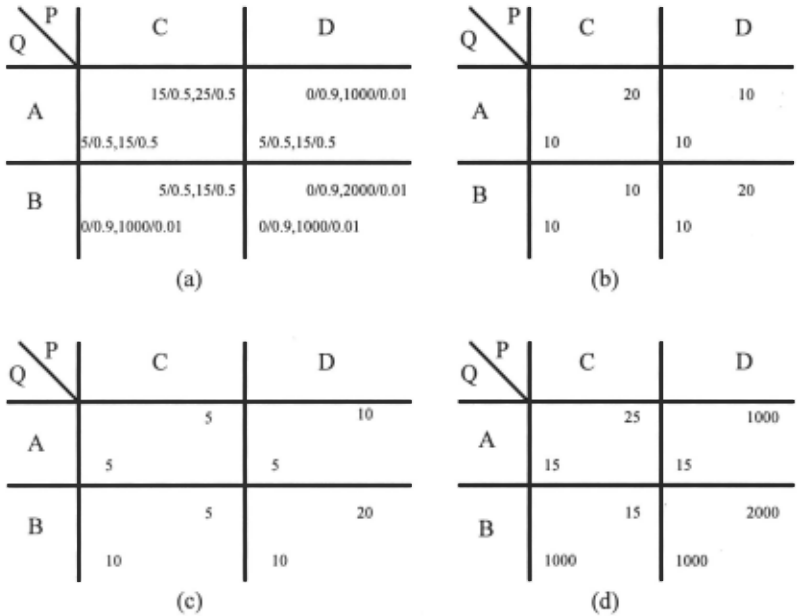
Take the uncertain game matrix in Figure l(a) as an exam ple. The probability associated with each payoff reflects the uncertainty of a nature move. Each entry XN in the game matrix denotes payoff X with probability Y. We can simpli fy the game matrix into an expected payoff form as shown in Figure I (b), which is a game that gives two Nash equi librium points. Since the expected payoffs are the same in all the outcomes in Figure 1 (b), Q makes no difference on each strategy. If Q has no risk preference, the uncertainty in Q's decision is an unavoidable risk for P. However, if Q is risk-averse, it will play strategy A to reduce the risk by rea soning on the game matrix in the risk form in Figure l(c). Each entry is calculated in terms of the risk definition in section 2.2. If P knows that Q is risk-averse, P should play strategy C in order to get the maximum expected payoff. By doing so, both agents could get a strategy combination that gives the highest expected utility while reducing risk at the same time. However, if Q is risk-seeking, it will play strate gy B for the highest possible payoff as in the game matrix in Figure l(d). IfP knows that Q is risk-seeking, P should play strategy D in order to get the maximum expected payoff. By doing so, both agents could get a strategy combination that gives the highest expected utility while seeking for the pos sible highest payoff at the same time. Therefore by knowing other agent's risk preference, each agent would know which strategy has the highest dominance of other agents. How ever, there is still a problem, how agents reach some par ticular outcome that is the Pareto-efficient and Nash equilib rium? It needs a negotiation protocol to coordinate agents to reach a stable outcome.
3 Risk Control in a Multi-agent Negotiation Protocol
By taking the risk preference into consideration, the nego tiation decision making will be based on the new notion of dominance instead of payoff as in the previous work. Here, we describe how the two communication actions can be used in a negotiation protocol to achieve the Pareto-efficient Nash equilibrium in the sense of dominance.
3.1 An Example of Negotiation Protocol
For simplicity, in the following communication protocol descriptions, the trusted third party is literally ignored.
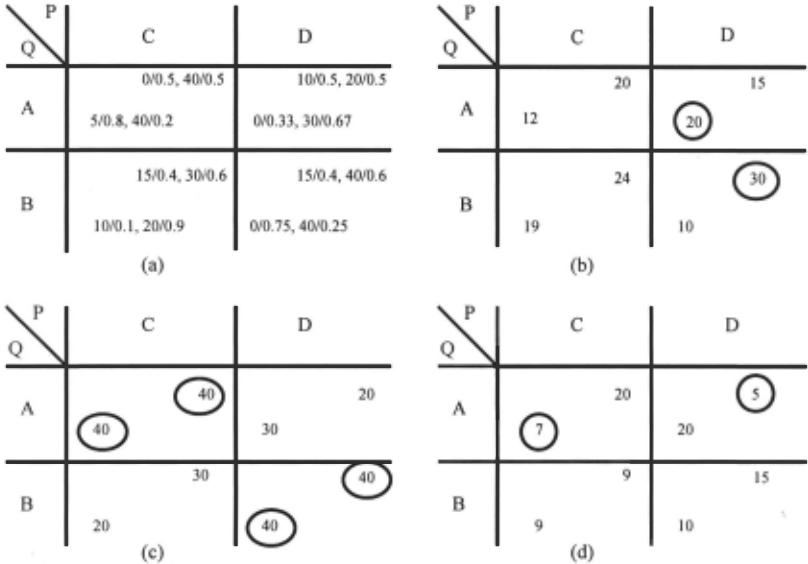
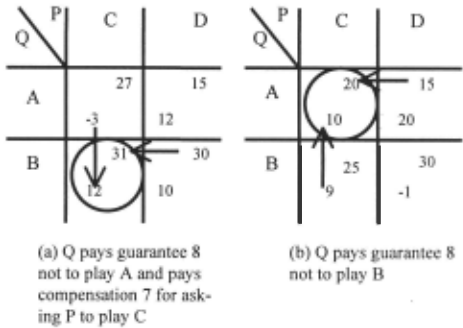
Consider an uncertain game matrix in Figure 2(a). Figure 2(b )(c)( d) are the corresponding expected payoff, the high est payoff and the risk matrix forms respectively. The cir cles in Figure 2(b )(c)( d) indicate the most desirable states in its corresponding game matrix. There is no Nash equilibri um in Figure 2(b) ami Figure 2(d) while two in Figure 2(c). Therefore, it is necessary for rational agents to negotiate a stable result. If both P and Q are risk-neutral, then this game can be solved according to the guarantee/compensation ne gotiation protocol based on the expected payoff matrix in Figure 2(b). Q will pay guarantee 8 not to play strategy A and will also pay a compensation 7 to ask P to play strategy C. This resulted in a new expected payoff game matrix in Figure 3(a). It can be shown that the strategy combination (B, C) is Pareto-efficient and the Nash equilibrium.
If Q is risk-averse and P is risk-seeking. Q may pay a guarantee 8 not to play strategy B and this results in a new game matrix in Figure 3(b). In Figure 3(b), the strategy combination (A, C) is a Pareto-efficient and Nash equilibri um subjected to the risk preference conditions that Q takes the minimum risk in Figure 2(d) and P gets the highest pos sible payoff in Figure 2(c). If Q is risk-natural and Pis risk averse. Q may pay a guarantee 8 not to play strategy B and P may pay a guarantee 6 not to play D and it forms the strategy combination (A, D) a Pareto-efficient and Nash equilibrium. If Q is risk-seeking and P is risk-neutral, Q may pay a guarantee 11 not to play strategy A and P may pay a guarantee 6 not to play D and it forms the strategy combination (B, D) also Pareto-efficient and the Nash equi librium.
It turns out that in the above example, with the nego tiation protocol, all strategy combinations (A, C), (A, D), (B, C), (B, D) can be made as a unique Paretoefficient and Nash equilibrium point, depending on dif ferent combination of the risk preference of both agents. Therefore, the rational agent can control the final nego tiated state they will reach. The final state may satisfy the different risk preference of each agent. But, of course, the expected payoff may be affected in each en counter of agents who have different risk preference from risk-neutral one.
3.2 General Negotiation Protocol for Risk Control
The general protocol of the negotiation is:
Procedure: Negotiation Protocol for Risk Control Input: the game matrix with payoff/probability entries Output: a game matrix with a unique Pareto-efficient and Nash equilibrium
- Construct the three game matrices ( Expected Payoff, Risk, Highest Payoff)
- Make a proposal that using guarantee or compensation communication actions based on the preference and ra tional assumption of other agents.
- If the game still doesn't have a unique Pareto-efficient and Nash equilibrium, then go to step 2.
- Play the game.
End of the Protocol
Note that Step 2 is different from the previous work. In the previous work, agents just need to analyze one matrix, but in this paper, an agent must analyze on an appropriate game matrix under the risk preference and find out the highest dominance that is consistent with risk preference. If no dominant strategy can be found under the new domi nance concept, then the agent needs to adopt asking guar antee or offering compensation negotiation actions to create one.
4. Discussion
In this paper, we define the risk in terms of a quantity that is calculated as the difference between the expected payoff and the least possible payoff. The definition of the risk can be a problem since the risk of losing or gaining certain amount of payoff may mean differently and non-linear to people. In fact, the risk measurement of certain amount of payoff was pointed out be a logarithm function [Bernoulli 1954]. The model of the risk preference discussed only three extreme types of the risk preference. It is too simple to reflect the true human risk preference in reality. Different functions of mapping payoff to utility will lead to different risk preference agents. A risk-averse agent maps less utility for a marginal payoff while a risk-seeking agent maps more utility for a marginal payoff [Hertz, 1983]. However, it is hard to obtain such an individual non-linear mapping func tion.
A risk preference can be a mixed weighting combination of three criteria: 1. Maximizing the expected value, 2.
Minimizing the expectation variance, and 3 Minimize the probability of an unacceptable low value [Fabrycky 1980]. A moderate risk-averse agent, for example, may also have a tolerance bound on risk. If the risk is under the tolerance bound then he will take the risk to seek for a higher expect-ed payoff. On the other hand, if the risk is over her toler ance bound, he will not play the strategy. Including such a tolerance bound into agent's decision making will indeed cause a more complex reasoning for the negotiation proto col to come up with a stable outcome. We leave it as future work.
The assumption of rationality of agents is redefined in the new notion of dominance instead of the expected payoff. Therefore an agent is still rational if he always maximizes the expected payoff that is subjected to his risk preference. But he sometimes would be treated as irrational in the old sense of rationality that is trying to maximize the expected payoff only.
We can prove that the proposed negotiation procedure with risk control will end within finite time. A similar con vergence theorem as well as the one of the feasibility of creating a unique Pareto-efficient and Nash equilibrium using the guarantee/compensation negotiation protocol via trusted third party can be proved [Wu and Soo, 1999].
5 Conclusions
We separated the risk preference from utility function as another dimension other than the expected payoff. To model the preference of taking risk, we defined three types of agents with different risk preferences. In this way, in game decision making, we redefined the concept of dominance so that the optimal strategy that agents select can take risk into account. As illustrated in the above examples, we showed that different risk preference agents in the same uncertain game could lead to different outcomes that satisfy the agent's risk preference. Therefore the agent can in some sense control the risk of the outcomes of his decision mak ing.
The purpose of agent negotiation is for the agents to reach a stable and efficient result. Under the risk preference model, agents negotiate to control not only the expected payoff but also the risk. The mechanisms of communication actions of guarantee and compensation help agents to re duce the risk due to unpredictable behaviors of other agents in games, especially in situations of there is no unique Nash equilibrium or there is a unique Nash equilibrium but not Pareto-efficient, e.g. prisoner's dilemma. The separation of the risk from the payoff and the redefinition of dominance in terms of different risk preferences allow agents to take risk control into decision making can reduce the risk due to the uncertainty of a nature move.
Acknowledgements
This work was financially supported by the National Science Council of Taiwan, Republic of China, under grant No. NSC88-2213-E-007-057.
Reference
- [Axelrod, 1984] R. Axelrod, The Evolution of Cooperation, Basic Books Inc., New York, 1984.
- [Brafman and Tennenholtz, 1997] R.I. Brafman and M. Tennenholtz, Modeling Agents as Qualitative Decision Makers, Artificial Intelligence, Vol.94, pp217-268, 1994
- [Bernoulli, 1954] D. Bernoulli, Exposition of a New Theory of the-Measurement of Risk, Econometrica, Vol. 22, pp. 23-36.
- [Durfee et al., 1993] E.H. Durfee, J. Lee, and P.J. Gmytra siewicz, Overeager Reciprocal Rationality and Mixed Strategy Equilibria, In Proceedings of the Eleventh Na tional Conference on Artificial Intelligence (AAAI-93), pp.225-230, 1993.
- [Fabrycky, 1980] W.J. Fabrycky and G.J. Thuesen, Economic Decision Analysis 2nd ed. 1980.
- [Gmytrasiewicz et al., 1991] P.J. Gmytrasiewicz, E.H. Dur fee and O.K. Wehe, The Utility of Communication in Co ordinating Intelligent Agents, in Proceedings of the Ninth National Conference on Artificial Intelligence (AAAI91), pp.166-172, 1991.
- [Haynes and Sen, 1996] T. Haynes and S. Sen, Satisfying User Preferences while Negotiating Meetings, in Pro ceeding of the Second International Conference on Multi Agent Systems (ICMAS-96), 1996.
- [Hertz, 1983] D. B. Hertz, Risk Analysis and its Applica tions, Chichester, John Wiley & Sons, 1983.
- [Koller and Pfeffer, 1997] D. Koller and A. Pfeffer, Repre sentations and Solutions for Game-theoretic Problems, Artificial Intelligence, Vol.94, pp 167-215, 1997.
- [March and Shapira, 1992] James G. March and Zur Sha pira, Variable Risk Preferences and the Focus of Atten tion, Psychological Review, 99(1), pp. 172-183, January, 1992.
- [Mor and Rosenschein, 1995] Y. Mor and J. S. Rosen schein, Time and the Prisoner's Dilemma, In Proceeding of the First International Conference of Multi-Agent Sys tem (ICMAS-95), pp.276-282, 1995.
- [Nash 1951] J. F. Nash, Non-cooperative Games, Ann. of Math. 54, pp.286-295, 1951.
- [Rasmusen 1989] E. Rasmusen, Games and Information: An Introduction to Game Theory, Basil Blackwell, Oxford, 1989.
- [Rosenschein and Genesereth, 1985] J.S. Rosenschein, M.R. Genesereth, Deals among Rational Agents, in Proceed ings of the ninth international conference on Artificial Intelligence(JJCAI-85) , pp.91-99. 1985.
- [Rosenschein and Zlotkin, 1994] J .S. Rosenschein and G. Zlotkin, Rules of Encounter, MIT Press, Cambridge, 1994.
- [Sandholm and Lesser, 1995] T.W. Sandholm and V.R. Lesser, Issues in Automated Negotiation and Electronic Commerce: Extending the Contract Net Framework, in Proceedings of the First International Conference on Multi-Agent Systems (ICMAS-95), pp.328-335, MIT Press, 199 5.
- [Shehory and Kraus, 1998] 0. Shehory and S. Kraus, Methods for Task Allocation via Agent Coalition Forma tion, Artificial Intelligence, Vol.l 0 I, pp.l65-200, 1998.
- [Tennenholtz 1998] M. Tennenholtz, On Stable Social Laws and Qualitative Equilibria, Artificial Intelligence, Vol.l02, pp.1-20, 1998.
- [Vidal and Durfee, 1995] J.M. Vidal and E.H. Durfee, Re cursive Agent Modeling using Limited Rationality, in Proceedings of the First International Conference on Multi-Agent Systems (ICMAS-95), pp. 376-383, MIT Press, 1995.
- [Wu and Soo, l998a] S. Wu, V. Soo, Escape from a Prison ers' Dilemma by Communication with a Trusted Third Party, in Proceeding of the Tenth International Confer ence on Tools with Artificial intelligent (ICTAI'98), pp.58-65, 1998.
- [Wu and Soo, 1998b] S. Wu, V. Soo, A Fuzzy Game Theo retic Approach to Multi-Agent Coordination, Pacific Rim international workshop of on Multi-Agent (PRIMA'98), 1998.
- [Wu and Soo, 1999] S. Wu, V. Soo, Game Theoretic Rea soning in Multi-agent Coordination by Negotiation with a Trusted Third Party, in Proceeding of the Third Interna tional Conference on Autonomous Agents (Agents'99), Seattle, Washington, 1999.
@inproceedings{ijcai1999p72,
  title     = {Risk Control in Multi-agent Coordination by Negotiation with a Trusted Third Party},
  author    = {Wu, Shih-Hung and Soo, Von-Wun},
  booktitle = {Proceedings of the Sixteenth International Joint Conference on
               Artificial Intelligence, {IJCAI-99}},
  publisher = {International Joint Conferences on Artificial Intelligence},
  editor    = {Thomas Dean},
  pages     = {500--504},
  year      = {1999},
  note      = {Distributed AI},
  url       = {https://ijcai.org/proceedings/1999/72},
}
TY - CPAPER TI - Risk Control in Multi-agent Coordination by Negotiation with a Trusted Third Party AU - Wu, Shih-Hung AU - Soo, Von-Wun T2 - Proceedings of the Sixteenth International Joint Conference on Artificial Intelligence, IJCAI-99 PB - International Joint Conferences on Artificial Intelligence PY - 1999 SP - 500 EP - 504 UR - https://ijcai.org/proceedings/1999/72 ER -Copied
Machine-readable versions of this paper, for tools and AI agents:





