
Computer Aided Tracing of Children?s Physics Learning: a Teacher Oriented View
Proceedings of the Sixteenth International Joint Conference on Artificial Intelligence. Cognitive Modeling. Pages 370-376.
© 1999 International Joint Conferences on Artificial Intelligence
Abstract
For an effective Teacher-Student interaction, the Teacher has to maintain a constant understanding of "what is going on" in the Student's mind. When coming to Physics, the Teacher's ability to propose and to relate explanations at different levels of abstraction - as a chains of causal interactions (deep) or as a set of observable phenomena (shallow) - may determine a successful and lasting learning in the Student. Here, we describe a knowledge representation to be used by the teacher to depict to herself the student's mental model and to tune her future lessons according to the current student comprehension. Supported by a cognitive theory of children physics learning, we used the system WHY for modeling the evolution of a student's learning as it appeared at the teacher's eyes. Two of WHY's features turned out to be essential: (a) to deal with explanations having different levels of abstraction, and (b) the possibility to continuously evaluate the coherence of the hypothesized Ieamer's model with respect to her explanation. In the long term, the work's outcome might contribute to the development of teaching assistant systems that support the teacher in identifying "what has to be explained next".
- Baffes P. T. and Mooney R. J. (1996). "A Novel Application of Theory Refinement to Student Modelling". Proc. of Thirteenth National Conference on Artificial Intelligence, Portland, pp. 403-408.
- Caravita S. and Hallden 0. (1994). "Re-framing the Problem of Conceptual Change". Learning and Instruction, 4, 89-111.
- Chi M. T. H., Slotta J. D. and de Leeuw N. (1994). "From Things to Processes: A Theory of Conceptual Change for Learning Science Concepts". Learning and Instruction, 4, 27-43.
- diSessa A. (1993). "Toward an Epistemology of Physics". Cognition and Instruction, 10, 105-225.
- Duit R. (1995). "Constraints on Knowledge Acquisition and Conceptual Change the Case of Physics". Proc. of Symposium on Constraints on Knowledge Construction and Conceptual Change at 6th European Conference for Research on Learning and Instruction (Nijmegen, The Netherlands).
- Forbus K.D. and Gentner D. (1986). "Learning Physical Domains: Toward a Theoretical Framework". In R. Michalski, J. Carbonell & T. Mitchell (Eds.), Machine Learning: An Artificial Intelligence Approach, Vol. II, Morgan Kaufmann, Los Altos, CA, pp. 311-348.
- Gertner A. S., Conati C, and VanLehn K. (1998). "Procedural help in Andes: generating hints using a Bayesian Network Student Model", Proc. of National Conference on Artificial Intelligence AAAI'98, pp. 106- 111.
- Hestenes D. (1987). "Toward a Modelling Theory of Physics Instruction". American Journal of Physics, 55, 440-454.
- Neri F., Saitta L. and Tiberghien A. (1997). "Modelling Physical Knowledge Acquisition in Children with Machine Learning". Proc. of I 9th Annual Conference of the Cognitive Science Society, pp. 566-571.
- Newell A. ( 1990). Unified Theories of Cognition, Harvard University Press, Cambridge, MA.
- Sage S. and Langley P. (1983). "Modeling Cognitive Development on the Balance Scale Task". Proc. 8th Int. Joint Conf. on Artificial Intelligence, pp. 94-96. IJCAI
- Saitta L., Botta M., Neri F. (1993). "Multistrategy Learning and Theory Revision". Machine Learning, I I, 153-172.
- Schmidt W.C. and Ling C.X. (1996). "A Decision-Tree Model of Balance Scale Development". Machine Learning, 24, 203-230.
- Shultz T.R., Mareschal D. and Schmidt W. (1994). "Modeling Cognitive Developemnt on Balance Scale Phenomena". Machine Learning, I 6, 57-86.
- Sleeman D., Hirsh H., Ellery I. and Kim I. (1990). "Extending Domain Theories: two case Studies in Student Modeling". Machine Learning, 5, 11-37.
- Tiberghien A. (1994). "Modelling as a Basis for Analysing Teaching-Learning Situations". Learning and Instruction, 4, 71-87.
- Vosniadou S. (1994). "Capturing and Modeling the Process of Conceptual Change". Learning and Instruction, 4, 45-69.
- Vosniadou S. and Brewer W.F. (1994). "Mental Models of the Day/Night Cycle". Cognitive Science, IB, 123-183.
- White R. T. (1994). "Commentary Conceptual and Conceptional Change". Learning and Instruction, 4, 117- 121.
References were extracted automatically from the PDF and may contain errors.
Full text extracted automatically from the PDF; figures, tables and equations may differ. The PDF is the version of record.
1 Introduction
For an effective teacher-student interaction, it is essential for the teacher having a continuous understanding of "what is going on" in the student's mind, i.e. to continuously hold a hypothesis about the student's knowledge consistent with her explanations. In addition, when corning to Physics, the teacher's ability to propose and to relate explanations at different levels of abstraction (for instance, as a chains of causal interactions (deep) or just as a set of observable phenomena (shallow)) may determine a successful and lasting learning.
Two of WHY's features were determining its choice for this research: (a) its capability to deal with explanations having many levels of abstraction, and (b) its capability to continuously validate the coherence of the Ieamer's model, proposed by the teacher, with respect to her explanations.
The long term work's outcome might possibly contribute to the development of teaching assistant systems supporting the teacher in identifying "what has to be explained next" during a cycle of lessons. At the present time, our research enabled the teacher to better realize and explore the limits involved in the Ieamer's evolving knowledge as observed in a past teaching experience [Tiberghien, 1994] . This a-posteriori experience enabled the teacher to consider what-if situation where alternative next lesson topics could be selected in order to canalize the student learning effort towards the acquisition/understanding of scientifically correct physics models.
The paper is organized as follows: in Section 2, we summarize current approaches to the modeling of human learning and we discuss the aspects that differentiate our approach from them. In Section 3 and 4, we describe the considered educational context and the system WHY, respectively. In Section 5, a case study of student modeling is reported, and in Section 6 we compare the student's explanations with respect to the WHY's ones. Finally, in Section 6, some conclusions are drawn.
2 Related works
From the point of view of cognitive science, various aspect of human learning have been identified and studied. Our research mainly related to the study of the phenomena of conceptual change [Tiberghien, 1994; Vosniadou & Brewer, 1994; Caravita & Hallden,l994; Chi et a!., 1994; Vosniadou, 1994]. No definition of conceptual change with universal validity has yet been found [White,1994]. But, roughly speaking the term conceptual change describes the evolution of the models of the world used by people to interpret data, to explain phenomena and to make predictions. Conceptual change has been mainly studied in the context of learning Mathematics or Physics [Forbus & Gentner, 1986; diSessa, 1993; Vosniadou, 1994; Chi eta!., 1994] because both areas make available a body of knowledge that is enough completed and detailed to allow a formal representation (logic or calculus). All this models use rich and "informal" knowledge representation and have essentially a descriptive nature: they describe mental models or knowledge states, but do not include a description of the "learning strategy", i.e., the actual mechanisms of transition from a knowledge state to another. Trying to represent the evolution of a student's learning by using these rich and informal knowledge models without the help of an automatic system, is almost impossible. Consequently, exploiting these frameworks to hypothesize what a student is learning during a cycle of lessons is a very though and long work.
On the other end, computer scientists also proposed models of human learning [Sleeman eta!., 1990; Baffes & Mooney, 1996; Sage & Langley, 1983; Newell, 1990; Schmidt & Ling, 1996; Shultz eta!., 1994]. And, they all show a dynamic nature: they are able to coherently match the variations of the learner's performances by exploiting some computer-oriented mechanisms such as backpropagation, theory revision operation, etc .. Unfortunately, the price to be paid for obtaining such automatically evolving systems consists in the use of simple formalisms to represent the learner's knowledge and, in some cases, in the complete carelessness for the kind of changes occurring to the learner's knowledge as only a mimic of her performance is pursued. Then these approaches provide only a limited, if any, support to the teacher in understanding what exactly the student currently knows.
We believe that an important aspect is overlooked in these last models: the strict interconnection between the shallow phenomenological knowledge in a specific domain and pre-existing deeper knowledge structures or theories [Vosniadou, 1994, 1995; Tiberghien, 1994; Chi eta!. 1994. This is particularly evident when examining a learner's explanations during learning: shallow and deep pieces of knowledge are mixed again and again by the learner in the effort to develop one coherent view of the world. In addition, human learning is, to a great extent, a search for explanations; then, any model of human learning should provide an explanatory framework, allowing not only to predict questions to answers, but also to put forward reasons in support of those answers.
Our approach intends to address these major aspects in the learner modelization by extending a descriptive model of learning [Tiberghien, 1984] with the explanatory framework provided by the learning system WHY [Saitta, Botta & Neri, 1993]. Note, however, that we do not claim that proposed knowledge representation resembles to the one in the student's mind. On the contrary, we claim that the resulting model is a functional model of the student's understanding of the domain. In our approach, the transitions between successive knowledge states are accomplished through interactive human-computer sessions. During these interactions, the teacher evaluates the coherence of her hypothesized learner's state against the previously collected student's answers and WHY proposes possible knowledge refinement when a student's answer cannot be explained on the basis of the current knowledge.
Finally, we believe that is relevant to clarify the differences between tutoring systems like, for instance, the Andes one [Gertner et a!., 1998] and our approach. Tutoring systems are student oriented, our approach is teacher-oriented. In the firsts, the student model is automatically built to select the next most effective hint during problem solving; instead, we help the teacher to described her perceived evolution of the student's model, and we delegate to her experience the choice about the "next lesson" topic. Essentially we chose to operate at a different time scale: days instead of minutes or hours. In addition, we focalize on the effective teaching/learning of (large) theories more than on providing hints to the student while she is solving a specific problem.
3 The Educational Perspective
In education research, results on students' conceptions show difficulties in learning physics [Hestenes, 1987; Duit, 1995; diSessa, 1993]. In [Tiberghien, 1994] a theoretical framework for interpreting such difficulties has been proposed. The fram~work has its foundation both in pedagogical studies and in the epistemology of science. In experimental sciences, questions are strongly linked to three main factors: the theoretical background, the experimental facts considered, and the explanations produced. In the chosen theoretical framework, interpretation and prediction in physics imply a modelling process articulated on three levels: "theory", "model" and "experimental field" of reference.
Tiberghien [ 1994] assumes that an explanation of the learner's behaviour can be given by focusing the modelling process on the specific task of understanding the material world, rather than on general logical mathematical reasoning. In this framework, a basic assumption, concerning the learner's cognitive activities, is made: when the learner is interpreting (or predicting) a material situation, she constructs a "model" of the situation, which depends on her background theory and is also internally coherent.
In [Tiberghien, 1994] no formal definition of these levels was given. A tentative addition of operational specifications is reported in [Neri et al., 1997]. Our basic assumption is that the "theory" level contains a causal model of the domain; thus, an explanation is a causal attribution.
The specific learning context considered is the following: students of six classes, at the first and second years of secondary school (11 - 13 year old), participated in a physics course, consisting of 11 sessions (once a week) including experiments, questions, discussion and explicit teaching. The contents of the course were basic concepts and qualitative relations in the domain of heat transfer in everyday life situations. Two students of each class were interviewed individually about the subject before and after the set of teaching sessions; and all the students filled two questionnaires, as well. In this paper we focalise our attention on the student David.
4 The Modeling Tool WHY
WHY [Saitta, Botta & Neri, 1993] has been chosen as testbed because of its ability to model both the answers and the causal explanations given by the children.
WHY learns and revises a knowledge base for classification problems using domain knowledge and examples. The domain knowledge consists of a causal model C of the domain, stating the relationships among basic phenomena, and a body of phenomenological theory P, describing the links between abstract concepts and their possible manifestations in the world.
The causal model provides explanations in terms of causal chains among events, originating from "first" causes. The phenomenological theory contains the semantics of the vocabulary terms, structural information about the objects in the domain, ontologies, taxonomies, domain-independent background knowledge (such as symmetry, spatial and temporal relations). Finally, P contains a set of rules aimed at describing the manifestations of abstractly defined concepts in terms of measurable properties, objects and events in the specific domain of application.
The causal model is represented as a directed, labeled graph. Three kinds of nodes occur in the graphs: causal nodes, corresponding to processes or states related by cause-effect relations, constraint nodes, attached to edges and representing conditions which must be verified in order to instantiate the corresponding cause-effect relation, and context nodes, associated to causal nodes, representing contextual conditions to be added to the cause in order to obtain the effect. The phenomenological theory is represented as a set of Horn clauses.
As said above, WHY's objective is to build up or revise a knowledge base KB of heuristic classification rules. A causal explanation (justification) for any proposed revision to the knowledge base is automatically provided.
It is important to stress the relations between the causal model and the heuristic knowledge base. As reasoning on the causal model is slow, some of the rules in KB act as shortcuts compiled from C. Some other rules, instead, do not have any relations with C. For instance, when KB is not derived from C but is directly acquired by the learner on a pure inductive basis. In the latter case, KB will give classifications (correct or not), for which no explanation exists with respect to C. Exploiting these different types of relations between KB and C, all the learning models emerged in the experimentation could be modeled. In the interplay between KB and C, the knowledge in P supplies the links between the general principles stated in C and the concrete experiments.
WHY relies on a sophisticated algorithm for uncovering errors or incompleteness in its knowledge that can be triggered when one of WHY's explanations does not match the student's ones. This provided useful information to the teacher in discovering where her hypothesized student's model was incoherent with the learner answer.
To model David's knowledge in WHY, we proceeded as follows. Each question answered by David consists of a) the description of an experimental setting for which a prediction about the heating effect has to be made, b) David's prediction and his (shallow or causal) explanation. In WHY, the experimental setting is an example description, the prediction is viewed as the example classification, and the student's explanation is interpreted as a chain of (shallow/deep) relationships determining the experiment outcome.
5 David Learns that Heating Causes Phase Transitions in Objects
As a case study: we compare here two significant knowledge states of David: before and after the teaching course. David's knowledge before teaching has been inferred on the basis of his answers and explanations to questions and interviews done before teaching. Part of David's knowledge before teaching is represented as a causal model in Figure 1. The drawing of the causal model make evident the findings emerging from David's answers. The most important are that David uses a notion of material causality linked to the "substance" of a body to describe what will happen when heating the body: "what happens to the body depends on what it is". For instance, water will eventually boil, if heated, whereas lead or iron or gold will melt, and, for this reason, they will become hot. Similarly, sugar becomes "caramel" and, again, it becomes hot. Questioned on the subject, David shows evidence to believe that "boiling" and "melting" are alternative (and mutually exclusive) behaviors, exhibited by different substance. In fact, he say that iron, gold and lead shall not boil, because they melt.
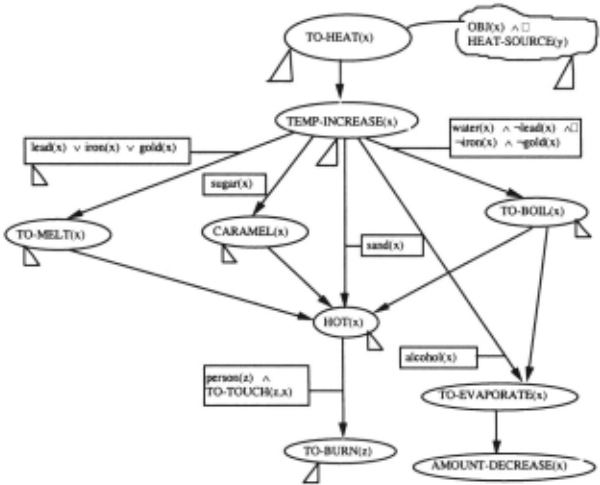
One of the limits of this model of heating is the student cannot answer questions about materials that he has not experience of: David actually answered "I don't know" about the possibility of diamond, salt and aluminum to become liquid or gaseous.
Aware of this findings, the teacher might decide to select as "next lesson topic" some working experience that stress the independence of the heating effect from the body materiaL
Up to here the WHY system helped the teacher to develop and to describe her comprehension of David's heating model according to his answers. At the same time, WHY took care to validate the coherence (consistency) of the model with respect to David's answers. In case of incoherence, WHY actives its interactive theory revision module to propose some useful adjustment to the causal modeL
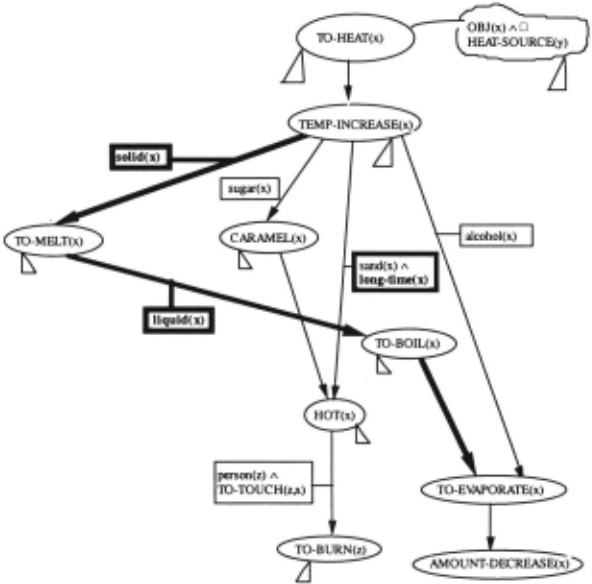
After the teaching course, during which David has seen several other experiments involving different materials, he fills the final questionnaire and participates to the final interview. From these latter answers, we may infer that his deep knowledge of the world is changed, under various respect In Figure 2, the inferred heating model of David after teaching is reported. Two changes deserve to be noted. The first one is that David explicitly considers time in determining the final state of a materiaL At the beginning, in fact, he simply said that the sand would become hot, when heated. Now, he is able to understand that the effect of heating takes time to happens, suggesting the idea of a "process". This finding is confirmed by the answers like: "in order for the water to start boiling, at least a quarter of an hour is necessary".
However, the most relevant change, with respect to the goal of the teaching course, is that David seems less committed to material causality for determining behaviors. He generalized from "iron", "lead", "gold" and "ice", that any "solid" may become liquid if sufficiently heated. Moreover, "to boil" and "to melt" are not anymore mutually exclusive behaviors, but they are possibly in sequence, as it should be. David's causality shows a shift from the "substance" to some underlying process, which, on the other hand, he is not yet completely capable of pinning down.
Aware of these findings, the teacher may just declare herself satisfied of David's progress. On the other hand, she might even try to evaluate the kind of conceptual changes occurred in David by comparing . his two knowledge states (Figure 1 vs Figure 2), or she may plan the teaching of new learning topics exploiting the freshly learned notions.
6 Explaining at Many Levels of Abstraction
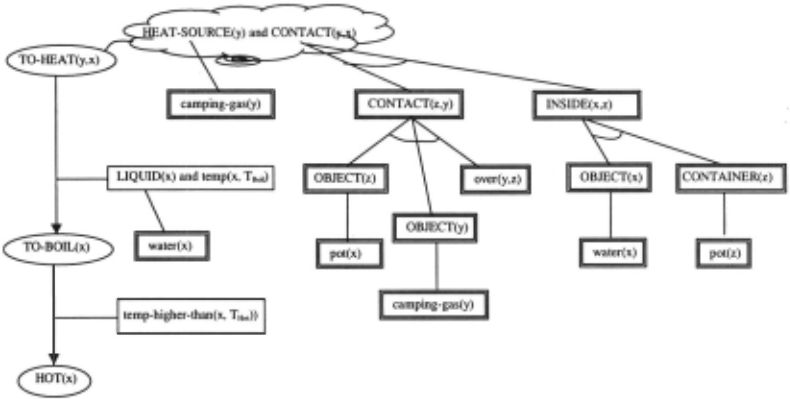
For developing the student's model and to trace her learning evolution, the capability to represent and to compare the student's explanations with respect to the ones deducible from the causal model is essentiaL In Figure 3, we report WHY's explanation for an experimental setting derived from David's model before teaching. This explanation is relative to a simple heating situation: some water, contained into a pot, is being heated by means of a camping gas; the water starts boiling and becomes hot
Figure 3 shows the relations between the causal model and the phenomenological theory. The causal path explains, from the abstract point of view, that a liquid becomes hot because of the heat transfer produced by an heat source. The phenomenological theory make the explanation concrete: the liquid heated is some water, the water is contained into a pot, the pot is over the heat source, and the heat source is a camping gas.
In fact WHY explanation is a template of explanations where either abstract or concrete concepts may be included to interpret an observed phenomenon. Such explanations can thus be read at many abstraction levels ranging from a pure causal explanation (i.e. deep knowledge based) down to a plain sequence of measurable phenomena (i .e. shallow knowledge based). These explanations template facilitate the task of accounting for David's explanations while the teacher was developing David's model. In fact most of a student's early explanations mix shallow and deep knowledge in the effort to acquire a coherent view of the new subject matter. In the case of the mentioned experiment, David performed the experience by himself (under the teacher's supervision) in the school's laboratory. When he was questioned about the heating phenomenon, he said "The water is a liquid and is over the fire. The fire is hot. Then, the water boils and becomes hot" .
7 Conclusion
We proposed a way of interpreting and describing learning progresses during teaching from the point of view of the teacher. In our approach, the tutor constructs and maintains a model of the student while the automatic system support the modeling activity by providing an enhanced knowledge representation framework. The articulated representation allows the modeling of phenomena observed in children learning elementary physics: notably their explanations in terms of simple causality, and the interdependence of "surface" pragmatic knowledge and "deep" causal one. Moreover, the structuring of the knowledge in terms of causal theory, phenomenological knowledge and experimental field provide a valuable framework for evidencing differences between the learner's knowledge and the target physics knowledge.
In the long term, we hope this research may contribute to the development of teaching assistant systems able to support the teacher in identifying "what has to be explained next" in a sequence of lessons.
@inproceedings{ijcai1999p54,
  title     = {Computer Aided Tracing of Children?s Physics Learning: a Teacher Oriented View},
  author    = {Neri, Filippo},
  booktitle = {Proceedings of the Sixteenth International Joint Conference on
               Artificial Intelligence, {IJCAI-99}},
  publisher = {International Joint Conferences on Artificial Intelligence},
  editor    = {Thomas Dean},
  pages     = {370--376},
  year      = {1999},
  note      = {Cognitive Modeling},
  url       = {https://ijcai.org/proceedings/1999/54},
}
TY - CPAPER TI - Computer Aided Tracing of Children?s Physics Learning: a Teacher Oriented View AU - Neri, Filippo T2 - Proceedings of the Sixteenth International Joint Conference on Artificial Intelligence, IJCAI-99 PB - International Joint Conferences on Artificial Intelligence PY - 1999 SP - 370 EP - 376 UR - https://ijcai.org/proceedings/1999/54 ER -Copied
Machine-readable versions of this paper, for tools and AI agents:





