
Unifying SAT-based and Graph-based Planning
Proceedings of the Sixteenth International Joint Conference on Artificial Intelligence. Challenge Papers. Pages 318-324.
© 1999 International Joint Conferences on Artificial Intelligence
Abstract
The Blackbox planning system unifies the planning as satisfiability framework (Kautz and Selman 1992, 1996) with the plan graph approach to STRIPS planning (Blum and Furst 1995). We show that STRIPS problems can be directly translated into SAT and efficiently solved using new randomized systematic solvers. For certain computationally challenging benchmark problems this unified approach outperforms both SATPLAN and Graphplan alone. We also demonstrate that polynomialtime SAT simplification algorithms applied to the encoded problem instances are a powerful complement to the "mutex" propagation algorithm that works directly on the plan graph.
- Bacchus, F. and Kabanza, F. (1996). Using temporal logic to con- trol search in a forward-chaining planner. In New Directions in Planning, M. Ghallab and A. Milani (Eds.), lOS Press, 141- 153.
- Bayardo Jr., R.I. and Schrag, R.C. (1997). Using CSP look-back techniques to solve real world SAT instances. Proc. AAAI-97, Portland, OR.
- Baioletti, M. , Marcugini, S., and Milani, A. (1998). C-SATPlan: a SATPlan-based tool for planning with constraints. AIPS-98 Workshop on Planning as Combinatorial Search, Pittsburgh, PA.
- van Beek, P. and Chen, X. CPlan: A constraint programming ap- proach to planning. Proc. AAA/-99, Orlando, FL.
- Blum, A. and Furst, M.L. (1995). Fast planning through planning graph analysis. Proc. /JCA/-95, Montreal, Canada. IJCAI
- Chapman, D. (1985). Planning for conjunctive goals. TR AI-TR- 802, M.I.T. AI Lab.
- Cheng, Y. , Selman, B., and Kautz, H. (1999). Control knowledge in planning: benefits and tradeoffs. Proc. AAA/-99, Orlando, FL.
- Ernst, M.D., Millstein, T.D., and Weld, D.S. (1997). Automatic SAT-compilation of planning problems. Proc. /JCAI-97, Nagoya, Japan. IJCAI
- Fikes, R. E., and Nilsson, N. 1971. STRIPS: A New Approach to the Application of Theorem Proving to Problem Solving. Ar- tificial Intelligence 5(2): 189-208. IJCAI
- Fox, M., and Long, D. 1998. The automatic inference of state in- variants in TIM. Forthcoming.
- Gerevini, A. and Schubert, L. 1998. Inferring state constraints for domain-independent planning. Proc AAAI-98, Madison, WI.
- Gomes, C.P. , Selman, B., and Kautz, H. (1998). Boosting combina- torial search through randomization. Proc. AAAI-98, Madison, WI.
- Giunchiglia, E., Massarotto, A. , and Sebastiani, R. (1998). Act, and the rest will follow : exploiting determinism in planning as satisfiability. Proc. AAAI-98, Madison, WI.
- Kambhampati, S. (1997). Challenges in bridging plan synthesis paradigms. Proc. /JCAI-97, Nagoya, Japan. IJCAI
- Kambhampati, S., Lambrecht, E., and Parker, E. (1997). Under- standing and extending graphplan. Proc. 4th European Conf on Planning , S. Steel, ed., vol. 1248 of LNAI, Springer.
- Kautz, H., McAllester, D. and Selman, B. (1996). Encoding plans in propositional logic. Proc. KR-96, Boston, MA.
- Koehler, J., Nebel, B., Hoffmann, J., and Dimopoulos, Y. (1997). Extending planning graphs to an ADL subset. Proc. 4th Euro- pean Conf on Planning, ibid.
- Li, Chu Min and Anbulagan (1997). Heuristics based on unit prop- agation for satisfiability problems. Proc. /JCA/-97, Nagoya, Japan. IJCAI
- Luby, M., Sinclair A., and Zuckerman, D. (1 993). Opti- mal speedup of Las Vegas algorithms. Information Process. Lett. , 17, 1993, 173-180.
- Kautz, H. and Selman, B. (1992). Planning as satisfiability. Proc. ECA/-92, Vienna, Austria, 359-363.
- Kautz, H. and Selman, B. (1998). The role of domain-specific ax- ioms in the planning as satisfiability framework. Proc. A/PS- 98, Pittsburgh, PA.
- Kautz, H. and Selman, B. (1996). Pushing the envelope: planning, propositional logic, and stochastic search. Proc. AAAI-1996, Portand, OR.
- McCarthy, J. and Hayes, P. (1969). Some philosophical problems from the standpoint of artificial intelligence. In Machine Intel- ligence 4, D. Michie, ed., Ellis Horwood, Chichester, England, page463ff.
- McDermott, D., et al. (1998). PDDL-the planning domain defi- nition language. Draft.
- Nebel, B. , Dimopolous, Y., and Koehler, J. (1997). Ignoring irrel- evant facts and operators in plan generation. Proc. 4th Euro- pean Conf on Planning, ibid.
- Rintanen, J. (1998). A planning algorithm not based on directional search. Proc. KR-98, A.G. Cohn, L.K. Schubert, and S.C. Shapiro, eds ., Morgan Kaufmann. Selman, B., Kautz, H., and Cohen, B. (1994). Noise strategies for local search. Proc. AAAI-94, Seattle, WA.
- Veloso , M. (1992). Learning by analogical reasoning in general problem solving. Ph.D. Dissertation, CMU.
- Weld, D. (1999). Recent advances in AI planning. AI Magazine, to appear.
References were extracted automatically from the PDF and may contain errors.
Full text extracted automatically from the PDF; figures, tables and equations may differ. The PDF is the version of record.
1 Introduction
It has often been observed that the classical AI planning prob lem (that is, planning with complete and certain information) is a form of logical deduction. Because early attempts to use general theorem provers to solve planning problems proved impractical, research became focused on specialized plan ning algorithms. Sometimes the relationship to inference was explicitly acknowledged: for example, the STRIPS system (Fikes and Nilsson 1971) was originally described as a way to make theorem-proving practical. In other work the rela tionship to deduction was developed after the fact. For exam ple, Chapman's (1985) work on TWEAK clarified the logic behind one variety of non-linear planning.
The belief that planning required specialized algorithms was challenged by the work on planning as propositional sat isfiability testing of Kautz and Selman (1992, 1996). SAT PLAN showed that a general propositional theorem prover could indeed be competitive with some of the best special ized planning systems. The success of SATPLAN can be at tributed to two factors:
- The use of a logical representation that has good com putational properties. Both the fact that SATPLAN uses propositional logic instead of first-order logic, and the particular conventions suggested for representing time and actions, are significant. Differently declarative rep resentations that are semantically equivalent can still have quite distinct computational profiles.
Bart Selman
Department of Computer Science Cornell University selman @cs.comell.edu
- The use of powerful new general reasoning algorithms such as Walksat (Selman, Kautz, and Cohen 1994). Many researchers in different areas of computer science are creating faster SAT engines every year. Furthermore, these researchers have settled on common representa tions that allow algorithms and code to be freely shared and fine-tuned. As a result, at any point in time the best general SAT engines tend to be faster (in terms of raw in ferences per second) than the best specialized planning engines. In principle, of course, these same improve ments could be applied to the specialized engines; but by the time that is done, there will be a new crop of SAT solvers.
An approach that shares a number of features with with the SATPLAN strategy is the Graphplan system, developed independently by Blum and Furst (1995). Graphplan broke previous records in terms of raw planning speed, and has be come a popular planning framework. Comparisons to SAT PLAN show that neither approach is strictly superior. For example, SATPLAN is faster on a complex logistics domain, they are comparable on the blocks world, and on several other domains Graphplan is faster. For excellent reviews and dis cussions of the two systems, see Kambhampati (1997) and Weld (1998).
A practical difference between SATPLAN and Graphplan is that the former takes as input a set of axiom schemas, while the input for the latter is a set of STRIPS:style operators. However, they bear deep similarities. Both systems work in two phases, first creating a propositional structure (in Graph plan, a plan graph, in SATPLAN, a CNF wff) and then per forming a search (over assignments to variables) that is con strained by that structure. The propositional structure corre sponds to a fixed plan length, and the search reveals whether a plan of that length exists. Kautz and Selman (1996) noted that the plan graph has a direct translation to CNF, and that the form of the resulting formula is very close to the origi nal conventions for SATPLAN. In the unifying framework of Kambhampati (1997), both are examples of disjunctive plan ners. The initial creation of the propositional structure is a case of plan refinement without splitting, while the search through the structure is a case of plan extraction. We hy pothesize that the differences in performance of the two sys tem can be explained by the fact that Graphplan uses a better algorithm for instantiating (refining) the propositional structure, while SATPLAN uses more powerful search (extraction) algorithms.
SATPLAN fully instantiates a complete problem instance before passing it to a general logic simplifier (a limited infer ence algorithm that runs to completion in polynomial time) and a solver (a complete or incomplete model-finding pro gram). By contrast, Graphplan interleaves plan graph instan tiation and simplification. The simplification algorithm used in Graphplan is based on mutex computation, an algorithm for determining that pairs of actions or pairs of facts are mu tually exclusive. Mutex computation can be viewed as rule of limited inference that is specialized to take particular ad vantage of the structure of planning problems (Kambhampati et al. 1997). Specifically, mutex computation is a limited application of negative binary propagation:
Each application of the rule allows the deduction of a nega tive binary clause (a mutex). The mutex algorithm used by Graphplan is incomplete (not all mutexes that logically fol low can be inferred) and terminates in polynomial time. Note that this algorithm is different from the simplification rule of unit propagation employed by the original SATPLAN: more powerful in propagating negative clauses, but somewhat less powerful in propagating positive information. The set of mu texes is used in two ways by Graphplan, both to prune nodes from the graph during instantiation and to prune branches of the search tree that involve mutually exclusive actions.
These observations have led us to create a new system that combines the best features of Graphplan and SATPLAN. This system, called Blackbox, 1 works in a series of phases:
- A planning problem (specified in a standard STRIPS no tation) is converted to a plan graph of length k, and mu texes are computed as described above;
- The plan graph is converted to a CNF wff;
- The wff is simplified by a general CNF simplification algorithm;
- The wff is solved by any ofa variety offast SAT engines;
- If a model of the wff is found, then the model is con verted to the corresponding plan; otherwise, k is incre mented and the process repeats.
Note that specialized limited inference is used in mutex com putation, while general limited inference is used in CNF sim plification. We will return to the complementary nature of these two processes in section 3 below. The input to the final general SAT engine can be considered to be the combinato rial core of the problem. The basic translation from a plan graph to SAT is described in Kautz, McAllester, and Selman (1996); in section 2 we will also describe a variation used in some of our experiments. Baioletti et al. (1998) also propose a similar scheme for translating plan graphs augmented with temporally-qualified goals into SAT.
The wff generated from the plan graph can be considerably smaller than one generated by translating STRIPS operators to axioms in the most direct way, as was done by the earlier MEDIC system of Ernst, Millstein, and Weld (1997). Fur thermore, the fact that the plan graph's mutex relationships are directly translated into negative binary clauses makes the formula easier to solve by many kinds of SAT engines.
1 Source code and benchmarks available from http://www.research.att.com/1cautzlblackbox/.
Blackbox currently includes the local-search SAT solver Walksat, and two systematic SAT solvers, satz (Li and An bulagan 1997) and reL.sat (Bayardo and Schrag 1997), in addition to the original Graphplan engine (that searches the plan graph instead of the CNF form). The two systematic solvers are comparable in power although quite different in approach: satz is based on forward-checking, while reLsat employs dependency-directed backtracking. In order to have robust coverage over a variety of domains, the system can em ploy a schedule of different solvers. For example, it can run Graphplan for 30 seconds, then Walksat for 2 minutes, and if still no solution is found, satz for 5 minutes.
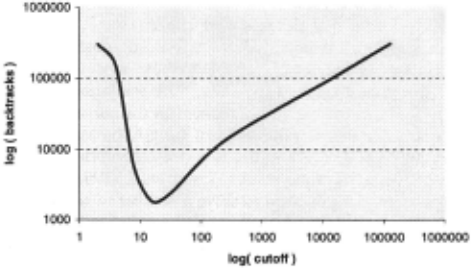
The Blackbox system actually introduces new SAT tech nology as well, namely the use of randomized complete search methods. As shown in Gomes, Selman, and Kautz (1998), systematic solvers in combinatorial domains often ex hibit a "heavy tail" behavior, whereby they get "stuck" on par ticular instances. Adding a small amount of randomization to the search heuristic and rapidly restarting the algorithm after a fixed number of backtracks can dramatically decrease the average solution time. Figure 1 illustrates the effect of adding randomized restarts to a deterministic backtracking search al gorithm. We see from the figure that as the cutoff is increased from its lowest setting the mean solution time first rapidly de creases. Then, as the cutoff continues to increase, the mean solution time increases in a near-linear fashion. This increase in expected time is due to the fact that for this problem a non negligible portion of the runs take arbitrarily long to com plete. In this example, at the optimal cutoff value, about 1 out of 100 runs succeeds in finding a solution.
We applied this randomization/restart technique to the ver sion of satz used by Blackbox. The variable-choice heuris tic for satz chooses to split on a variable that maximizes a par ticular function of the number of unit propagations that would be performed if that variable were chosen (see Li and Anbu lagan (1997) for details). Our version, satz-rand, randomly selects among the set of variables whose scores are within 40% of the best score. (The value 40% was selected empir ically.) The cutoff value is specified in the solver schedule. No one value cutoff value is ideal for all domains. Indeed, predicting good cutoff values is a deep theoretical question (the known asymptotic results (Luby et al. 1993) are often not practical). If you need to solve a number of similar prob lems, it is feasible to carefully tune the cutoff value on a few of the instances, and then use that value for the rest of the set. However, this cannot be done when a unique problem is encountered, or if you do not specify the parallel plan length in advance and the system must search through a series of different size problems.
A simple and effective practical solution is to provide the solver with a schedule of different cutoff values. The sched ule specifies some number of trials with a very low cutoff value, and if those all failed, then so many at a higher value, and so forth until either a solution is found or all trials end in failure. This can be viewed as a version of the well-known search strategy of iterative deepening. Like iterative deepen ing, the time spent on trials with a low cutoff value is negli gible compared to that spent on trials with a higher value, so that even when the early part of the schedule fails to find a solution little overall effort is wasted.
2 Empirical Results
In order to test the effectiveness of the Blackbox approach we selected benchmark problems that have the following characteristics:
- Domains are computationally challenging: there is no simple polynomial time algorithm for optimal planning.
- Solution time is dominated by search: plan graph gen eration is relatively fast, but solution extraction is hard.
- Problem instances are critically constrained: finding optimal plans is much harder than finding sub-optimal ones.
- Both both parallel and sequential planning problems are included.
- Instances push the limits of the approach in order to demonstrate how it scales up.
In this paper we present results on a set of such problems from logistics planning (Velosa 1992), a highly parallel planning domain, and from the classic blocks world, a purely sequen tial domain. The test machine was an SGI 194 MHz R10000 Challenge server, where each process ran on a dedicated pro cessor. The largest amount of RAM allocated by Blackbox during solution of the largest logistics problem (log.d) was 178 MB, and during the solution of the largest blocks world problem (bw.c) was 660MB. Most of the memory was allo cated during the phase of constructing the initial plan graph.
Table 1 compares the performance of Blackbox (version 3.4), SATPLAN, Graphplan, and IPP (version 3.3) on our lo gistics benchmark problems, where the optimal plan length is provided as input. Graphplan is the original code devel oped by Blum and Furst (1995) that also is incorporated in the front-end of Blackbox. IPP (Koehler et al. 1997) is a new implementation of the Graphplan algorithm including many improvements and extensions. We tried the solvers satz, satz rand, and Walksat for both Blackbox and SATPLAN. Input to Blackbox, Graphplan, and IPP was in PDDL STRIPS format (McDermott 1998); input to SATPLAN was a set of hand-crafted axiom schemas using the "state-based" encod ings described in Kautz and Selman (1996). Blackbox sim plified wffs before passing them on to a solver using the failed literal rule, while SATPLAN simplified using unit propaga tion.
Let us first make some general observations. We see that the scaling of Blackbox using any of the SAT solvers is better than Graphplan. It is important to note that up to the point at which the wff is generated from the plan graph, the code running in Blackbox and Graphplan is identical. This indicates that the cost of performing the SAT translation is small compared to the savings gained by using any of the SAT engines instead of the (relatively) simple backward-chaining search performed by Graphplan. Although IPP generally im proves upon Graphplan, in this case it only provides faster solution times on the two smallest instances, and is always slower than Blackbox. This is due to the fact that most of the improvements in IPP over Graphplan are not invoked in this test: they only come into play when the plan length is not given, or when the initial state description contains facts that are irrelevant to the solution. This test also does not allow us to take advantage of the "RIFO" heuristic graph pruning option in IPP, because doing so prevents IPP from finding the minimum parallel length solutions at all.
In short: for critically-constrained planning problems where plan extraction is the computational bottleneck for Graphplan-type solvers, translating the plan graph into SAT and applying a general SAT solver can boost perfor mance.
A second general observation is that the scaling of the best solution times for Blackbox (using satz-rand) is close to the scaling of the best solver-only times for SATPLAN (us ing Walksat). This is quite remarkable, given the fact that the Blackbox encodings were generated automatically, whiie the SATPLAN axioms were carefully hand-tuned in order to provide the best possible performance for Walksat. The SATPLAN encodings even included explicit state invariants (such as the fact that "a truck is only at one location at a time") that are known to boost the performance of problem solvers (Kautz and Selman 1998). Even more striking is the fact that when the time to generate the SATPLAN encod ings is also taken into account, the overall Blackbox times are consistently better than the SATPLAN times. For exam ple, Blackboxtakes 28 seconds to generate and solve log.d, while SATPLAN takes 3.6 minutes (3.5 minutes to generate and 7 seconds to solve).
In short: advances in SAT solvers have made plan ning using SAT encodings automatically generated from STRIPS operators competitive with planning using hand crafted SAT encodings.
These results contrast with earlier experiments on solving automatically-generated SAT encodings of planning prob lems. Kautz and Selman ( 1996) reported that both Walksat and ntab (a determinisitc backtracking solver, less complex than satz or reLsat) had difficulty solving plan graph gen erated SAT encodings of the larger logistics problems, get ting as far as log.b before the running time exploded. The MEDIC system (Ernst, Millstein, and Weld 1997) used the same solvers but generated the SAT encodings directly from the STRIPS axioms without taking advantage of an interme diate plan graph representation, by using the conventions de scribed in Kautz, McAllester, and Selman (1996). They re ported a solution time of 1.1 hours using Walksat on log.a. One should note that there is no significant overhead in us ing a plan graph for generation; in fact, the generation phase in Blackbox takes only a few seconds for each of prob lems described above, versus several minutes for generation by SATPLAN or MEDIC.
| problem | par- | Blackbox | Graphplan | IPP | SATPLAN | |||||
|---|---|---|---|---|---|---|---|---|---|---|
| allel time | walksat | satz | satz- rand | create | walks at | satz | satz- rand | |||
| rocket. a rocket.b log.a log.b log.c log.d | 7 7 11 13 13 14 | 3.2 sec 2.5 sec 7.4sec 1.7 min 14.9 min - | 5 sec lOsee 5 sec 7 sec 9 sec 52 sec | 5 sec 5 sec 5 sec 7 sec 9 sec 28sec | 3.4 min 8.8 min 31.5 min 12.7 min - - | 28 sec 55 sec 1 hour 2.5 hour - - | 42 sec 41 sec 1.2 min 1.3 min 1.7 min 3.5 min | 0.02 sec 0.04 sec 2 sec 3 sec 2 sec 7 sec | 0.3sec 0.3sec 1.7 min 0.6 sec 4 sec l.Shour | 2 sec 1 sec 4 sec 7 sec 0.8 sec 1.6 min |
A longer version of this paper will contain a detailed comparison with MEDIC. However, our preliminary exper iments indicate that wffs generated from a plan graph (as in Blackbox) have significantly different computational properties from ones generated directly from STRIPS (as in MEDIC), despite the fact that they are logically equivalent (Kautz, McAllester, and Selman 1996). In particular, the plan graph-based wffs contain fewer variables, more clauses, and are easier to solve. For example, the encoding of log.a gen erated by Blackbox contained 2,709 variables and 27,522 clauses, while the encoding generated by MEDIC (using the regular operator representation with explanatory frame ax ioms) contained 3,510 variables and 16,168 clauses. As shown above, the Blackbox wff can be solved by satz-rand in 5 seconds, but we have not yet been able to find a setting for the parameters for satz-rand that will let it solve the MEDIC wff in less than 24 hours.
The differences between the two kinds of wffs can be explained by the fact that the plan graph algorithm prunes many unreachable nodes, thus reducing the number of vari ables in the corresponding encoding, while propagating mu texes between nodes, thus increasing the number of (nega tive binary) clauses. The added binary clauses increase propagation at each branch of the backtracking search and thus speed the solution time. An interesting open question that we are currently investigating is whether a SAT solver that uses dependency-directed backtracking (e.g. reL.sat) can actually "learn" the added clauses while running on a MEDIC-type encoding.
In short: use of an intermediate plan graph represen tation appears to improve the quality of automatic SAT encodings of STRIPS problems.
Next, let us consider the differences in performance caused by different SAT solvers for Blackbox and SATPLAN. First, we see that while Walksat performs very well on the smaller Blackbox instances, it does poorly on the two largest, log.c and log.d. By contrast, local search works well for even the largest SATPLAN encodings. (This suggests some specific connection between local search and state based encodings, a topic that has received relatively little at tention since the original SATPLAN work.) The determin istic version of satz shows more consistent behavior across the Blackbox instances, although it stumbles on rocket.b and log.d. Satz stumbles even more dramatically on log.a and log.d for the SATPLAN encodings.
What is happening in each of these "stumbles" is that the satz variable choice heuristic (which is usually very good) has made a wrong choice early on in the search tree, and so th,e algorithm spends much time exploring a large area of the search space that is devoid of solutions. As discussed in Gomes, Selman, and Kautz (1998), one can observe this occurring for backtrack search for either a deterministic al gorithm on a large distribution of problem instances, or for a randomized backtrack algorithm repeatedly solving a sin gle instance. The latter case is the easiest to observe and has formed the basis of most experimental work on the subject, since one can simply do many runs of the algorithm (where the variable choice heuristic randomly breaks "ties"). In the experiments discussed here we have, by contrast, a determin istic algorithm running on small of different instances. In a set of examples this small it is not surprising that the phenomena only occurred for 4 of the 12 trials.
| problem | Timeout /satz-rand | Prove optimal /satz | Prove optimal /reLsat |
| rocket.a rocket.b | 59 sec 1 min | 59 sec 1 | 57 sec 1 min |
| min | |||
| log.a | 1.3 min | 1.3 | 1.1 min |
| log.b | 2.1 min | 45 min | 2.1 min |
| log.c | 3 min | - | 4.9 min |
| log.d | 3.7 min | 3.7 min | 2.6min |
We next reran the experiments using the randomized/restart version of satz described earlier. The Blackbox sched ule for satz-rand used a cutoff of 20 backtracks for up to 10 restarts, followed by a cutoff of 200 backtracks restarting un til a solution was found. The SATPLAN schedule for satz rand was a cutoff of 16 backtracks restarting until a solution was found. These schedules were only very roughly tuned by hand after observing a few trials and are not necessarily op timal. However, in each case the observed solution time was significantly reduced. For Blackbox the times for rocket.b and log.d were cut in half, while even more significant sav ings were seen for SATPLAN, where the solution time for log.d decreased from 1.8 hours to 1.6 minutes.
In short: Randomized restarts boost the performance of systematic SAT algorithms on encodings of planning problems.
Table 2 shows the results of running Blackbox and the same logistics instances where the parallel solution length is not specified in advance. The times for running Graphplan or IPP in this mode on these instances are only marginally higher than when the plan length is given as input: most of the work the Graphplan-type engines perform occurs when the plan length reaches the optimal bound. We ran Blackbox with satz-rand in two modes: in the first "timeout" mode, if a solution is not found after a few restarts (I 0 restarts at cutoff 20, I restart at cutoff 200), the plan length is incremented. In the second mode, Blackbox is made complete by mak ing the final part of the solver schedule run satz without any cutoff. Thus, only the second mode actually proves optimal ity. By comparing two modes, we see that the first (time out) is much faster than the second, even though the same quality solutions are ultimately found. This is because in the second mode most of Blackbox's effort goes into proving the non-existence of a solution of length one step less than optimal. Or, in other words, the "co-NP" part of the SAT translation was empirically harder than the "NP" part for satzrand. Finally, the table presents some data from our initial ex periments using the dependency-directed backtracking SAT solver reLsat. This is also a complete method that guarantees optimality, but now we see that it's timings are comparable with using satz-rand in its incomplete mode. (When the plan length is given as input, our preliminary experiments indicate that satz-rand usually has a edge over reLsat.)
In short: Performance of Blackbox for plan length search tasks can be acceptable, even though information from failed too-short trials is not reused, as it is in Graph plan.
A problem with the SAT approach in some domains is that the problem encodings become very large. A notable case is the classic single-armed blocks world. Because no par allel actions are permitted, the plan graph must contain as many layers as there are actions in the solution. If there are n blocks, then there are O(n 2 ) actions and O(n 4 ) mutexes per layer. Thus the translation of a 28-step, 15 block problem (large.c) contains about 2.5 million clauses, most of which are negative binary clauses (mutexes).
We therefore developed a modification to the translation scheme that can reduce the number of clauses in such cases. Note that it is not logically necessary to translate a particular mutex if that negative binary clause is implied by other parts of the translation. If particular, if we add clauses that state that an action implies its effects as well as its preconditions (the latter are part of the default translation), then mutexes do not need to be explicitly translated for actions with conflicting ef fects or conflicting preconditions: only mutexes where the ef fect of an action conflicts with the precondition of another are needed. Table 3 shows the results of performing this "com pressed" translation. The encodings are about 75% smaller in the number of clauses and considerably easier to solve by satz-rand (which has no difficulty in chaining through the Horn clauses that entail the "missing" mutexes). For compar ison the final column provides solution times for the Graph plan search engine working on the plan graphs that explic itly include all the inferred mutex relations. Performance of Blackbox and Graphplan is comparable, although neither is currently state of the art. (However, Blackbox's ability to find optimal solutions to a 28-step blocks world problems would have been considered state of the art performance as little as two years ago.)
In short: SAT encodings become problematically large in sequential domains with many operators, although re finements to the encoding scheme can delay the onset of the combinatorial explosion.
In summary, our experiments show that Blackbox pro vides an effective approach for "search bound" problem in stances in certain highly parallel planning domains such as logistics planning. The approach runs into difficulties in do mains such as the blocks world where both the intermediate plan graph and the SAT translation become very large, al though the technique of compressed encodings provide sig nificant relief.
A longer version of this paper (in preparation) will include results on an expanded set of benchmark problems, including the instances from the AIPS-98 Planning Competition. Al though the performance of Blackbox in the AlPS competition was respectable (no competitor dominated it in on all cat egories in round 1, and only IPP did so in round 2), we must note that the competition problem instances did not provide a way of distinguishing planning systems that employ plan graphs on the basis of their search strategies. Nearly all of the instances were "too easy" in the sense that once a planning graph was generated any search strategy could extract a solu tion, or "too hard" in the sense that the planning graph grew intolerably large before conversion to CNF. For example, Blackbox's difficulty in dealing with the "gripper" domain were due to explosion of the initial plan graph, even though the domain is inherently non-combinatorial (a linear time do main specific optimal planning algorithm exists). Differences in performance between the various systems was largely due to various graph-pruning strategies each employed, such as the RIFO strategy of IPP (Nebel et al. 1997). Many of these strategies can be incorporated into Blackbox by simply re placing it's Graphplan front-end with e.g. IPP.
| problem | steps | Blackbox | Graphplan | |||
|---|---|---|---|---|---|---|
| default | compress | |||||
| clauses | time | clauses | time | |||
| reverse | 8 | 1,347 | 2 sec | 917 | 3 sec | 2 sec |
| 12step | 12 | 25,978 | 5 sec | 6,643 | 3 sec | 3 sec |
| large. a | 12 | 116,353 | 13 sec | 18,061 | 5 sec | 3 sec |
| large.b | 18 | 469,993 | 6.5 min | 123,653 | 28 sec | 1.9 min |
| large.c | 28 | 2,496,832 | * | 917,402 | 1.3 hour | - |
The memory required for the SAT encoding can be an is sue for running Blackbox on small-memory machines (as noted above, ones with less than the 178 MB required for log.d), particularly because the current code does not opti mize memory use (e.g., several copies of the wff are kept in core, and memory is not reused when wffs are sequentially generated with larger bounds). Even so, the falling prices for RAM (currently about $1000 for 512MB) support the argu ment that the approach will only grow more practical with time. A more serious technical challenge comes from recent work on structure sharing techniques for compactly repre senting large plan graphs (as will appear in the next versions of IPP and STAN (Fox and Long 1998)). How can one trans late such representations into SAT without multiplying out all the shared structure? Instead of compiling into pure SAT, one might try to compile the plan graph into a smaller set of axiom schemas, that is, a "lifted" form of CNF. The axiom schemas could be passed on to a general lifted SAT solver or further compiled irito rules in a constraint logic programming sys tem. The latter alternative appears particularly attractive in the light of good results recently obtained in using constraint logic programming to solve planning problems (van Beek and Chen 1999).
3 The Role of Limited Inference
The plan graph approach to STRIPS planning gains much of its power through its use ofmutex computations, as we briefly described above. During construction of the plan graph, Graphplan marks a pair of instantiated actions as mutually ex clusive if one deletes a precondition or add-effect of the other. It further determines that a pair of facts (predicates fully in stantiated at a particular time-instant) are mutually exclusive if all the actions that add one are exclusive of all actions that add the other. Additional mutexes are added between actions if a precondition of one is mutex with a precondition of the other. If one takes the number of preconditions or effects of an operator to be constant then mutex computation can be per formed in 0( n 2 ) time, where n is the number of instantiated actions (where an instantiated action specifies all its parame ters as well as a particular time step).
| percent set by | ||||
|---|---|---|---|---|
| problem | vars | uprop | flit | blit |
| 12step | 1191 | 13% | 43% | 79% |
| bw.a | 2452 | 10% | 100% | 100% |
| bw.b | 6358 | 5% | 43% | 99% |
| bw.c | 19158 | 2% | 33% | 99% |
| rocket. a | 1337 | 3% | 24% | 40% |
| rocket.b | 1413 | 3% | 21% | 49% |
| log.a | 2709 | 2% | 36% | 45% |
| log.b | 3287 | 2% | 24% | 30% |
| log.c | 4197 | 2% | 23% | 27% |
| log.d | 6151 | 1% | 25% | 33% |
Thus mutex computation is simply a specialized form of constraint propagation, i.e., limited deduction. Some nodes can be determined to be inconsistent during instantiation and immediately eliminated from the plan graph. The remaining mutex relations are used to constrain the search over the ei ther the graph or its SAT translation. It is natural to wonder if other forms of limited inference are useful for planning prob lems. Blum (personal communication) observes that comput ing higher-order mutexes (between triples of actions, etc.) is not very useful. Do the binary mutex computations extract all important "local" information from the problem instances?
We decided to test this hypothesis by experimenting with a series of different limited inference algorithms that work on the the SAT encodings of the problems. We used the program "compact" developed by James Crawford, and considered the following options:
- unit propagation Apply unit resolution. Requires O(n) time.
- failed literal For each literal, try adding the literal to the for mula and applying unit resolution. If inconsistency is determined then then literal can be set to false. Requires O(n 2 ) time.
- binary failed literal For each pair of literals, try adding the pair of literals to the formula and applying unit reso lution. If inconsistency is determined then the binary clause consisting of the negations of the literals can be added to the formula, and the single failed literal rule applied again. Requires O(n 3 ) time.
Table 4 shows the result of applying each of these kinds of simplifications to a series of encodings of blocks world and logistics planning problems. For each problem we show the number of variables in the instance and the percentage of those variables whose values are determined by local com putation. The results for unit propagation (uprop) seem to confirm the intuition that there is little local information left in these problems. For the blocks world problems only be tween 2% and 13% of the variables are determined by unit propagation, and for the logistics problems no more. than 3% are determined. However, the story changes dramatically for the failed literal rule (flit). In the blocks world from 33% to 100% (i.e., the problem is completely solved!) of the vari ables are determined. In the logistics domain over 21% of the variables are eliminated. The binary failed literal rule (blit) is even more powerful. All of the blocks world problems were either solved completely or made trivial to solve (less than 131 variables) by this rule. The logistics problems were also further reduced in size, although they remained non-trivial to solve.
These results led us to select the failed literal rule as the de fault simplification procedure for Blackbox. It runs quickly and greatly decreases the size and hardness of the problem in stance. So far the higher overhead (0(n 3 ) versus O(n 2 )) for the binary failed literal rule makes it impractical for the do mains we have considered: it takes about as long to simplify the problem with the binary rule as to solve it using the unary simplifier and satz-rand. Still, these results suggest that an improved implementation of the binary rule could be of dra matic help in certain domains.
Thus we see that general limited inference computations on the SAT-encoding of planning problems provide a powerful complement to the kind of specialized mutex computations performed by the Graphplan front-end to Blackbox. There is a role both for planning-specific and domain-independent simplification procedures. In future work we plan to see if we can find other polytime simplification algorithms for SAT that take particular advantage of the structure of SAT encodings of planning problems.
4 Conclusions
We have provided an overview of the Blackbox planning system, and described how it unifies the plan graph approach to STRIPS planning with the planning as satisfiability frame work. It provides a concrete step toward the /JCAI Challenge for unifying planning frameworks (Kambhampati 1997). We discussed empirical results that suggest that new randomized systematic SAT algorithms are particularly suited to solving SAT encodings of planning problems. Finally, we examined the role of limited inference algorithms in the creation and solution of problem encodings.
There is strong evidence that the best current general SAT engines are more powerful than the search (plan extractio~) engines used by Graphplan and its descendents. Although 1t is possible to incorporate the heuristics used by these general solvers back into a specialized planner (see Rintanen (1998) for such an approach), given the rapid development of new SAT engines such a tactic may be premature. As an alterna tive, Giunchiglia et al. (1998) present evidence that it possi ble to dramatically boost the performance of a general SAT engine by feeding it a tiny amount of information about the structure of the encoding (in particular, identification of the action variables). There is also much work on improving the plan graph generation phase (e.g. , Kambhampati et al. (1997), Nebel et al. (1997)) which could be directly incorporated in Blackbox by replacing its front-end. .
Blackbox is an evolving system. Our general goal IS to unify many different threads of research in planning and inference by using propositional satisfiability as a common foundation. An important direction that we have not touched on in this paper is the use of domain specific control knowl edge in planning(Bacchus and Kabanza 1996; Kautz and Sel man 1998; Gerevini and Schubert 1998; Fox and Long 1998); see Cheng, Selman and Kautz ( 1999) for work on adding con trol knowledge to Blackbox.
@inproceedings{ijcai1999p47,
  title     = {Unifying SAT-based and Graph-based Planning},
  author    = {Kautz, Henry A. and Selman, Bart},
  booktitle = {Proceedings of the Sixteenth International Joint Conference on
               Artificial Intelligence, {IJCAI-99}},
  publisher = {International Joint Conferences on Artificial Intelligence},
  editor    = {Thomas Dean},
  pages     = {318--324},
  year      = {1999},
  note      = {Challenge Papers},
  url       = {https://ijcai.org/proceedings/1999/47},
}
TY - CPAPER TI - Unifying SAT-based and Graph-based Planning AU - Kautz, Henry A. AU - Selman, Bart T2 - Proceedings of the Sixteenth International Joint Conference on Artificial Intelligence, IJCAI-99 PB - International Joint Conferences on Artificial Intelligence PY - 1999 SP - 318 EP - 324 UR - https://ijcai.org/proceedings/1999/47 ER -Copied
Machine-readable versions of this paper, for tools and AI agents:





