
Exploratory Interaction with a Bayesian Argumentation System
Proceedings of the Sixteenth International Joint Conference on Artificial Intelligence. .
© 1999 International Joint Conferences on Artificial Intelligence
Abstract
- [Anderson, 1983] Anderson, J. R. (1983). The Architecture of Cognition. Harvard University Press, Cambridge, Mas- sachusetts.
- [Buchanan and Shortliffe, 1985] Buchanan, B. G. and Short- liffe, E. H. (1985). Rule-based expert systems: The MYCIN experiments of the Stanford heuristic program- ming project. Addison-Wesley Publishing Company.
- [Chu-Carroll and Carberry, 1995] Chu-Carroll, J. and Car- berry, S. (1995). Response generation in collaborative negotiation. In Proceedings of the Thirty-Third Annual Meeting of the Association for Computational Linguistics, pages 136-143.
- [Elhadad and Robin, 1996] Elhadad, M. and Robin, J. (1996). An overview of SURGE: A reusable comprehen- sive syntactic realization component. Technical Report 96- 03, Department of Mathematics and Computer Science, Ben Gurion University, Beer Sheva, Israel.
- [Elsaesser, 1987] Elsaesser, C. ( 1987). Explanation of proba- bilistic inference for decision support systems. In Proceed- ings of the AAAI-87 Workshop on Uncertainty in Artificial Intelligence, pages 394-403, Seattle, Washington.
- [Hobbs et al., 1993] Hobbs, J. R., Stickel, M. E., Appelt, D. E. , and Martin, P. (1993). Interpretation as abduction. Artificial Intelligence, 63(1-2):69-142.
- [Jonsson, 1995] Jonsson, A. ( 1995). Dialogue actions for natural language interfaces. In IJCAI95 -Proceedings of the Fourteenth International Joint Conference on Artificial Intelligence, pages 1405-1411, Montreal, Canada. IJCAI
- [McConachy et al., 1998] McConachy, R., Korb, K. B., and Zukerman, I. (1998). Deciding what not to say: An attentional-probabilistic approach to argument presenta- tion. In Proceedings of the Twentieth Annual Conference of the Cognitive Science Society, pages 669-674, Madison, Wisconsin.
- [Pearl, 1988] Pearl, J. ( 1988). Probabilistic Reasoning in In- telligent Systems. Morgan Kaufmann Publishers, San Ma- teo, California.
- [Toulmin, 1958] Toulmin, S. (1958). Uses of Argument. Cambridge University Press, Cambridge.
- [Vreeswijk, 1994] Vreeswijk, G. (1994). IACAS: An inter- active argumentation system. Technical Report CS 94-03, Department of Computer Science, University of Limburg.
- [Zukerman et al., 1998] Zukerman, I., McConachy, R., and Korb, K. B. (1998). Bayesian reasoning in an abduc- tive mechanism for argument generation and analysis. In AAAI98 -Proceedings of the Fifteenth National Confer- ence on Artificial Intelligence, pages 833-838, Madison, Wisconsin.
References were extracted automatically from the PDF and may contain errors.
Full text extracted automatically from the PDF; figures, tables and equations may differ. The PDF is the version of record.
1 Introduction
An ideal interactive argumentation system would allow a user to respond to an argument with a full counterargument, and it would allow the argumentation process to go on indefinitely, producing a series of arguments and counterarguments. In this paper, we describe an interactive version of our argu mentation system NAG (Nice Argument Generator), which enables a user to explore the impact of different beliefs and propositions on arguments generated from Bayesian networks (BNs). Such an exploratory capability constitutes a signifi cant step towards allowing a user to interact freely with an argumentation system.
NAG interacts with a user through a web interface. The in teraction starts when NAG presents to the user background information for a particular scenario and a hyper-text ren dering of the argument generated by NAG in support of a goal proposition. NAG attempts to generate arguments that are nice, meaning that they are both normatively correct and persuasive for the target audience. To this effect it consults two models during argument generation: a normative model, which contains our best understanding of the domain of dis course, and a revisable model of the user's beliefs. These models are not necessarily synchronized, since the user and NAG may have different beliefs and may apply different in ference patterns. Thus, operationally, a nice argument is one that achieves a desired degree of belief in the goal in each of these models.
After presenting an argument, NAG allows the user to per form the following operations: (1) select a new goal proposi tion; (2) ask NAG to argue for or against a proposition in the current argument; (3) ask NAG to include or exclude a propo sition; (4) ask NAG a what about question, i.e., to consider the effect of a proposition on the argument; and (5) ask NAG a what if question, i.e., to consider a hypothetical change in the belief in a proposition. Each response results in the gen eration of a (revised) argument which incorporates the user's request. The user can either retain this argument or revert to the previous situation. These operations enable the user to ex amine different aspects of an argument in piece-meal fashion.
The argument generation process is described in [Zuker man et al., 1998; McConachy et al. , 1998]. The focus of this paper is on the interactive capabilities of the system. In par ticular, we consider key features which support these capa bilities: (1) an attentional mechanism which updates the acti vation of concepts as the interaction with the user progresses (Section 4 ); (2) a set of operations for exploring the argument (Section 5); and (3) a set of probabilistic patterns and an ac companying Argument Grammar, which extend patterns such as Toulmin 's (1958) to enable the generation of natural lan guage arguments from BNs (Section 6). These features pro vide a foundation for enabling users to argue with NAG.
In the next section, we show a sample interaction with NAG. In Section 3, we describe the argument generation pro cess. We then consider NAG's knowledge representation and attentional mechanisms, followed by its exploratory opera tions and argumentation patterns. Finally, we discuss the re sults of a preliminary evaluation, review related research and present concluding remarks.
2 Sample Interaction
In this section, we describe an actual interaction with a user. Our domain is a fictitious murder scenario, which was cho sen to minimize the influence of a user's pre-existing beliefs. The interaction started when the user was given the following preamble (which contains all the available observables).
Scratchy, a notorious spy from Vulcan, was found murdered in his bedroom, which is in the second storey of his house.
Indentations were found on the ground right outside Scratchy 's window, and they were observed to be circular. In addition, one set of footprints was found outside Scratchy's window, but the bushes were undisturbed.
Itchy and Scratchy were long-term enemies, and Itchy's fin gerprints were found on the murder weapon (a gun discov ered at the scene and registered to Itchy).
Itchy, who is the head of the INS, has a ladder with oblong supports, which he was planning to use to paint his house.
Poochie, the town's mayor, has a cylindrically-supported lad der which is available only to him.
The user was then asked for his degree of belief in the goal proposition (Itchy did not kill Scratchy) and in Itchy's means, opportunity and motive to kill Scratchy, and also for his confidence in these judgments. The user indicated that it is rather likely that Itchy had a motive, quite likely that he had the means, and less likely than not that he had the opportunity to kill Scratchy or that he killed Scratchy. 1 NAG then gen erated an initial argument in support of the goal, taking into account the user's beliefs. Notice however, that the presented degrees of belief are NAG's.
Very probable hatred between Itchy and Scratchy imply a very probable motive to kill Scratchy.
Itchy 's firing of the gun and Itchy 's gun being used to kill Scratchy imply a means to murder Scratchy.
Circular indentations outside Scratchy's window, cylindrical supports to Poochie's ladder and availability of Poochie 's ladder only to Poochie imply Poochie almost certainly was outside Scratchy's window, which together with Itchy 's ladder almost certainly not being outside Scratchy's window and a single person being outside Scratchy's window implies Itchy very probably not being outside Scratchy's window.
The circular indentations outside Scratchy's window imply Scratchy very probably being shot from outside the window. This together with Itchy very probably not being outside Scratchy's window imply a very probable lack of opportunity to murder Scratchy.
Even though Itchy very probably had a motive to kill Scratchy and Itchy had the means to murder Scratchy, the very prob able lack of opportunity to murder Scratchy implies Itchy 's very probable innocence.
After this argument, the user retained his belief in Itchy's motive to kill Scratchy, but reduced his belief in Itchy's means to kill Scratchy to rather likely. He also reduced his belief in Itchy's opportunity to murder Scratchy and Itchy's guilt to quite unlikely, which are closer to NAG's normative beliefs than the user's initial beliefs after the preamble.
The exploratory interaction started with a request to ex clude the proposition Itchy fired the gun, which resulted in a stronger argument for Itchy's innocence, where the paragraph regarding Itchy's means to murder Scratchy was omitted, and the concluding paragraph was replaced as follows.
Even though Itchy very probably had a motive to kill Scratchy and Itchy could have had the ·means to murder Scratchy, the very probable lack of opportunity to murder Scratchy implies Itchy's almost certain innocence.
The user returned to the original argument (without retain ing the exclusion), and asked NAG to support the proposition Only one person was outside Scratchy's window. NAG gen erated the following sub-argument.
A single set of footprints outside Scratchy's window implies a single person being outside Scratchy 's window.
The user then requested that this sub-argument be included in the main argument, and asked a What if question which explored the effect of a belief of even chance in the proposi tion Itchy was outside Scratchy 's window. This resulted in an argument which yielded a weak belief in the goal.
Itchy and Scratchy very probably hated each other; therefore, Itchy very probably had a motive to kill Scratchy.
1 The descriptive names for the probabilities are based on those described in [Elsaesser, 19871.
Itchy fired the gun and Itchy's gun was used to kill Scratchy; hence, Itchy had the means to murder Scratchy.
Circular indentations were found outside Scratchy's window; hence, Scratchy very probably was shot from outside the win dow.
If Itchy maybe was outside Scratchy's window and Scratchy very probably was shot from outside the window, Itchy possi bly had no opportunity to murder Scratchy.
Despite a very probable motive to kill Scratchy and the means to murder Scratchy, the possible lack of opportunity to murder Scratchy implies Itchy's possible innocence.
After the exploratory interaction, the user was asked post test questions regarding his belief in the goal proposition and in Itchy's means, opportunity and motive for killing Scratchy. The user did not change his beliefs as a result of the interac tion (but three of these beliefs were already close to NAG's).
3 Argumentation Process
Figure 1 shows the modules of NAG. The Strategist, which receives as input a goal proposition, drives the argumentation process and produces an argument in support of this goal. 2 This process is influenced by the context, which changes at each turn in the interaction due to a user's request and the argument NAG generates to address this request.
The argument generation process is composed of a se quence of generation-analysis cycles [Zukerman eta!., 1998]. The Strategist first invokes the Attentional Mechanism (Sec tion 4) to activate propositions which are related to the items that are currently salient (including the goal). These proposi tions form an initial Argument Graph- a network with nodes that represent propositions and links that represent the infer ences that connect these propositions. This Argument Graph is passed to the Generator, which consults the user model and the normative model to add information to the graph. The in ferences and propositions that are compatible in both models and are related to the propositions in the current Argument Graph are incorporated into the graph. The resultant Argu ment Graph is then passed by the Strategist to the Analyzer in order to evaluate its niceness.
To assess the persuasive power of an argument represented by an Argument Graph, the Analyzer determines its effect on the belief in the goal proposition in the user model (Sec tion 4). The normative correctness of the argument is as sessed by determining its effect on the belief in the goal in the normative model. If the Analyzer reports that the Argu ment Graph is not nice enough, e.g., the belief in the goal is not high enough in one or both of the models, the Argument Graph is returned to the Strategist, and another generation analysis cycle is performed: the Strategist re-activates the Attentional Mechanism to expand the reasoning context, fol lowed by a re-activation of the Generator and then the Ana lyzer. This process iterates until a nice Argument Graph is built, or NAG is unable to continue, e.g., because it failed to find further evidence. In this case, NAG performs the follow ing actions in turn. First, it tries to enhance the argument by including propositions that are believed only in the normative model. If the resulting argument achieves the intended belief in the goal in the normative model, it is retained. However, the added propositions are not immediately incorporated into the user model; they will be incorporated if the user accepts them implicitly (by failing to question their inclusion in the argument). If this argument fails, NAG attempts to argue for the negation of the goal. To this effect, it first tries a nice argument, and then an argument which includes additional normative propositions. Finally, if this fails too, NAG selects the strongest argument it could generate, either for the goal or its negation. These actions were chosen, instead of simply giving up, based on suggestions made by users who tried a previous version of NAG. Note that failure can still happen if the user's requirements over-constrain NAG, e.g., the user de mands the inclusion of a particular proposition in an argument for a goal that is not related to this proposition (Section 5).
2 The interface allows the user to select a goal proposition that NAG should argue for. However, for our evaluation the initial goal proposition is determined in advance, and the user is allowed to se lect subsequent goals.
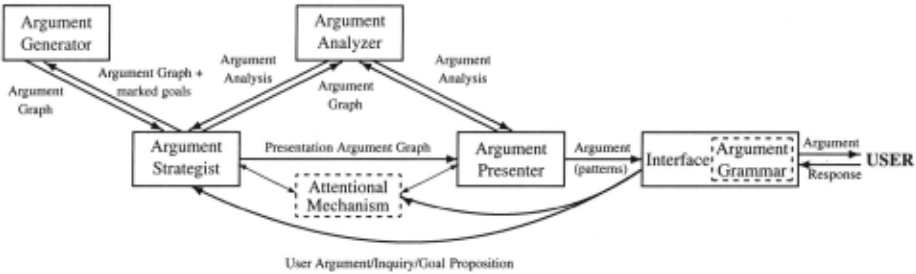
Once an argument is generated, the Argument Graph is passed to the Presenter, which selects an argumentation strat egy, e.g., premise-to-goal or goal-to-premise, and removes (easily inferred) propositions from the argument [McConachy et a!., 1998]. After each removal, the Presenter activates the Analyzer to check whether the belief in the goal proposition has not been significantly altered, and the Attentional Mech anism to determine whether the argument can still be fol lowed by the user. After the Presenter determines that no more propositions can be removed from the argument, it ex tracts Bayesian reasoning patterns from the Argument Graph, and passes them to the interface, which uses the Argument Grammar to generate a textual version of the argument, and presents it in hyper-text form (Section 6).
4 Knowledge Representation and Attentional Mechanism
Both the user model and the normative model rely on a BN as their primary representational tool, each model using a differ ent BN. We have chosen BNs because of their ability to rep resent normatively correct reasoning under uncertainty. Dur ing argument generation, the Generator may draw upon ad ditional knowledge bases, such as rule-based systems, to add information to the BNs as needed. During argument analy sis, the Analyzer performs BN propagation on the portions of the normative and user models which correspond to the Ar gument Graph and are connected to the goal.
3 It came late to our attention that the behaviour of our propa gation algorithm departs from that of, for example, the Bayesian
In order to simplify the argument generation process and to model more accurately a user's cognitive abilities, we ap ply the Attentional Mechanism, which focuses upon the por tion of the BN in each model that may be relevant to the cur rent argument. 4 Hence, each of the user model and the nor mative model at any given time contains a single Bayesian subnetwork that is in focus. The structural intersection of these subnetworks forms the Argument Graph. For example, consider a situation where NAG's normative model believes that Poochie's ladder was outside Scratchy's window (P1) and that it is available only to Poochie (P2). In addition, the normative model has an inference pattern whereby these propositions have implications about Poochie being outside Scratchy's window (P3). Now, let us assume that the user model shares the normative model's belief in P1 , is uncertain about P2, and also believes that Poochie was seen at the local toy store on the night of the murder (P4). Further, the user model has an inference pattern whereby P 1, P2 and P4 affect the belief in P3. In this example, P1 and P2 and their link to P3 are included in the Argument Graph, but P4 is excluded, since it does not appear in the normative model. When ana lyzing the Argument Graph, propagation is done twice, once for the Bayesian subnetwork in the normative model and once for that in the user model (in our example, the probability calculations for the user model are marginalized over P4 to match the inference pattern in the normative model). Thus, we assess the niceness of the same argument with respect to both the user model and the normative model, thereby deter mining its persuasiveness and normative correctness respec tively. In this example, NAG's argument for P3 will achieve a strong belief in this proposition in the normative model, but only a middling belief in the user model.
A plausible model of attentional focus requires NAG to fol low associative links that do not necessarily represent eviden tial or causal relationships. We incorporate such links into our user and normative models by building one hierarchical semantic network (SN) on top of the user-model BN, and one on top of the normative-model BN (Figure 2). When perform ing attentional modeling, links in both the SN and the BN are followed. However, the resulting Argument Graph contains only propositions and links from the BNs.
propagation algorithm in [Pearl, 1988], in particular in its treatment of loops. This departure does not seem to affect NAG's argumen tative behaviour in the examples run to date. Nonetheless, we shall implement the standard propagation procedure in the near future.
4 As shown in [Zukerman et al., 1998], the Attentional Mecha nism can greatly reduce argument generation times. For instance, generation times were halved for our sample BNs, which contained between 20 and 120 nodes; the BNs for the example discussed in this paper contain 23 nodes.
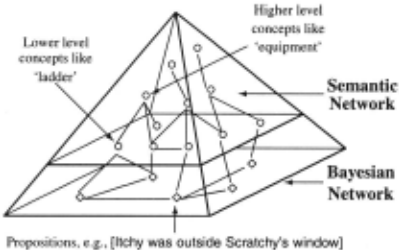
To begin attentional simulation, NAG obtains an initial set of salient concepts and propositions from the context of the argument (in our example, the initial context is the pream ble describing the murder scenario). As the argument or in teraction progresses, new propositions become salient. For example, if the user asks NAG to include a proposition in an argument, this proposition and the concepts in it will be come salient. We use activation with decay [Anderson, 1983], spreading from the (clamped) salient objects to determine the focus of attention. This process passes activation through the nodes in the SN and BN in the user model and in the norma tive model, each node being activated to the degree implied by the activation levels of its neighbours, the strength of asso ciation with those neighbours, and its immediately prior acti vation level (reduced by a time-decay factor). This iterative process ceases when an activation cycle fails to activate a new node. Any nodes in the SN or BN which achieve a threshold activation level at the end of this process are brought into the span of attention.
The context is dynamic, changing with each new request and resulting argument. In addition, the context for the user model may differ from that for the normative model, since NAG's experiences and the user's differ. NAG reasons about the argument and presents it, while the user reads it and rea sons about it. After each request, the context for the nor mative model is composed of the proposition in this request and the propositions and concepts active upon completion of the reasoning process for the last argument. In addition to the proposition in the user's request, the context for the user model contains the propositions and concepts which were activated while the system simulated argument presentation, which NAG does in order to select a presentation order for its argument [McConachy et al., 1998].
5 Interacting with NAG
The interaction with the user influences NAG's argument gen eration process by changing the attentional focus and the be liefs in NAG's normative and user models. Since NAG has limited reasoning capacity (Bayesian propagation is restricted to the portion of the Argument Graph that is connected to the goal and the KBs are not exhaustively searched), the beliefs in NAG's user model and normative model may be affected by the additional Bayesian updating performed when addressing a user's request. Also, as indicated above, a request involving a particular proposition makes that proposition salient, which together with the argument generated to address this request modifies the context. As a result, when the user chooses to cancel his or her last request and revert to the previous argu ment, the argument generated by NAG may be slightly differ ent from the previous argument.
NAG supports the following exploratory operations.
Selecting a new goal. This operation allows the user to re quest NAG to argue for any proposition known to it. Cur rently, the available propositions (and their negations), i.e., those in the normative and user models, are presented in a pull-down list. Clearly, this requires the interface to know in advance all the propositions accessible to the argumenta tion process, and so does not scale up. Nonetheless, this ap proach was adopted because it enables us to test exploratory interactions without introducing the complications attendant to accepting new goals presented in natural language.
As stated above, a newly selected goal is added to the rea soning context and passed to the Strategist, which activates the generation-analysis cycles described in Section 3.
Asking NAG to argue for or against a proposition in the argument. Here too the selected proposition is added to the reasoning context, and the generation-analysis process is ac tivated to produce a sub-argument for or against this propo sition. The presumption is that a new sub-argument for this proposition should be stronger than the current sub-argument. The user may then ask NAG to incorporate the resultant sub argument into the main argument or may retain the previous argument (possibly in a modified form).
Including/excluding a proposition. As when selecting a new goal, a proposition to be included in the argument is se lected from the pull-down list. The inclusion of a proposi tion cancels any previous exclusion of this proposition or its negation. The proposition is added to the reasoning context, and the generation-analysis process is activated in an attempt to produce a revised argument which includes it. The resul tant argument may differ substantially from the last argument, in particular if the included proposition has a detrimental ef fect on the goal, thereby requiring the introduction of addi tional sub-arguments to maintain the desired level of belief in the goal. If, despite the inclusion of the selected proposi tion in the context, NAG generates a nice argument without this proposition, then NAG activates additional generation analysis cycles (currently two) to attempt to link this propo sition to the argument. If the proposition still cannot be con nected, NAG reports this failure.
A proposition to be excluded is selected from the current argument. The exclusion of a proposition drops from consid eration both the proposition itself and its negation, and can cels any previous inclusion of this proposition or its negation. NAG then tries to construct an argument without the excluded proposition; that is, the proposition is removed from the BNs (as are those of its ancestors that have no other connections to the argument). The children of the excluded proposition may then become premises, in which case uninformed priors for them are used. If the children have other parents, their condi tional probabilities are marginalized over the excluded propo sition, so that Bayesian propagation can proceed without it. Although any probabilistic impact of excluded propositions is avoided, exclusion has the opposite effect on attentional processing: asking someone to not think of unicorns has the opposite effect. Thus, excluded propositions are added to the reasoning context, which may induce NAG to incorporate re lated propositions in the argument.

As usual, the user may retain the resulting argument, or revert to the previous (possibly modified) argument.
Considering the effect of a proposition (what about). For this operation NAG returns only the reasoning path which connects the selected proposition to the goal (rather than re turning the entire argument for the goal). This allows the user to inspect the effect of an isolated factor on the goal. To per form this operation, NAG adds the selected proposition to the reasoning context, and activates the generation-analysis pro cess. The subgraph that connects the selected proposition to the goal is then returned for presentation. The user can choose to revert to the previous (possibly modified) argument, or to include the examined proposition in the argument.
Considering a hypothetical change in the belief in a proposition (what if). In this operation NAG changes the degree of belief in the selected proposition and converts the proposition into a premise. These changes, which take place in both the user model and the normative model, are tempo rary, since the user is explicitly requesting hypothetical rea soning. After producing a revised argument in light of the hy pothetical belief, NAG reinstates the original beliefs in both the user model and the normative model and re-generates the previous argument. As usual, the change in context may re sult in the previous argument being modified.
Undoing changes. The user may undo the inclusion or exclu sion of propositions and the incorporation of sub-arguments for or against a proposition. Each undo operation brings a proposition into focus. After the user completes his or her un doing actions, the generation-analysis process is reactivated, and NAG presents the resulting argument.
6 Argumentation Patterns and Grammar
The generation of natural language output from a BN requires the identification of probabilistic patterns which yield specific argumentation patterns. The patterns we have considered so far are: explain-away [Pearl, 1988], neutralize, contradict, cause, evidence and imply (which is a generic pattern that is used when the others are not applicable). When the inter face receives an ordered list of patterns, it activates the corre sponding productions in our Argument Grammar to generate natural language output. The formulas presented below iden tify probabilistic patterns with reference to the simple BN in Figure 3 (A and B may be groups of nodes).
Explain away. Reflects a situation where there are several potential explanations for a proposition, and finding out that one of these explanations is likely reduces the probability of the others. Its probabilistic requirements are:
P(CIA) > P(C) and P(CIB) > P(C), which means that A and Bare potential explanations for C; and
P(AIBC) < P(AIC) and P(BIAC) < P(BIC), which means that given C, A explains away Band vice versa. Fi nally, we require P(AIBC) < threshold and P(BIAC) < threshold, where threshold is a probability indicative of an Explain-away({A}, {B}, C,strength?, direction?):
Given(typea ?) Antecedent( C ,type a?),
Antecedent( {A} ,nominal) lmply(strength ?,direction ?,typec ?) Consequent( { B} ,typec ?).
Given that the grass is wet, the fact that the sprinklers were on last night implies that it probably did not rain.
Contradict -short( {A}, { B}, { C} ,strength?, direction?, cause?): Although(typea ?) Antecedent( {A} ,type a?),
Antecedent( { B},nominal)
I mply(strength ?, direction?, cause?, typec ?)
Consequent( { C},typec ?).
Although Itchy's fingerprints were found on
the gun, Itchy's alibi implies his innocence.
Figure 4: Sample productions in the Argument Grammar.
unlikely event; this ensures that the explaining-away effect has a useful impact on the argument.
Neutralize. Reflects a situation where some of the an tecedents of an implication undermine the effect of others on the consequent, and the posterior belief in the consequent re mains largely unchanged from its prior. That is, B neutrali~es A if P(CIAB)~P(C) and P(CIA) <P(C).
Contradict. Similar to Neutralize, but one of the antecedents wins. That is, P(CIAB) >P(C) and P(CIA) <P(C).
Imply. Reflects a situation where the current beliefs in the antecedents increase the belief in the consequent. That is, P(CIAB) > P(C).
Cause. Like Imply, but the relations have a "cause" tag.
Evidence. Like Imply, but the relations run in the opposite direction to the links in the BN.
Figure 4 illustrates two productions in our Argument Grammar with reference to Figure 3; the words in sans serif are invocations of production rules. Explain-away takes as in put two lists of propositions ({A} and {B}), and one single ton (C), which is the pivot on which the explanation hinges. Contradict-short takes two lists of antecedents ( {A} against the consequents and {B} in favour), and one list of conse quents, { C}. This production is used when {A} contains only one or two propositions. The direction? and cause? param eters of the productions are obtained from tags in the BNs. For example, cause?=+ and direction?= 'forward' indicate a causal relation, while direction?='backward' indicates an ev idential relation. The strength? parameter is obtained from the normative-model BN, since NAG states its own degrees of belief.
The Argument Grammar is feature-based. The produc tions in Figure 4 illustrate the type feature, which indicates whether a proposition should be realized in sentential or nom inal form. For instance, the "despite" realization of Although requires a nominal continuation (e.g., "Despite Itchy's hatred for Scratchy"), while as shown in Figure 4, the "although" re alization requires a sentential continuation. Our grammar as sumes that each proposition has at least one realization (nom inal or sentential); it can produce a nominal realization from a sentential one and vice versa by performing simple manip ulations. To expedite the interaction, currently each node in the BNs has a hand-generated sentential or nominal realiza tion. These realizations may be replaced by appropriate calls to grammars such as SURGE [Elhadad and Robin, 1996].
7 Evaluation
We performed a preliminary evaluation of the interactive fea tures of NAG by testing the system with 16 current and for mer members of our department, using the murder scenario. The subjects reported their degrees of belief in four propo sitions and their confidence in their judgments immediately after reading the preamble, then after NAG's initial argument for Itchy's innocence, and after interacting with NAG using our exploratory operations. The propositions considered per tained to Itchy's guilt and his means, motive and opportunity to kill Scratchy. The most substantial change in belief af ter interacting with NAG concerned Itchy's guilt: 7 people reduced their belief in Itchy's guilt, while 3 people retained their belief that Itchy was probably innocent and 4 people re mained uncertain. The mean degree of belief dropped from 41% after the initial argument to 36% after interacting with NAG. Even though these results are not statistically signifi cant (due to the small sample size and high variance), they suggest that our exploratory interactions were helpful in per suading users to accept NAG's arguments. We hypothesize that the modest effect of these interactions was partly due to NAG's limited knowledge (several users indicated that addi tional factors should have been considered in NAG's argu ments). Interestingly, the users' confidence dropped after the initial argument (possibly because NAG's argument contra dicted some of the users' intuitions), but increased overall af ter the exploratory interactions. In most cases, the increased confidence accompanied user beliefs which agreed with or moved towards the beliefs in NAG's normative model.
8 Related Research
Our work extends traditional explanation capabilities for ex pert systems, e.g., [Buchanan and Shortliffe, 1985], in that it uses BNs as its main representation formalism and supports the exploration of arguments in ways that complement the justifications generated by earlier systems.
NAG is most similar in scope to the interactive argumen tation system IACAS [Vreeswijk, 1994]. Like NAG, IACAS allows the user to add or remove information from its argu ments. However, IACAS does not model attentional focus or tailor its arguments to the user.
Several researchers have incorporated context into dia logue systems, e.g., [Jonsson, .1995]. However, since these are often information providing systems, they use context mainly to further specify the user's requirements. In contrast, NAG uses the user's request and immediately preceding argu ment to determine the focus of attention, which in tum affects the argument generation process.
NAG's analysis-generation cycle resembles the abductive mechanism used in [Hobbs et al., 1993] to infer implicit infor mation, and the propose-evaluate-modify cycle used in [Chu Carroll and Carberry, 1995] to initiate information-sharing subdialogues. However, unlike these systems, NAG uses Bayesian reasoning and generates complete arguments.
9 Conclusion
We have described the interactive capabilities of our argu mentation system, NAG, which support the exploration of different aspects of its arguments. The integration of these ex ploratory operations into our system required the adaptation of NAG's argumentation process to accommodate a user's re quests, the incorporation of dynamic context changes into our attentional mechanism, and the identification of probabilis tic patterns which support the selection of appropriate natural language patterns.
Our preliminary evaluation shows that the exploratory op erations presented in this paper can improve the understand ing of NAG's arguments. These operations provide a founda tion for more elaborate forms of argumentation.
Acknowledgments
This research was supported in part by grant A49600323 from the Australian Research Council.
@inproceedings{ijcai1999p184,
  title     = {Exploratory Interaction with a Bayesian Argumentation System},
  author    = {Zukerman, Ingrid and McConachy, Richard and Korb, Kevin B. and Pickett, Deborah},
  booktitle = {Proceedings of the Sixteenth International Joint Conference on
               Artificial Intelligence, {IJCAI-99}},
  publisher = {International Joint Conferences on Artificial Intelligence},
  editor    = {Thomas Dean},
  year      = {1999},
  url       = {https://ijcai.org/proceedings/1999/184},
}
TY - CPAPER TI - Exploratory Interaction with a Bayesian Argumentation System AU - Zukerman, Ingrid AU - McConachy, Richard AU - Korb, Kevin B. AU - Pickett, Deborah T2 - Proceedings of the Sixteenth International Joint Conference on Artificial Intelligence, IJCAI-99 PB - International Joint Conferences on Artificial Intelligence PY - 1999 UR - https://ijcai.org/proceedings/1999/184 ER -Copied
Machine-readable versions of this paper, for tools and AI agents:





