
On the Gains and Losses of Speculation in Equilibrium Markets
Proceedings of the Fifteenth International Joint Conference on Artificial Intelligence. Distributed Artificial Intelligence. Pages 632-638.
© 1997 International Joint Conferences on Artificial Intelligence
Abstract
In computational markets utilizing algorithms that establish a market equilibrium (general equilibrium), competitive behavior is usually assumed : each agent makes its demand (supply) decisions so as to maximize its utility (profit) assuming that it has no impact on market prices. However , there is a potential gain from strategic beha v ior (via speculating about others) because an agent does affect the market prices, which affect the supply /demand decisions of others, which again affect the market prices that the agent faces . This paper presents a method for computing the maximal advantage of speculative behavior in equilibrium markets . Our analysis is valid for a wide variety of known market protocols. We also construct demand revelation strategies that guarant ee that an agent can drive the market to an equilibrium where the agent's maximal advantage from speculation materializes. Our study of a particular market shows that as the number of agents increases , gains from speculation decrease-often turning negligible already at moderate numbers of age nts . The study also shows that under uncertainty regarding others, competitive acting is often close to optimal, while speculation can make the agent signific antly worse off-even if the agent 's beliefs are just slightly biased. Finally, protocol dependent game theoretic issues related to multiple agents counterspeculating are discussed .
- S . Ba-rber& and M . 0 . Jackson . Stra.te~y -proof exchans:e . Econometrica, 63(1) :51-87, 1995.
- J . Q . Chen' &nd M . P. Wellman . The WALRAS a1,orithm : A con- verA'ent distributed implementation of general equilibrium outcomes . Comput~Jtionol Economict, 1997 . To appear .
- J. Hu and M . P. Wellman . Self-fulfillins: bia." in multia.sent lea.rnin& . In Proc.. of the Second International Confer-ence on Mulh-Agent S ~ttemt {ICMAS) , pa.s:es 118-125, Keih~nn~ Pl~z ~. Kyoto , J~p~n, Dec . 1996.
- L . Hurwicz . On i nfo rm~tion.Uly decentr~lized :~y:~tem1 . In C . Mc Guire ~nd R . R~dner, editou, Decuaon and O rganazation, ch~pter 14 , p~ges 297-336 . University of Minnesot~ Press , 1986 . Second edition .
- D . Kreps . A Courte in Macroeconom•c TheorJJ . Princeton U. Pre:ts , 1990 .
- J . F . Kuro1e ~nd R . S imb~. A m ic ro e co no mic ~ppro ~ch t o optima.l resource a.lloc~t i on in di;~tributed c omputer ty stema . IEEE Tran1action• on Computer• , 38(5) :705-117 , 1989.
- E . Ma.linva.ud . Lecture• on Mtcroec on o m• c TheorJI . N o rth-Holla.nd , 1985 .
- A . Ma.s•Colell , M . Whinston, ~nd J . R . G reen . M ic roeconomic TheorJI . Oxford Univeuity Preu, 1995 .
- T . MuUen a.nd M . P. Wellm~n . A :timple c omputational ma.rket for network informa.tion tervice•. In Procudmg• of the Fir~t lnternahonol C onference on Mulh-Agent St~ttemJ { IC MA S), pa.ge• 283-239 , Sa.n Fra.n • ci:tco, CA, June 1995.
- J. Na.:th . Equilibrium points in n-peuon ga.mes . Proc. of the Nahonal Academ11 of Scaen cu , 36 :43-49, 1950 .
- D . J. Robert• a.nd A . Po:t'C.lewa.ite . The incenti ve s for p ric e -ta.k in g be- havior in la.rs:e excha.n«e econom ie:t . S co no mctraca , 44(1) : 11 5-12 7 , 19 76 .
- J . S. Ro sen:tchein a.nd G . Zlotkin . Rules of Enc ounter. MIT Pre:u, 199 4 .
- T . W . Sa.ndho lm . Limita.tion:t of the V ic krey a.uction in c omputational multia.s-ent :ty.ttems. In Proceedtngt of the Se cond /nternoh onol C onfer- enc e on Mulh-Agent S t~Jtenu { !C MA S), pa.s-e:t 299-3 06 , K e ihanna. Pla.z~. Kyo to, Ja.pa.n , Dec . 1996.
- T . W . Sa.ndholm a.nd V . R . Le. uer . Adva.nta.ge s of a. leveled c ommitment conua.ctin& protocol. In AAA/-96 , pa.ges 126-133, Portland , O R , Au« . 199 6 . Extended veuion : UMa.u Co mp . Sc i. t e c hnic al report 95-72.
- H. R . Va.rian . Macroeconom•c ono l11••s . New York : W . W . Norton , 1992 .
- M . Wellma.n . A ma.rket.-oriented prosra.mmin« environment a.nd it• a.p- plica.tion to di:stributed multicommodity flow problems . Jo urnal of Ar- t ifictal Intelligen ce Ruearch, 1: 1-23 , 1993.
- M . Wellma.n . A co mputa.tiona.l ma.rket m od el fo r d i~uibuted c onfigura- tion duisn . In AAAI-94 , pa.su 40 1-407, Sea.ttle , WA , July 199 4 .
- F . Y«&e a.nd J . Akkerma.n.t . Power loa.d m a. na.gement a.s a. computa.tio na.l ma.rket. In Proceeding• of the s~cond Jnternata o nal Conference on Mult•- Agent Su1temt { IC MAS} , pa.s-u 393-4 0 0 , K eiha.nna Pla.za. , Kyoto, Ja.pa.n , Dec . 1996.
References were extracted automatically from the PDF and may contain errors.
Full text extracted automatically from the PDF; figures, tables and equations may differ. The PDF is the version of record.
1 Introduction
General equilibrium theory, a microeconomic market framework , has recently been successfully adapted for and used in computational multiagent systems in many application domains, see e.g. [6; 16; 17; 9; 18; 2]. It provides a distributed method for efficiently allocating goods and resources among agents. Such a market can have two types of agents, producers and consumers. It has a finite number of commodities. The amount of each commodity is unrestricted , and each commodity is usually assumed arbitrarily divisible. Different elements
Fredrik Y gge
EnerSearch and Department of Computer Science (IDE) University of Karlskrona/Ronneby 372 25 Ronneby Fredrik. Y gge@enersearch.se
within a commodity are not distinguishable, while ele ments from different commodities are. Each consumer has a utility function which encodes its preferences over different consumption bundles, i.e. over vectors. Each element of the vector describes how much of a given com modity the agent consumes. Each consumer also has an initial endowment of the different commodities. The pro ducers can use some commodities to produce others. The production vector of a producer describes how much of each commodity the agent produces. Net usage of a com modity is denoted by a negative number. A producer's capability of turning inputs into outputs is characterized by its production possibilities set, which is the set of fea sible production vectors. The producer's profits are di vided among the consumers according to predetermined proportions which need not be equal (one can think of the consumers owning stocks of the producers) .
The market is said to be in general equilibrium in terms of the prices on commodities, consumers' consumption decisions, and producers' production decisions if
- I markets clear: for each commodity, production plus endowments equals consumption, and
- II each consumer consumes a bundle of commodities such that the agent could not afford another bun dle of higher utility given its initial endowments, the current prices, and the profits it receives from producers, and
- III each producer uses the feasible production vector that maximizes its profits given the prices.
If the production possibilities sets are convex, and the consumers' preferences are continuous, non-decreasing and locally insatiable, then at least one such equilibrium exists [8; 5; 15]. 1 A sufficient condition for uniqueness of such an equilibrium is that the demand for each good is nondecreasing in the prices of the other goods.
1 lf agents act competitively (as opposed to strategically via speculation), each general equilibrium is Pareto efficient: no agent can be made better off-with any methodology for making decisions-without making some other agent worse off. Such competitive general equilibria are also stable in the sense of the core solution concept of coalition formation games: no subgroup of agents is motivated to pull out of the general equilibrium and form their own market.
The analysis in this paper is based on the assumption that a protocol is used that establishes a market price for each good such that supply meets demand, and that reallocation is performed after these prices have been es tablished. There are many alternative algorithms that can be used to find such a general equilibrium. Clearly, if no such equilibrium exists, no algorithm can find it. In this paper we analyze the gains and losses of strategic behavior via speculation. We do this by analyzing the equilibrium. If an equilibrium does not exist, the agents will not achieve a resource reallocation, and in that case, the gains and losses of speculation are not well defined. The equilibrium-based analysis makes our results proto col independent-as long as the agents exchange goods only after an equilibrium has been reached. This allows our results to hold for most market algorithms that have been used to find an equilibrium. Some of these algo rithms are now discussed.
To reach a general equilibrium, the price tiitonnement process is usually used. This is an iterative mechanism, and the trades, production, and consumption are as sumed to occur only after the process has terminated. At each iteration, the auctioneer sets a vector of prices. Then all agents have to declare a vector of how much they are willing to buy and sell of each commodity at the current prices. Based on this information, the auc tioneer updates the price vector for the next iteration. Under certain technical conditions, this process is guar anteed to converge to a general equilibrium [8]. Within computational multiagent systems, Wellman has devel oped a general equilibrium based software system called WALRAS. As example domains, he has used WALRAS in flow routing in a network [16], and in configuration de sign [17]. Wellman discusses how the latter application fails to meet the assumptions for existence of a general equilibrium. For example, because some design param eters are discrete, production possibilities sets cannot be convex. Mullen and Wellman have applied WAL RAS to a distributed information network example [9] . The iterative market process of WALRAS differs from tatonnement . Specifically, WALRAS uses asynchronous declarations by the agents, and the agents bid demand functions (of price) as opposed to just quantities. This process converges to a general equilibrium [2] . As in tatonnement, trades in WALRAS only occur after the market process has terminated.
In addition to the price-based market mechanisms, resource-based mechanisms exist for reaching the general equilibrium. In such a resource-based protocol ( cf quan tity tiitonnement [8]}, the auctioneer sets the allocation of commodities to agents at each iteration, and agents report how much more or less they are willing to pay for each commodity. The auctioneer then takes these dec larations into account in changing the allocation in the next iteration: agents that increase their willingness to pay get more, and others get less than on the previous iteration. The algorithm terminates when an equilib rium is reached. Kurose and Simha have developed a market mechanism-applied to file allocation-where at each iteration, the agents compute their marginal worths for resources [6] . Based on these worths, resources are reallocated at every iteration. This differs from most other equilibrium approaches where trades only occur after all iterations have been completed. In Kurose and Simha's approach, the solution gets better at every iter ation, and is guaranteed to finally converge to the opti mum. Recently, resource-based market mechanisms have been used and thoroughly studied in electricity distribu tion [18] . A sufficient condition for the applicability of our analysis to resource-based approaches is that real location is not performed until an equilibrium has been reached.
Classically in equilibrium markets, the agents are as sumed to act competitively: they treat prices as exoge nous. This means that each agent makes and reveals its demand (supply) decisions truthfully so as to maximize its utility (profit) given the market prices-assuming that it has no impact on those prices. The idea be hind this price-taking assumption is that the market is so large that no single agent's actions affect the prices. However, this is paradoxical since the agents' declara tions completely determine the prices. The price-taking assumption becomes valid as the number of agents ap proaches infinity: with infinitely many agents (of com parable size), each agent is best off acting competitively since it will not affect the prices.
However, in markets with a finite number of agents, an agent can act strategically, and potentially achieve higher utility by over/under representing [7, pp. 220223], [4]. In doing so, the agent has to speculate how its misrepresentation affects the market prices, which are simultaneously affected by how other agents respond to the prices which changed due to the first agent's strategic actions. This paper addresses the question of how much an agent can gain or lose by such strategic behavior in such a complex setting of interrelationships.
The theory in this paper stems from well established principles in microeconomics-such as general equilib rium theory and the theory of optimal price setting in oligopoly and monopoly markets-and is extended for situations where agents have estimation errors in their beliefs regarding the behavior of other agents. First, a general, protocol independent study of the potential gains and losses from speculation is presented in Sec tion 2. This is concretized for the case where only one agent is speculating under perfect information in Sec tion 3, and under biased beliefs about others in Sec tion 4. Simultaneous speculation by multiple agents is game theoretically discussed in Section 5. Finally, Sec tion 6 concludes. Note that all numerical utility values in this paper have been multiplied by 100 for readabil ity. In all, we believe that the methodology presented in this paper is important for builders of computational markets where the agents represent self-interested real world parties that can tailor their agents so as to take advantage of the other agents in the system.
2 A Method for Analyzing the Potential Gains from Speculation
The goal of a self-interested consumer is to find the con sumption bundle that maximizes its utility. To find the optimal bundle when acting in an equilibrium market, the consumer must speculate how other agents respond to prices. This is because its demand decisions affect the prices, which affect the demand and supply decisions of others, which again affect the prices that the consumer faces . Using the model of other agents, the consumer computes its optimal demand decisions. Note that other agents might also be speculating (in the same way or some other, suboptimal way) . That is included in the agent's model of the other agents.
The goal of a self-interested producer is to find the pro duction vector that maximizes its profits. 2 Again, this requires a model of how others react to prices because the producer's production decisions affect the prices, which affect the demand and supply decisions of others, which again affect he prices that the producer faces.
Using standard notation from microeconomics, let there be n commodities, and let the price vector be P = (p1, P2, . . . , PnL where p; is the price for good i. Let the resulting allocation for consumers be x; (p) = (x;1(p), x;z(p), . .. , X;n(P)]T , where x;i is consumer i's allocation of good j . Let the initial endowments be e; = (e;1, e;2, ... , e;nJT, where e;i is consumer i's endow ment of good j . Now, consumer i's excess (net) demand of good j is z;i(P) = X;j(p)-e;i . Let u;(x;) be consumer i's utility as a function of its allocation, and let oil, be the fraction of producer h that consumer i owns. The pro ducers' profits are divided among consumers according to these shares. However , the consumers are assumed to have no say-so in the producers' production decisions.
Furthermore, let y;(p) = [Yil(P), Yi2(p), ... , Yin(P)JT be the production vector of producer i, where Yii rep resents the amount produced, and a negative number means that the good is an input . Let Y; be the produc tion possibilities set of producer i. The profit of producer i is p · y;(p), where y; E Y; . For presentation uniformity with the case of the consumer, we define the excess de mand of producer h to be Zhi(P) = -Yhi(p) .
Let there be k agents in addition to the speculating agent that we investigate. The excess demand of these k agents for good j is
2 This makes the standard assumption that the producer is able to alter its production plan costlessly during the search for equilibrium.
For the purposes of this section, we do not make any restricting assumptions about how these k agents make their supply /demand decisions (which determine the ex cess demands) . In particular, we do not assume that agents act competitively. The speculating agent that we investigate uses its information about zj (p) as the basis of its strategic behavior as is now described.
The total excess demand with the speculating agent included is
Once the market has reached a general equilibrium, sup ply meets demand, i.e. Zj(P) = 0 for every good j . 3 Substituting this into (2) gives
2.1 Case A: Speculating Consumer
A solution to the following maximization problem gives the highest utility that a speculating consumer theoret ically can obtain.
provided that the equilibrium is unique and the market protocol finds it (this is discussed further in Section 3.2). The last equality assumes that either the speculating consumer's utility does not decrease as the amount of any good is increased in the consumer's consumption bundle, or the consumer can freely dispose of any good. Otherwise, "=" should be changed to ":5".
2.2 Case B: Speculating Producer
Similarly to the case of a speculating consumer, a so lution to the following maximization problem gives the highest profit that a speculating producer can obtain.
provided that the equilibrium is unique and the market protocol finds it. The last equality turns into y.; ~ z1 (p) iffree disposal [8] for both inputs and outputs is possible for each commodity.
We call the solution to the applicable optimization problem above (depending on whether the speculator is a producer or a consumer) p·.
3 This holds even if agents are strategic-assuming that the particular market algorithm finds an equilibrium. The equilibrium reflects how the speculating agent is acting strategically, and how the other agents have reacted to the new price vector that came about due to the strategic agent's actions.
3 Strategic Behavior with Perfect Information
In the previous section we obtained a method for deter mining the highest utility that an agent theoretically can obtain. This section shows how this method can be used in practice.
3.1 A Simple Example
To demonstrate the method, we show how it applies to a specific case. We choose a setting with no producers. In such pure exchange markets, the consumers just real locate their initial endowments among themselves [15; 5] . We choose a set of agents that is similar to the one described by Hu and Wellman [3]. Specifically, we let every agent-except for the speculating one that we investigate-be a competitive agent with constant elas ticity of substitution, i.e. a utility function of the form
where we have chosen O:ij = 1 and p = t· Since these agents act competitively, and the speculating agent is assumed to have perfect information, the analysis of this example is protocol independent as long as the resources are reallocated after equilibrium (3) has been reached.
For simplicity and readability, we use only two goods ( n = 2). The endowments are the same for all the com petitive agents and they are 2 for good 1 and 1 for good 2. We let the speculating agent have the utility function
and an endowment of 1 for both goods.
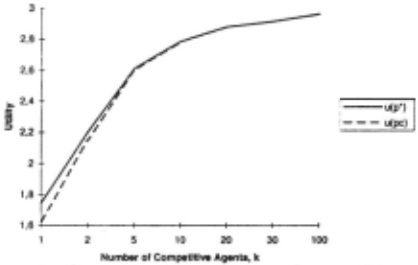
Most of this section is devoted to computing the gain from strategic behavior. For the casual reader, the main results of this section are condensed in Table 1 and Fig ure 1 below.
We get, e.g. from [17] and the definition of excess de mand, that the excess demand of the competitive agents IS
Because prices are only relative, we can set one of the prices arbitrarily, e.g. Pn can be set to 1, i.e. P2 = 1. From the budget constraint (p · z(p) = 0) we then ~ ( ) _ · '\'n -1 ( ) · k ( ) _ k ( ) get "n p - - L..j:1 PiZi P , I.e. z2 P1 - -p1z1 P1 · Using these and (7) and (8), we get
From (7) we see that x,i must be greater than zero. If the speculating agent chooses to minimize P1, it should sell as much of x1 as possible and thus, as seen from the expression for x, 1 in (9), and the requirement that x, 1 > O h > min_ I + k ( 1 ) 2 'we avep1 P1 - -2(2k+l) 2k+1 + 2(2k+1) · Analogous reasoning for x,2 shows that p1 < p'{'ax = 4~ + V ~ ( 1 - i) + ( 4 1 k) 2 . If k approaches infinity, both Piin and p'{'ax approach ~ ~ 0.707. Therefore, with an infinite number of agents, the speculator cannot af ford to affect the price in any way.
The first derivative of u, with respect to p1 is
It turns out that limp ~ "''~+ >=.&. 8 8 u ·~P. PI > 0 and li~ 1 _.p;"""- ~ < 0, and that the solution to ~ = 0 is unique in the interval Pi in < P1 < Pi ax. Therefore, the optimum, Pi, is obtained by solving ~ = 0.
The results of optimal strategic behavior are compared to the results of competitive behavior by the same agent . When the agent acts competitively, the excess demand (with u,) is z, 1 = "2:; 1 - 1. Setting the excess demand to zero gives k (P;&\~\) - 2) + P2:; 1 - 1 = 0. Solving for the competitive price gives Pi = ~· The results are shown in Table 1. 4
| k | p""" | prnaz | p | PC | u,(p;) | u,(pc) |
| 1 | 0.4343 | 1.281 | 0.7601 | 0.7746 | 1.746 | 1.626 |
| 2 | 0.5403 | 1.000 | 0.7402 | 0.7454 | 2.202 | 2.152 |
| 5 | 0.6303 | 0.8262 | 0.7227 | 0.7237 | 2.614 | 2.602 |
| 10 | 0.6667 | 0.7670 | 0.7154 | 0.7157 | 2.788 | 2.784 |
| 20 | 0.6863 | 0.7372 | 0. 7114 | 0.7115 | 2.884 | 2.884 |
| 30 | 0.6931 | 0.7272 | 0.7100 | 0. 7160 | 2.918 | 2.918 |
| 100 | 0.7029 | 0.7131 | 0.7080 | 0.7080 | 2.967 | 2.967 |
p .
Table 1: Acting strategically vs. acting competitively. k is the number of agents acting competitively. Piin is the price for x1 in the market when the speculating agent sells as much x1 as possible. p'{'ax is the price for x 1 in the market when the speculating agent sells as much x2 as possible. Pi is the market price as a consequence of strategic acting. Pi is the market price as a consequence of competitive acting by the same agent. The values u, are the corresponding utilities for the agent under obser vation.
In Figure 1, the utility is plotted for the situations where the agent acts strategically and where it acts com petitively. As expected (see e.g. [11]), the larger the number of agents, the smaller the gain from strategic behavior, and the less reason not to act competitively. In this example, already when the number of competitive agents is around five , the gain from strategic behavior is negligible.
4 Since utility is ordinal, one should be careful when dis cussing degrees of improvement.
3.2 Reaching Equilibrium
Obviously an agent 's best strategy is to declare an ex cess demand function such that the market will con verge to the prices that are optimal for the speculating agent . More formally, when perfect information is avail able, an agent 's best strategy-even if the other agents are not acting competitively, and some of them may be producers-is to declare an excess demand function with the property
for each good j , and which has a form such that the particular algorithm for searching for the market equi librium converges to p* . Depending on the setting, the difficulty of finding such a function varies. As shown be low, finding it for the simple example from above where all other agents' supply /demand functions can be taken as fixed (to do this, they do not have to be competitive in general) is normally not hard. However, finding it may be more difficult if the other agents try to act strategi cally via speculation as well. These game theoretic issues will be addressed in Section 5.
Having computed the optimal speculative solution, u; (pi) , we would like to describe the strategic behavior leading to this solution under any particular market pro tocol used. For example, if p1 is established via an algo rithm whose only requirement for finding the equilibrium is OZt(Pdfapl < 0, 5 and we have that azf(pl)fapl < 0 (i.e. demand decreases as price increases-as is the case in our example above) , we see that if
5 An example of such an algorithm is binary search. The WALRAS market framework uses this implementation.
there is a single solution for p1 = Pi, and that solution will be found by the algorithm. 6 It turns out that sim ple demand revelation strategies exist for the specula tor which guarantee that an equilibrium will be reached where the speculator's maximal gain from speculation (derived earlier in this paper) materializes. The follow ing linear function defines one such strategy-i.e. it ful fills (12) :
where zf(pi) and Pi are the speculator's (perfect) es timates of zf (Pi) and Pi respectively. Another viable strategy is defined by the constant function
4 Dealing with Uncertainty: Strategic Behavior under Biased Beliefs about Others
This section extends the discussion to include the impact of uncertainty on the speculating agent 's strategy.
4.1 The General Setting
Above, when an excess demand function was chosen based on perfect information, the exact form of the func tion was unimportant as long as it fulfilled (12). How ever, if the speculating agent cannot estimate zf per fectly, its outcome will depend on the function chosen, i.e. the choice of an excess demand function will de pend on the probability distribution that characterizes the uncertainty in the speculator's beliefs. Rather than analyzing how the excess demand is chosen for different uncertainty situations and how the speculator should try to reduce the uncertainty by learning about its environ ment in an efficient way, we describe how, for a specific choice of Z3 j, a specific error in the estimation of the competitive agents' behavior affects the outcome of the market.
Independently of how the z,i function is chosen, the possible market outcomes can be determined by solving (3) . If no solution exists, of course, no algorithm can find it , and if multiple equilibria exist, a protocol dependent analysis is required to find out which one will be chosen.
4.2 The Example Revisited
Returning to the above example, we first assume that z, 1 has been chosen as describe by ( 13) , but that now there is an error in the estimation. We define this error learn more about other agents' excess demand/supply functions. If many agents are involved in such probing, it seems that time becomes an important factor . Some agents might reveal progressively more of their compet itive demands in order to speed up the convergence {as it might be urgent for them to get the resources traded), while others might extend the probing in order to max imize their benefit from the trade. 9
6 The above reasoning extends easily to a market with more than two goods. If p is established via an algo rithm whose only requirements for finding the equilibrium are 8z;(p)f8p; < 0 and 8z;(p)f8p 1 ?: 0, i -::f; j (e.g. WAL RAS) , and we have that 8z~(p)f8p; < 0 and 8z~(p)f8pj?: 0, i -::f; j, then (12) should be generalized to z;;(p*) = -z~(p*) and az;;(p)f8p;:::; 0 and az;;(p)f8p}?: 0, i ""j.
Once the other agents' strategies are known (e.g. from a game theoretic equilibrium analysis), the methods of this paper can be used to analyze the speculating agent's strategy alternatives. The methods are protocol inde pendent, and they can be used to estimate the potential gains from speculation in any particular setting, as well as to determine how far from the optimal strategy a par ticular strategy is-as long as the other agents' strategies can be fixed conceptually. This does not mean that they need to be known with certainty.
The methods of this paper can also be used when game theoretic analysis fails. Especially when speculation is based on expected actions of other agents-instead of a game theoretic equilibrium analysis of strategies-the theory of speculation under biased beliefs is highly ap plicable. In addition, the example market used in this paper suggests that if a market is of at least moderate size, the gain from speculation is so small, and the risk of being significantly worse off due to estimation error is so great, that one can expect that each agent will act close to its competitive behavior.
6 Conclusions
We presented a method for computing the maximal ad vantage of speculative strategic behavior in general equi librium based markets. It is computed from the other agents' supply /demand functions {classic competitive behavior by the other agents is a special case of this) . The method enables one to analyze how much an agent could gain or lose by speculating in a particular system, and it is also useful when evaluating different strategies since it allows one to determine how close to the optimal strategy they are. Our analysis is valid for a wide vari ety of known market protocols. We also constructed de mand revelation strategies that guarantee that an agent can drive the market to an equilibrium where the agent's maximal advantage from speculation materializes.
Our study of a particular market shows that as the number of agents increases, the gains from speculation decrease-often turning negligible already at moderate numbers of agents. The study also shows that under uncertainty regarding other agents, compet1t1ve acting is often close to optimal, while speculation can make the agent significantly worse off- even if the agent 's beliefs are just slightly biased.
9 Some work has addressed non-competitive behavior in WALRAS [3], although there was only one speculating agent in the experiments, and this agent was limited to simple lin ear price prediction about how its actions affect the prices. Further analysis is required to determine whether its optimal strategy can be captured in this model. This need not be the case because the optimal strategy may involve some more "aggressive" behavior, e.g. the probing described above.
We believe that computational agents representing self-interested real world parties will deviate from com petitive behavior in practice only if the potential gain from speculation is sufficiently large compared to the cost of the computation or information gathering ac tions required for speculation. We also believe that an agent will not speculate when that incurs potentially large losses when estimation errors are present . Merging the above results with these beliefs suggests that spec ulation problems diminish as the market grows or the agents' information about others becomes less certain.
Finally, we discussed the protocol dependent game theoretic issues related to multiple agents counterspecu lating. There are many open issues in this area and the difficulties should not be underestimated.
Acknowledgments
The authors thank Arne Andersson, Junling Hu, John Nachbar, Eric Schenk, Fernando Tohme, Michael Well man, and Curt Wells for interesting discussions and com ments. Fredrik also thanks Hans Akkermans, Rune Gus tavsson and Hans Ottosson for all their support .
@inproceedings{ijcai1997p93,
  title     = {On the Gains and Losses of Speculation in Equilibrium Markets},
  author    = {Sandholm, Tuomas and Ygge, Fredrik},
  booktitle = {Proceedings of the Fifteenth International Joint Conference on
               Artificial Intelligence, {IJCAI-97}},
  publisher = {International Joint Conferences on Artificial Intelligence},
  editor    = {Martha E. Pollack},
  pages     = {632--638},
  year      = {1997},
  note      = {Distributed Artificial Intelligence},
  url       = {https://ijcai.org/proceedings/1997/93},
}
TY - CPAPER TI - On the Gains and Losses of Speculation in Equilibrium Markets AU - Sandholm, Tuomas AU - Ygge, Fredrik T2 - Proceedings of the Fifteenth International Joint Conference on Artificial Intelligence, IJCAI-97 PB - International Joint Conferences on Artificial Intelligence PY - 1997 SP - 632 EP - 638 UR - https://ijcai.org/proceedings/1997/93 ER -Copied
Machine-readable versions of this paper, for tools and AI agents:





