
Generating Multimedia Briefings: Language Generation in a Coordinated Multimedia Environment
Proceedings of the Fifteenth International Joint Conference on Artificial Intelligence. Invited Speakers. Pages 1607-1611.
© 1997 International Joint Conferences on Artificial Intelligence
Abstract
Communication can be mor e effective when several media (such as te xt, sp eech , or graphics) are integrated and coordinated to pr ese nt information . This changes th e nature of me dia specific gene ration (e.g., language generation) which must take into account the multim e dia context in which it occurs. In this paper, I will pr esent work on coordinating and int egra ting speech, text, static and animated 3D graphics, and stored imag es, as part of several systems we hav e develop ed at Columbia University. A pa rti cular focus of our work has been on the generation of presentations th at brief a user on information of int erest.
- [Aho et a/., 1997] A. Aho, S.-F. Chang, K. R. McKe- own, D. Radev , J. Smith, and K. Zaman. Columbia Digital News System: An environment for briefing and search over multimedia information. In Proceedings of ADL-97, Washington, D.C., May 1997.
- [Dalal et a/., 1996a] M. Dalal, S. Feiner, K. R. McKe- own, D. Jordan, B. Allen, and Y. alSafadi. MAGIC: An experimental system for generating multimedia briefings about post-bypass patient status. In Proc. 1996 AMIA Annual Fall Symp., pages 684-688, Wash- ington, DC, October 26-30, 1996.
- [Dalal et a/., 1996b] M. Dalal , S. Feiner, K. R. McKe- own, S. Pan, M. Zhou, T. Hoellerer, J. Shaw, Y. Feng, and J. Fromer. Negotiation for automated generation of temporal multimedia presentations. In Proc. ACM Multimedia '96, pages 55-64, Boston, MA, November 18-22, 1996.
- [Feiner and McKeown, 1990] S. K. Feiner and K. R. McKeown. Coordinating text and graphics in explana- tion generation. In Proceedings of the National Con- ference on Artificial Intelligence, Boston, Mass., Au- gust 1990.
- [Feiner and McKeown, 1991] S. Feiner and K. R. McK- eown. Automating the generation of coordinated mul- timedia explanations. IEEE Computer, 24(10):33-41 , October 1991.
- [Kupiec et a/., 1995] Julian M. Kupiec, Jan Pedersen, and Francine Chen. A trainable document summa- rizer. In Edward A. Fox, Peter Ingwersen, and Raya Fidel, editors, Proceedings of the 18th Annual Inter- national ACM SIGIR Conference on Research and Development in Information Retrieval, pages 68-73 , Seattle, Washington, July 1995.
- [Luhn, 1958] Hans P. Luhn. The automatic creation of literature abstracts. IBM Journal, pages 159-165, 1958.
- [McKeown and Radev, 1995] K. R. McKeown and D.R. Radev. Generating summaries of multiple news arti- cles. In Edward A. Fox, Peter Ingwersen, and Raya Fidel, editors, Proceedings of the 18th Annual Inter- national ACM SIGIR Conference on Research and Development in Information Retrieval, pages 74-82, Seattle, Washington, July 1995.
- [McKeown et a/., 1990] K. R. McKeown , M. Elhadad , Y. Fukumoto, J. Lim, C. Lombardi , J . Robin, and F. Smadja. Language generation in COMET. In Current Research in Language Generation. Academic Press, London, 1990.
- [McKeown et al., 1992] K. R. McKeown, S. K. Feiner, J. Robin, D. Seligmann, and M. Tanenblatt. Gener- ating cross references for multimedia explanations. In Proceedings of AAAI-92. AAAI, July 1992.
- [McKeown et a/., 1993] K. R. McKeown, J. Robin, and M. Tanenblatt. Tailoring lexical choice to the user 's vocabulary in multimedia explanation generation. In Proceedings of the 31st Annual Meeting of the Associ- ation for Computational Linguistics, Columbus, Oh. , June 1993.
- [McKeown eta/., 1995] K. R . McKeown, J. Robin, and K. Kukich. Generating concise natural language sum- maries. Information Processing and Management, spe- cial issue on summarization, 31(5):703-733, Septem- ber 1995.
- [McKeown et al., 1997] K. R. McKeown , S. Pan , J. Shaw, D. Jordan, and B.A. Allen . Language gener- ation for multimedia healthcare briefings. In Proceed- ings of the ACL Conference on Applied Natural Lan- guage , Washington, D.C. , April 1997 . 1612 INVITED SPEAKERS [MUC, 1992] DARPA Software and Intelligent Systems Technology Office. Proceedings of the Fourth Message Understanding Conference (MUC-4), 1992.
- [Paice and Jones, 1993] Chris D. Paice and Paul A. Jones. The identification of important concepts in highly structured technical papers. In Proceedings of the 16th Annual International ACM SIGIR Con- ference on Research and Development in Information Retrieval, pages 69-78, 1993.
- [Pan and McKeown , 1996] S. Pan and K. R . McKeown. Spoken language generation in a multimedia system. In Proceedings of ICSLP 96, volume 1, pages 374-377, Philadelphia, PA, 1996.
- [Rau et a/., 1994] L. F. Rau , R . Brandow, and K. Mitze. Domain-independent summarization of news. In Sum- marizing Text for Intelligent Communication, pages 71-75, Dagstuhl, Germany, 1994.
- [Robin and McKeown, 1993] J. Robin and K. R. McK- eown. Corpus analysis for revision-based generation of complex sentences. In Proceedings of the 11th N a- tiona/ Conference on A rtificia/ Intelligence, Washing- ton, D.C ., July 1993. American Association for Arti- ficial Intelligence.
- [Robin and McKeown, 1996] J. Robin and K. R . McK- eown. Empirically designing and evaluating a new revision-based model for summary generation. A rti- ficia/ Intelligence, 85 , August 1996. Special Issue on Empirical Methods.
- [Roderer and Clayton, 1992] N. Roderer and P. Clay- ton. IAIMS at Columbia Presbyterian Medical Center: Accomplishments and challenges. In Bull. Am. Med. Lib. Assoc., pages 253-262, 1992.
- [Seligmann and Feiner , 1991] D. Seligmann and S. Fei- ner. Automated generation of intent-based 3D illus- trations. In Proc. ACM SIGGRAPH '91 (Computer Graphics, 25{4), July 1991}, pages 123-132, Las Ve- gas, NV, July 28-August 2 1991.
- [Smith and Chang, 1996] J .R. Smith and S.-F . Chang. Searching for images and videos on the World-Wide Web . Submitted to IEEE Multi- media Magazine, also CU-CTR Technical Report 459-96-25, 1996. Demo accessible from URL http://www.ctr.columbia.edu/webseek. Link
References were extracted automatically from the PDF and may contain errors.
Full text extracted automatically from the PDF; figures, tables and equations may differ. The PDF is the version of record.
1 Introduction
In many contexts , explanations can be more effective if they use multiple media. In our work, we have ex plored the generation of multimedia explanations in the context of providing instructions for equipment mainte nance and repair [Feiner and McKeown, 1991], providing briefings on patient status after bypass for various care givers lDalal et al., 1996a; 1996bJ, and providing illus trated briefings over online documents in an Internet en vironment [Aho et a/., 1997] . A key characteristic of our work is the dynamic generation of content and form at the time an explanation is required. This means that we can vary not only what is communicated, but also how different media are used in combination to best convey information depending upon the situation.
Our work has integrated a range of media within an explanation , including the use of written text accompa nied by static graphics, the use of spoken language, text, and animated graphics, and the use of textual summaries with representative images. Our research has focused on coordinating the different media in a single explanation, using individual media to present aspects of the presen tation for which they are particularly suited and ensuring Lhat generation within one medium enhances portions of the presentation in other media.
· A great number of people have collaborated on the .projects that are overviewed in this abstract of my invited talk. See the Acknowledgments Section for a list of contrib utors who in other situations have been co-authors.
The nature of generation for an individual medium, such as language, is changed by the fact that it occurs in a multimedia environment. For example, how lan guage refers to information and entities in the domain changes when there is an accompanying illustration of the same information or entities. Furthermore, the na ture of this change depends upon the specific media used. For example, coordination of spoken language and ani mated graphics requires that spoken references be tem porally synchronized with the accompanying graphical reference. The combined use of text and speech, on the other hand , changes the content of generated references. Spoken references can be shorter and more natural as long as the accompanying textual reference provides the full, unambiguous reference.
In our more recent work , multimedia explanations are generated for the goal of briefing a user [Dalal et al., 1996a; Aho et al., 1997] . In the healthcare domain, they provide a concise summary for time-pressure.d caregivers. In the Internet environment , they highlight information contained in the underlying multimedia documents. In both scenarios, the nature of language generation dif fers from traditional text generation: summaries must be concise, using as few words as possible; at the same time, they must be informative, conveying as much in formation as possible in limited time or space.
In this paper, we present issues for language gener ation when produced as part of a multimedia briefing. We begin with a brief overview of the approaches we use in the three systems we have developed. We then discuss the modification of language generation for the multimedia context and finally, highlight questions for summarization.
2 An Overview of Columbia University Multimedia Systems
In this section , we provide a brief overview of several multimedia systems developed at Columbia University, highlighting domain, types of media used , and the goals for generating explanations. For full details on each sys tem, refer to the original papers cited below, from which the examples of generated explanations are drawn.
2.1 COMET
COMET (COordinated Multimedia Explanation Test bed) generates coordinated, interactive explanations that combine text and three-dimensional graphics [Feiner and McKeown, 1991]. COMET not only deter mines what information to communicate using a content planner, but also how to express it in each medium us ing medium-specific generators [McKeown et al., 1990; Seligmann and Feiner, 1991; McKeown et al., 1993]. Text and graphics are coordinated by communication with a media coordinator [Feiner and McKeown, 1990; McKeown et al., 1992]. COMET was developed to pro vide explanations for equipment maintenance and repair. It generates explanations that instruct users how to carry out diagnostic tests on a particular piece of equipment, a military radio receiver-transmitter. Explanations typ ically describe one or more steps in these tests that are presented in a series of displays, where each display in cludes an illustration and a caption providing the textual instruction.
2.2 MAGIC
MAGIC (Multimedia Abstract Generation for Intensive Care) is being developed to provide a multimedia in terface to health care data. In particular, MAGIC is designed to provide briefings on patient status immedi ately following a coronary bypass operation. In a Car diac Intensive Care Unit, communication regarding pa tient status is critical during the hour immediately fol lowing bypass. It is at this critical point, when care is being transferred from the operating room to the Inten sive Care Unit and monitoring is at a minimum, that the patient is most vulnerable to delays in treatment. During this time, there are a number of caregivers who need information about patient status and plans for care. Yet, the only people who can provide this information are those who were present during surgery and they are often too busy attending to the patient to communicate much detail.
MAGIC takes as input online data collected during the surgical operation as well as information stored in the mainframe databases at Columbia Presbyterian Medi cal Center [Roderer and Clayton, 1992]. It generates a multimedia briefing that integrates speech, text, and animated graphics to provide an update on patient sta tus [Dalal et al., 1996a]. Like COMET, it dynamically determines both content and form of the explanation, but the focus here is on the coordination of temporal media [Dalal et al., 1996b]. Language generation ad dresses the issue of producing language (wording and sentence structure) appropriate for the spoken medium [Pan and McKeown, 1996; McKeown et al., 1997] as op posed to the more traditional task of generating written language. Given the healthcare setting, MAGIC also faces the added constraint of conciseness; the generation process must make coordinated use of speech and text to produce an overview that is short enough for time pres sured caregivers to follow, but unambiguous in meaning.
2.3 CDNS
Research in CDNS (Columbia Digital News System) fo cuses on the development of technologies to aid people in finding and tracking information on current events. We are developing a system, CDNS, that provides up to-the-minute briefings on news of interest, linking the user into an integrated collection of related multimedia documents. Our research aims at tracking news stories on the same event, producing a briefing that describes how the event has changed over time. A representative set of images or videos can be incorporated into the sum mary. The user can follow up with multimedia queries to obtain more details and further information.
The goal of summarization within CDNS is to brief the user on information within the collection of related docu ments. In many cases, the summary provides enough in formation for the user to avoid reading the original doc ument. In others, the user may want to check the orig inal documents to verify information contained within the summary, to follow up on an item of interest, or to resolve conflicting information between sources. To meet the demands of this environment, our work fea tures summarization over multiple articles, merging in formation from all relevant sources into a concise state ment of the facts. This is in contrast to most previ ous work that summarizes single · articles [Luhn, 1958; Paice and Jones, 1993; Rau et al., 1994; Kupiec et al. , 1995]. Summaries must identify how perception of the event changes over time, distinguishing between accounts of the event and the event itself [McKeown and Radev, 1995]. Eventually, given access to live news, the summa rizer will be able to provide updates since the last gener ated summary, identifying new information and linking its presentation to earlier summaries.
Unlike COMET and MAGIC, CDNS must determine the content of a briefing through analysis of input tex tual documents. Furthermore, while CDNS generates the content and form of the written summary, images are selected as a whole from an online collection of im ages .
3 Language Generation m a Multimedia Context
In a multimedia explanation each medium presents in formation about the same subject. In some cases, the exact same information is presented in multiple media, providing different viewpoints of the same material. In other cases, media may present complementary informa tion about the same topic when certain types of infor mation are more easily communicated in one medium than another. For example, spatial information such as location may be more easily conveyed in graphics, while abstract information such as illness severity may be more easily conveyed in language.
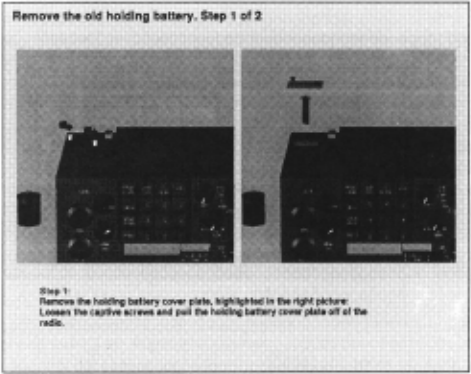
The fact that each medium presents information about the same topic, sharing communicative goals, means that individual media can not be generated in isolation. How individual media generation is affected by other media depends on the types of media that are coordinated within the multimedia presentation. A multimedia pre sentation that coordinates speech and graphics engen ders different influences on the language generation pro cess than one that coordinates text and images.
As an example of the kind of influences that exist, con sider that at the most basic level, different media refer to the same information or entities within the same mul timedia presentation, often to satisfy the same high level goal. If they have knowledge about the references used in other media, they can use that to influence how refer ring expressions are generated in their own medium. In addition to changing how referring expressions are gen erated, in some cases an explicit cross reference may be effective to link information in one media with another. Exactly how the generation of referring expressions is modified varies depending upon the media involved.
Text and static graphics. In our earlier work on COMET, multimedia presentations comprised writ ten language and static graphics. In this scenario, text appears as a caption below an illustration. To signal where text and illustration refer to the same object or action, an explicit cross reference must be generated link ing the two media. Here, generating a textual cross ref erence must make use of knowledge about the graphical illustration to determine what kind of cross reference to generate. The language generator can make use of information about the illustration content to identify a referent for the hearer; the text "the old holding bat tery, shown in the cutaway view" uses information about special graphical features used in the illustration (here graphics cut a"'ay a portion of the radio to reveal the holding battery which is internal to the radio). Alternatively, it can use information about illustration structure as shown in Figure 1 or information about spatial loca tion. To generate cross references, language generation must be modified to determine when a cross reference is needed (e.g., when a user will not know the referent of a textual expression alone) and query the illustration representation to construct cross reference content. In COMET, generating cross references is carried out co operatively by the graphics and text components and can involve modifications to the illustration as well as to language [McKeown et al., 1992].
Spoken language and animated graphics. When spoken language and animated graphics are part of the multimedia presentation as is the case in MAGIC, a more implicit means of linking references across media can be used. As references are spoken, graphical representa tions of the referenced information can be highlighted in the accompanying illustration. In this scenario, spo ken references must be coordinated with accompanying highlighting that changes over time, involving negotia tion between speech and graphics to arrive at both a compatible ordering and duration of references [Dalal et al., 1996b]. In particular, speech has grammatical con straints on how references are linearly, and thus tem porally, ordered within a sentence. At the same time, graphics has spatial constraints on how information is ar ranged within an illustration. Taken individually, such constraints might result in an incoherent presentation which refers to graphical representations at random lo cations in the illustration. Similarly, durations of both spoken references and highlighting must be coordinated to avoid changes in highlighting at semantically anoma lous points in the sentence or blinking that might occur if highlighting is changed too frequently.
The problem for language generation in this context is to produce enough information to facilitate coordination. First, note that the full ordering of spoken references is only determined when all grammatical constraints have been applied and the final sentence generated. But it would be quite inefficient to wait until this point to co ordinate with graphics as it could potentially involve generating many sentences that were never used in the final presentation. Instead, we produce a partial order ing over references at an intermediate point in language generation, after words have been selected but before grammatical constraints are applied. Second, given that any particular ordering of spoken references produced by the language generation component may not be compat ible with graphics' orderings, the language generation process must be modified to produce several possibilities ordered by preference. Third, since graphics does not understand the meaning of a string of words that forms the spoken reference, the language generator must main tain a mapping between the words of the reference and the semantic object they refer to in order to communi cate with graphics via the media coordinator. Finally, to facilitate synchronization of spoken references with high lighting, the spoken language generator must be able to compute duration of a spoken reference, to reason about
S. Jones
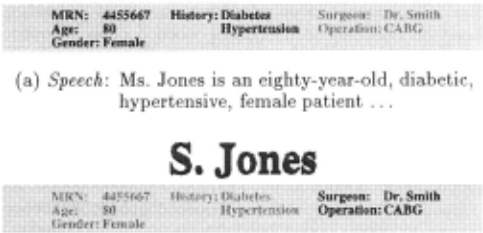
(b) Speech: ... of Dr . Smith undergoing CABG.
Figure 2: A portion of coordinated speech and graphics generated by MAGIC
where pauses can be adjusted in speech to allow more flexibility in coordinating with highlighting, and to se lect semantically appropriate points in the sentence be tween references which can be temporally coordinated with changes in highlighting [Pan and McKeown, 1996].
Figure 2 shows a portion of a multimedia briefing gen erated by MAGIC. Here, as each part of the first sen tence is spoken, the corresponding information in the demographics chart of the accompanying illustration is highlighted. Just the chart is shown in Figure 2.
Spoken and written language. In MAGIC, both speech and text are used within the same presentation. Textual references are used to provide labels for objects and information displayed graphically. Language gener ation takes advantage of the use of both media to keep spoken language shorter and more colloquial, thus bet ter meeting our goal of briefing caregivers. As long as the text label on the screen is generated using the full, unambiguous reference, speech can use an abbreviated expression. For example, when referring to the medical devices which have been implanted as part of cardiac care, speech can use the term "pacemaker" so long as the textual label specifies it as "ventricular pacemaker" . Similarly, MAGIC uses "balloon pump" in speech in stead of "intra-aortic balloon pump" , which is already shown on the screen. In order to do this, lexical choice in both media must be coordinated. Lexical choice for text always selects the full reference, but lexical choice for speech must check what expression the text genera tor is using. The speech lexical chooser must check what attributes the text generator includes in its reference and omit those.
Written language and images. In CDNS, a written summary is generated along with several representative images as shown in Figure 3. In this scenario, the spe cific objects contained in the image are unknown 1 , and
1 Unless we use vision techniques to do image analysis and identify the objects the image contains, a prospect that is not yet feasible for domain independent image processing,
QUERY OUTPUT
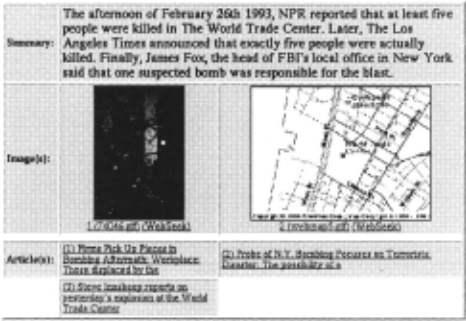
therefore, the written summary cannot explicitly refer to image content . Unlike the other multimedia systems dis cussed here, the content and form of the accompanying image is not dynamically generated at the time of the presentation. Instead, an image is selected for use when the briefing is generated. The problem here is to ensure that the images selected are relevant to the content of the summary. We are exploring the use of integrated processing of textual and image features to select ap propriate images. This is done by classifying unlabeled images as part of an underlying ontology. Image features can be used to reliably make certain categorizations; for example, image features can be used to determine if the image is a graphic, such as a map, or a photograph as well as more semantic categorizations such as whether it is a portrait showing a person or a landscape [Smith and Chang, 1996]. We are augmenting this by using sta tistical analysis of the text accompanying an image to provide a better semantic classification of image content (e.g., whether an image pertains to a terrorist event or a particular political event such as a Russia-US summit) [Aho eta/., 1997]. By applying standard text categoriza tion techniques to different amounts of text surrounding an image in a multimedia document, from caption to text fragment to full document, we are experimenting with the improvement on classification over using image features alone.
4 Issues for Summarization
Just as the nature of language generation changes in a multimedia context, so do problems for summary gen eration change from the generic problems in language generation. Summaries must convey maximal infor mation in a minimal amount of space. This requires selecting words and sentence structures that can con vey information concisely. Sometimes, this means the use of complex sentence structure, including multiple modifiers of a noun or verb, conjunction (e.g., "and"), and ellipsis (i.e., deletion of repetitions across conjoined phrases) . For example, phrases such as "hypertensive" and "undergoing CABG" use fewer words than iffull sen tences were used to convey each of these facts separately (see Figure 2). Conciseness also means the selection of words that can convey multiple aspects of the informa tion to be communicated. For example, a verb such as "surged" conveys both the direction and the speed of a gain on the stock market. Furthermore, our re search shows that some information is opportunistically added into the summary, depending on the words and syntactic structure already used [McKeown et a/., 1995; Robin and McKeown, 1996].
we cannot reliably identify and label image content.
We characterize problems for summary generation as falling into two separate classes, conceptual summariza tion, or determining what information should be in cluded in a summary, and linguistic summarization, the task of determining how to convey as much information as possible in a short amount of text. Conceptual sum marization takes input from multiple sources, whether databases or text, and determines how it can be merged together , often using semantic generalization to do so. Our work in CDNS addresses problems in conceptual summarization. Information is extracted from each ar ticle and represented in a template using systems de veloped under the DARPA message understanding pro gram [MUC, 1992]. CDNS then uses planning operators to determine how to merge information from the sepa rate templates representing each article. In particular, it looks for contradictions, agreements, and refinements of information, and makes generalizations.
Our work in MAGIC addresses problems in linguistic summarization. As in previous work on summarization over data [Robin and McKeown, 1993; 1996], we address the following issues:
- How to use syntactic and lexical devices to convey information concisely?
- Given the choice of a particular word or syntactic structure, how does this constrain (or allow) the at tachment of additional information?
- How to fold multiple pieces of information into a single linguistic construction?
In MAGIC, this means conveying as many attributes from the underlying database as possible in one sentence through the use of modifiers such as adjectives or prepo sitional phrases. Thus, in Figure 2, the first sentence conveys nine separate attributes. In addition, coordi nated use of speech and written language also aids in meeting our goal of conciseness; shorter references can be generated in speech since they are clarified in the written labels of the accompanying illustration.
5 Conclusion
In this extended abstract, we have outlined issues for the generation of multimedia briefings and shown how we have addressed them in several different systems. While in this paper we focused on the problem of generating references in a multimedia environment, we have also looked at the interaction between generation in different media for other problems as well. For example, in work on COMET we explored how separation of information into different pictures can influence sentence breaks. In general, style of generation in one media can and should influence generation in others.
Of course, there are many other issues in the genera tion of multimedia briefings. In our current work, we are addressing the generation of different types of prosody for speech using information from language generation. We are particularly interested in the use of prosody that facilitates coordination within the multimedia environ ment such as pause duration. For example, by com puting a range on pause duration and options on pause placement, we simplify the task of temporally synchro nizing spoken and graphical actions. In CDNS, we are continuing to exploit multimedia features in online news sources to improve both generation of illustrated brief ings and search over online, multimedia documents. We are also working on the generation of summaries from live information that update a user over information al ready received.
Acknowledgments
This extended abstract reflects the work of many indi viduals over the course of many years. My closest col laborator in work on multimedia explanation has been Steven Feiner, with whom I have enjoyed many long hours of thought-provoking discussion, joint meetings on system design and development, and mad races to deadlines. In our recent work on MAGIC, Mukesh Dalal has also joined our collaboration on multimedia coor dination. Others who have contributed to work de scribed here include: Michael Elhadad, Doree Selig mann, and Jacques Robin (COMET); Desmond Jordan, Barry Allen, Shimei Pan, James Shaw, Michelle Zhou, Tobias Hollerer, and Yi Lang (MAGIC); Alfred Aho, Shih Fu Chang, Dragomir Radev, John Smith, Alex Jaimes, and Kazi Zamen (CDNS).
@inproceedings{ijcai1997p233,
  title     = {Generating Multimedia Briefings: Language Generation in a Coordinated Multimedia Environment},
  author    = {McKeown, Kathleen R.},
  booktitle = {Proceedings of the Fifteenth International Joint Conference on
               Artificial Intelligence, {IJCAI-97}},
  publisher = {International Joint Conferences on Artificial Intelligence},
  editor    = {Martha E. Pollack},
  pages     = {1607--1611},
  year      = {1997},
  note      = {Invited Speakers},
  url       = {https://ijcai.org/proceedings/1997/233},
}
TY - CPAPER TI - Generating Multimedia Briefings: Language Generation in a Coordinated Multimedia Environment AU - McKeown, Kathleen R. T2 - Proceedings of the Fifteenth International Joint Conference on Artificial Intelligence, IJCAI-97 PB - International Joint Conferences on Artificial Intelligence PY - 1997 SP - 1607 EP - 1611 UR - https://ijcai.org/proceedings/1997/233 ER -Copied
Machine-readable versions of this paper, for tools and AI agents:





