
Prioritized Goal Decomposition of Markov Decision Processes: Toward a Synthesis of Classical and Decision Theoretic Planning
Proceedings of the Fifteenth International Joint Conference on Artificial Intelligence. Planning and Scheduling. Pages 1156-1161.
© 1997 International Joint Conferences on Artificial Intelligence
Abstract
We describe an approach to goal decomposition for a certain class of Markov decision processes (MOPs) . An abstraction mechanism is used to generate abstract MOPs associated with different objectives, and several methods for merging the policies for these different objectives are considered. In one technique, causal (least-commitment) structures are generated for abstract policies and plan merg ing techniques, exploiting the relaxation of policy commitments reflected in this structure, are used to piece the results into a single policy. Abstract value functions provide guidance if plan repair is needed. This work makes some first steps toward the synthesis of classical and decision theoretic planning methods .
- R. E. Bellman. Dynamic Programming . Princeton, 1957.
- C. Boutilier, R. Dearden, and M. Goldszmidt. Exploiting structure in policy construction. In /JCA/-95, pp.ll 04-1111, Montreal, 1995. IJCAI
- M. E. Bratman. Intentions, Plans, and Practical Reason. Har- vard, 1987.
- T. Dean, L. P. Kaelbling, J. Kirman, and A. Nicholson. Plan- ning with deadlines in stochastic domains. In AAAI-93, pp.574-579, Washington, D.C., 1993.
- T. Dean and K. Kanazawa. A model for reasoning about per- sistence and causation. Comp. Intel., 5(3): 142-150, 1989.
- R. Dearden and C. Boutilier. Abstraction and approximate de- cision theoretic planning. Artif. Intel., 89:219-283, 1997.
- R. A. Howard. Dynamic Programming and Markov Pro- cesses. MIT Press. Cambridge, 1960.
- R. L. Keeney and H. Raiffa. Decisions with Multiple Objec- tives: Preferences and Value Trade-offs. Wiley, New York, 1978.
- N. Kushmerick, S. Hanks, and D. Weld. for probabilistic least-commitment planning. pp.l 073-1078, Seattle, 1994. An algorithm In AAA/-94,
- D. McAIIester and D. Rosenblitt. Systematic nonlinear plan- ning. In-AAA/-91 , pp.634-639,Anaheim, 1991.
- J. S. Penberthy and D. S. Weld. UCPOP: A sound, complete, partial order planner for ad!. In KR-92, 1992.
- M. L. Puterman. Markov Decision Processes: Discrete Stochastic Dynamic Programming . Wiley, NY, 1994.•
- D. S. Weld. An introduction to least commitment planning. AI Magazine, Winter 1994:27-61, 1994.
- Q. Yang, D. S. Nau, and J. Hendler. Merging seperately gen- erated plans in limited domains. Comp. Intel., 8(4), 1992.
References were extracted automatically from the PDF and may contain errors.
Full text extracted automatically from the PDF; figures, tables and equations may differ. The PDF is the version of record.
1 Introduction
Markov decision processes (MDPs) have become a stan dard conceptual and computational model for decision the oretic planning (DTP) problems, allowing one to model un certainty, competing goals, and process-oriented objectives. One of the key drawbacks of MDPs, vis-a-vis classical plan ning methods, is the exponential nature of standard, dynamic programming policy construction algorithms. These gener ally require explicit state space enumeration.
Recent work in DTP has focused on techniques that exploit problem structure to solve MDPs in efficient ways. Such methods include problem decomposition based on reachabil ity analysis [4] and exact and approximate abstraction algo rithms [6, 2] in which states are (implicitly) aggregated de pending on whether they agree on the values of certain prob lem variables. Indeed, these abstraction methods apply an in sight fundamental to classical planning: feature-based search methods are usually much more tractable than state-based methods. This underlies, for instance, regression and causal link planning algorithms [13] .
In this paper, we investigate another way of decompos ing MDPs for efficient solution, namely, goal decomposition. Speeifically, if utility is assigned to the achievement of cer tain features (as in multi-attribute utility theory [8]), we will consider "components" of the utility function separately. In rough outline, we decompose the utility function, construct an abstract policy for each component that maximizes per formance with respect to its objectives, and then attempt to merge the abstract policies into a single, coherent, approxi mately optimal policy for the entire set of objectives.
2 MDPs and Least-Commitment Plans
2.1 Markov Decision Processes
We assume that the system to be controlled can be described as a fully-observable, discrete state Markov decision process [1, 7, 12], with a finite set of system states S. The control ling agent has available a finite set of actions A which cause stochastic state transitions: we write Pr( s, a, t) to denote the probability action a causes a transition to state t when exe cuted in states. A real-valued reward function R reflects the objectives of the agent, with R( s) denoting the (immediate) utility of being in states. A (stationary) policy 1r : S -+ A de notes a particular course of action to be adopted by an agent, with 1r( s) being the action to be executed whenever the agent finds itself in states. We assume an infinite horizon (i .e., the agent will act indefinitely) and that the agent accumulates the rewards associated with the states it enters.
In order to compare policies, we adopt expected total dis counted reward as our optimality criterion; future rewards are discounted by rate 0 ::::; f3 < 1. The value of a policy 1r can be shown to satisfy [7] :
The value of 1r at any initial states can be computed by solv ing this system of linear equations. A policy 1r is optimal if V" ( s) 2:: V"' ( s) for all s E S and policies 1r'. The opti~l value function v· is simply the value function for any opti mal policy. We refer to [I, 7, I2] for a description of policy construction techniques.
2.2 Action and Reward Representation
Several good representations for MDPs, suitable for DTP, have been proposed. These include stochastic STRIPS opera tors [9, 6] and dynamic Bayes nets [5, 2] for representing ac tions, and related methods for describing reward functions. We will adopt the STRIPS-style specification used in [6].
We assume a set of atomic propositions used to describe the planning problem of interest. Each action a is represented by two components, a precondition and a probabilistic ef fect set. A precondition P is a list of literals, interpreted in the usual way: a can only be performed in states satisfying P. A probabilistic effect set£ comprises a set of context effect pairs of the form (C, EL). Each C is a context un der which action a has a different (stochastic) effect. Were quire that the set of contexts be mutually exclusive and ex haustive given P. The associated effects list EL describes the possible effects action a could have in context C and the probability with which they occur. More precisely, EL = (E1 ,p1 ; ... ; En,Pn) where each E; is a list of literals (an ef fect) and each p; is the probability of effect E; occurring. If E; occurs, the resulting state change is such that the literals mentioned in E; become true and any literal whose atom does not occur in E; retains its truth value [9] (i.e., E; is a STRIPS style change list).
To concisely represent actions that have multiple, uncorre lated stochastic effects, we use action aspects [6]. Each as pect for action a is represented exactly as a probabilistic ef fect set, with its own set of contexts and effects. However, the effects lists in different aspects must be disjoint (i.e., have no atoms in common). To determine the net effect of a in state s, the condition C; satisfied by s in each aspect £; is deter mined, and a joint effect consisting of the union of one effects list from each aspect occurs with the product of the probabil ities associated with these lists. 1
| II Actwn | Context | Effect | Prob II |
|---|---|---|---|
| drill p Asp. I) | 0 | hole(p) | 1.0 |
| drill(p) (Asp.2) | pres.<ed(p) ,pressed(p) | hot 0 0 | 0.9 0.1 1.0 |
| drill(p) (Asp.j) | 0 | .,painted(p) 0 | 0.9 0 .1 |
| paint(p) | --w | painted(p) | 1.0 |
| press(p) (Asp.l) | 0 | pres.<ed(p) 0 | 0.95 0.05 |
| pre.u(p) (Asp.:l) | 0 | -,painted(p ) 0 | 0.95 0.05 |
| mdrill(p) (Asp. I) | T | hol~(p) 0 | 0.7 0.3 |
| mdrill' p (Asp.2) | T | -,painted(p ) | 1.0 |
| Feature | Reward |
|---|---|
| hole(Pl) 1\ pressed(Pl ) pain~((~{) hole P2 | 10 7 2 |
This representation is illustrated in Figure I. We have sev eral job shop operations that can be applied to parts, such as drilling, manual drilling, pressing, and painting. The ef fects of these operations are shown in the table. For instance, drill(p) has several independent effects (aspects): it produces a hole in p, it might cause the drill bit to become hot if p is pressed, and tends to destroy p's paint job. If one drills a pressed, painted part p, the different aspects combine to pro duce the following effects:
Pressing can sometimes fail, and also destroys paint. Manual drilling is not guaranteed to produce a hole and is guaranteed to destroy paint. No preconditions are shown in the table, but we assume that the drilling action has the precondition ·hot (the drill bit is not hot).
The reward function R can also be represented compactly in many circumstances. We assume the reward function as sociates additive, independent rewards with different domain propositions [8]: the reward associated with a state is simply the sum of the rewards given for the propositions it satisfies. Figure 2 shows such a function, where reward is given based on the features of two distinct parts P 1 and P2. We assume reward 0 is associated with all unmentioned features.
1 This representation reflects the same kinds of independence as sumptions one finds in Bayes net action representations [5, 2], and offers the same conciseness of representation when there are multi ple uncorrelated effects.
2.3 Approximate Abstraction
The abstraction technique developed in [6] can reduce the size of the MDP one needs to solve to produce an approxi mately optimal policy. Using regression-like operations, we can discover which atoms influence the probability of other propositions becoming true when certain action sequences are executed. When a reward function has independent com ponents, we can sweep through the action descriptions de termining which propositions (contexts and preconditions) influence the ability to make the reward proposition true or false, which propositions, in turn, influence these, and so on. Such atoms are deemed relevant atoms, the set of which is de noted R . Once this process is completed, any atoms not in R (i .e., that do not influence the probability of a reward proposi tion through any action sequence) can be ignored. Their truth values cannot influence the optimal choice of action.
For instance, suppose the only atom that influences reward is hole( Pi) . Since drilling affects this, its precondition ·hot dictates that atom hot is relevant. Since hot is affected by drilling if pressed(Pi), atom pressed(PJ) is also added to R . No atom influences any action's effect on pressed(PJ) ; thus, a fixed point is reached, with the only relevant atoms be ing hole( Pi), hot and pressed( Pi) . The abstract MDP over this reduced space has only 8 states, and can be more easily solved to produce an optimal policy.
More importantly, one can ignore certain reward proposi tions to produce an approximate abstraction (see [6]). For instance, in Figure 2, atoms hole(PJ) , pressed(PJ), and painted(P i) have a larger influence on reward than hole(P2) . By ignoring the hole(P2), we create an abstract space much smaller than the one needed to solve the MDP optimally only atoms pertaining to Pi (and hot) are introduced into R , hence the resulting abstract MDP. This MDP has only 16 states and is easier to solve. One optimal policy (among sev eral possibilities) for this MDP has the form:
| lf•pressed(Pi ): | press( Pi) |
| If pressed(P i) 1\ •hole(P 1) 1\ •hot : | drill( Pi) |
| If pressed( Pi) 1\ •hole( Pi) 1\ hot: | mdrill(Pi) |
| If pressed(Pi) 1\ hole(PJ) 1\ •painted( Pi) | : paint( Pi) |
| If pressed(PJ) 1\ hole( Pi) 1\ painted( Pi) : | no-op |
This computational benefit comes at the cost of optimality: the policy makes no attempt to machine P2, since any value associated with it has been ignored. However, if the value lost is small enough, the tradeoff for a (potentially exponen tial) decrease in computation time may be acceptable.
Formally, we can describe the approach as follows: 1) Se lect a subset, IR, of immediately relevant atoms that influ ence immediate reward. These will generally be the atoms that have the largest impact on reward. 2) Generate the set R of relevant atoms satisfying the properties: a) IR ~ R; and b) if P E R "occurs" in an effect list of some action as pect, each atom occurring in the corresponding context, or in the precondition for a, is in R . 3) Solve the MDP associated with this reduced set of atoms R . We note that generating R given the set IR can be done in O(EIRI) time, where E is the size of the set of action descriptions (i.e., the number of context-effect pairs).
2.4 Least-Commitment Plans
We will use least-commitment (or partially-ordered) plans to represent the relevant parts of policies in a way that allows them to be more easily "merged." We briefly review the rel evant concepts here, but refer to [ 13] for more details.
A least-commitment plan (LCP) consists of a set of action instances A, a set of causal/inks involving these actions and a set of ordering constraints (i .e., using the relations< and>) over these actions. We ignore issues of quantification (e.g., involving codesignation constraints, etc.) for simplicity. A causal link is a tuple (a , p, b) where a and bare actions and pis a proposition. Intuitively, such a link represents the fact that a has effect p, b has precondition (or a context) p, and that no action that might occur between a and b will change the truth of p. We say that a produces p and that b consumes p. When constructing a plan, we may introduce an action c in order to achieve a sub goal q, where c has the additional effect of making p false. If c can be consistently ordered between a and b, we say that c threatens (a , p, b). 2 To ensure the plan is valid, we resolve the threat by insisting that c occur before a or after b. Such constraints restrict the legal sequences of action instances. We can think of an LCP as representing its set of linearizations: the sequences of action instances in A consistent with the ordering constraints.
We do not discuss here algorithms for producing LCPs, but refer to [ 13] for a survey and to some of the key developments presented in [ 10, 11 ].
3 Goal Decomposition
The aim of goal decomposition is similar to that of abstrac tion: to solve smaller MDPs by ignoring variables. Unlike the abstraction method of [6], however, we do not solve a sin gle abstract MDP (e.g., for Pi-objectives) and ignore other objectives completely. Instead, we solve several abstract MDPs, each pertaining to different sets of objectives (e.g., one for Pi and one for P2), and combine the results into a sin gle policy of higher value than any individual abstract policy.
There are two major challenges that must be met to solve this task. First, we must decide how to decompose the re ward function in order to generate (and solve) small, abstract MDPs (Section 3.1). Second, we must merge policies, which itself involves several difficulties. Chief among these is the fact that policies offer no flexibility. In Section 3.2, we de scribe how to extract essential causal structure from abstract policies that reveals the flexibility inherent in a policy. In Section 3.3, we discuss policy merging. We first describe a merging procedure that uses the value functions of two ab. stract policies, rather than the policies themselves, to guide a search through state space. We then propose a method for merging that uses the causal structure of the first policy to constrain search through state space.
The details of the various algorithms described in this pa per are based on several assumptions. We assume that our problems are goal-oriented; that is, we are only concerned with the achievement of propositions in the "final state" that results from executing a sequence of actions. 3 We also as sume that each action has a primary or most probable effect, and that an initial state has been given. These assumptions legitimize the use of causal links and classical LCPs. We conjecture, however, that the basic framework for MDP de composition and policy merging can be applied in much more general settings with appropriate extensions.
2 We refer to [ 13] for a discussion of the complexities introduced by the existence of conditional effects.
3.1 Decomposing the Reward Function
.Decomposing the reward function does not involve much more than partitioning the set of reward attributes in some way, say into sets In1 , In2 , ... , and generating the appro priate sets of relevant atoms n1, n2, .... For instance, Fig ure 2 naturally suggests the decomposition described in Sec tion 2.3, (using the rewards associated with P 1 in one abstrac tion and the reward for P2 in another). Several factors will influence the choice of abstract MDPs.
When merging policies (Section 3.3), we assume that cer tain abstract policies are given priority over others; that is, abstractions should be orderable in terms of importance. Par titioning of reward attributes should therefore be such that features with large impact on reward should lie within more important partitions. In our example, the rewards associated with the completion of P 1 are more critical, so the partitions are ordered so that Pi's success is given priority over P2. When objectives conflict and policies cannot be satisfactorily merged (e.g., if Pi and P2 require the same consumable re source), this prioritization allows the more important objec tives to be achieved. This approximates the behavior of an optimal policy, which would make a similar tradeoff when faced with conflicting objectives.
Attributes whose effect on reward is not independent should obviously be placed in the same abstraction. In our example, the contribution to reward made by hole(Pl) and pressed(PJ) is highly correlated. Achieving one without ac counting for the other makes little sense.
The odds of successful policy merging can be increased if there is little interaction between atoms in different abstract spaces; this can be a factor in the choice of In sets. If an ac tion influences an atom in two different spaces, the policies may interact in undesirable ways. The potential for interac tion can be detected by a simple extension of the algorithm that generates n sets. Such interaction cannot generally be avoided, but if the overlap is substantial one might consider merging different In sets, or breaking them up differently. Of course, larger MDPs usually result and the "degree of po tential interaction" should be balanced against the increased size of the MDP and the potential loss in value if one of the objective sets cannot be accommodated by merging. We re fer to [6] for further discussion of reward attribute selection for abstraction and the tradeoff with abstract MDP size.
3.2 Extracting Causal Structure from Policies
Once the reward function has been decomposed, the abstract MDPs associated with feature sets n1, n2, ... can be formu lated and solved, and optimal policies rr1 , rr2 , . . . and value functions V1, V2, . . . determined. We note that this process can proceed in an incremental anytime fashion, with attention focused on the highest priority MDPs, leaving lower priority MDPs to be solved as time permits.
3 We refer to [4] to see how such objectives can be encoded in an MOP using absorbing states. For example, we can have a distin guished stop action that precludes further actions.
As we will see, it will be useful to extract the essential causal structure of a policy rr in the form of a LCP: this flex ibility will aid in merging. We assume each action has a unique most likely or primary effect. We define the most likely execution path (MLEP) of an abstract policy to be the sequence of actions and states, given the initial state I, that is most likely. We assume that this path ends in some ab stract goal state G (see below). We generate the LCP for pol icy rr by extracting causal link information from the actions that occur along this path and the objectives that are actually achieved in G. Any linearization of this LCP is guaranteed to be "optimal" in the sense that its MLEP leads to the same abstract goal state. Furthermore, should execution of the plan fall "off path" with an unlikely action effect, rr can be used to dictate a new action choice (a new LCP can also be generated at this point if replanning/remerging is desired).
LCP extraction for rr proceeds as follows. We first gen erate the MLEP for rr given initial state I to goal state G. 4 We then call a least-commitment planning algorithm, such as Weld's [13] UCPOP, with initial state I and goals consisting of those reward propositions in the current n set satisfied by G. Planning will be very constrained (and efficient) however: when a subgoal q for action b is selected, the most recent ac tion a (in MLEP) that produces q is chosen as the producer and causal link (a , q, b) is generated. Any requirements for action a (preconditions and specific context propositions) are then added as subgoals. We note that there is no ambiguity in choice of context for a (and hence a's conditional effects) as these are uniquely determined by the state in which a occurs in MLEP. Finally, threats to causal links are resolved respect ing the ordering of MLEP.
At each step, the LCP produced by this algorithm has rr's MLEP as one of its linearizations. Since this path is a solution to the planning problem we constructed, UCPOP will return a plan without backtracking: MLEP acts as an oracle. Further efficiency can be gained by generating causal link informa tion during MLEP generation, leaving only threat resolution to complete the planning process.
To illustrate, consider the optimal abstract policy de scribed in Section 2.3 (pertaining to PI) with initial state:
The action sequence (press( Pi), drill(PJ),paint(PJ)) ap pears on the MLEP, and the goals pressed(P 1), hole(P 1) and painted(PJ) are determined. UCPOP then uses the actions above to generate the LCP shown in Figure 3: causal links are denoted by solid lines and ordering constraints by dashed lines. Note that press(PJ) and drill(PJ) are ordered be fore paint( P 1) because they threaten the effect painted( P 1). On the other hand, press(PJ) and drill(PJ) are unordered: though the policy commits to their ordering, this commitment is discovered to be unessential to goal achievement in the planning process. Execution in either order (assuming most likely outcomes) will be optimal.
4 A terminal state G can be identified as one whose value V.,.. (G) is not significantly greater than the sum of the reward propositions it satisfies, or one for which a stop action has been selected.
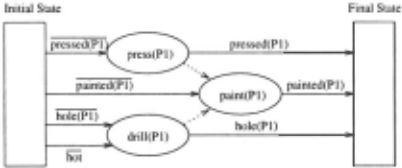
As we will see, plan merging benefits from having LCPs with as few constraints and causal links as possible, increas ing the odds of success. The LCP extraction algorithm can be altered to produce "relaxed" plans that approximately cor respond to MLEP. In particular, we may ignore certain con text conditions consumed by an action if these do not sub stantially influence goal achievement. For example, suppose smooth(PJ) , while potentially important at certain states, is of marginal value on the current MLEP for rr. If, say, smooth(PJ) is produced by the initial state and consumed by drill, and only marginally increases the probability of hole, the link from the initial state to drill could be dropped. Merging new plans with this relaxed LCP might result in a (slightly) less than optimal execution of rr if the new plan de stroys smooth( Pi) before drilling; however, the added flexi bility makes merging easier and may be worthwhile.
3.3 Prioritized Policy Merging
Using State Space Search Suppose we now have a set of abstract MDPs that have been solved. For concreteness, assume two such MDPs whose optimal policies rr1 , rr2 and value functions V1 , V2 have been determined. Our goal is to produce a new policy rr that behaves well with respect to both sets of objectives, without solving a new MDP that combines both abstract spaces. To do this, we can use the value func tions as heuristics to guide a search through state space. Each value function tells us how good a state is with respect to its own objectives: if V; ( s) is high, the goals in MDP i are achievable. Note, however, that this does not mean the goals are achievable jointly with those of some other MDP j.
More precisely, we define a search process whose nodes are states, whose arcs are labeled with actions, and whose ini tial state is the start state. At any active node of the search tree, we consider the effect of each possible action; that is, we add children corresponding to the unique state resulting from each action. Each such states has values V;(s) . The most promising such state is that with the highest such values. 5 Even if no action dominates all others, under the assumption that the reward function is additive, the sum of values V; ( s) can be used as the heuristic value of state s.
5 The unique state associated with an action is due to the "pseudo-deterministic" assumption we made, but, in fact, the value of this resulting state is not the only consideration. If an action is likely to be successful but has some risk associated with it, the fact that its likely outcome is better than that of another action is not suf ficient reason to select it (note that the abstract policies do take such
How this search process proceeds is rather flexible; but a best-first approach seems most appropriate. Each value V; ( s) is a "perfect" heuristic in that, should the agent consider only objectives in space i, it could attain V;(s). If the agent at tempts to integrate other objectives, this can only cause the value V; ( s) to go down (or, at best, stay the same). Thus, the "multi valued" heuristic (or the sum of values V; ( s )) overesti mates the true value of the states, and i-s admissible-a sim ple best first search using this as the heuristic function will be appropriate. 6 The search process terminates once an appro priate goal state is reached.
Merging does require that we consider the "combined" ab stract space containing the relevant atoms from all abstract MDPs involved. However, while this space is considerably larger than the individual abstract spaces, we never need to construct policies, or plan in substantial ways, in the com bined space. Thus, the exponential "blow up" in state space size is not a factor in policy merging.
To illustrate the process, consider the example above, where the value functions with respect to parts P 1 and P2 are denoted V1 and V2. Assume pressed(P2) holds at the start state (along with the relevant propositions for PI). Suppose press(PJ) is chosen as the first action: it causes no drop in V1 or V2? However, at any subsequent point drill(Pl) or drill(P2) will cause a drop in value because hot becomes true, preventing drilling ofthe other part. But an alternative initial action, drill(P 1), exists and subsequent search will lead di rectly to an appropriate sequence of actions. Notice that this process leads to a policy in which the actions drill(PJ) and press(PJ) are reversed (w.r.t. the original rr!). Note, how ever, that policy rr1 does not play a role in the search process.
Modifying the example slightly, suppose that drilling causes hot to become true no matter what. In this case, drill( P2) causes a drop in V1 , while drill( P 1) causes a drop in V2 (regardless ofpressed(Pl)). Since Pi has higher value, the first drop is greater and we will "commit" to drilling P 1, and using mdrill for P2.
Finally, we note that pseudo-determinism is exploited by the search to find a merged action sequence rather than a pol icy per se. However, as mentioned, should any action have an unlikely effect, the agent can always resort to one of the abstract policies to decide how to act at the resultant, "off path" state (e.g., choose to execute rr; for that abstract policy with highest value V;(s)). We could also imagine applying the search process to the most probable "unlikely" branches, or remerging online as circumstances warrant.
Using Plan Structure to Guide Search One difficulty with the search process described above is the fact that the ac tual search space explored can be quite hrrge. Furthermore, a number of alternatives may be explored before a genuine conflict is detected (as in the second case above). A second difficuity lies in the fact that this process does not lend it self to revision of policies or to the incremental construction of merged policies in an anytime manner. For example, if we merge policies for several abstract spaces, and then later solve another abstract MDP, merging the new policy requires revisiting the entire search process, unless some form of de pendency information is recorded.
considerations into account). Thus we use the expected value of an action w.r.t. v; (or Q-value of the action) as a guide.
6 Multiple path (or cycle) checking is also appropriate in our pseudo-deterministic setting to ensure progress in being made.
7 To be precise, a slight drop in value, corresponding to the dis count factor will occur. We shall ignore this effect in our discussion.
We now describe a process that alleviates these difficulties to some extent: when merging 1r1 and 1r2, we will first ex tract an LCP P1 for 1r1 and restrict our search to action se quences that have high value with respect to V2 (on MDP 2). Any such action sequence must, however, respect the causal links in plan P1 . This makes the search process easier for two reasons. First, the flexibility in ordering constraints in P1 al lows us to consider several different optimal policies (w.r.t. V1) without explicit backtracking. Second, we will not con sider policies that are inconsistent with P1 . This means we are committing to a particular means of achieving objectives in the first space. As such, the resulting merged policy may not be as good as one that doesn't adhere to such restrictions; but · the computational benefits may make this worthwhile. Once we've merged 1r1 and 1r2, we can extract a new LCP P2 that can be used when considering subsequent objectives. Recording plans allows the merging process to proceed in an incremental fashion. We now make this more precise.
Assume that an LCP P1 has been extracted for a particu lar set of objectives, 8 and that an abstract value function V2 has been generated for a new abstract MDP. Our merging pro cess is prioritized: as before, we generate a path starting at the start state. Only now, this path must be consistent with P1 (i.e., sorrie linearization of P1 is a subsequence of this path), and V2 alone is used as the heuristic function. Hence, we search for the best policy with respect to V2 subject to the constraints imposed by Pt. This prioritization is neces sary in instances where all objectives cannot be met. Since some must be "sacrificed," we commit to the plan pertaining to higher valued objectives. 9 The search proceeds as follows :
- Each search node corresponds to a state and is annotated by a set of open links and permissible actions from P1.
- Each arc in the search tree is annotated by an action.
- We use V2 as the heuristic function.
- We search from the start state: its open links are produced by start, and permissible actions are those that can consistently be executed first in P1 .
- Each node is expanded using only actions that are on the permis sible list from P1 , or that do not threaten any link on the open Jist. Irrelevant actions (that do not belong to P1 and do not influence atoms in R2 ). are not considered.
- If an action a from P1 is used, the child node is annotated as fol lows: all links consumed by a are removed from the open Jist and those produced by a are added; a is removed from the permissible
8 This need not be for a single abstract MDP: a set of such MDPs may have been merged as in the previous section.
9 We assume without further mention that if abstract policy 1r1 has very low value, compared to the set of objectives it is designed to achieve, it can be ignored completely. Priority can be altered dy namically in this and other ways.
·
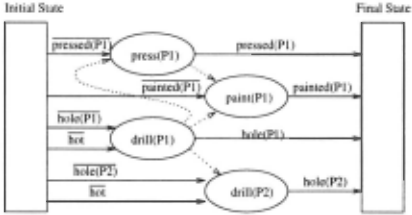
Jist; and any new action, all of whose predecessors (w.r.t. order ing constraints of P1) now lie on the search path, is added to the permissible Jist.
The open list keeps tracks of links that must be respected by any action inserted to achieve objectives in V2 , while the per missible list serves as a "plan counter" for P1 . A best-first search using V2 can be used. Once this search is complete, we can extract (backtrack-free) a new LCP P2 from the cho sen path. The process can then be repeated using P2 should one wish to consider further objectives (abstract MDPs).
It is often the case that more than one optimal policy exists. Although our use ofLCPs allows us to capture the causal link structure of a number of policies, there may be different poli cies involving substantially different actions (e.g., a different way of making holes). Hence, at any point where merging re sults in a greatly reduced value in V2 , we have the option of backtracking to a different optimal (or possibly suboptimal) policy for the earlier abstract MDP, generating a new plan for it and attempting to merge with this new plan. Thus, our com mitment to P1 need not be absolute.
To illustrate the merging process, let our first abstract plan P1 be that in Figure 3 (corresponding to PI), and let the second value function V2 correspond to the sole objective pertaining to P2 (attained by drill(P2)) . Assume again that pressed(P2) holds. Search using V2 suggests a number of potential actions: drill(P2), drill(Pl), and press(PI). In tuitively, the first action is desirable relative to v2 and the other two actions are from P1 . (Action mdrill(P2) is subop timal w.r.t. V2 , and all actions involving PI are irrelevant to V2.) The action drill(P2) threatens drill(Pl) in P1 because of its effect hot. Hence, we consider the next possible action, drill(Pl). Suppose we choose to follow this path. As a sub sequent action, we can choose either drill(P2) or press(P I). The conditional effect hot of drill(P2) is no longer a threat. We can continue from here on in a straightforward manner, eventually generating the LCP shown in Figure 4. Note that merging reversed the ordering of press(Pl) and drill(PI) in the original abstract policy without backtracking, show ing the benefits of extracting causal structure. In addition, mdrill(P2) is never considered because of its low value.
As a second example, again imagine that hot becomes true whenever drilling occurs. Any attempt to use drill(P2) as the first action will threaten drill( P 1) as above; but drill( PI) precludes subsequent execution of drill(P2). The commitment to the initial plan means that an alternative action must be chosen: the value function v2 dictates that action mdrill(P2) should be performed and the goal state is then reached (though with lower probability). An LCP can then be extracted which achieves both sets of objectives, as shown in Figure 5. We note that action mdrill(P2) is not on the MLEP for the optimal policy 1r2 ; but commitment to the first plan forced us to consider a suboptimal way of achieving the sec ond objective. In general, the algorithm-using the optimal value function V2-effects "repair" of an unmergeable pol icy. Indeed, if at that point the optimal policy 1r2 dictated that a different (conflicting) objective should be attempted (e.g., shipping a different part instead of P2), the merging algo rithm would have stirred us to a completely new "goal."
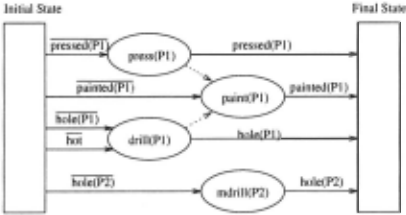
The key difference between merging using only abstract value functions and merging using a plan is that the latter commits to a particular way of achieving the higher priority objectives and attempts to work around these commitments when determining how to achieve lower priority objectives. This commitment has some clear computational advantages, but comes at the cost of perhaps sacrificing some lower pri ority objectives because one is not willing to consider (sub stantially) different ways of attaining high priority goals.
The plan-based merging approach shares much of the mo tivation underlying work on intentions and resource-bounded reasoning in planning [3] . Although it may result in infe rior policies as compared to the first, Jess constrained search method, the commitment embodied by the plan-based ap proach is suitable when, due to uncertainty and resource con straints, we prefer an anytime approach in which we first gen erate a plan for the most important objectives. Later, we can modify such plans, taking into account other, less important objectives. In addition, efficient planning may often require us to accept certain assumptions about the state of the world or its dynamics. Once we Jearn that one of these assumptions is false, it may not be possible to replan from scratch, as re quired by the first merging approach. Revision of a plan tore flect changing assumptions may prove more suitable in such circumstances.
This use of commitment could be taken even further: we could extract an LCP for both (sets of) objectives and attempt to merge them, thus committing to a specific means of attain ing both. We note that it may be possible to use and modify existing plan merging techniques (e.g., see [14]) in this regard. However, strong commitment to earlier (higher prior ity) plans remains essential if plans prove unmergeable.
4 Concluding Remarks
We have suggested a method of goal decomposition for MDPs based on abstraction and least-commitment planning. Our technique allows certain classes of MDPs to be solved efficiently, though suboptimally, through the solution of a set of considerably smaller MDPs associated with different ob jectives. There are a number of questions relating classical planning, DTP and resource-bounded reasoning that may, in the future, be addressed satisfactorily within this framework. These include the derivation of goals from general decision theoretic considerations, the utility of classical plans in DTP settings, and the derivation of intentions or commitments from the decomposition of objective functions.
We are currently exploring generalizations of this ap prmich, in particular, the development of least-commitment, causal link representations of complete policies and meth ods of extracting such from standard, state-based policies. This will enable the restrictive assumptions of goal-based, pseudo-deterministic problem structure to be dropped. We are also exploring other means of merging and methods for bounding the error associated with prioritized merging.
@inproceedings{ijcai1997p167,
  title     = {Prioritized Goal Decomposition of Markov Decision Processes: Toward a Synthesis of Classical and Decision Theoretic Planning},
  author    = {Boutilier, Craig and Brafman, Ronen I. and Geib, Christopher W.},
  booktitle = {Proceedings of the Fifteenth International Joint Conference on
               Artificial Intelligence, {IJCAI-97}},
  publisher = {International Joint Conferences on Artificial Intelligence},
  editor    = {Martha E. Pollack},
  pages     = {1156--1161},
  year      = {1997},
  note      = {Planning and Scheduling},
  url       = {https://ijcai.org/proceedings/1997/167},
}
TY - CPAPER TI - Prioritized Goal Decomposition of Markov Decision Processes: Toward a Synthesis of Classical and Decision Theoretic Planning AU - Boutilier, Craig AU - Brafman, Ronen I. AU - Geib, Christopher W. T2 - Proceedings of the Fifteenth International Joint Conference on Artificial Intelligence, IJCAI-97 PB - International Joint Conferences on Artificial Intelligence PY - 1997 SP - 1156 EP - 1161 UR - https://ijcai.org/proceedings/1997/167 ER -Copied
Machine-readable versions of this paper, for tools and AI agents:





