
An Adaptive Architecture for Modular Q-Learning
Proceedings of the Fifteenth International Joint Conference on Artificial Intelligence. Learning. Pages 820-824.
© 1997 International Joint Conferences on Artificial Intelligence
Abstract
Reinforcement learning is a technique to learn suitable action policies that maximize utility, via the clue of reinforcement signals: reward or punishment. Q-l ea rning , a widely used reinforceme nt learning method, ha s been analyzed in much research on a utonomous agents. However , as the size of the problem space increases, agents need more comp utational resources and require more time to learn appropriate policies. Whitehead proposed an architecture called modular Q-learning, that decomposes the whole problem space into smaller subproblem spaces, and distribut es them among multiple modules. Thus, each module takes charge of part of the whole problem. In modular Q-learnin g, however, human designers have to deco mpo se the problem space, and create a suitable set of modules manually. Agents with such a fixed module architecture ca nnot adapt themselves to dynamic e nvironments. Here, we propose a new architecture for reinforceme nt lea rning ca ll ed AMQL (Automatic Modular Q-Learning), that enables agents to obtain a suitable set of modules by themselves using a selection m et hod. Through experiments, we show that agents can automatica ll y obtain s uit able modules to gain a reward. Furthermor e, we show that agents can adapt themselves to dynamic environments e ffi ciently, through recon str u ct ing modules.
- [Benda et al., 1985] M. Benda, V. Jagannathan, and R. Dodhiawalla. On Optimal Cooperation of Knowl- edge Sources. Technical Report BCS-G2010-28, Boe- ing AI Center, 1985.
- [Dayan and Hinton, 1993] Peter Dayan and Geoffrey E. Hinton. Feudal Reinforcement Learning. In Advances in Neural Information Processing Systems 5, pages 271-278, 1993.
- [Ono and Fukumoto, 1996] Norihiko Ono and Kenji Fukumoto. Multi-agent Reinforcement Learning: A Modular Approach. In Proceedings Second Interna- tional Conference on Multi-Agent Systems, pages 252- 258, 1996.
- [Sabes and Jordan , 1996] Philip N. Sabes and Michael I. Jordan. Reinforcement learning by probability match- ing. In Advances of Neural Information Processing Systems 8, 1996.
- [Singh, 1992] Satinder P. Singh. Reinforcement Learn- ing with a Hierarchy of Abstract Models. In Proceed- ings of the Tenth National Conference on Artificial Intelligence, pages 202-207, 1992.
- [Thrun and Schwartz, 1995] Sebastian Thrun and An- ton Schwartz. Finding Structure in Reinforcement Learning. In Advances in Neural Information Pro- cessing Systems 7, pages 385-392, 1995.
- [Watkins, 1989] C.J.C.H . Watkins. Learning from De- layed Rewards. PhD thesis, University of Cambridge, 1989.
- [Whitehead et al. , 1993] Steven White- head, Jonas Karlsson , and Josh Tenenberg. Learning Multiple Goal Behavior via Task Decomposition and Dynamic Policy Merging. In ROBOT LEARNING. Kiluwer Academic Press, 1993.
References were extracted automatically from the PDF and may contain errors.
Full text extracted automatically from the PDF; figures, tables and equations may differ. The PDF is the version of record.
1 Introduction
Reinforcement learning is one of the techniques by which agents can learn suitable action policies that maximize their utilities, via reinforcement signals of reward or pun ishment. There have been various investigations of au tonomous agents using this learning technique. How ever , reinforcement learning with monolithic methods lacks scalability, since agents require much more time to learn suitable action policies when dealing with more complex and larger problems. Additionally, agents use more computational resources to memorize the utilities of all states and actions.
·Also with "Research for the Future" Project, Faculty of Science and Technology, Keio University, Shin-Kawasaki Mitsui Building West 3F, 890-120 Kashimada, Saiwai-ku, Kawasaki , 221, Japan
t Also with Sony Computer Science Laboratory Inc. 3-1413 Higashi-Gotanda, Shinagawa-ku, Tokyo, 141 , Japan
To tackle this problem, some methods that decompose the problem space have been suggested. Whitehead pro posed an architecture called modular Q-learning [1993] that decomposes the whole problem space into smaller subproblem spaces and distributes them among multi ple modules. The goals of multiple goal problems are decomposed into subgoals, which are then distributed as subgoals among multiple modules. Since each module learns only to accomplish its own goal, the number of states that each module can take decreases in compari son with monolithic Q-learning. As a result, Whitehead showed that modular Q-learning improves on learning time and requires less computational resources.
Modular Q-learning and other methods that decom pose the problem into modules need a human designer to decompose the whole problem and design an appropri ate set of modules. This is because the learning perfo~· mance depends on the design of the module set. How ever, agents with fixed modules might not be able to adapt to dynamic environments flexibly.
In this paper, we propose a new architecture that en ables agents to obtain a suitable set of modules through interaction with the environment , so that agents can fl ex ibly adapt to dynamic environments. Also, we experi mentally evaluate this architecture. As an example of a learning problem that is computationally intractable for agents, we take the pursuit game problem. We inves tigate the suitability of this architecture and its adapt ability under dynamic environments.
2 Learning with the Modular Approach
In this section, we describe the basics of Q-learning and modular Q-learning. Also, we show an example that uses modular Q-learning.
2.1 Reinforcement Learning (Q-learning)
Autonomous creatures generally receive reinforcement signals from the environment for their actions or action sequences. Reinforcement learning is a technique for an agent to learn suitable action policies that maximize a utility from the clues of reinforcement signals. Utility is often represented by the discounted cumulative rein forcement in the future, as follows:
where V1 is the discounted cumulative reinforcement from time t through the future, r1 is the reward received at time t, and !'(0 ::; /' ::; 1) is the temporal discount factor.
Q-learning [Watkins, 1989] is a widely used method of reinforcement learning, where learning corresponds to building a precise Q-function.
The Q-function gives the estimated utilities that agents receive when they take an action in a state, and the agents refer to this function to decide on their actions. For deterministic domains, the utility of an action a in response to a state x is equal to the immediate payoff r plus the best utility that can be obtained from the next state y. However, during the course of learning, the Q function may not be true. Therefore, the value of Q(x, a) is updated in the following way:
where /3(0::; f3::; 1) is the learning rate, maxQ(y,b) is b the maximum Q-value at state y, and /' is the discount rate.
The simplest way to express the Q-function is to make a Q-table that contains each Q-value for every pair of state and action. However, as the size of the problem space increases, this takes more computational resources and requires much more time for learning.
2.2 Modular Q-Learning
Some research shows that methods which decompose a problem space improve learning performance in re inforcement learning [Dayan and Hinton, 1993] [Singh, 1992]. One investigation of the modular approach shows the improvement of learning performance [Whitehead et al., 1993].
A modular Q-learning architecture contains a number of modules , each of which dedicates itself to the corre sponding subproblem. This architecture makes the Q table smaller and improves learning time for problems with multiple goals.
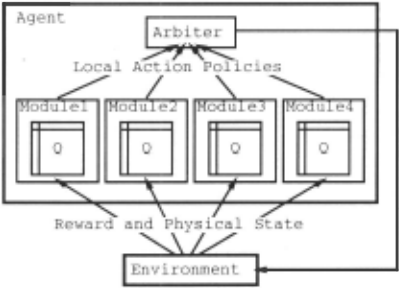
In modular Q-learning, each module has its own sub goal and decides its action policy according to its sub goal. An arbiter is used to mediate global action with a certain strategy (decision by majority, etc.). Each module includes a Q-table for the pairs of partial states and actions. Modules learn to achieve their respective goals through updating their Q-values. Since individ ual modules cannot consider other modules' goals, learn ing agents may yield suboptimal performance. What is worse, even if human designers succeed in designing an appropriate set of modules for a situation, such a pre determined method reduces agents' ability to adapt to dynamic environments.
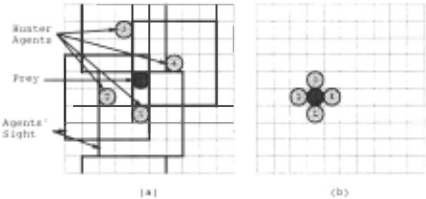
Ono [1996] applied modular Q-learning to the learning of cooperative behavior of multi-agents in a pursuit game (Figure 2( a)). The pursuit game that was presented by Benda [1985] is a basic problem of distributed artificial intelligence. The purpose of this problem is to capture a prey agent by making four hunter agents surround the prey (Figure 2(b)). In Ono's research, hunter agents learned the optimal action policy to capture the prey. Ono's learning agents consist of three modules. Each module takes the relative position of the prey and of one of the other hunters as its state.
Considering the state space, for example, in the case of each hunter agent having a limited visual field of depth (5 x 5), as shown in Figure 2(a) , the possible number of states that agents may encounter reaches (5 2 + 1) 4 = 456976. This means a learning agent with a monolithic Q-table needs enormous memory resources. However, when only two agents organize separate Q-tables, the possible number of states decreases to (5 2 + 1? = 676. Through experimenting witl; architectures in the pursuit game, Ono showed that agents with modular Q-learning not only solve state space issues but also learn cooper ative behavior. However, the method which Ono took was to decompose the state space and allocate suitable modules of modular Q-learning in advance.
3 AMQL Architecture
In modular Q-learning, human designers have made modules suitable for the environment. The resulting agents with fixed modules cannot adapt to dynamically changing environments. Here, we propose a new archi tecture, called AMQL (Automatic Modular Q-Learning), that enables agents to obtain a suitable set of modules by themselves. Also, we experimentally show the avail ability of this architecture.
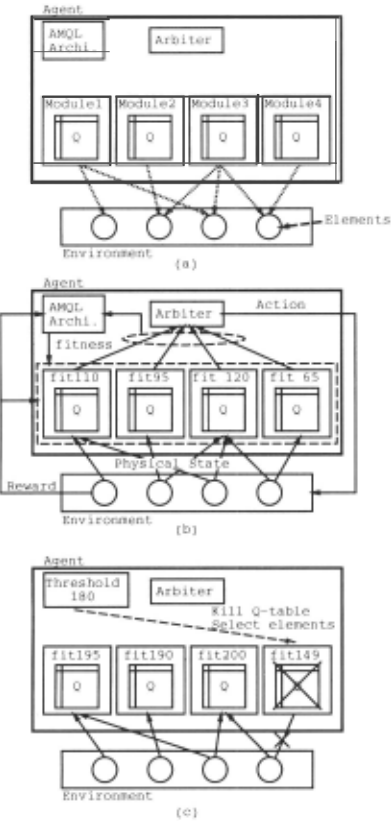
The AMQL architecture has three phases when it ob tains the set of modules. Firstly, modules in agents select elements of the environment, and make a Q-table (Fig ure 3(a)). While agents learn, the AMQL mechanism provides fitness estimates for modules that contribute a reward acquisition action (Figure 3(b)). At selection time, modules are evaluated and selected according to fitness (Figure 3( c)). After repeating these three phases , agents obtain a suitable set of modules. In short, AMQL executes module selection like a genetic algorithm. The specific mechanisms are as follows.
3.1 Element Selection Phase
In the AMQL architecture, agents have a fixed number of modules. Each agent recognizes the environment as a state of n elements(E1 , E2 , ···,En)· In other words , the input of an agent is as follows.
Where 5; is a state of element E;, elements correspond to the sensors of robot agents. Each module randomly selects 1 - m elements (1 :::; m < n) from the set of elements E, and makes a Q-table for the states of se lected elements. Through this process, the state space is allocated to multiple modules.
3.2 Fitness Allocation Phase
When agents receive a reward by an action, the modules that contribute to this action are allocated a fitness. This fitness indicates the degree of contribution of a module.
Agents decide their action by using the greatest mass (GM) strategy, proposed by Whitehead [1993].
The expression, where f 9 m (5) is an action policy of an agent, represents that the Q-values of l modules are summed up for all possible actions, and the action that has the largest sum is selected.
When agents receive a reward at state 5 and action a, the Q-value at state 5 is compared for each mod ule. Modules that have the Q-value of action a have the largest sums. In other words, all modules that desire action a increase their fitness. The fitness is cleared at every stage of module selection, and is added whenever the module contributes to the acquisition of a reward.
Modules do not refer to other modules' Q-tables and each updates its own Q-table individually. The goal of the module is to learn appropriate action policies for inputs of elements to which the module 'Should pay at tention. Modules that pay attention to the appropriate subset of elements can learn appropriate action policies. Therefore, appropriate modules achieve greater fitness.
3.3 Module Selection Phase
At every period of module selection T, agents evalu ate their own modules. In evaluating modules, selection mechanisms assess the fitness of each module. Modules whose fitness is over the threshold remain, but if fitness is under the threshold, modules select elements of the environment again, and make a new Q-table. Threshold at module selection is represented as follows:
k = (number of reward acquisition) x p
In the case that p(O < p < 1) is a constant that deter mines how good modules must be to be retained, the closer p is to 1, the higher the quality of the module selected.
3.4 Algorithm
The AMQL architecture consists of the above three phases. The actual algorithm is as follows:
- Each module selects 1-m elements from n elements that organize the environment. Modules then make a Q-table and set an initial Q-value.
- Set the fitness of all modules to 0.
- Set the execution counter t of agents to 0.
- Set agents to initial states.
- Agents receive the current state x.
- If state x is the goal state, then t = t + 1 and go to 11.
- Agents select their own action by the GM strategy and execute it.
- Update Q-tables of each modules.
- If agents receive a reward with action a, then set the fitness of the module, that Q-value of action a is the biggest in every action, to fitness = fitness + 1.
- Go to 5.
- If t < T (the period of select), then go to 4.
- Calculate a fitness threshold and evaluate fitness of all modules. Modules where fitness is under the threshold select 1 - m elements again. These mod ules then make a Q-table and set an initial Q-value. Go to 2.
4 Implementation and Evaluation
In this paper, we use the pursuit game as a problem that is computationally intractable. Specifically, we investi gate the following. Firstly, we compare the performance of the AMQL architecture with previous architectures. Also, we investigate the adaptability of AMQL architec ture in dynamic environments compared to fixed module Q-learning.
4.1 Simulation Environment
We assume that the fundamental simulation environ ment of the pursuit game is as follows:
- The environment consists of a 10 x 10 grid. Edges are connected (torus).
- Initial positions of each agent are determined ran domly.
- At each time step, agents choose an action from any of 5 actions (move north, east, south, west , or stay at their current position). More than one hunter agent can share the same grid. However, hunter agents cannot share with the prey. There fore, hunter agents that try to move to the grid al ready occupied by the prey, cannot move and must stay at their current positions. The prey agent se lects its own action randomly. .
- Hunter agents have a 5 x 5 sight, as shown in Fig ure 2(a). Each agent is assigned an identifier (Agent 1-4). A hunter agent can recognize the relative po sition and identifier of any other agents in its sight.
- A trial ends when the goal is accomplished (the prey agent is captured) or at 2, 000 time steps.
Parameters for the AMQL architecture are as follows. A hunter agent has four modules. The period of module selection T is 200 trials. The constant p that determines the threshold of the module is 0.9. When modules are initialized or there are some modules that are regarded as not adaptable at the module selection phase, these modules select any 1-3 other agents randomly and make a Q-table.
Parameters for Q-learning are as follows. The learning rate is (3 = 0.1 , the discount factor is 1 = 0.9, a reward is r = 1, and the initial value of the Q-value is 0.1.
4.2 Comparison among AMQL an·d Previous Architectures
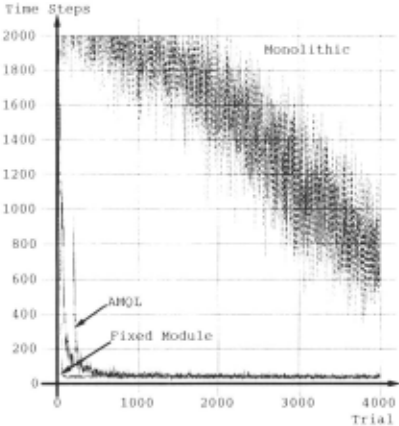
We have compared the AMQL architecture with pre vious architectures: monolithic Q-learning and a fixed module architecture. Hunter agents with the monolithic architecture have one Q-table for all possible states. In the case of fixed modules, hunter agents have three mod ules that pay attention to each different hunter agent and the prey agent . This set of modules is the same as Ono's [1996]. One execution is performed in up to 4000 trials. Figure 4 shows the time steps taken for capture at each trial. Each experiment is repeated ten times, and the averages of these are plotted.
The results of the monolithic architecture show that it takes a long time to learn suitable behaviours. This is because the number of states that the monolithic Q table has to take increases to 26 4 = 456976, so that it takes a long time to update Q-values suitably. However, using AMQL or the fixed module architecture, agents can capture the prey agent with less time steps. In al most every experiment, the AMQL architecture selected the module that takes states of two or three agents as an input. Therefore, the number of states that AMQL modules take becomes 26 2 = 676 or 26 3 = 17576, and agents with the AMQL architecture can learn to capture the prey faster. Comparing learning speed and quality of solution for this simple case, the fixed module archi tecture previously designed by human designers is bet ter than the AMQL architecture. After learning, agents with AMQL took about 15 time steps more on average than the well formed modules. However, in every ex periment, agents with AMQL succeeded in obtaining a suitable set of modules.
The reason why convergence of AMQL is slower is that the AMQL architecture takes time to find a suitable set of modules. In other words, in the case of fixed mod ule architecture, human designers are needed to design a suitable set of modules. The AMQL architecture cannot only learn faster , but can also obtain suitable modules automatically. These two features are important for au tonomous agents. This result shows that the AMQL architecture has the capability to obtain suitable sets of modules with improvement of learning speed due to the modular architecture.
4.3 Adaptation to Changing Environments
In the next experiment, we evaluate the adaptability to problem change. To change the problem dynamically, we set the following additional conditions.
- There are four hunter agents and two prey agents in the grid field. Each prey agent has an identifier (prey1, prey2).
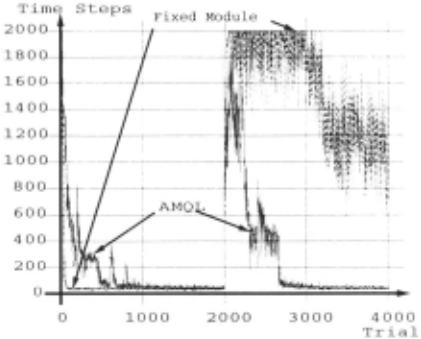
- From the beginning to trial 2000, hunter agents re ceive a reward only when the prey agent 1 is cap tured, but no reward when the prey agent 2 is caught. However, from trial 2001, the environment changes so that hunter agents receive a reward only when prey 2 is captured.
In this experiment, we compare the adaptability to dynamic environments, between the AMQL architecture and the fixed module architecture that is designed by human designers. The fixed module architecture in this experiment is the same as that in the previous experi ment: hunter agents have three modules that pay attention to each different hunter agent and prey agent 1. No modules pay attention to prey agent 2.
| I Module I | Before change | I After change |
|---|---|---|
| Module1 | Hunter2 Hunter3 Prey1 | Hunter2 Hunter4 Prey2 |
| Module2 | Hunter2 Hunter3 Hunter4 | Hunter2 Hunter3 Prey2 |
| Module3 | Hunter3 Hunter4 Prey1 | Hunter3 Prey1 Prey2 |
| Module4 | Hunter2 Hunter3 | Hunter4 Prey2 |
Figure 5 shows the time steps for capture at each trial. Each experiment is also repeated ten times, and the aver ages of these are plotted. Before the problem is changed, the convergence of learning with the fixed module ar chitecture is faster than with the AMQL architecture. However, the fixed module architecture cannot capture well in the environment after the problem changes. This is due to the set of modules being designed for the en vironment before the change. However, agents with the AMQL architecture can capture well even after chang ing the problem, because the architecture changes the modules when the target is changed.
Table 1 shows the changes of elements to which the modules of hunter agentl pay attention. This result shows that agents have some modules that pay atten tion to prey1 before changing, and that these modules pay attention to prey2 after changing, because agents always have to pay attention to elements that are related to reward. Moreover, when agents pay attention to elements that are not related to reward, agents waste learning time and computational resources.
Human designers cannot design a suitable set of mod ules in dynamically changing environments, since they cannot predict the future environment. However, agents with AMQL architecture obtain suitable, though still not optimal, sets of modules that consider their own reward and learning performance in a current environment.
Figure 5 shows that convergence of AMQL, immedi ately after changing environment , takes longer to con verge than at the beginning. This is because Q-functions immediately after changing have learned to catch preyl. This obstructs the module in learning the new problem. However , this feature can be an advantage, if what mod ules have learned can be used even after the environment has changed.
These experimental results show that an agent with the AMQL architecture is able to obtain a suitable set of modules and to adapt according to changing problems.
5 Discussion
There has been much research dealing with modular architectures for reinforcement learning. Thrun and Schwartz offered the SKILLS algorithm which obtains the structure of problem space that can be used among multiple tasks and called skills, and considered both per formance loss and description length [1995]. However, to obtain useful skills takes more time than to find optimal policies with a monolithic Q-function. AMQL makes the description length smaller and learning convergence faster than monolithic architecture, though not optimal. We consider that the idea of considering performance and description length is useful for AMQL.
At the present time, modules in AMQL have lookup tables, because these are easy to treat and to anal yse. Also, general function approximators such as neural networks have been applied to reinforcement learning. Sabes and Jordan discussed the association between rein forcement learning and expert networks [1996]. We con sider that this model also can be applied to AMQL. In this case, each module obtains an appropriate part of in put using AMQL. Such an architecture can be expected to have faster learning convergence and more adaptabil ity than a monolithic architecture.
It is important to know how autonomous agents should design their adaptive mechanism for the environment. The real world is an open system, and changes dynami cally. Thus, it is difficult to predict the behavior of fu ture environments perfectly and to design optimal struc tures. In that respect, AMQL seems a promising archi tecture, because it can dynamically and automatically obtain suitable module structures through interactions with the environment, and learn faster than monolithic Q-learning architectures. We consider the AMQL archi tecture to be applicable to various autonomous agents in order to improve both the adaptability and the learning time.
6 Conclusions and Future Work
In this paper, we proposed an AMQL architecture that obtains a suitable set of modules through the interac tion with the environment. We showed the availability of the architecture and its adaptability to dynamic en vironments, through experiments on pursuit game prob lems. Simulation results showed that agents with the AMQL architecture can not only learn faster but also can obtain suitable sets of modules automatically. More over, through experiments where the problem changed dynamically, we showed that agents with the AMQL ar chitecture can adapt themselves to dynamically changing environments, in a way that was impossible for agents with the previous fixed method. These features enable autonomous agents to adapt more flexibly and efficiently.
When the environment changes drastically, the cur rent AMQL architecture may abandon modules which have learned strategies that are no longer relevant. It seems useful to keep such modules, in case a similar sit uation arises in the future. We plan to investigate this architecture.
@inproceedings{ijcai1997p118,
  title     = {An Adaptive Architecture for Modular Q-Learning},
  author    = {Kohri, Takayuki and Matsubayashi, Kei and Tokoro, Mario},
  booktitle = {Proceedings of the Fifteenth International Joint Conference on
               Artificial Intelligence, {IJCAI-97}},
  publisher = {International Joint Conferences on Artificial Intelligence},
  editor    = {Martha E. Pollack},
  pages     = {820--824},
  year      = {1997},
  note      = {Learning},
  url       = {https://ijcai.org/proceedings/1997/118},
}
TY - CPAPER TI - An Adaptive Architecture for Modular Q-Learning AU - Kohri, Takayuki AU - Matsubayashi, Kei AU - Tokoro, Mario T2 - Proceedings of the Fifteenth International Joint Conference on Artificial Intelligence, IJCAI-97 PB - International Joint Conferences on Artificial Intelligence PY - 1997 SP - 820 EP - 824 UR - https://ijcai.org/proceedings/1997/118 ER -Copied
Machine-readable versions of this paper, for tools and AI agents:





