
Control Structures for Incorporating Picture-Specific Context in Image Interpretation
Proceedings of the Fourteenth International Joint Conference on Artificial Intelligence. Action and Perception. Pages 50-54.
© 1995 International Joint Conferences on Artificial Intelligence
Abstract
This paper describes an efficient control mechanism for incorporating picture-specific context in the task of image interpretation. Although other knowledge-based vision systems use general domain context in reducing the computational burden of image interpretation, to our knowledge, this is the first effort in exploring picture-specific collateral information. We assume that constraints on the picture are generated from a natural language understanding module which processes descriptive text accompanying the pictures. We have developed a unified framework for exploiting these constraints both in the object location and identification (labeling) stage. In particular, we describe a technique for incorporating constrained search in context-based vision. Finally, we demonstrate the effectiveness of this approach in PICTION, a system that uses captions to label human faces in newspaper photographs.
- [Ballard et al., 1978] Dana Ballard, Cristopher Brown, and J. Feldman . An approach to knowledge directed image analysis. In Computer Vision Systems, pages 271-282. Academic Press, 1978. IJCAI
- [Burhans et al., 1995] Debra Burhans, Rajiv Chopra, and Rohini Srihari. Domain specific understanding of spatial expressions. In Proceeding of the IJCAI-95 Workshop on Representation and Processing of Spatial Expressions, Montreal, August 1995.
- [Burns et al., 1984] J. Burns, A. Hanson, and E. Rise- man . Extracting straight lines. Technical Report 84- 29, University of Massachusetts, Amherst, 1984.
- [Chellapa and Kashyap, 1992] R Chellapa and R.L. Kashyap. Image understanding. In Stuart C. Shapiro, editor, Encyclopedia of Artificial Intelligence. John Wiley, 2nd edition, 1992.
- [Chopra et al., 1995] Rajiv Chopra, Rohini Srihari, and Anthony Ralston. Hyperarc consistency and expensive constraints. Technical Report 95-21, SUNY at Buffalo, 1995.
- [Firschein and Fischler, 1987] Firschein and M.A . Fischler. Readings in Computer Vision , Issues, Prob- lems, Principles, and Problems.
- [Garvey, 1976] J. D. Garvey. Perceptual strategies for purposive vision. Technical Note 117, AI Center, SRI International, 1976.
- [Govindaraju et al., 1992] Venu Govindaraju, Sargur N. Srihari, and David B. Sher. A Computational Model for Face Location based on Cognitive Principles. In Proceedings of the lOth National Conference on Ar- tificial Intelligence ( AAAI-92}, pages 350-355, 1992.
- [ISX, 1991] ISX Corporation. LOOM Users Guide, Ver- sion 1.4, 1991.
- [Mohr and Henderson, 1986] R . Mohr and Thomas C. Henderson . Arc and path consistency revisited. Arti- ficial Intelligence, 28:225-233, 1986.
- [Mohr and Masini, 1988] R. Mohr and G. Masini. Good old discrete relaxation. In Proceedings of ECAI-88, pages 651-656, 1988.
- [Mulder et al. , 1988] Jan A. Mulder, Alan K. Mack- worth, and WilliamS . Havens. Knowledge structur- ing and constraint satisfaction: The mapsee approach. IEEE PAMI-10, 10(6):866-879, 1988.
- [Niemann et al., 1990] H. Niemann, G. F. Sagerer, S. Schroder, and F. Kummert. Ernest: A Seman- tic Network System for Pattern Understanding. Pat- tern Analysis and Machine Intelligence, 12(9):883- 905, 1990.
- [Selfridge, 1982] Peter G. Selfridge. Reasoning About Success and Failure in Aerial Image Understanding.
- [Srihari and Burhans, 1994] Rohini K. Srihari and De- braT. Burhans. Visual Semantics: Extracting Visual Information from Text Accompanying Pictures. In Proceedings of AAAI-94, pages 793-798 , 1994. Seat- tle, WA.
- [Srihari et al., 1994] Rohini K. Srihari, Rajiv Chopra, Debra Burhans, Mahesh Venkataraman, and Venu- gopal Govindaraju. Use of Collateral Text in Image Interpretation. In Proceedings of the ARPA Workshop on Image Understanding, pages 897-905, Monterey, CA, 1994.
- [Strat and Fischler, 1991] Thomas M. Strat and Mar- tin A. Fischler. Context-Based Vision: Recognizing Objects Using Information from Both 2-D and 3-D Imagery. IEEE PAM!, 13(10) :1050-1065, 1991.
- [Strat, 1992] Thomas M. Strat. Natural Object Recogni- tion. Springer-Verlag, 1992.
References were extracted automatically from the PDF and may contain errors.
Full text extracted automatically from the PDF; figures, tables and equations may differ. The PDF is the version of record.
1 Introduction
To solve the inherently under-constrained task of im age interpretation, additional sources of knowledge have successively been added to provide the necessary con straints for the recognition of objects and understanding of scenes.
Vision systems have attempted to exploit general knowledge assumed applicable to all scenes and spe cific knowledge of scene objects and their appear ance/configuration (model based vision). As a result, complex control strategies to utilize knowledge in the image interpretation task have been suggested. Devising control structures for knowledge based vision has been an active area of research since the mid 1960's with sev eral refinements of the cycle of perception and the de velopment of hierarchical, heterarchical and blackboard models. See [Firschein and Fischler, 1987; Chellapa and Kashyap, 1992] for the historical development of control structures in image understanding.
*This work was supported in part by ARPA Contract 93F148900-000.
State University of New York at Buffalo Buffalo, New York 14228-2567
U.S. A.
There has also been recent work in domain independent control structures where interpretation can be formally stated based on the semantics of a standard ized representation[Niemann et al., 1990].
1.1 Collateral Based Vision
Our research has focused on developing a computational model for "understanding" pictures based on accompa nying, descriptive text. Understanding a picture can be informally defined as the. goal-driven process of locat ing and identifying objects whose presence in the image is suggested by the accompanying text . The ideas pre sented in this paper carry the notion of top-down control one step further, incorporating not only general context but a high-level description of the actual picture.
We have divided this problem into two major sub tasks. The first task is the processing of language input. We are developing a theory called visual semantics which describes a systematic method for extracting and repre senting useful information from text pertaining to an ac companying picture. This information is represented as a set of constraints. The processin~ of captions for gen erating constraints is discussed in lSrihari and Burhans, 1994]. The second major task involves the design of an architecture wherein collateral information from text can be efficiently exploited in the process of image interpre tation. This second sub task is the focus of this paper.
There are several applications which are enabled by collateral-based vision. These include diagram un derstanding, indexing and retrieval from text/image databases and aerial image analysis.
We first present an overview of PICTION, a caption based face identification system. Section 3 discusses con trol in Piction, constraint satisfaction as a model for con trol , spatial reasoning and a general algorithm which ex ploits constrained search . The next section highlights some limitations and discusses future work to overcome them.
2 PICTION
The computational model for collateral-based vision we have developed can be applied to any situation where photos are accompanied by descriptive text. In describ ing the model however, it is useful to present working examples based on this model. For this reason, we refer to the system PICTION [Srihari et al., 1994], that iden tifies human faces in newspaper photographs based on information contained in the associated caption. PIC TION is noteworthy since it provides a computationally less expensive alternative to traditional methods of face recognition in situations where pictures are accompanied by descriptive text. Traditional methods employ model matching techniques and thus require that face models be present for all people, for them to be identified by the system.
CONTEXTUAL: in-picture (name: Kevin Starr; class : human) in-picture (name: Brian Heffernan; class: human) CHARACTERISTIC: gender(name: Brian Heffernan, male) gender(name: Tom Kait, male) SPATIAL: surrounded-by(Kevin Starr, (Brian Heffernan, Tom Kait ... )) strict-left-of(Brian Heffernan, Tom Kait) below(David Nagowski, Brian Heffernan) in-row(number: 4; names: (Brian Heffernan, Tom Kait )) in-row(number: 2; names: (David Nagowski, Rich Bland ))
Figure 2: A subset of the constraints generated from the caption of Figure 1.
The four main components of the model are as follows : (i) a natural-language processing (NLP) module, (ii) an image understanding (IV) module, (iii) a high level control module, and (iv) an integrated language/vision knowledge base.
The NLP module processes the caption text and expresses the result as a set of constraints. Spatial Con straints are geometric or topological constraints, such as left-of, above, between, inside, etc. They can be bi nary or n-ary, and describe inter-object relationships. They are typically used to identify/ disambiguate among objects but can also be used to locate them. Charac teristic Constraints are those which describe proper ties of objects. Examples include gender and hair color. Finally, Contextual Constraints are those which de scribe the setting of the picture, and the predicted ob jects in it. For example, the people present (explicitly mentioned in the caption), whether it is an outdoor scene, and general scene context (apartment , airport , etc) .
The IU module performs two basic functions, the lo cation and segmentation of objects, and the extraction of visual properties. The face-location module[Govin daraju et al., 1992] is an object locator which uses edge contours as basic features, and a "springs and templates" model in a multi-resolution framework . We are currently improving a simple neural network based gender discrim inator. A line detector [Burns et al., 1984] is being used to construct simple detectors for 2D rectilinear objects.
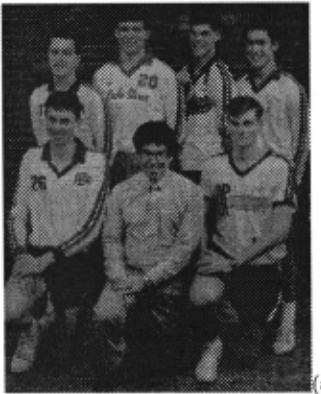
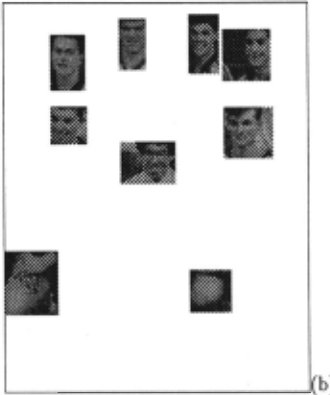
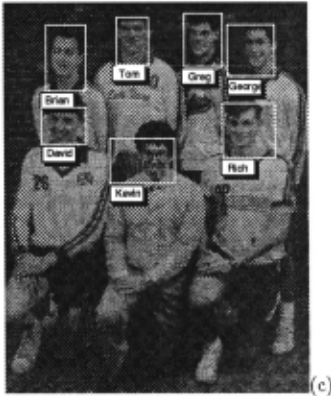
Figure 1 is an example of a digitized newspaper pho tograph and the accompanying caption. The task is to correctly identify each of the seven people mentioned in the caption. Information from the caption (in the form of a constraint graph) is used to locate and label faces . Figure 2 illustrates some of the constraints which were derived from the caption. The number of faces and the fact that they are aligned in rows is used by a pro gram which locates faces in the image. Identification of the faces revolved around the correct interpretation of the word 'surround'. We have interpreted it as ann ary constraint involving minimum distances from a given candidate to the rest . The simultaneous satisfaction of this and the remaining constraints resulted in the final , correct labeling.
PICTION has been implemented in LOOM[ISX, 1991]. The visual routines have been implemented in C; the system runs on a Sun Sparcstation.
3 Control in PICTION
Recent work by Strat and Fischler[1991] discusses the use of context in visual processing, but focuses on the ex ploitation of low-level collateral information (e.g., light ing conditions) . Furthermore, they do not address the generation of these constraints. We present a control strategy which exploits {i) a confident hypothesis of the image contents and (ii) all levels of contextual informa tion to aid the visual processing.
Our approach is to select a set of object classes of interest which we would like to locate and identify in images. For PICTION this set has been restricted to one object class, the human face. However, recognizing additional classes of objects {like hats and boxes) may greatly assist us in identifying faces .
Constraint satisfaction provides a ·single framework for incorporating spatial, characteristic, contextual and other general domain constraints without having to over specify control information. However the location of ob jects is still performed at the IU level thereby allowing existing object detectors to be integrated into the overall model.
3.1 The Single Object Class Problem: Labeling Faces
For the single object class version of PICTION, the over all control can be summarized in a few steps :
- Constraint Graph Generation (hypothesis genera tion: NLP module)
- Face Candidate Generation (candidate generation : IU module)
- Consistent Labeling (verification and recognition)
Knowledge of the domain allows us to make simplify ing assumptions for spatial reasoning. The assumptions concern spatial representations of objects, frames of ref erence, scale and rotation invariance. Spatial reasoning in this domain involves verification of predicates corre sponding to spatial relations. [Burhans et al., 1995]
3.2 Constraint Satisfaction as a Control Paradigm
A static constraint satisfaction problem (V, D, C, R) in volves a set of n variables, V = { Vt, v2 , . . . v,J, each with an associated domain Di of possible values. The search space consists of the Cartesian product of the vari ables' domains, D = D1 X D2 X . .. x Dn. A set of constraints C is specified over some subsets of these variables, where each constraint Cp involves a subset { i 1 , .. . , iq} of V and is labeled by a relation Rp of R, subset of the Cartesian product Di, x ... x Di. that specifies which values of the variables are compatible with each other. A solution to a CSP consists of an assignment of values to variables such that all con straints are satisfied. Various approaches exist for solv ing CSP's. A common approach is based on problem reduction strategies, and involves achieving local, i .e. node and arc, consistency[Mohr and Henderson, 1986; Mohr and Masini, 1988]. This reduces the amount of backtracking required for global consistency.
In PICTION, each variable Vi corresponds to an ob ject or person hypothesis, i.e., object or person predicted to be in the picture by the constraint generator. The do main Di for each variable is initialized to the set of all candidates { Ci, , . . . , Ci,.} generated by a call to the face locator .
There are 3 types of constraints used in the label ing process. Unary Constraints typically correspond to characteristic constraints (e.g., gender, color of hair, etc.) . Binary Constraints typically correspond to spa tial constraints (e.g. left-of, above, etc.). N-ary Con straints correspond to rules obtained from the domain a priori but applied in a discretionary manner by the constraint satisfier, or n-ary spatial constraints like the 3-ary constraint between. An example of a domain de pendent n-ary constraint is one which examines height relationships between people in the same row. It fa vors those solutions where the vertical positions of faces do not differ significantly and where there is a minimal amount of horizontal overlap.
Constraint satisfaction .in a schema-based methodol ogy has been used in computational vision, eg. the MAPSEE system[Mulder et al., 1988]. Their approach is that of data driven scene labeling where image features are nodes and possible interpretations form the sets of labels. Our application of constraint satisfaction is in a goal-driven image interpretation system where a strong scene hypothesis forms the set of nodes, and located ob jects (features) form the sets of labels. The constraints in our system· are picture specific as well as domain de pendent.
3.3 Hyper Arc Consistency and Expensive Constraints
There are two key differences between the statement of PICTION's constraint satisfaction problem and a tradi tional CSP. Traditionally unary constraints are satisfied before higher order constraints. Knowing that certain binary constraints are cheaper to evaluate than unary constraints motivated a new algorithm where constraints are applied based on cost and reliability measures. Ad ditionally, the algorithm can handle n-ary constraints without explicitly computing the complete correspond ing n-ary relation [Chopra et al., 1995].
3.4 Multiple Object Classes: Generalizing PICTION
So far we have seen a control strategy that exploits col lateral information to identify objects of a single class in an image. This needs to be extended to more general cases involving multiple object classes. Apart from mak ing it applicable to domains with more than one object class of interest, this capability may be required even if there is a single object class of interest. We borrow here the terminology of defining a target vocabulary and a recognition vocabulary[Strat , 1992]. Even if the target vocabulary consists of a single object class, its recogni tion is greatly enhanced by the development of a large recognition vocabulary. For the example in figure 3, the recognition vocabulary would need to contain pic ture frames apart from faces. Though picture frames may be specific to the newspaper photograph domain, the idea is applicable to other domains with a specific set of interesting objects and a larger set of recognizable objects.
We currently assume an unstructured collection of ob ject locators associated with object classes is available. We are designing a hierarchy of object locators that is linked to our semantic lexicon. This lexicon is orga nized as a comprehensive ontology of object classes. This will enable us to recognize more object classes using the same primitive object locators. We also assume a cor responding set of image processing tools to verify and compare predetermined attributes of instances of these object classes. Domain specific knowledge allows us to make assumptions regarding object representations and frame of reference for spatial reasoning. Given these as sumptions, a naive approach would be:
- Constraint Graph Generation (same as before, constraints are between objects of same/different classes)
- All Object Classes Candidate Generation (apply ob ject locators for all object classes mentioned in the caption)
- Consistent Labeling (verification and recognition)
The above scheme is wasteful, since all object classes needn't be identified for the identification of the target vocabulary. It does not exploit locative constraints to reduce the search space and improve the performance of the object locators/candidate generators.
The caption of the image in figure 3 is "Sharon Bot toms and April Wade hold a picture of Tyler Doustou" 1 . Assuming picture frames/portraits in our recognition vo cabulary, the relevant constraints generated are
included-in(Tyler Doustou, PicFramel); left-of(Sharon Bottoms, April Wade)
Using the naive approach, labeling is impeded by the failure of the face locator to find Tyler's face. The pic ture frame also cannot be labeled as no candidate frame object satisfies the included-in relation with a face can didate.
Constrained Search
To overcome the above limitations, we choose a more complex approach with some semblance to planning. The idea of using partial interpretation results to local ize the search for related objects has been used in sev eral vision systems. For example, constrained search is used by Selfridge [1982] to guide the search for building shadows, but with minimal spatial reasoning. In Sec tion 2 we classified constraints as contextual, spatial and characteristic. When the control algorithm employs any of these constraints to disambiguate candidates, we call them verification constraints and when it employs them to locate candidates for an object, we term them locative constraints. We assume cost and reliability measures for our object locators and attribute verifiers are available.
1 0btained with permission from the Buffalo News
The control algorithm loops over three stages:
- Decision Stage A complex cost/utility function is employed to decide which object class to detect next, given the current state of the constraint graph and labelings. The factors taken into account for this function are the tool cost, reliability, number of ob jects to be found, size of search region, number of constraints between this class and the objects of in terest and the level of interest in this particular class of objects. Some measures are class specific (tool cost), others are instance specific (number of ob jects) and some are dynamic (size of search region).
- Labeling Stage: Candidates for objects of chosen group are located using the collateral information available. These objects, candidates and the con straint relations between the objects are inserted in a constraint graph representing the partial in terpretation. Constraint satisfaction techniques are applied to uniquely label the objects. Constraints between objects in the new group and between ob jects in prior groups and the new ones are satisfied to increment the partial interpretation of the image.
- Propagation Stage: Any object which has been labeled uniquely in the previous module potentially constrains the search region for those objects in volved in a spatial relation with it. The propaga tion module computes the search region using the labeled object and the type of spatial relation. So far, this spatial prediction has been implemented for binary spatial constraints.
The effect of locating objects of a particular class can then be summarized as (i) potential identification of ob jects already located, (ii) labeling and partial identifica tion of current class objects and (iii) constraining and prioritizing the search for some other objects.
As we have mentioned, an object locator is parame terized by the number of objects of that particular class. Since the actual routines for object-location are not com pletely accurate, we might obtain too few or too many object candidates. Information from the spatial predic tion stage is used at this point to attempt a solution. The object locator routines are called again on the con strained search region with relaxed parameters if there were initially too few candidates. If there were extra can didates, the information is used to order the candidates and the top choices are picked.
Traditionally, planning in vision has been deliberative, i.e. a plan for the entire task is constructed prior to object location based on probabilistic measures[ Garvey, 1976; Ballard et al., 1978]. We employ planning reac tively to choose amongst locators using a-priori knowl edge as well as the observable situation to minimize com putation and maximize accuracy.
In addition to verifying spatial relations between ob ject candidates, the spatial reasoning module performs the task of spatial prediction. In the process of interpre tation, any object that becomes uniquely labeled can serve as a potential reference object. Spatial relations between this reference object and other objects not yet located are used to generate search areas for those ob jects. The simplifying assumption of a known fixed ref erence frame makes this task relatively simple.

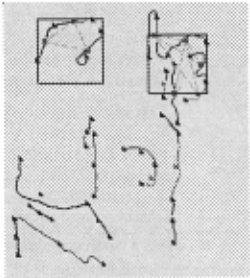

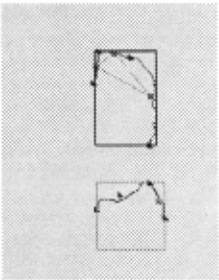
As an example of how picture-specific constraints can enable a constrained search for objects, consider Figure 3. The object schema for "picture frames" yields the information that it contains a frame/border and an in terior and that the border is typically a rectangle or an oval. The other object schema is for faces. Based on this, the control module invokes the following operations:
- Since rectangles and ovals are easier to find than faces, the decision stage chooses to look for picture frame objects first. It finds one candidate, a working constraint graph containing a single node is created and labeling is successful. Next, the search region for Tyler's face is constrained because of the relation included-in. Control loops back to the decision stage where the next best class (the only one left in this example) is chosen.
- The object locator for faces is now called to find 3 faces. The schema contains information that one face must be in a specified constrained area. Fig. 3 (2nd image) shows the output of the face locator. Since the number of candidates (two) is less than the known number of faces, the locator must be called again. Since neither of the candidates found is in the constrained region, the missing face must be in it, and the locator is called on this sub-image. The last image on the top of the page shows the output. The rectangle in black is the candidate returned by the face-locator and the grey rectangle is a weaker choice not returned in the first pass. The third face candidate is thus located.
- The constraint graph is now augmented with 3 more nodes (representing the 3 persons) and initialized with the new labels and 2 constraints (ref. sec tion3.4) resulting in a successful labeling.
4 Future Work
The cost function evaluated for different classes in the decision stage is currently based on weights computed by trial and error. The encoding of relative tool costs and measures should be made more declarative or learned from a training set. We also need to relax our assump tion of a known fixed frame of reference and incorporate progress made in the field of spatial representations. The constrained search paradigm is currently being applied only for spatial relations between objects. We need to explore its application to· other visual relations, for ex ample, if darker-than(A,B) and A is uniquely labeled, then that constrains the value of the characteristic con straint (brightness) of B, and could be used for a locative purpose.
There are several sources of collateral information which can accompany an image. The task of co-referencing words/phrases in the text with their corresponding im age areas is greatly facilitated if deictic input is also avail able. Our system does not currently make use of deictic input.
We are experimenting with several techniques to find faces given poor edge data. These techniques include the use of color, a more sensitive edge detector, and finding facial features (e.g., eyes) directly without locating the face contour. We have recently started experimenting with color images. Color is useful in several ways; it can help the face locator detect boundaries of objects, and allows us to assert and process additional characteristic constraints of objects. An example of such a character istic constraint for the face object class is hair color.
5 Summary
We have presented a computational model for incorpo rating picture-specific constraints in the task of image interpretation. We have applied the constraint satisfac tion paradigm to this problem. In particular, we have illustrated the use of constrained search in improving the efficiency and accuracy of object locators. A face identifi cation system, FICTION has been described, which uses collateral information derived from captions to identify human faces in newspaper photographs. We have identi fied several limitations of the system and have suggested approaches to overcome them.
Acknowledgments
The authors would like to thank Debra Burhans, Hans Chalupsky, Venu Govindaraju and Mahesh Venkatra man for their input in writing this paper.
@inproceedings{ijcai1995p7,
  title     = {Control Structures for Incorporating Picture-Specific Context in Image Interpretation},
  author    = {Chopra, Rajiv and Srihari, Rohini K.},
  booktitle = {Proceedings of the Fourteenth International Joint Conference on
               Artificial Intelligence, {IJCAI-95}},
  publisher = {International Joint Conferences on Artificial Intelligence},
  editor    = {Chris S. Mellish},
  pages     = {50--54},
  year      = {1995},
  note      = {Action and Perception},
  url       = {https://ijcai.org/proceedings/1995/7},
}
TY - CPAPER TI - Control Structures for Incorporating Picture-Specific Context in Image Interpretation AU - Chopra, Rajiv AU - Srihari, Rohini K. T2 - Proceedings of the Fourteenth International Joint Conference on Artificial Intelligence, IJCAI-95 PB - International Joint Conferences on Artificial Intelligence PY - 1995 SP - 50 EP - 54 UR - https://ijcai.org/proceedings/1995/7 ER -Copied
Machine-readable versions of this paper, for tools and AI agents:





