
How to Use Limited Memory in Heuristic Search
Proceedings of the Fourteenth International Joint Conference on Artificial Intelligence. Automated Reasoning. Pages 236-241.
© 1995 International Joint Conferences on Artificial Intelligence
Abstract
Traditional best-first search for optimal solutions quickly runs out of space even for problem instances of moderate size, and linearspace search has unnecessarily long running times since it cannot make use of available memory. For using available memory effectively, we developed a new generic approach to heuristic search. It integrates various strategies and includes ideas from bidirectional search . Due to insights into differe nt utilizations of available memory, it allows the search to use limited me mory effectively. Instantiations of this approach for two different benchmark domains showed exce ll e nt results that are statistically significant improve ments over previously re ported results: for finding optima l solutions in the 15-Puzzle we achieved the fastest searches of all those using the Manhattan distance heuristic as the only knowledge source, and for a scheduling domain our approach can solve much more difficult problems than the b es t competitor. The most important lessons we learned from the experiments are first, that also in domains with symmetric graph topology selecting the right search direction can be very important , and second, that memory canunder certain conditions- be used much more e ffect iv e ly than by traditional best-first search.
- [Chakrabarti et al., 1989] P.P. Chakrabarti, S. Ghose, A. Acharya, and S. C. DeSarkar . Heuristic search in restri cted memory. Artificial Intelligence , 41(2):197- 221, 1989.
- [de Champeaux , 1983] D. de Champeaux. Bidirectional heuristic search again. J. ACM, 30:22-32 , 1983 .
- [Dechter and Pearl, 1985] R. Dechter and J . Pearl. Gen- eralized best-first strategies and the optimality of A*. J. ACM, 32(3):505-536, 1985.
- [Dillenburg and Nelson, 1994] J .F. Dillenburg and P.C . Nelson . Perimeter search. Artificial Int elligence, 65:165-178 , 1994.
- [Ghosh et a/. , 1994] S. Ghosh , A. Mahanti , and D.S. Nau. ITS: an efficient limited-memory heuristic tree search algorithm. In Proc. AAAI-94, pages 1353-1358, 1994.
- [Hart et al., 1968] P.E . Hart, N.J . Nilsson, and B. Raphael. A formal basis for the heuristic determi- nation of minimum cost paths. IEEE Transactions on Systems Science and Cybernetics (SSG), SSC- 4(2):100-107, 1968.
- [Kaindl and Khorsand , 1994] H. Kaindl and A. Khorsand. Memory-bounded bidirectional search . In Proc. AAAI-94, pages 1359-1364, 1994.
- [Kaindl and Smetana, 1994] H. Kaindl and H. Smetana. Experimental comparison of heuristic search algo- rithms. In AAAI-94 Workshop on Experimental Eval- uation of R easoning and Search Methods , pages 11-14, 1994.
- [Kaindl et a/., 1994] H. Kaindl, A. Leeb, and H. Smetana. Improvements on linear-space search algo- rithms. In Proc. ECAI-94, pages 155-159, 1994.
- [Kainz , 1995] G . Kainz . Heuristische Suche mit begrenz- tem Speicherbedarf. Doctoral dissertation , Technische Universitat Wien, 1995. Forthcoming.
- [Koll and Kaindl, 1993] A.L. Koll and H. Kaindl. Bidi- rectional best-first search with bounded error : Sum- mary of results. In Proc. IJCAI-93, pages 217-223 , Chambery, France, 1993. IJCAI
- [Korf, 1985] R.E. Korf. Depth-first iterative deepening: An optimal admissible tree search. Artificial Int elli- gence, 27(1):97-109 , 1985.
- [Korf, 1993] R.E. Korf. Linear-space best-first searc:h. Artificial Intellig ence, 62( 1) :41-78, 1993.
- [Kwa, 1989] J .B.H . Kwa. BS*: An Admissible Bidirec- tional Staged Heuristic Search Algorithm . Artificial Intelligence, 38(2) :95-109, 1989.
- [Lawler and Wood, 1966] E.L. Lawler and D. Wood. Branch-and-bound methods: a survey. Operations R e- search, 14:699-719, 1966.
- [Pohl, 1971] I. Pohl. Bi-directional search. In Ma- chine Intelligence 6, pages 127-140 , Edinburgh, 197 1. Edinburgh University Press.
- [Rao et a/., 1991] V.N. Rao, V. Kumar , and R .E. Korf. Depth-first vs best-first search. In Proc. AAAI-91 , pages 434-440, Anaheim , 1991. Los Altos , CA.: Kauf- mann .
- [Reinefeld and Marsland, 1994] A. Reinefeld and T.A. Marsland . Enhanced iterative-deepening search. IEEE Transactions on Pattern Analysis and Machine Intelligence (PAM!} , 16(12):701-709 , July 1994 .
- [Russell, 1992] S. Russell. Efficient memory-bounded search methods. In Proc. ECAI-92, pages 1-5, Vien na, Austria, 1992 . Chichester: Wiley.
- [Sen and Bagchi, 1989] A.K. Sen and A. Bagchi. Fast recursive formulations for best-first search that allow controlled use of memory. In Proc. IJCAI-89, pages 297-302, 1989 . IJCAI
- [Sen and Bagchi, 1993] A.K. Sen and A. Bagchi . Job se- quencing with quadratic penalties : an A* -based graph search approach. In Proc. CAIA-93, pages 190-196, Orlando, FL, March 1993.
- [Taylor and Korf, 1993] L.A. Taylor and R.E. Korf. Pruning duplicate nodes in depth-first search. In Proc. AAAI-93, pages 756-761, Washington, D.C., 1993. Los Altos, CA .: Kaufmann .
- [Townsend , 1978] W . Townsend. The single machine problem with quadratic penalty fun ction of comple- tion times: a branch-and-bound solution. Manage- ment Sci ence , 24(5) :530-534 , 1978 .
- [Zhang and Korf, 1993] W. Zhang and R.E. Korf. Depth-first vs. best-first search : new results. In Proc. AAAI-93, pages 769-775, Washington, D.C., 1993. Los Altos, CA.: Kaufmann .
References were extracted automatically from the PDF and may contain errors.
Full text extracted automatically from the PDF; figures, tables and equations may differ. The PDF is the version of record.
1 Introduction
Best-first search in the tradition of A · [Hart et a/., 1968] typically requires exponential space. Therefore, it quickly runs out of space even for problem instances of moderate size when searching for optimal solutions.
In contrast, linear-space search like IDA · [Korf, 1985], REFS [Korf, 1993] and DFBB [Lawler and Wood, 1966] does not suffer from memory limitations. Typically, there is even much more memory available than needed by such algorithms. Since they cannot make use of such memory, however, their running time is unnecessarily long.
One of the major problems of heuristic search is how to use available but limited memory effectively. Pure uni directional approaches to utilizing limited memory still
Angelika Leeb
MIT Lab. f. Comp. Sc. 545 Technology Square Cambridge, MA 02139 U.S.A.
Harald Smetana
Lerchengasse 12 A - 3430 Tulln Austria
did not lead to convincing results [Chakrabarti et al., 1989; Ghosh et al., 1994; Reinefeld and Marsland, 1994; Russell , 1992; Sen and Bagchi , 1989] . Therefore, we propose to consider in addition ideas from bidirectional search [Kaindl and Khorsand, 1994; Koll and Kaindl , 1993; Kwa, 1989; Pohl, 1971] .
In this paper we integrate various unidirectional strategies and include ideas from bidirectional search in a generic approach to heuristic search. Due to insights into different utilizations of available memory, our approach allows the search to use limited memory effectively.
First, we present our new generic approach to heuristic search that specifically focuses on using limited memory. Then we show how this approach can be appropriately instantiated for two very different domains with few and many distinct cost values, respectively. For both do mains, we report experimental data that represent sig nificant improvements over previously published results. Finally, we compare our approach more generally with related work.
2 A Generic Approach to Heuristic Search Using Limited Memory
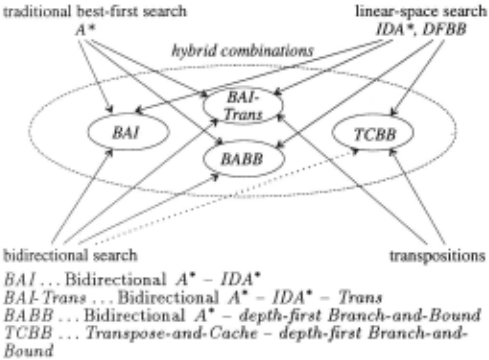
We developed a new generic approach to heuristic search that integrates various approaches and typically leads to hybrid combinations of search algorithms . One of the main ideas to address the memory problem is to combine linear-space search with conventional best-first search in a bidirectional style. Fig. 1 gives an overview and indicates how our new algorithms integrate ideas from various approaches in hybrid combinations-this will be discussed in detail below. First, we explain the generic approach generally. Its major steps are:
- Assign the search directions and the available mem ory to the traditional best-first and the linear-space algorithm, respectively.
- Perform traditional best-first search using some or even nearly all of the available memory.
- Unless the best-first search has already found an op timal solution, use a linear-space algorithm in the reverse direction. Use the memory structure built up by the previous best-first search, possibly to gether with additional memory that is still available.
Note, that the linear-space algorithm per se only re quires little memory, but it can utilize additional mem- Figure 1: Overview of the generic approach and some instantiations.
ory through direct access, e.g., via hashing.
Since this approach does not allow for changing the search direction more than once; it can be viewed as a non-traditional form of bidirectional search. In particu lar, the recently proposed perimeter search [Dillenburg and Nelson, 1994] fits into it. However, we explicitly do not propose to use a wave-shaping strategy 1 (see also [de Champeaux, 1983]), since it is inefficient in terms of running time.
Under certain circumstances to be discussed below, one or more of the steps can also be omitted during in stantiation. For instance, if the domain shows a strong asymmetry, the search direction is known before the search begins. Moreover, our generic approach can also be instantiated as unidirectional search.
Since this generic approach has to be instantiated for appropriate use, we must give guidelines for doing so. First of all, it is important to understand how given memory can be utilized during heuristic search. While some of these utilizations appear to be well understood, we could not find a clear categorization in the literature. Note that item 5(b) given below appears to have been previously overlooked. We distinguish the following uti lizations of given memory:
- for ordering the sequence of node generations: traditional best-first search like A* organizes the memory as a priority queue for this purpose, while more recent linear-space REFS has to backtrack;
- for storing state information of generated nodes: for instance, in the well-known 15-Puzzle the con figuration of tile positions can be stored;
- for finding transpositions 2 in a directed acyclic graph in order to avoid "treeification" during search: again, A* is a well-known example, while IDA*
1 Wave-shaping has to compute heuristic estimates be tween all nodes in one search frontier and all nodes in the other, i.e. , the effort is proportional to the cross product of the numbers of nodes in the frontiers.
2 Transpositions arise when different paths lead to the same node.
----- ----------
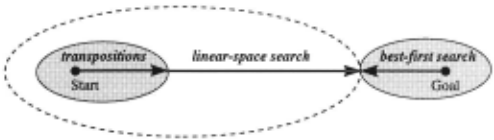
Figure 2: An approach to using memory on both sides.
and DFBB normally cannot recognize transposi tions without extra memory (which may also be used as in [Taylor and Korf, 1993]);
- for caching information about heuristic estimates: three cases can be distinguished here:
- (a) static heuristic value: storing such values avoids recomputation;
- (b) more accurate information closer to a goal: memory-bounded algorithms like MREC [Sen and Bagchi, 1989] propagate better heuristic es timates found during their linear-space searches back to the stored part of the search graph;
- (c) heuristic information computed between two search frontiers: wave-shaping approaches to bidirectional search utilize memory to store such values computed during the search;
- for finding solutions:
two cases can be distinguished here:
- (a) finding solutions at all: traditional bidirectional search like BHPA [Pohl , 1971] and IBS; [Koll and Kaindl, 1993] needs the memory to find solutions by recognizing meetings of the search frontiers;
- (b) finding solutions earlier: the non-traditional approach to bidirectional search described below uses memory to find so lutions earlier than without the memory.
- for proving solution quality: bidirectional heuristic search utilizes given memory for storing estimates of the optimal solution cost to be used for proving the quality of a solution found .
The combination of search ideas to be chosen during an instantiation of our generic approach should utilize the given memory in several different ways. This typi cally leads to higher efficiency since their advantages are more or less disjoint and nearly add up, while using the same amount of storage just for one purpose may not give the same pay-off. Fig. 2 shows a useful specializa tion of our generic approach that uses memory on both sides of the search space: a transposition table [Reinefeld and Marsland, 1994] on one side, and the memory of a traditional best-first search on the other. The former is used for finding transpositions and caching more accu rate heuristic evaluations closer to the goal. The latter first of all orders the sequence of node generations and helps finding transpositions in another part of the search space, and finally it supports finding solutions earlier .
Of course, an instantiation should make use of any domain-specific information available. In particular, it should combine those unidirectional search algorithms that best suit the properties of the domain (see, e.g., [Rao et a/. , 1991; Zhang and Korf, 1993]) . For instance, in some domains IDA* is the choice, while in others DFBB is much better.
3 Instantiating for a Domain with Few Distinct Cost Values: 15-Puzzle
First we show how our generic approach can be instan tiated for a domain that is characterized by having only few distinct cost values: the well-known 15-Puzzle. Un der this condition, it is reasonable to select IDA · for the linear-space search part .
Moreover, we can assume to have a monotone evalua tion function: the Manhattan distance. Since A* makes good use of monotone heuristics [Dechter and Pearl , 1985], we select it for the part of the best-first search .
Based on the key idea of bidirectional search, we let A · and IDA · search in opposite directions in steps 2 and 3 of our generic approach, respectively. Fig. 1 illustrates this instantiation that leads to BAI (Bidirectional A* - IDA*) .
According to the idea of using memory in various ways, we may also give the IDA* search some part of the avail able memory as a transposition table. Fig. 2 illustrates this approach generally. We call this variant of BAI due to the use of this table BAI- Trans (see also Fig. 1) .
If A* cannot find a solution using the given memory, then IDA* searches in the reverse direction towards the frontier of the prior search. Since we consider the case of finding optimal solutions , this search cannot always terminate immediately after a solution is found. A bet ter solution may exist, and the algorithm must find an optimal one and subsequently prove that it is optimal.
More technically, the IDA* part must be changed slightly. Instead of having to find the goal node, a solu tion is found whenever the depth-first search meets the frontier of the opposing A · search. If the cost of this so lution is smaller than the cost of the best solution found so far (or if it is the first solution found) then its value is stored. Of course, the cost of the best solution found so far may be sub-optimal, or the algorithm does not yet know that it is already optimal. However, if the stored value does not exceed the non-overestimating threshold of the IDA · part, then its depth-first search is exited successfully with an optimal solution.
In addition to these necessary changes, the IDA* part has the advantage to start with an increased initial threshold based on an admissible estimate of the optimal solution cost as determined by the A* part. Since we as sume a monotone heuristic h, the minimum off = g + h for all nodes in OPEN is always an admissible estimate. Therefore, if this estimate is higher than the usual initial threshold of IDA · , then it can be used here instead.
Moreover, it is not necessary to have the IDA · part search again in the space already explored by A ·. More technically, when the depth-first search invoked by IDA · meets a CLOSED node of the opposing A · search frontier, this branch can be cut off (meeting an OPEN node is in general insufficient) . We call this nipping according to an analogous method described in [Kwa, 1989] .
In an efficient implementation of the 15-Puzzle even the effort of hashing at every node causes an overhead that cannot be ignored. Therefore, we implemented BAI in such a way that it avoids hashing at those nodes where-based on the heuristic estimate-it knows that the frontier of the opposing A* search is yet out of reach.
According to step 1 of our generic approach, the search directions must be assigned to the A · and the IDA · part, respectively. For traditional bidirectional search, Pohl [Pohl , 1971] proposed and used a cardinality criterion for the problem of determining the frontier from which to select a node for expansion: continue searching from the frontier with fewer OPEN nodes. While this is utilized for each node expansion in traditional bidirectional search algorithms, BAI has to decide this issue once at the very beginning of the whole search. When the search space is sufficiently symmetric, the initial search direction can be determined at random. When the search space is at least slightly asymmetric and no specific knowledge for determining the search direction is available, it seems reasonable to make shallow probes into the search space from both sides and to use the idea of the cardinality criterion. Since BAI incorporates IDA ·, using this al gorithm also for probing is consistent with the overall approach. For instance in the 15-Puzzle, the first few iterations of IDA* are searched from both sides, and the direction with fewer generated nodes is assigned to the IDA · part of the overall search , since especially for dif ficult problems it will have to search much deeper than the A* part .
Let us shortly discuss the behavior of BAl. In the best case, it would seem to be the same as A*. In fact, BAI can even be better than pure A* . BAI assigns the search direction dynamically, which can lead to better results than systematically going in one direction. In the worst case, BAihas to perform the part of A*, without savings in the IDA* part (except the effect of nipping).
A key question is how BAI saves effort without having enough memory available for completing the A · search. Primarily, it can save one or more of IDA · 's iterations. Due to the better initial threshold, some of the early it erations can be saved. Since the earlier iterations are comparably cheap, this helps much less than saving the last iteration. The search can also be terminated after a complete iteration of IDA · if the cost of the best solu tion already found is not larger than the new increased threshold. Therefore, large savings are possible when BAI terminates earlier than pure IDA · .
4 Instantiating for a Domain with Many Distinct Cost Values: Single Machine Scheduling
Now let us show how our generic approach can be in stantiated for a domain that is characterized by having many distinct cost values: a scheduling domain described and used for experiments in [Sen and Bagchi , 1993; Townsend, 1978).3
3 Since this benchmark domain is not widely known, we sketch it shortly. It deals with one-machine job sequence problems of the following form. Jobs J; with processing times
For problems with many distinct cost values, IDA* is known to be much less efficient. But it is reasonable to select DFBB for the linear-space search part, assuming that a good upper bound can be determined quickly which is the case in this kind of problem.
Again , a monotone evaluation function is available, so we can analogously to BAI select A* for the part of the best-first search. Based on the key idea of bidirec tional search, we let A* and DFBB search in opposite directions in steps 2 and 3 of our generic approach, re spectively. Fig. 1 illustrates this instantiation that leads to BABE (Bidirectional A* - depth-first Branch-and Bound). Technically, the computation of the heuristic is different in the backward direction, and the neces sary modification is not completely trivial. While in the forward direction all the jobs on the current path are al ready included, in the backward direction the jobs on the path have not yet been included. The best approach we found is to define a new problem that excludes all these jobs, and to compute the heuristic for this problem.
Due to the above mentioned asymmetry of the arc cost distribution , the better search direction can be de termined a priori in this domain. (The reasons are dis cussed below.) Therefore, step 1 of our generic approach can be omitted here.
For the same reason, another possibility to instantiate our generic approach here is to omit also the best-first search part completely and to provide all the available memory in the form of a transposition table. Analo gously to its use in IDA*, it both finds transpositions and caches dynamically acquired heuristic information. Therefore, we call this algorithm TCBB (Transpose-and Cache - depth-first Branch-and-Bound). Still , the bidi rectional idea of starting on either side of the space is important here, which is illustrated by the dotted arrow in Fig. 1.
An obvious advantage of both BABE and TCBB over A* is their ability to continue searching although the memory is too small to store all the nodes. A much less obvious advantage of TCBB over A* is that-under cer tain conditions- TCBB utilizes available memory much more effectively. This will be explained together with empirical results below.
5 Experimental Results
In our experiments, we compared BAI, BAI- Trans, BABE and TCBB with other algorithms on the task of finding optimal solutions in two different domains. From the derivations of our algorithms, it should be intuitively clear that these algorithms are admissible, i.e., if a so lution exists, they terminate with an optimal solution. Formal proofs can be found in [Kainz, 1995].
a; and penalty constants p; (associated with completing a job at timet;) are submitted to a one-machine job-shop. t; is the sum of the times ai of all jobs j on the currently evaluated path. The penalty function is G;(t;) = p;t1. All the jobs must be sequenced on the machine in such a way that the sum of all penalties is minimized. Important properties of this domain are a symmetric graph topology and an asymmetric distribution of arc costs that is due to the quadratic penalty function.
5.1 15-Puzzle
Now let us have a look on specific experimental results for finding optimal solutions to a set of (sliding-tile) 15Puzzle problems. 4 We compare our new algorithms BAI and BAI- Trans on these problems with other algorithms that achieve the best results known here yet without us ing domain-specific knowledge about the puzzle other than the Manhattan distance heuristic: IDA*, Trans [Reinefeld and Marsland, 1994] and IDPS* (perimeter search) [Dillenburg and Nelson, 1994]. REFS has the po tential to be better than IDA* on the sliding-tile puzzle, but actually its results are slightly worse on this specific problem set according to [Korf, 1993] due to noise in the tie-breaking on the last iteration.
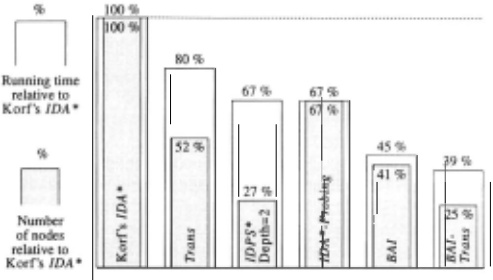
Fig. 3 shows a comparison of these algorithms in terms of the avera~e number of node generations and their run ning times. The data are normalized to the respective search effort of IDA*. Trans (using 256k nodes of mem ory) achieves savings of nearly half of the nodes com pared to IDA*, and although the effort for hashing slows it down, Trans is faster than IDA* since it utilizes its memory well. 6 IDPS* saves even 73 percent of the nodes generated by IDA ·, but due to its wave-shaping overhead only 33 percent of the running time. 7
4 We used the complete set of 100 instances from [Korf, 1985].
5 In an efficient implementation of the 15-Puzzle, even checking of whether a node generated by IDA · is in the opposing search frontier means a measurable overhead, al though this can be done efficiently via hashing. The reason is that node generation and evaluation can be done very ef ficiently for the sliding-tile puzzles [Korf, 1993]. Even the machine architecture can influence the relative running time up to a certain degree. Therefore, we note that our data were gained using a Convex C3220. On this machine, IDA · searches 210k nodes per second.
6 The data in the figure were gained using a re implementation of Trans based on efficient code provided by Jonathan Shaeffer. Note the different way of presenting the results: absolute data in our figure vs. relative to problem difficulty in [Reinefeld and Marsland, 1994]. We had to re implement Trans, since the detailed data in terms of node generation numbers provided by Alexander Reinefeld and the data reported in [Reinefeld and Marsland, 1994] were insuffi cient to get comparable data on the running times. Actually, Trans+Move is the best algorithm described in [Reinefeld and Marsland, 1994], but its absolute results are less than one percent better than those of Trans. Therefore, we did
The results of our new algorithms shown in Fig. 3 were generated by giving them also 256k nodes of mem ory, and determining the search direction via probing through IDA · searching its first three iterations (this generates only very few nodes but already indicates the better search direction with a relatively high reliability of 80 percent). RAJ saves more nodes than Trans, and it is also faster. The overhead through hashing is smaller due to our strategy of avoiding it if possible. Our combi nation RAJ- Trans saves three quarters of IDA · 's nodes and 61 percent of its running time. This shows that the respective advantages of using memory in these differ ent ways nearly add up, although the available memory for each of its parts is just half of the memory given to each RAJ and Trans, i.e., RAJ- Trans altogether has 256k nodes of memory available here. Although RAJ Trans does not use wave shaping, it generates slightly fewer nodes than IDPS* with perimeter depth 2. Be cause of avoiding the overhead of wave shaping, RAJ Trans is clearly faster than IDPS* (although with this perimeter depth this overhead is relatively very small). In order to make sure that these results are not due to chance fluctuations, we performed statistic tests. 8 The superiority of RAJ- Trans in terms of running time over pure IDA ·, pure Trans and IDPS* as shown in the figure is statistically significant.
Although the search space of the sliding-tile puzzle ap pears to be quite symmetric, it is interesting to see how much can be gained here just by selecting the search di rection dynamically. Therefore, we conducted a special experiment with a variant of IDA · that just uses our ap proach for selecting the search direction: IDA* -Probing. Fig. 3 shows that even this simple linear-space algorithm is slightly faster than Trans, since it has no overhead in running time. Moreover, the advantage of IDA · -Probing over pure IDA · is statistically significant. In order to see how well probing via three iterations already indi cates the better search direction, we compared its re sult with that of a perfect oracle. Using it would still generate 64 percent of IDA*'s nodes, i.e., IDA*-Probing with an overhead in generated nodes for determining the
notre-implement Trans+ Move and cannot include it into the figure, lacking data on the running times.
7 The results reported in [Dillenburg and Nelson, 1994] are based on runs using a different sample set of the IS Puzzle, and a different perimeter depth. Using the same perimeter depth ( 4), the results on Korf's set with our re implementation are even better in terms of the number of node generations, but very much slower in terms of running time (even slower than IDA ·). In personal communication with John Dillenburg it turned out that their implementa tion of IDA · is slower than Korf's one that we are using by a factor of about 60 per generated node. In such an implemen tation the overhead especially of wave shaping does not show up that clearly as it does in an efficient one. Since smaller perimeter depth means fewer stored nodes and therefore less overhead through wave shaping, the perimeter depth 2 re sults in better running time, and consequently we show these data in our figure.
8 More details on the statistic tests used can be found in [Kaindl et al., 1994; Kaindl and Smetana, 1994].
search direction of only less than 0.1 percent is overall just 3 percent worse than this. Systematically searching in the backward direction, however, is not significantly better due to high standard deviations, although it saves 17 percent over systematically searching in the forward direction.
In summary, instantiating our generic approach as de scribed lead to the fastest searches for finding optimal so lutions on the 15-Puzzle of all those using the Manhattan distance heuristic as the only knowledge source. While saving 61 percent of the running time of pure IDA* may not seem impressive, the difficulty of significantly improving its results may be appreciated when looking at the many less successful attempts with various algo rithms (see the section on related work below).
5.2 Single Machine Scheduling
The best results yet reported for the scheduling problem that we chose for our experiments are those of A · that searches systematically in the forward direction: finding optimal solutions to random problems of 28 jobs in an average of some few seconds each with less than 300k nodes of memory. As compared in [Sen and Bagchi, 1993], these results signified a very strong improvement over previous approaches that did not utilize the graph structure of the search space.
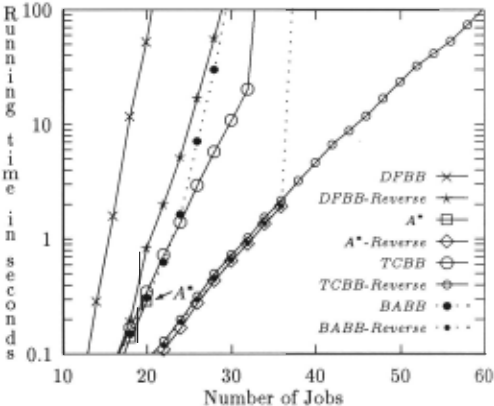
Fig. 4 shows A* data and the results of DFRR in com parison to the results that we achieved through instanti ating our generic approach appropriately. Except DFRB and DFRR-Reverse, all the algorithms were given the same amount of memory: 16k nodes. 9 The data point annotated in the figure via "A*" indicates the result with the previously best method. The main discovery was that systematically searching in the reverse direction from the goal to the start-yields much better results: see the data of D F BB-Reverse and A*-Reverse. These results are very surprising since the graph topology of the search space is symmetric. According to current the ory, such a strong effect of reversing the search direction would have been attributed to a strong asymmetry of the graph topology.
9 We chose this amount of memory for showing the high efficiency of TCBB in regard to memory utilization. We used the same 100 randomly generated problem instances per "number of jobs" as [Sen and Bagchi, 1993], since Anup Sen made the generator available to us. The figure shows the results in terms of running time, but the numbers of gener ated nodes are quite the same, since computing the heuristic values dominates the running time. Note, that the data are shown on a logarithmic scale.
Actually, the reason for this phenomenon is due to the asymmetric distribution of arc costs induced by the quadratic penalty function in these problems. In order to find this reason, we made special experiments, and since this phenomenon also occurs without using heuris tic values, it is at least not primarily related to their accuracy. We can explain it as follows: when searching in the forward direction, many nodes must be generated in order to find that a path is bad since the arc costs are initially small; in the backward direction, however, the arc costs are initially large and vary strongly, which allows the identification of bad paths already after rela tively few node generations.
Independently of search direction, A* still runs out of space with increasing problem difficulty, and pure DFBB cannot recognize transpositions and has excessive run ning times due to the huge number of nodes searched. Our algorithm BABE is better than A* insofar as it can continue searching when A* already has to quit due to lack of memory on difficult problems with many jobs. However, it does not utilize the given resources opti mally.
Although A* is slightly faster than TCBB due to gen erating slightly fewer nodes, our new algorithm TCBB utilizes its memory much better than A* (and BABE). While A* runs out of 16k nodes of memory (in the for ward direction) even for problems with more than 20 jobs, TCBB needs no more memory for problems of 32 jobs. Even when it cannot store all of the searched nodes on more difficult problems, it still finds solutions.
One reason for the better utilization of memory by TCBB compared to A* in this domain is that it is pos sible here for TCBB to find a good upper bound quickly that avoids storing all the nodes with a higher estimated cost. In contrast, A* is unaware of an upper bound and stores many nodes with bad values. Another reason is that in these problems the branching degree is relatively high, and TCBB can avoid storing many nodes, which reinforces the effect above. In contrast, A* stores all of them due to its strategy of generating and storing all the successors at once at node expansion.
Due to the strong asymmetry of the arc cost distribu tion, this unidirectional search algorithm is even much better in the reverse direction: TCBB-Reverse-but the bidirectional view was necessary to discover the strong asymmetry in this domain. TCBB-Reverse can solve even problems with 60 jobs in an average of about 100 seconds, which shows how well our approach scales up. While A*-Reverse is much better than A* in the for ward direction, it still runs out of 16k nodes of memory for problems with more than 36 jobs.
In summary, we achieved very strong overall improvements with our approach in this scheduling domain com pared to the best results reported in the literature. In particular, our approach can solve much more difficult problems with the same amount of memory and within reasonable time.
6 Related work
Originally, bidirectional heuristic search did not work as expected [de Champeaux, 1983; Kwa, 1989; Pohl, 1971]. Recent results show that bidirectional search has the po tential to improve on unidirectional search [Kaindl and Khorsand, 1994; Koll and Kaindl, 1993]. Unfortunately, traditional bidirectional search requires rather compli cated mechanisms that make it difficult to implement. Moreover, in domains that can be implemented with fast node generation and computation of the heuristic func tion like the 15-Puzzle, these mechanisms imply a cer tain overhead. Therefore, the generic approach in this paper tries to utilize key ideas of bidirectional search in an efficient manner.
A bidirectional algorithm sketched in [Korf, 1985] em ploys DFID (depth-first iterative-deepening without us ing heuristic knowledge). Since its space requirement is still O(bdf 2 ), it cannot solve difficult problems.
Perimeter search [Dillenburg and Nelson, 1994] is a non-traditional approach to bidirectional search that may look very similar to our algorithm BAl. However , the key difference is the use of a form of wave shaping in perimeter search, that makes it inefficient in terms of running time.
Apart from bidirectional search there are some rela tions to unidirectional search algorithms with reduced space requirements: MREC[Sen and Bagchi , 1989], MA* [Chakrabarti et a/., 1989], SMA* [Russell , 1992], ITS [Ghosh et a/., 1994], and the approach of using certain tables for IDA* [Reinefeld and Marsland, 1994] . From these, Trans and Trans+ Move [Reinefeld and Marsland, 1994] gave the best results on the 15-Puzzle in terms of running time that we are aware of. Similarly to some of this referenced work, our BAI algorithm can be viewed as saving nodes otherwise searched by IDA*. Our new algorithm TCBB is clearly analogous to Trans, but due to including DFBB instead of IDA* it is much more effi cient in domains with many distinct cost values and the possibility of getting reasonable upper bounds on the solution cost.
7 Conclusion
Our approach makes use of some known ideas and algo rithms . However , this paper contains several new ideas and results:
- We developed a generic approach to heuristic search that utilizes limited memory effectively.
- We categorize several different utilizations of given memory for heuristic search and identify a new one in our approach.
- During experiments with instantiations of our ap proach in two different domains, we learned that even for nearly symmetric graph topology, selecting the search direction can be important . Especially the distribution of arc costs can be crucial.
- We found that- under certain conditions- available memory can be utilized much more effectively than by A*.
- In both selected domains- the 15-Puzzle and a spe cial scheduling domain- we achieved significantly better results with our approach than those previ ously reported in the literature.
In summary, our new generic approach to heuristic search integrates various strategies and includes ideas from bidirectional search. Due to insights into different utilizations of available memory, it allows the search to utilize limited memory effectively.
Acknowledgments
Our implementations are based on the very efficient code of IDA* and A* for the puzzle made available by Richard Korf and an efficient hashing schema by Jonathan Sha effer, as well as on code of A* and DFBB for the schedul ing domain by Anup Sen. Alexander Reinefeld and Tony Marsland provided the data on the generated nodes for Trans and Trans+ Move as well as comments on an ear lier draft of this paper . Finally, we acknowledge the useful comments on an earlier draft by Wilhelm Barth, Wolfgang Schmid and Anup Sen.
@inproceedings{ijcai1995p31,
  title     = {How to Use Limited Memory in Heuristic Search},
  author    = {Kaindl, Hermann and Kainz, Gerhard and Leeb, Angelika and Smetana, Harald},
  booktitle = {Proceedings of the Fourteenth International Joint Conference on
               Artificial Intelligence, {IJCAI-95}},
  publisher = {International Joint Conferences on Artificial Intelligence},
  editor    = {Chris S. Mellish},
  pages     = {236--241},
  year      = {1995},
  note      = {Automated Reasoning},
  url       = {https://ijcai.org/proceedings/1995/31},
}
TY - CPAPER TI - How to Use Limited Memory in Heuristic Search AU - Kaindl, Hermann AU - Kainz, Gerhard AU - Leeb, Angelika AU - Smetana, Harald T2 - Proceedings of the Fourteenth International Joint Conference on Artificial Intelligence, IJCAI-95 PB - International Joint Conferences on Artificial Intelligence PY - 1995 SP - 236 EP - 241 UR - https://ijcai.org/proceedings/1995/31 ER -Copied
Machine-readable versions of this paper, for tools and AI agents:





