
Residue-Driven Architecture for Computational Auditory Scene Analysis
Proceedings of the Fourteenth International Joint Conference on Artificial Intelligence. Action and Perception. Pages 165-173.
© 1995 International Joint Conferences on Artificial Intelligence
Abstract
The Residue-Driven Architecture presented her e is a model of auditory stream segregation from input sounds. A subsystem to extr a ct auditory str e ams by using some sound attributes is called an agency and the design of each agency is based on the residue-driven architecture . This architecture consists of three kinds of agents: an event-detector, a tracergenerator, and tracers. The event-detector calculates a residue by subtracting the predicted input from the actual input. When a residue exceeds a threshold value, tracer-generator generates a tracerthat extracts an auditory stream from the residue and returns a predicted input of the next time frame to the event-detector. This approach improves the performance of segregation and the resulting system can segregate a woman's voiced stream, a man's voiced stream, and a noise stream from a mixture of these sounds. Binaural segregation is also designed by the architecture.
- [Blauert, 1983] J. Blauert. Spatial Hearing: the psy- chophysics of human sound localization. MIT Press.
- [Bodden, 1993] M. Bodden. Modeling human sound- source localization and the cocktail-party-effect. Acta Acustica, 1:43-55, Feb./ Apr. 1993.
- [Boll, 1979] S.F. Boll. A Spectral Subtraction Algorithm for Suppression of Acoustic Noise in Speech. In Pro- ceegings of the International Conference on Acoustics, Speech, and Signal Processing, pages 20D-203, IEEE.
- [Bregman, 1990] A.S. Bregman. Auditory Scene Analy- sis -the perceptual organization of sound. MIT Press.
- [Brooks, 1986] R.A. Brooks. A Robust Layered Control System for a Mobile Robot. IEEE Journal of Robotics and Automation, RA-2(1):14-23, 1986.
- [Brown, 1992] G.J. Brown. Computational auditory scene analysis: A representational approach. PhD the- sis, Dept. of Computer Science, University of Sheffield.
- [Brown and Cooke, 1992] G.J. Brown and M.P. Cooke. A computational model of auditory scene analysis. In Proceedings of the International Conference on Spoken Language Processing, pages 523-526, IEEE, 1992.
- [Cooke et al., 1993] M.P. Cooke, G.J. Brown, M. Craw- ford and Green: Computational Auditory Scene Anal- ysis: listening to several things at once. Endeavour, 17(4):186-190, 1993.
- [Erman et al., 1980] L. Erman, F . Hayes-Roth, V. Lesser, and R. Reddy. The Hearsay-II speech- understanding system: Integrating knowledge to re- solve uncertainty. Computing Surveys, 12:213-253, ACM, 1980.
- [Jeffress, 1948] L.A. Jeffress: A place theory of sound localization. Journal of Comp. Physiol. Psychol., 61:468-486, 1948.
- [Lesser et al., 1993] V. Lesser, S.H. Nawab, I. Gal- lastegi, and F. Klassner. IPUS: An Architecture for Integrated Signal Processing and Signal Interpreta- tion in Complex Environments. In Proceedings of the Eleventh National Conference on Artificial Intel- ligence, pages 249-255, AAAI, 1993.
- [Maes, 1979] P. Maes editor. Designing Autonomous Agents: Theory and Practice from Biology to En- gineering and Back. special issue of Robot and Au- tonomous Systems, MIT Press/Elsevier, 1991.
- [Minsky, 1986] M. Minsky. Society of Minds. Simon & Schuster, Inc., 1986.
- [Nakatani, Okuno, and Kawabata, 1994] T . Nakatani, H. G. Okuno, and T. Kawabata. Auditory Stream Segregation in Auditory Scene Analysis with a Multi- Agent System. In Proceedings of the Twelve National Conference on Artificial Intelligence, pages 10D-107, AAAI, August 1994.
- [Nakatani, Kawabata, and Okuno, 1995a] T . Nakatani, T. Kawabata, and H.G. Okuno: A computational model of sound stream segregation with the multi- agent paradigm. In Proceedings of 1995 International Conference on AcoustiC$, Speech and Signal Process- ing, to appear, IEEE, Detroit, May 1995.
- [Nakatani et al, 1995b] T. Nakatani, M. Goto, I. Takatoshi, and H.G. Okuno: Multi-Agent Based Binaural Sound Stream Segregation. In Proceedings of IJCAI-95 Workshop on Computational Auditory Scene Analysis, to appear, Aug. 1995.
- Okuno, 1993)
- H.G. Okuno. Cognition Model with Multi-Agent System (in Japanese). pages 213-225.
- T. Ishida, editor. Multi-Agent and Cooperative Com- putation II, Tokyo, Japan: Kindai-Kagaku-sha, 1993.
- [Okuno, Nakatani, and Kawabata, 1995] H.G. Okuno, T. Nakatani, and T. Kawabata. Cocktail-Party Ef- fect with Computational Auditory Scene Analysis- Preliminary Report -. In Proceedings of the Sixth International Conference on Human-Computer Inter- action, to appear, Elsevier Science B.V., July 1995.
- [Ramalingam and Kumaresan, 1994] C.S. Ramalingam and R. Kumaresan. Voiced-speech analysis based on the residual interfering signal canceler (RISC) algo- rithm. In Proceedings of the International Conference on Acoustics, Speech, and Signal Processing, Vol.I, pages 473-476, IEEE, 1994.
- [Slaney, Naar and Lyon, 1994] M. Slaney, D. Naar, and R.F. Lyon. Auditory Model Inversion For Sound Sepa- ration. In Proceedings of the International Conference on Acoustics, Speech, and Signal Processing, Vol.II, pages 77-80, IEEE, 1994.
- [Stadlerand Rabinowitz, 1993] R.W. Stadler and W.M. Rabinowitz. On the potential of fixed arrays for hear- ing aids. Journal of Acoustic Society of America, 94(3) Pt.1:1332-1342, Sept. 1993.
References were extracted automatically from the PDF and may contain errors.
Full text extracted automatically from the PDF; figures, tables and equations may differ. The PDF is the version of record.
1 Introduction- What is Computational Auditory Scene Analysis?
AI research on the understanding of sounds has a rich history dating back to the ARPA Speech Understand ing Project in the 1970's. While a great deal has been learned, systems that can understand general acoustic signals (e.g. voiced speech, music and/or other sounds) from real-world environments have not been built. There are systems that understand clean speech well in rela tively noiseless laboratory environments but that cannot in more realistic, noisier environments. At a crowded party, one can attend one conversation and then switch to another. This phenomenon is known as the cocktail party effect and it shows that humans can selectively attend to sound from a particular source even when it is mixed with other sounds. Computers also need to decide which parts of a mixed acoustic signal are relevant to a particular purpose- which part should be interpreted as speech, for example, and which should be interpreted as a door closing, an air conditioner humming, or another person interrupting.
A number of researchers have therefore concluded that research on speech understanding and on non speech understanding need to be unified within a general framework. One such framework is su~ested by Breg man's book, Auditory Scene Analysis lBregman, 1990], which discusses the psycoacoustic aspects. This work has inspired a number of attempts to model what is known about the human auditory system. It has also encouraged researchers to explore more general mod els of the structure of sounds in order to deal with more realistic acoustic environments. Researchers have also begun trying to understand computational audi tory frameworks as parts of larger perception systems whose purpose is to give a computer integrated infor mation about the real world. To discriminate the AI and computer science approach from the psychoacous tic approach, it has been called Computational Auditory Scene Analysis (hereafter, CASA) [Cooke et al., 1993; Nakatani, Okuno, and Kawabata, 1994].
Research topics related to CASA include modeling is sues, sound understandings issues, architectural issues, control issues, representational issues and applications. They also include research on how different sensors can be integrated with models of how the human's auditory apparatus works in concert with vision and other kinds of sensation. Here, we focus on system architecture based on the multi-agent paradigm. The multi-agent system was recently proposed as a new modeling technol ogy in artificial intelligence [Brooks, 1986; Maes, 1979; Minsky, 1986; Okuno, 1993]. We take Minsky's view that an agent has a limited capability, although an agent in Distributed Artificial Intelligence is much more powerful and more like a human being than ours is.
In this paper we present a new architecture called Residue-Driven Architecture. The rest of this paper is organized as follows: Section 2 discusses the related works on CASA and identifies the issues. Section 3 in troduces the Residue-Driven Architecture and discusses intra-agency and inter-agency interactions. Section 4 presents the design and implementation of two agencies based on harmonics and localization (the direction of sound source). Evaluations and the conclusions are re spectively given in Section 5 and 6.
2 Previous Works on Computational Auditory Scene Analysis
One of goals in computational auditory scene analysis is to understand acoustic events, or the sources of sounds [Bregman, 1990]. An acoustic event is represented by au ditory streams (hereafter, simply streams) each of which is a group of acoustic components that have consistent attributes. Since acoustic events are represented hier archically (e.g., as an orchestra), auditory streams have also a hierarchical structure. The process that segregates auditory streams from a mixture of sounds is called audi tory stream segregation. Since acoustic components need to be organized into auditory streams, the segregation of auditory streams requires the exclusive allocation of sound to a particular stream. Auditory stream segrega tion is performed at various levels of perception. Some streams are very simple and are extracted according to simple attributes, while others are extracted by grouping streams segregated at earlier stage of processing.
Bregman proposed two mechanisms of auditory stream segregation: simultaneous (spectral} grouping, followed by sequential grouping [Bregman, 1990]. In the simultaneous grouping, streams are extracted from a mixture of sounds; and in the sequential grouping, streams from the same acoustic event are grouped to gether. No algorithms of grouping for computer imple mentations, however, have been proposed. Nakatani et al. also showed that Bregman's approach failed in seg regating man's and woman's voiced speech in their ex periments [Nakatani, Okuno, and Kawabata, 1994].
In extracting acoustic attributes, some systems as sume the human's auditory model of primary process ing and simulate the cochlear processing [Bodden, 1993; Brown, 1992; Slaney, Naar and Lyon, 1994]. Brown and Cooke designed and implemented the system that builds various auditory maps for input sounds and integrates them to segregate speech from input sounds [Brown, 1992; Brown and Cooke, 1992]. An auditory map repre sents acoustic attributes such as onset, offset, AM and FM modulations, and formants. Since the integration process becomes complicated when treating a mixture of sounds in real-world environments, the blackboard ar chitecture [Erman et al., 1980] is used to simplify this integration process [Cooke et al., 1993]. The algorithm building an auditory map is executed in batch in the sense that any part of the input should be available to the algorithm at any time. Batch algorithms, however, are not suitable for providing a wide variety of system responses. If the system needs a reflective response (that is it may react immediately without deliberate consid e;ation) , it cannot wait for auditory maps to be built: some fragmentary information may be enough to decide its behavior. Additionally, it is not easy to incorporate schema-based segregation and grouping of streams into such a system, since it does not support a mechanism for extending capabilities.
To design a more flexible and expandable system, con trol mechanisms are needed. IPUS (Integrated Process ing and Understanding Signals) [Lesser et al., 1993] in tegrates signal processing and signal interpretation into the blackboard system. IPUS has a small set of frontend signal processing algorithms (SPAs). It chooses the correct parameter setting for each SPA and computes the correct interpretation by dynamic SPA reconfigura tion. IPUS views this reconfiguration as a diagnosis of discrepancy between top-down search for SPA parameter settings and bottom-up search for the correct interpreta tion. IPUS has various interpretation knowledge sources which understand actual sounds such as hair driers, foot steps, telephone rings, fire alarms, and waterfalls. IPUS may have problems in scaling up, because when the num ber of SPAs increases it may fail to choose the correct parameter settings. And to support a reflective response, another system may be needed to compute required in formation.
Nakatani et al. took a multi-agent approach to audi tory stream segregation [Nakatani, Okuno, and Kawa bata, 1994] . The HBSS (Harmonic-Based Stream Seg regation) system was designed and developed using a multi-agent system. It uses the Fourier transformation instead of the auditory model because it is easy to im plement and its properties are well known. Since the HBSS uses only harmonics as a cue of segregation and retains only information of the previous time frame, it extracts auditory streams incrementally. Although its mechanism is simple, it can segregate two streams from a mixture of man's and woman's voiced speech. The HBSS can in principle segregate any number of harmonic sounds that have no fundamental frequencies in common, but the HBSS fails in scaling up the segregation because of its imperfect exclusive sound allocation caused by its poor prediction of next inputs and because of its crude mechanism for checking the consistency of streams. The main cause of these problems is that each agent does not use any temporal information about streams. Spatial in formation may be also used to cope with the problems. Another error is due to background noise. The definition of noise is relative, because a noise is simply something that cannot be classified by the focused attributes.
In this paper we present a new architecture to cope with the following problems of the HBSS:
- imperfect exclusive allocation
- usage of temporal and spatial information
- noise treatment .
3 Residue-Driven Architecture
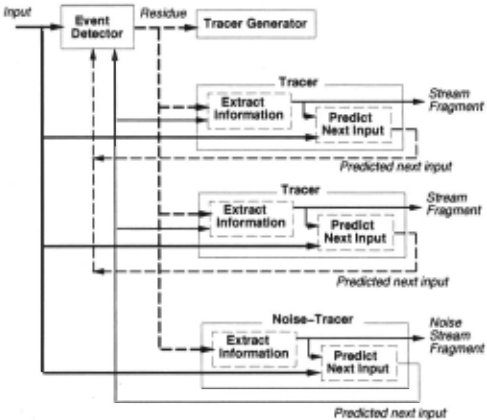
Auditory stream segregation systems must (1) deter mine that streams appear, (2) trace the streams, (3) de termine that the streams have ended, and ( 4) resolve in terference between simultaneous streams. The Residue Driven Architecture (Figure 1) consists of subsystems comprising three kinds of agents: an event-detector, a tracer-generator, and tracers. A subsystem extracting auditory streams by using some auditory attributes is called an agency. An agency based on the Residue Driven Architecture extracts streams as follows:
- An event-detector subtracts a set of predicted in puts from the inputs and sends the residue to the tracer-generator and tracers.
- if the residue exceeds some threshold value, a tracer generator searches for the values of focused auditory
Input -t Event
attributes. If it finds appropriate values of the at tributes, it generates a tracer to trace on the at tributes. If it does not find such values, it generates a noise-tracer.
- Each tracer extracts a stream fragment by tracing the attributes of the stream. It also generates a predicted next input by adjusting the segregated stream fragment to the next input and sends this predicted input to the event-detector.
Once a tracer-generator generates a new tracer that starts extracting a stream, the agency returns to a stable state because the residue becomes zero unless an input does not contain a new sound. When a new sound comes in, the residue becomes nonzero and a new tracer to ex tract the new sound is generated and the system returns to a stable state. If a tracer predicts that the next in put will be zero and the actual input is zero, the tracer terminates by itself. If the tracer-generator fails to find an appropriate attribute, it considers that a noise comes in. Since the agency treats unknown sounds as noise, the definition of noise is relative to each agency. There is only one event-detector and one tracer-generator and one noise-tracer, but the number of tracers changes ac cording to the input.
A tracer extracts information and generates a stream fragment. Stream fragments are grouped into a stream. The important constraint in grouping is exclusive allo cation, which means that each input fragment should be allocated to only one auditory stream.
Interactions between agents can be classified as intra agency interactions and inter-agency interactions. Intra agency interactions are performed between agents within the same agency and the main way these kinds of interactions occur is via the predicted next input. Since tracers are of the same kind, predicted next input is of the same kind and it is easy to calculate a residue by us ing these predicted next inputs. A noise-tracer, however, differs from other tracers and thus its predicted next in put should be given to each tracer and event-detector (Figure 1). Another way of such an interaction is via shared variables.
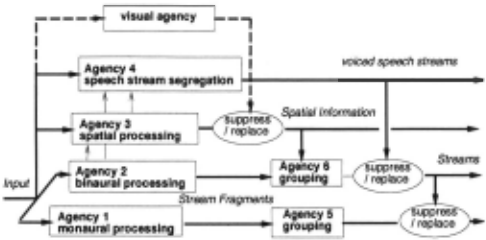
One way inter-agency interactions occur is via the in put/output relation. To model binaural hearing, for ex ample, a pair of agencies behave like a pair of ears and each agency extracts stream fragments with spatial in formation. Such stream fragments are given to a group ing agency, which constructs auditory streams according to spatial information. Another way of intra-agency in teraction is modeled by the subsumption architecture [Brooks, 1986], a simple example of which is shown in Figure 2.
Agency 1 in this figure extracts streams from monaural inputs, and agency 2 extracts auditory stream fragments from binaural inputs. Agency 3 extracts spatial informa tion such as the direction of sound sources from binaural inputs. It also uses the information given by agency 2. Agencies 5 and 6 construct streams by grouping stream fragments generated by agencies 1 and 2. Agency 4 ex tracts voiced speech stream fragments by using informa tion extracted by agencies 2 and 3. Agency 4 may replace the output of agency 6 with its own output or simply suppresses the output. Streams extracted by monaural processing may be replaced by those of binaural process ing. The output of agency 3 may be replaced by a visual agency (e.g., a video-camera tracking system). The rea son that the grouping agency is separated from agency 1 or 2 is that it can be modeled by the Residue-Driven Architecture [Nakatani et al, 1995b].
4 Designing Agencies
In designing an agency, the three kinds of agents should be specified. In this paper we describe the design and implementation of a harmonic segregating agency and the design of a harmonics-based localizing agency.
4.1 Harmonics Segregating Agency
Before describing each agent, we define several terms [Nakatani, Kawabata, and Okuno, 1995a]. First, the harmonic intensity Et(w) of the sound wave Xt(T) at time frame t is defined as follows:
Here, T is time, k is the index of harmoni'cs, Xt ( T) is the residual input, and Ht ,k(w) is the sound component of the kth overtone. Since some sound components, in particular for larger k's, are usually destroyed by inter fering sounds, the simple Ht,k(w) cannot be used. To improve the sound consistency check, a valid overtone for a harmonic stream is defined. An overtone is valid if the intensity of the overtone exceeds a threshold (Equa tion (1)) and the local time transition of the intensity can be approximated in a linear fashion (Equation (2)):
Here, DFTt(w) is the frequency component of the in put at frequency w and at time frame t . In calculat ing the value of Mt,k and at,k, we use temporal infor mation about fundamental frequencies. Let w.,.,k be an average frequency of the kth overtone over m consec utive time frames at time T. And Hn,dwn,k) is de fined as II DFTn(k · Wn,k) II· Mt,k is the mean value of II Hn,k(wn,k) II over m time frames. at,k is the vari ance of II Hn+I,k(Wn+I,k) - Hn,k(wn,k) II over m time frames.
The valid harmonic intensity E~ ( w) is defined as the sum of the II Ht,k(w) II over valid overtones. A dormant period for a noise stream is also defined. The period is dormant if there are only nonharmonic sounds. The av erage spectral intensity of the noise is calculated during the dormant period.
Tracer-Generator and Event-Detector
The tracer-generator is designed as a set of pitch watcher agents. The set of pitch watcher agents behave like a simple filter bank, but not auditory filter bank. Each pitch watcher has its own frequency region (about 25 Hz wide) and watches a residual input to detect the appearance of a new harmonic stream whose fundamen tal frequency is in its region. A pitch watcher is ac tivated when the following conditions are satisfied: (a) E: ( w) / Et ( w) > r and (b) there is a power peak near fre quency win the residual input, where w is the frequency that maximizes Et(w) within the region. Since there is more than one activated pitch watcher, the pitch watcher that gives the maximum Et(w) is selected by the tracer generator and generates a tracer. If there is no active pitch watcher during a dormant period, the noise-tracer is activated. The current setting of constants is as fol lows: c = 0.15,p = 0.05, r = 0.1, and m = 10.
Harmonics tracer
A harmonics tracer gets the initial fundamental fre quency from a pitch watcher when it is generated. At each residual input, each harmonics tracer extracts the fundamental frequency that maximizes the valid har monic intensity E~(w) . It then calculates the intensity and the phase of each overtone by evaluating the abso lute value and the phase of Ht ,k(w) . It generates a pre dicted next input in a waveform by adjusting the phase of its overtones to the phase of the next input frame. The event-detector calculates a residue by subtracting the predicted inputs from the actual input [Nakatani, Okuno, and Kawabata, 1994; Ramalingam and Kumare san, 1994]. Each tracer recovers its input by adding its predicted input to the residual input before calculating the fundamental frequency. If there are no longer valid overtones, or if the intensity of the fundamental overtone drops below a threshold value, it terminates itself.
Noise tracer
The noise tracer segregates the static noise stream ac cording to the average spectral intensity [Boll , 1979]. It calculates the spectral intensity time average of the resid ual input during the dormant period. The noise tracer sends a predicted next input to other agents by sending the spectral intensity. When a tracer receives a spectral intensity, it estimates the intensities of its sound com ponents at each frequency by subtracting the predicted values. The predicted next input of the noise tracer in hibits the generator from generating unnecessary tracers and makes harmonics tracers robust against a nonhar monic noise. The noise tracer calculates average spectral intensity for a long-time range as well as for a short-time range, and it terminates itself when the short-time range average intensity drops below a threshold value.
4.2 Harmonics-based Localizing Agency
The harmonic agency uses monaural (single-channel) input . If multi-channel inputs from a pair of micro phones or a microphone array is available, localization, or the direction of a sound source, can be also used to segregate auditory streams. In fact, binaural processing of signals or spatial hearing is said to play a critical role in the cocktail-party effect [Blauert, 1983] . There are several ways to extract spatial information from binau ral input. One common way is called coincidence model, which calculates the interaural difference in time that the same sound arrives at each of a pair of microphones [Jeffress, 1948] . Another is to use the interaural intensity difference. These two information can be extracted by calculating interaural cross-correlation, which is based on the auditory model. Bodden used both information to get spatial information and to control the parameters of filters to extract one sound from a mixture of sounds [Bodden, 1993]. Some research also uses microphone ar ray systems [Stadlerand Rabinowitz, 1993].
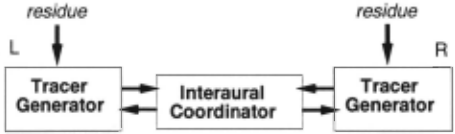
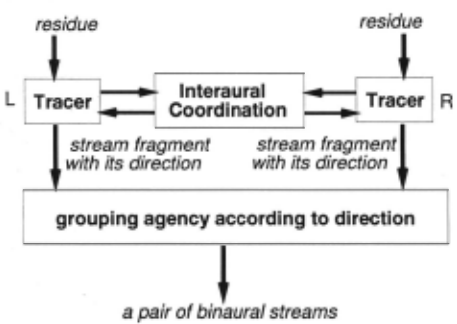
Since the design of harmonics segregating agency is independent of the (human) auditory model, we take the same approach to design a localizing agency. The localizing agency consists of two agencies: harmonics based binaural segregating agency and binaural grouping agency [Nakatani et al, 1995b]. Harmonic-based binaural segregating agency is modeled by the Residue-Driven Ar chitecture and is an extension of harmonics segregating agency described in the previous subsection. Its event detector is the same as that of monaural system. The structure of its tracer-generator and tracers are shown respectively in Figure 3 and 4. The binaural tracer generator consists of a pair of tracer-generators and an interaural coordinator. Its interaural coordinator takes candidates of new sounds from a pair of tracer-generator and orders them to generate a binaural tracer to extract a stream.
A binaural tracer consists of a pair of tracer and an interaural coordinator. Its interaural coordinator takes information about harmonic structure from a pair of tracers and determines the fundamental frequency and direction of the stream being traced by calculating the interaural differ~nce in time and the interaural intensity difference. A pair of tracers extract stream fragments with their direction, which are organized into streams by grouping according to their directions. This grouping agency is also modeled by the Residue-Driven Architec ture. In this case, the directional information is used to generate a tracer which constructs a pair of binau ral streams by grouping stream fragments of the same direction.
| Benchmark mixture | Man's voice | Woman's vmce | white nmse |
|---|---|---|---|
| 1 | 0 dB | -1.6 dB | - |
| 2 | 0 dB | -1.6 dB | 10 dB |
| 3 | 0 dB | -1.6 dB | 5 dB |
| 4 | 0 dB | -1.6 dB | 0 dB |
| 5 | 0 dB | -1.6 dB | -2.8 dB |
The merit of using harmonics is that it is easy to cal culate the two kinds of interaural differences. Otherwise, we have to use spectrum for frequencies up to about 1.5 KHz to calculate them and use the envelop of sounds instead for frequencies of more than 1.5 KHz.
5 Evaluations
5.1 Evaluations of Harmonics-based Segregation Agency
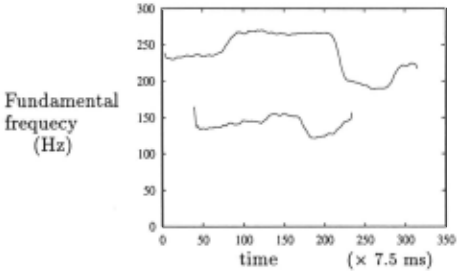
We evaluated the performance of the system by using a mixture of a man's voiced speech and a woman's voiced speech, both saying "a-i-u-e-o". Figure 5 shows the fun damental frequency patterns of two speeches. The upper curve is that of the man's voiced speech and the lower one is of the woman's voiced speech. -There is no common fundamental frequency, but there are several common overtones. We also used other four sets of mixed sounds by adding different power levels of white noise to it (see Table 1). Sounds are put into the system at each time frame (30-ms frame period, with a hamming window) .
Experiment 1
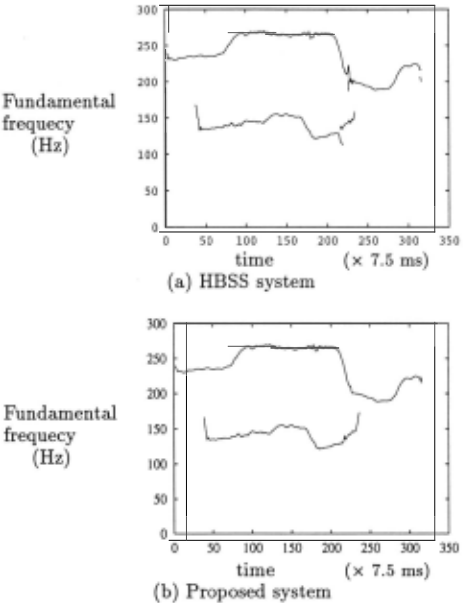
The first experiment compared the proposed system based on the Residue-Driven Architecture and the HBSS system. Figure 6 shows fundamental frequency patterns of streams segregated from benchmark mixture 1 by each system. Only two harmonic tracers were generated in the proposed system and thus no grouping was needed. In the HBSS system, on the other hand, 37 harmonic trac ers were generated. In Figure 6(a), a woman's voiced speech was segregated as one stream, while a man's voiced speech was segregated as two consecutive streams. The segregation is much improved by using temporal in formation in the proposed system.
Experiment 2
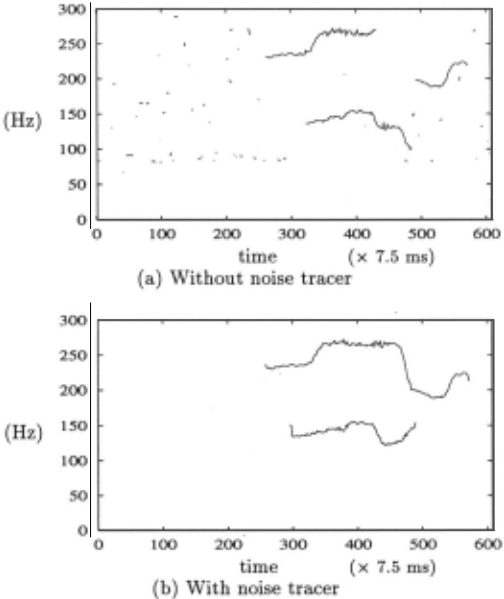
The second experiment evaluated the noise tracer by benchmark mixture 4 in which the power of white noise was the same as that of the man's speech. More precisely, the benchmark first contained only white noise and then a woman started to speak "a" and was followed by a man starting to speak. Without the noise tracer, many trac ers were generated in trying to find a harmonic structure in white noise, and the woman's voiced speech could not be segregated well. The quality of segregated streams of the man's voiced speech was also poor. With the noise tracer, the man's and the woman's voiced speeches were well segregated, although several false streams were also segregated. False harmonic tracers were generated but terminated immediately. The total numbers of harmonic tracers generated with and without the noise tracer were respectively 13 and 55. In the HBSS system, the total number of harmonic tracers generated with and with out the noise tracer were respectively 46 and 268. The proposed system reduces the number of harmonic trac ers effectively, demonstrating that sound components are allocated exclusively.
Experiment 3
The results of the third experiment, evaluating the quality of segregated sound streams with regard to spec tral distortion and pitch error, are shown in Tables 2 and 3. Spectral distortion is a square root of errors of the en velop of sounds and calculated in kepstrum distance. In evaluating spectral distortion, benchmark mixture 1 to 4 were used. Their signal-noise (SN) ratios of white noise to the man's voiced speech varied from 10 dB, 5 dB, 0 dB to -2.8 dB. With noise tracer, the spectral distortion for each segregated sound was reduced by less than half.
Pitch errors, or errors of fundamental frequency, of segregated sounds were evaluated by using all bench mark mixtures in Table 1. When white noise was very small like benchmark mixture 2, the segregated man's voiced speeches were better than those segregated from benchmark mixture 1 (without noise). Pitch error with out the noise tracer was small when the noise level was low, but error increased as the noise level became higher. These experimental evaluations showed that the noise tracer is effective in improving the quality of segregated streams.
| compared to | Benchmark | man's original vmce | woman's orignal vmce | |
|---|---|---|---|---|
| 1 | mixed sounds | 15.8 dB | 12.7 dB | |
| segregated sound | 8.7 dB | 7.49 dB | ||
| 2 | mixed sound | 21.2 dB | 23.9 dB | |
| Without nmse tracer | 13.9 dtl | 13.1 dtl | ||
| With nmse tracer | 11.7 dB | 10.1 dB | ||
| 3 | mixed sound | 31.5 dB | 36.0 dB | |
| Without nmse tracer | 23.2 dtl | 16.6 dtl | ||
| with nmse tracer | 15.5 dtl | 14.3 dtl | ||
| 4 | mixed sound | 45.9 dB | 51.8 dB | |
| w1thout nmse tracer | 33.3 dtl | 27.7 dtl | ||
| with nmse tracer | 23.5 dB | 20.2 dB | ||
| I BeL..-,Inch,--ma--,-rk-----HII | ma?'s I vmce | woma?'s vmce | |
|---|---|---|---|
| 1 | segregated sound | 0.71 Hz | 0.31 Hz |
| without noise tracer | 0.69 Hz | 0.40 Hz | |
| 2 with noise | tracer 0.65 | Hz | 0.41 Hz |
| 3 | without noise tracer | 0.82 Hz | 0.51 Hz |
| with noise | tracer 0.80 | Hz | 0.55 Hz |
| without 4 | noise tracer 1.28 | Hz | 0.92 Hz |
| with noise tracer | 1.04 | Hz | 0.79 Hz |
| without 5 | noise tracer 4.76 | Hz | 1.79 Hz |
| with noise tracer | 1.43 | Hz | 1.50 Hz |
5.2 Evaluation of Localizing Agency
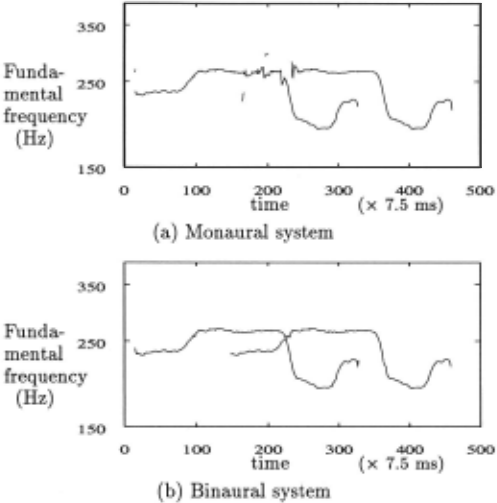
Localizing agency was evaluated by using a mixture of the same woman's speech saying "a-i-u-e-o" in Fig ure 5, synthesized by adding the first speech and the sec ond speech starting 1.1 seconds after the first one. One speaker was positioned at -45 degree and the other was at 45 degree in the frontal plane. The proposed system with monaural input could not segregate two streams well as is shown in Figure 8(a). In particular, the initial part of second woman's voice could not be segregated, because the harmonic structures of both sounds resemble each other. The binaural system segregated two streams well as is shown in Figure 8(b), since it could use directional information to remove ambiguities of the harmonic struc ture between both sounds. The results of other bench marks of different spatial settings also showed the good performance similar to Figure 8(b ).
6 Conclusions and Future Works
This paper described the Residue-Driven Architecture for segregating auditory streams in computational au ditory scene analysis. The previous HBSS system has several problems concerning imperfect exclusive alloca tion, usage of temporal and spatial information, and noise treatment. The Residue-Driven Architecture can easily incorporate mechanisms to cope with these prob lems. This architecture is used to define an agency that segregates auditory streams by tracing sound attributes. Two agencies, harmonic segregating agency and localiz ing agency, are presented. Both harmonic agency with the noise tracer and localizing agency improve the qual ity of segregation.
A lot of issues remain, since auditory stream segre gation is a primitive function for computational audi tory scene analysis. Okuno et al. proposed two essential problems [Okuno, Nakatani, and Kawabata, 1995].
- the cocktail-party effect - selectively attending one conversation or sound source and then changing the focus of attention to another [Okuno, Nakatani, and Kawabata, 1995] .
- the Prince Shotoku effect - · listening to several things at the same time [Cooke et al., 1993]. This effect is named for Prince Shotoku (574-622) in Japan, who is said to have been able to listen to seven people petitioning him at the same time.
These problems require speech stream segregation, whose main issues are handling consonants or jumping sounds. There may be many clues in speech stream segregation, such as temporal structure, spectral struc ture, spatial structure and attributes of voiced speech.
From the view-point of AI research, the representation of voiced speech including vowels and consonants is manda tory, but as far as we know, no such representation has been proposed. We are instead using the localizing agency to extract speech streams from binaural inputs. The cocktail-party effect is seldom observed when one ear is plugged or hearing is impaired, and this is because the ability to localize a sound source is damaged. Speech stream segregation has many potential applications and we think that CASA will contribute various aspects of social life.
Acknowledgments
We thank David F. Rosenthal for cooperation in writ ing the introduction section of an earlier draft of the paper as well as for discussions on computational au ditory scene analysis. We also thank Makio Kashino, Kunio Kashino, Masataka Goto, Rikio Onai and Ikuo Takeuchi for such discussions. We also appreciate the pointer to the literature on binaural processing given by an anonymous reviewer.
@inproceedings{ijcai1995p22,
  title     = {Residue-Driven Architecture for Computational Auditory Scene Analysis},
  author    = {Nakatani, Tomohiro and Okuno, Hiroshi G. and Kawabata, Takeshi},
  booktitle = {Proceedings of the Fourteenth International Joint Conference on
               Artificial Intelligence, {IJCAI-95}},
  publisher = {International Joint Conferences on Artificial Intelligence},
  editor    = {Chris S. Mellish},
  pages     = {165--173},
  year      = {1995},
  note      = {Action and Perception},
  url       = {https://ijcai.org/proceedings/1995/22},
}
TY - CPAPER TI - Residue-Driven Architecture for Computational Auditory Scene Analysis AU - Nakatani, Tomohiro AU - Okuno, Hiroshi G. AU - Kawabata, Takeshi T2 - Proceedings of the Fourteenth International Joint Conference on Artificial Intelligence, IJCAI-95 PB - International Joint Conferences on Artificial Intelligence PY - 1995 SP - 165 EP - 173 UR - https://ijcai.org/proceedings/1995/22 ER -Copied
Machine-readable versions of this paper, for tools and AI agents:





