
Scope and Abstraction: Two Criteria for Localized Planning
Proceedings of the Fourteenth International Joint Conference on Artificial Intelligence. Planning. Pages 1612-1618.
© 1995 International Joint Conferences on Artificial Intelligence
Abstract
Localization is a general-purpose representational technique for partitioning a problem into subproblems. A localized problem-solver searches several smaller search spaces, one for each subproblem. Unlike most methods of partitioning, however, localization allows for subproblems that overlap - i.e. multiple search spaces may be involved in constructing shared pieces of the overall plan. In this paper we focus on two criteria for forming localizations: scope and abstraction. We describe a method for automatically generating such localizations and provide empirical results that contrast their use in an office-building construction domain .
- Christensen , J. "A Hierarchical Planner that Gen- erates Its Own Hierarchies," in Proceedings of the Eighth National Conference on Artificial Intelli- gence {AAAI90}, Boston, Massachusetts, pp. 1004- 1009 (1990) .
- Fikes, R .E, Hart, P.E., and Nilsson, N.J . "Learn- ing and Executing Generalized Robot Plans," Ar- 1618 PLANNING tificial Intelligence , Volume 3, Number 4, pp . 251- 288, (1972).
- Knoblock, C.A. "Learning Abstraction Hierarchies for Problem Solving," in Seventh International Workshop on Machine Learning, pp . 923-928 (1990) .
- Knoblock, C.A., Tenenberg, J .D. , and Q. Yang. "A Spectrum of Abstraction Hierarchies for Plan- ning," Proceedings of the 1990 Workshop on Auto- matic Generation of Approximations and Abstrac- tions, Boston, Massachusetts, pp .24-35 (1990).
- Khartam, N.A. Investigating the Utility of Artifi• cia/ Intelligence Techniques for Automatic Gener- ation of Construction Project Plans, Doctoral Dis- sertation, Stanford University Department of Civil Engineering (1989) .
- Korf, R .E. "Planning as Search: A Quantitative Approach," Artificial Intelligence {33,1), pp . 65-88 (1987).
- Lansky, A.L. "Action-Based Planning," in Proceed- ings of AIPS-94, .the Second International Con- ference on AI Planning Systems, Chicago, Illinois (June 1994).
- Lansky, A.L . "Localized Event-Based Reasoning for Multiagent Domains," Computational Intelligence Journal, Special Issue on Planning {4,4) (1988).
- Lansky, A. L. "Localized Planning with Diverse Plan Construction Methods," NASA Technical Note FIA-TR-94-05, NASA Ames Research Cen- ter (1994) . Under review for Artificial Intelligence Journal.
- Lansky, A.L. "Localized Search for Multiagent Do- mains," Proceedings of the Twelfth International Joint Conference on Artificial Intelligence {IJCA/- 91}, Sydney, Australia, pp. 252-258 (1991).
- Mackworth, A. K. "Consistency in Networks of Re- lations," Artificial Intelligence, Volume 8, pp . 99- 118 (1977) .
- Kambhampati, S. "On the Utility of Systematicity: Understanding Tradeoffs Between Redundancy and Commitment in Partial-Ordering Planning," Pro- ceedings of the 1993 AAAI Spring Symposium on Foundations of Automatic Planning: The Classical Approach and Beyond, pp. 67-72 (1993) . IJCAI
- Sacerdoti, E. "Planning in a Hierarchy of Abstrac- tion Spaces," Artificial Intelligence, 5, pp. 115-135 (1974) . IJCAI
- Wilkins, D.E. Practical Planning, Morgan Kauf- mann Publishers (1988) .
References were extracted automatically from the PDF and may contain errors.
Full text extracted automatically from the PDF; figures, tables and equations may differ. The PDF is the version of record.
1 Introduction
Over the years, many researchers have focused on the use of abstraction to reduce search costs for planning and other types of problem-solving [1, 3, 4, 6, 13, 14]. Abstraction techniques restructure a problem and the problem-solving process into a set of "abstraction lev els." At the top level of abstraction, a problem is de scribed at its most coarse-grained level of detail. Each successive level is made more concrete by incrementally adding information to the problem description. The use of abstraction can improve problem-solving performance if the solution found for an abstract level serves as a good starting point for problem-solving at the next level of detail. Thus, abstraction may be viewed as a heuristic for ordering which pieces of a problem are solved first, and which later.
Our work also focuses on partitioning a problem to improve problem-solving (in our case, planning) perfor mance. Our technique, localization, restructures a plan ning problem by partitioning its components into re gions. Semantically, each region defines a "region of interaction" consisting of a subset of the overall prob lem requirements and action-type descriptions that are related in some way. A problem's regional structure then forms a basis for partitioning the overall planning space into a set of smaller spaces, one for each region. Each space is focused on constructing a plan fragment that contains region actions and satisfies region requirements.
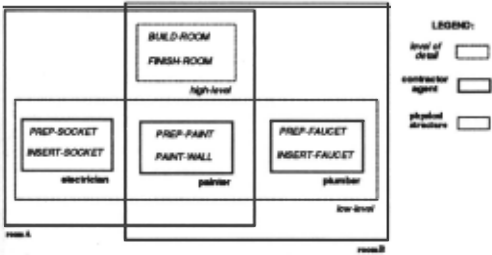
For example, consider the localization depicted in Fig ure 1 for a building construction domain. This partition ing is based on mixed criteria: level of detail, contractor agents, and building-structure. Each box represents a region and contains the names of action types within that region's frame of reference. Some boxes also con tain other boxes - those of their subregions. Each region would be associated with the requirements pertaining to its action types or the action types of its subregions. For example, problem solving for painter would focus strictly on painting activities and requirements. In con trast, region roomA would focus on the decomposition of high-level activities into lower-level electrician and painter activities for roomA.
There are at least two ways in which localization dif fers from traditional uses of abstraction for planning. First, localization more strictly partitions the frame of reference for problem solving; region requirements are satisfied only with respect to a region plan fragment, not the entire global plan. In contrast, most abstraction based frameworks conduct reasoning globally at the low est level of detail.
Second, localized search can accommodate complex region structures. Instead of being confined to parti tionings composed of "levels," the regions comprising a localization may take on nearly any configuration - dis joint, hierarchical , overlapping. Indeed, since regions may overlap, localized problem-solving typically flows back and forth among the regional search spaces (usually, to cope with region interactions) rather than searching a sequence of problem levels. The localized search algo rithm maintains consistency between these search spaces and the plan fragments that they generate, and also guarantees that all regional requirements are ultimately satisfied [9, 10].
In contrast, a traditional abstraction-based planner can revisit a planning level only via backtracking. Because of this, abstraction researchers have focused on devising partitioning techniques that guarantee minimal interaction between levels (thus minimizing backtrack ing). Unfortunately, however, real-world problems do not often lend themselves to neat partitioning; as a re sult, levels tend to collapse.
-
As our sample domain illustrates, many criteria can be used to form a localization. Indeed, one criteria is abstraction; a region could be formed to correspond to each abstraction level. Localized search would then pro ceed from one region-level to the next, as in traditional abstraction-based planning. One focus of this paper is to show how Knoblock's method for generating abstraction based partitionings [3) can be used to automatically generate abstraction-based localizations, even for non STRIPS-based planning frameworks. As in Knoblock's work, our method yields a partitioning that guarantees monotonicity in the planning process: if a solution ex ists for a particular region (level), it can be found by refining a solution found at the preceding region (level), without disturbing established requirements. A region partitioning based on this form of abstraction will thus yield a search process that visits each region space only once (except for backtracking) :
Another interesting criterion for localization is scope - i.e. the relevance of problem requirements to specific portions of the plan. Scope-based partitionings typically correspond to the natural structural characteristics of a problem. For example, when planning how to construct a building, some problem requirements will be relevant only to plumbing activities and others only to electri cal activities. Alternatively, requirements might be clus tered on the basis of building structure - e.g., rooms and floors (again, see Figure 1).
Localizations based on scope usually do not guarantee monotonic consideration of region requirements. Region search spaces may be visited more than once, even with out backtracking. For example, in the scenario depicted in Figure 1, we might begin by constructing a high-level plan in region high-level. These high-level activities might then be further refined on a room-by-room basis. The planner might start by planning electrical and paint ing activities for roomA, then plan out plumbing activities for roomB, and finally return to painting activities for roomB (thereby causing a return to the painter search space). Although they may not guarantee monotonicity, scope-based localizations can provide powerful search re duction benefits, often surpassing those obtained using abstraction.
The primary goal of this paper is to demonstrate how localization can improve problem solving and, in par ticular, how scope and abstraction serve as criteria for localization. We begin in Sections 2 and 3 by describ ing the localized planning architecture of the CoLLAGE planner [7, 9) and the kinds of search improvements that localization can provide. Next, Sections 4 and 5 dis cuss how scope and abstraction can be used as criteria for generating localizations. In particular, we describe how the Loc localization generator was used to generate scope and abstraction-based localizations for CoLLAGE. Finally, in Section 6, we provide empirical results that contrast the utility of a variety of localizations for an office-building planning domain. We also contrast our results with those obtained using SIPE-2 on the same domain [5, 14) .
2 Localized Planning
CoLLAGE differs from traditional planners in two key ways: its use of localization to partition the planning search space and its use of non-traditional plan construc tion methods. In this section we provide a short descrip tion of both. For a more thorough description see (9] .
Intrinsic to CoLLAGE is the notion of planning as con straint satisfaction. Each CoLLAGE problem descrip tion includes a set of action types and a set of con straints. The planner's task is to create a plan con sisting of actions of the types provided that satisfies all problem constraints. Each plan (or plan fragment) consists of actions, relations between actions (forming a partial ordering) , and binding requirements on action parameters that have been imposed as a result of the planning process. 1
In contrast to STRIPS-based action descriptors (2], a CoLLAGE action-type description simply provides an ac tion name and the types of its parameters. For instance,
:action-type
(insert-socket ?s_socket ?w_wall ?l_loc)
defines an insert-socket action type. A specific in stance of this type might be (insert-socket socket1 wal12 loc3) .
Rather than being defined in terms of state-based goals and preconditions, CoLLAGE problem require ments are defined in terms of action-based constraints. Such constraints focus on desired forms of action instan tiation, action relationships, and action-parameter bind ing requirements. For example, consider the constraint:
1 A CSP-network [11] on action-parameter-variables is embed ded in the plan and maintained as part of the planning process.
(before
(paint-vall ?p_paint ?v_vall)
(insert-socket ?s_socket ?v_vall ?l_loc))
This requires that each insert-socket action be tempo rally preceded by a paint-vall action at the same wall; i.e. a wall must be painted before sockets are finally in serted. In a STRIPS-based framework, this requirement would be stated in terms of a state-based precondition for insert-socket actions. CoLLAGE includes an ex tensive library of action-based constraint forms that can be utilized. The advantages of action-based represen tation and its relationship to state-based representation are discussed at length elsewhere [7, 9].
Each constraint C is associated with three types of mechanisms that it inherits from its constraint form: a check method, a set of fix methods, and an activator (along with an initial activation setting). The role of a check for C is to test whether or not C is satisfied by a plan. Whenever a check is applied, it returns a list of bugs - descriptions of the ways in which C is violated. The fix methods for C implement the various possible plan "repairs" that will satisfy these bugs. For exam ple, the check for our sample constraint would return all insert-socket actions that have no appropriate preced ing paint-vall action. For each such action, the fixes would either find an existing paint-vall action for the same wall and make sure it precedes the insert-socket action, or alternatively, would create a new such action.
The purpose of C's activator (and initial activation setting) is to indicate when C may be violated. Some constraints (i.e., COLLAGE's analogue to "goals") are initially active when planning begins. Others can be violated only by the addition of actions into the plan. Thus, C's activator is a set of action types. If any in stance of one of these types is added into the plan, C will be "triggered" or activated for consideration by the planner. For instance, the constraint above is activated by the addition of insert-socket actions.
In addition to describing action types and constraints, a COLLAGE problem description also specifies how these types and constraints should be partitioned into regions. This partitioning may take on nearly any desired struc ture; the only restriction is that region-subregion rela tionships form a DAG. Once specified, CoLLAGE uti lizes the regions and their constraints to drive plan ning search. Instead of backward- or forward-chaining on goals and preconditions, as a traditional planner would, CoLLAGE searches a localized constraint satis faction search space (see Figure 2) . The planning space for each region R is focused on constructing a region plan fr\l.gment, PlanR, that contains actions of the types in R or any of R's descendant regions. At the end of planning, PlanR must satisfy all of R's constraints.
Search control for each region is governed by an agenda-based mechanism: constraints may be activated by the addition of actions into the plan, placed on a con straint agenda, and later handled by the region search mechanism. A region agenda is used to regulate control flow between regions. It keeps track of which regions have been activated for further planning (i.e. which re gions have active constraints). Agendas may also be associated with heuristics that determine the order in which activated constraints and regions are chosen.
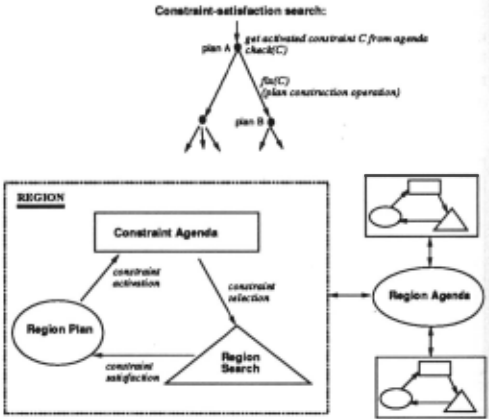
Since regions may share subregions (and thus, region plans may share subregion plans), plan changes made by a fix in one region may activate constraints in other regions. As a result, planning will typically flow back and forth between regions, necessitating careful consis tency maintenance among the region planning spaces. CoLLAGE's consistency maintenance algorithms are de scribed in [9]. Analytical and empirical results for lo calized search [9, 10] have demonstrated that significant search-cost reduction can be obtained, and up to expo nential savings in domains that require substantial back tracking. However, because of the need for consistency maintenance, localized reasoning can be complex. There is a tradeoff between focusing the application of con straints as narrowly as possible and the cost of keeping all of the region spaces consistent. A good localization balances both factors.
3 Improving Search Costs
Nearly all AI problem-solving systems conduct search with respect to some object of interest - be it a plan, schedule, or model. Typically, each search node is asso ciated with a current value for the object and each arc is associated with an operation that transforms the object in some way. For example, in a planning search space, each search space node is associated with a plan and each arc is associated with a plan construction operation that adds new actions, relations, or variable bindings into the plan. Given this kind of framework, planning search costs can be improved in at least three ways:
- Reducing the cost of each arc operation. One way to do this is to tune algorithms to problem require ments. Another way is to reduce the size of the plan being considered at each node.
- Using search heuristics. Good search heuristics can result in less backtracking and may also improve solution quality.
- Reducing the size of the implicit search space, typi cally by removing redundant or irrelevant nodes and arcs. One way of doing this is to eliminate from con sideration those operations that are irrelevant to the plan at a particular node, or those that would oth erwise be considered elsewhere in the search space, to the same effect.
Localization may be viewed as a technique for tackling aspects of all three kinds of improvements. By defini tion, localized search applies each planning operation (constraint fix) only to a region plan - the portion of the overall plan that the constraint is "relevant to." Since the cost of plan-construction operations is often related to plan size (e.g., the cost of temporal closure and CSP binding-propagation), applying operations to smaller plan fragments can reduce planning cost. In our experience with CoLLAGE, this type of savings alone has yielded significant gains.
One of the major contributions of abstraction is that it is a good search heuristic - indeed, one that guar antees monotonic consideration of domain requirements. Although localization does not, in general, provide such guarantees, it too serves as an excellent search heuris tic. One reason is that domain constraints are tackled on a region by region basis: by default, CoLLAGE ad dresses all activated constraints within a region before moving to another region's search space. By design, the constraints within the same region tend to be the ones "most related" to one another (they constrain each other most tightly). Thus, localization can lead to a constraint ordering that tends to resolve conflicts as rapidly as pos sible. Since localized search proceeds according to how constraints activate one another during planning, it also serves to focus planning on the most relevant constraints and plan fragments at each point in the search process.
Localization can also be viewed as a way of reduc ing the size of the otherwise global space, since only re gional constraints are considered at each search node. Constraints associated with other regions are "less rele vant," so removing them from consideration eliminates redundancy within the search space [12]; other regions' constraints can be tackled later with (usually) no sub stantial effect on the form of the final plan.
4 Localization Criteria
Until recently, CoLLAGE users were required to describe how action types and constraints should be partitioned - i.e. localization was based on a user's intuition about problem structure. We are now exploring how localiza tions can be generated automatically using Loc, a lo calization generator developed for CoLLAGE. For the remainder of this paper, we will focus on two criteria we have examined: abstraction and scope.
4.1 Abstraction-Based Localization
Knoblock's method for generating planning abstraction levels for STRIPS-based frameworks is based on an anal ysis of problem goals and operator descriptors [3] . A par tially ordered graph of state literals is derived, wherein an arc from literal Ll to literal L2 indicates that Ll must be at the same or higher level than L2. The strongly con nected components of this graph form the abstraction levels. A total ordering of these components determines the order in which these levels are planned, each focused on achieving the literals comprising its level. The signif icance of Knoblock's technique lies in the fact that plan operators introduced to achieve literals at each level are guaranteed not to conflict with operators introduced at higher (preceding) levels.
How can this method be adapted to CoLLAGE's action-based planning framework (or to other types of problem solving)? Looking at the graph construction process in more detail, one notices that it is based on an activation relationship between literals: i.e. how achiev ing a literal Ll can activate or lead to achieving L2. The result is a partitioning in which literals on a particular level cannot lead to ("activate" ) planning for literals on preceding levels.
Knoblock's method can be adapted to CoLLAGE by making the analogies in the table below. In Knoblock's framework , each plan-construction operation is focused on achieving a particular literal ; in CoLLAGE, each op eration is focused on satisfying a constraint . Just as achieving literal Ll may lead to achieving literal L2, sat isfying constraint Cl may lead to satisfying C2.
| STRIPS | COLLAGE | |
| Planning step | achieve literal | satisfy constraint |
| How a planning step leads to other planning steps | by introducing more literals to achieve | VIa constraint activation |
| Abstraction unit | level = set of literals | region = set of action types and constraints |
Thus, to find an abstraction-based localization for CoLLAGE, one must focus on the activation relationships between constraints. From the syntactic description of each CoLLAGE constraint, we derive the types of actions it can add into a plan. Given the activators for each constraint (another set of action types), we then derive a constraint activation graph, where an arc from con straint Cl to constraint C2 indicates that Cl might ac tivate C2. We then find the strongly connected components of this graph. Each of these components is used to form a planning region consisting of the constraints for that component. Using region-agenda heuristics, these regions are searched in an order consistent with the ac tivation graph.
4.2 Scope-Based Localization
Another important criterion for localization is the scope or relevance of constraints to various portions of a plan. Determining the precise scope of an action-based con straint is simple: the action-types relevant to a con straint can be syntactically derived from its description. A problem's "most localized" or most finely-grained lo calization consists of a region for each action-type and a region for each constraint. Each constraint-region in cludes, as a subregion, each of the action-type-regions it refers to. This forms a two-tiered localization struc ture, with action-type regions below a layer of constraint regions. However, this structure usually manifests a great deal of overlap, since many constraints may refer to the same action-types.
Starting with this "most localized" partitioning, scope-based localizations can be created by merging and restructuring regions in a variety of ways. For exam ple, if constraints Cl and C2 are relevant to exactly the same set of action types, the Cl region should be merged with the C2 region. Alternatively, if C2's action types are a subset of Cl's action types, the C2 region should be made a subregion of the Cl region. Notice that these transformations do not enlarge C1 's and C2's scope of application with respect to the emerging plan - they merely optimize a localization by reducing the num ber of unnecessary regions and the need for consistency maintenance.
As another example, consider the following, more heuristic, scenario. Suppose that Cl is relevant to ac tion types {A1, A2, A3, A4, A5} and C2 is relevant to {A2, A3, A4, A5, A6}. The scope of these two constraints are similar, but not identical. However, it might be worthwhile to merge the two constraint regions together; the scope of application of both C1 and C2 would be slightly increased, but the amount of regional interac tion would be reduced. Alternatively, suppose that C2 is relevant to {A3, A4, A5, A6} . In this case, we might decide to make the C2 region a subregion of the C1 re gion. This would reduce region interaction and would increase the scope of C1 (to include A6), but would not increase the scope of C2.
Often, scope-based and abstraction-based localiza tions are similar. After all, if two constraints are relevant to the same action types, they usually bear some acti vation relationship to one another. However, these two criteria are not identical. For example, suppose that C1 is relevant to {A1, A2, A3}, has activator set {A1, A2}, and can add actions of types {A1, A3}. Similarly, sup pose that C2 is relevant to { A2, A3, A4}, has activator set {A3, A4}, and can add actions of types {A2, A4} . Clearly, the scope of these two constraints is different.
Yet since they can activate one another (via A2 and A3), they would be placed in the same region in an abstraction-based localization.
How can scope be used in a STRIPS-based framework? Using our analogy ( constraint~literal, action~operator) , we see that the scope of a literal is the set of operators relevant to it. This set can be derived from the problem description: for each predicate P, find those operators that "add," "delete" or have a literal of type P as a pre condition. A STRIPS-based planner localized according to scope would test the modal truth criterion for P only with respect to the plan operators that are "relevant" toP. CoLLAGE's predecessor system, GEMPLAN [8, 10] localizes state-based reasoning in just this way.
5 Loc Localization Generator
Loc's input is a set of problem action types and con straints. From this information, Loc can generate a va riety of localizations. Each localization is composed of a set of regions, {R1 ... Rn}, where each region R; consists of a set of constraints, a set of action types, and a set of subregions: R; = ({C;, ... C;m}, {A;, .. . A;P}, {R;, ... R;.}).
The first localization generated by Loc is the the most localized one: for ·each action A there is a region RA = ( {A}), and for each constraint C, there is a region Rc = ( {C}, {RAi ... RA;}), where {A; ... Ai} is the set of action types relevant to C. Loc then applies a suite of transforms that iteratively modify this localization in a variety of ways. Currently, there are three basic Loc transforms:
- Subsume( R;, Rj) : Parent region R; "absorbs" or subsumes child region R;. Rj is removed and R; contains the union of the constraints, action types, and subregions of both regions.
- Merge( { R1 ... Rn}) : This transform replaces R1 ... Rn with a region R that contains the union of all the constraints, action types, and subregions of {R1 ... Rn}.
- CreateH ierarchy(Ri, Rj ): This transform makes R; a subregion of R;.
To create an abstraction-based localization, we use the method described in Section 4.1 to find the set of activation-based clusterings of constraints. Starting with the "most-localized" localization, Loc applies a Merge transform to each cluster of corresponding constraint re gions, yielding a set of regions corresponding to the set of abstraction levels.
Generating interesting scope-based localizations is a bit more challenging. We have identified eight distinct scope-based uses of the three basic transforms, four of which are described below:
- Remove regions which serve no purpose: If a child region Rc has only one parent Rp and either: Rc has no constraints; or Rp has only one child (Rc) and no action types of its own; then Subsume(Rp , Rc)·
- Merge children regions with identical scoping func tionality: If {R1 ... R,.} have exactly exactly the same parent regions and have no constraints of their own, then Merge({Rl ... R,.}) .
- Merge parent regions with identical scoping func tionality: If { R1 .. . Rn} have exactly the same sub regions and no action types of their own, then Merge( {R1 ... R,.} ).
- Scoping hierarchy: If the subregions of Rc form a subset of the subregions of Rp and Rc has no action types of its own, CreateHierarchy(Rp, Rc)·
The transforms above do not alter the scope of constraint application; they merely optimize a partitioning by re moving unnecessary regions. The other four transforms are heuristic versions of the tranforms above. They have more relaxed application requirements and tend to re move excessive overlap at the expense of increasing con straint scope. We are currently developing evaluation criteria for controlling their use.
6 Experimental Results
In order to compare the effects of our localization crite ria on planning performance, we conducted a suite of experiments in an office-building construction domain that was also the subject of a study using SIPE-2 [5] . We developed three localizations that make use of the abstraction-based and non-heuristic scope-based trans forms described in Section 5. The first, scoped, is there sult of applying the scope-based transforms to the "most localized" localization, L . The second, abstracted, is the result of applying the abstraction-based merges to L . In this domain, its structure remains identical to L, ex cept for one very large region, resulting from the need to merge several constraints that potentially activate one another. Finally, a third localization, abstracted-scoped, results from applying the scope-based transforms to ab stracted. This localization combines the two criteria of scope and abstraction within a single localization. It contains the same large region as abstracted, but removes some unnecessary regions and regional overlap.
Each of these localizations was applied to the same suite of problems, for buildings ranging in size from one to ten floors with identical floor plans on each floor. We also conducted tests with a hand-crafted localiza tion, user-specified, and with a global localization, global abstracted. The latter consists of a single region con taining all action types and constraints, and utilizes a constraint-ordering heuristic to simulate the effect of im posing abstraction levels on the search process. That is, the constraints are applied in an order that conforms with the constraint clumps used in abstracted; however, they are applied within a global search context rather than a localized search context.
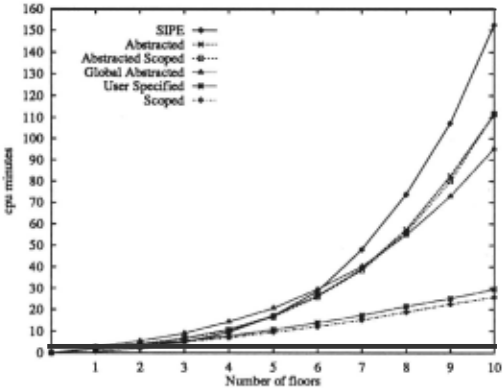
The graph below shows total run-time for all five test scenarios as well as for SIPE-2 on the same domain. One obvious conclusion is that scoped performs best . The most important factor is that this localization manifests less unnecessary regional collapse than abstracted and abstracted-scoped. In particular, due to potential con straint activation relationships, the abstraction-based lo calizations contain a very large region containing all ac tions involved in constructing the office-building frame . Since temporal closure is one of the expensive opera tions in this domain, closure over large region plans can be quite costly. An important reason why scoped (and user-specified) performs so well is that it generates fewer closure relations (though the skeletal temporal structure of the plans generated by all of the localizations was the same). Since localized planning generates only locally derivable closure relations, localizations with smaller re gions have cheaper closure costs.
Although scoped performs best, notice that global abstracted outperforms both of the abstraction-based lo calizations (as well as SIPE-2) in the long run. Although global-abstracted performs completely global planning operations (whereas abstracted and abstracted are at least somewhat localized) , in the end the latter two are un duly weighed down by the need to perform consistency maintenance. Thus, they poorly balance the increased partitioning vs. consistency-maintenance tradeoff.
It is also interesting to note that our hand-crafted lo calization for this domain, user-specified, is nearly identi cal to scoped. Indeed, scoped surpasses the performance of user-specified. These facts support the viability of Loc as an automatic localization generator. Also of im port is the performance of CoLLAGE relative to that of SIPE-2. Although these results are admittedly for en tirely different planners implemented on different hard ware, it is clear that the slope of the CoLLAGE curves (even global-abstracted) increase much more slowly than that of the SIPE-2 curve. This result is the best proof we have to date of the relative efficiency and scalability of action-based (in contrast to STRIPS-based) planning, even without the use of localization.
7 Conclusions
This paper described localization and localized search: techniques for partitioning a planning problem into sub problems and searching a set of smaller, though possibly interacting, subproblem spaces. Since localized search can cope with complex, overlapping localization struc tures, it provides a powerful mechanism for coping with real-world planning problems. And since it is a generally applicable technique, we believe localization has great potential for other types of problem-solving as well.
A key focus of this paper was on the kinds of search cost improvements that localization can obtain. In par ticular, we concentrated on two criteria for localiza tion: abstraction and scope. Abstraction-based localiza tions are derived from constraint-activation information. Scope-based localizations are based on the relevance of constraints to specific pieces of the plan. We described how Loc, an automatic localization generator, can be used to generate localizations based on both criteria. In empirical tests we showed that scope-based localizations attained the best results.
Future work with localization and Loc will focus on feeding information about the planning process and the form of the final plan back into Loc, enabling it to im prove a localization by analyzing planning behavior. For example, currently, Loc applies transforms solely on the basis of the problem description - e.g. the potential scope (or activation) of constraints. However, during planning, specific constraints may actually be applied to much narrower portions of the plan. Similarly, differ ent applications of the same constraint may be focused on different portions of the plan (e.g. the same electri cal constraint might be applied to activities on different floors). We would like to extend Loc to include splitting transforms, thereby allowing constraints to be applied in narrower contexts. One excellent candidate for focussing the splitting process will be the actual parameter bind ings assigned to plan variables. Another motivation for utilizing feedback is to guide the application of heuris tic scope-based transforms. For example, if consistency maintenance costs are particularly high for certain re gions, they would be good candidates for merging.
Acknowledgments
Thanks to John Allen, Rich Keller, Rich Levinson, Bar ney Pell and the members of the FIA-SPOT reading group for useful comments and stimulating discussions.
@inproceedings{ijcai1995p208,
  title     = {Scope and Abstraction: Two Criteria for Localized Planning},
  author    = {Lansky, Amy L. and Getoor, Lise},
  booktitle = {Proceedings of the Fourteenth International Joint Conference on
               Artificial Intelligence, {IJCAI-95}},
  publisher = {International Joint Conferences on Artificial Intelligence},
  editor    = {Chris S. Mellish},
  pages     = {1612--1618},
  year      = {1995},
  note      = {Planning},
  url       = {https://ijcai.org/proceedings/1995/208},
}
TY - CPAPER TI - Scope and Abstraction: Two Criteria for Localized Planning AU - Lansky, Amy L. AU - Getoor, Lise T2 - Proceedings of the Fourteenth International Joint Conference on Artificial Intelligence, IJCAI-95 PB - International Joint Conferences on Artificial Intelligence PY - 1995 SP - 1612 EP - 1618 UR - https://ijcai.org/proceedings/1995/208 ER -Copied
Machine-readable versions of this paper, for tools and AI agents:





