
Massively Parallel Support for Efficient Knowledge Representation
Proceedings of the Thirteenth International Joint Conference on Artificial Intelligence. Neural Networks. Pages 1325-1330.
© 1993 International Joint Conferences on Artificial Intelligence
Abstract
PARKA is a frame-based knowledge representation system implemented on the Connection Machine. The system, which provides extremely fast property inheritance inference capabilities, performs fast "recognition" queries of the form "find all frames satisfying m property constraints " in O(d+m) time-proportional only to the depth of the knowledge base (KB), and independent of its size. PARKA's performance is measured in tenths of a second, even for KBs with 100,000+ frames. We show similar results on the Cyc KB, and for queries involving knowledge structure pattern matching in support of case-based planning. With such run-time performance, PARKA is possibly the "fastest knowledge representation system in the world".
- [Brachman, 1985] R.J. Brachman. I Lied about the Trees. AI Mag. 6, 3 Fall, 1985.
- [Brachman & Schmolze, 1985] R.J. Brachman and J.G. Schmolze. An Overview of the KL-ONE Knowledge Representation System. Cog. Sci., 9, 2 April-June 1985.
- [DeMara & Kitano, 1992] R. DeMara and H. Kitano. PACE Benchmark for Parallel AI Architectures. Tech. Rep. IMPACT-92-004-USC/CMU, and PKPL 92-5, Department of EE -Systems, University of Southern California, and School of Computer Science, Carnegie Mellon University, 1992.
- [Evett et al, 1993] M.P. Evett, L. Spector, and J.A. _Hendl<?r. Massively Parallel Frame-Based Property Inhentance 10 PARKA. To appear in Journalfor Parallel and Distributed Computing, 1993.
- [Evett & Hendler, 1992a] M.P. Evett and J.A. Hendler. Degradation of Interprocessor Communication Operations on the Connection Machine. Tech. Rep., Department of Computer Science, Univ. Maryland, College Park, November, 1992.
- [Evett & Hendler, 1992b] M.P. Evett and J.A. Hendler. An Update of PARKA, a Massively Parallel Knowledge Representation System. Tech. ReJ>., CS-TR-2850, Department of Computer Science, Univ. Maryland, College Park, February, 1992.
- [Fahlman, 1979] S.E. Fahlman. NETL: A SysJ~m for Representing and Using Real World Knowledge. MIT Press, 1330 Neural Networks Cambridge, MA, 1979.
- [Hammond, 1989] K. Hammond. Case-Based P_lanning: Viewing Planning as a Memory Task. Academic Press, 1989.
- [Kettler et al, 1993] B. Kettler, J.A. Hendler, W.A. Andersen, and M.P. Evett. "Massively Parallel Support for a Case- based Planning System." In Proceedings of the Ninth IEEE Conference on AI Applications, IEEE 1993.
- [Kitano & Higuchi, 1991] H. Kitano and T. Higuchi. Massively Paiallel Memory-Based Parsing. Proceedings of IJCA/-91, 1991.
- [Lenat & Guha, 1990] D.B. Lenat and R.V. Guha. Building Large Knowledge-Based Systems. Addison Wesley, Reading, Mass., 1990.
- [Moldovan et al, 1989] D. Moldovan, W. Lee, and C. Lin. SNAP: A Marker-Propagation Architecblre for Knowledge Processing. Tech. Rep. CENG 89-10, Dept. Electric& Engineering-Systems, University of Southern California, Los Angeles, CA, Sept 1989.
- [Selman & Levesque, 1989] B. Selman and H. Levesque. The Tractability of Path-Based Inheritance. Proceedings of /JCA/-89, Morgan-Kaufman, San Mateo, CA, 1989. IJCAI
- [Spector et al, 1990] L. S~tor 1 M.P. Evett and J.A. Hendler. Knowledge Representation 10 PARKA. Tech. Rep. TR• 2409, Department of Computer Science, University of Maryland, College Park, MD, Feb. 1990.
- [Spector et al, 1992] L. Spector, W. Andersen, J.A. Hendler, B. Kettler,E. Schwartzman, C. Woods and M.P. Evett. Knowledge Representation in PARKA --Part 2: Ex~riments, Analysis, and Enhancements. CS-TR-2837, UMIACS-TR-92-16, Department of Computer Science, Univ. Maryland, January 1992.
- [Stanfill & Waltz, 1986] C. Stanfill and D. Waltz. Toward Memory-Based Reasoning. Communications of the ACM, Vol. 29, No. 12, December 1986, pp. 1213-1228.
- [Tate, 1976] A. Tate. Project Planning Using a Hierarchic Non-linear Planner. Research Report No. 25, Department of Artificial Intelligence, University of Edinburgfi, 1976.
- [Touretzky, 1986] D.S. Touretzky. The Mathematics of Inheritance Systems. Morgan Kaufmann, Los Altos, CA, 1986.
- [Von Eicken et al, 1992] T. Von Eicken, D. Culler, S. Goldstein and K. Schauser. Active Messages: a Mechanism for Integrated Communication and Computation. Tech. Rep. UCB/CSD 92/#675, Computer Sctence Division, EECS, University of California, Berkeley, CA.
- [Wilensky, 1986] R. Wilensky. Some Problems and ProPQsals for Knowledge Representation. Tech. Rep. UCB7CSD 86/294, University of California, Berkeley, May 1986.
References were extracted automatically from the PDF and may contain errors.
Full text extracted automatically from the PDF; figures, tables and equations may differ. The PDF is the version of record.
1. Introduction
C~~ently, AI is experiencin~ a period of soul-searching. Cnt.Ics contend that the promise of the AI techniques of the 80's has evaporated because those techniques did not deliver. It is not that their formalisms and theory were unacc~ptable-they worked fme for small, contrived domains. Real-l~fe domains, however, are orders of magnitude larger. Run-time performance of these earlier AI techniques is completely unacceptable for such domains; these techniques were computationally ineffective 4 ·
Knowledge r~pre~ntation (KR) forms a core component of_ most AI a~phcat1ons. Thus, the speed of KR systems is a pnmarx contributor to poor run-time performance. For several years, It has been our goal to design a KR system with computationally effective inferencing on knowledge bases large en_ough to support real-world, commonsense reasoning. We believe such a system will serve as a foothold for the developm~nt of realistic AI applications requiring rapid response time. Our system, PARKA, is a symbolic, frame based. ~ system tha_t takes advantage of the Connection Machme s (CM) massiVe parallelism to deliver the run-time performance we have mandated.
In this paper~ we discuss the design and implementation of PARKA. Then, v.:e present a short analysis of the expected and ob:;erved run-time performance of several different PARKA opera~10ns. We argue that PARKA offers computationally effecuve knowledge representation on realistically large concepts are represented as directed graphs, whose arcs (or links) are stored as frame pointers in the slots of frames. Thus, the KB can be viewed as a network frames connected by their links.
1 Email: evett@cs.umd.edu
~mail: waander@cs.umd.edu
3 Email: hendler@cs.umd.edu
4 The term was coined by Shastri.
Ontological relations (related to the study of "natural kinds", in philosophy) among frames are encoded via the IS-A ("is a") property. The IS-A relation is intimately related to the calculation of property inheritance inferences (see below) and, as such, IS accorded special status in PARKA. The subgraph consisting of all IS-A links and frames is referred to as the IS-A hierarchy of the net. Nomenclature similar to that of tree structures refers to elements of the hierarchy: for any node in the subgraph, adjacent node(s) representing superclass(es) are referred to as parenJs; those representing subclasses are called children. Likewise, nodes above and below any node are called its ancestors and descendanJs, respectively. All IS-A hierarchies are rooted and acyclic.
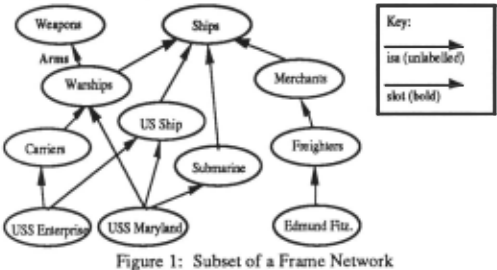
A small subset of a frame network is shown in Figure l. The frames are shown as ovals. The properties of each frame are represented by the arcs emanating from them. Unlabelled arcs are IS-A links.
2. 2 Inheritance Mechanism
PARKA employs a property inheritance mechanism on its IS-A hierarchy. In PARKA, a frame is said to be explicitly valued for a given property if it is incident on a property link of that type-that is, if the frame contains a slot by that name. Any frame not explicitly-valued for a given property inherits the value of its nearest ancestor(s) (using a variant of Touretzky's inferential distance ordering scheme) that is explicitly-valued for that property. If there is more than one such node (which is possible because PARKA allows multiple inheritance), the inherited value is either ambiguous, or is arbitrarily chosen from among the possible candidates.
The first version of PARKA [Evett et al, 1993; Evett & Hendler, 1992] handled multiple-inheritance-as have many previous frame-based KR systems [Brachman & Schmolze, 1985] is just one)-by using inheritance path length to disambiguate multiple inheritance paths. This paradigm suffers from redundancy, ambiguity, and other problems, and has been soundly criticized in the philosophical community as being epistemologically inadequate. Many of these criticisms are detailed in [Touretzky, 1986] and [Brachman, 1985].
To address the problems of multiple inheritance, PARKA uses a top-down credulous inheritance mechanism based on Touretzky's inferential distance ordering (IDO) metric to disambiguate multiple inherited values. It works like this: assume the frame in question, X, is not explicitly valued for the given property, A. Let B be the set of ancestors {8 1 , B 2 , ... } of X that are explicitly valued for A. X takes B.'s value for A as its own, provided B. is an element of B such that there is no B . (~ B.) such that'B. is an IS-A descendant of B .. If more than 1 one element of B rheets this criterion, X is said to be ambiguously valued for property A.
Unfortunately, many retrieval operations involving top down inheritance mechanisms, including IDO, have been shown to be NP-hard [Selman & Levesque, 1989]. To allow calculation of these operations in a timely manner, we adopted a slightly weaker ordering scheme for inheritance disambiguation. Let B be the set of ancestors of X explicitly valued for property A. X takes B.'s value for A as its own, where Bi is that element of B wlth the largest topological number. If more than one element of B meets this criterion, X is. said to be ambiguously valued for property A. The topological number, topo(Z), of a frame Z, is defined inductively: Topo(<root node>)= 0. For all other frames, Z, topo(Z) = 1 + the maximum topo(Y), for each Y, a parent of Z. PARKA can calculate inheritance inferences using this disambiguation metric in O(d) time, independent of KB size, where dis the !SA-depth of the frame network. Our topological disambiguation scheme differs from inferential distance ordering because it may arbitrarily disambiguates among two ancestors when neither is an IS-A ancestor of the other. PARKA discovers ambiguity only if the ancestors have the same topological number.
Though PARKA's disambiguation mechanism is not as powerful as complete IDO, it is considerably stronger than a simple path-length based scheme. Natably, it does not suffer from the problems of redundancy noted in [Touretzky, 1986]. Also, examination of the PARKA encoding of the Cyc commonsense KB (see Section 3.3) reveals no ambiguous inheritance relations incorrectly disambiguated by PARKA. If Cyc turns out to be exemplary of other, future KBs, then this shortcoming promises to have very little impact on most inferences.
2. 3 Implementation
PARKA's internal representation of a frame consists of a block of processors, one for each frame's IS-A parents. These processors are contiguous across the CM's processor address space. One processor of each block is distinguished as a referent for all other frames pointing to the represented frame.
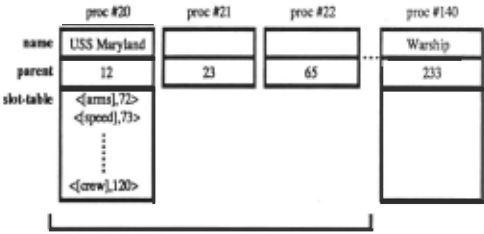
The slots of each frame are encoded in a slot table, stored in a processor of that frame's block. The table is a list of pairs (<property>, <property-value>), each component being a processor address. Figure 2 illustrates the internal representation on the CM of part of the net shown in Figure 1. The large rectangles represent the distinguished processor of each block of processors corresponding to a particular frame. The small rectangles represent the remaining processors of those blocks. [Bracketed] values represent addresses of the processor representing the correspondingly named property.
To look up the value of a given property, X, for a frame,
Y, PARKA scans through the frame's slot table, looking for an entry corresponding to the given property. If a matching slot table entry is found, the corresponding value stored there is the address of the processor representing the frame that is the value of property X for frame Y. In general, slot retrieval is proportional to the size of the largest slot table in the KB. PARKA maintains a cache of the most recently accessed properties to accelerate this process.
3. Performance
To demonstrate that PARKA can provide computationally effective knowledge representation, we implemented and timed a number of retrieval operations on very large KBs. Tests included inheritance queries on very large pseudo-random KB's, conjunctive queries on the Cyc KB, and structure retrievals on a large KB supporting a case-based planner.
3 .1 Inheritance Queries
Almost all KB queries involve some inferencing along the IS-A hierarchy because almost all queries involve having to calculate the inherited value of a set of properties for a set of frames. PARKA uses several data structures to speed such inheritance inferencing, including using multiple processors to represent frames having multiple parents. It uses an activation wave propagation algorithm to calculate the value for a given property of every frame in the KB in time independent of the size of the network.
First, the IS-A root frame is "activated", forming an activation wave. At each iteration, this wave is passed downward along IS-A links. The activation wave propagates synchronously; all nodes in the current "wave front" simultaneously activating the incident nodes that have not yet been activated. Each such iteration is a propagation step. Because PARKA is implemented on the CM, each propagation step is accomplished with a single parallel operation. In detail, at propagation step i:
- Frames in topological level i explicitly valued for the property set their wave value to k, where k's high order bits are i (the topological level of the frame that is the origin for this value), and k's low order bits are the frame's property value.
- Every frame (processor) not explicitly valued for the property in question that has a parent node at topological level i-1 "pulls" down the value of the activation wave from those parents.
- Frames at topological level i not explicitly valued choose as their own activation wave value the largest of those pulled down from the parent frames. Because the high order bits of each wave value are the topological level of the origin node, the selected value conforms to the 100 scheme outlined in section 2.2.
The number of propagation steps required to calculate a property value is equivalent to the depth, d. of the network's IS-A hierarchy. Consequently, PARKA's run-time for queries, such as "what things are black?", is O(d), and is independent of the size of the KB. To answer a similar query, most serial KR systems would require O(bd) time, where b is the average downward fan-out of the IS-A network.
The topologies of most successfully implemented large KBs have been very shallow relative to their breadth. It is commonly believed that this shallowness will persist and be accentuated as net size increases. (We implemented the Cyc commonsense KB in PARKA (see section 3.3), and it does enjoy a similarly shallow IS-A topology.) Consequently, we expect PARKA's O(d) performance of inheritance inferences to scale up with larger KBs.
To determine how PARKA would compare against a serial representation system, we created a serial version of PARKA, called SPARKA ("serial-PARKA"). To make the comparison of the timings between PARKA and SPARKA as fair as possible, we implemented SPARKA as a severely stripped down version of a more complete serial implementation (detailed in [Specta et al, 1992]). It has very little functionality other than for simple property inheritance calculations, but is optimized to effect those calculations as quickly as possible.
We tested our analytical predictions of PARKA's run-time performance of simple property inheritance queries by timing responses to queries on topologies of varying size and depth. Then, we timed SP ARKA on the same queries and networks.
The networks were to be quite large-up to 128K nodes 6 · As encoding the networks by hand was out of the question, we developed a number of different algorithms for generating pseudo-random networks with certain topological characteristics. These techniques are described in [Evett eta/, 1993; Evett & Hendler, 1992]. Our experience with the Cyc KB (see section 3.3) affirmed our belief that the topologies used to measure PARKA's performance are reflective of the topologies of realistic KBs.
Figure 3 shows PARKA's run-time for frame networks of depth 8, and of varying size. These timings isolate the effect of network size on run-time, supporting our supposition that PARKA's computation of inheritance queries is independent of network size 7 · The serial system's run-time, however, was linear with respect to network size. The figure contains best-fit curves to highlight this linear relation.
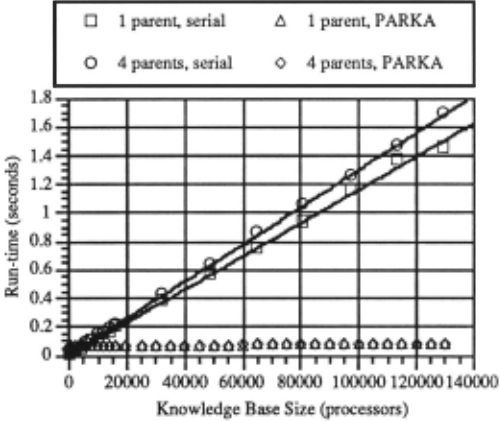
The networks used in the timings were of two topological types: trees (each frame having exactly one parent) and directed graphs (each frame having between one and four parents.) We used different types of topologies to demonstrate that PARKA's run-time was independent of upward IS-A fan-out.
~imings were made on a "quarter" CM-2, consisting of only 16K processors.
7 Actually, we observed a degree of correlation between PARKA's run-time and the size of the networks. We examined this degradation away from our theoretical performance predictions. The results of this study are detailed in [Evett & Hendler 1992]. The degradation is completely accounted for by the performance of the CM's interprocessor communication operations. The run time of these operations degrades proportionally with router network load.
A comparison between the serial KR system and PARKA in Figure 3 showes that the latter remains computationally effective even for very large KBs, while the serial system's performance becomes unacceptable for large networks. We fully expect this contrast to become increasingly stark for the much larger KBs undoubtedly required for the large, truly artificially intelligent applications of the future. (Lenat and Guha [ 1990] suggested that such networks will contain tens of millions of nodes.)
3 . 2 Recognition Queries on the Cyc KB
The ability to solve recognition queries has driven much of PARKA's design. The problem of recognition is well-known in the field of knowledge representation [Fahlman, 1979; Wilensky, 1986; etc.] Recognition is the problem of answering KB queries of the form: "find all frames x where P/x.c 1 ) 1\ Plx.0) 1\ ··· 1\ P ix,c,.)", where P;(x,c) is a unary predicate true tor all frames, x, that have value c. for property P .. E.g.: "What object is most characterized by this list o'f property values? .... " and "what have trunks, tusks, and are big and gray?" Such queries, which are extremely time consuming for serial-based systems, offer an excellent opportunity to demonstrate the advantages of a parallel system such as PARKA.
PARKA's ability to execute inheritance inferences quickly makes it particularly suitable to recognition. Because PARKA can determine which objects have a given value for a given property in O(d) time, PARKA can determine which objects satisfy a set of p property constraints in no more than O(dp) time, where dis the depth of the net.
In fact, PARKA uses a pipelining technique to evaluate recognition queries in time O(d+p). Because each wave propagation step of an inheritance inference occurs "in lockstep"-all frames at the same topological level calculating their property value simultaneously-pipelining can be added to the basic process outlined in section 2.2. At each propagation step i, all frames at topological level j, such that j ~ i. retrieve from their parent(s) the wave activation value having to do with the (j-i)-th element of the set of properties being inferred. The complete propagation requires d + p - 1 propagation steps.
PARKA's O(d+p) performance compares very favorably with recognition queries on serial systems, which require O(pbd) time for the same queries, where b is the average f~~out of the IS-A hierarchy. We tested these predictions by ttmmg PARKA's performance for recognition queries containing a varying number of conjuncts on an implementation of the Cyc KB. The results appear in Figure 4, and support our run-time analysis. We discuss these results in the next section.
3. 3 Using Cyc for Validation of PARKA
Our motivation for using the Cyc KB to evaluate PARKA's performance is twofold. First, we want to validate PARKA's inference mechanisms on a KB of large size and realistic topology. Because Cyc is the largest and most comprehensive commonsense KB in existence, it is an obvious choice. A second and more exciting motivation is that we envision some future version of Cyc being built on top of a massively parallel substrate, like PARKA, to make its reasoning services fast enough to be used by an intelligent agent operating in the world in real time.
,.,
On the lowest level, Cyc consists of a frame system (frames are called "units" in Cyc), representing assertions (in the form of binary relations, or slots) about entities in the world. Above that level is the CycL "constraint language", which allows the specification of inferences to be made about units in the KB. The inference mechanisms provided by CycL range from the very simple, such as the slot inverse mechanism (e.g. father(John,Mary) .. fatherOf(Mary,John)), to theorem proving using general "wffs", to unsound inference methods such as analogy.
3.3.1 The Subset of Cyc in PARKA
PAR~ implements only some of the inference capabilities provided by CycL, particularly those having to do with property inheritance. We represented only the subset of Cyc involving I~-A based property inheritance and ontologies.
The versiOn of the Cyc KB we used for our tests contained a total of26214 units, 8591 (33%) of which were collections, and 17623 (67%) instances. Of the instances, 4031 (15% of the total) were slots (slots are explicitly represented in the Cyc ontology). To accommodate a KB of this size, we used a 16,384 processor CM-2 with a virtual processor ratio of 4:1. The maximum depth of the KB along the specs/instances relation was 23; this is the number of steps required for PARKA's wave propagation algorithms to terminate.
3.3.2 Performance of PARKA on the Cyc KB
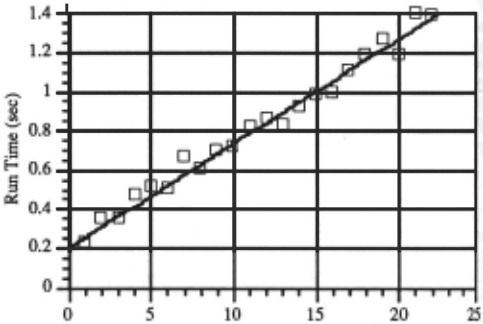
For c_>ur test on the Cyc KB, we tried a series of recognition quenes of a type employed by CycL to find in the KB units "similar" to a given unit. A unit is considered "similar" to a given unit if it has the same slot values for some number of slots exceeding a specified threshold value. We chose a Cyc unit (#%Burma-1986) with a relatively large number of local as~rtions (22), and executed an algorithm to find matching umts for the first n slots (1 s; n s; 22) of that unit. Whereas Cyc's serial algorithm finds only an arbitrary number of matching units, this algorithm exhaustively matches the probe against the entire KB at one time, thus finding all appr?I?riate matches. This experiment was designed to show empmcally both the O(d+m) complexity of conjunctive recognition queries in PARKA, and to demonstrate that PARKA can be used to provide fast matching for analogy· related functions, a task which traditionally has been difficult for serial systems.
As Figure 4 clearly shows, the time required to perform recognition queries grows only linearly in the number of conjuncts, and overall performance, even for a query of 22 conjuncts, is excellent. The run-time matches the O(d+m) performance predicted by analysis.
3. 4 Structure Retrieval for Case-Based Planning
As another part of our demonstration of PARKA's computational effectiveness as a KR system for very large AI applications, we implemented a general structure retriever mechanism. PARKA's structural retrieval mechanism has been used to support CaPER, a case-based planning system [Kettler eta/, 1992]. Concepts and individuals in CaPER's memory are represented using PARKA frames.
Structure retrieval is a generalization of recognition. The problem of structure retrieval is to find the set of all m-tuples (x 1 , x 2 , ··· , x,), where xi are frames, such that P/x;,x.,) A Pz(x.,x.) A ... A Plx.,x.) A Qlx.,c 1 ) A ... AQixi'c 1 ), where P,(x~.i) are binary 'pfedicates' between specified tuple com'pdnents, and Qlx;,c 1 ) are unary predicates on the specified tuple component
The problem can be viewed as that of finding all subgraphs (them-tuples) in a KB frame network that match a specified probe graph (the conjunction of binary and unary predicates). The KB is viewed as a graph, where the vertices are frames, and the edges are the 2-tuples comprising the binary relations represented by slots. A probe graph consists of a set of variables, a set of unary constraints, and a set of binary constraints. The unary constraints restrict the domains of the variables. The binary constraints specify relations (in terms of inherited property values, etc.) that must hold between variables. The algorithm returns all subgraphs that simultaneously satisfy all constraints. Note that this is an exact match algorithm. Future implementations will provide inexact matching capabilities with programmable similarity metrics.
PARKA uses the pipelining technique outlined in section 3.2 for the retrieval of all components of the probe graph having to do with property inheritance, set membership, and subclass/superclass membership. The algorithm uses a mechanism similar to the join operation of database theory to combine these results.
We have not yet completed a theoretical analysis of the PARKA's run-time performance of structure retrieval, relying so far on empirical evidence to demonstrate PARKA's computational effectiveness for structure retrieval queries. We compared PARKA to a serial KR system on the same KB to demonstrate the advantages provided by the massively parallel PARKA system. For the serial system we used an optimized serial version of PARKA. The serial version was highly-indexed to allow for fast retrievals of all those frames being valued for a given property.
We timed several structure retrieval probes used by CaPER to retrieve exemplar plans from two case bases, consisting of one hundred and of ten plan cases. These KBs involved a domain of automobile assembly plans that were constructed via use of the Nonlin planner [Tate, 1976]. Each case base was encoded as a PARKA knowledge base. The larger case base consisted of over 10,000 frames, requiring over 35,000 processors. In this KB, a structure retrieval probe with 9 unary and 8 binary constraints took approximately .7 seconds of CM time. Future implementations are expected to reduce retrieval times to under 200 milliseconds for comparable probes through the use of more pipelining and caching techniques. The timings for this and several other probes on these KBs are shown in Figure 5.
As can be seen, for some of the queries PARKA experienced a speed-up of more than 10,000 over the serial system. The run-time for the serial structure retrieval algorithm was much worse than linear in the size of the KB. The run-time of the parallel algorithm, on the other hand, appeared to grow only logarithmically in the size of the KB.
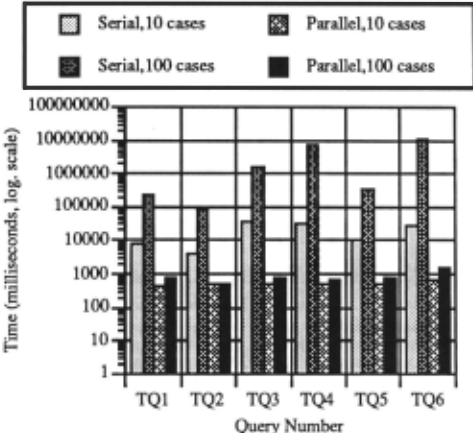
Because retrieval probes can be specified over any relation in the current KB, this algorithm allows cases to be retrieved on arbitrary features, not restricted to any set of predetermined indexes. Because of this, there is no privileged set of indexing features by which cases can be found in memory. This lack of a need for a priori computed indexing features is one of PARKA's strengths. Because of it, PARKA is not hindered from retrieving potentially useful cases that share unindexed features with the target problem (other benefits are discussed in [Kettler eta/, 1992].)
We know of only one other massively parallel system that provides something like structure retrieval. DeMara and Kitano describe a generic pattern matching algorithm [Hammond, 1989] running on Moldovan's SNAP system [Moldovan et a/, 1989]. The "pattern matching" problem shares some similarities to that of structure retrieval, but is considerably different. The algorithm listed there is for finding matches against 4-node subgraphs, and it does so very quickly due to the special-purpose hardware on which SNAP is implemented. Our algorithm works for arbitrarily specified graphs, and runs on general-purpose hardware.
4. Future work
PARKA was intended as a basis for large AI systems. The implementation of the Cyc KB in PARKA was just the first of what we hope will be a series of uses of PARKA in other large AI systems. Potential uses for PARKA include other case-based AI systems, as the basis of a massively parallel knowledge server, and as part of a knowledge-mining system. In addition, we plan to examine how PARKA might be more fully integrated into the Cyc representation system, proper.
Our immediate plans for PARKA center around completing the core representational capabilities outlined in [ 14 and 15]. This work will include the implementation of partonomic and set-theoretic representational mechanisms.
Also, we have implemented a simple version of PARKA
on the MIMD CM-5. Preliminary results show that we should be able to represent KBs of over 1M frames on a lK-processor CM-5 and obtain run-time performance nearly an order of magnitude better than the results in this paper. Because the CM-5 is a MIMD machine (though we use it as a SPMD machine), we plan to use an active messaging scheme [Von Eicken eta/, 1992] to increase the flexibility of PARKA's memory association schemes, and to increase the use of pipelining in inferencing.
5 · Conclusion
Using KBs with over 100,000 frames, we have shown that PARKA computes several types of KR retrievals in time independent of the size of the KB and dependent only on network depth. The run-time of these operations is in the tenths of seconds. This performance compares very favorably to serial representation systems; for structure retrieval operations we recorded speed-ups of more than 10,000 fold over a highly-optimized serial representation system. Bec~use our empirical evidence so far has supported our_ analybcal claims, we believe that PARKA's performance will scale up to even larger KBs.
We argue that PARKA's performance for these operations has demonstrated that it can offer computationally effective knowledge representation on realistically large KBs. This in turn, demonstrates that massively parallel KR systems can serve as a basis for large AI applications in real-world domains.
Acknowledgments:
We wish to thank the Systems Research Center at the University of Maryland for their support in this research. We also thank the University of Maryland Institute for Academic Computing Services (UMIACS) and Thinking Machines Corp. for the use of their Connection Machines. The support staff at both institutions were very helpful during the development of PARKA.
This work has been supported by AFOSR grant 01-5-28180, ONR grant N0014-88-K-0560, and NSF grant 1R1-8907890.
References:
- [Brachman, 1985] R.J. Brachman. I Lied about the Trees. AI Mag. 6, 3 Fall, 1985.
- [Brachman & Schmolze, 1985] R.J. Brachman and J.G. Schmolze. An Overview of the KL-ONE Knowledge Representation System. Cog. Sci., 9, 2 April-June 1985.
- [DeMara & Kitano, 1992] R. DeMara and H. Kitano. PACE Benchmark for Parallel AI Architectures. Tech. Rep. IMPACT-92-004-USC/CMU, and PKPL 92-5, Department of EE - Systems, University of Southern California, and School of Computer Science, Carnegie Mellon University, 1992.
- [Evett et al, 1993] M.P. Evett, L. Spector, and J.A. _Hendl<?r. Massively Parallel Frame-Based Property Inhentance 10 PARKA. To appear in Journalfor Parallel and Distributed Computing, 1993.
- [Evett & Hendler, 1992a] M.P. Evett and J.A. Hendler. Degradation of Interprocessor Communication Operations on the Connection Machine. Tech. Rep., Department of Computer Science, Univ. Maryland, College Park, November, 1992.
- [Evett & Hendler, 1992b] M.P. Evett and J.A. Hendler. An Update of PARKA, a Massively Parallel Knowledge Representation System. Tech. ReJ>., CS-TR-2850, Department of Computer Science, Univ. Maryland, College Park, February, 1992.
- [Fahlman, 1979] S.E. Fahlman. NETL: A SysJ~m for Representing and Using Real World Knowledge. MIT Press,
Cambridge, MA, 1979.
- [Hammond, 1989] K. Hammond. Case-Based P_lanning: Viewing Planning as a Memory Task. Academic Press, 1989.
- [Kettler et al, 1993] B. Kettler, J.A. Hendler, W.A. Andersen, and M.P. Evett. "Massively Parallel Support for a Case based Planning System." In Proceedings of the Ninth IEEE Conference on AI Applications, IEEE 1993.
- [Kitano & Higuchi, 1991] H. Kitano and T. Higuchi. Massively Paiallel Memory-Based Parsing. Proceedings of IJCA/-91, 1991.
- [Lenat & Guha, 1990] D.B. Lenat and R.V. Guha. Building Large Knowledge-Based Systems. Addison Wesley, Reading, Mass., 1990.
- [Moldovan et al, 1989] D. Moldovan, W. Lee, and C. Lin. SNAP: A Marker-Propagation Architecblre for Knowledge Processing. Tech. Rep. CENG 89-10, Dept. Electric& Engineering-Systems, University of Southern California, Los Angeles, CA, Sept 1989.
- [Selman & Levesque, 1989] B. Selman and H. Levesque. The Tractability of Path-Based Inheritance. Proceedings of /JCA/-89, Morgan-Kaufman, San Mateo, CA, 1989.
- [Spector et al, 1990] L. S~tor 1 M.P. Evett and J.A. Hendler. Knowledge Representation 10 PARKA. Tech. Rep. TR· 2409, Department of Computer Science, University of Maryland, College Park, MD, Feb. 1990.
- [Spector et al, 1992] L. Spector, W. Andersen, J.A. Hendler, B. Kettler,E. Schwartzman, C. Woods and M.P. Evett. Knowledge Representation in PARKA -- Part 2: Ex~riments, Analysis, and Enhancements. CS-TR-2837, UMIACS-TR-92-16, Department of Computer Science, Univ. Maryland, January 1992.
- [Stanfill & Waltz, 1986] C. Stanfill and D. Waltz. Toward Memory-Based Reasoning. Communications of the ACM, Vol. 29, No. 12, December 1986, pp. 1213-1228.
- [Tate, 1976] A. Tate. Project Planning Using a Hierarchic Non-linear Planner. Research Report No. 25, Department of Artificial Intelligence, University of Edinburgfi, 1976.
- [Touretzky, 1986] D.S. Touretzky. The Mathematics of Inheritance Systems. Morgan Kaufmann, Los Altos, CA, 1986.
- [Von Eicken et al, 1992] T. Von Eicken, D. Culler, S. Goldstein and K. Schauser. Active Messages: a Mechanism for Integrated Communication and Computation. Tech. Rep. UCB/CSD 92/#675, Computer Sctence Division, EECS, University of California, Berkeley, CA.
- [Wilensky, 1986] R. Wilensky. Some Problems and ProPQsals for Knowledge Representation. Tech. Rep. UCB7CSD 86/294, University of California, Berkeley, May 1986.
@inproceedings{ijcai1993p183,
  title     = {Massively Parallel Support for Efficient Knowledge Representation},
  author    = {Evett, Matthew P. and Andersen, William A. and Hendler, James A.},
  booktitle = {Proceedings of the Thirteenth International Joint Conference on
               Artificial Intelligence, {IJCAI-93}},
  publisher = {International Joint Conferences on Artificial Intelligence},
  editor    = {Ruzena Bajcsy},
  pages     = {1325--1330},
  year      = {1993},
  note      = {Neural Networks},
  url       = {https://ijcai.org/proceedings/1993/183},
}
TY - CPAPER TI - Massively Parallel Support for Efficient Knowledge Representation AU - Evett, Matthew P. AU - Andersen, William A. AU - Hendler, James A. T2 - Proceedings of the Thirteenth International Joint Conference on Artificial Intelligence, IJCAI-93 PB - International Joint Conferences on Artificial Intelligence PY - 1993 SP - 1325 EP - 1330 UR - https://ijcai.org/proceedings/1993/183 ER -Copied
Machine-readable versions of this paper, for tools and AI agents:





