
Learning to Represent Codons: A Challenge Problem for Constructive Induction
Proceedings of the Thirteenth International Joint Conference on Artificial Intelligence. Neural Networks. Pages 1319-1323.
© 1993 International Joint Conferences on Artificial Intelligence
Abstract
The ability of an inductive learning system to find a good solution to a given problem is dependent upon the representation used for the features of the problem . Systems that perform constructive induction are able to change their representation by constructing new features . We describe an important, real-world problem - finding genes in DNA - that we believe offers an interesting challenge to constructiveinduction researchers. We report experiments that demonstrate that: (1) two different input representations for this task result in significantly different generalization performance for both neural networks and decision trees; and (2) both neural and symbolic methods for constructive induction fail to bridge the gap between these two representations. We believe that this real-world domain provides an interesting challenge problem for constructive induction because the relationship between the two representations is well known, and because th e representational shift involved in constructing the better representation is not imposing.
- [Baum and Haussler, 1989] E . B. Baum and D. Haus- sler. What size net gives valid generalization? Neural Computation, 1:151-160, 1989.
- [Craven and Shavlik, 1993] M. W . Craven and J. W. Shavlik . Learning to predict reading frames in E. coli DNA sequences. In Proc. of the 26th Hawaii In- ternational Con[ on System Sciences, pages 773-782, Wailea, HI, 1993. IEEE Press.
- [Farber et a/., 1992] R . Farber, A. Lapedes, and K. Sirotkin . Determination of eucaryotic protein coding regions using neural networks and information theory. Journal of Molecular Biology, 226 :471-479, 1992.
- [Hinton, 1989] G . E . Hinton . Connectionist learning procedures . Artificial Intelligence , 40 :185-234, 1989.
- [Matheus and Rendell, 1989] C . J . Matheus and L. A. Rendell . Constructive induction on decision trees. In Proc. of the Eleventh International Joint Con[ on Ar- tificial Intelligence, pages 645-650 , Detroit, MI, Au- gust 1989. IJCAI
- [Matheus, 1990] C. J. Matheus. Feature Construction: An Analytic Framework and an Application to De- cision Trees. PhD thesis, University of Illinois at Urbana-Champaign , 1990.
- [Michalski, 1983] R. S. Michalski. A theory and method- ology of inductive learning. Artificial Intelligence, 20:111-161, 1983.
- [Pagallo and Haussler, 1990] G. Pagallo and D. Haus- sler. Boolean feature discovery in empirical learning. Machine Learning, 5:71-99, 1990.
- [Quinlan, 1993] J. R . Quinlan. C4.5: Programs forMa- chine Learning.
- Morgan Kaufmann, San Mateo, CA, 1993 .
- [Rosenblatt, 1958] F . Rosenblatt. The perceptron : A probabilistic model for information storage and orga- nization in the brain . Psychological Review, 65(6), 1958.
- [Uberbacher and Mural, 1991] E. C. Uberbacher and R. J . Mural. Locating protein coding regions in human DNA sequences by a multiple sensor -neural network approach . Proc. of the National Academy of Sciences, 88 :11261-11265, 1991.
References were extracted automatically from the PDF and may contain errors.
Full text extracted automatically from the PDF; figures, tables and equations may differ. The PDF is the version of record.
1 Introduction
The ability of an inductive learning system to find a good solution to a given problem is dependent upon the repre sentation used for the features of the problem. Work in constructive induction [Michalski, 1983] has focused on methods for constructing new features, thereby changing the problem representation [Matheus and Rendell, 1989; Matheus, 1990; Pagallo and Haussler, 1990]. Similarly, one of the touted virtues of multi-layer artificial neural networks is that their hidden units are able to construct new features from the given input features . In this paper we describe a difficult real-world problem that we believe provides an interesting challenge for inductive learning systems that adjust their input representations. We also present a set of experiments that support our claim that this task poses a challenge to existing systems that per form constructive induction.
·This research was partially supported by DOE Grant DE FG02-91ER61129, NSF Grant IRI-9002413, and ONR Grant N00014-90-J-1941.
The real-world task that we discuss is the problem of identifying genes in DNA sequences. As part of the Hu man Genome Project, many biological laboratories are now in the process of ascertaining the DNA sequence of humans and other organisms. One of the primary challenges of these efforts is to distinguish the more in teresting parts of DNA sequences from the parts with little or no functionality. Several researchers have ad dressed this problem using neural networks and have found that the input representation has a significant im pact on the generalization performance of the trained networks [Craven and Shavlik, 1993; Farber et a/., 1992; Uberbacher and Mural, 1991] . In this paper we further investigate two particular input representations. The performance difference between these two representa tions is especially intriguing because the relationship be tween the representations is well known, and further more, the representational shift involved in going from the weaker representation to the better one involves only forming an appropriate set of conjunctions.
In this paper we present two sets of experiments. We first demonstrate the effect of input representation on generalization performance for this problem domain, us ing both a symbolic learning method (Quinlan's C4) and a neural learning technique (Rosenblatt 's perceptrons) . We then evaluate two approaches to constructive induc tion on this problem and show that neither of them seem to be able to construct the features needed for good gen eralization. The first approach to constructive induction involves simply adding hidden units to the networks used in the first experiment. The second approach that we in vestigate is CITRE [Matheus and Rendell, 1989], which performs constructive induction on decision trees.
2 The Problem Domain
This section provides a brief description of the problem that serves as a testbed for our experiments. A more thorough treatment of the biology underlying the prob lem can be found in a genetics textbook.
A DNA strand is a linear sequence of nuc/eotides com posed from the alphabet {A, G, T, C}. Certain subse quences of a DNA strand, called genes serve as blueprints for proteins. Proteins are important because they provide most of the structure, function, and regulatory mechanisms of cells. Interspersed between the genes are areas, termed noncoding regions, that do not encode pro teins. An important problem in biology is to be able to distinguish the coding from the noncoding regions of DNA sequences.
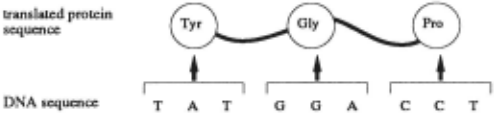
Proteins are also linear sequences; they are composed from the 20-character alphabet of amino acids. As il lustrated in Figure 1, each consecutive string of three nucleotides in a gene encodes a single amino acid (e.g., "GGA" encodes glycine). The nucleotide triplets are called codons and the mapping from codons to amino acids is called the genetic code. The genetic code is al most universal across species and is well known. The process of translating a gene into protein involves group ing nucleotides into codons and inserting the amino acid encoded by each codon into the protein chain being syn thesized.
In order to determine the amino-acid sequence en coded by a given DNA sequence, it is necessary to know the reading frame of the sequence. The reading frame refers to how the nucleotides of a DNA sequence are grouped into codons as a gene is translated. As an anal ogy, consider trying to decode a bit stream that contains a message encoded in ASCII. Unless the bits are cor rectly grouped into bytes, the decoded message will be nonsense.
The problem that we address in this paper is the fol lowing: given a relatively small, fixed-length "window" on a DNA sequence, predict whether or not the sequence is part of a gene that is "in-frame " with the window. The window is considered to be in-frame with a gene when the leftmost nucleotide in the window is the first nucleotide in a codon of the translated gene. Thus the problem involves classifying input sequences into two classes: coding and noncoding. Other researchers have also investigated neural network approaches [Farber et a/., 1992; Uberbacher and Mural, 1991] to the problem of finding genes in DNA sequences.
3 The Effect of Input Representation
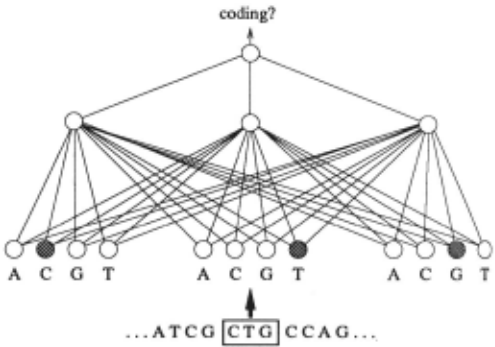
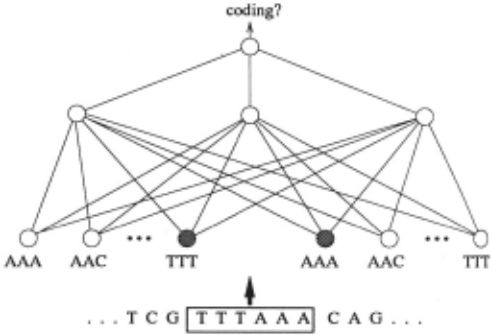
In this section we describe two different representations that can be used for DNA sequences and compare there sultant performance for these representations using both perceptrons and decision trees. The first approach is to use a binary encoding of the nucleotides that are present in the input window. This input representation requires four features for every nucleotide position in the input window, where each feature represents one of the four nucleotides that could occupy the position. We will re fer to this as the nucleotides representation. The sec ond approach involves representing the codons that are present in the window and are in-frame with respect to the window. This input representation involves sixty four binary features for every codon position in the win dow, where each feature represents one of the co dons that could occupy the position. We will refer to this as the codons representation. Figure 2 and Figure 3 depict artificial neural nets using the nucleotides and codons representations respectively.
In order to evaluate the effect of input representation for the problem of recognizing genes in DNA, we con struct generalization curves (described below) for both representations using the C4.5 decision tree algorithm [Quinlan, 1993], and perceptrons [Rosenblatt, 1958]. A
perceptron is a neural network with no hidden units. A window size of 15 nucleotides is used to determine the input features for both representations. We partition the set of sequences into four sets, and all of our experi ments involve a four-fold cross-validation methodology. 1 For both representations, classifiers are trained on ex ample sets that range from 100 to 10,000 examples. For a given run, each successive training set is a superset of the previous training set. The classifiers are tested on a disjoint set of 5,000 examples after learning each training set , and the accuracies on this set are plotted. All training and testing sets contain approximately 50% coding sequences and 50% noncoding sequences.
The perceptrons are trained until convergence using a conjugate-gradient algorithm. 2 A tuning set consisting of ten percent of each training set is used to determine when the network weights are saved so that networks do not "overfit" the training data, Members of the tuning set are not presented to the network as ordinary train ing examples, but instead are used during learning to estimate the accuracy of the network on unseen exam ples. Pessimistic pruning [Quinlan, 1993] is used on the trained decision trees to help avoid overfitting.
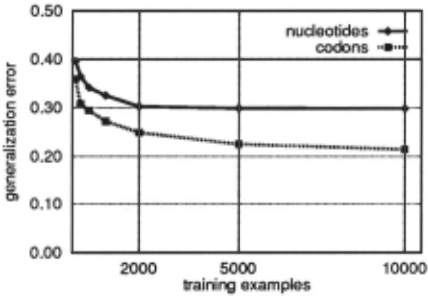
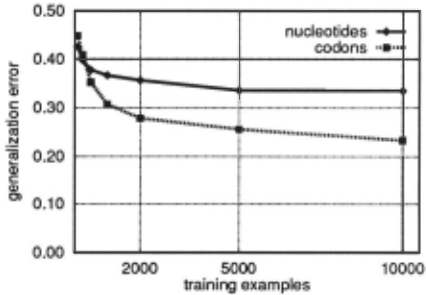
Figure 4 shows the observed generalization curves for perceptrons using the nucleotides and codons input rep resentations. Figure 5 shows the observed generaliza tion curves for decision trees using both representations. A generalization curve plots test-set error on the y-axis against training set size on the x-axis. It can be seen that perceptrons achieve better generalization perfor mance than decision trees for both input representations. This result indicates that the inductive bias of neural networks is better suited to this task than the bias of decision trees. Furthermore, for both learning methods, using the codons representation results in classifiers that generalize substantially better than those using the nu cleotides representation.
1 In four-fold cross-validation, classifiers are trained using examples drawn from three of the sets and tested on examples from the fourth set. This procedure is repeated four times so that each set is used as the testing set once.
2 A conjugate-gradient algorithm obviates the need for learning-rate and momentum parameters.
4 Gene Recognition and Constructive Induction
Because the defining characteristics of genes are more readily apparent at the codon level than the nucleotide level, the codons representation of DNA sequences is ob viously a better representation for the task of recognizing genes. However, what if we did not know a priori that the codons representation was a reasonable input repre sentation to try for this task? Would this representation be discovered by state-of-the-art learning systems that perform constructive induction?
There are several reasons why the problem of find ing genes provides an interesting testbed for construc tive induction research. First, it is a real-world problem that can be "reverse-engineered." We know that codons provide a good representation for the problem, and the mapping between nucleotides and codons is known. Sec ond, the representational shift involved in going from nu cleotides to codons is neither trivial nor overly-complex. The codons representation does not contain any informa tion that is not present in the nucleotides representation, and the features of the codons representation, namely the codons themselves, are simply ternary conjunctions of adjacent nucleotides. Thus we would expect that a fairly general feature-construction algorithm would be able to construct codon features from the nucleotide fea tures. Third, the process of finding the codons represen tation is, to some extent, a problem of scientific discov ery. The process of "cracking" the genetic code in the early 1960's involved discovering the mapping between sequences of nucleotides and sequences of amino acids.
Two parts of this discovery, in particular, are manifested in the process of learning the codons representation: ( 1) determining that each consecutive nucleotide triplet en codes a single amino acid; and (2) determining that the code is non-overlapping (i.e., codons do not overlap each other) .
In the following sections we describe experiments that involve applying both neural and symbolic construc tive induction approaches to the problem of recognizing genes. The question that motivates these experiments is whether or not general methods for constructive induc tion are able to discover the "right" representation (i.e., the codons representation) for this problem when given only the nucleotides representation?
5 Constructing Features in Networks
The artificial neural networks used in the previous exper iment were perceptrons, meaning that they did not have any hidden units. When used for classification tasks, such as the gene-recognition problem, perceptrons are able only to make linear discriminations in their input space. The role of hidden units in a neural network is to transform the input space into a different representation - one in which two classes may be separated by a sin gle linear boundary. Thus, the concepts represented by hidden units can be thought of as constructed features. The question that we address in this section is whether or not neural networks using the nucleotides represen tation, when given a sufficient number of hidden units, are able to construct features that enable them to ap proach the generalization performance of networks using the codons representation. It is important to note that we are not particularly concerned with exactly what fea tures the networks learn to encode with their hidden units. It is possible that the hidden units could learn a local encoding of codons, or they may learn a distributed representation of codons, or some entirely different, but useful , set of features.
In order to investigate this question, we construct gen eralization curves using networks with different numbers of hidden units. The methodology and the data sets used to train and test the multi-layer networks are the same as in the previous experiment . Networks are trained using a conjugate-gradient algorithm until a local minimum is reached. A tuning set is used to determine when the weights are saved. The networks that we test have 5, 10, 20 and 40 hidden units. Each hidden unit is fully connected to the set of input units. The number of free parameters (weights + biases) in a neural network gives a rough indication of the capacity of the network [Baum and Haussler, 1989] . The 40-hidden-unit networks used in this experiment have 2481 parameters. In contrast, it would take only 1601 parameters to encode by hand a network that had a layer of 320 hidden units hard wired to represent each of the 64 codons in each of the five codon positions in the window. Thus, although the networks in this experiment do not provide a topology that enables them to form a local representation of the co dons in the window, they should have sufficient com plexity to form an alternative, distributed encoding of similar features. We do not allow the networks to form a local representation of codons, because to do so would require either hard-wiring codon features into the net works, or using networks with an extremely large number of parameters. For example, a network with 320 fully connected hidden units has 19,521 parameters. Using a rule-of-thumb that recommends two training examples per parameter [Hinton, 1989], such a network would re quire training with more examples than is practicable.
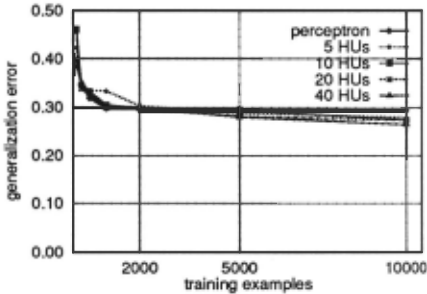
Figure 6 shows the generalization curves for networks with 5, 10, 20 and 40 hidden units, as well as the nu cleotides perceptrons used in the first experiment . Al though networks with hidden units offer an improvement over the generalization performance of perceptrons us ing the nucleotides representation, this improvement is not enough to match the performance of the perceptrons using the codons representation. This result indicates that the fully-connected networks are failing to represent codons with their hidden units. Although the networks with 40 hidden units should have sufficient capacity to form a representation of codons, it is possible that net works with more hidden units would learn such a repre sentation.
6 Constructing Features m Trees
A number of algorithms have been developed to perform feature construction using decision trees as the concept description language [Matheus and Rendell, 1989; Pa gallo and Haussler, 1990]. The CITRE system [Matheus and Rendell, 1989] provides a general approach for con structive induction on decision trees. In this section we describe an experiment in which we train decision trees using the nucleotides representation, and then use CITRE to construct features on these decision trees. The mo tivation for this experiment is to see if a symbolic sys tem for constructive induction, such as CITRE, is able to bridge the generalization gap between the nucleotides representation and the codons representation.
The CITRE approach to feature construction involves an iterative cycle of learning a decision tree, constructing new features, and then learning a new tree using the constructed and original features. CITRE uses a learned decision tree to suggest constituent features to be used in the constructed features. As outlined by Matheus, the CITRE approach has four aspects:
- the detection of when new features are required
- the selection of relationships used to define new features
- the generalization of new features
- the global evaluation of constructed features
We will now discuss how we address these four aspects in our experiment.
Matheus' criterion for detection is that feature con struction should be performed whenever disjunctive re gions, as evidenced by the presence of more than one positively-labelled leaf, are detected in a decision tree (for our purposes, a positively-labelled leaf is one labelled coding). We believe that for many real-world tasks this is probably too stringent of a criterion because it requires the concept to be represented as a conjunction. In our experiment, we finesse the issue of defining a good de tection criterion; instead we just try to establish a lower bound on the generalization error over a fixed number of iterations of tree building and feature construction.
The selection process involves forming conjunctions of pairs of Boolean features. Matheus describes a num ber of ways in which pairs of features can be selected [Matheus, 1990]. In this experiment we use the adja cent method which selects all adjacent pairs of tests that occur on decision-tree branches that lead to positively labelled leaves. The selection process can also exploit domain knowledge to narrow the set of candidate con structed features. We do not use any domain knowl edge in the selection process because we are interested in determining how well we can do without using such information.
The generalization step enables CITRE to generalize the features constructed in the selection process. For example, constants may be replaced by variables. In this experiment we do not perform any generalization of constructed features.
The evaluation process serves to limit the number of new features constructed. The evaluation criterion we use is the information gained when an individual fea ture is used to partition the entire training set. For this experiment we limit the number of constructed features to 320 at any given time. Since there are 60 original features, the total number offeatures never exceeds 380. When the number offeatures is restricted in this manner, CITRE can be thought of as performing a beam search through the space of constructed features. Note that 320 features is the number necessary to represent each codon in each position in the input window.
In order to evaluate the ability of CITRE to construct useful features, we test the feature-construction process starting only with nucleotides as features. In this exper iment we use fixed-size training sets of 5,000 examples.
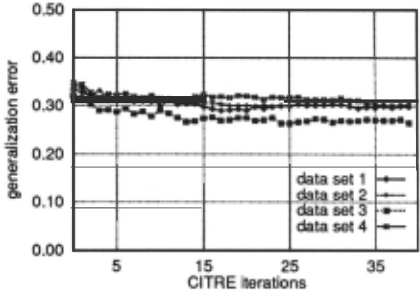
The training and test sets are the same 5,000-example sets used in the previous experiment. We run CITRE for 40 iterations on each training set.
Figure 7 shows the test set error for each of the four training sets on each iteration of CITRE. From this figure it can be seen that the generalization performance fluctu ates slightly as the feature set changes. Over the course of the feature-construction process, however, test set ac curacies do improve somewhat. Table 1 shows the gener alization performance of the CITRE-induced trees relative to the performance of C4.5 trees using both representa tions. The numbers in this table represent averages over all four folds of data. The CITRE error rate was deter mined by taking the tree from the iteration with the best performance for each data set. Thus, the error rate for the CITRE approach is a lower bound on what it would be if we used, say, a tuning set to decide when to stop iterating. All differences in this table (except CITRE vs. the nucleotides perceptrons, and CITRE vs. 40-hidden unit networks) are significant to at least the 0.025 level using a paired, 1-tailed t-test .
The results of this experiment indicate that CITRE, when given no domain knowledge, is able to improve upon the performance of a decision tree using only the nucleotides representation, but that this improvement is not enough to match the performance of trees using the codons representation. We have also conducted this ex periment using the fringe feature selection method [Pa gallo and Haussler, 1990], and competitive evaluation of features [Matheus, 1990]. However, we found that the adjacent selection method and information-based evalu ation provided the best results. Further experimentation needs to be conducted to explore the effects of using do main knowledge, feature-generalization operators, and more iterations of feature construction.
| I approach | %error |
|---|---|
| C4.5 with nucleotides | 33.59 |
| CITRE starting with nucleotides | 28.75 |
| C4.5 with codons | 25.60 |
| perceptron with nucleotides | 29.53 |
| 40 HU network with nucleotides | 27.95 |
| perceptron with codons | 22.56 |
7 Conclusions
We have described a real-world machine learning task that we believe serves as an interesting challenge problem for researchers investigating constructive induction. The problem is an interesting one for several reasons:
- it embodies the complexity inherent in an important real-world problem,
- two different, yet natural, input representations re sult in significantly different generalization perfor mance for neural networks and decision trees trained using them,
- the relationship between the two representations is well known,
- the representational shift involved in constructing the better representation is not too imposing.
We have presented experiments that demonstrate that the nucleotides and codons representations result in sig nificantly different test set accuracies for both percep trons and decision trees. Additionally, we have presented experiments in which we tested the ability of both neural and symbolic constructive induction methods to bridge the gap between the two representations. These exper iments indicate that the two approaches do not easily find the constructed features necessary to approach the performance of the codons representation.
The next question to be addressed in our research is how much domain knowledge is required in order to match the performance of the codons representation? One obvious piece of domain knowledge that could be exploited is information about the sequential nature of DNA. For example, in a neural network we could con nect hidden units so that each one is connected only to a spatially-local part of the input window. Similarly, we could bias CITRE so that conjunctions of neighboring nucleotides are preferred. Although we know the map ping between nucleotides and codons, it is important to find feature-construction methods which are as general as possible so that they can be extended to problems in which a good representation is not known.
The challenge that we issue to the machine learning community is to develop an approach that is able to achieve the performance of the codons representation us ing the nucleotides representation, and as little domain knowledge as possible. 3 We believe that this problem can help guide research in constructive induction towards its goal of finding effective domain-independent biases for feature construction.
Acknowledgements
Insightful comments by Chris Matheus contributed to this research and its presentation. Dave Opitz provided helpful comments on an earlier version of this paper.
@inproceedings{ijcai1993p182,
  title     = {Learning to Represent Codons: A Challenge Problem for Constructive Induction},
  author    = {Craven, Mark W. and Shavlik, Jude W.},
  booktitle = {Proceedings of the Thirteenth International Joint Conference on
               Artificial Intelligence, {IJCAI-93}},
  publisher = {International Joint Conferences on Artificial Intelligence},
  editor    = {Ruzena Bajcsy},
  pages     = {1319--1323},
  year      = {1993},
  note      = {Neural Networks},
  url       = {https://ijcai.org/proceedings/1993/182},
}
TY - CPAPER TI - Learning to Represent Codons: A Challenge Problem for Constructive Induction AU - Craven, Mark W. AU - Shavlik, Jude W. T2 - Proceedings of the Thirteenth International Joint Conference on Artificial Intelligence, IJCAI-93 PB - International Joint Conferences on Artificial Intelligence PY - 1993 SP - 1319 EP - 1323 UR - https://ijcai.org/proceedings/1993/182 ER -Copied
Machine-readable versions of this paper, for tools and AI agents:





