
Abduction and Dynamic Preference in Plan-Based Dialogue Understanding
Proceedings of the Thirteenth International Joint Conference on Artificial Intelligence. Natural Language. Pages 1186-1191.
© 1993 International Joint Conferences on Artificial Intelligence
Abstract
In this paper, we present a unified model of dialogue understanding involving various sorts of ambiguities, such as lexical, syntactic, semantic, and plan ambiguities. This model is able to estimate and revise the most preferable interpretation of utterances along with the progress of dialogues, the features of which successfully capture the dynamic nature of dialogue understanding. The model supports abductive reasoning and dynamic preference, which is comprised of two portions: ( 1) an extension of firstorder logic for maintaining multiple interpr etations of ambiguous utterances in a dialogue; (2) a device which estimates and revises the most preferable interpretation of these multiple interpretations. Since the model is logic-based, it provides a good basis for formulating rational justification of its current interpretation, which is one of the most desirable aspects in generating helpful responses.
- [Appelt and Konolige, 1989] Douglas E. Appelt and Kurt Konolige, A Nonmonotonic Logic for Reason- ing about Speech Act and Belief Revision. In Pro- ceedings of the 2nd International Workshop on Non- Monotonic Reasoning, Lecture Notes in Artificial In- telligence, Vol.346, pp.164-175, Springer-Verlag, 1989.
- [Carberry, 1990a] Sandra Carberry. Plan Recognition in Natural Language Dialogue. MIT Press, 1990.
- [Carberry, 1990b] Sandra Carberry. Incorporating De- fault Inferences into Plan Recognition. In Proceedings of AAAI-90, pp.471-478, 1990.
- [Charniak, 1988] Eugene Charniak. Motivation Analy- sis, Abductive Unification and Nonmonotonic Equal- ity. Artificial Intelligence, Vol.34, pp.275-295, 1988.
- [Charniak and Goldman, 1988] Eugene Charniak and Robert Goldman. A Logic for Semantic Interpreta- tion. In Proceedings of the 26th Annual Meeting of ACL, pp.87-94, 1988.
- [Charniak and Goldman, 1991] Eugene Charniak and Robert Goldman. A Probabilistic Model of Plan Recognition. In Proceeding$ of AAAI-91, pp.160-165, 1991.
- [Charniak and Shimony, 1990] Eugene Charniak and Solomon E. Shimony. Probabilistic Semantics for Cost Based Abduction. In Proceedings of AAAI-90, pp.106- 111, 1990.
- [Hirst, 1987] Graeme Hirst. Semantic Interpretation and the Resolution of Ambiguity. Cambridge Univer- sity Press. 1987.
- [Hobbs et al., 1988] Jerry R. Hobbs, Mark Stickel, Paul Martin, and Douglas Edwards. Interpretation as Ab- duction. In Proceeding$ of the 26th Ann•ttal Meeting of ACL, pp.95-103, 1988.
- [Kantz, 1990] Henry Kautz. A Circumscriptive Theory of Plan Recognition. In Philip R. Cohen, Jerry Mor- gan, and Martha E. Pollack, editors, Intentions in Communication, pp.105-133. MIT Press, 1990.
- [Konolige, 1989] Kurt Konolige, Hierarchic Autoepis- temic Theories for Nonmonotonic Reasoning: Pre- liminary Report. In P.ror.eedings of the 2nd Interna- tional Workshop on Non-Monotonic Reasoning, Lec- ture Notes in Artificial Intelligence, Vol.346, pp.42-59, Springer-Verlag, 1989.
- [Moore, 1985] Robert C. Moore. Semantical Considera- tions on Nonmonotonic Logic. Artificial Intelligence, Vol.25, pp. 75 --94, 1985. IJCAI
- [Nagao, 1989] Katashi Nagao. Semantic Interpretation Based on the Multi-World Model. In Proceedings of IJCAI-89, pp.1467-1473, 1989. IJCAI
- [Nagao, 1990] Katashi Nagao. Dependency Analyzer: A Knowledge-BaBed Approach to Structural Disam- biguation. In Proceedings of COLING-90, Vol.2, pp.282-287, 1990.
- [Nagao, 1992] Katashi Nagao. A Preferential Constraint Satisfaction Technique for Natural Language Analysis. In Proceedings of ECAI-92, pp.523-527, 1992.
- [Perrault, 1990] C. Raymond Perrault. An Application of Default Logic to Speech Act Theory. In Philip R. Cohen, Jerry Morgan, and Martha E. Pollack, edi- tors, Intentions in Communication, pp.161-185. MIT Press, 1990.
- [Pollack, 1986] Martha Pollack. Inferring Domain Plans in Question-Ans-wering. Ph.D. Thesis, University of Pennsylvania, 1986.
- [Reiter, 1980] Raymond Reiter. A Logic for Default Reasoning. Artificial Intelligence, Vol.13, pp.81 -132, 1980.
- [Small et al., 1988] Steven I. Small, Garrison W. Cot- trell, and Michael K. Tanenhaus, editors. Lexical Ambiguity Resolution. Morgan Kaufmann Publishers, Inc., 1988.
- [van Beek and Cohen, 1991] Peter van Beek and Robin Cohen. Resolving Plan Ambiguity for Cooperating Response Generation. In Proceedings of IJCAI-g1, pp.938-944, 1991.
- [Waltz and Pollack, 1985] David L. Waltz and Jor- dan B. Pollack. Massively Parallel Parsing: A Strongly Interactive Model of Natural Language Inter- pretation. Cognitive Science, Vol.9, pp.51-74, 1985.
References were extracted automatically from the PDF and may contain errors.
Full text extracted automatically from the PDF; figures, tables and equations may differ. The PDF is the version of record.
1 Introduction
To properly understand natural language utterances, di alogue participants must deal with several sorts of am biguity in utterances. Such ambiguity can involve lex ical, syntactic, semantic, and pragmatic ambiguity. In this paper, we propose a model of plan recognition for utterances involving the above mentioned sorts of am biguities. This model is able to estimate and revise the most preferable interpretation of the utterances along with the progress of dialogues. Our model successfully captures the dynamic nature of dialogue understanding. Our framework is comprised of two portions: (1) an ex tension of first-order logic for maintaining multiple in terpretations of ambiguous utterances in a dialogue; (2) a device which estimates and revises the most prefer able interpretation among these multiple interpretations. Since the model is logic-based, it provides a good basis for formulating rational justifications of its current in terpretation. The ability to provide justification is one of the most desirable aspects in generating helpful re sponses. The features contained in our model are ex tremely useful for interactive dialogue management.
According to Pollack [1986], a plan represents an agent's beliefs and intentions about achieving a goal. Similarly, a recognized plan represents the recognizing agent's beliefs about the plan constructed by the plan· ning agent. Since planning and recognizing agents are different, their knowledge and beliefs need not be the same, and the plan constructed by the planning agent may not be the plan that the recognizing agent would have constructed in the same circumstances. Based upon this observation, we can view the recognized plan as a set of assumptions which tlie recognizing agent inferred from utterances using his/her background knowledge and be liefs about the plan construction agent.
Because of the dynamic nature of dialogues, it is im· portant to maintain sets of possible assumptions, as mul tiple interpretations, whenever ambiguous utterances are encountered. Also we need a device which estimates the most plausible interpretation among multiple com· petitive interpretations 1 . A measure of the plausibility should also capture the dynamic nature of dialogues. Af. ter some information is provided by means of an utter· ance, the plausibility of a certain context 2 will increase, while plausibilities of other contexts will decrease.
Methods and devices to resolve ambiguities of utter· ances have been proposed in the literature. These meth-. ods include Small et al. [1988] for lexical disambigua tion, Charniak and Goldman [1988] for lexical and se mantic disambiguation, Hirst [1987] and Nagao [1990] for syntactic disambiguation, Nagao [1992] for syntactic and semantic disambiguation, and Carberry [1990a) and van Beck and Cohen [1991] for pragmatic (or recognized plan) disambiguation.
Simply combining these approaches to disambiguate all sorts of ambiguities quickly leads to combinatorial explosion. Because these methods have different frame· works, cooperation among disambiguation methods is difficult at best. While our method still has a combi natorial explosion, because it has a unified framework, it allows synergy among different types of ambiguity res· olution.
1 Competitive interpretations are those which are mutually exclusive.
2 Note that throughout this paper, we call a consistent set of facts and assumptions a context. If there are multiple con sistent sets for a dialogue, we say there are m.ultiple contextj.
Waltz and Pollack [1985] proposed a connectionist model for natural language interpretation which allows strong interaction among lexical, syntactic, and prag matic processes. The model is able to give a proper interpretation for a semantically ambiguous sentence by considering the contextual influence on meaning inter pretation. However, the model has two major disadvan tages as a framework for natural language dialogue un derstanding systems, particularly for formulating helpful responses in cooperative dialogues. First, it doesn't. ad dress plan recognition problems. We think that their framework is not suitable for dealing with plan ambi guity. Second, the model is fairly weak in explaining and rationally justifying its current interpretation. This problem is inherent in methods which represent interpre tation by means of the energy distribution of a network. The latter disadvantage is, for other reasons, also the case with probabilistic approaches to plan recognition [Charniak and Goldman, 1991].
Towards a unified framework for interpreting ambigu ous utterances, we introduce a dialogue understanding model based on the Multi- World Model [Nagao, 1989], which is a formal model for maintaining multiple in terpretations of ambiguous natural language sentences. The model represents worlds as first-order axiomatic systems linked through translations between worlds. These translations are mappings of theorems between axiomatic systems. The results of the semantic interpre tation are assumed to be constructed on such a multi world structure. In this model, a context is defined a.'l a sequence of worlds which include a consistent set of facts and assumptions.
In this paper, we extend the model so that it over comes the problems mentioned above. First, prefer ences among contexts are dynamically computed based on facts and assumptions in each context . The pref erence captures a measure of the plausibility of a con text. The current most preferable context contains a currently recognized plan. Second, changing the most plausible context among mutually exclusive con texts in response to new information (utterances) is formally treated as belief revision of a plan recogniz ing agent. Most previously proposed models for re solving ambiguity in plan recognition [Carberry, 1990a; van Beek and Cohen, 1991] cannot revise their pragmatic decisions once they commit to one recognized plan.
2 The Multi-World Model Revisited
We previously developed a logical framework for seman tic interpretation called the Multi- World Model [Nagao, 1989]. In this paper, we extend it so that it can provide a mechanism of abductive rea.'loning and of preferences among multiple contexts each of which consists of con sistent sets of facts and a.<Jsumptions. In Section 2.1 and Section 2.2, we revisit the model. In Section 2.3, we describe the extension to the model.
2.1 Worlds
The Multi-World Model is a 2-tuple < W, T >, where:
- W : Set of worlds.
- T : Set of tran.~lations between worlds.
Worlds arc represented by first-order axiomatic sys tems. Thus, a world is denoted by w =< Aw, Vw >.
1. Axioms Aw
Aw : Set of axioms of world w.
2. Vocabulary Vw
- {a) Vc ... : Set of constants of world w.
- (b) VJ:,. : Set of n-ary function symbols of world w.
- (c) v;,:, : Set of m-ary predicate symbols of world w.
- {d) Vt ... = U{Vj., I i EN}.
- {e) VP ... = {vt .. I j EN}.
- {f) Vw = Vc., U Vt .. U Vp.., : Vocabulary of world w.
2.2 Translation between Worlds
A translation between worlds is defined by a mapping of a set of logical formulae in one world to a set in another world. It consists of a translation of vocabulary and a translation of formulae.
2.2.1 Translation of Vocabulary
Let WI and w2 be worlds; 11t, the translation of vocabu lary between WI and w2 , is then defined by the following injections:
- For constants, vtc : Vc .. , ~ Vcw 2 ·
- For function symbols, vt} : Vlu,, ~ V}.., (i EN).
- For predicate symbols, vt~ : vt ~ vt (j E N). wl w 2
- vt =< vtc, vt}('i E N), vt~(j E N) > : Translation of vocabulary between 'WI and w2.
2.2.2 Translation of Formulae
Let 'WI and w2 be worlds; ft , the translation of formu lae between 'WI and w2 , is then defined by the following functions, using ·ot, the translation of vocabulary:
1. Translation of terms
- (a) If xis a variable, then ft(x) = x.
- (b) If a term t is a constant, then ft( t) = vtc( t ).
- (c) If ti, ... , tn are terms and f is a n-ary function symbol, then /t(/(ti, ... , tn)) = vtt(f)(ft(ti ), ... , ft(t,.) ).
2. Translation of atomic formulae
- (a) If ti and t2 are terms and ti = t2, then ft([ti = t2]) = [ft(tl) = ft(t2)].
- (b) If ti, ... , tm are terms and P is an m-ary predicate symbol, then ft(P(ti, ... , tm)) = vtp(P)(ft(tl), .... ft(tm)).
3. Translation of formulae
- (a) If ¢> and 1/J are formulae, then ft(¢> 1\ 1/J) = ft(¢>) 1\ ft(1/!), ft(¢> v 1/1) = ft(¢>) v ft('¢), ft(--,¢>) = --,ft(¢>), and ft(¢>--> 1/J) = ft(¢>) --> ft( '1/J).
- (b) If x is a variable and ¢> is a formula, then ft(Vx.¢>) = Vx.ft(¢>) and ft(3x.¢) = 3x.ft(¢>).
We denote the translation between worlds by the sym bol t, consisting of the above vt and ft.
2.2.3 Consistent Translation
There are many cases where reasoning in one world needs the axioms in another world. We therefore define a consistent translation as a translation whose resultant axioms are consistent with original axioms in the target world.
A more precise description is as follows:
Let w1 and w2 be worlds, and let t be translation be tween w1 and w2. If the translation results of all axioms of w1 are consistent in w2 (i.e., -.3¢ E t(Aw,) = {t('lj1) I 1/J E Aw,} U Aw 2 s.t. t(Aw,) U Aw 2 1- ¢1\ ·¢ ), then trans lation t is called a consistent translation.
Consistently translated axioms can be regarded as ax ioms of w2 (i.e., V¢ E Aw,, t( ¢) E Aw 2 ).
2.2.4 Possible-Modal Axiom
Let w be a world, and ¢ be a formula defined in w. If there is a world w' that is connected with w by a con sistent translation t and t(¢) is a theorem (i.e. , 3w', 3t: w =? w', t is a consistent translation, Aw' 1- t( ¢) ), then the world w has a possible-modal axiom that is described as 0¢ ( E Aw ). Possible-modal axioms are distinguished from (normal) axioms. So possible-modal axioms do not affect consistent translations.
The formulae satisfying the condition of modality of possibility play important roles in the Multi-World Model. These axioms may be inconsistent with one world, but consistent with some other world.
2.3 Abductive Reasoning Based on the Multi-World Model
Abduction is an inference schema, such that from Vx.¢(x)--+ 1/J(x) and 1/J(a), one concludes ¢(a). One can think of 1/J(a) a.-s the observable evidence, of Vx.¢(x) --+ 1j1(x) as a general principle that explains '¢1(a)'s occur rence, and of ¢(a) as the underlying cause or explana tion of 1/J( a). This type of inference is not valid. There may be alternative explanations, such as ¢(a)'s, which are considered as assumptions. Therefore, other crite ria are required to choose among the possible assump tions. In the Multi-World Model , abductive rea.c;;oning is described by means of possible-modal axioms and pref erences among contexts (consistent sets of facts and as sumptions). For example, a principle used in abduction Vx.¢(x) --+ 1/J(x) is represented as a possible-modal ax iom <>Vx.'ljJ(x) --+ ¢(x). From this axiom and a factual belief 1/J(a), one can conclude ¢(a) in a certain world. However, this conclusion is treated as an assumption. Each possible assumption is placed on an (abductive) world as an axiom. A context that includes such an abductive world is assigned a preference according to degrees of dependencies of axioms in the context. The preference can change a.c;; information grows. When we need to select among multiple mutually exclusive con texts, a preference operator is used to choose the 'best' context. This context, along with its assumptions, then becomes the preferred context.
2.3.1 Multiple Contexts
In the Multi-World Model, a world sequence in which worlds are connected through consistent translations is called a context. Abductively inferred beliefs (recognized plans and interpretations of utterances) are considered as axioms of special worlds called abd·udive worlds. If these beliefs are mutually exclusive (i.e., alternatives of the same phenomenon) , then each one is placed on dif ferent abductive worlds in the same layer. The Multi World Model that is structured as a hierarchy (shown in Figure 1) describes mult·iple contexts. For example, a world sequence, w0 , w1_ 1 , w2_ 1 , represents one context, while the sequence wo , 'W1-1, 'W2-2 describes a different context.
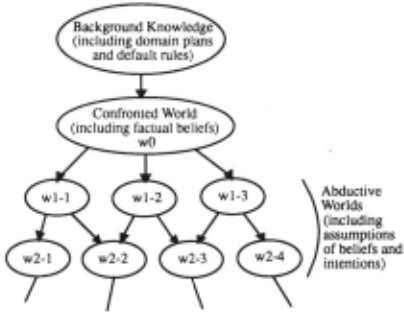
Multiple contexts are constructed as follows:
- When an utterance is processed, facts or assump tions are derived from it.
- Abductive worlds are constituted of individual as sumptions, and the confronted world is constituted of facts.
- A relationship between facts and assumptions is de fined as a consistent translation from the confronted world to an abductive world.
- When a new utterance is processed, relationships · between worlds change a.'> the occasion demands.
- Multiple contexts are constructed from several re lationships among facts and assumptions (i.e., the confronted world and abductive worlds).
- Preferences among multiple contexts are calculated according to degrees of dependency between worlds, which can change as information grows.
- A preferred context includes preferred assumptions.
Since the preferences can dynamically change in re sponse to the situation, we have to design a device for computing preferences that sufficiently captures the dy namic nature of preferences. Numerical descriptions of preferences can sufficiently capture information dynam ics. Actually, the numerical plausibility of abductive in ference is widely utilized in other works [Hobbs et al., 1988; Charniak and Shimony, 1990].
The preferences we use arc defined by degrees of de pendency between worlds connected via consistent trans lations.
2.3.2 Dependency between Worlds
Let WI and w2 be worlds, lett be consistent translation between WI and w2, and let r/> = ... 1\ P(a) 1\ ... be an axiom of WI, and '1/J = ... 1\ Q( b) 1\ ... be an axiom of w2 (except the axioms translated by t from WI ) . If at least one of the following relations between r/> and 7/1 hold (i.e., provable in w2 ), then we say that there is a dependency between WI and w2 by a consistent translation t:
- Argument equality
If t( a) = b holds, then there is a dependency be tween rf> and '1/J called argument equality.
- Predicate equality If t(P) = Q holds, then there is a dependency be
tween r/> and '1/J called predicate equality.
- Positive entailment
If t(P(a)) .- Q(b) or Q(b) .- t(P(a)) holds (except for the case where t(P(a)) = Q(b) holds), then there is a dependency between r/> and '1/J called positive entailment.
- Negative entailment
If t(P(a)) .- ·Q(b) or ·Q(b) .- t(P(a)) holds, then there is a dependency between r/> and '1/J called neg ative entailment.
In this case, at least one (translation of) possible modal axiom must be included in a proof sequence of t(P(a)) .- ·Q(b) or ·Q(b) .- t(P(a)).
Each dependency, except negative entailment, has a positive degree of dependency (let each be Ui, then u1,u2,u3 > 0) . While negative entailment has a neg ative degree of dependency u4 < 0.
If several dependencies hold, the degree of dependency is defined as the sum of each value, which is called the degree of dependency between worlds and is denoted by dw, .w2·
For example, if r/> = PI(ai) 1\ P2(a2) is in WI, '1/J = Qt(bt) 1\ Q2(b2) is in w2, and t(at) = b1,t(a2) = b2,t(PI) = QI, t(P2(a2)) .- Q2(b2) hold, then the degree of dependency between WI and w2 becomes dw 1 .w 2 = 2Ut + U2 + U3.
2.3.3 Preferences among Multiple Contexts
A context is represented by a world sequence like w0.w1··.. Let W; be a set of abductive worlds in the i-th layer and w; be its element (i.e. , w; E W;) . Wo means the layer of the confronted world which includes factual information.
A preference of a context wo. Wt··., p( wo . Wt··.) is cal culated as follows:
In this ca.'ie, the preference of w0 .. . w; is calculated by adding the preference of wo .. :wi- I and the degree of dependency between 'Uii- I and w;, and nonualiz ing by the sum of all the contexts including a world in W;.
3 Plan Recognition and Belief Revision in Dialogue Understanding
We apply the Multi-World . Model to plan recognition and belief revision in utterance comprehension with a method that describes the changing of preferences among contexts of beliefs. We treat belief revision as dynamic assignments of preferences among con texts constructed from utterances, not as conventional static assignments of truth values or preferences.
Recogni11ing the speaker's beliefs and plans is impor tant for understanding utterances. If there are alterna tive beliefs or plans inferred from an utterance, then we should make a.<>sumptions which correspond to each al ternative. Perrault [1990] constructed a formal theory of speech acts based on Reiter's default logic [Reiter, 1980], but he could not properly deal with belief revi sions that result from speech acts. The model for belief revision should describe preferences among competitive assmuptions of beliefs. Appelt and Konolige [1989] pro posed a formal treatment of belief revision based on hi erarchic autoepistemic logic [Konolige, 1989], an exten sion of Moore's autoepistemic logic [Moore, 1985] . In this framework, a hierarchy of defaults represents pref erences among beliefs (i.e., the result of a default rule in one level is preferred to the result of a default rule in a higher level). However, it cannot deal with preferences among consistent beliefs that dynamically change as the volume of observed information increases.
A heuristic method has been proposed to assess am biguous contexts and choose a pi·eferred alternative [Car berry, 1990aj3. However, once a context is selected by the method, even if a more appropriate context (includ ing alternative plans) is later found , it cannot switch the current selected context to that context. Our framework allows the context model to dynamically switch to a more preferable context by maintaining multiple contexts and updating preferences among contexts.
3.1 Example
In many cases, there can be mutually exclusive hypothet ical interpretations of an utterance. This multiplicity is caused by the uncertainty of the recognizing agent's be liefs about the planning agent's beliefs and ambiguity in utterances. As an example of ambiguous utterances which yield multiple interpretations, consider the follow ing dialogue between two agents, A and B. We a.<>sume that agents A and B live in the same town, and they are acquaintances of each other. One day agent A met agent B on his way to a river bank.
3 Carberry [1990b] discusses the problem of building and revising the context model based on evidential reasoning. Her motivation is similar to ours, hut her mechanism is still unclear about basic probability assignments and preference rules.
Al: Where are you headed?
- Bl: I'm going to the bank. See, here I have a terrific gun which I bought yes terday.
A2: Gosh! Are you going to rob it?
- B2: No, I'm going to Tama river. Across the river there are woods.
A3: Oh, I see. You are going hunting.
We assume that the plan library of agent A in this example is the same as that of Kautz's example [Kautz, 1990] (Figure 2). Additionally, we assume that there is
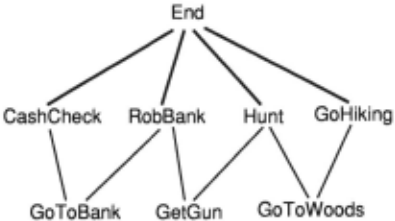
a river called Tama in the town. Also, in the town there is only one bank (a place in which money is kept).
Agent B's goal is to go to the woods across the river to hunt. After agent A heard utterance Bl by B, A might have assumed that agent B is going to rob a bank. This recognition is entailed by Kautz's method of plan recog nition. However, after B uttered B2, A would have recognized that B actually intended to go to the woods across the river to hunt . Since a recognized plan is based on the beliefs of a recognizing agent, it may not be the plan that the planning agent constructed. We can view the recognized plan as a set of the most plausible as sumptions held by the recognizing agent. As it is a set of assumptions, the recognizing agent may revise his/her assumptions after additional information is provided to him/her by means of utterances. Therefore, we have to design the plan recognition process so that recognizing agents can revise their assumptions appropriately based upon information provided.
In our framework, semantic interpretations of ambigu ous utterances and intentions, which are abductively in ferred by using ambiguous plans, are uniformly treated as assumptions. These assumptions are represented by logical formulae and placed ou differeut abductive worlds as axioms. In addition, we assume that (domain) plans are represented as possible-modal axioms asserted in the background knowledge.
For example, the domain plans in the Kautz's example [Kautz, 1990] are represented as follows:
P1 : OVx.GoToBankt(x) _, 3y.CashCheck(y)
P2: OVx,y.GoToBank1(x) 1\ GetGun(y)->
3z.RobBank1(z)
P3: OVx,y.GoToWoods(x)I\GetGun(y) _, 3z .Hunt(z)
P4: OVx.GoToWoods(:z:) _, 3y.GoHiking(y)
We assume that they have a priori knowledge about the above plaus and the following default rule:
D1 : OVx.GoToBank2(x)-> 3y.GoToHiver(y)
When agent B makes the utterance Bl , A infers B's beliefs aud iutcntious a.<; follows:
The word "bank" has two meaniugs which are denoted by Bank1 (a place in which money is kept) and Bank2 (laud along the side of a river) , so the assumptions GoToBankt( et) and GoToBank2 ( e2 ) are constructed. The abductive worlds w1-1 and w1-2 correspoudiug to each assumption arc created as shown iu Figure 3, where the constants e1 and e2 represent iustances of events 4 .
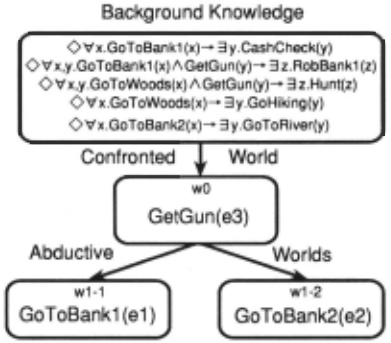
In addition, the factual belief GetGun(e3 ) is placed ou the coufronted world wo. Consistent translatious of wo-to-w1-1 and wo-to-w1-2 are successfully constructed. Trauslations of vocabulary are identical mappings. Mul tiple contexts wo.WI-1 and w0 :w1_2 are then considered for calculat.iug preferences. In this ca.<;e, the prefereuces of contexts wo.w1-1 and w0 .w1_2 are the same since no dependency between worlds is found.
Then, by using plans P1 and P2 , the two inferred inten tions, CashCheck(e4 ) and RobBank1(e5 ), are generated and placed on the lower layer abductive worlds w2 _ 1 and w2-2, respectively (Figure 4).
Consistent translations are constructed in order to counect worlds 5 . Multiple coutexts are then consid ered for computing prefereuces. The preferences of wo.w1-1·w2-1 and wo.w1-1·W2-2 are calculated as fol lows. The degree of dependency between w1_ 1 and w2-1 becomes u2 + ·u3 because there is a predicate equality of GoToBanA:1 aud GoToBankt(et) entails CashCheck(e4 ) by using the plan P1 (P1 is inher ited from the background knowledge to w2-d 6 . While the degree of dependency between w1-1 and w2-2 be comes 2u2 + u 3 because there are two predicate equal ities of GoToBank1 and Get Gun, and GoToBank1 ( el) entails RobBank1 ( e5 ) by using the plan P2 (inherited from the background knowledge to w2-2) and the fact GetGun(e3 ) exists in w 1_ 1 (inherited from wo to w1-d· The context w 0 .w1_ 1 .w 2_ 2 is the most preferable be cause the preference value is the highest among the al ternative contexts.
4 We already have a syntactic/semantic analysis device which can recognize utterances and extract facts and assump tions from them. For the sake of simplicity, we don't describe this device in this paper. See Nagao [1992).
5 If we represent logical semantic interpretations more strictly, then WJ-2 will he inconsistent with w2_ 2 (and per haps with tli2-J) because these worlds refer to the different semantic objects of "bank."
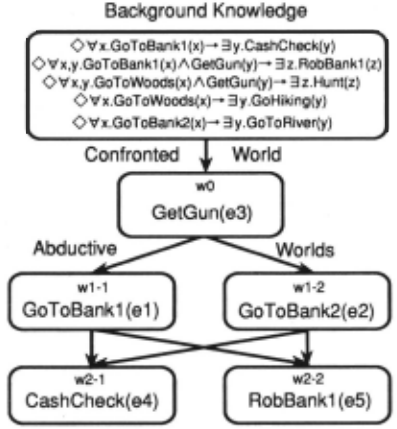
After B gives the utterance B2, the factual be lief GoToRiver(e6) 1\ GoToWoods(e7) is generated and placed on the confronted world. Plans P~ and P4 are activated when the fact GoToWoods(e1) IS encoun tered. Assumptions of B's intention Hunt(es) and GoH iking( e9 ) are then inferred . . Ab.ductive worlds w2-:-3 and w2_ 4 , which have each assumptiOn, are generated m the same layer of w2_ 1 and w2-2· This is done because these four worlds are mutually exclusive. The multi world is constructed as shown in Figure 5.
Now, we consider the preferences of the contexts in cluding w1_ 2, The preferences of wo.WI-2·W2-3 and w0.w1_ 2.w2_ 4 are calculated a.'! follows. The degree of dependency between wo and w1-2 becomes u2 + u3, because GoToBank2 (e2) entails GoToRiver(e6) by us ing the default rule D1 which is inherited from the background knowledge to w1-2. The degree of depen dency between w 1_ 2 and w2-3 becomes 2u2 + u3, since GoT oW oods( e1) and GetGun( e3) (inherited from wo to w1_ 2) entails Hunt(e8 ) by using the plan P3 (inherited
6 The composition of consisitent translations are also con sidered as consistent translations. Mappings of constants to skolemized variables are also constructed in translations. See Nagao (1989]. Unification between a skolemized variable and a constant is based on Charniak 's abducti11e unification [Char niak, 1988].
Background Knowledge
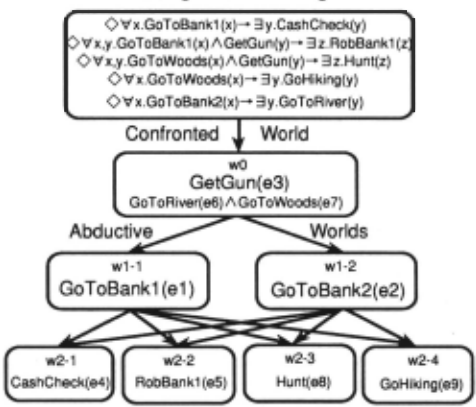
from the background knowledge to W2-3)· While the degree of dependency between w1-2 and w2-4 becomes u2 + u 3 , because GoT oW oods( e1) (inherited from wo to w1_ 2 ) entails GoH·iking(eg) by using the plan P4 (inher ited from the background knowledge to W2-4)· Now, the context w 0 .w1_ 2.w2_ 3 is the most preferable since the contexts including w1_ 1 have lower preference values.
This example shows that beliefs and intentions in ferred by the hearer can be revised as observed (heard) information increases. Our model captures the phenom ena by maintaining multiple contexts and dynamically assigning a preference value to each context.
4 Concluding Remarks and Further Work
We have developed a new framework for plan recogni tion and belief revision which properly treats ambiguities in dialogue understanding. These ambiguities include lexical, syntactic, semantic, and plan ambiguities. This model is able to estimate and revise the most preferable interpretation of utterances as the dialogue progresses. The model successfully captures the dynamic nature of real world conversation. The framework is comprised of two portions: ( 1) an extension of first-order logic for maintaining multiple interpretations of ambiguous ut terances in a dialogue; (2) a device which estimates and revises the most preferable interpretation among these multiple interpretations. Since the model is logic-based, it provides a good basis for formulating rational justifi cations of its current interpretation, which is one of the most desirable aspects in generating helpful responses.
Also the model deals with the dynamic nature of dia logues by means of the following two mechanisms. First, preferences among contexts are dynamically computed based on facts and assumptions within each context.
The preference captures a measure for the plausibility of a context. The currently most preferable context con tains a currently recognized plan. Secondly, changing the most plausible context among mutually exclusive contexts along a dialogue is formally treated as a belief revision of a plan recognizing agent. Most previously proposed models for resolving ambiguity in plan recog nition cannot revise their pragmatic decisions once they commit to a recognized plan.
We are currently working on the following extensions: ( 1) providing a mechanism for detecting a critical dia logue situation where several competitive interpretations have closer preference measures, and entering a clarifica tion dialogue; (2) extending the model to entail temporal reasoning and planning.
Our model regards the most preferable interpretation as the recognized plan (or the most plausible interpre tation). However, in some dialogues, many alternatives may have nearly equal preference values. In this critical situation, one may wish to query for additional informa tion in order to commit to the preferable context with more certainty. A criterion for detecting the critical sit uation using preference measures of mutually exclusive contexts is being carried out.
Acknowledgments
The author would like to give great thanks to the other members of Sony CSL, especially Ei-Ichi Osawa, for their helpful comments and support.
@inproceedings{ijcai1993p164,
  title     = {Abduction and Dynamic Preference in Plan-Based Dialogue Understanding},
  author    = {Nagao, Katashi},
  booktitle = {Proceedings of the Thirteenth International Joint Conference on
               Artificial Intelligence, {IJCAI-93}},
  publisher = {International Joint Conferences on Artificial Intelligence},
  editor    = {Ruzena Bajcsy},
  pages     = {1186--1191},
  year      = {1993},
  note      = {Natural Language},
  url       = {https://ijcai.org/proceedings/1993/164},
}
TY - CPAPER TI - Abduction and Dynamic Preference in Plan-Based Dialogue Understanding AU - Nagao, Katashi T2 - Proceedings of the Thirteenth International Joint Conference on Artificial Intelligence, IJCAI-93 PB - International Joint Conferences on Artificial Intelligence PY - 1993 SP - 1186 EP - 1191 UR - https://ijcai.org/proceedings/1993/164 ER -Copied
Machine-readable versions of this paper, for tools and AI agents:





