
Semantic Interpretation Based on the Multi-World Model
Proceedings of the Eleventh International Joint Conference on Artificial Intelligence. Speech and Natural Language. Pages 1467-1472.
© 1989 International Joint Conferences on Artificial Intelligence
Abstract
This paper proposes the Multi-World Mode/ as a new logical framework for semantic interpretation ofnaturallanguage. The model represents worlds as first-order axiomatic systems linked through interpretations between worlds, which are mappings of theorems between these axiomatic systems . Results of semantic interpretation are assumed to be constructed on such a multi-world structure. To understand ambiguous sentences, people make assumptions to complement information that is unknown to them. If an assumption is consistent with information that is known to them, then they will support that assumption and make a unique interpretation of the sentence. When a new sentence comes in whose interpretation conflicts with a previous interpretation, they will consider another assumption. When the context is fixed, the whole interpretation will be decided by selecting the most preferable assumptions. The Multi-World Model was designed as a formal description of facts, assumptions, background knowledge, and their relationships. This paper defines the Multi-World Model and presents its application to semantic interpretation with concrete examples.
- [Barwise et al., 1977] Jon Barwise (editor), Handbook of Mathematical Logic. North-Holland, 1977.
- [Charniak, 1988] Eugene Charniak, "Motivation Analy- sis, Abductive Unification and Nonmonotonic Equal- ity," Artificial Intelligence, 34:275-295, 1988.
- Deguchi and Oka, to appear] Hiroshi Deguchi and Toshiyuki Oka, "Hierarchical Reasoning and Knowl- edge Networks" (in Japanese), to appear.
- [Dowty et al., 1981] David R. Dowty, Robert E. Wall, and Stanley Peters, Introduction to Montague Seman- tics. D. Reidel, Dordrecht, 1981.
- [Hobbs et al., 1988] Jerry R. Hobbs, Mark Stickel, Paul Martin, and Douglas Edwards, "Interpretation as Ab- duction," Proceedings of the 26th Annual Meeting of the Association for Computational Linguistics, 95- 103, 1988.
- [Landman, 1986] Fred Landman, Towards a Theory of Information . Foris, Dordrecht, 1986.
- Maruyama, to appear] Hiroshi Maruyama, "Maximal Join for Anaphora Resolution," in John Sowa, Norman Foo, and Anand Rao (editors), Conceptual Graphs for Knowledge Systems, Addison-Wesley, to appear.
- [Nagao, 1988] Katashi Nagao, "Semantic Interpretation Based on the MultiWorld Model," TRL Research Re- port TR87-1025, 1988.
- [Reiter, 1980] Raymond Reiter, "A Logic for Default Reasoning," Artificial Intelligence, 13:81-132, 1980.
- [Zadrozny, 1987] Wlodek Zadrozny, "A Theory of De- fault Reasoning," Proceedings of the Sixth National Conference on Artificial Intelligence (AAAI-87}, 385- 390, 1987.
- Zadrozny and Jensen, to appear] Wlodek Zadrozny and Karen Jensen, "Semantics of Paragraphs," to appear. Nagao
References were extracted automatically from the PDF and may contain errors.
Full text extracted automatically from the PDF; figures, tables and equations may differ. The PDF is the version of record.
1 Introduction
People use background knowledge to interpret sentences, to resolve anaphora, and to check the coherence of a text. If their background knowledge is not sufficient for this purpose, then they make assumptions in order to understand their meaning.
Generally, people interpret sentences by making as sumptions based on partial information. The assump tions may be inconsistent with each other, and therefore the factual information derived from the sentences is re lated to each of the assumptions separately.
It is difficult to represent the meaning of sentences by logical expressions when assumptions must be taken into account. Reiter's default logic [Reiter, 1980] is one way to overcome this problem. The model-theoretical basis of the Multi-World Model is a Kripke Model [Landman,
1986], and default reasoning can be expressed by using the modality of possibility.
Another problem is that semantic interpretation changes according to the growth of information obtained from the sentences read. The Multi-World Model can treat dynamic interpretation by using assumptions and knowledge represented by logical formulae.
The main ideas in this paper are as follows:
- When a sentence is processed, a fact or assumptions are derived from it.
- Abductive worlds are constituted of individual as sumptions, and the confronted world is constituted of facts .
- These worlds are considered as first-order axiomatic systems.
- A relationship between a fact and an assumption is defined as a mapping from a confronted world to an abductive world.
- When a new sentence is processed, the relation ships between worlds will change as the occasiOn demands.
- When the whole context is fixed, contextual refer ences and ambiguities in the worlds are resolved.
Semantic interpretation of sentences consists of local relationships between facts and assumptions. These re lationships are called interpretations between worlds. We call this model of worlds and interpretations between worlds the Multi-World Model.
In the next section of this paper, we define the Multi World Model.
In the last section, we describe the semantic interpre tation of natural language sentences by the Multi-World Model, and give concrete examples.
2 The Multi-World Model
The Multi-World Model is based on the idea that many logical domains are interconnected by mappings from formulae in one domain to those in other domains. This idea was originally developed by Deguchi and Oka, who called it a Knowledge Network [Deguchi and Oka, to appear].
We develop a model for semantic interpretation based on their formalization.
The MultiWorld Model IS a 2-tuple < WS, IS >, where:
- W S : Set of worlds.
- IS : Set of interpretations between worlds.
In the next paragraphs, we define worlds and interpre tations between worlds.
2.1 Worlds
Worlds are represented by first-order axiomatic systems. Thus, a world is denoted by W =< Aw, Vw >.
- Axioms Aw Aw : Axioms of world W.
- Vocabularies Vw
- (a) Vcw : Set of constants of world W.
- (b) V]~ : Set of n-ary function symbols of world W.
- (c) V?w : Set of m-ary predicate symbols of world W.
- (d) Vfw = U{Vjw I i EN}.
- (e) Vpw = {Vtw I j EN}.
- (f) Vw = Vcw U Vfw U Vpw : Vocabularies of world W .
2.2 Interpretations between Worlds
An interpretation between worlds is defined by mapping from a set of logical formulae in one world to a set in another world. It consists of an interpretation of vocab ularies and an interpretation of formulae.
2.2.1 Interpretation of Vocabularies
Let W1 and W2 be worlds; J, the interpretation of vocabularies between wl and w2, is then defined by the following injections:
- For constants, l c : Vcw, ___. Vcw,.
- For function symbols, J 1 i : v 1 i ---. v 1 i (i EN). Wt w2
- For predicate symbols, J~ : vt ---. vt (j E N). wl w2
- J =< lc,lJ(i E N), J~(j E N) > : Interpretation of vocabularies between wl and w2.
2.2.2 Interpretation of Formulae
Let W1 and W2 be worlds; K, the interpretation of formulae between wl and w2, is then defined by the following functions, using J, the interpretation of vo cabularies:
- Interpretation of Terms
- (a) If xis a variable, then K(x) = x.
- (b) If a term tis a constant, then K(t) = lc(t).
- (c) If t1, ... , tn are terms and f is a n-ary function symbol, then
- K(f(t1, ... , tn)) = J,(f)(K(tt), ... , K(tn)) .
2. Interpretation of Atomic Formulae
- (a) If t1 and t2 are terms and t1 = t 2 , then K([t1 = t2]) = [K(tt) = K(t2)].
- (b) If t1, ... , tm are terms and Pis a m-ary predi cate symbol, then K(P(t1, . .. , tm)) = Jp(P)(K(tt), . . . , K(tm)) .
- Interpretation of Formulae
- (a) If¢ and 1/J are formulae, then K(¢1\,P) = K(¢) 1\K(,P), K(¢ v ,P) = K(¢) v K(,P), K(-.¢) = -.K(¢) , and K(¢ ---.,p) = K(¢)---. K(,P).
- (b) If x is a variable and ¢ is a formula, then K(Vx¢) = VxK(¢) and K(3x¢) = 3xK(¢).
We denote the interpretation between worlds by the symbol I, consisting of the above J and K.
2.3 Conditions on Interpretations
We now specify some conditions for the interpretation between worlds.
2.3.1 Strong Interpretation
Let W1 and W2 be worlds, and let I be an interpre tation between wl and w2. If any axioms of wl are interpreted in W2 as theorems by I (i.e., if 'V¢ E Aw,, then Aw, 1- I(¢)), then interpretation I is called a strong interpretation.
If I is a strong interpretation, then the following the orem holds.
Theorem 1 Let W1 and W2 be worlds, and let I be a strong interpretation from W1 to W2 . If¢ is a theorem in W1 (i.e., Aw, 1-¢, then I(¢), the interpretation of¢, is also a theorem in W2 (i.e., Aw 2 1- I(¢)).
We e;ive a proof of this theorem is given in another paper [Nagao, 1988].
2.3.2 Weak Interpretation
Strong interpretation is inadequate for dealing with semantic interpretation of natural language. Therefore, we introduce another interpretation.
It seems rarely to happen that all the axioms of one world are interpreted in another world as theorems. However, there are many cases where reasoning in one world needs the axioms in another world. We therefore define weak interpretation as considering interpreted ax ioms as axioms in the target world if they are consistent with the original axioms in the target world.
A more precise description is as follows:
Let W1 and W2 be worlds, and let I be interpretation between wl and w2. If the interpretation results of all axioms of W1 are consistent in W2 (i.e., if V¢ E Aw,, then Aw, fl -.I(¢)), then interpretation I is called a weak interpretation. Weakly interpreted axioms can be regarded as axioms of W2 (i .e., I(¢) E Aw 2 ) .
If I is a weak interpretation, then the following theo rem holds.
Theorem 2 Let W1 and W2 be worlds, and let I be a weak interpretation from W1 to W2 . If¢ is a theorem in W1 (i.e., Aw, 1- ¢), then I(¢), the interpretation of¢, is also a theorem in W2 (i.e ., Aw 2 1- I(¢)).
Proof of this theorem is also given in another pa per [Nagao, 1988].
2.4 Building a Kripke Model with the MultiWorld Model
We now show that a Kripke Model [Landman, 1986] can be constructed by using the M ulti.World Model.
2.4.1 Henkin-Extension of Worlds
We introduce into the first-order language a witnessing constant [Barwise et al., 1977], representing an existen tially closed sentence such that 3xP( x) ( P is a predicate symbol). It is denoted by CP(x)·
The Henkin-Extension is an extension of first-order logic that includes witnessing constants of level n. They are defined recursively:
Let Lw be a language of world W.
- Level 0 : a sentence 3xP(x) includes only constants of Lw.
- Level n > 0 : a sentence 3xP( x) includes at least one witnessing constant of level n-1.
The Henkin-Extension of world W is the deductively closed world Wex, which has witnessing constants of each level in addition to Lw and axioms 3xP(x)--+ P(cP(x)) (called Henkin axioms), corresponding to each witness ing constant, in addition to Aw.
2.4.2 Interpretation between Henkin-Extended Worlds
Let W1 and W2 be worlds, let Wex, and Wex, be their Henkin-Extensions, and let I be an interpretation be tween W1 and W2. An interpretation between Wex, and Wex 2 , I* is then defined as follows:
- For every constant c, I*(c) =I( c).
- For every witnessing constant Cp(x)> I*(cP(x)) = CJ(P(x))·
- For every function and predicate symbol, I* is same as I.
If I is a strong/weak interpretation, then I* is also a strong/weak interpretation.
2.4.3 Canonical Structure
The canonical structure of Wex' Cano(Wex), consists of:
- Canonical base: A quotient set constructed by an equivalence relation ~ such that
Vt1, t2 E CTex, t1 ~ t2 --+ Aw · ., f- [t1 = t2],
where CTex is a set of closed terms of Wex·
It is denoted by Cbase(Wex)·
- Canonical relation: A relation on the canonical base constructed by functions and predicates of Lw · .,.
2.4.4 Possible Worlds
A set of possible worlds corresponding to Henkin Extended world Wex is defined as follows:
Let s be a possible world corresponding to Wex (i.e., s E Sw.J. We denote the canonical structure of s as Cano(s), the canonical base of s as Cbase(s) and the world which is extended to s as W(s).
1 This means that worlds into which functional composi tions of intrepretations are mapped are also included.
2.4.5 Kripke Model Constructed by the Multi World Model
The Kripke Model which is constructed by the Multi World Model< WS, IS> and the world W(W E WS) is a 5-tuple < S,~,D,q, V >,where:
- S is a non-empty set such that s = Sw · ., = u{w:x I I* : Wex--+ w:xl·
- ~ is a partial order on S such that Vs,s' E S,s ~ s' =: 3I E IS, I: W(s)--+ W(s'), I is a strong/weak interpretation.
- D is a set of domains of variables such that D = u{ Cbase(w:x) I I* : Wex --+ w:x}.
- q is a function that selects from D a domain in each possible world such that Vs E S, q(s) = Cbase(s), and if s 1 ~ s2 then I*(q(s1)) ~ q(s2).
- V is a function assigning V. to every possible world s. V, is a partial function that maps from the set of formulae of Lw to the set of truth values, such that
- V,(¢) = 1 iff Cano(s) I= I(¢),
- V,(¢) = 0 iff Cano(s) I= I(-.¢),
- Undefined otherwise,
where ¢ is an atomic formula of Lw.
Truth value assignments to arbitrary formulae are the same as for the Kripke Model.
2.4.6 Modalities in the Multi.World Model
Modalities in a Kripke Model are defined in the Multi World Model by introducing modal operators to the first order language of worlds.
Let M =< S, ~, D, q, V > be a Kripke Model con structed by the Multi-World Model < W S, IS > and the world W(W E WS), and let¢ be a formula of W.
1. Necessity
- (a) 0¢ is true relative to s iff V s' such that s ~ s', V.~(¢) = 1,
- (b) 0¢ is false relative to s iff 3s' such that s ~ s', V.~(¢) = 0.
2. Possibility
- (a) 0¢ is true relative to s iff 3s' such that s ~ s', v,,(¢) = 1,
- (b) 0¢ is false relative to s iff V s' such that s ~ s', V.~(¢) = 0.
In any world W' that connected with W by a strong/ weak interpretation I, I(¢) is a theorem (i.e., VW', 3I : W --+ W', I is a strong/weak interpretation, Aw' f I(¢)). Therefore, a theorem ¢ of a world W (i.e., Aw f- ¢) satisfies the above definition of necessity.
On the other hand, the axioms satisfying the con dition of possibility play important roles in the Multi World Model. These axioms may be inconsistent with a world, but consistent with another. We call such axioms possible-modal axioms.

3 Semantic Interpretation
In general, the system for semantic interpretation of nat ural language sentences consists of the following process:
- Translate the input sentence into the intermediate representation.
The intermediate representation is a well-formed construction with no ambiguity (e.g., a first order logical formula or a formula of intensional logic [Dowty et al., 1981)).
- Relate the intermediate representation to its deno tation, the semantic objects in the world involved in the system (e.g., database entries) .
The process mentioned above is illustrated in Figure 1.
However, an interpretation will generally be changed according to the context . When a person tries to in terpret a sentence, he constructs semantic objects based on background knowledge or knowledge obtained from preceding sentences. But if he fails to construct them, then he makes some assumptions and constructs seman tic objects based on these assumptions. When he tries to interpret the next sentence and notices that a for merly constructed assumption is not correct, or that an other assumption is better, he replaces the old assump tion with a new one.
Thus, the system for semantic interpretation should be flexible enough to allow changes of interpretation.
3.1 Process of Semantic Interpretation
In our method, semantic interpretation is done according to the following process:
- The sentence is translated into a logical for mula. If it is translated into a higher-order log ical formula, then it is reconstructed into first order formulae and meta-operators. (E.g., "John knows that Mary is young" will be translated as I<nOWJohnYoung(Mary). Here, KnOWJohn is a meta-operator. The meaning of KnoWJohn is de fined in the MultiWorld Model.)
In this paper, we consider only first-order formulae.
- One unambiguous sentence is translated into one logical formula, and is considered as a fact .
- If a sentence is ambiguous and can be translated into several logical formulae , then these are considered as assumptions.
- A fact is regarded as an axiom of the confronted world, and each assumption is regarded as an axiom of the abductive world separately.
- The confronted world is connected with the abduc tive worlds by weak interpretations.
- An interpretation from the confronted world to the abductive world determines the semantic interpre tation of a sentence.
- The abductive worlds construct a hierarchy if the following sentences produce other assumptions. The abductive worlds constructed by one sentence are on the same level in the hierarchy of worlds.
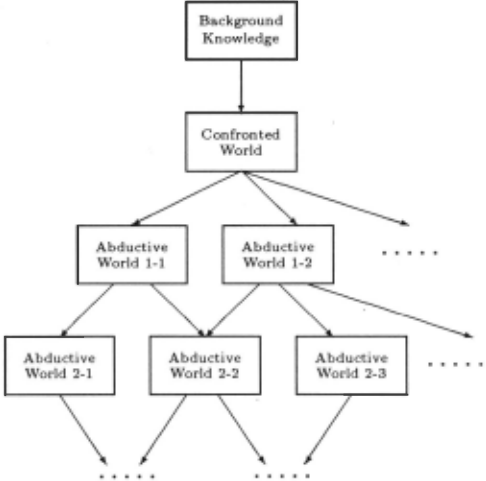
The hierarchy of worlds for semantic interpretation is represented in Figure 2.
All arrows in this figure represent weak interpreta tions.
- As new sentences are processed by the system, the weakly interpreted axioms may be found to be in consistent with the axioms of an abductive world. In such cases, the weak interpretation into this ab ductive world is eliminated.
- When the context is fixed and there exist several abductive worlds that are consistent with the inter preted axioms of the confronted world, then we must select the most plausible abductive world. There is a heuristic rule for defining a preference relation be tween abductive worlds:
"The abductive world with the latest and most in formation is the most preferable."
The preferability of abductive worlds depends on the amount of possible-modal axioms in the back ground knowledge that are consistent with assump tions in these worlds and the recency of facts in the confronted world that are also consistent with assumptions. 2
2 This is an intuitive definition of preference.
3.2 Sentence Understanding Using Assumptions
As mentioned before, when people understand a sentence ("understanding a sentence" means assigning a proper interpretation to that sentence), they do so by using their background knowledge, and if their background knowl edge is not sufficient for the purpose, then they build suitable assumptions in order to complement their un derstanding.
For example, take the ambiguous sentence
"John just saw a man with a telescope."
There are two interpretations of "with a telescope":
- John saw a man by using a telescope.
This interpretation is based on the assumption that "John" had a telescope and that he used it as an instrument to see "a man."
- John saw a man who had a telescope.
This interpretation is based on the assumption that "a man" had a telescope.
Suppose that the next sentence is:
"John bought it yesterday."
In this case, the first interpretation seems to be better than the second one.
However, when the third sentence is:
"But John gave it to him this morning,"
the second interpretation seems to be more adequate than the first.
In general, we cannot decide the complete interpreta tion of sentences until the whole context is fixed .
We now explain the process of making facts and as sumptions for interpreting each sentence.
- Sentence 1. "John just saw a man with a telescope." This sentence is translated into the following two logical formulae:
Fu :lt1,e1,e2,x,y{Just(t1) 1\ See(e1,t!) 1\ agent(el) = John 1\ patient(e1) = x 1\ Man(x) 1\ instrument(el) = y 1\ Telescope(y) 1\ H ave(e2, t 1 ) 1\ agent(e2) =John 1\ patient(e2) = y}.
Here, t 1 is a time variable, ~;(i E {1,2}) is an event variable, and John is a constant corresponding to the individual "John."
F1.2 3t1 ,e1 ,e2,x,y{Just(tl) 1\ See(e1,t1) 1\ agent( e1 ) = John 1\ patient( el) = x 1\ Man( x) 1\ H ave(e2, tl) 1\ agent(e2) = x 1\ patient(e2) = y 1\ Telescope(y )} .
The first formula includes the result of inference us ing the background knowledge: "if a person uses a telescope to see something, then he/she has the telescope."
The two formulae are inconsistent, because the event Have of each formula is derived from "with a telescope," the event variable e2 of each formula is equivalent, and agent is a function.
Thus, since the two formulae cannot be placed in the same world, they are considered as assumptions and are placed in separate abductive worlds.
The constant John and the witnessing constants CJI1an(x)> CTelescope(y) are placed in the confronted world.
- Sentence 2. "John bought it yesterday."
This sentence is translated into the following logical formula:
F2 3t2, e3, e4 {Y esterday(t2) 1\ Buy( e3, t2) 1\ agent( e3) John 1\ patient( e3) it1 1\ Have( e4, t2) 1\ agent( e4) = John 1\ patient( e4) it I}.
This formula also includes the result of inference using the background knowledge that "if a person bought something, then he/she has it."
This formula is placed in the confronted world.
it1 is a constant corresponding to the pronoun "it." The pronoun resolution procedure described in the next section returns the formula it1 = cTele·cope(y)> and is placed in the confronted world.
Consider the following possible-modal axiom in the background knowledge:
The axiom means "it is possible that if a person has something at a moment then he/she has it after the moment ."
The result of inference by using F2 and I< 1 is con sistent with Fu, but not with F1.2. This makes the abductive world including Fu more plausible than the one including F1.2.
- Sentence 3. "But John gave it to him this morning." This sentence is translated into the following logical formula:
F3 3t3, e5 , es{ M orning_of _Today(t3) 1\ Give(e5 , t3) 1\ agent(e5) = John 1\ patient(e5) it 2 1\recipient(e5) = he 11\Have(e6, t3)1\agent(e6) = he1 1\ patient(e6) = it2} .
This formula also includes the result of inference using the background knowledge that "if a person gave something to another person, then the person given it has it."
This formula is placed in the confronted world. it2 is a constant corresponding to the pronoun "it" and he1 is a constant corresponding to the pronoun "him." The pronoun resolution procedure returns the formula it2 = CTelescope(y) 1\ he1 = CJ11an(x) > which is placed in the confronted world.
The result of inference using F3 and K 1 is consistent with F1.2, but not with Fu. In addition, F3 comes after F2 . Therefore the abductive world including F12 is more plausible than the one including Fu .
We consider the interpretation of an ambiguous sen tence as a problem of making assumptions to comple ment partial information and of determining which as sumption is supported at the moment when the context seems to be fixed . Dynamic interpretation involves the problem that a supported assumption will change ac cording to the change in the context.
The M ultiWorld Model is intended to provide a rep resentational basis for these problems. But a more com plicated problem to formalize the preference relation of worlds should be contemplated in order to sophisticate the model.
3.3 Anaphora Resolution Using the MultiWorld Model
There are many discourse-oriented phenomena in natural language understanding, such as focus, topic, coherence, cohesion and so on.
One fundamental phenomenon that can be observed in many natural languages is called anaphoric reference or simply anaphora.
Pronouns are the typical, but not the only, markers for anaphoric reference. Once a term is introduced, it can be referred to in various ways, for example, by simi larity (i.e., using the same word, a synonym, or a closely related word), by a definite noun phrase or paraphrase reference, and by zero anaphora (i.e., ellipsis).
According to the traditional approach, the anaphora resolution algorithm consists of the following steps: [Maruyama, to appear]
- Select a definite expression from the current sen tence. If all the definite expressions have been re solved, then terminate.
- From the discourse structure, find the referent that satisfies certain syntactic and semantic constraints.
We assume that the semantic constraints are included in the background knowledge.
Here is an example of resolution of the pronoun "it." This example is a modified version of that in a forthcom ing paper [Zadrozny and Jensen, to appear].
- Sentences
Consider the following sentences:
- 51 : A ship entered a port.
- S2 : It brought a diseas e.
- S3 : It struck rapidly.
· Logical Formulae
The above sentences are translated into the follow ing formulae:
- F1 : 3ii,el,x,y{Past(ti) 1\ Enter(e1,t1) 1\ agent(e!) = x 1\ Ship(x) 1\ patient(el) = y 1\ Port(y)} .
This formula is placed in the confronted world, along with the witnessing constants Cship(x)> Cport(y) ·
- F2 3t2,e2,z{Past(t2) 1\ Bring(e2,t2) 1\ agent( e2) = it11\patient( e2) = z 1\Disease(z)}. This formula is placed in the confronted world, along with the witnessing constant cviuau(z)· The following equalities are produced for the pronoun resolution:
- E2.1 : it1 = Cship(x) ·
- E2.2 : it1 = CPort(y) ·
These two formulae are inconsistent with each other, since there is no entity that can be a ship and a port simultaneously. Consequently, these formulae are placed in the abductive worlds separately.
- F3 3t3,e3,x{Past(t3) 1\ Strike(e3,t3) 1\ agent( e3) it2 1\ patient( e3) x 1\ Rapidly(e3)}.
This formula is placed in the confronted world, and the following equalities are produced for the pronoun resolution:
- E3.1 : it2 = cship(x)·
- E3.2 : it2 = CPort(y) ·
- E3.3 : it2 = C Diuau( z) ·
Since each formula is inconsistent with the oth ers, these formulae are placed in different ab ductive worlds, which then construct a hierar chical structure.
· Background Knowledge
The background knowledge includes the following formulae:
- Enter1 : OVt , e, x, y[{Enter(e, t) 1\ agent( e) = x 1\ patient(e) = y} -+ Ve'{Come_in(e', t) 1\ agent( e') = x 1\ patient( e') = y} ].
- Enter2 : OVt, e, x, y[{Enter(e, t) 1\ agent( e) = x 1\ patient(e) = y} -+ Ve'{People(x) 1\ Join( e', t) 1\ agent( e') = x 1\ patient( e') = y 1\ Group(y)}].
- Ship1 : OVx[Ship(x) -+ Vt , e, y{Carry(e, t) 1\ agent( e) = x 1\ patient( e) = y 1\ (People(y) V Goods(y))}].
- ShiP2 OVx[Ship(x) -+ {Aircraft(x) V Space_vehicle(x)} ].
- Port: Vx{Port(x)-+ Harbour(x)}.
- Bring1 : OVt , e, x, y[{Bring(e , t) 1\ agent( e) = x 1\ patient(e) = y} -+ Ve'{Carry(e', t) 1\ agent(e') = x 1\ patient(e') = y}].
- Bring2 : OVt, e, x, y[{Bring(e , t) 1\ agent( e) = x 1\ patient(e) = y} -+ Ve'{Cause(e', t) 1\ agent( e') = x 1\ patient( e') = y} ].
- Disease: Vx{Disease(x)-+ Il/ness(x)} .
- Strike1 : OVt , e, x, y[{Strike(e, t) 1\ agent( e)= x 1\ patient( e) y} -+ Ve'{Hit(e', t) 1\ agent(e') = x 1\ patient(e') = y}].
- Strike2 : OVt, e, x, y[{Strike(e, t) 1\ agent( e)= x 1\ patient(e) = y} -+ Ve'{Harm(e', t) 1\ agent(e') = x 1\ Illness(x) 1\ patient(e') = y 1\ Suddenly( e')} ].
The formula E2.1 can be derived from the possible modal axioms Ship1 and Bring1 in the background knowledge. But E2 .2 cannot be derived from any axioms, and thus E2.1 is preferable to E2 .2 .
The formula E3.3 can be derived from the axiom Disease and the possible-modal axiom Strike2 in the background knowledge, but the other formulae E3.1 and E3.2 cannot, thus E3.3 is the most prefer able.
We assume that the semantic interpretation needs background knowledge and that the assumptions are made in the process of reading the sentences.
The example of anaphora (pronoun) resolution men tioned above is evidence that the M ultiWorld Model is capable of handling discourse-oriented problems.
4 Relation to Other Work
Our approach is closely related to those that consider interpretation of a sentence as a problem of abduc tion [Hobbs et al., 1988] and decide the reference of anaphoric expressions by using assumptions that are consistent with the context [Charniak, 1988].
We intend to introduce a logical framework for inter pretation of sentences, but we have not yet discussed the inference mechanism precisely, as the above works do.
Their ideas will be useful in enabling us to introduce a more formalized concept of preferential relationships between assumptions into our model. We will also study an efficient algorithm for abductive inference in order to implement our model.
Another logical framework for natural language under standing is proposed in a forthcoming paper [Zadrozny and Jensen, to appear]. This is aimed at building a computational model of a paragraph that represents in teraction between sentences, the background knowledge to which these sentences refer, and metatheoretical op erators that indicate the types of models permitted. The model is based on partial models of logical formu lae [Zadrozny, 1987].
The special emphasis of our model is its capability of dealing with dynamic interpretation, while Zadrozny's model is mainly concerned with topic and coherence of context.
5 Concluding Remarks
Logic plays an important role in constructing a theoreti cal basis for the semantics of natural language. However, we should not use higher-order logic, since no theorem provers of higher-order logic work efficiently. On the other hand, first-order logic is not sufficient for seman tic interpretation of natural language sentences, since ambiguous sentences have several interpretations that may contradict each other, and contradictions cannot be handled properly in first-order logic. We assumed that a semantic interpretation is constructed by build ing assumptions and selecting the most likely assump tion. When people interpret ambiguous sentences, they make several possible interpretations, but cannot always choose the correct one because their background knowl edge is limited. In addition, we must take account of the fact that an interpretation changes because of incoming data. The MultiWorld Model has the functions of a log ical system for a formal treatment of natural language, and a flexible mechanism for dynamic interpretation.
We are plaiming to extend the model to describe pref erential relationships between worlds more formally. We will also be investigating an efficient inference algorithm in order to implement a system based on our formaliza tion.
Acknowledgements
We would like to thank members of the IBM Tokyo Research Laboratory, Wlodek Zadrozny of the IBM Thomas J . Watson Research Center, and the reviewers for their valuable comments on a draft of this paper, and Michael McDonald for his helpful advice on the wording.
@inproceedings{ijcai1989p234,
  title     = {Semantic Interpretation Based on the Multi-World Model},
  author    = {Nagao, Katashi},
  booktitle = {Proceedings of the Eleventh International Joint Conference on
               Artificial Intelligence, {IJCAI-89}},
  publisher = {International Joint Conferences on Artificial Intelligence},
  editor    = {N. S. Sridharan},
  pages     = {1467--1472},
  year      = {1989},
  month     = {8},
  note      = {Speech and Natural Language},
  url       = {https://ijcai.org/proceedings/1989/234},
}
TY - CPAPER TI - Semantic Interpretation Based on the Multi-World Model AU - Nagao, Katashi T2 - Proceedings of the Eleventh International Joint Conference on Artificial Intelligence, IJCAI-89 PB - International Joint Conferences on Artificial Intelligence PY - 1989 SP - 1467 EP - 1472 UR - https://ijcai.org/proceedings/1989/234 ER -Copied
Machine-readable versions of this paper, for tools and AI agents:





