
SCOTT: A Model-Guided Theorem Prover
Proceedings of the Thirteenth International Joint Conference on Artificial Intelligence. Automated Reasoning. Pages 109-114.
© 1993 International Joint Conferences on Artificial Intelligence
Abstract
SCOTT (Semantically Constrained Otter) is a resolution-based automatic theorem prover for first order logic. It is based on the high performance prover OTTER by W. McCune and also incorporates a model generator. This finds finite models which SCOTT is able to use in a variety of ways to direct its proof search. Clauses generated by the prover are in turn used as axioms of theories to be modelled. Thus prover and model generator inform each other dynamically. This paper describes the algorithm and some sample results.
- [Ballantyne and Bledsoe, 1982] M. Ballantyne and W . Bledsoe, On Generating and Using Examples in Proof Discovery, Machine Intelligence, 10, pp. 3- 39.
- [Chang and Lee, 1973] C. Chang and R. Lee, Symbolic Logic and Mechanical Theorem Proving, New York, Academic Press.
- [Karpenko, 1992] A. Karpenko, Lattices of implicational logics, Bulletin of the Section of Logic, 21, pp.82-91.
- [Lusk and McCune, 1992] E. Lusk, and W . McCune, An Entry in Overbeek's 1992 Theorem Proving Contest, Journal of Automated Reasoning, forthcom- ing.
- [McCune, 1990] W. McCune, OTTER 2.0 Users Guide, Argonne National Laboratory, Argonne, Illinois.
- [Slagle, 1967] J. Slagle, Automatic Theorem Proving with Renamable and Semantic Resolution, Journal of the ACM, 14, pp. 687-697.
- [Slaney, 1992] J. Slaney, FINDER (Finite Domain Enu- merator): Notes and Guide, Technical Report TR- ARP-1/92, Australian National University Auto- mated Reasoning Project, Canberra.
- [Thistlewaite et al, 1988] P. Thistlewaite, M. McRobbie and R. Meyer, Automated Theorem Proving in Non-Classical Logics, Pitman, London.
References were extracted automatically from the PDF and may contain errors.
Full text extracted automatically from the PDF; figures, tables and equations may differ. The PDF is the version of record.
1 The Parents
1.1 Syntax: OTTER
The theorem prover OTTER, written by W. McCune and based on earlier work by E. Lusk, R. Overbeek and others, is a product of Argonne National Laboratory and is widely regarded as the most powerful program of its type for certain classes of problem ([McCune, 1990; Lusk and McCune, 1992]). Its basic method is forward chaining, applying a rule of inference R, seen here as a partial function on clauses, to generate new clauses as in Figure 1. The clauses are divided into two disjoint sets, the set of support and the usable list. Initially the set of support is non-empty. Clearly the proof search may terminate with a successful proof, or the set of support may be emptied, showing that there is no proof in the chosen search space, or it may fail to terminate. First order logic being undecidable, this is to be expected.
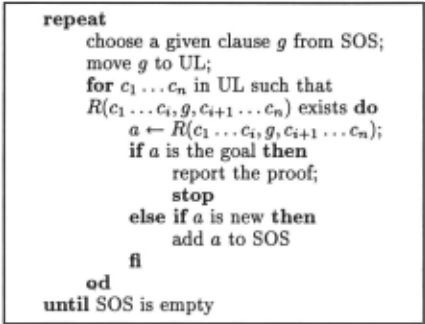
The simplest rule applied by OTTER is binary reso lution, together with unification and factoring. More in teresting and powerful variants include hyper-resolution, negative hyper-resolution and unit resulting resolution. For equational reasoning the available rules include the various forms of paramodulation and term rewriting (de modulation).
A crucial part of the algorithm is the decision as to whether each deduced formula is "new". In general this means that it is not subsumed by any formula al ready kept. Much of the high performance of OTTER is due to its sophisticated techniques for reducing the time spent computing subsumption and related proper ties. These techniques are not the focus of the present paper. Also not shown in the simple version of the algo rithm in Figure 1 is the rewriting due to demodulation and the like which may take place before the subsump tion test. Nor have back subsumption and back demod ulation (whereby the generated clause is used to sim plify the existing clause database) been made explicit, although in many applications they are important.
1.2 Semantics: FINDER
Deduction is only one form of reasoning. Another is the generation of models of a given theory. A model of a theory shows that theory to be consistent, but it also shows much more. It is an account of what it might be like ~or the theory to be true. It divides the whole language mto truths and falsehoods in a way consonant with the theory. Thus, given an effective means of detecting the truth values it assigns to formulas, it can be used to reach out beyond the given basis to determine semantic properties of all formulae.
If a_ theory has finite models, one way of generating them IS to fix the domain as consisting of a few objects (say three objects, or thirty) and then to perform an exhaustiv~ search in the space of functions definable by e~umeration over that domain. A model is an interpreta tion of the non-logical symbols in the theory's language making all of its axioms true. Since all of the struc tures in question are finite, it is easy to recognise models when they are found. There are, of course, more efficient and less efficient methods of searching. FINDER(see [Slaney, 1992]) performs a backtracking search, building a database of facts about the search space to enable it to avoid ever having to backtrack twice for the same reason. The details are interesting but are not germane to the present application since any reasonable constraint satis faction algorithm could be used to much the same effect provided it is not heavily dominated by the overheads of starting up a search.
FINDER accepts input in a fairly friendly format. It works with first order theories in clausal form couched in a many-sorted language. Function symbols must be given first order types in terms of the sorts. There are a few pre-defined function symbols: for example, each sort comes with an identity relation, symbolised by'='. Each sort is also equipped with a total order, symbolised with '<'and'>'. Evidently, this convention does no harm and it is often useful. A clause is a set of literals and is true iff for every assignment of elements from the domains to variables occurring in it one of those literals is true.
It is worth noting that what FINDER does is rather ~ifferent from logic programming. In the first place, it Imposes no order on the evaluation of clauses and has no 'flow of control'. The clauses meet each candidate model in ~ b_ody; if they are all true then the model is good, w?Ile If any clause is false, the model is adjusted to deal with that badness, resulting in a new candidate. In the second place, FINDER is not able to show the nonexis tence of models and hence cannot prove sets of clauses inconsistent. It returns a null result if there is no model within a specified finite search space, but always leaves open the possibility that there may be models outside that space. In the third place, it finds and specifies the models without any reference to the Herbrand universe. The do~ain consists simply of the first object, the sec ond obJect and so forth, any relationship with terms of the language being accidental.
2 Putting it Together
There are several distinct ways in which semantic infor mation such as the truth value of a formula in a model can be used to direct proof searches. The oldest and sim plest is goal deletion. In attempting to show by backward chaining that a goal formula is a theorem of some theory, we decompose the goal into simpler subgoals and work recursively on those. In typical cases, most of the sub goals are unprovable. Having discovered that a subgoal cannot be reached, the proof search must backtrack and try another. Hence techniques for rapidly detecting and deleting unprovable subgoals are valuable. One good technique is to test goals for truth in some simple model of the theory. Any that are false are unprovable and may be deleted. See [Ballantyne and Bledsoe 1982] and [Thistlewaite et al, 1988] for some discussio~. OTTER is a forward chaining prover, so goal deletion is not the main present concern, though it is fairly obvious how a method similar to that of SCOTT could be used for goal deletion in backward chaining systems.
Another use for semantic information is in the false preference strategy. This is appropriate to forward chaining proof search and uses some model or models in which the goal is false. The strategy is to prefer par ent clauses of inferences to be ones false in the guiding ~odel or models, on the thought that the goal is more hkely to be deduced from clauses which imply it in the models than from those which do not. Since this is only a heuristic, it can usually be shown not to affect the prover's completeness. SCOTT (optionally) implements the _false preference strategy in a straightforward way, testmg each kept clause against a guiding model and as signing greater weight to clauses which are true in the model than to those which are false.
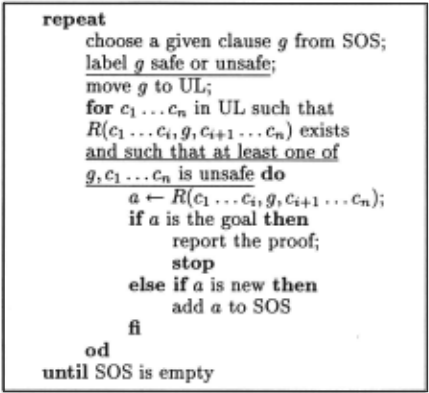
Most interesting for present purposes is the idea of semantic resolution. Given any model M, a simple the orem assures us that if there is a derivation of the empty clause from a set of clauses using unification, resolution and factoring then there is one in which no inference has parents both of which are true in M. This is a well worn result, for a fuller account of which see [Chang and Lee, 1973] or [Slagle, 1967]. SCOTT implements seman tic resolution by means of two very simple amendments to OTTER's algorithm. These are underlined in Figure 2. The safe clauses are those true in the guiding model. They are "safe" because they are known to form a con-
if generating then fi if g is false in M then N- Model(TU {g}); if N is not null then M-N fi fl if g is true in M then T- TU {g} fi if g is true in M then label g 'safe' else label g 'unsafe' fisistent set whose immediate consequences may therefore safely be omitted. If the given clause g is safe then it may not react with other clauses unless they are unsafe. This cuts down the number of generated clauses sufficiently to have a marked effect on OTTER.
Before the guiding model can be used it must be found. The clause testing module which assigns labels to given clauses calls FINDER from time to time, to generate a model of a set of clauses or to return the information that no model was found within the delimited search space. The logic of the clause tester is given in Figure 3. Note that at any given time it is either in generating mode or in simple testing mode. At the start of the proof search it is in generating mode; after a while it stops trying to generate any new models and becomes just a tester. This is because model generation is expensive in comparison with testing and because there comes a time when no better model can be found without enlarging the search space to an unacceptable degree. The cutoff point at which the mode is switched may be set as a parameter, the default being after 100 clauses have been evaluated. Also at any given time the tester has associated with it a theory T (the set of safe clauses so far) and a model M of that theory. The further procedure 'Model' is the model generator (in effect FINDER, in SCOTT's case) and its parameter is the theory to be modelled. It must be given a finite search space, so that it always com pletes even when it fails to find a model. In order to set up the semantic apparatus consistently, FINDER is called initiaily with the theory consisting of the clauses (if any) in the initial usable list. If it fails to model this, the whole proof attempt fails, since otherwise dynamic semantic resolution would not fit with the set of support algorithm.
Two input scripts are needed for SCOTT. One is the normal OTTER input consisting of the problem to be solved. It specifies the initial contents of the usable list and the set of support, together with any settings for OTTER's optional parameters such as which rules to use, what weight limit to set and what results should be printed. The other is a FINDER input file, consisting of the sort and function specifications for the problem, together with any clauses in the initial usable list and op tionally FINDER settings such as verbosity modes. Ex pert knowledge about the problem domain may be added in the form of extra clauses to help direct FINDER to the models. In practice this facility is best used spar ingly, as the program may make more intelligent choices of model than the "expert". Any extra clauses given to FINDER are not communicated to the OTTER part of the prover, so they do not form part of the proof.
3 Case Studies
A systematic evaluation of SCOTT has yet to be made, since it has been designed and developed only in 1992. The following sample results show its effect in three se lected cases where OTTER is already one of the most effective theorem provers available. These involve con densed detachment axiomatisation of propositional log ics and are among the hardest solved problems in the field. It would have been easy to show dramatic speedup effects in cases where OTTER does poorly- non-Horn ground problems for example 1 -but it is of more inter est and value to improve what OTTER does best.
3.1 Classical Pure Implication
One problem set for which OTTER is particularly suit able is determined by the single axiom for the classical propositional calculus of pure implication
given by Lukasiewicz. The problem is to derive from this some axioms known to be sufficient for the theory, using the rule of condensed detachment
where a is the most general unifier of A and C. A con venient sufficient axiom set consists of these five: 2
A very simple OTTER input file for the first axiom, for example, reads as follows.
1 An amusing example is the pigeonhole problem with naive input, where the time taken in one case is reduced from hours to about a minute. However, on closer examination it emerges that the FINDER half of SCOTT actually solves the problem completely in a few milliseconds, after which the OTTER half labours through a proof search, treating the solution just as a hint!
2 Axiom 4 is in fact redundant, but it has been included in the problem set because it is nicely intermediate in difficulty between axioms 3 and 5.
set(hyper_res). % Hyper-resolution list(usable). -p(x) I -p(i(x,y)) I p(y). -p(i(a,a)). %This is the goal end_of_list. list(sos). p(i(i(i(x,y),z),i(i(z,x),i(u,x)))). end_of_list .The predicate p is for provability, and the function sym bol i for implication. The goal is a Skolemized denial of the axiom to be derived. OTTER input for the other four problems is similar, with the different goals of course. In practice there may be some further settings such as a weight limit and a limit on the number of distinct vari ables per clause. The fifth problem is difficult. To the best of my knowledge, OTTER is the only prover to have solved it automatically. 3
The basic FINDER input used by SCOTT in tandem with the OTTER input reads as follows. This is for the first problem; for the second, it is necessary only to declare another constant b and to change the goal.
sort value { cardinality < 4 } function { } p: value -> bool {} i: value,value -> value {} a: value. {} clause { } end p(i(x,y)), p(x) -> p(y) . p(i(a,a)) -> false.In fact, it pays to use some expert knowledge amounting to the fact that the implication relation may be expected to be acyclic. By embedding that relation in the default total order on the values we may cause the FINDER half of SCOTT to avoid searching too many isomorphic subspaces. This alternative clause set is the one used for problem (3) and, with a change of goal, for problem (4) .
clause { } x < y, p(i(y,x)) -> false. x < y, p(x) -> p(y). p(i(i(i(a,b),a),a)) ->false.For hard problems like (5) we shall probably also want to help FINDER along with some more expert knowledge about what models of implication logics are like. In the experiment reported here it was directed to a good model by being informed ahead of time of some of the clauses which it would eventually have modelled anyway. The OTTER input was also changed a little, by imposing a length limit in order to cut down the number of clauses kept and by making it less verbose.
3 Since this paragraph was written, the theorem prov ing group in the 'Fifth Generation' project ICOT in Tokyo have reported a proof using their Model Generation Theo rem Prover MGTP-N which however is closely modelled on OTTER.
| clauses generated | clauses kept | clauses given | time (sec) | |
|---|---|---|---|---|
| 1: OTTER | 2828 | 376 | 70 | 3.42 |
| 1: SCOTT | 245 | 68 | 30 | 1.13 |
| factor | 11.5 | 5.53 | 2.33 | 3.03 |
| 2: OTTER | 3070 | 386 | 74 | 3.72 |
| 2: SCOTT | 450 | 99 | 35 | 2.04 |
| factor | 6.82 | 3.90 | 2.11 | 1.82 |
| 3: OTTER | 8774 | 595 | 134 | 8.56 |
| 3: SCOTT | 1782 | 130 | 60 | 2.59 |
| factor | 4.95 | 4.58 | 2.23 | 3.31 |
| 4: OTTER | 1204953 | 1762 | 1196 | 1010 |
| 4: SCOTT | 220734 | 1069 | 733 | 352 |
| factor | 5.46 | 1.65 | 1.63 | 2.87 |
| 5: OTTER | 4282987 | 17508 | 2285 | 3865 |
| 5: SCOTT | 1544423 | 13967 | 1823 | 2070 |
| factor | 2.77 | 1.25 | 1.25 | 1.87 |
Note that FINDER needs some termination condition such as a cardinality limit or a time limit. The more generous this limit, the longer SCOTT will spend trying (and failing) to model inconsistent sets of clauses, but the more restrictive it is made the more likely SCOTT is to miss some useful model. At this stage, the course between these two undesirable outcomes is steered man ually, though clearly such heuristics are programmable.
As will be observed from Figure 4, SCOTT improves on OTTER on every measure. The 'factor' in each case is the figure for OTTER divided by that for SCOTT. The counts of clauses give measures of the amount of work done. In each case about two thirds of the given clauses were labelled 'safe', so approximately four ninths (two thirds squared) of clauses which would otherwise have been generated are avoided because their parents are safe. The amount of the time spent generating mod els and testing clauses for safety was 23% for problem 4 but only 8% for problem 5. In order to keep these ex periments tidy for easy reporting, very simple FINDER input was used. Where SCOTT is used to tackle really serious problems, the option of giving it extra seman tic information is clearly valuable. The input of expert knowledge and heuristics may be restricted to the se mantic side, leaving the theorem prover itself clean.
3.2 Extending Intuitionist Implication
In [Karpenko, 1992] Karpenko raised the problem of find ing an axiom which would strengthen intuitionist pure implication to classical pure implication but whose ad dition to various substructural systems would produce new substructural logics. There are several solutions to this problem, one of which is the formula
| clauses generated | clauses kept | clauses given | t~~) | |
|---|---|---|---|---|
| Natural OTTER | 22725376 | 89639 | 3606 | 25591 |
| SCOTT | 6395 | 149 | 87 | 7.90 |
| factor | 3553 | 602 | 643 | 3239 |
| Tuned OTTER | 209242 | 1862 | 377 | 289 |
| SCOTT | 3428 | 82 | 52 | 5.16 |
| factor | 61.0 | 22.7 | 7.25 | 56.1 |
where A* B is defined as
The theorem-proving problem is to derive from this, to gether with some standard axioms for intuitionist impli cation, goal 3 of the set given in the last example:
A suitable set of 'standard axioms' is the following.
and again the problem is easily set up for OTTER to solve by enumerating consequences by condensed detach ment.
Observe that the second axiom assures us that the im plication relation is transitive. Hence we are entitled to add a new clause giving us the rule of condensed transi tivity.
where cr is the most general unifier of B and C. The OTTER input clause for this reads:
This is a useful proof-shortening device. Figure 5 shows the results of running OTTER and SCOTT on this prob lem, first without any special settings, except for a limit of three distinct variables per formula, then (after many experiments) with settings hand-tuned to help OTTER. It is worth noting that this problem was open until closed by SCOTT.
| clauses generated | clauses kept | clauses given | t~~) | |
|---|---|---|---|---|
| OTTER | 4016344 | 11304 | 1991 | 11708 |
| SCOTT | 3047711 | 17621 | 6558 | 29593 |
| factor | 1.32 | 0.64 | 0.30 | 0.40 |
3.3 Many Valued Logic
A similar problem to that presented by the Lukasiewicz single axiom arises in the axiomatisation of his many valued logic. This time there is a negation connective as well as implication. The rule of inference is again condensed detachment, and the axioms are:
The thought behind axiom (3) is that (A - B) - B defines A v B, so (3) amounts to the commutativity of disjunction. Now the hard problem is to show that im plication is a total order:
In view of axiom 2, we may add the clause for condensed transitivity as before. Next, it is not hard to see that the logic being axiomatised satisfies a rule of replace ment of proved equivalents. We can secure the effect of replacement by adding a clause to make derived two-way implications into equalities thus:
together with settings to make OTTER add demodu lators (rewrite rules) whenever it derives a directable equality. This, for instance will cause any subformula of the form ...,...,A to be rewritten as A, thus eliminating huge numbers of redundant equivalents.
With careful setting of weight limits and the like, OTTER can now solve the problem. It takes 3 hours 15 minutes on a Sparc-2, generating 4016344 clauses of which 11304 are kept and 1991 are given (added to UL) . FINDER can easily be instructed to find a model of all the axioms except for the commutativity one, in which model negation is well-behaved in that x- y is everywhere the same as ·y- ·x and in which the goal formula is false. The results of running SCOTT with that FINDER file and with the same problem input as OTTER are interesting (Figure 6). Overall performance actually degrades, despite the fact that over 95% of all given clauses are labelled 'safe'.
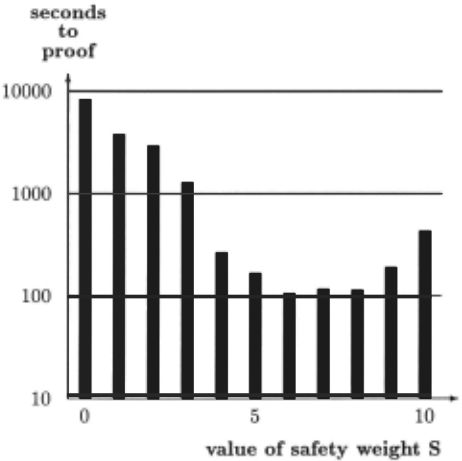
More useful for this problem is the false preference strategy. OTTER normally selects given clauses by weight, lightest first, taking the weight to be the number of symbols in the clause. SCOTT applying the false pref erence strategy with a safe-weight of S tests each kept clause before its insertion in the set of support and adds S to its weight if it is true in the current model. This causes selection of 'safe' clauses to be delayed. Figure 7 shows the effect on OTTER's proof search. Note that the scale is logarithmic. The case S = 0 is just OTTER, since dynamic semantic resolution was not used in this experiment. An improvement of almost two orders of magnitude is possible, but only if the choice of S is right. At present, no automatic method of finding an appropri ate value for S is known, though it seems likely that the optimal value will be similar for cognate problems.
4 Remarks
SCOTT brings semantic information into the service of forward chaining resolution proof search. Looked at ab stractly, this is obviously a move in the direction of intel ligence. OTTER is powerful but blind. When asked to prove Axiom (1) in the Lukasiewicz implicational calcu lus problem, it starts performing exactly the same search as it does when asked for a proof of Axiom (4) . In other words, it never refers to the goal except to check whether the proof is finished, so the goal has no effect on the search. The really remarkable fact is that such a strategy works at all! The effect of injecting models is to enable SCOTT to look ahead. Even a crude model carries infor mation. Whether through the false preference strategy, semantic resolution of a combination of the two, this in formation allows the goal to affect the direction of the search. In cases where this leads to incompleteness 4 or inefficiency, it can be disabled since SCOTT has OTTER as a sub-program, so nothing is lost in the move from OTTER to SCOTT. Moreover, the addition a complex set of tools to OTTER, has opened new possibilities for heuristics on which research may usefully be focussed.
4 SCOTT's dynamic semantic resolution is obviously com plete where the rule of inference is binary resolution, but incomplete in general for hyper-resolution and the like. Its completeness for condensed detachment is an open question.
In theorem proving, there are no magic bullets. No one technique gives easy solutions to all problems. Dy namic semantic resolution and the false preference strat egy are like most other worthwhile ideas in the field in that they work spectacularly in a few cases and solidly across a fair range, have little or no effect in other cases and sometimes make matters worse. Hence the present paper issues no claim to have solved all the problems. Indeed, in that it opens questions about the effective ness of semantic resolution relative to problem-specific models it may be taken to have posed some new ones. The significance of so doing depends in part on whether these are interesting problems. My feeling, for what it is worth, is that if we could explain both the successes and the failures of SCOTT in its various configurations then we should understand the heuristics of first order theorem proving better than we do. Meanwhile, whether it be seen as a theorem prover of a new type or simply as OTTER with yet another optional add-on, SCOTT is both an intriguing departure and a power tool.
@inproceedings{ijcai1993p16,
  title     = {SCOTT: A Model-Guided Theorem Prover},
  author    = {Slaney, John K.},
  booktitle = {Proceedings of the Thirteenth International Joint Conference on
               Artificial Intelligence, {IJCAI-93}},
  publisher = {International Joint Conferences on Artificial Intelligence},
  editor    = {Ruzena Bajcsy},
  pages     = {109--114},
  year      = {1993},
  note      = {Automated Reasoning},
  url       = {https://ijcai.org/proceedings/1993/16},
}
TY - CPAPER TI - SCOTT: A Model-Guided Theorem Prover AU - Slaney, John K. T2 - Proceedings of the Thirteenth International Joint Conference on Artificial Intelligence, IJCAI-93 PB - International Joint Conferences on Artificial Intelligence PY - 1993 SP - 109 EP - 114 UR - https://ijcai.org/proceedings/1993/16 ER -Copied
Machine-readable versions of this paper, for tools and AI agents:





