
SMART+: A Multi-Strategy Learning Tool
Proceedings of the Thirteenth International Joint Conference on Artificial Intelligence. Machine Learning. Pages 937-944.
© 1993 International Joint Conferences on Artificial Intelligence
Abstract
Inducing concept descriptions in First Order Logic is inherently a complex task. There are two main reasons: on one hand, the task is usually formulated as a search problem inside a very large space of logical descriptions which needs strong heuristics to be kept to manageable size. On the other hand, most developed algorithms are unable to handle numerical features, typically occurring in realworld data. In this paper, we describe the learning system SMART+, that embeds sophisticated knowledge-based heuristics to control the search process and is able to deal with numerical features. SMART+ can use different learning strategies, such as inductive, deductive and abductive ones, and exploits both backgruond knowledge and statistical evaluation criteria. Furthermore, it can use simple Genetic Algorithms to refine predicate semantics and this aspect will be described in detail. Finally , an evaluation of SMART+ performances is made on a complex task.
- [Bergadano eta/., 1988] F. Bergadano, A. Giordana, and L. Saitta. Automated Concept Acquisition in Noisy Environment. IEEE Transaction on Pattern Analysis and Machine Intelligence, PAMI-10, 555-575, 1988.
- [Bergadano and Giordana, 1990] F. Bergadano and A. Giordana. Guiding Induction with Domain Theories. In Machine Learning: An Artificial Intelligence Approach, III, R.S. Michalski and Y. Kodratoff (Eds), Morgan Kaufmann, 474-492, Los Altos, CA. 1990.
- [Pe Raedt and Bruynooghe, 1991] L. De Raedt and M. Bruynooghe. Towards Friendly Concept-Learners. Proc . of the TJCAT-91, 849-854, Sidney, Australia, 1991. IJCAI
- [DeJong, 1975] K.A. Dclong. Analysis of the Behavious of a Class of Genetic Adaptive Systems. Ph.D. dissertation, Department of Computer and Communication Sciences, Umversity of Michigan, Ann Arbor, MI. 1975.
- [DeJong and Mooney, 1986] G. DeJong and R. Mooney. Explanation based learning: An alternative view. Machine Learning, 1, 47-80, 1986.
- [Gemello and Mana, 1991] R. Gemello and F. Mana. RIGEL: An Inductive Learning System. Machine Learning, 6, 7-36, 1991.
- [Goldberg, 1989] D.E. Goldberg. Genetic Algorithms. Addison-Wesley Publishing Company, Reading, MA, 1989.
- [Michalski, 1980] R.S. Michalski. Pattern recognition as a rule-guided inductive inference. IEEE Transactions on Pattern Analysis and Machine Intelligence, PAMI-2, 349- 361, 1980.
- [Mitchell eta/., 1986] T. Mitchell, R. Keller, and S. Kedar- Cabelli. Explanation Based Generalization: A Unifying View. Machine Learning, 1, 47-80, 1986.
- [Muggleton and Buntine, 1988] S. Muggleton and W. Buntine. Machine Invention of First-Order Predicates by Inverting Resolution. Proc. of the Fifth International Conference on Machine Learning, 339-352, Ann Arbor, MI, 1988.
- [Pazzani and Kibler, 1992] MJ. Pazzani and D. Kibler. The Utility of Knowledge in Inductive Learning. Machine Learning, 9, 57-94, 1992.
- [Poole, 1989] D. Poole. Explanation and Prediction: An Architecture for Default and Abductive Reasoning. Computational Intelligence, 5, 97-110, 1989.
- [Quinlan, 1990] R. Quinlan. Learning Logical Definitions from Relations. Machine Learning, 5, 239-266, 1990.
- [Rouveirol and Puget, 1990] C. Rouveirol and J.F. Puget. Beyond Inverse of Resolution. Proc. of the Seventh International Conference on Machine Learning, 122-131, Austin, TX, 1990.
- [Sammut and Bannerji, 1986] C. Sammut and R. Banerji. Learning concepts by asking questions. In Machine Learning: An Artificial Intelligence Approach, II, R.S. Michalski, J. Carbonell, and T.M. Mitchell (Eds), Morgan Kaufmann, Los Altos, CA. 1986.
- [Torasso and Console, 1989] P. Torasso and L. Console. Diagnostic problem solving. Van Nostrand Reinhold, 1989.
- [Utgoff, 1986] P. Utgoff. Shift of Bias for Inductive Concept Learning. In Machine Learning: An Artifitiallntelligence Approach, II, R.S. Michalski, J. Carbonell, and T.M. Mitchell (Eds), Morgan Kaufmann, 107-148, Los Altos, CA, 1986.
- [Yager, 1983] R. Yager. Quantified Propositions in a Linguistic Logic. International Journal of Man-Machine Studies. 19. 195-227, 1983.
References were extracted automatically from the PDF and may contain errors.
Full text extracted automatically from the PDF; figures, tables and equations may differ. The PDF is the version of record.
1 Introduction
In the recent literature, inducing concept descriptions in First Order Logic is receiving an increasing interest [Bergadano eta/., 1988, Michalski, 1980, Quinlan, 1990, Gemello and Mana, 1991, Pazzani and Kibler, 1992].
In general, the task of learning concept descriptions (or relations) is formulated as a search problem inside a space of logical formulas, built up starting from a set of initial predicates, evaluable on the learning events. Two cru~ial points attract the attention of many researchers: the destgn of strategies that limit the search space, and the choice of the representation language. As discussed in [Utgoff, 1986] choosing inappropriate features for describing the learning events can prevent the induction algorithm from finding good concept descriptions.
The system SMART+, described in this paper, proposes solutions for both problems and proved to be effective in coping with tasks more complex than the ones approached so far in the literature. SMART+ is an improved version of ML-SMART [Bergadano et a/., 1988, Bergadano and Giordana, 1990], and offers sophisticated learning strategies that can either be selected in alternative or combined together, depending on the choice of the teacher. On the one hand, induction can be guided by a domain theory using deductive and/or abductive reasoning. On the other hand, besides the well known information gain rule [Quinlan, 1990], other statistical criteria are available that can be more effective in complex problems.
* This work has been partially supported by EEC, project BLEARN II, no. 7274.
Moreover, SMART+ offers a mechanism for dealing with numerical features in order to help solving the hard problem of choosing an appropriate concept description language. In particular, it is able to infer a quantitative definition of numerical features according to the context in which those features are used. For instance, suppose we have a symbolic language in which terms such as short, medium and long are defined to characterize the length of an object: an object is considered short if its length is less than a given value k1, long if its length is greater than a given value k2 and medium if its length is between k1 and k2. How to choose values for k 1 and k2 depends on the context those features are used in: if we are dealing with bicycles, cars and airplanes, suitable values might be kl = 7 feet, k2 = 30 feet, but if we are dealing with different kinds of aircrafts (pipers, military jets, passenger cargos), suitable values might be k1 = 50 feet, k2 = 100 feet. In SMART+ the teacher is only requested to provide the system with a range of possible meaningful values for a given feature and the system itself should find the best assignments for the task at hand.
The paper is organized as follows: an overview of the knowledge representation formalism in SMART+ is given in Section 2, whereas Sections 3 through 6 describe the available learning strategies. Finally, some experiments on a complex artificial domain, simulating a problem of pattern recognition, will be discussed in Section 7, and conclusive remarks follow in Section 8.
2 Knowledge Representation
SMART+ is a problem solver designed for the task of learning concept descriptions from examples. Given a set Hoof concepts and a set Fo of labelled instances, SMART+ generates as output a classification theory described in a Hom clause language L extended with functions, negation and numerical quantifiers. In particular, a well formed formula (wff) in the language L has the form:
being Hie Hjc Ho predicates denoting sets of concepts and cp a logical fonnula stating a condition over the tenns t 1· ... , tn. Expression (1) actually means that if an event f, to be classified, is an instance of a concept h belonging to the set Hi and the condition cp( t 1, ... ,tn) is true of f, then h is included in Hj- As the set of concepts Hj implied by a rule is, in general, in the body of another rule, the knowledge learned by SMART+ defines a structured classification theory, which can be described as a discrimination graph. In order to deal with noise, partially incorrect classification rules are allowed. The value of the weight w, in (1), is an estimate of the probability that the rule give the correct classification; it is evaluated as the ratio between the number of correct instances matched and the number of total instances matched to the learning events Fo.
Fonnula <p(t1, ... ,tn) is built up by using predicates in a set P, connectives A and..., and quantifiers ATM. A1L and EX. As described in [Yager, 1983]. these quantifiers stand for ATMost, A1Least and EXactly, respectively, and can be considered as an extension of the standard existential quantifier (similar to the numeric quantifiers used in the INDUCE system [Michalski, 1980]).
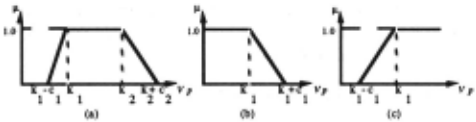
In order to cope with the fuzziness inherent in real-world data, a continuous-valued semantics is adopted for the predicates in L. For each predicate pe P, a corresponding semantic function /p. mapping a numerical base variable to the interval [0,1], must be defined by the teacher in order to specify how to evaluate the truth of p on the learning events. As a matter of fact, fp is a function that evaluates the membership J.lp of a numerical feature V p with respect to a trapezoidal fuzzy set Sp. The value of Sp can be defined by means of parameters that will occur in the predicate p as variable tenns. Terms in a predicate p are subdivided into two categories: objects and parameters. The first ones, denoted by the symbols x 1 ·... , xn, can only be bound to items corresponding to learning instances or components of them, whereas the second ones, denoted by the symbols k 1. ... , km. correspond to fuzzy set parameters and can only be bound to numerical constants.
Trapezoidal fuzzy sets are considered and defined as in Figure 1(a), in a way that allows the fuzzy set to be identified by a pair of real parameters, k1 and k2. Special cases are reported in Figure 1(b) and 1(c), in which open intervals are represented; in these cases, one numerical parameter is sufficient to define the fuzzy set.
For each parameter k, the teacher must specify the range in which k has to be searched for and the approximation requested for tuning its value. A default value can also be specified; this will be used by the system in the case that this learning capability is explicitly disabled by the teacher.
The semantics for the logical connectives can be chosen by the teacher, as well, in order to implement a specific evidential calculus. By default, SMART+ adopts a pair oft nonn and t-cononn functions [Bergadano et at., 1988] for the AND and OR connectives, respectively. The semantics of the quantifiers can be expressed by means of these connectives [Yager, 1983, Bergadano eta/., 1988].
3 Main Learning Strategy
SMART+ shares with FOIL [Quinlan, 1990] a general-to specific search strategy for inductive learning, but it has a richer set of specializing operators and uses more sophisticated strategies.
The basic search strategy has been combined with a policy of reduction to subproblems. The main goal of the reduction to subproblems is that of producing a structured knowledge base; in particular, it can be considered as a form of constructive learning, where intermediate concepts, corresponding to subsets of Ho. are generated automatically. In fact, the classification rules are actually intended to be valid only in the context of already hypothesized concepts, as described in Section 2. Then, the learned rules do not constitute a "flat" set; on the contrary, they are organized into a graph G of rules, called subproblem graph. Nodes of G correspond to sets of concepts, and logical fonnulas label edges. A node (H,F) of G is called a "subproblem", because it represents the problem of discriminating among the classes it contains. The root <Ho.Fo) of the graph corresponds to the initial problem, i.e. the problem of distinguishing among the whole set of concepts. Notice that the sets of examples occurring in sibling nodes need not be disjoint.
A complete and consistent solution of a problem (Ho.Fo) is obtained when all the rule weights are equal to 1, and the leaves of G contain sets Fi whose union equals Fo. This is the ideal case, when no noise and errors are present. However, in real-world problems this assumption cannot be accepted and the final solution turns out to be (in general) inconsistent and/or incomplete.
The use of a subproblem graph, instead of flat classification rules, enhances classification efficiency, since common parts of different rules will only be tested once. Moreover, it makes it easier to learn the rules, because it separates the task into smaller contexts which can be solved separately. Finally, this structure of the knowledge base is well suited for a diagnostic process based on a multi-stage refinement strategy. In Figure 2 the process of generating the subproblem graph is schematically represented.
For each subproblem the learning process follows the same search scheme, as described in the following. The search within a subproblem SPi = (Hi.Fi) develops a specialization tree according to a general-to-specific strategy, similar to the one used in FOIL [Quinlan, 1990] or FOCL [Pazzani and Kibler, 1992]. The difference is that many search strategies, going from best-first to beam search, are available in addition to the popular hill climbing one. Moreover, SMART+ has a reacher set of operators for building a more specific formula; in particular it can use numerical quantification and numerical optimization.
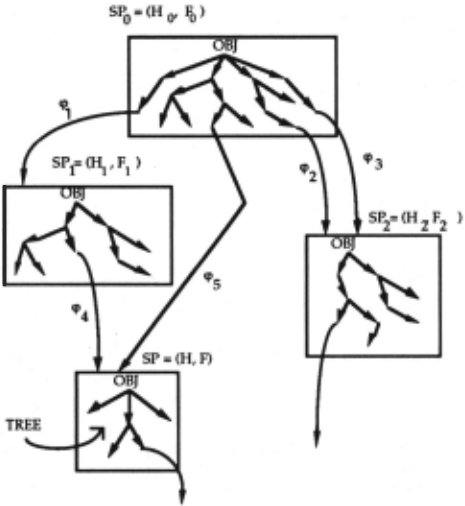
When an inductive hypothesis of the type cp ~ Hj is found (being Hj a proper subset of Hj), a rule of type (1) 1s created and the events F'~i belonging to the extension of cp are declared "solved". Consequently, the focus of the search is moved on those formulas, on the frontier of the tree, which contain in their extension not yet solved events. The development of the specialization tree is guided by combining reasoning about background knowledge, supplied to the system, and statistical criteria. The primary goal of the control strategy is to find rules that are both statistically significant, because verified by many learning events, and meaningful with respect to the background knowledge. In this phase only consistent rules (i.e. with w=l) are accepted.
The search stops when all the events Fi are covered by some rule of type (1) or when tt)ere is no more hope of discovering such rules. In this case the system can also decide to accept rules with weight w<l. Afterwards, all the events matched by rules having the same conclusion Hj are merged together into a single set Fj and a new subproblem (Hj.Fj) is defined. This process offers an important advantage: in every subproblem, all the events, which were previously subdivided among the extensions of many rules, are OR-ed into a single relation. In this way, the inductive strategy (relaying on statistical criteria) acquires new strength. A deeper description of this search procedure can be found in [Bergadano eta/., 1988].
4 Guiding Induction Using Domain Theories
A fundamental characteristic of SMART+ is its ability of guiding induction. by exploiting a (possibly incomplete) domain theory. This is achieved by integrating induction with deduction and/or with abduction. The mechanism for integrating induction and deduction has been described in [Bergadano and Giordana, 1990]. The specialization tree, generated by the induction process, has the same structure of the deduction tree generated by a theorem prover based on SLD. Therefore, a domain theory can be used to construct the initial part of the specialization tree, and, then, induction can be used to complete the proof, discovering information missing in the domain theory. If the theory is perfect, the method becomes an EBG [Mitchell eta/., 1986, DeJong and Mooney, 1986].
The abductive mechanism has been introduced more recently and, for some aspects, shares some ideas with systems like CIGOL [Muggleton and Buntine, 1988] and CLINT [De Raedt and Bruynooghe, 1991]. Given a Hom clause theory T and a formula cp, associated to a node n of the specialization tree, the formula cp 0 , obtained by exhaustively applying the absorption rule [Sammut and Bannerji, 1986] between cp and clauses in T, is said to be the generalization of cp through the theory T. Formula cp 0 is said to be an explanation of cp with respect toT, in the sense that T, cp 0 ~ cp [Poole, 1989, Torasso and Console, 1989]. Therefore, the basic inductive procedure is modified as follows:
- (a) Let 'I' be the formula selected for specialization at a given step; SMART+ determines the set A of literals that can be used to specialize 'I' with a non-negative information gain.
- (b) For each literal Li e A, all the possible generalizations cp 0 , with respect toT, are computed for formulas cpi = 'I'"Li.
- (c) Then, all the formulas cpi are evaluated, using a criterion which takes into account both the information coming from the extension of cpi on the learning set Fo and the generalization obtained with respect to the theory T. The best N formulas are then added to the specialization tree. The value of N can be 1, if a greedy strategy is used, or greater than 1 if a beam-search or a best-first strategy is used.
Using this abductive strategy, a domain theory will bias only to a limited extent the choice of a literal, without imposing a determinate choice, as it happens using the purely deductive strategy. Our claim is that this abductive strategy could be a knowledge-based alternative to the one based on determinate literals, introduced to resolve the impasse of greedy algorithms.
5 Search Control strategies
A choice among several search control strategies, ranging from FOIL's hill climbing to the best-first and beam-search ones, is offered by SMART+ for guiding the inductive process. The evaluation rule for each strategy is also a matter of choice. Given a formula 'I' in the specialization tree, the score s('lf) of 'I' is computed as the sum of two independent terms:
where J..L('I') is a measure of the quality of a hypothesis 'If, and Gr('lf) is a measure that tries to capture how well 'I' is "explained" by a given domain theory T. The coefficients a and b can be chosen in such a way to weigh the contribution of the two terms with respect to the global evaluation S('lf).
In tum, the quality measure J..l.('lf) of a formula 'If is represented as a weighed sum of two components:
being 1..1.1 ('If) the information gain obtained by <p with respect to its immediate ancestor in the specialization tree and J..1.2('1') an evaluation of the completeness and consistency of 'I'· By assigning a= 1 and P=O we obtain the information gain rule, whereas by putting a=O and P=1 we obtain the ML-SMART control rule [Bergadano eta/., 1988]. As a matter of fact, the information gain evaluation J..l.t('lf) has been defined by extending the classical rule in order to deal with many classes at one time.
Two kinds of statistical information are extracted from the extension 'I'* of a formula 'If: the instance distribution histogram (denoted by m('lf)) and of the object distribution histogram (denoted by m*('lf}} over the concepts in the set Ho. In particular, m('lf) is a n-dimensional vector with n=IHol: each component mi (1~ i ~ n) corresponds to the number of events f e Fo which are instances of the concept hie Ho and are covered by 'I'· Analogously, m*('lf) is ann dimensional vector, whose generic component m*i corresponds to the global number of different bindings in 'I'* between variables in 'I' and objects occurring in learning instances of class hi. Moreover, for each subproblem sp = <H,F>, an analogous pair of vectors M(sp) and M*(sp), reporting distributions analogous tom and m·, evaluated on all the instances in F, are also defined.
Suppose that formula 'I' has been obtained by making another formula <p more specific; the problem is how to evaluate the information gain of 'I' with respect to <p. First of all, the classes having a non null component in m('lf) are partitioned into two groups: the ones which are likely to be classified, and the ones which are likely to be excluded later on. This partition is necessary in order to compute the information gain given by a literal, according to the formula used in FOIL [Quinlan, 1990]. The partition into two groups of classes is described by a Boolean vector l('lf), whose
· 1
< > ·
1 ·f mi('f') ·
h
genenc e ement ti 'I' 1s set to 1 Mi(sp) 1s greater t an a
user defined threshold Vmin and the information gain gi('lf) = m*i('lf)*(li(<p)-Ii('lf}} > 0, where
and set to 0 otherwise. Vector t{'lf) is said to be the target of 'I'·
The first condition asks for the classes in the target to have a still significant amount of instances in order to be meaningful, i.e. not less than a user-defined degree of acceptability. The second condition on the information gain requests that formula 'I' has positive support for those classes. Then, the information gain of 'I' is computed according to the target t('lf) in the following way:
In (6), the first factor accounts for completeness and the second one for consistency.
Finally, the measure GT('I') is obtained by considering the generalization 'I'G of 'I' with respect to the theory T and the saturation 'l's of 'I' [Rouveirol and Puget, 1990]. The saturation can be simply obtained by adding to 'I' all the literals in the head of the clauses used to abduce 'I'G. Then GT('If) is evaluated as:
being NJit('lf'l) and Nut(~) the number of literals occurring in 'I'G and 'l's, respectively. Equation (7) is an empirical estimate of how well 'I' is explained by the theory T; in fact GT('If) increases when NJit('lf'l) decreases, i.e., when simple, non-trivial explanations are found. If there is no theory, i.e., Tis empty, GT('I') is always equal to 0, because 'lf'1 = 'l's = 'I'· Then, rule (2) implicitly reduces to a pure statistical evaluation of 'I'·
6 Optimising Numerical Predicates
Numerical parameters defining fuzzy set boundaries are learned in two steps. The first one occurs when a formula <p is made more specific using a literal containing some parameter k. In this way, literals are added one at a time and, consequently, parameter values are determined by taking into account only a partial context. Of course, this strategy can lead to a non-optimal choice; hence, . a second optimization step, trying to perform a global optimization, can be applied before adding a rule to the subproblem graph. This is done using a simple genetic algorithm [DeJong, 1975].
6.1 Local Optimisation Algorithm
The mechanism for making the local choice for parameters is a simple extension of the one used for adding a literal without parameters. The difference is that a predicate containing parameters does not correspond to a single literal, but rather to the whole set of literals obtainable by sampling the range specified by the teacher, according to the assigned parameter precision. For each literal Li obtained in this way, the formula <p"Li is evaluated using rule (2). Of course, different literals can produce the same target. For each target, the literal with the best evaluation J..L (if a hill climbing strategy is used) or the best n ones (if a beam-search strategy is used) are selected for specialisation.
The algorithm for searching the values of the parameters of a predicate pis reported in Figure 3. It receives as input arguments a formula cp, a predicate p and, for each parameter k occurring in p, a triple <min, max, step> describing the range of variability and the granularity of k. A set of suitable values, to be used in order to specialise formula cp with predicate p, is returned as a result.
Informally, vectors m and m · are evaluated for all the possible assignments of values to the parameters of p, according to the range and the granularity. Then, the promising m 's are identified and the corresponding targets are determined. Finally, for every target, the most suited setting of the parameters is selected. The FLOP algorithm has an exponential complexity in the number of parameters of the predicate p; therefore, a coarse granularity is used in order to limit the size of the number of m and m· to be evaluated.
Algorithm FLOP (<p, p, {(mini, maxi, slepi) : ViE [l..n]}) ViE [l..n] ki =mini; i= 1; Let BEST be a table whose entries are sets of triples (g, t, <kt.····kn)) indexed by a target mask t while i ~ ndo m=instance distribution histogram for <pAp(kl , ... ,kn); m*=object distribution histogram for <p" P<kl , ... ,kn); t =target mask form and m· g = gain(p) with respect to t if g > 0 and g > BEST[t]-+g then BEST[t] = (g, t, <k1 ·... ,kn)) endif ki = ki + stepi; while i ~ nand ki > maxi do ki=mini;i=i+l; if i ~ n then ki = ki + stePi endif enddo if i ~ n then i = 1 endif enddo BESTP ARS = { } for each entry in BEST do add the triple (g, t., (k~o ... ,kn)) to BESTPARS endfor return (BESTPARS)Figure 3 - Algorithm to find locally optimal parameter assignments.
However, the use of a coarse granularity can lead to inaccuracy in this learning phase. Furthermore, the specialisation process leads to learn parameter values for a given predicate when the ones of other predicates have been already chosen. In many cases this strategy prevents learning optimal values. On the other hand, a contextual optimisation of all the parameters in the multidimensional space of numerical features would be impossible in this learning phase. Therefore, the refinement step described in the following can be useful in order to increase the accuracy of the classification theory.
6.2 Global Optimisation Using a Genetic Algorithm
Genetic Algorithms [Goldberg, 1989] can be an excellent tool for optimising multimodal numerical functions, such as the semantic functions implicitly associated with the classification rules. In the present case a simple Genetic Algorithm of the type proposed by DeJong [DeJong, 1975] has been used and implemented as described in [Goldberg, 1989].
Given a formula cp, all the parameters ki occurring in cp define a string of reals rs = #:[k1, ... , kn]; as a predicate p can occur more than once in cp, for each occurrence of p in cp the parameters of p will have a different occurrence in rs. A string rs is then converted into a bit string representation in order to use the standard Genetic Algorithm.
In order to prevent the crossover operator from generating values outside the range assigned by the teacher to the parameters, the following conversion algorithm is adopted to map a string of reals rs into the corresponding bit string bs:
- Given a parameter ki and the range [mini, maxi] assigned by the teacher, ki is represented as follows:
being 0 ~ Oi ~ fli, where Ni is the number of bits chosen by the teacher for representing the increment Oj. The value of Ai is obtained from Ni accor.ding to the following equation:
- Given a string rs = #:[k~o ... , knJ. for each parameter ki in rs a field of Ni bits will be defined in bs, where the value of the corresponding Oj is represented.
Given a formula cp, the Genetic Algorithm is then applied, trying to increase the completeness and the consistency of cp. An initial population A(cp} of bit strings is generated at random and the fitness of each individual bs is evaluated by computing the extension cp*(bs) and by ranking the resulting formulas according to the evaluation given by (3). Afterwards the usual genetic evolution begins.
Actually, two types of crossovers, c 1 and c2. are used. Crossover c 1 is the standard single point crossover, whereas crossover c2 is defined as follows: given two parents bs 1 and bs2, a parameter kc is selected at random and two offsprings bs ]' and bsi are generated in three steps:
- The parameters to the left of kc in bs]' and bs2' are obtained by copying the parameters in bsJ and bs2, respectively.
- The parameter kc in both offsprings is obtained by averaging the two corresponding values in the parents.
- The parameters to the right of kc are obtained in bs]' by copying the corresponding ones in bs2 and viceversa in bsi.
The choice between c 1 and c2 is controlled by two probabilities Pl and P2· respectively, such that:
The standard mutation operator is applied with a probability Pm = 0.001.
7 Evaluation on a Test Case
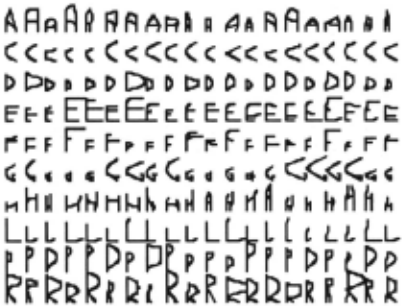
The application domain is quite complex, even though artificial, and bears many features of a real-world one. Ten capital letters of the English alphabet have been chosen, a Hom clause theory has been invented and used by a random choice theorem prover in order to generate instances of these letters, some of which are shown in Figure 4. Each letter is represented as a set of segments that are described by the initial and final (x,y) coordinates in a Cartesian plane. From these attributes, other features can be extracted, such as the length of a segment, its orientation, its preceding and following segments, and so on. Some of these features are numerical by nature and then parameterised fuzzy semantics definition have been adopted for the corresponding symbolic literals.
SMART+ has been run under many different conditions, by using hill-climbing and beam-search strategies coupled with evaluation rule (2) in which a and b have been both set to 1, J.1 is given by expression (3) with (n=1.~=0) or (a=0.~=1) depending on the evaluation rule to be applied and CJT(Ijl) is 0 when no theory is used. Table I reports the results obtained by using a learning set of 1000 instances (100 per class) in the following cases: (a) using the default values for numerical parameters, as assigned by the teacher and a hill-climbing strategy coupled with information gain selection rule (a=1.~=0+No OPT); (b) performing only a local optimisation according to the algorithm described in Section 6.1 and a hill-climbing strategy coupled with information gain selection rule (n=1.~=0+Local OPT); (c) performing only a local optimisation and hill-climbing search strategy coupled with ML-SMART evaluation rule (a=0.~=1 and Local OPT); (d) performing only a local optimisation, hill-climbing search strategy, rule (2) and using two partial theories: T1 (a=0,~=1, Local OPT and T1 ), which describes the feature of a closed region in a capitol A, and T2 (a--o.~=l, Local OPT and T2), describing, in addition, the set of segments forming a semicircle. Such theories are very weak and have been proposed by a human expert that was not aware of the theory actually used to generate the characters. As the same results have been obtained by setting a= 1,~=0, i.e. by using the information gain rule, they are not explicitly reported. (e) using local optimisation plus the global optimisation performed by Genetic Algorithm, hill-climbing, theory T2 and rule (2) (a=0.~=1, Local+GA OPT and T2).
The second column in Table I refers to the number of formulas in the learned knowledge. The next three columns refer to the recognition rate (the correct label is assigned to a sample), the error rate (cases in which a wrong label is assigned to a sample) and the ambiguity rate (cases in which no label is assigned to a sample), respectively, evaluated on an independent test set of 5000 events (500 per class).
| umber of learned formulas | Recog- nition Rate |
|---|---|
| 81 | 41.48 |
| 43 | 80.2 |
| 48 | 82.62 |
As can be noted from Table I, the use of even incomplete domain theories greatly help the inductive search, by letting the system perform significantly better. Moreover, the capability of learning numerical parameters, i.e. adjusting the concept description language semantics as needed, appears determinant to the success of the application. In fact, using the default values the performances achieved were very poor, whereas by only using local optimisation the recognition rate doubled, and raised up to 98% with the use theory T2. A further significant improvement is then added by the global optimisation algorithm that brings the recognition rate to 99.7%. On the other hand the simplicity and compactness of the knowledge base increases in accordance with the performances, as it is possible to grasp from the values reported in the second column, of course, at the cost of a greater computation time (Smart+ using Local+GA OPT and theory T2 took twice as much as without Genetic Algorithm).
A second experiment concerns the use of theory T2: it should be pointed out that when the domain theory is used to initialize the search tree in an EBL fashion and, then, pure induction is applied, the performances obtained are quite poor, as shown in Table II. This is probably due to the incompleteness of the domain theory which led the system too far in wrong directions. If the theory is also used to bias the inductive search, as done by using rule (2) to score hypotheses, after the initial EBL process, the results are closer to the ones obtained without theory. Thus. abductive bias turned out to be more reliable than the deductive one in the case of weak domain theories.
A last comment concerns the comparison between hill climbing and beam-search strategies, in absence of theory. Even though extensive tests have not been performed at this time, the beam-search strategy seems to be more effective, by letting the system explore a smaller part of the search space but converging more quickly towards robust knowledge.
However, this test is not enough for stating the superiority of one strategy with respect to the other; on the other hand, what can be said (also on the basis of other applications) is that in learning structured concepts a global evaluation rule like (2), associated with a best-first or beam-search strategy, may result in a more effective and simpler knowledge base.
8 Conclusion
As an alternative to the empirical strategy based on determinate literals, we suggested the use of a domain theory to guide the induction algorithm. Such a theory does not need to be complete or consistent and can be limited to a rough description of the structural aspects of the problem. An abductive reasoning mechanism has been embedded in SMART+ in order to guide the induction process. Moreover, a new evaluation rule, combining both information coming from data with information coming from the theory, has been proposed. In this way, bias on induction due to the theory is much more gentle than when a top-down deduction is used as in a previous version of the system.
Furthermore, SMART+ has been equipped with a method for learning fuzzy set values in first order logic environments, which combines an extension of the methodology developed for learning relations with genetic algorithms. In particular, genetic algorithms can be an effective tool for refining numerical parameters such as thresholds, weights and coefficients which control the flexible matching of a symbolic expression against a real world instance. The applicability of the method has been demonstrated on a non-trivial learning problem of pattern recognition.
However, the conclusion we can make from this experiment is that the symbolic approach proposed by Artificial Intelligence can be extended in order to be effective in dealing with patterns of the real world such as complex signals. In particular this approach can compete quite well with other methods, such as Neural Networks, in domains where structural knowledge is relevant and where there exists background knowledge which can be exploited.
@inproceedings{ijcai1993p129,
  title     = {SMART+: A Multi-Strategy Learning Tool},
  author    = {Botta, Marco and Giordana, Attilio},
  booktitle = {Proceedings of the Thirteenth International Joint Conference on
               Artificial Intelligence, {IJCAI-93}},
  publisher = {International Joint Conferences on Artificial Intelligence},
  editor    = {Ruzena Bajcsy},
  pages     = {937--944},
  year      = {1993},
  note      = {Machine Learning},
  url       = {https://ijcai.org/proceedings/1993/129},
}
TY - CPAPER TI - SMART+: A Multi-Strategy Learning Tool AU - Botta, Marco AU - Giordana, Attilio T2 - Proceedings of the Thirteenth International Joint Conference on Artificial Intelligence, IJCAI-93 PB - International Joint Conferences on Artificial Intelligence PY - 1993 SP - 937 EP - 944 UR - https://ijcai.org/proceedings/1993/129 ER -Copied
Machine-readable versions of this paper, for tools and AI agents:





