
The Re-use of Linguistic Resources across Languages in Multilingual Generation Components
Proceedings of the Twelfth International Joint Conference on Artificial Intelligence. Natural Language. Pages 966-970.
© 1991 International Joint Conferences on Artificial Intelligence
Abstract
An approach to generation system design is described which supports maximal expression of commonalities across languages. Within this approach it becomes natural to represent inherently multilingual grammars and semantics. The approach rests on the linguistic notion of functional similarity and difference: by capturing the functions languages need to perform, we achieve a level of linguistic description which carries across languages far more effectively than accounts that are structurally based. We demonstrate the general principles, implementation, and benefits of the approach with respect to three unrelated languages: English, Chinese, and Japanese.
- [Bateman et al., 1991] John A. Bateman, Christian M.I.M . Matthiessen, Keizo Nanri, and Licheng Zeng. Multilingual text generation: an architecture based on functional typology. In Interna- tional Conference on Current Issues in Computational Linguistics, Penang, Malaysia, 1991. Also available as technical report of the department of Linguistics, U ni- versity of Sydney.
- [Halliday, 1984] Michael A.K. Halliday. Language as code and language as behaviour: a systemic-functional interpretation of the nature and ontogenesis of dia- logue. In Robin P. Fawcett, M.A.K. Halliday, Sidney Lamb, and A. Makkai, editors, The Semiotics of Cui- ture and Language, volume 1. Frances Pinter, London, 1984. (Open Linguistics Series) .
- [Halliday, 1985] Michael A.K. Halliday. An Introduction to Functional Grammar. Edward Arnold, London, 1985.
- [Kasper, 1989] Robert T. Kasper. A flexible interface for linking applications to PENMAN's sentence gen- erator. In Proceedings of the DARPA Workshop on Speech and Natural Language, 1989. Available from USC/Information Sciences Institute, Marina del Rey, CA.
- [Li and Thompson, 1981] Charles N. Li and Sandra Thompson. A reference grammar of Mandarin Chi- nese. University of California, California, 1981.
- [Mann, 1983] William C. Mann. The anatomy of a sys- temic choice. Discourse Processes, 1983. Also avail- able as USC/Information Sciences Institute, Research Report ISI/RR-82-104, 1982.
- [Matthiessen and Bateman, 1991] Christian M.I.M. Matthiessen and John A. Bateman. Text generation and systemic-functional linguistics: experiences from English and Japanese. Frances Pinter, London, 1991.
- [Matthiessen, 1985] Christian M.I.M. Matthiessen. The systemic framework in text generation: Nigel. In James D. Benson and William S. Greaves, editors, Systemic Perspectives on Discourse, Volume 1. Ablex, Norwood, New Jersey, 1985.
- [Matthiessen, 1990] Christian M.I.M. Matthiessen. Lex- icogrammatical cartography: English systems. Tech- nical report, University of Sydney, Linguistics Depart- ment, 1990. Ongoing expanding draft.
References were extracted automatically from the PDF and may contain errors.
Full text extracted automatically from the PDF; figures, tables and equations may differ. The PDF is the version of record.
1 The task of multi-language generation
Despite the growing need to develop text generation sys tems capable of producing texts from the same knowl edge source in more than one language, most major generation systems remain mono-lingual: there has also been very little work on extensible multi-language gen eration that seeks an architecture within which the work involved in adding a new language may be minimized. Reliance upon an appropriate typological theory of lan guage, however, makes it possible to build a system where different languages can both converge and diverge in terms of knowledge source, semantics, grammar, etc. In this paper, we describe such an approach to gener ation system design, showing how it supports maximal expression of commonalities across languages. Within this approach it becomes natural to represent inherently multilingual grammars and semantics that provide a ba sis for the rapid development of new grammar and se mantic components. The approach rests on the linguistic notion of functional similarity and difference: by captur ing first the functions that languages need to perform, we achieve a level of linguistic description which carries across languages far more effectively than accounts that are structurally based.
The paper demonstrates the general principles, ben efits, and implementation of the approach we propose with respect to three languages that are unrelated ac cording to structural typologies and language families:
Department of Linguistics University of Sydney Sydney, N.S.W. 2006
Australia
English, Chinese, and Japanese. We will see that despite the superficial differences between them, the communica tive tasks that all three need to achieve in fact enforce a degree of commonality of description that can be used to support maximal sharing of linguistic resources.
2 Linguistic description based on function: a monolingual example
In order to build a theoretically sound system based on a general, typologically informed account of multi lingualism, we have begun a collaborative research ef fort that takes a well-established English text genera tion system, the Penman system (under development at USC/lSI since 1980), as its base. This choice is moti vated by the functional-orientation of linguistic descrip tion within the system. Our basic assumption is that commonality across languages is functional in the first instance, not structural or realizational: i.e., function ality has to be preserved across languages, but struc tural realizations may very well differ. To begin our de scription of the multilingual system, therefore, we first illustrate the kind of linguistic description which pro vides a basis for multilinguality: i.e., the functionally ori ented description of the Nigel systemic-functional gram mar [Matthiessen, 1985] for English developed within the Penman system. Systemic-functional grammars have the required property of representing function as theo retically prior to structure and this, as we shall see, is the crucial perspective which makes multilingual descrip tions practicable.
A systemic-functional grammar captures grammatical variation in terms of minimal grammatical choices be tween grammatical features. These choice points are or ganized into an interconnected network representing the interdependencies between possible grammatical feature selections. The grammar of a language is the complete statement of these interdependencies and their conse quences for structural realization: this is the systemic network from which the general theory takes its name. Crucially, the principle motivations for including fea tures are functional rather than structural. Grammat ical structures are only arrived at by making these ab stract functionally motivated choices of features in the network: each feature selected can then add structural constraints to the specification of the linguistic unit be ing described.
More formally, a systemic network representing func tional organization is a directed acyclic graph with labelled arcs whose nodes correspond to grammatical choice points; these are called systems. The outward di rected labelled arcs denote the terms of the system. Each system has two or more terms, or output features, which at the stratum of grammar represent minimal grammat ical alternations. In addition, the inward directed arcs for each system denote an entry condition which deter mines the paradigmatic context in which the alternation represented by the system is relevant . In general, the entry condition is defined as a boolean expression over the possible input arc labels.
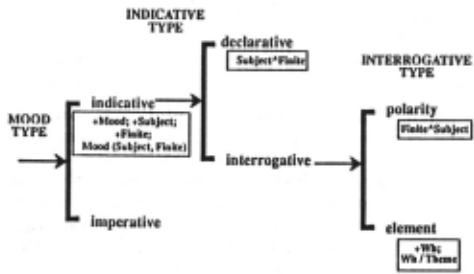
As a particular example area, we consider the re sources of MOOD in English grammar: that is, the area of the grammar concerned with speech act: questioning, asserting, etc. Figure 1 shows a simplified extract from the MOOD fragment of Nigel. Here we can see that there are three grammatical systems MOOD TYPE, INDICATIVE TYPE, and INTERROGATIVE TYPE. The structural conse quences of the grammatical features are shown in boxes underneath the feature which controls their application. Thus, we can gloss this network fragment as follows . The speaker must make an abstract choice between whether s/he wishes to make an indicative clause or an imper ative clause; if an indicative clause is chosen, then sev eral structural constraints apply, i.e.: the insertion of functionally labelled constituents Mood, Subject, and Finite, and the structural positioning of Subject and Finite as subconstituents of Mood. Then, the speaker must go on to make an abstract functional choice be tween 'declarative' and 'interrogative'; if a declarative clause is selected, then the structural constraint that the constituent labelled as the Subject must precede the constituent labelled as the Finite applies. Finally, iff the speaker had instead selected 'interrogative', then s/he must also go on to select between 'polarity' and 'ele ment'; 'polarity' calls for the structural constraint that the Finite precede the Subject (giving rise to yes/no questions: did he go'!), 'element' calls for the structural constraint that there is a functional element labelled Wh, and that this element occurs first- i.e., is conflated with the constituent Theme which always comes first in En glish clauses (giving rise to Wh-questions: where did he go?) .l
Each abstract choice point in the grammar network also has a decision procedure associated with it that decomposes the minimal grammatical alternation into the minimal semantic distinctions necessary for motivat ing that alternation. The decision procedures are called choosers and the individual semantic alternations are called inquiries [Mann, 1983]. Although our account of multilinguality extends into these areas also, space pre cludes their discussion here. We shall for present pur poses simply take the level of inquiries as given and note that the set of semantic distinctions for the MOOD sys tems are: command-q, statement-q, question-q, and polarity-variable-q; these may for the purposes of this paper be seen as classifying speech acts semanti cally in the obvious way suggested by their names - we see something of their use below in Section 4.
1 For a more complete account of the Nigel grammar of English and the linguistic motivations for its descriptions, see [Halliday, 1985, Matthiessen, 1990]. For an almost com plete account of the use to date of systemic-functional lin guistics in (monolingual) text generation, see [Matthiessen and Bateman, 1991].
3 The move to multilinguality: Chinese and Japanese
Although the Nigel treatment of MOOD is part of a gram mar of English, its functional orientation is not, in fact , particularly English-specific. It seems very likely that all languages have evolved grammatical resources for estab lishing and maintaining symbolic interaction -i.e., for engaging in dialog - and this basic dialogic resource can be understood more generally in terms of the metaphor of exchange [Halliday, 1984].
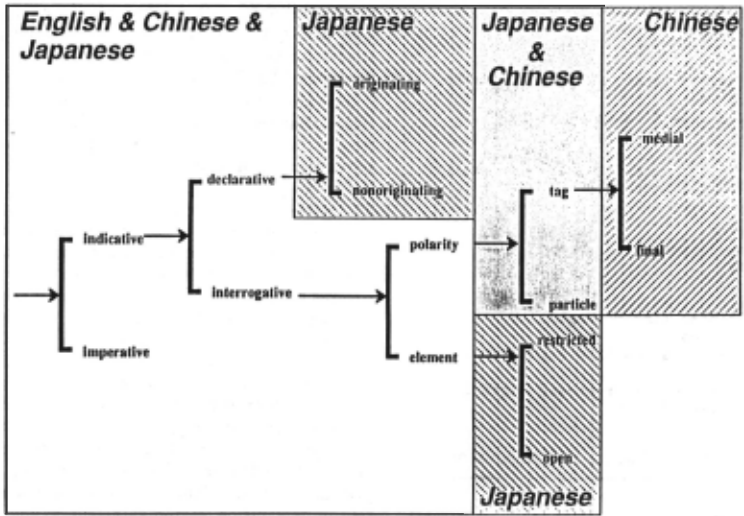
Given this level of abstraction, it is not surprising that many other languages also make use of this functional or ganization. In fact, we can up to a point use identical sys tem networks fragments for Chinese and Japanese also. All three languages contrast, for example, declarative clauses with polarity interrogative ones. It is only when we come to more specific, or delicate, areas of functional potential that the languages begin to differ: whereas En glish stops in delicacy at polarity interrogative clauses, Chinese and Japanese provide further options. For Chi nese, the speaker's expectation as to the answer to the polarity interrogative may be neutral ('tag' interroga tive) or neutral/biased ('particle' interrogative) [Li and Thompson, 1981, Section 18.6]; and the interrogative tag may be either clause-medial or clause-final. Thus, in ad dition to simple polarity interrogative just, Chinese, for example, provides the following further, more delicate functional distinctions: 2
2 There are, of course, further subtypes and distinctions: this is the case for almost all of the examples we give in this paper. Our purpose here is, however, to make the general principles and mechanisms clear rather than to provide ex haustive accounts.
| tag, medial ta wancheng sfhe finish | mei wancheng | zuoye'? |
|---|---|---|
| not finish | homework | |
| tag, final | ||
| ta wancheng | zuoye | mei wancheng ? |
| s/he finish | homework | not finish |
Similar types of extensions in options are provided by Japanese. FUrthermore, Japanese offers increased del icacy beyond the features 'declarative' and 'element'. The functions of these areas are as follows. In addi tion to giving information {'declarative'), a speaker of Japanese must also indicate whether s/he is the original source of that information ('originating') or not ('non originating'): i.e., if the information was obtained from some other source, e.g., heard on the radio or gener ally rumored, then this must be overtly indicated. This is done by adding the expression sou-desujda following the main process of the clause. The latter component of this expression is the copula verb 'to be' and it is this that carries the 'interpersonal deictic center' (Ide) of the clause: i.e., the part of the clause that carries statements concerning the social distance between the interlocutors (near: da; not near: desu). Also, in addi tion to demanding information concerning a particular element ('element'), a speaker of Japanese must also ei ther leave the possibilities for that element unrestricted ('open'), which is equivalent to a simple Wh-question in English, or restrict the possible fillers of that element to a determinate set ('restricted'):
sore- wa hon desu ka nooto desu ka ? that- TOPIC book is QUESTIO:S notebook is QUESTIO:S "is that a book or a notebook?"
The increased functionality beyond polarity is similar for both Chinese and Japanese, although the more del icate variance between final or medial tags is not avail able for Japanese. Given the areas of convergence and divergence of functionalities we have now seen, it is pos sible to present a combined, multilingual grammatical system network for MOOD that covers English, Chinese, and Japanese; this is shown in Figure 2. Here we can clearly see the sharing of areas of grammatical descrip tion.
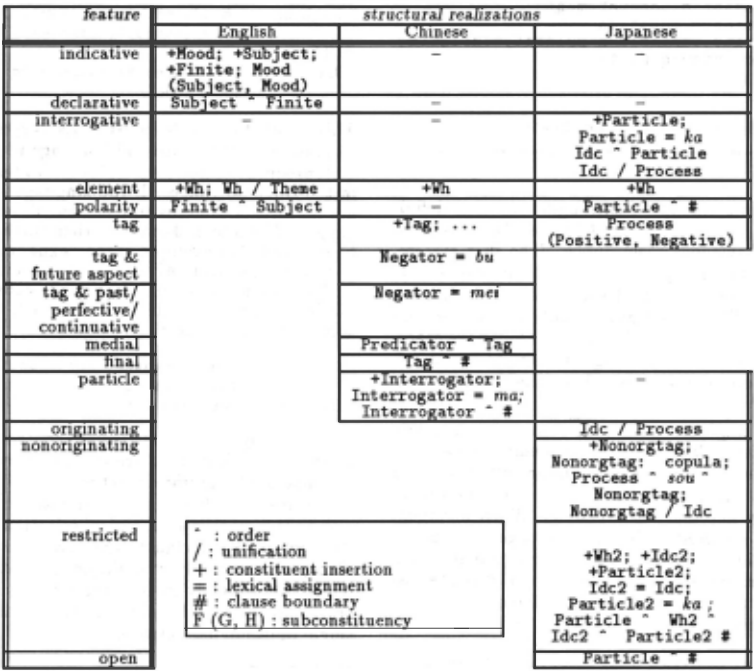
While English, Chinese, and Japanese thus have a number of MOOD systems in common, the various options in these systems are tactically different: that is, they are realized in different ways in the three languages. For example, in English the contrast between a 'declarative' and a 'polarity'-interrogative is realized by the Mood ele ment, that is, by the combination of Subject and Finite; specifically, 'declarative' is realized by 'Subject before Finite', as in he has, and 'polarity' is realized by 'Finite before Subject', as in has he. However, Chinese does not have a Mood element consisting of Subject and Fi nite; the contrast between 'declarative' and 'polarity' is thus not realized by variation within such an element. Rather, the contrast is realized by the presence or ab sence of a special mood tag or particle; specifically, it is the 'polarity' interrogative that is marked by either a mood tag or a mood particle, depending on the type of 'polarity' interrogative, whereas in 'declarative', there is no presence of mood tag or mood particle. Japanese acts
(system :name INDICATIVE-TYPE :inputs indicative :outputs ((declarative (order subject finite)) (interrogative)) :chooser INDICATIVE-TYPE-CHOOSER)
Figure 4: Internal monolingual definition of a grammat ical system in Penman
in this respect very similarly to Chinese; it does not have a Mood element and also realizes the contrast between 'declarative' and 'polarity' (in fact all 'interrogatives') by the deployment of a mood particle ( ka). Now, since the grammatical theory separates the functional, strate gic part of the grammar from the realizational, tactic aspect, stating these three sets of realizations separately is quite straightforward.
The realization statements for the three languages are tabulated in Figure 3; an example of their use is given in Section 4
4 Computational implementation of multilingual systemic networks
In this section we briefly describe the computational im plementation of the multilingual environment for gram mar description that we rely on to express generaliza tions of the kind illustrated in the previous section. To add the ability to define multilingual grammar compo nents, we have extended the monolingual grammar def inition notation provided by the Penman system. Fig ure 4 shows the current internal monolingual definition of the INDICATIVE TYPE grammatical system used above: the definition simply linearizes the information given graphically in the network notation; entry conditions for the system are given as a boolean expression over gram matical features (in this case simply 'indicative') under the slot :inputs and the output terms of the system, i.e., the grammatical features that are at issue for choice, along with their respective structural realizations, are given in a list under the slot :outputs. The value of the :chooser slot determines where to locate the decision procedure (or chooser) responsible for selecting purpose fully between the grammatical features of the system in the context of a determinate text need.
We extend this definitional notation for system net works by allowing conditionalization according to lan guage of all or some of the inputs, outputs, realization statements, and choosers. Language conditions are given as disjunctions over the languages for which the gram matical system definition is to hold specified by the key word :variety. These disjunctions may be nested and cumulatively restrict the language applicability of the conditionalized components. We also allow conditional ization of entire systems by introducing a :variety slot for the definition as a whole. 3
3 We use the term :variety rather than, e.g., :language, to draw attention to language variety both across languages and within individual languages. Functional variety, or reg-
t'art~c.le ·
Figure 3: Multilingual realization options for speech function
(system :name INDICATIVE-TYPE :inputs indicative :outputs ((declarative (:variety English (order subject finite))) (interrogative (:variety Japanese (insert Particle) (lexify Particle ka) (order Ide Particle) (conflate Ide Process)))) :chooser INDICATIVE-TYPE-CHOOSER) (system :name POLARITY-TYPE :variety (Chinese Japanese) :inputs polarity :outputs ((tag (:variety Chinese (insert Tag)) (:variety Japanese (expand Process Positive Negative) ... )) (particle (:variety Japanese (order-at-end Particle)))) :chooser POLARITY-TYPE-CHOOSER)(t I finish :actor (p I person) :actee (a I assignment) ) : command-q noncommand :statement-q nonstatement :question-q question :polarity-variable-q polarity-variable :expectation-q neutralFigure 5 shows example multilingual internal defini tions required for some of our Chinese, Japanese and English MOOD systems given above. The first system, INDICATIVE-TYPE, is applicable to all languages cov ered, but only has structural consequences in English and Japanese. The second applies only to Chinese and Japanese. This means that all languages will have gram matical features such as 'interrogative' and 'declarative', but only Chinese and Japanese have the features 'tag' and 'particle' . 4
Given this implementation, we can now generate clauses in multiple languages given a single knowledge base specification - as long as the information required by the distinct languages is common or more specific in formation than necessary is available. When divergent information is required in distinct languages, as, for ex ample, occurs in our English, Chinese, and Japanese ex periment when one language makes more delicate dis tinctions than another, then further inferencing may be required in order to obtain sufficient information for guiding generation. This can be seen more concretely in the following, where we provide an input specifica tion that spans our three example languages. The input specification is the standard one used by Penman - the Sentence Plan Language (SPL: [Kasper, 1989]).
ister, is also being addressed using this extended framework, although this goes beyond the scope of the present paper.
4 For more details of the currently implemented algo rithms, see [Bateman et al., 1991].
The partial SPL input specification 5 shown in Figure 6 states that there is a process t of semantic type finish with an actor p of semantic type person and an actee a of semantic type assignment. In addition, a set of inquiry and inquiry responses concerning speech acts are present . The generation process then proceeds as follows. The general multilingual network is entered and when deci sions concerning MOOD are made, the grammatical fea tures 'indicative', 'interrogative', and 'polarity' are made irrespective of which language is being generated. Since no language restrictions are given outside of the real ization statements for the definitions of these systems, there is no difference internally in the representation of these systems to the state of affairs in the monolingual Penman generator. The inquiry specifications in the SPL {i.e., : command-q, : statement-q, :question-q, and : polari ty-variable-q) are sufficient to motivate grammatical feature selection. Naturally, however, de pending on which language .is being generated, distinct sets of realization statements will have been collected. The pool of constraints following selection of these three grammatical features is as follows for each language:
English: Chinese: Japanese: +Mood; +Subject; +Finite; Mood (Subject, Finite); FiniteASubject none +Particle; Particle · ka;Idc I Process; ldcAParticleThis simply follows the constraints as specified according to grammatical feature and language in Figure 3.
Subsequently, however, different states of affairs hold in the three languages. If the language is English, there are no further systems to consider; if, however, the lan guage is Chinese or Japanese, then further options must be resolved. For example, if the : expectation-q inquiry (which we use to motivate the grammatical alternation under POLARITY TYPE: Section 3) calls for the gram matical feature 'particle' to be selected, the realizational constraints added are:
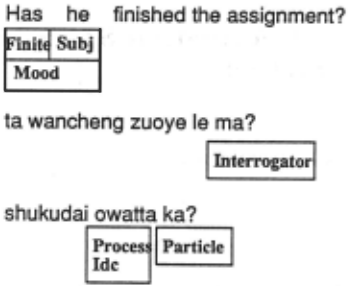
Chinese: +Interrogator; Interrogator · rna; Interrogator A # Japanese: Particle A #Combining these particular contributions of con straints with those that are generated by the other com ponents of the grammar network for each of the three languages, i.e., those concerned with tense, aspect, pro cess types, participants, lexical selection, etc., we obtain the very different clause structures shown in Figure 7. Thus, we can see how multiple generation possibilities which differ widely in structural properties can be gen erated from a single semantic specification and with a single multilingual network.
5 This is partial in that we have omitted much information that is necessary for generation in any language but which is not central to the discussion here.
5 Conclusions
Our trial languages, English, Chinese and Japanese are typologically very different structurally. For instance, Japanese has fairly elaborate verb structure, whereas Chinese does not; Japanese is classified as an SOV lan guage, but English and Chinese are basically SVO, while German is SOV only in 'dependent' clauses. However, we have now illustrated how such languages can share systemic potential as well as diverge within a system net work. We used genetically unrelated languages in order to show that the crucial criterion for grasping common ality is functionality. It can be noted that already for the restricted area of MOOD grammar, the functional view point allows groupings of languages along dimensions of similarity and dissimilarity where a structural typology would not have suggested a basis for comparison. It should also be clear that many further languages could be added without substantial alteration: the important observations to make are that resources of a more general nature are shared and diversification in function across languages only appears later, at more delicate levels in the network, and that functional organization differs less than syntagmatic organization.
@inproceedings{ijcai1991p142,
  title     = {The Re-use of Linguistic Resources across Languages in Multilingual Generation Components},
  author    = {Bateman, John A. and Matthiessen, Christian and Nanri, Keizo and Zeng, Licheng},
  booktitle = {Proceedings of the Twelfth International Joint Conference on
               Artificial Intelligence, {IJCAI-91}},
  publisher = {International Joint Conferences on Artificial Intelligence},
  editor    = {John Mylopoulos and Ray Reiter},
  pages     = {966--970},
  year      = {1991},
  month     = {8},
  note      = {Natural Language},
  url       = {https://ijcai.org/proceedings/1991/142},
}
TY - CPAPER TI - The Re-use of Linguistic Resources across Languages in Multilingual Generation Components AU - Bateman, John A. AU - Matthiessen, Christian AU - Nanri, Keizo AU - Zeng, Licheng T2 - Proceedings of the Twelfth International Joint Conference on Artificial Intelligence, IJCAI-91 PB - International Joint Conferences on Artificial Intelligence PY - 1991 SP - 966 EP - 970 UR - https://ijcai.org/proceedings/1991/142 ER -Copied
Machine-readable versions of this paper, for tools and AI agents:





