
Your Metaphor or Mine: Belief Ascription and Metaphor Interpretation
Proceedings of the Twelfth International Joint Conference on Artificial Intelligence. Natural Language. Pages 945-949.
© 1991 International Joint Conferences on Artificial Intelligence
Abstract
ViewGen, an algorithm and program for belief ascription, represents the beliefs of agents as explicit, partitioned proposition-sets known as environments. A way of extending ViewGen to the interpretation of metaphor, and in particular to the comprehension of metaphor within the belief spaces of particular agents, has been described elsewhere. The paper reports the further refinement and recent implementation of this approach, as well as summarizing the argument for the claim that ordinary non-metaphorical belief ascription and the transfer of information in metaphors can both be seen as different manifestations of a single environment-amalgamation process, one in which explicitly metaphorical amalgamations are triggered by "preference breaking" in the sentence being processed. This requires a consideration of the scoping of metaphor with respect to belief contexts, analogous to the scoping of quantification and definite descriptions with respect to such contexts. As a topic of ongoing and future work, the issue of mixed metaphor, of two distinct types, is briefly addressed.
- [Ballim, 1987] Afzal Ballim. The subjective ascription of belief to agents. In Advances in artificial intelligence.
- Edited by J. Hallam and C. Mellish. Chichester, Eng- land: John Wiley & Sons. [Ballim and Wilks , in press] Afzal Ballim and Yorick Wilks. Artificial Believers. Hillsdale, N.J.: Lawrence Erlbaum Associates. [Ballim et a/., 1991]
- A. Ballim, Y. Wilks and J. Barnden Belief ascription, metaphor, and intensional identifica- tion. Cognitive Science, 15, pp.133-171.
- [Barnden, 1989] John A. Barnden. Belief, metaphori- cally speaking. In Proceedings of the Jst Inti. Conf. on Principles of knowledge Representation and Rea- soning. San Mateo, CA: Morgan Kaufman.
- [Barnden, 1990] John A. Barnden. Naive Metaphysics: a metaphor-based approach to propositional attitude representation (Unabridged version). Memoranda in Computer and Cognitive Science, MCCS-90-174.
- [Bochenski, 1961] I. Bochenski. A History of Formal Logic. Indiana: Notre Dame University Press.
- [Cohen and Margalit, 1972] J . Cohen and A. Margalit. The role of inductive reasoning in the interpretation of metaphor. In Semantics of natura/language .. Edited by D. Davidson and G. Harman. Dordrecht: Reidel.
- [Cohen and Levesque, 1985] P. R. Cohen and H. J. Levesque. Speech acts and rationality. In Proceed- ings of the 29rd Annual Meeting of the Association for Computational Linguistics. University of Chicago.
- [Davidson, 1978] D. Davidson. What metaphors mean. Critical Inquiry, 5, pp.31-48.
- [Falkenhainer et a/., 1989] B. Falkenhainer, K. Forbus and D. Gentner. The structure-mapping engine: algo- rithm and examples. Artificial Intelligence, 41, pp.1- 63 .
- [Indurkhya, 1987] B. lndurkhya. Approximate Semantic Transference: A Computational Theory of Metaphor. Cognitive Science, 11, pp.445-480.
- [Lakoff, 1971] G. Lakoff. On generative semantics. In Semantics. Edited by D. Steinberg & L. Jokobovits. London and New York: Cambridge University Press. 950 Natural Language [McCarthy and Hayes, 1969]
- J. McCarthy and P. Hayes. Some Philosophical problems from the Standpoint of Artificial Intellgience. In Machine Intelligence. Edited by Meltzer & Mitchie. Edinburgh University Press.
- [Perrault, 1987] R. Perrault. Invited presentation. Meet- ing of the Association for Computational Linguistics. Stanford, Calif.
- [Perrault, 1990] R. Perrault. An application of default logic to speech act theory. In Plans and intentions in communication and discourse. Edited by P. Cohen, J. Morgan & M. Pollack. Cambridge, Mass.: MIT Press.
- [Rieger, 1975] C. Rieger. Conceptual Memory and In- fluence . Edited by R. Schank. North Holland: Ams- terdam.
- [Wilks, 1975] Y. Wilks. Preference Semantics. In Formal Semantics of Natural Language. Edited by E. Keenan. Cambridge, UK: Cambridge University Press.
- [Wilks, 1977] Y. Wilks. Making preferences more active. Artificial Intelligence, 8, pp. 75-97.
- [Wilks and Ballim, 1987] Y. Wilks and A. Ballim. Mul- tiple agents and the heuristic ascription of belief. In Proceedings of the 10th International Joint Conference on Artificial Intelligence. Los Altos, Calif.: Morgan Kaufmann. [Wilks and Bien, 1979] IJCAI
- Y. Wilks and J. Bien. Speech acts and multiple environments. In Proceedings of the 6th International Joint Conference on Artificial Intel- ligence. Tokyo, Japan. IJCAI
- [Wilks and Bien, 1983] Y. Wilks and J. Bien . Beliefs, points of view and multiple environments. In Cognitive Science, 8, pp.120-146
References were extracted automatically from the PDF and may contain errors.
Full text extracted automatically from the PDF; figures, tables and equations may differ. The PDF is the version of record.
1 ViewGen: The Basic Belief Engine
A computational model of belief ascription is described in detail elsewhere [Wilks and Bien, 1979, 1983] [Ballim, 1987] [Wilks and Ballim, 1987] [Ballim and Wilks, in press] and is embodied in a prolog program called View Gen. The basic algorithm of this model uses the notion of default reasoning to ascribe beliefs to other agents un less there is evidence to prevent the ascription. Perrault (1987, 1990] and Cohen and Levesque [1985] have also recently explored a belief and speech act logic based on a single explicit default axiom. As our previous work has shown for some years, the default ascription is basically correct, but the phenomena are more complex than are normally captured by an axiomatic approach.
ViewGen also avoids certain counter-intuitive assump tions, such as the non-persistence of ignorance about any given proposition p [Perrault, 1990]. Also such systems viewpoint, shown as the box with "John" on the lower edge, is a nested viewpoint, as it is enclosed within the system viewpoint shown (through an intervening topic environment about John, shown as the box with "John" on its upper edge). Environments are dynamically cre ated and altered. The basic algorithm of interest in this paper is an amalgamation mechanism that ascribes be liefs from one viewpoint to another (or, "pushing one environment down into another"); ascribing certain be liefs, transforming some, and blocking the ascription of others. The simplest form of this algorithm, described in [Wilks and Bien, 1979, 1983], is that a viewpoint should be generated using a default rule for ascription of beliefs. The default ascriptional rule is to assume that another person's view of a topic is the same as one's own ex cept where there is explicit evidence to the contrary. In examples of this sort, where the topic is also the agent into whose environment an ascription is being attempted (i.e., replace "Earth" by "John" in the example), propo sitions in an outer topic environment E (for the topic John, in the example), are pushed inwards into a topic environment (for the same topic) within a believer view point (John's) nested within E. Such inward pushing is central to our later observations on metaphor.
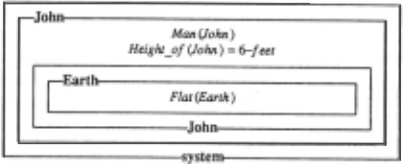
Belief ascription is a far more complex phenomenon than is shown in this brief summary and the key to our method is the delimitation and treatment of cases where the default algorithm is incorrect. We call these atypical beliefs and they include technical expertise, self knowledge (itself a form of expertise), and secrets. For example, beliefs that I have about myself, such as how many fillings I have in my teeth, are beliefs that I would not normally ascribe to someone else unless I had rea son to do so (if, say, the person to whom I was ascrib ing the belief was my dentist). A representation based on lambda expressions is used in dealing with atypical beliefs, and is described elsewhere [Ballim, 1987] [ Bal lim and Wilks, in press] [Wilks and Ballim, 1987], and follows a suggestion originally made by McCarthy and Hayes [1969]. This combination of a basic default as cription rule with a mechanism for dealing with atypical belief is an original algorithm and has not, to our knowl edge, been described or tested elsewhere in the literature.
2 Metaphor: Shifting the Belief Engine to a Higher Gear
Metaphor is normally explicated, formally or computa tionally, by a process that transfers properties by some structural mapping from one structure (the vehicle) to another (the tenor). Classic examples in AI would be the work of Falkenhainer, Forbus and Gentner [1989] and of Indurkhya (1987]. All these authors are concerned, as we are, with metaphor and analogy viewed as some form of structural mapping; the difference from them of what we offer here is the linkage between that process and the process of belief ascription (and also that of "intensional identification"), as explained in [Ballim, Wilks and Bar den, 1991].
We are exploring the application of our basic belief al gorithm to metaphor as an experiment to see if it gives insight into the phenomenon. That should not be as surprising as it may sound: metaphor has often been viewed, in traditional approaches, as "seeing one thing as something else", a matter of viewpoints, just as we are presenting belief. We propose that propositions in the topic environment for the vehicle of a metaphor be "pushed inward" (using the standard algorithm men tioned above), into an embedded environment for the tenor, to get the tenor seen through the vehicle, or the view of the tenor-as-vehicle.
The key features here are: (1) one of the concep tual domains, namely the metaphor vehicle, is viewed as a "pseudo-believer"; (2) the pseudo-believer has a metaphorical view of a topic or domain; {3) the genera tion of such a view is not dissimilar from ascribing be liefs to real believers; ( 4) explicating this by pushing or amalgamating environments yields new intensional enti ties after an actual transfer of properties.
So, in
Jones threatened Smith's theory by reimple menting his experiments.
we would know we had a preference-breaking, and po tentially metaphorical, situation from the object-feature failure on "threaten" (assuming this expects a person ob ject), at least if we accept the argument of Wilks [1977] that metaphors could be identified, procedurally at least, with the class of preference-breaking utterances. {This includes assertions that violate class relationships, such as "An atom is a billiard ball.")
The awkward cases for that broad delimitation are forms like "Connors killed McEnroe", which breaks no verb preferences but is read metaphorically by some as "beat soundly at tennis" . Here one might consider tak ing the classic Marcus-escape and use our . procedural definition to rule this example out of court as a "garden path metaphor".
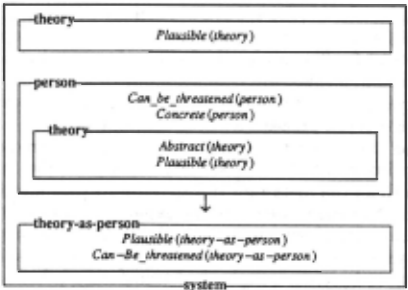
We could now plausibly form a metaphoric view of theory-as-person using the environment-amalgamation process sketched above. Figure 3 shows possible sys tem environments for theory and person, and the re sulting theory-as-person environment, where the arrow indicates the new environment resulting from the appli cation of the default rule when the properties of the outer environment {for Person) are amalgamated into the in ner environment {for Theory) and survive unless contra dicted (as the Concrete predicate in fact is). So, by this maneuver, a new and complex metaphorical property of theories is derived. It might be, of course, that this pro cedure of belief-overriding as a basis for metaphor would produce no different a set of plausible properties trans ferred than any other system (e.g. that of Falkenhainer et al.); and that would be, again, an experimental ques tion, as would be the very difficult issue how many "irrel evant" properties are ascribed as well, and whether there is a danger of them swamping the metaphorically rele vant ones. But the importance or originality we propose would lie in the fact that it was further application of an algorithm designed to explicate another phenomenon altogether (i.e., belief), and therefore yield a procedural connection between the notions, as we argued in detail in [Ballim et al. , 1991].
There is a further interesting aspect to the connection between belief and metaphor. We have stressed a pro cedural connection that may seem improbable to some people. There is also the important but neglected phe nomenon that the content of belief is often inherently metaphorical, and in a way that conventional theorists totally neglect by their concentration on simplistic belief examples like "John loves Mary". A far more plausible candidate might be a truth such as:
Prussia threatened France before invading it successfully in 1871.
What are we to say of this historically correct belief? What are the entities referred to by "Prussia" and "France"? Simple translation into some first-order ex pression like lnvade(Prussia, France, 1870) just ob scures the real problem, one for which the semantics of first order logic are no help at all. Are the entities re ferred to somehow metaphorically the Prussian people, etc., or army, or a part of the army?
Following the approach described earlier, we might ex pect to detect breaking of linguistic preferences of the verb "threaten"; perform a trial pushdown of properties of the "People" environment (given by the conventional preferences of "threaten") into an environment for Prus sia ( = a land mass, the basic representation). An im portant safeguard, that there is no space to discuss here, would be that we examined our inventory of represen tations to see if we had one for "Prussia" that already expressed the (dead) metaphor of a country-name-as-a polity (some would insist that this was a metonymy, but we do not address this alternative here).
The amalgamation of the notions of belief ascription and metaphor interpretation is described and justified in detail in [Ballim et al., 1991]. The method as described there explicitly addresses the case of metaphor only at the top level of discourse, within the system's own no tions of the component elements of the metaphor. But of course, in the general process of metaphor interpretation, we must relativize these processes to the space of any rel evant believer. The system might believe the zoological truism that pigs are clean and neat, but when talking to the non-zoologist John, use the standard metaphor "He's a pig" on the assumption that John would perform the ascription against the dirty-unhygenic-pig belief that the system believes John to hold. The system must be able to model that metaphorical ascription, whose elements the system itself does not believe.
This relativization is included in a recent implemen tation of the approach within ViewGen by Ballim, as extended by one of us (Wang). The need for relativiza tion underscores the benefits of our method of unify ing metaphorical transference with belief ascription. We shall analyze such examples later in more detail, but we must first discuss an issue of "metaphorical scope" that is implicitly raised by the above.
3 Metaphorical Scope
Consider the sentence
John believes that a cure for terrorism is needed.
The complement of this belief report - the clause fol lowing the word "that" - can be construed as involving a terrorism-as-disease metaphor. We must first realize that there is a metaphor scoping issue here. The "inner scope" reading involves the idea that John himself thinks of terrorism as a disease (and we might predict that he would report his belief by means of the sentence "A cure for terrorism is needed"). The "outer scope" reading is that John believes something about terrorism that is be ing portrayed by the speaker in terms of disease-curing. John does not necessarily have a belief couched in these terms, nor would he necessarily report his belief in these terms. (Perhaps John would say: "Something needs to be done to eliminate terrorism and repair the damage it has done to society.")
We now concentrate on the inner scope reading. In the process of setting up a topic environment for terror ism inside John's belief environment, the system needs to perform (i) the normal default ascription proces, here moving some of its own beliefs about terrorism down into John, as well as performing (ii) a metaphoric transfer ence process. This combination of tasks is simplified by our method of dressing the tasks in essentially the same algorithmic clothes.
This is especially so since it is John's view of disease that is important in the metaphoric transference, not the system's. After all, John might believe that diseases are caused by demonic influences, say, and this belief could affect what he would think of as reasonable ways of curing terrorism- e.g., exorcism. Thus, in task (ii), a disease topic environment must be set up within John's belief environment, and it is that topic environment that acts as the source of the metaphoric transference. The setting up of John's disease topic environment will it self, moreover, normally involve the default ascription process, moving system beliefs about disease down into John. Thus, belief ascription and metaphoric transfer ence are tightly bound up with one another.
The case for integrating belief ascription and metaphor is yet further strengthened by bringing in the possibility that John actually believes that terrorism is literally a disease. (A more realistic example for the present phase of the argument could be obtained by re placing "terrorism" by "laziness", say.) We could cast this as an intensional identification by John of the con cepts of terrorism and disease. We show in (Ballim et al., 1991] that such identifications can themselves be handled by the same environment manipulations as are used for metaphor, although we concentrate there on the identi fication of descriptions of ordinary objects, such as when John takes Jim's father and Frank to be the same per son whereas the system does not . Hence, we form a unity out of the trinity of belief ascription, metaphor and in tensional identification. The important point for present purposes is that in interpreting "John believes that a cure for terrorism is needed" the system can abstain from making a decision about whether John literally or only metaphorically thinks of terrorism as a disease, since the same overall belief ascription process is used in either case.
One special case of the issue of a metaphor be ing nested in belief report complements is when the metaphor is itself about belief or other mental states. An example of this is "John believes that one part of Mary wanted to go skiing, but another part wants to sit by the fire" where the metaphor of the mind as compart mented into sub-minds or sub-people is being used. This issue is discussed at length in Harnden [1989, 1990].
The distinction between inner and outer scope read ings of metaphors within belief report complements is analogous to a classic distinction usually made in the case of object descriptions within such complements. Consider the description "Mary's uncle" in "John be lieves that Mary's uncle drinks gin." The description could be taken to be one which is in some form directly used in John's belief (so that John might report his belief by "Mary's uncle drinks gin"). This is the inner scope (or "de-dicto") reading. Alternatively, the description could merely be taken to be one that is used by the speaker to define the person that John believes to drink gin; John might be thinking of the person in some com pletely different way. This is the outer scope (or "de-re") reading.
Henceforth in this paper we consider only the inner scope interpretation of embedded metaphor. The outer scope case can be dealt with in a similar but simpler way.
4 Embedded Metaphor Ascription
In the following, the system is considering the beliefs of an agent M, with no intervening agents. Let us say that M's "peculiar" topic environment for T contains the beliefs about T that are recorded in M's space before an attempt to push the system's T beliefs down into M has been made. Let us say that M's "expanded" topic environment for T contains the beliefs about T that are recorded in M's space after the attempt.
Supposing Tl, T2 are two topics, there are two ways the system could proceed when it takes M to see Tl as T2. The first is for the system to form M's expanded topic environments for Tl and for T2 separately, and then try to do the metaphor transference by pushing the expanded T2 beliefs down into the expanded Tl environ ment. The second way is, essentially, to do these steps in the other order: the system forms its own Tl-as-T2 environment by one metaphorical transference, forms a
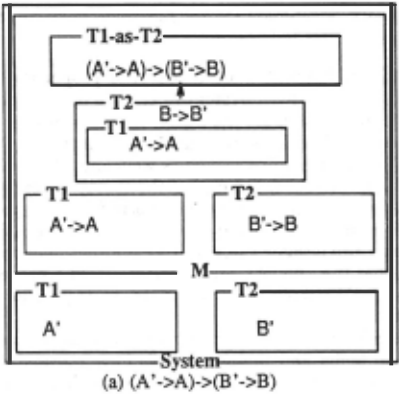
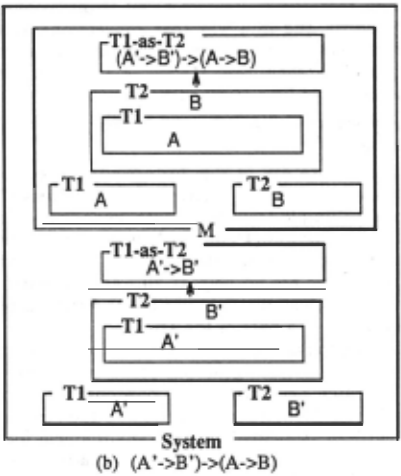
peculiar Tl-as-T2 environment within M's space by another metaphorical transference (by trying to push M's peculiar T2 beliefs into M's peculiar Tl environment), and then trying to push the system's Tl-as-T2 beliefs down into M's peculiar Tl-as-T2 environment.
These two possibilities can be described as (A'-+ A) --+ (B'--+ B) and (A'-+ B') --+ (A --+ B), where A', B' are the system's sets of beliefs about T2 and Tl, A, B are M's peculiar sets of beliefs about T2 and Tl, and --+ is the operation of trying to push beliefs in (the normal default ascription process). The two different processes and results are shown in Figure 4. It is clear that the two results are basically the same, but that a difference can arise from the propositions which are ascribed either from A or from B', since the earlier ascribed propositions may prevent the later ascription. Currently it seems to us that the first process, namely (A'-+ A) --+ (B' --+ B), is the correct one.
We can now consider the general process of the trig gering of metaphor and the amalgamation processes that follow. Let us return to the rather tired exampleofWilks (1977]:
My car drinks gasoline.
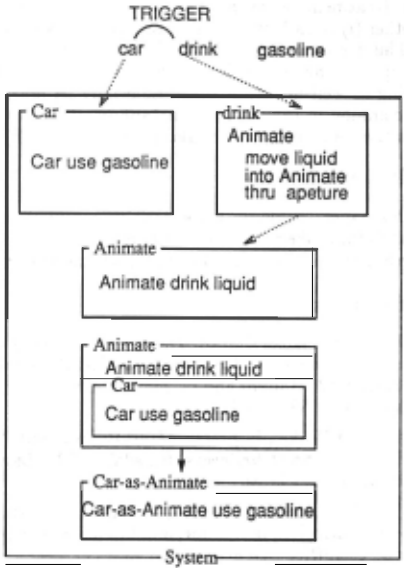
In that paper it was argued that this metaphor was de tected or triggered by the preference failure of "drink" (not getting an animate agent) and that the metaphor was to be understood by matching into an appropri ate knowledge base for Car, where some such form was found as that "Cars use gasoline". This location of "use" (rather than "leak", say) as being semantically close to "drink" resulted in a literal reading of "Cars use gaso line". The algorithm (not given in any detail here) was implemented later by Modiano. It was also argued that two metaphorical perspectives were available: this one, and one of Cars seen as Animate, from the failed prefer ence of the verb.
If we now generalize this class of example within the belief ascription approach to metaphor of this paper, we can achieve a much more general account, one in which there is only a single perspective, although this can ap pear, as we noted, at any level of belief.
Suppose we again take the failed preference as trig gering the metaphorical belief amalgamation, within the system's own level of belief initially. We now access the system's belief environments for the concepts that fail to prefer each other (Car and Drink). See Figure 5 for a sketch of the propositional content. The drink en vironment shows that the preferred agent of the verb is Animate, so the environment for Animate and Car are brought into focus in the system's main environ ment, and the metaphorical amalgamation for ear-as animate is performed just as for the Theory-as-person case above. We see that "Car-as-animate use gasoline" appears in the resulting intensional environment for Car as-animate and, when that belief is present at any level of belief ascription (done here for the system's own be liefs only) we see that that proposition will enter un contradicted into the belief space of the individual who hears and is engaged in understanding "Cars drink gaso line". We assume in saying this that Cars and Cars-as-X can be identified for temporary inference purposes, and that other (so far unmentioned) ascribed beliefs about Cars-as-animate (such as that they leak gasoline) will not be amalgamated into the environment of the believer of "Cars drink gasoline" since drink/leak will (hopefully) contradict each other as any such small/large, dark/light pair will be found to do. Thus the appropriate literal in terpretation will enter the relevant belief environment through a single process of belief ascription.
5 Some Further Work
Metaphor can involve more than the two conventional domains (tenor and vehicle). Two cases of this phe nomenon in which we have some interest for the future are what we can call parallel mixed metaphor and /se rial mixed metaphor (or cascaded metaphor). In parallel mixed metaphor, the tenor domain is viewed simulta neously in terms of more than one vehicle. An exam ple from mathematics or computer science is "the right child of this node is a leaf", which is taking a view of nodes both as parts of a biological tree and as people. In cascaded metaphor, the tenor is viewed in terms of a ve hicle which itself acts as the tenor for another metaphor (and so on). For instance, one interpretation of "A cure for terrorism is especially urgent now that it is seeping through the whole world" has it that terrorism is being viewed, as in a previous example, as a disease, and a disease is being viewed in turn as a liquid.
Since the original belief ascription algorithm was ex plicitly designed to be applied recursively so as to con struct any necessary level of belief ascription, it can al ready be applied to deal with serial mixed metaphors.
The treatment is such that it makes no difference whether (i) A-as-B is seen as C or (ii) A is seen as B-as C. This seems to accord well with our intuitions about examples we have considered. We plan to tackle parallel mixing as well in future work, especially as both types are common in the realm of metaphors of mind (which form the central concern of Barnden [1989, 1990]).
Acknowledgments
This paper builds on work done in conjunction with Afzal Ballim. We are grateful also for useful suggestions from Subhankar Banerjee, David Fa well and Dihong Qiu.
@inproceedings{ijcai1991p139,
  title     = {Your Metaphor or Mine: Belief Ascription and Metaphor Interpretation},
  author    = {Wilks, Yorick and Barnden, John A. and Wang, Jin},
  booktitle = {Proceedings of the Twelfth International Joint Conference on
               Artificial Intelligence, {IJCAI-91}},
  publisher = {International Joint Conferences on Artificial Intelligence},
  editor    = {John Mylopoulos and Ray Reiter},
  pages     = {945--949},
  year      = {1991},
  month     = {8},
  note      = {Natural Language},
  url       = {https://ijcai.org/proceedings/1991/139},
}
TY - CPAPER TI - Your Metaphor or Mine: Belief Ascription and Metaphor Interpretation AU - Wilks, Yorick AU - Barnden, John A. AU - Wang, Jin T2 - Proceedings of the Twelfth International Joint Conference on Artificial Intelligence, IJCAI-91 PB - International Joint Conferences on Artificial Intelligence PY - 1991 SP - 945 EP - 949 UR - https://ijcai.org/proceedings/1991/139 ER -Copied
Machine-readable versions of this paper, for tools and AI agents:





