
Speech Acts and Multiple Environments
Proceedings of the Sixth International Joint Conference on Artificial Intelligence. .
© 1979 International Joint Conferences on Artificial Intelligence
Abstract
This brief paper outlines joint work that implies a view of the explication of Speech Acts different from those current in Al. It is exploratory at present, but we intend that it should lead to programs as soon as possible. We propose a system that engages in dialogue with a human user so as to discuss others and in doing so, interprets the appropriate communicative force of the user's utterances. The three key features of the explication of co mmuni cative force presented are: I. multiple envi_ronments: the ability to interpret an expression or a des c ription relative to some particular knowledge, e.g. relative to the beliefs of one person about another. It is a ge neralization of the computer science approach to expression evaluation, using the notion of an environment to fix the interpretation of names occurring in the expression. 2. dual knowledge representation: an "experiential" representation is used to mem orize sentences or other episodes (exemplified by pseudo-tests, or PTs), while a frame-type repres e ntation is used to memorize knowledge needed more generally for reasoning. 3. a least effort principle of understanding: considered to be a language universal, which requires (a) that the system maintain as much representation as possible in the frame-like forms, rather than in PTs, and (b) that the system maintain a highly redundant representation in the PTs, achieved by a process we call percolation of belief.
- J.L. Austin, "Performative utterances"(l96l ) Philosophical Papers, Oxford.
- J.S. Bien, "Towards a multiple e nvironmen t model of natural language" Pro c . IJCAI 4 (1975) 237-240. •
- J.S. Bien, "Computational explication of intensionality" in A.J.C.L. Mi c rofiche . No . 9 7 (1976). •
- H. Clark & C. Marshall, "Definite Ref e r ence and Mutual Knowledge", Sloan Workshop, Pennsyl- vania, May 1978.
- P. Cohen, "Planning Spee ch Acts" Ph.D. Thesis, Dept. Computer Scien ce, Univ. Toronto (1978).
- C. Cruder et al. "The absolute sleeper effect " Personality and Social Psychology, 36, 1978, 1061-1073. -- (
- P. Hayes & M. Rosner, "Ully". Pro c . AIS B Conf., Edinbur~ 1976, 46-49. -
- M. Minsky, "Matter, Mind and Models" in Bobrow (ed.) Semantic Information Processing, MIT, 1968, 203-43.
- J. Searle, Speech Acts, Oxford, 1969.
- Y. Wilks, "A preferential pattern-se e kin g semantics, Artificial Intelligence, 6, 1975, 53-74.
- Y. Wilks, "Making preferences more active" Artificial Intelligence, ll , 1978, 197-223.
References were extracted automatically from the PDF and may contain errors.
Full text extracted automatically from the PDF; figures, tables and equations may differ. The PDF is the version of record.
1. INTRODUCTION
Speech Acts (SAs) originated as a notion in phllosophy [1) , ( 9) much preoccupied with the logical properties of sentences like "I promise to pay you five pounds" and, later, with access to the intentions in a speaker's head. Linguists worked with these notions subsequently but, like AI workers, they have added little that is distinctive to the original perception that utterances have a distinctive communicative force (as a threat, a promise, a warning, etc.), in addition to literal content. We believe that an AI approach to this area that is to contribute distinctively will have to make use of general principles concerning the environmental embedding of beliefs, etc., as well as a least effort maxim for their manipulation. The first of thes e, advocated by Bien in 1975 l21, has been used by Cohen ( s) and others of the Toronto group, but the distinctive feature we discuss here concerns the maintenance and change of such environments under a general r equirement of cognitive efficiency.
2. TIRESIAS
We propose a system able to engage in a limited conversation with a human user: let us call it TIRESIAS for a reason that will appear. The topic of the conversation would be the relationships of a group of fri ends (seef 7]) known in varying degrees to both TlRESIAS" and the user. We expect sample dialogues such as: $1 USER: Frank is coming tomorrow, T think. $2 TIRESIAS: Perhaps I should leave .
U: Why?
T: Coming from you, $1 is a threat.
U: Does Frank hate you ?
$3 T: I don't know-but you think he does, and that is what is important right now.
The important feature we require here is TIRESIAS' ability to evaluate its descriptions of persons differently in different environments Thus, at $1, TIRESIAS detects a threat (not in itself necessarily interesting) on the basis of evaluating its representation of itself, inside that of Frank, inside that;,,~f the user, which we might write (given thatt:~ is the data-structure for P inside Q, that is, Qs model of P):

whereas seeking him, or Note that all the data-bases are in TIRESIAS, so an outer TIRES lAS bracket exists round all evaluations, though we may sometimes omit it.
at $1 , when questioned, TIRESIAS is
to evaluate J"mple Frank's view of
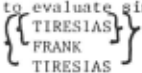
where he discovers that he has no specific information on wha t Frank thinks of him. The generation of $2, and TIRESIAS understanding of $1 as a t hreat, may , l e t us suppose, depend on a specific belief that the user believes that Frank dislikes TIRESIAS (but as $3 shows, not a belief by TTRESIAS that Frank dislikes him). Let us follow this through by examining infe rences plausibly generated by TIRESIAS' construction of the two nestings of environments shown above and comparing their results. The c ruc ial diffe renfe hefe is~between the evaluatio~ of VRANKJ in UJSER..) and in [ riRESIASJ . Ano ther assumption is important to what follows: the nesting of environments f FRANK}that the exampl e requires will not in USER
general exist already in the system (as it does in [ s) et nl). as a partition of the space of beliefs : we find i t implausible and cl>mp tationally ove rweight to assume that all such pa rtitions a r e already marked in the system. £FRANK] will he r e be constructoo by
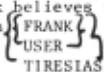
USEH } ' "pushing down" {FRANK into (usERJ . To put it simply, TlRESlAS will construct the user's view of Frank by infe r ence· from his views of the two participants: he will assume that user believes about Frank what he does, unless expli c it in fo rmation about Frank likes the user, and tha t Frank~elieves that he (Frank) hates the use r, then [FRANKL~ USERJ TIRESIA
will contain Frank dislikes user, since the belief of the user, that Frank likes the user, is ove rridden by explicit counter information. Thus , be liefs are transferred by counting in what it is reasonable for TIRESIAS to believe others believe, rather than counting out: that is t o say, believing about another's beliefs only what we have explicit evidence for. To see how such structures are obtained, we must consider briefly the form of knowledge representati ons 1n the system.
3. FRAMES AND PSEUDO-TEXTS
The -~;;t-i-~n--~-{ fra-;~-i-s··;m; well known(. 8) , and here we assume in addition a variant called a pseudo-text (1iJ whi ch is an information structure that is the semantic r epresentation of a t ext, obtained by a semanti cs-driven parser such as (lO:J . A PT is an interconnected set of proposition represen tations, called templ a tes, each of which consists of three princi pal nodes or t erminals, that represent in right-left order, the actor, action, and object of an event. The terminals are, in fact, trees of semantic primitives, but here we shall place the English names of those trees at the terminals. In such a notati on, we may write the template for "Frank is coming tomorrow", said by the user, as follows in the PT in TIRESIAS for{USER}
Frank come a J
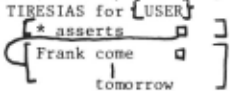
where a is a dummy node, and * is a ,Pointer to the name of the PT in which we are ~SER}in this case). The same sentence would be rarsed into a corresponding representation in tJRANK} with * now replacing "Frank" rather than "user". It should be emphasized that the PTs are a surface semantic represent a tion of such sentences, and are not frames in the sense of a structure with an a priori determined list of slot and filler names to facilitate inferencing; they are es s entially episodic text representations, but it is those we shall need, in addition to some frame information, to deal with the example to hand.
It will be evident that, ln t he description of input we have given, there is no general representa tion of Frank: information about him will be clustered in [FRANK'! , but will also appear, as we saw, in tySER} and possibly many other PTs.
We have postulated in various publications [ 2] ()o] the operation of a general principle of preference in language: one tha t asserts that the effectiveness of natural languages depends on them being constructed so that, in general, correct interpretations are those found with least effort: one could put this by saying that a system should prefer those representation that it is easiest to construct and maintain. No~consider~ain the contrasti~g evaluations
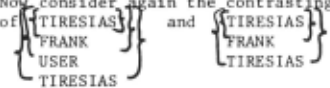
If we further shallow level corresponding standard slot may expect: assume that at the privileged there is always a frame structure to the episod i c PT, whi ch contains names such as DISLIKE, then we in '[1· I HES I i\s] givt·n l h:1 t tht· sys tern knows no ont· who dislikPs it, although in{.USERJ may be a t emp latt· (n>rresponding to a belief of the use r)

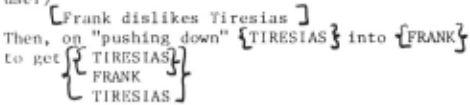
in tht· way we sket ched in the last section , no inconsistency of content is noted and no bel i efs a r e reset. But on pushing the value of this object down into USER to get the deepest nesting shown earlier, we encounter
[ 1rank dislikes Ti resias] as W<·ll :1s the two connected templates for $1 shown v:1rl i e r in this se c tion, and both of tht·sp i tvms wi 11 ht·c·nmt· part of the constructed "systt·ms vi ew o f USERs view of Frank".
4. BELIEF PERCOLATION AFTER PUSH-DOWN
Two ; ff;;;-ts may now be expec ted:
i) the inference from Frank dislikes Tiresias in\_USERJ ; together with plausible inference rules about dislike, fear, and Leaving places, will generate the reply $2 even though no such consequence was derivable in .(1TIRESlAS1~ alone as we see at $3.
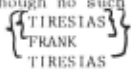
ii) on a least effort principle, the key t emplate belief Frank dislikes Tiresias that will have been copied from (USER} into ~~~lAj (:dislikes Tiresias J
and into .f-nRESIAs1 as [Frank dislikes*] 'rrREsrASJ
during the construction of the desired viewpoint, will now remain present when the push-down is, as it were, pulled apart: it remains in the PT copy. In this way, the beliefs of the user about Frank (about Tiresias) percolate to [nRESIAs] , or FRANK
rathe r to the relevant part oftfRANKJ(the privileged shallow l evel),
and s imilarly to STlRESIAS1 l.TI RES I AsJ" '
This resulting, highly redundant, representa tion may seem a paradoxical result of a least e ffort principle but we maintain that this spread of beliefs from PT t o PT, via push down vva luation, leads to a structure requir ing l ess effort when the same or similar input is encountered in the future. This is because a push-down of environments as we have des c ribed it may be considered to require con siderable resources: so, for example,{FRANK} shou{d be checked, before being evaluated in tUSERl : t o see if that push-down had been done JatP l y, and, if it h:1d, it nPcd no t lw done again, since the relevant beliefs, _!" rank dislikes Ti_!~_:> ias_ in this case, would already have percolated into it. One may notice that such pe rcolations, if they exist, deny th e whole basis of intensional l og i c (the denial of p believes x ~ x), but seem consis tent with corrunon sense, and more technicall y with the ~leeper ~ec_!(6] , the inf prcn ce o f beliefs from unreliable sources.
I t should not be emphasized that we are not trespassing into possible wo rlds: for they require the assignment of all vari ables. In the re cursive pushing down of PTs we envi sage only r elevant beliefs will be res e t. It is certainly true , however, that these suggestions will impinge on the area on intensional logic
(see [2] and, of course, Tiresias in the Gree k myth was the seer who knew that Jocasta was the mother of Oedipus (who knew tha t Jocasta was the wife of Oedipus, and even that Jocasta was Jocasta, but NOT that key fact known to Tiresias). But there is no space to explore these connexions, although we do believe that even the simple considerations set out here could lead to a ri cher procedur al explication of SAs than thos e current in AT .
@inproceedings{ijcai1979p212,
  title     = {Speech Acts and Multiple Environments},
  author    = {Wilks, Yorick and Bien, Janusz S.},
  booktitle = {Proceedings of the Sixth International Joint Conference on
               Artificial Intelligence, {IJCAI-79}},
  publisher = {International Joint Conferences on Artificial Intelligence},
  editor    = {Bruce G. Buchanan},
  year      = {1979},
  month     = {8},
  url       = {https://ijcai.org/proceedings/1979/212},
}
TY - CPAPER TI - Speech Acts and Multiple Environments AU - Wilks, Yorick AU - Bien, Janusz S. T2 - Proceedings of the Sixth International Joint Conference on Artificial Intelligence, IJCAI-79 PB - International Joint Conferences on Artificial Intelligence PY - 1979 UR - https://ijcai.org/proceedings/1979/212 ER -Copied
Machine-readable versions of this paper, for tools and AI agents:





