
Generating Causal Explanation from a Cardio-Vascular Simulation
Proceedings of the Eleventh International Joint Conference on Artificial Intelligence. Intelligent Tutoring Systems. Pages 489-495.
© 1989 International Joint Conferences on Artificial Intelligence
Abstract
In this paper, we present QUALEX, a system and algorithm for generating first-order qualitative causal graphs for tutorial purposes based on de Kleer and Brown's qualitative modeling theory. QUALEX is embedded in a constructive simulation environment called Heart Works which teaches hydraulics principles about the cardio-vascular system to first year college biology students.
- [Brown et al., 1982] Brown, J.S., Burton, R.R., and de Kleer, J. "Pedagogical, Nat ural Language and Knowl- edge Engineering Techniques in SOPHIE I, II, and III". In Sleeman, D. and Brown, J.S. (Ed.), Intelli- gent Tutoring Systems, pp. 227-282, Academic Press, Inc, London, 1982.
- [Clement, 1983] Clement, J. "A Conceptual Model Dis- cussed by Galileo and Used Intuitively by Physics Stu- dents". In Gentner, D. and Stevens, A.L., (Ed.), Men- tal Models, pp. 325-340, Lawrence Erlbaum Assoc, Hillsdale, NJ, 1983.
- [de Kleer and Brown, 1981] de Kleer, J. and Brown, J.S . "Mental Models of Physical Mechanisms and Their Acquisition". In Anderson, (Ed.), Cognitive Skills and Their Acquisition, pp. 285-309, Erlbaum, 1981.
- [de Kleer and Brown, 1984] de Kleer, J. and Brown, J.S. "A Qualitative Physics Based on Confluences". Arti- ficial Intelligence, 24: 7-84, 1984.
- [diSessa, 1983] diSessa, A.A. "Phenomenology and the Evolution of Intuition". In Gentner, D. and Stevens, A.L., (Ed.), Mental Models, pp . 15-34, Lawrence Erl- baum Associates, Publishers, Hillsdale, New Jersey, 1983. 494 Intelligent Tutoring Systems [Forbus, 1984]
- Forbus, K.D . "Qualitative Process The- ory". Artificial Intelligence, 24, 1984.
- [Forbus and Gentner, 1986a] Forbus, K.D. and Gen- tner, D. "Causal Reasoning about Quantities". Cog- nitive Science, (1986), pp. 196-207.
- [Forbus and Gentner, 1986b] Forbus, K.D. and Gen- tner, D. Learning Physical Domains: Toward a The- oretical Framework. Technical Report UIUCDCS-R- 86-1247, Department of Computer Science, Univ. of Illinois at Urbana-Champaign, Urbana, IL, December 1986.
- [Hollan et al., 1982] Hollan, J.D., Hutchins, E .L., and Weitzman, L. "STEAMER: An Interactive In- spectable Simulation-Based Training System". The AI MAGAZINE, (Summer 1984), pp. 15-27.
- [Larkin, 1983] Larkin, J .H. "The Role of Problem Rep- resentation in Physics". In Gentner, D. and Stevens, A.L. (Ed.), Mental Models, pp. 75-98, Lawrence Erl- baum Associates, Hillsdale, NJ, 1983.
- [Pearl, 1987] Pearl, J. "Embracing Causality in Formal Reasoning". In Proceedings of AAAI-87, The 6th N a- tiona/ Conference on Artificial Intelligence, pp. 369- 373, AAAI, 1987.
- [Peterson and Campbell, 1985] Peterson, N .S. and Campbell, K. "Teaching Cardiovascular Integrations with Computer Laboratories". The Physiologist , 28, 3 {1985), pp. 159-169.
- [Reif, 1987] Reif, F. "Interpretation of Scientific or Mathematical Concepts: Cognitive Issues and In- structional Implications". Cognitive Science, 11 (1987), pp. 395-416.
- [Wenger, 1987] Wenger, E. ARTIFICIAL INTELLI- GENCE and TUTORING SYSTEMS -Computa- tional and Cognitive Approaches to the Communica- tion of Knowledge. Morgan Kaufmann Publishers, Inc, Los Altos, CA, 1987.
- [White and Frederiksen, 1986] White, B.Y. and Fred- eriksen, J .R. "Intelligent Tutoring Systems Based upon Qualitative Model Evolutions". In Proceedings of Int. Joint Conference of Artificial Intelligence, pp . 313-319, 1986.
- [White and Frederiksen, 1987] White, B.Y. and Fred- eriksen, J .R. Progressions of Qualitative Models as a Foundation for Intelligent Learning Environments. Report 6277, BBN Laboratories, Inc, Cambridge, MA, May 1986.
- [White and Horwitz, 1987] White, B.Y. and Horwitz, P. ThinkerTools: Enabling Children to Understand Phys- ical Laws. Report 6470, BBN Laboratories, Inc, Cam- bridge, MA, March 1987.
- [Williams et al., 1982] Williams, M.D., Hollan, J.D., and Stevens, A.L. "Human Reasoning About a Sim- ple Physical System" . In Gentner, D. and Stevens, A.L.(Ed.), Mental Models, pp. 131-154, Lawrence Erl- baum Associates, Publishers, Hillsdale, New Jersey, 1983.
References were extracted automatically from the PDF and may contain errors.
Full text extracted automatically from the PDF; figures, tables and equations may differ. The PDF is the version of record.
1 Introduction
Drawing on the rich literature from mental models and qualitative physics, we find that qualitative causal rea soning is not only a central and coherent aspect of human mental life [Forbus and Gentner, 1986a; Pearl, 1987], but also expertise. Problem-solving within physical do mains typically begins with a qualitative causal analy sis of the problem [deKleer and Brown, 1981; Forbus, 1984· Larkin 1983· Williams et a/., 1983]. Educational , , , .1 d research has built on this evidence with both detai e studies of scientific concept acquisition [diSessa, 1983; Clement 1983· Forbus and Gentner, 1986b; White and Horwitz,' 1987],and pedagogical design wi~h a qualitat~ve causal emphasis [Brown et a/., 1982; Reif, 1987; White and Frederiksen, 1986a and b; White and Horwitz, 1987].
In elementary physics education the pedagogical issues relate to whether, when and how to introduce qualit'a tive reasoning into a predominate emphasis on quantita tive methods. In contrast, elementary biology education, e.g. a first-year college for non-majors, tends to. an en tirely qualitative approach that can best be descnbed as contrastive classification. The students' primary learn ing task is to absorb facts and causal relations as f~cts about a particular type, system, structure or functiOn. Students are rarely expected to problem-solve and the laboratory is intended to give the student experience with real entities and procedural operation of equipment.
·we wish to express our gratitude to the rest of the re search group of Heart Works: Nils Peterson, Dan Udovi~, Keith Downing, Carla Wenzlaff, and Eckehard Doerry. Thts research is supported in part by the Fund for Improvement of Post Secondary Education (FIPSE), U. S. Department of Education.
Thus, although the student is given qualitative explana tions they are rarely sufficiently formal and robust to allow' her or him to learn underlying principles and pre dict behavior. Most biology students do not come with sufficient background in physics. The following quote. is typical of the standard textbook treatment of the cardiO vascular system.
Even though the total cross-sectional area in creases in the terminal arteries, arterioles, and capillaries and even though the rate of blood flow through individual vessels decreases in tan dem, these vessels, because of their small diam eter, are the major sites of resistance in the cir culation. This is reflected in precipitous drops in blood pressure.
Much of this situation is not the fault of biology edu cators: biological systems are exceedingly complex and comparatively unknown. However, the cardio-vascular system is one of the few systems which is well-enough understood in terms of hydraulic principles to give us the rare opportunity to introduce to biology students through simulation these pedagogical objectives: (1) teach general scientific principles that underlie the <:>P eration of complex biological systems, (2) develop skills for integrating knowledge about complex systems, and (3) make lab experience more accessible.
For the past two years we have been engaged in an intelligent tutoring system research project called Heart Works. Heart Works explores the above pedagogical ob jectives through two innovations. Firstly, it makes the reactive learning environment for simulations more re active by introducing the notion of a constructive simu lation. Secondly, it unabashedly believes that teaching dynamic physical system behavior should be based ~m qualitative causal explanations generated from first pr~n ciples. To these ends, Heart Works creates a constructive simulation of the cardio-vascular system that is capable of explaining its own behavior in terms of qualitative causal hydraulic principles.
This paper will focus almost entirely on the issue of generating explanations from the si~ulat~on, h~wever, a brief understanding of the constructive SimulatiOn en vironment will aid in general comprehension. By con structive simulation we mean that students build circu latory models from a set of cardio-vascular components such as valves and vessels. They may also manipulate the simulation through more traditional means such as parameter setting. Whenever a change to the system is made, the components dynamically evaluate producing a new state(s) of the system. To achieve this functionality, each component is modeled as a constraint-based numer ical simulation and programmed in an object-oriented methodology. Heart Works was prototyped in KEE run ning on a Symbolics 3645. A production version is cur rently implemented in Allegro Common LISP on the Mac II .
In contrast to simulation systems teaching diagnos tic skills such as SOPHIE [Brown et al., 1982) and STEAMER [Hollan et al., 1984), as a constructive sim ulation Heart Works is an experiment in teaching scien tific principles and methods by a design approach. The student is presented with a system design problem that must be solved by an understanding of the function and structure of the components and their interacting behav iors. For example: Given a pulsatile pressure source and using one-way valves create a counterclockwise blood flow loop from the pressure source through vessels to muscle and back through vessels. The solution to this problem requires that the student understand the rela tionship of pressure difference to flow and the structure and function of one-way valves. Given that the simula tion is highly reactive and uses a direct manipulation, graphic animation interface, it clearly falls into the class of intelligent tutoring systems that Wenger [1987] calls knowledge presentation systems.
2 What is Qualitative Causal Explanation?
However, we were not satisfied with a system that of fered no direct causal explanation of its behavior to the student. For example, given the question, "What is the effect of cholesterol deposits in the arteries on blood pres sure, and why?", generating an explanation requires un derstanding the implications of the fundamental tenets and principles of the underlying causal mechanics with regard to the topological structure of a cardiovascular system.
2.1 Extension to Confluence Theories
In developing the explanation system for Heart Works we need a language that is sensitive to the causal mech anisms, the directionality from causes to effects, and the sequential dependency of causal chains. Following the taxonomy of White and Frederiksen [1986b], Heart Works requires explanations that are primarily first order. Models that reason on the basis of changes in system properties are called ''first-order" because they are based on the first order derivative, as in "If the pres sure difference increases, then the flow increases."
Because of its constructive simulation approach and thus the necessity to model individual components, Heart Works is based primarily on the de Kleer-Brown model [1984] . In this model equations constructed from the basic arithmetic operations, but using only sign val ues, are called confluences. Confluences are solved by propagation of constraints, using generate and test when unresolvable simultaneities occur. However, de Kleer and Brown's confluence notations are borrowed and ex tended to introduce the notion of global concepts, like system flow and total pressure difference. At first glance, the introduction of these global features may seem to vi olate the "no-function-in-structure" principle, for it goes beyond the original confluence theory. But, if one views the whole target system as a single device, then those global features will be "local" to the system. This view, in fact, corresponds to the notion of decomposable men tal models discussed by Williams et al. [1981) . That is, a model consists of a set of mental objects, each of which can be further decomposed.
Note that confluences as constraint equations do not distinguish causes and effects. In particular, de Kleer and Brown's theory does not have any principled way of distinguishing between possible causal factors in an intrastate. For example, if one needs to represent the relationship of "the change of a valve's opening area can cause the flow through the valve to change, but not vice versa," the formalism of confluence oP + oA- oF= 0 alone would not suffice.
We approach this problem by classifying the qualita tive variables in the system model into two types, sys tem parameters (exogenous variables) and system prop erties (endogeous variables). The system parameters in a qualitative model correspond to those features which can be directly manipulated to cause changes in the system, e.g., a valve's opening area. They always stand for the root causes whenever the system behavior changes. By contrast, the system properties are those whose changes are caused by either a system parameter or a system property, e.g., the flow through the valve. From a prag matic standpoint of troubleshooting, for example, faults would fall into the system parameters and symptoms into the system properties. This strong typing is required for reasoning about what cause can bring about what ef fects.
Though the qualitative model extends the original in tention of the confluence theories, the three characteris tics of de Kleer and Brown's notations still hold:
- A qualitative variable can appear in more than one confluence, and thus can be affected in different ways simultaneously;
- A confluence in a qualitative model must be indi vidually satisfied no matter what the other effects on the same variable in different confluences are;
- A system component may have a different set of confluences in a different state. For example, when a vessel is closed, the system enters a new qualitative state and the above confluences would not apply.
3 Generating Causal Explanation
The previous discussion of causal explanation represents a general orientation to the issues of causal explanation and the desiderata chosen for Heart Works. It points out the necessity to develop a system for reasoning through causalities in order to explain dynamic system behavior. However, most of the previous research literature, with a few exceptions, is descriptive and does not yield much specific guidance about how to automate the generation of qualitative causal explanations. To transcend the limi tations of past work, this section will focus exclusively on developing a formalism and implementation for a causal reasoning explanation process. This reasoner is called QUALEX. Since Heart Works is a constructive simula tion environment which we hope to use for systems other than the cardio-vascular, the QUALEX design should be dynamic, robust and domain-independent .
The approach is to break the process into three steps, ensuring reasoning from structures to functions [deKleer and Brown, 1984):
- Gather the information about the topology of the target system, including the types of the devices and their interconnections;
- Generate the component models of the individual devices and integrate them according to the sys tem's topological information gathered above. The integration includes the qualitative descriptions of the system's continuity and compatibility conditions and results in a qualitative model of the target sys tem. (For the hydraulics domain, compatibility con ditions are (1) the total pressure drop in a passage equals the sum of all the sub-pressure drops along the way of the passage, and (2) the total resistance in a passage equals the sum of all the sub-resistances along the way of the passage. A continuity condi tion is that the total liquid flowing out of the passage equals the total liquid entering the passage.)
- Use qualitative techniques to reason about the sys tem model generated above to derive the first-order causal chains in the form of an intrastate causal graph.
3.1 A Qualitative Inference Engine
The task now is to derive causal graphs directly from the topology of the target system. Causal graphs are di rected, acyclic graphs whose nodes represent variables and whose arcs represent first-order cause-effect rela tions. These relations are typed as either directly pro portional or inversely proportional. For example, the relations "A is inversely proportional to B; B is directly proportional to C; B is directly proportional to D." al low an instantiated representation such as "When A in creases B decreases which in turn decreases C and D." In order to derive the graphs the only information that Q U ALEX requires is the topological structure of the lab simulation, including the devices and their interconnec tions. All the other information about the underlying causalities of the system's first-order behaviors can be derived by a qualitative inference engine as described below.
Deriving a causal graph is analogous to reasoning through the qualitative model in confluences to update the status of the qualitative variables, while observing the extensions introduced above. Though they are a type of equation, confluences do not obey the available quantitative mathematical principles. A new causal rea soning framework must be developed. First, some key concepts for this formalism need to be defined.
Besides its symbolic name and type, each qualitative variable in the model has two additional facets . The first is its qualitative value that indicates its state change. For example, if the quantitative value of a variable is increasing, then its qualitative value would be "+", and vice versa. The second is its sign in the confluence that indicates its relationship with other variables. The prod uct of these two values determines the role played by that variable in a confluence. It is not surprising to see that a variable can play different roles in different confluences due to the signs preceding the variable, even though its qualitative value is always unique in the model.
Now, in order to find the qualitative value, qv, of a variable that appears in several confluences, any one of the confluences can be a candidate relation to derive qv. The roles of the variables in a confluence may be used to deduce the roles of other variables in the confluence. For instance, given a confluence ay - ax = 0, if the quantity of X is decreasing, then its qualitative value (derivative) ax is negative. Because a "-" precedes ax in this confluence, and ax is negative, then X plays a positive role due to the interaction of the two "-" 's. X's positive role determines that the role of Y must be negative so that the equation will balance. Consequently, from the role and the sign of a qualitative variable, the qualitative value can be deduced. In the above case, the qualitative value of Y is "-" .
The motivation in defining the term role is to intro duce the qualitative value (QV) theorem for reasoning through the confluences to generate causal chains.
QV Theorem: Suppose a confluence has N variables in the form
In order to find the qualitative value of vari able X; in the confluence, the other variables (Xl, ... ,X;-l,Xi+l,····Xn) must all play an identical role R. If such an R exists, then the qualitative value of X; equals (sign(X;) x R x (-)) .
In the expression (sign(X;) x R x (-)),sign(X;) stands for the sign preceding X; in the confluence, and (Rx (-)) stands for X; 's role which is always opposite of R in the confluence. The product of the sign and the role give the qualitative value of the variable.
To illustrate this, consider confluence aA+aB -ac = 0. Suppose we want to find the qualitative value of A, and we know that aB = + and ac = +, we simply cannot use this confluence to find aA, because aB and ac do not play an identical role: aB is playing a positive role, while ac is playing a negative role. However, if aB = + and ac =-,then both of them are playing the positive role. To keep the equation balanced, aA thus must play an inverse role, i.e., negative, which leads to aA = -, since sign(A) =+,and R =+in (sign(A) x R x (-)).
3.2 A Derivation Process
As a case study, let us use the above formalism to an swer the question raised at the beginning of this paper: "What is the effect of cholesterol deposits in the artery on the blood pressure in the heart, and why?" We will use the steady state cardiovascular model (Peterson and Campbell, 1985] to conduct the causal reasoning for this problem.
The hydraulic behavior can be modeled qualitatively by the confluences that consist of the descriptions of the components and the continuity and compatibility condi tions in the system. In this formalism, P, A, F, R, and I< stand for Pressure-drop, cross-sectional Area, Flow, Resistance, and coefficient of heart strength and con ductivity, respectively. The subscripts indicate the par ticular components being modeled, with c for capillaries, a for artery, h for heart, and sys for system. "in/out" attached to pressure-drop stands for input/output pres sure to the component.
HEART:
ARTERY :
CAPILLARYBED :
CONTINUITY CONDITIONS :
COMPATIBILITY CONDITIONS :
SYSTEM:
When the cholesterol deposits increase in the artery, the cross-section of the artery decreases. Let us see how the causal chains from the decrease of the cross-sectional area Aa to the increase of the heart pressure Pheart and other changes in the system are generated. Below, nota tions ft, JJ. , 0 attached to a variable, X, means that the quantitative value of the variable is increasing (8X = + ), decreasing (8X =-),or remains constant (8X = 0), re spectively.
STEP
| a. | 8Aa JJ., 8Ac0, 8Kh0, 8Ph,,.0, 8Pc 0 ., 0 | Given |
| b. | 8Aa JJ., 8Kh0, 8Ac0 -+ 8R,y, 1t | a; 10 |
| c. | 8Ph,,. 0, 8Pco•f0 -+ 8P,y,0 | a; 12 |
| d. | 8R,y, lt, P,y,0 -+ 8F,y, JJ., | b, c; 11 |
| e. | 8F1 y1 JJ.-+ 8F; JJ., (i = h, a, c) | d; 8 |
| f. | 8Fh JJ., 8Kh0 -+ 8Ph | a, e; 1 |
| g. | JJ. 8Ph JJ., 8Ph,,. 0 -+ 8Pho.t lt | a, f; 3 |
| h. | 8Ph 0 _, ft, 8Kh0 -+ 8Pheart lt | a, g, 2 |
| 1. | 8Fc JJ., 8Ac0 -+ 8Pc .lJ. | a, e; 6 |
| j . | 8Pc JJ., 8Pco.,0 -+ 8Pc,,. .lJ. | a, i; 7 |
Following the causal chains, either backward or forward , in the causal graph (see Figure 1), an articulation can be rendered in English.
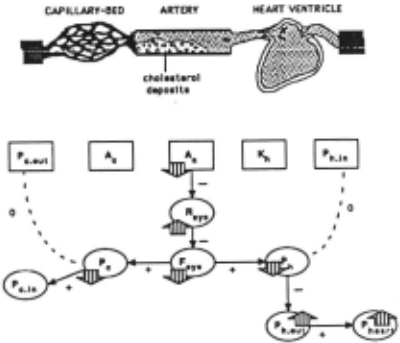
Labels on arcs are: +direct; - inverse; 0 constant . Squares are system parameters; circles are properties.
For example, a forward tracing of the causal chain pro duces the following output:
''The decrease of the artery's cross-sectional area (A a JJ.) causes the total resistance in the system to increase (Ray· '()-)and, as a result, the blood flow in the system will decrease (F·y· JJ.) . The decreased flow will cause the pressure-drop across the heart to decrease (Ph JJ.). Given the pulmonary pressure constant (Ph,,. 0 ), the de creased pressure-drop (Ph JJ.) indicates that the arterial pressure has increased (Pho., ft), which in turn causes the heart's internal pressure to increase (Pheart '()-) ... "
Giving a full account of the underlying causality from the decrease of the artery's cross-sectional area to the increase of the heart pressure and to the decrease of the blood flow to the capillaries, this explanation clearly spells out the causal relationships in the system.
3.3 First-Order Causal Chain Generation
We are now ready to discuss an algorithm of causal rea soning for QUALEX to derive first-order causal chains from the system topology (see Figure 2).
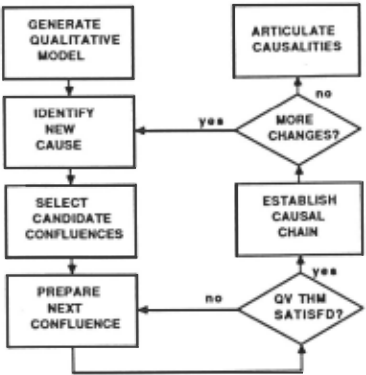
begin CAUSAL-GRAPH-GENERATION:
- Generate the complete set of confluences, CONFS, from the system topology. CONFS must capture the component models and the continuity and compat ibility conditions in the system.
- Substitute in CONFS the identical variables in the system with a unique name. For example, if an artery is connected to a capillary bed, then the out coming pressure from the artery would equal the incoming pressure to the capillary bed. These two names will be substituted with a common internal name chosen by the system.
- Gather the system parameters from CONFS into Svs-PARAMS. Identify the cause, C, chosen by the user in Svs-PARAMS. Mark the qualitative values of the variables in Svs-PARAMS except C as 0 in CONFS.
- Draw square nodes for the variables in Svs-PARAMS and draw circle nodes for other system properties. The positions of the nodes are chosen to reflect the positions of the corresponding system components' icons in the simulation.
- Select from CONFS those candidate confluences which involve the cause C and put these confluences in CF-SET.
- For each CF in CF-SET, do:
- Find those variables in CF whose qualitative value is not known and put them in UNKNOWN. Put the remaining variables into KNOWNS.
- If UNKNOWN contains only one variable V, and the variables in KNOWNS all play an identical role R, then
Assign (sign(V) x R x (-))as the qualitative value for V . Note that sign(V) is a function returning the sign of variable V in CF.
Draw a positive arc from C to V if the qualita tive values of V and C are equal, or a negative arc if the qualitative values of V and C are op posite. Store CF as a justification for the arc just drawn. Identify V as a new cause C, and recurse from step 5.
end CAUSAL-GRAPH-GENERATION.
This procedure starts from the root cause, a system parameter, to derive the qualitative values of those sys tem properties whose changes are directly related to the cause. Each variable is assigned a qualitative value only once. These variables in turn become the causes that propagate further changes. Note that a single perturbation assumption is used (step 3) to reduce the complexity of multiple causalities. This suggests that in order to derive a causal chain, one can hold all but one causal parameter constant so as to create a situation ideal for studying the causal impact of this individual cause on all the system properties. The advantage of this is obvious: when a variable, X, remains constant, 8X = 0. The zero effects can be ignored during qualita tive reasoning.
The key notions used in the algorithm are the roles of qualitative variables in the model and the QV theorem described above. These notions are formed on the ba-. sis of mathematical deductive reasoning about the con straint equations. Thus, the correctness of the algorithm for generating the causal chains is entirely dependent on the validity of the qualitative model of confluences. For the model to be valid, it is essential that it is both cor rect and complete: correct in the sense that it does not violate the underlying causal principles of the domain, and complete in the sense that none of the device de scriptions and the system's compatibility and continuity conditions are missing. With a valid qualitative model of the system, this algorithm will always generate the optimal causal graph in the sense that the causal chain does not "leap over" any particular concept underlying the causalities.
4 Discussion
One limitation in the current approach is that it does not handle circular topologies with confluences, which only describe changes in an intrastate [deKleer and Brown, 1984]. Adding this extension would allow the represen tation of feedback .
QUALEX is domain-independent . It is based on device-ontology to generate qualitative, causal explana tions. QUALEX has been implemented in a version of Heart Works written in KEE (IntelliCorp. Corp.) and Common Lisp on a Symbolics 3645. As a result of a ju dicious choice of data structures, the algorithm is fairly efficient and runs sufficiently fast for human-computer interaction. For a qualitative model with q system com ponents, n confluences, and an average number of v vari ables in a confluence, the computing time is O(q + nv) . In the CAUSAL-GRAPH-GENERATION algorithm, step 1 takes O(q); step 2 takes O(n); step 3 takes O(n); step 4 takes O(nv); step 5 takes O(n); step 6 takes O(nv). The total complexity, therefore, is O(q + nv).
Once the causal graph is generated the tutoring sys tem can use it for either student modeling purposes or explanation and remediation. If it is used for student modeling, the causal graph can be generated as the ex pert model of the causality of the system and used in traditional student overlay models. If it is used directly as output, such as in our simulations, the system must integrate the output into the user interface or discourse manager. We have experimented with displaying the causal graph directly as part of the simulation window. The results of extensive protocol studies indicate that after students learn to read the notation, it seems to be an effective addition to animation in explaining the be havior of the system. In addition to a graphic display, we have also converted the causal graph output into syn thesized English text. A more sophisticated use of the causal graph could focus on sub graphs of the explanation in response to student modeling concerns.
We should finally point out that the QUALEX algo rithm will also work in tutoring systems that are not simulation based. All that is necessary is provision of the initial system parameter values. These function as the initial causes in the causal chain.
5 Conclusion
In this paper, we have presented QUALEX, a sys tem and algorithm for generating first-order qualitative causal graphs for tutorial purposes based on deKleer and Brown's qualitative modeling theory. QUALEX is em bedded in a constructive simulation environment called Heart Works which teaches hydraulics knowledge about the cardio-vascular system to first year college biology students.
@inproceedings{ijcai1989p79,
  title     = {Generating Causal Explanation from a Cardio-Vascular Simulation},
  author    = {Douglas, Sarah A. and Liu, Zheng-Yang},
  booktitle = {Proceedings of the Eleventh International Joint Conference on
               Artificial Intelligence, {IJCAI-89}},
  publisher = {International Joint Conferences on Artificial Intelligence},
  editor    = {N. S. Sridharan},
  pages     = {489--495},
  year      = {1989},
  month     = {8},
  note      = {Intelligent Tutoring Systems},
  url       = {https://ijcai.org/proceedings/1989/79},
}
TY - CPAPER TI - Generating Causal Explanation from a Cardio-Vascular Simulation AU - Douglas, Sarah A. AU - Liu, Zheng-Yang T2 - Proceedings of the Eleventh International Joint Conference on Artificial Intelligence, IJCAI-89 PB - International Joint Conferences on Artificial Intelligence PY - 1989 SP - 489 EP - 495 UR - https://ijcai.org/proceedings/1989/79 ER -Copied
Machine-readable versions of this paper, for tools and AI agents:





