
Correct Parallel Status Assignment for the Reason Maintenance System
Proceedings of the Eleventh International Joint Conference on Artificial Intelligence. Tools. Pages 30-34.
© 1989 International Joint Conferences on Artificial Intelligence
Abstract
This paper represents a beginning development of a parallel truth maintenance system to interact with a parallel inference engine. We present a solution which performs status assignments in parallel to belief nodes in the Reason Maintenance System (RMS) presented by [Doyle, 1979], [Doyle, 1983]. We examine a previously described algorithm by [Petrie, 1986] which fails to correctly detect termination of the status assignments. Under Petrie's algorithm, termination may go undetected and in certain circumstances (namely the existence of an unsatisfiable circularity) a false detection may occur. We present an algorithm that corrects these problems.
- [Dijkstra and Scholten, 1980] E.W. Dijkstra and C.S. Scholten. Termination detection for diffusing compu- tations. Information Processing Letters, 11(1), 1980.
- [Doyle, 1979] Jon Doyle. A truth maintenance system. AI, 12(3):231-272, nov 1979.
- [Doyle, 1983] Jon Doyle. Some theories of reasoned as- sumptions, an essay in rational psychology. Technical Report CMU-CS-83-125, Carnegie-Mellon University, May 1983.
- [Fulcomer and Ball, 1988] R. Fulcomer and W.E . Ball. Correct parallel status assignments for the reason maintenance system. Technical Report WUCS-88-26, Washington University, 1988.
- [Fulcomer and Ball, 1989] R.M. Fulcomer and W.E. Ball. Towards a fully parallel reason maintenance sys- tem. In The 2nd Int 'I Conference on Industrial and Engineering Applications of Artificial Intelligence and Expert Systems, 1989.
- [Petrie, 1986] C. J. Petrie. A diffusing computation for truth maintenance. In Proceedings of the IEEE In- ternational Conference on Parallel Processing, pages 691-695, 1986.
References were extracted automatically from the PDF and may contain errors.
Full text extracted automatically from the PDF; figures, tables and equations may differ. The PDF is the version of record.
1 Introduction
A major problem facing AI researchers today is that computation time for inferencing and related activities is extremely expensive. This means large knowledge bases will be almost impossible to use in practical applications t~at require a fast or predictable response time (e.g. real time systems). However, by designing and using efficient parallel algorithms, we hope to generate a significant in crease in speed over sequential methods.
We will present a solution which performs status as signments in parallel to belief nodes in the Reason Maintenance System (RMS) presented by [Doyle, 1979], [Doyle, 1983]. [Petrie, 1986] describes an incomplete par allel algorithm using the technique of diffusing compu tation given by [Dijkstra and Scholten, 1980].
2 Background
In this section we present a brief overview of both ter mination detection for diffusing computation problem as presented by [Dijkstra and Scholten, 1980] and Doyle's RMS. Then, we give Petrie's parallel solution for giving status assignments to belief nodes and show how this solution can lead to incorrect termination detection.
*Supported by McDonnell Aircraft Company under con tract number Z71021.
William E. Ball Department of Computer Science Washington University One Brookings Drive St. Louis, MO 61630
2.1 Diffusing Computation
In the diffusing computation problem, we are given a system consisting of a number of nodes (processors) able to communicate over links. \Ne assume the existence of a node without incoming links and call this node the en vironment or root. All other nodes are called internal nodes. Initially each node is in a neutral state. A dif fusing computation begins when the environment sends a message to one or more successor nodes. This message or set of messages is to be sent only once.
When a neutral internal node receives a message, it becomes engaged and may send messages to its succes sor nodes. At some later time it returns to the neutral state; nodes in the neutral state may not send messages . A node may change from neutral to engaged and back several times during the computation.
A diffusing computation is defined as having termi nated when all nodes have reached the neutral state. The computation is such that only a finite number of messages is sent from any internal node. With this re striction, it can be shown that the computation will even tually terminate.
We require that the environment be able to tell that the diffusing computation has terminated. To detect ter mination, a signaling system is superimposed on the dif fusing computation such that the environment will be signalled when the computation is completed. The sig naling is restricted to require that from the moment the computation begins to the time the environment is sig naled, each link will have carried as many messages in one direction as it has carried signals in the other direc tion.
The signalling system obeys the following rules:
Rule 1 When a neutral node receives a message and be comes engaged, it "remembers" the identity of its en gager.
Rule 2 When an engaged node becomes neutral, it sends a signal to its engager.
Rule 3 An engaged node may not become neutral until it has sent a signal for each message it has received; the signal for the message which. caused it to become engaged is sent last (as implied by the Rule 2 ) .
Rule 4 An engaged node may not become neutral until it has received a signal for each message it has sent.
From these rules, the following theorems are concluded (see [Dijkstra and Scholten, 1980]):
Theorem 1 At all times, a directed path exists from the environment to each engaged node along the edges from engagers to engaged nodes.
Theorem 2 A bounded number of steps after the dif fusing computation has terminated, the environment will have returned to the neutral state.
Theorem 3 When the environment has returned to the neutral state, the diffusing computation has terminated.
2.2 Review of Doyle's RMS
An RMS is used along with an inference engine (IE) to maintain a consistent set of beliefs and inferences. The inferences are then passed to the RMS, which creates a node for each belief and maintains the dependencies between these beliefs.
Each node in the RMS is to be assigned a status of IN or OUT, where an IN label means the node is believed to be true, and an OUT label means either the truth value of the node is not known or the node is not be lieved to be true. Associated with each node is a set of justifications, in which each justification contains an IN SET and an OUTSET. An INSET contains those nodes which must be believed in order for the node to be la beled IN. An OUTSET contains those nodes which must not be believed in order for the given node to be labeled IN. A justification is valid if every node in its INSET is labeled IN and every node in its OUTSET is labeled OUT. If at least one justification in a node's justification set is valid, the node is labeled IN; otherwise the node is labeled OUT.
The consequences of a node C is the set of all nodes which mention C in one of their justifications. The sup porters of the node (supporter-nodes) is the set of nodes which the RMS used to determine the status of the node. For IN nodes, the supporter-nodes are the INLIST U OUTLIST of its supporting justification. The RMS picks one node from each justification in the justification set to form the supporter-nodes of an OUT node. These nodes are either an OUT node from an INLIST or an IN node from an OUTLIST in a justification.
The ancestors of a node are formed by taking the tran sitive closure of the supporter-nodes of that node. The set may include the node itself.
2.3 Petrie's Use of Diffusing Computation
To take advantage of the proofs supplied [Dijkstra and Scholten, 1980] for diffusing computations, [Petrie, 1986] proposed considering each node in a RMS to be a sep arate processor. Justifications are then represented as directed arcs from antecedents to the consequence; only a single consequence is computed by each rule in this representation. In all figures, a justification is rep resented by a circle with incoming arcs from an tecedents and outgoing arcs to the consequence. A plus next to the antecedent arc indicates an an tecedent in the INSET and a minus indicates an antecedent in the OUTSET. Diffusing computation is used to give a status assignment of IN or OUT to each node corresponding to the labeling that is performed in Doyle's algorithm.
Petrie admits that his computation is incomplete in the same sense that Doyle's is incomplete, which is with respect to unsatisfiable circularities being introduced into the network by a new justification. This in turn creates a graph for which no consistent status assign ment can be found.
Each processor stores the set of justifications for that node. Messages are sent to consequences and signals are sent to antecedents in the justification set. When all belief nodes are in a neutral state, one node becomes the environment or root of the diffusing computation when its status changes from OUT to IN by the entrance of a new justification (passed from the IE) .
The algorithm begins by the root node issuing a "NIL sweep", which sets the status of its transitive closure of consequences to NIL. This is done using a diffusing computation. Once the "NIL sweep" has terminated, a second diffusing computation is begun for IN/OUT status assignments.
The use of the engager is as discussed in the previous section. Once a node receives its first message from its engager, it checks to see if its status will change. A NIL status will change to IN or OUT, so all statuses will change at least once. If the status is unchanged, a signal is sent back to the predecessor and no messages are sent to the consequences. If the status of the node is changed, it sends messages to its consequences. A processor also replies to any sender if it has already received another message to which it has not replied, i.e. it is engaged and the new message does not change the node's current status assignment. A node replies to the engager (under normal circumstances) when it receives replies from all of its consequences or successors.
To detect unsatisfiable circularities, Petrie proposes the following solution. Along with a status message, an antecedent node sends a list of ancestors to its conse quences. This list will include the antecedent when it is sent. If the consequent node appears in an ancestor list it receives, within a message that changes its status, it signals a "trouble reply" to its engager. Thus a node can determine if its current status depends on itself. Petrie states that if an engaged node switches status twice as a result of being its own ancestor then it is involved in an unsatisfiable circularity. We will also use this obser vation in our algorithm.
2.3.1 Problems with Petrie's Algorithm
In this section, we point out three problems with Petrie's solution.
Problem 1 Incorrect definition of environment node.
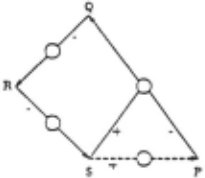
Petrie does not define the environment node such that it has no incoming edges, which permits termination to be detected. In his computation, the environment node may have incoming edges, as in Figure 1. Since S is both a supporter of P and in the transitive closure of consequences of P, P may receive incoming messages.
Problem 2 Possible false termination detection in the presence of unsatisfiable circularities.
In detecting unsatisfiable circularities, Petrie's solu tion allows the consequence to signal a "trouble reply" to its engager if the consequence appears in an ancestor list within a message which changes its status. But if the consequence signals "trouble" to its engager, it can vio late all the rules regarding signalling the engager. Such a signal must be sent only when the consequence becomes neutral; only after the consequence has sent signals for all other messages it has received; and only after it has received signals for all messages it has sent.
Even if the sending of the trouble signal is otherwise legal, the sending of this signal makes the consequence neutral. Since it must change status, it will have to send messages to transmit its new status to its conse quences. These messages violate the requirement that neutral nodes send no messages.
The consequences which were engaged by the <.roubled node above may still be computing their own statuses. The signaling of the trouble reply has cut off the directed path from the environment to such consequences. The environment may detect termination while computation is still going on. Thus it is possible to falsely detect termination.
Problem 3 Non-termination of the underlying compu tation.
The termination-detection algorithm for diffusing computations requires that all nodes send a finite num ber of messages. In Petrie's algorithm, if an unsatisfi able circularity occurs all nodes on the cycle will com pute forever, changing their statuses and sending update messages to their consequences on the cycle. Petrie's al gorithm detects the existence of such cycles but does not stop the status-assignment processing of the nodes on the cycle.
3 Improved Algorithm
The solution we present also uses diffusing computation to perform the status assignments. We use the same mapping Petrie proposed, i.e. each node in the RMS is a separate processor and justifications are represented as directed arcs from antecedents to a single consequence. We will use the term cycle to mean the circular passing of messages. A better term would be .circularity, but its use becomes too cumbersome. For our purposes, a cycle may become an unsatisfiable circularity or may be satisfied.
In our solution, the environment or root node does not represent a belief. It is a separate node which is re sponsible for receiving the justification from the IE and passing the first message to the consequece of that justi fication to begin the computation. All belief nodes will be considered internal nodes and will compute the same algorithm. The node whose status changes because of the incoming justification will be called the head node. In this section we will discuss the actions of an internal node in general, including the handling of unsatisfiable circularities. Then we will discuss the special character istics of the head node and those of the environment. Theorems and selected proofs appear in Section 4.
3.1 Actions of an Internal Node
We will refer to Figure 2, throughout this section, in which the dotted justification arc represents the incom ing justification from the IE, making P the head node. When an internal node, such as Q, receives its first mes-
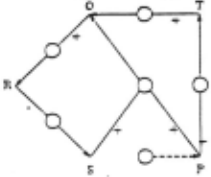
Fi~urt ~ . sage from an antecedent, such as T, it becomes engaged and T is considered its engager. A message is of the following form:
[1nessage type, antecedent, antecedent status, ancestor list, cycle list].
Each time Q receives a message, it will send messages to its consequences, which is R in this figure, if Q's status or label changes, or if its force list is non-empty. We will discuss the properties of the force list in a later section.
In order to perform the parallel status assignment computation, an internal node must have the following extra parameters. The state holds the entire state of be lief node prior to the beginning of this computation. The ancestor list holds the node's current ancestor list. The possibles list holds all of the cycles this node has de tected. The force list holds all of cycles which have pre viously been detected as unsatisfiable circularities. The signal wait list holds all ordered pairs of the form ( cy cle, 'U') and/or (cycle,'S') to be sent within the signal to the nodes engager. The detection list holds those cycle list for which it has sent or will send an unsatisfiable pair (cycle,'U') in its signal back to its engager.
3.1.1 "NIL sweep" Message
If the message type is "NIL sweep", and T is the en gager of Q, then T sends a message:
to Q. At which time Q performs the following steps: (1) sets T as its engager, (2) saves its entire state prior tore ceipt of the message (3) sets its status to NIL, ( 4) clears its ancestor list, (5) makes any changes to its justification list, invalidating any justifications where T was an an tecedent if such justifications were previously valid, (6) sends messages of the "NIL sweep" to its consequences, if Q 's status changed because of this message, and (7) signals back to T at any time, when all consequences have signaled to Q, unless Q receives another message to which it must return a signal before sending a signal toT.
By Theorems 7 and 9, Q will never receive a mes sage of another type as long as it is engaged because of a "NIL sweep" message, and the transitive closure of consequences of the head node will be set to NIL be fore sending another message of a type other than "NIL sweep" .
3.1.2 "Label" Message
The "label" message has the same format as the "NIL sweep" message, except the type of message is different, and all statuses being sent will be either IN or OUT.
Any node, such as R, which receives a "label" mes sage from an antecedent, such as Q, will perform the following:
If R's detection list is non-empty, then it has sent a pair , ( cyclelist , 'U') in the signal to its previous engager when R became neutral, for each cyclelist that is an el ement of R's detection list. Upon receiving a label mes sage at this time, R will place new pairs in it's signal wait list of the form ( cyclelist, 'S') for all elements of its detection list , and set the detection list to empty. This is necessary for handling circularities that may have looked unsatisfiable at one point during the computation, but may actually be satisfiable once all the labels have been propogated. The elements of the signal wait list will be included in R's signal to its engager. Once R signals its engager, its signal wait list is cleared.
If the cycle list sent within Q's message is non-empty, R must place the cycle list in its force list after it has sent its messages out or has determined that it does not send any further messages. If R determines that it must send messages because of the message it received from Q, R must include the cycle list received in its message to its consequence in the cyc)e list. This ensures that each member of the cycle becomes aware of its presence on that cycle. If the cycle list is already present in the force list , this cycle list will not be passed in the next messages sent by R. If R determines that it does not send any messages because of Q, then the cycle list is not passed. Below, when the case asks if R's force list is empty, it is asking for the state of the force list prior to R's receipt of the message.
R will then do the following steps if R itself does not appear in the ancestor list sent by Q.
Case 1: the message does not causeR to change status and R's force list is empty.
R may signal back at any time to the sender of the message, obeying all rules of signaling. R will not send any further messages to its consequents.
Case 2: the message does not cause R to change status and R's force list is non-empty.
Each element of the force list tells R which possible unsatisifiable circularities it is on. R intersects each el ement of the force list with its consequences. For each result of the intersection, which is the consequence on the cycle that R is present on, R is forced to send its current status. The force list is then set to empty.
Case 3: the message does cause R to change status.
Since R changes status, it must change its supporter nodes and ancestors. Then it sends its new status, and ancestor list using another "label" message, to all of its consequences. If R's force list is non-empty, it sets it to empty since those consequences on the force list will receive a message from R anyway.
Internal node R will do the following if R does ap pear in the ancestor list sent AND R's possibles list does not contain an element equivalent to the ancestor list R received. In other words, this is the first time R has detected it is on this specific cycle.
For Case 1 above, R will not send any messages to any consequents. Since it does not send messages through the cycle, it does not consider seeing a cycle at all.
For Case 2 above, R is the first node of the cycle it received to detect that this cycle exists. But R may be involved in another cycle which may be an unsatisfiable circularity, therefore R must propagate its current status to the consequents on the cycles that are elements of the force list , but not necessarily to all consequents.
For Case 3 above, since R must change status under these circumstances, it places the cycle list from the an cestor list Q sent in its possibles list. Then R resets its own ancestor list to itself only. All this is in preparation to detect an unsatisfiable circularity. R then sends out "label" messages to all its consequents, but it includes the detected cycle in the cycle list field of the message to its consequence on the detected cycle. The force list is reset to the incoming cycle.
Internal node R will do following if R does appear in the ancestor list sent AND R's possibles list does contain an element equivalent to the cycle R received on the ancestor list from Q.
For Case 1 above, Since R has no reason to pass any "label" messages to its consequences, it does not detect an unsatisfiable circularity. The cycle is removed from its possibles list.
For Case 2 above, R is both engaged and has detected its own presence on a cycle. But since its status does not change, R cannot detect an unsatisfiable circularity. R may be involved in other unsatisfiable circularities be cause its force list is non-empty. Thus R must send out its current status to all consequents that are elements of cycles on the force list , though R does not send out the cycle list it just received in these messages. Then the force list is set to nil and the cycle is removed from R's possibles list.
For Case 3 above, this will be the second time R is forced to change status due to the same cycle. Therefore R is the first to detect a possible unsatisfiable circularity. It moves the cycle from the list of possibles to the detec tion list, (deleting it from its possibles list), places this cycle in an ordered pair with 'U' to send in its signal wait list R does not send any messages to any consequences, since it is currently in an inconsistent state. This is up held even if the force list is non-empty. But since no messages are sent out, the force list remains as it is. Thus R ceases the message passing around the nodes of this particular cycle.
The force list is what ensures that if any node on a cycle receives a message after an unsatisfiable circularity has been detected by some node on the cycle, that the node which detected the circularity and has included it in its signal to its engager, will now include the matching satisfied pair in its signal to its engager. This is a neces sary construct, since a node may think it sees an unsat isfiable circularity and send such a signal, because of a delay in the message passing of another node which will satisfy the cycle. Petrie gives an example of this using Figure 2, in which the dotted line represents the incom ing justification for P. Thus P is the head node. After P sends out its label messages to Q and T, messages are passed around the cycle Q, R, S until Q detects an un satisfiable circularity and signals it toP, only to receive a satisfying message from delayed T, which causes Q to sig nal the matching satisfying pair to T, which propagates it back to P. So no unsatisfiable circularity is present.
3.1.3 "Reset" Message
A third and final message that a node, say Q, may receive is the "reset" message. The "reset" message also has the same format with all of its fields empty except for the type field. This message instructs Q to reset itself to the state which it saved when it received its first "NIL sweep" message. The reset message is sent when unsatisfiable circularity was detected within the graph during the assignment of IN and OUT status to the belief nodes. We leave it as the responsibility of the head node to detect the actual presence of such a circularity as will be presented in the next section.
Instead of leaving the graph in a state of inconsistent labelings, the graph will return to the state it was in prior to the entry of the justification which caused the diffusing computation. It is this part of the computation which is incomplete, in that we do not solve the labeling problem, but attempt to avoid it.
The step an internal node follows when it receives the "reset" message is to simply reset its state and pass the message to its consequents.
3.2 Actions of the Environment and Head Node
The head node is the consequent of the incoming justifi cation. This node is engaged by the environment. Every internal node will have the algorithm available for exe cution if it becomes the head node, but only one such node will execute the code during a single diffusing com putation. The justification will be added to the head node's justification set and the appropriate supporter nodes identified. Computation proceeds only if the jus tification is valid and the head node changes status from OUT to IN. The first set of messages the head node initi ates are the "NIL sweep" messages. The head node will only be set to NIL if it is involved in some cycle present in its transitive closure of consequences, as in Figure 1, where the dotted line represents an incoming justifica tion. Theorem 7 shows that eventually the head node will receive all signals back from its consequences after sending the "NIL sweep" message. After all signals are received, the head node initiates the "label" messages.
It is obvious that every node that receives a "NIL sweep" message will eventually receive a "label" message. If the head node has the label of NIL, it must check its jus tifications to change its own status, from NIL to IN or OUT before sending the first "label" message. In Fig 1. the entering justification became invalid, so the head node, P, assigns itself the status of OUT, and sends its new status in the "label" messages to Q.
Since the head node is also an internal node, it may de tect an unsatisfiable circularity which involves it. If the head node detects an unsatisfiable circularity in which it is involved, it saves this detection and the cycle list un til all signals are received. Once the head node receives all signals from its consequences, it performs a matching between the pairs (cycle, 'U') and (cycle, 'S') propagated through the signals received, in an attempt to match ev ery pair with a 'U' to a pair with the same cycle list and an 'S'. By theorem 5, the existence of one pair with a 'U' without a match to a pair with an 'S' means there exists an unsatisfiable circularity with the nodes in the unmatched cycle list. Once such a circularity is detected, the head node will send out the "reset" messages to all its consequences. By Theorem 10, eventually P will receive all signals from its consequences. Then P will signal to its engager the environment, which will detect termina tion. If no unsatisfiable circularity can be detected, P will not issue the "reset" message, therefore not send ing a'ly messages to its consequents. As above, it will eventually signal its engager, the environment.
4 Proof of Correctness
This section presents theorems and selected proofs of the correctness of the algorithm for parallel status assign ment. All proofs not given can be found in [Fulcomer and Ball, 1988]. Previously we defined a cycle to be a circularity of status assignments, i.e. the status of each node within this circularity actually depends on itself, or a node is its own supporter. A node N detects a cycle C if N sees itself on the ancestor list sent in a message from an antecedent A and the status of A causes N to change status. A node is a detector of the cycle if the node detects the cycle. A node is no longer a detector of a cycle if the cycle has been broken. Breaking a cycle occurs when a node in the cycle becomes supported by a node outside that cycle. A node N detects an unsat isfiable circularity C, if N is a detector of the cycle C', that matches and at any point prior to C' being broken, N sees itself on the ancestor list sent in a message from the same antecedent as in C', such that N must change status. The definitions of detector and broken unsatis fiable circularity are the same as that for a cycle. The following lemmas are necessary.
We state the following lemmas.
Lemma 1 The detector of an unbroken cycle is unique. Lemma 2 The detector of an unbroken unsatisfiable circularity is unique, and this node is the unique detector of the unbroken cycle corresponding to this unsatisfiable circularity.
Lemma 3 If an unsatisfiable circularity C is detected, all nodes on C will have C in their force list.
Lemma 4 Let C be an unsatisfiable circularity. If any node on C receives a message then all nodes on C will receave a message.
Lemma 5 Let C be an unsatisfiable circularity with N as its detector. Another node on C cannot detect C as a cycle unless N has received a message resulting from the breaking ofC.
A corollary of this lemma is:
Corollary 1 Let C be an unsatisfiable circularity with N as its detector. Another node on C cannot detect C as an unsatisfiable circularity unless N has received a message resulting from the breaking of C.
Lemma 6 Let C be an unsatisfiable circularity and N be its detector. The breaking of C results in N sending the pair ( C, 'S') in its signal to its en gager.
Theorem 4 If an unsatisfiable circularity remains un broken the message passing within the circularity will halt.
Let C be the unsatisfiable circularity, and N be its de tector. Part of detecting C, involves N changing status. But by construction of the algorithm, N will not send out any messages when it has detected C. Since N ceases all message sending, and none of the rules in section 2 have been violated by N ceasing, N will eventually enter the neutral state. If C remains unsatisfiable, i.e. C is not broken, then message passing around C will not occur during the rest of the computation. By Lemmas 4, and 6, if any other messages are passed along C, N will even tually signal that C is satisfied. If C is satisfiable then all rules are maintained and N will eventually reach the neutral state. Since these are the only two cases, the theorem holds. 0
Theorem 5 Let C be a cycle and P bethe head node. Given P has received all signals corresponding to all "la bel" messages it has sent out. If the pair ( C, 'U') is prop agated to the head node and no pair ( C, 'S') is propagated to the head node, then C is ultimately unsatisfiable.
P cannot match the pair (C,'U') with a pair (C, 'S'). Since (C,'U') has reached P, by construction of the algo rithm, there must exist some node N which detected C to be an unsatisfiable circularity. There is matching (C,'S') sent to P by N, so by Lemma 6, N cannot have received another message after the detection of C. By Lemma 4, no nodes on C received any messages. Thus all nodes on C must still be in a state of inconsistency. Therefore, an unsatisfiable circularity exists in the graph. 0
We state the following theorem without proof.
Theorem 6 Let C be a cycle. If for every pair (C, 'U'), there is a matching pair (C, 'S') propagated to the head node, then no unsatisfiable circularity exists.
Theorem 7 There will be no overlapping between the "NIL sweep" and the labeling algorithm.
To show this, we must show that all signals from "NIL sweep" messages eventually reach the head node before any "label" messages are sent. Since there is only one status involved in performing the "NIL sweep", there can be no unsatisfiable circularities. Even stronger, no node will detect any cycle because after the first change in status to NIL, the node will not change again when another "NIL sweep" message is received. We assume all node obey the rules in section 2. Therefore when the head node receives all signals corresponding to the "NIL sweep" messages it sent, all nodes in its transitive closure of consequences will be in the neutral state. 0
We state the following theorems without proof.
Theorem 8 There will be no overlapping among the la beling computation and the reset computation.
Theorem 9 There will be no overlapping of the "NIL sweep" and the reset computation.
Theorem 10 If the reset computation is necessary, the head node will receive all signals corresponding to its re set messages, resulting in termination of diffusing com putation.
5 Conclusion
Since none of the conditions for termination detection for diffusing computation are violated, this algorithm will terminate. Further research includes locking mech anisms so that multiple justifications can be sent by the IE simultaneously to initiate multiple diffusing compu tations and the handlin~ of contradictions in parallel. [Fulcomer and Ball, 1989 J
Acknowledgments: Thanks go to Charles Petrie for his initiation of the problem and discussion. We would also like to thank the CICS group for their discussion and readings of this text.
@inproceedings{ijcai1989p5,
  title     = {Correct Parallel Status Assignment for the Reason Maintenance System},
  author    = {Fulcomer, Rosanne M. and Ball, William E.},
  booktitle = {Proceedings of the Eleventh International Joint Conference on
               Artificial Intelligence, {IJCAI-89}},
  publisher = {International Joint Conferences on Artificial Intelligence},
  editor    = {N. S. Sridharan},
  pages     = {30--34},
  year      = {1989},
  month     = {8},
  note      = {Tools},
  url       = {https://ijcai.org/proceedings/1989/5},
}
TY - CPAPER TI - Correct Parallel Status Assignment for the Reason Maintenance System AU - Fulcomer, Rosanne M. AU - Ball, William E. T2 - Proceedings of the Eleventh International Joint Conference on Artificial Intelligence, IJCAI-89 PB - International Joint Conferences on Artificial Intelligence PY - 1989 SP - 30 EP - 34 UR - https://ijcai.org/proceedings/1989/5 ER -Copied
Machine-readable versions of this paper, for tools and AI agents:





