
The ELINT Application on Poligon: The Architecture and Performance of a Concurrent Blackboard System
Proceedings of the Eleventh International Joint Conference on Artificial Intelligence. Parallel and Distributed Processing. Pages 212-219.
© 1989 International Joint Conferences on Artificial Intelligence
Abstract
In this paper we discuss Poligon, a skeletal system for the development of concurrent blackboard based applications, its architecture and the motivation for its design. A number of experiments have been performed in order to evaluate the performance of Poligon. Some of these are detailed and the results are shown. Lessons learned in the development of Poligon are given and conclusions about the performance of similar systems are drawn.
- [Aiello, 1986] Nelleke Aiello. User-Directed Control of Parallelism: The CAGE System. Technical Report KSL- 86-31, Knowledge Systems Laboratory, Computer Sci- ence Department, Stanford University, April 1986.
- [Delagi, 1986] Bruce Delagi. CARE Users Manual. Tech- nical Report KSL-86-36, Knowledge Systems Laboratory, Computer Science Department, Stanford University, 1986.
- Delagi et al., 19861
- Bruce A Delagi, Nakul P. Saraiya, Gregory T. Byrd. LAMINA: CARE Applications Inter- face . In Proceedings of Third International Conference on Supercomputing, pages 12-21, Boston, MA, March 1988 International Supercomputing Institute. Also Technical Report KSL-86-76, Knowledge Systems Laboratory, Computer Science Department, Stanford University, 1986.
- [Delagi and Saraiya, 1988] Bruce A. Delagi and Nakul P. Saraiya. ELINT in LAMINA: Application of a Concur- rent Object Language. In SIGPLAN Notices, February 1989, ACM. Also Technical Report KSL-88-33, Heuris- tic Programming Project, Computer Science Department, Stanford University, 1988.
- Robert Engelmore and Tony Morgan (eds.) Blackboard Systems. Addison-Wes- ley Publishing Company Inc., Menlo Park 1988.
- [Ensor and Gabbe, 1985] J. Robert Ensor and John D. Gabbe. Transactional Blackboards. In Proceedings of the Ninth International Joint Conference on Artificial Intelli- gence, pages 340-344, Los Angeles, California, August 1985. International Joint Committee on Artificial Intelligence [Fennell and Lesser, 1977]
- Richard D. Fennell and Victor R. Lesser. Parallelism in AI Problem Solving: A case Study of Hearsay-II. In IEEE Transactions on Computers, pages 98-111, February, 1977.
- [Lesser and Corkill, 1983] Victor R. Lesser and Daniel D. Corkill. The Distributed Vehicle Monitoring Testbed: A Tools for the Investigation of Distributed Problem Solv- ing Networks. In The AI Magazine, pages 15-33, Fall 1983.
- [Nii et al., 1988] H. Penny Nii, Nelleke Aiello and James Rice. Experiments on Cage and Poligon: Measuring the Performance of Parallel Blackboard Systems. In Dis- tribu.ted Artificial Intelligence II. L. Gasser and M. N. Huhns (eds). Pitman Publishing Ltd. and Morgan Kauf- mann, 1989. Also Technical Report KSL-88-66, Knowl- edge Systems Laboratory, Computer Science Department, Stanford University, October 1988.
- [Rice, 1986] James Rice. The Poligon User's Manual. Technical Report KSL-86-1 0, Heuristic Programming Project, Computer Science Department, Stanford Univer- sity, 1986.
- [Rice, 1988a] James Rice. Problems with Problem-Solv- ing in Parallel: The Poligon System. In Proceedings of Third International Conference on Supercomputing, pages 25-34, Boston, MA, March 1988 International Supercomputing Institute. Also Technical Report KSL- 88-04, Knowledge Systems Laboratory, Computer Sci- ence Department, Stanford University, January 1988.
- [Rice, 1988b] James Rice. The Advanced Architectures Project. Technical Report KSL-88-71, Knowledge Sys- tems Laboratory, Computer Science Department, Stanford University, January 1989.
- [Selig, 1987] Lawrence J. Selig. An Expert System using Numerical Simulation and Optimization to find Particle Beam Line Errors. Technical Report KSL-87-36, Heuris- tic Programming Project, Computer Science Department, Stanford University, 1987.
References were extracted automatically from the PDF and may contain errors.
Full text extracted automatically from the PDF; figures, tables and equations may differ. The PDF is the version of record.
1 . Introduction
It is often said that future AI applications will make signifi cantly greater computational demands than the present generation. The Advanced Architectures Project of Stanford University's Heuristic Programming Project [Rice, 1988b] is investigating this issue, since it has as its objective achieving computational speed-up for expert systems through the use of parallel hardware and new, advanced soft ware architectures. This requires the development of ev erything from designs for parallel hardware, which might be appropriate for the execution of future symbolic programs, through operating system and language concepts to problem solving frameworks and eventually mounting applications on them in order to test the new designs.
Poligon [Rice, 1986] is one of the problem-solving frameworks developed as part of the Advanced Architectures Project. In Section 2, we discuss Poligon's architecture as a design for a high-performance, concurrent blackboard system aimed particularly at the problem domain of soft real-time problems, and what motivated this design. Section 3 dis cusses the applications mounted on the Poligon framework and experiments performed on the Poligon system to mea sure its performance. Section 4 presents the results of these experiments and an interpretation of them. We conclude in Section 5 with a number of the lessons we have learned in the process and pointers for future research.
* The author gratefully acknowledges the support of the following funding agencies for this project; DARPA/RADC, under contract F30602-85-C-0012; NASA, under contract number NCC 2-220; Boeing Computer Services, under con tract number W-266875.
speed-up .I The main motivation of the Poligon system was to find a way to eliminate the serializing aspects of the blackboard model. We viewed this as doing the following:
- Eliminating the scheduling mechanism and finding ways to support concurrent rule activation all across the black board.
- Optimizing the design for distributed-memory, message passing hardware, which should be able to deliver the best performance for large numbers of processors (of the order of hundreds to thousands.)
- Distributing the knowledge base over the blackboard so that there would be no serialization in the access to the blackboard from the executing knowledge.
- Designing the system so as to allow it to be highly com pilable. It was clear from the outset that a considerable portion of the expense of existing AI systems is due to the fact that they are optimized for easy modification and debugging, rather than high run-time performance. The resulting system, therefore, had to be designed so as to be able to be compiled efficiently yet still be intelligible and debuggable during the development cycle.
As these ideas progressed we developed the notion of a blackboard consisting of active nodes, tightly associated with the knowledge relevant to them.
A very simple scheme was developed for invoking the knowledge that had been distributed to the blackboard nodes: rules are activated as daemons as a result of modifications to the slots of a node (see Figure 1).
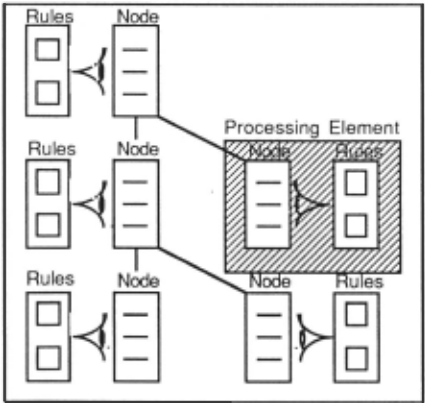
The distributed-memory hardware model, on which the Poligon system was to operate had the property that each processor was · effectively a uniprocessor system. This meant that if we viewed the blackboard with a "Node as a Process/Processor" model then we would lose potential par allelism due to being able to execute only one piece of code (rule) at a time for any given node.
I Speed-up can be viewed as the ratio of the system's speed using N processors to its speed using only one.
What we needed, therefore, was a mechanism to allow the activation of multiple rules for any given blackboard node. This caused us to develop a model of Po ligon which was as follows: "A blackboard node is a process on a processor, surrounded by a collection of processors able to service its requests to execute rules." It can easily be seen that this model is very close to a distributed object system model. This is by no means a coincidence. The underlying hardware system on which Poligon was implemented was a con current, distributed object oriented system [Delagi et al., 1986].
The model expressed above is not without problems. In order to minimize the probability of a node being locked for a long period, which would delay remote access to it, as much processing is done in the remote rule invocations as possibJe2. This means that, when the rules execute, they have to do so in the context of a snap-shot of the solution state as it was when the rule was invoked (see Figure 2). Remote reads to other nodes, even the invoking node, are expensive and one cannot guarantee that things haven't changed by the time that the result of the read has been re turned .
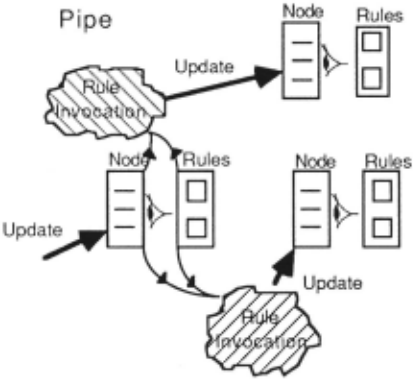
2There are no user accessible locks in Poligon. Poligon nodes become locked (enter critical sections) during slot reads and updates, which are cheap operations. The Poligon archi tecture is such that deadlock will not happen as a result of system action, though the user can still write a program that will live-lock, e.g. two nodes each waiting for one node to update the other will wait for ever.
This Jed to the development of the idea of a Po ligon node as being an agent capable of evaluating its own performance. Mechanisms had to be included so as to allow the system to be able to assess any request to modify its local state and to decide whether to perform the update, or what else to do in stead, on the basis of its own view of how it is progressing towards its goal of solving the problem.
3. Experiments on Poligon
In this section we briefly describe the experiments performed on the Poligon system to date. Two applications have been mounted on Poligon: Elinl, a soft real-time situation as sessment problem and ParAble, a diagnostic application for particle accelerator beam-lines [Selig, 1987]. The experi ments with the Elint application have now been completed, whereas those on the ParAble system are in their infancy, so only the Elint application will be considered here. A more detailed treatment of the Elint experiments can be found in [Nii et al., 1988].
The Elint application encodes knowledge used to interpret the radar emissions made by planes that are received by ground-based tracking stations distributed across the country. Because these tracking sites are passive devices, they can only detect the bearing and spectral characteristics of the radar emissions. Between them, it is their responsibility to deduce a position, course, identity and intention for any air craft traveling through the monitored airspace. The Elint application simulates a central machine that integrates re ports from these detection sites in order to achieve the over all goals mentioned.
The important characteristics of the Elint problem were:
- A continuous stream of input data.
- No a priori knowledge of the behavior or number of the aircraft being tracked.
- The need to emit periodic reports capturing the system's evolving view of the solution.
The Elint problem was chosen both because it was non trivial and was in a class of problems, for which blackboard systems had already been used, and also because it was hoped that parallelism would be readily available. It was antici pated that parallelism could be extracted from the concurrent execution of knowledge on any given part of the solution space and from the potentially large number of independent elements in that solution space, i.e. aircraft.
The application was taken from a serial implementation and was not restructured so as to be better suited for parallel execution. The blackboard was, however, composed of three distinct layers in the abstraction hierarchy. Data flowing from one level to the next allowed pipes to be formed that were three stages long.
Perhaps the most important lesson that we learned from performing these experiment<; was to find a way to measure the relative performance of concurrent real-time systems. The best way that we found to do this was to pump data into the system at a given rate, which was under the control of the user, and examine the system's output over time. There is a measurable time between the time that data comes into the system and the time that any associated reports come out of the system. If this time difference increases on average over the course of a run then the system was not able to keep up with the rate at which data was being pumped into it. The experiment was then performed again with the data rate turned down until the report latency did not increase. This gave us a measure for the system's throughput, which we took to denote its peak performance.
The experiments that were performed were intended to measure a number of different aspects of the system's per formance:
- The speed-up that the Poligon system could deliver.
- The peak throughput of the system.
- The ability of the system to exploit large knowledge bases.
- The granularity of the system.
Experiments to measure these are described in Section 4.
4. Experimental Results
The space available for this paper does not allow a full ex planation of the experimental results, so the interested reader is again advised to refer to [Nii et al., 1988] for more details. It is hoped that the treatment here will be sufficient to give the gist of what we have learned.
It should be noted here that wherever reference is made to absolute times, these are measured in terms of the perfor mance of the simulated hardware on which the Poligon sys tem runs [Delagi, 1986]. Each processing element of this machine is of about the performance of a TI Explorer™ II+ processor. 1
4. 1. Measurement of Speed-up and Throughput
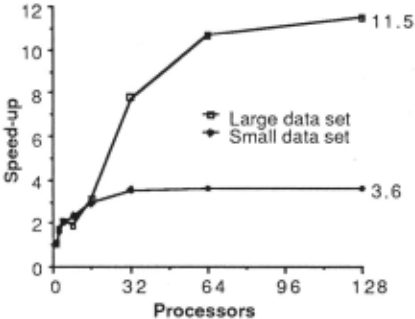
In this experiment two different data sets were used. One was designed to allow the Poligon system only to create one pipe in the solution space, the second allows Poligon to create four pipe-lines; it was four times as dense 1 . The combination of these two results allows us to do the following:
I Explorer 1s a trade mark of Texas Instruments Corpora tion .
- Measure the peak throughput for the larger data set.
- Determine the contribution to speed-up due simply to pipe-line parallelism.
- Compare the results from the two data sets so as to be able to get a measure of the ability of the system to ex ploit parallelism in the source data, i.e. data parallelism. The results from the two data sets are shown in Figure 3. In this experiment we learned the following:
- The peak speed-up shown in this application due to pipe line parallelism was 3.6. This showed that although the length of the pipe was three, speed-up was greater than three because of the concurrent execution of rules by the different stages of the pipe.
- The peak throughputs measured from the two data sets were not significantly different. This indicates that Poligon was able to achieve an almost linear increase in speed-up as the problem size of the data set increased, an important result.
- The peak throughput for the system as measured from the larger data set was about 340}ls per signal data record. Because of the linear increase in performance wilh data set complexity it is assumed that with more complex prob lems higher performance could be achieved. By compari son the Elint application, when coded to run in the AGE blackboard system took about 3.7 seconds to process each piece of signal data.
lThe small data set can be thought of as representing only one aircraft, the second had four. The data was, therefore, no more complex, there was just more of it.
4.2. Measurement of Poligon's Ability to Ex ploit Large Knowledge Bases
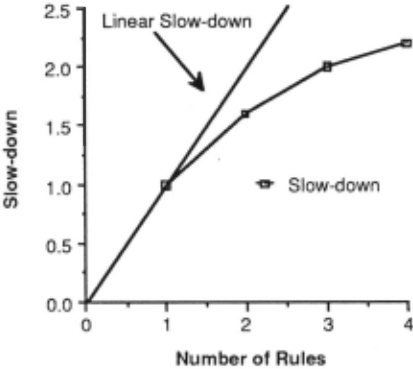
In this experiment the Poligon system was tested using the small data set used above. The Poligon framework was modified so that, whenever a rule was invoked, N rules would be invoked, rather than just one. N - 1 of these rules had the special characteristic that they performed almost all of the processing required except for any blackboard modify ing updates. This gave a measure of the system load if the knowledge base was N times larger, whilst still giving the right behavior for this application.
The results from this experiment are shown in Figure 4.
In this experiment, if the system were able to exploit par allelism in the knowledge base to the fulJ, one would expect that the system would not slow down at all as new knowl edge was added, i.e. the line shown in Figure 4 would be horizontal. If, on the other hand, the system bogged down completely as more knowledge was added one would expect that the result would be worse than linear slow-down, that is the plot would appear above the "linear slow-down" line. As can be seen easily from the graph, Poligon's performance was better than linear. In order to perform four times as much work it took only 2.2 times as long. This means that, as long as there are sufficient computational resources, the Poligon system delivers good performance for a knowl edge base whose size is at least up to four times that of the Elint application.2
4. 3. Measurement of the Granularity of Poligon's Rules
In this experiment some of the internal mechanisms within Poligon were timed in order to get some empirical measure of the granularity of the system.
Within a blackboard system a number of mechanisms are of crucial importance to the performance of the system. Amongst these arc slot reads, slot writes and rule invoca tion.3
In order to determine the costs of these operations they were performed repeatedly in a manner which allowed the individual costs to be measured with some precision.
The results of these experiments are as follows. It should be noted that all of these results neglect any communication overhead, so they are only representative for local operations.
- Slot reads take 1.36 + 0.94n }.LS, where n is the number of slots being read at once, Poligon supports a form of mul tiple slot read operation.
- Slot updates take 18 + 53.7n }.LS, where n is the number of slots being written. Poligon allows arbitrary user code to be executed during the slot update operation, so this is a representative figure taken from the Elint application. This is for the case of no rules being associated with the slots being updated.
2rn AGE, the Elint knowledge base was composed of about twenty knowledge sources, each having about three rules.
3Node creation is another important aspect, which was not measured in this experiment.
- The overhead cost of starting up a rule's execution is about lms per rule invoked.
A substantial part of the time taken performing these op erations could be optimized considerably. For instance, a figure of about 500J.!s for rule invocation could relatively easily be achieved in a real system and more than this im provement could be expected for a system which allowed specialized microcode or similar efficiency tuning. This shows that there is a lower bound to the granularity that the user can expect to achieve. For computations taking less than a few milliseconds it may not be worth starting up a rule to perform the computation, the cost of parallel execu tion would be in excess of the serial execution time.
5 . What We have Learned
We have learned a number of lessons from this project, some of which were counter to our intuitions.
- Our intuition told us that programming a concurrent blackboard system would not be too hard because of the assumed implicit asynchrony in serial blackboard systems. We found this not to be the case. We found the pro gramming task to be difficult and, we believe, a reconcep tualization of existing problems will be required in order to port them for efficient parallel execution. The diffi culty of implementation of applications is due largely to the divergence of implementations or serial blackboard systems from the pure blackboard model in order to make implementation and programming more manageable as was mentioned in Section 2 and is covered more thor oughly in [Rice 88al.
- We found that the Poligon system and architecture itself performed fairly well. Although programming the system was not trivial, the Poligon system provided a useful ab straction model that allowed the development of an appli cation in a blackboard-like manner that still gave the cor rect answers and acceptable performance.
- We had thought that parallelism in the knowledge base would be crucial to the achievement of high performance. In the applications that we used, knowledge proved to be sparse and the pipe-line parallelism that resulted from it delivered only a factor of three in speed-up. The small amount of speed-up from pipe-line parallelism was due to the short length of the pipes, the lack of applicable knowledge and the difficulty in balancing the pipes. Most of the parallelism seen in the applications implemented in the Advanced Architectures Project was derived from the data, not the code. The limit to the length of the pipes derived from the application was not one that resulted from the structure of the problem itself, but rather came from the fact that the application was rcimplemcntcd for Poligon from the AGE implementation, not rcformul::nccl.
- When we started the project our intuition told us that the significantly greater cost of communication relative to computation would bias the programmer in favor of doing as much as possible locally before a message was sent. It turned out that doing this increased the granularity of the system and restricted parallelism. We found that, al though communication is expensive, as long as data keeps flowing along a pipe the price that is payed is in latency, not in speed-up. The fact that processes are not held up
by communication is a result of the non-blocking mes sage sending ability of the hardware. Thus, fine-grained systems are likely to be significant for achieving good performance from large multiprocessors but the increased latency due to distributing the work could have an adverse effect on real-time performance.
- We learned that simulation of multiprocessors is expen sive. A number of projects are interested simply in the difficulties caused by the asynchronous behavior of con current systems. Such projects are able to use a simple model for their implementations on existing hardware. We, on the other hand, wanted to measure the performance of our software on the hardware we were developing pre cisely in order to refine both our hardware and software designs. This is computationally a very expensive task and has proved to be a major limiting factor on the work that we have done. Having said this, however, it should be noted that we are confident that we have achieved better results and have gained deeper insights than we would have done if we had concentrated on building real hard ware.
- Resource allocation was found to be a significant factor in delivering high performance. The fact that blackboard nodes arc often very long-lived means that an even load balance can easily be disrupted by a few busy nodes. In the experiments reported here the allocation of processes to processors was done randomly. Other experiments in the Advanced Architectures project have shown that, com pared to the ideal, perfect load balanced state I, even with very careful site allocation the Elint application lost 30% in efficiency and delivered 30% less speed-up than in the perfectly load balanced case. This could not be recovered through the usc of more processors [Delagi and Saraiya, 1988] .
6. Conclusions
In this paper we have described Poligon, a blackboard framework designed to operate on distributed-memory multiprocessors. We have described experiments performed on it, shown the results and discussed the conclusions that can be drawn from them and mentioned some lessons that were learned along the way.
We have shown that the Poligon system can deliver a speed-up for the Elint application of nearly twelve, with ncar linear speed-up gain with increasing problem complexity. We have also shown significantly better than linear slow down as a result of increasing knowledge base complexity. We arc confident, therefore, that given a larger problem Poligon could deliver significantly more speed-up than this.
From our work we can conclude that data parallelism is likely to he the most important source of parallelism in the forcsccilblc future, at least until truly huge knowledge bases arc developed. This requires that concurrent problem-solving systems should he not only able to exploit data parallelism but be able to do so in a manner which allows the rapid development, easy maintenance and modification of knowledge bases and encourages the development of software that is not brittle when knowledge is added or removed or when the system meets circumstances that were not anticipated by the programmer. Poligon is a possible first step in this direction.
1 This was possible to measure because of being able to "cheat" in the processor allocation for the simulator, assum ing global knowledge.
@inproceedings{ijcai1989p34,
  title     = {The ELINT Application on Poligon: The Architecture and Performance of a Concurrent Blackboard System},
  author    = {Rice, James},
  booktitle = {Proceedings of the Eleventh International Joint Conference on
               Artificial Intelligence, {IJCAI-89}},
  publisher = {International Joint Conferences on Artificial Intelligence},
  editor    = {N. S. Sridharan},
  pages     = {212--219},
  year      = {1989},
  month     = {8},
  note      = {Parallel and Distributed Processing},
  url       = {https://ijcai.org/proceedings/1989/34},
}
TY - CPAPER TI - The ELINT Application on Poligon: The Architecture and Performance of a Concurrent Blackboard System AU - Rice, James T2 - Proceedings of the Eleventh International Joint Conference on Artificial Intelligence, IJCAI-89 PB - International Joint Conferences on Artificial Intelligence PY - 1989 SP - 212 EP - 219 UR - https://ijcai.org/proceedings/1989/34 ER -Copied
Machine-readable versions of this paper, for tools and AI agents:





