
Towards a Theory of Conflict Detection and Resolution in Nonlinear Plans
Proceedings of the Eleventh International Joint Conference on Artificial Intelligence. Planning, Scheduling, Reasoning About Actions. Pages 937-941.
© 1989 International Joint Conferences on Artificial Intelligence
Abstract
This paper deals with a well known problem in AI planning: detecting and resolving conflicts in nonlinear plans. We sketch a theory of restricted conflict detection and resolution that subsumes conflict handling in classical nonlinear planners. By relaxing the restrictions, we develop a more general concept of conflicts suggesting practical and theoretical limitations of conflict handling in nonlinear plans.
- [Chapman, 1987] Chapman, D.: Planning for Conjunc- tive Goals. Art. Int., 32 (1987), pp. 333-377
- [Dean and McDermott, 1987] Dean, T.L./ McDermott, D.V.: Temporal Data Base Management. Art. Int., 32 (1987), pp. 1-55
- [Fikes et. al., 1972] Fikes, R.E./ Hart, P./ Nilsson, N.J.: Learning and Executing Generalized Robot Plans. Art. Int., 3 (1972), pp. 251-288 [
- [Fikes et. al., 1971] Fikes, R.E./ Nilsson, N.J.: STRIPS: A New Approach to the Application of Theorem Proving to Problem Solving. Art. Int., 2 (1971), pp. 189-208 IJCAI
- [Hertzberg and Horz, 1988] Hertzberg, J ./ Horz, A.: Erkennung und Auflosung von Konftikten in nicht- linearen Planen. In: Forschungsgruppe Experten- systeme (ed.): Aus der Arbeit der Forschungs- gruppe Expertensysteme. Arbeitspapiere der GMD No. 337 (1988)
- [Lifschitz, 1986] Lifschitz, V.: On the Semantics of STRIPS. In: Georgeff, M.P./ Lansky, A.L. (eds.): Proc. of the 1986 Workshop "Reasoning about Ac- tions and Plans". Los Altos: Morgan Kaufmann, 1986
- [Sacerdoti, 1977] Sacerdoti, E. D.: A Structure for Plans and Behavior. New York: Elsevier North Holland, 1977
- [Tate, 1975] Tate, A.: Interacting Goals and their Use. Proc. IJCAI-1975, pp. 215-218 IJCAI
- [Tate, 1977] Tate, A.: Generating Project Networks. Proc. IJCAI-1977, pp. 888-893 (1977) IJCAI
- [Sussman, 1975] Sussman, G.J .: A Computer Model of Skill Acquisition. New York: Elsevier North Hol- land, 1975
- [Waldinger, 1977] Waldinger, R.: Achieving Several Goals Simultaneously. Mach. Int., 8 (1977), pp. 94- 136
- [Wilkins, 1984] Wilkins, D.E.: Domain-independent Planning: Representation and Plan Generation. Art. Int., 22 (1984), 269-301
- [Wilkins, 1986] Wilkins, D.E.: Hierarchical Planning: Definition and Implementation. Proc. ECAI-86, 466-478 (1986)
References were extracted automatically from the PDF and may contain errors.
Full text extracted automatically from the PDF; figures, tables and equations may differ. The PDF is the version of record.
1 The problem
Nonlinear planning was invented [Sacerdoti, 1977, Tate, 1977] as a least commitment strategy for opera tor ordering. A nonlinear plan specifies a strict partial ordering on operators that can be interpreted to rep resent every linear ordering compatible with it . (Note that NOAH [Sacerdoti, 1977], e.g., uses a specialization of this interpretation as it does not allow every compati ble linear ordering but considers ordering whole branches only.)
While being efficient in that it allows whole areas of the space of linear plans to be· searched at once, nonlinear planning poses a new problem compared to linear plan ning: one has to decide whether really every linear order ing of operators in a nonlinear plan results in a correct operator sequence to be executed. This is the well known problem of detecting and-if necessary-resolving con flicts in nonlinear plans. Of course, conflicts also arise in linear plans: a STRIPS [Fikes et. a/., 1971] plan, e.g., containing what we call a conflict would simply be incor rect or incomplete. But as linear plans are special cases of nonlinear ones, conflict handling in linear plans proves to be less complex.
Although every nonlinear planner has to detect and resolve conflicts in one way or another, there is no coher ent theory of conflict handling. Instead, this is described anew for every planner, and it seems that some planner implementors have deviated from the path of generality without mentioning that they have done so.
In this paper, we deliver a sketch of a theory of conflict detection and resolution in nonlinear plans. The empha sis is on the coherence of the theory developed; we do not claim all the ideas we present here are new.
2 The theory (restricted)
In this section, we introduce relevant concepts and give some results on conflict handling for the "ground case", where a single node in a plan produces conditions that may be destroyed by another single node. We will see how to generalize matters in the following section.
Throughout the paper, plans are partially ordered sets of operators with unique least and greatest elements called start and finish, respectively. As usual , plans will be represented as graphs; hence we will speak of start, finish, and operator nodes or simply nodes if the exact class of a node is of no importance. As nodes correspond to operators, we will speak of preconditions and postcon ditions of nodes. The precondition of start is empty; its postcondition describes the initial state. The precondi tion of finish describes the goal state. We assume that conditions are formalized in a first order language A, employing the concept of derivability of conditions from sets of conditions. (In the following, all conditions are tacitly assumed to be in A.)
As to the "ground case" of conflict management con si9ered in this section, we make two assumptions:
- The STRIPS assumption: domain conditions only change if mentioned by the postconditions of a node in the plan, and the operator description defines a function that unambiguously maps situations onto situations.
- The locality assumption: every node must specify all the domain conditions it may change regardless of the domain conditions holding before it.
There are different ways to actually implement the locality assumption. One way- which is inspired by [Lifschitz, 1986]-is the following: operator postcondi tions are represented by add and delete lists in STRIPS [Fikes et. a/., 1971] fashion; they may contain only ground atomic formulas (or schemata for such formulas); every non atomic formula true at one place in the plan must be true in the domain in general and is represented outside the plan.
We do not, however, want to favor one particular in terpretation of the locality assumption and therefore will speak just of positive and negative node postconditions and of derivability of conditions from the postconditions of some node in the plan.
Note that the locality assumption does not necessarily imply decidability of the postconditions of a node.
2.1 Conflicts
We now come to the definition of a conflict which, how ever, requires some preliminaries.
Definition 2.1 (Plan, start, finish) . The ordered pair II=(O,<) is a plan iff
0 is a set of nodes containing at least the nodes start and finish, and
< ~ 0 x 0 is a strict partial ordering on 0 such that start<finish and V NEO\{start,finish}: start<N<finish.
If there is some node N with a precondition C in the plan, and there is no other node P preceding N which produces C, then the plan cannot be correct (assuming that conditions that are generally true do not appear in preconditions). Executing it will fail because the action corresponding to N will not be applicable. So, for a condition C, there may be users and producers in a plan. Using a condition does not imply deleting it, of course.
Definition 2.2 (User, Producer) Let N be a ·node with preconditions Pre and postconditions Post, and C a condition;
N is a producer of C iff Post r C N is a user of C iff C E Pre
Now we are going to define well formed plans, i.e. plans that are syntactically useful. A plan is well formed if every user of a condition is preceded by a producer of the condition.
Definition 2.3 (Well Formedness) Let II=(O,<) be a plan. II is well formed iff
VC E A VUE 0 : if U is user of C then 3P EO: Pis producer of C and P< U
In the following, all plans are assumed to be well formed.
Given a plan, there will often be more than one pro ducer of a condition C. The definition of dependency which follows makes explicit that a user node U of con dition C possibly gets C delivered by a producer P.which is closest to U respecting <:
Definition 2.4 (Dependency) Let II=(O,<) be a plan, C a condition, and P, UEO. Then D=(P,C, U,II} is a dependency between P and U concerning C in II iff
- P is a producer of C
- U is a user of C,
- P< U, and
- V NE 0: if P<N< U then N is not a producer of C
The partial ordering of nodes induced by dependencies is a subset of the operator ordering, due to the third condition in the definition. There may, of course, be more than one dependency assuring the same condition for the same node, serving the need of assuring it under possibly many linearization alternatives.
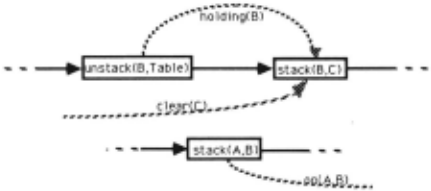
In figure 1 you see a node representing the operator stack(B, C) with preconditions holding( B) and clear( C). For both of the preconditions there is a relevant pro ducer, e.g. the node unstack(B, Table}.
Now we are heading into the direction of defining a conflict. The idea is that we have a conflict if the condi tion of a dependency is destroyed by the postcondition of a node that can be ordered between the user and the pro ducer of the dependency with no new producer restoring the predicate. In order to state this formally, we need an intermediate step.
Definition 2.5 (Enclosure) Let II=(O,<) be a plan and D=(P,C, U,II} be a dependency between P and U concerning C.
Then D encloses NE 0 iff
3 <'COxO: <C<' and P <' N<' U <' is c-;;lled an enclosure of N in D.
The partial plan in figure 1 is intuitively not correct, because the dependency concerning holding(B) encloses the node stack( A,B) which is a producer of -.holding(B). (Note that this must be locally derivable from the post conditions of stack( A, B)!)
Definition 2.6 (Conflict) Let II=(O,<) be a plan, D=(P, C, U,II} be a dependency between P and U con cerning C, and Post be the postconditions of NE 0. Then (D,N} is a conflict between D and N iff
- { C}UPost r false
- D encloses N with enclosure <'
- V P 'E 0: if N<' P '<' U then P' is not a producer of c
A plan containing no conflicts is called conflict free.
Deriving a procedure for conflict detection is straight forward from the definition. For an inefficient ver sion [Hertzberg and Horz, 1988] one may simply trans late the conflict definition and the preceding ones into a Prolog program. '
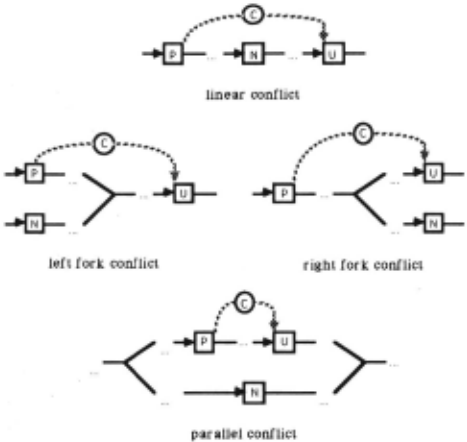
Applying the definition, there are four different types of conflicts depending on the relative positions of nodes P, U, and N. They are shown in figure 2.
Every other "type" of conflict, such as the double cross conflict in NOAH [Sacerdoti, 1977], is a combination of these four elementary types and can be handled by han dling the elementary conflicts involved. (Special com binations may suggest special resolution strategies, of course.)
Dependencies or related concepts have long been rec ognized as important for planning, even before the ad vent of nonlinear planning as in, e.g. STRIPS' triangle tables [Fikes et. a/., 1972], HACKER's [Sussman, 1975]
and Waldinger's [Waldinger, 1977] protections, and IN TERPLAN's [Tate, 1975] holding periods. In nonlinear planners , detecting conflicts by looking for some variant of dependency in one branch and a node destroying it in a parallel branch is an obvious idea and has-in one way or another-been done, e.g. in NOAH [Sacerdoti, 1977] us ing the TOME, NONLIN [Tate, 1977] using the GOST, SIPE [Wilkins, 1984], and TWEAK (Chapman, 1987] using the necessary truth criterion. A similar concept of dependency and conflict is used in time map manage ment as in, e.g., (Dean and McDermott, 1987]
2.2 Resolving conflicts
Detecting conflicts is one thing; resolving them is an other . (For brevity, we will keep things mostly informal here. A more formal treatment is straightforward and can be found in [Hertzberg and Horz, 1988]. In the fol lowing, variables D , C, P, N , U refer to those in Defini tion 2.6.) Definition 2.6 tells us what to do: One can resolve a conflict by
- constraining variables to prevent the derivation of false, or
- preventing the enclosure of N by D, or
- arranging another producer of the condition endan gered:
Like Chapman (Chapman, 1987], we don't consider re solving conflicts by deleting nodes .
If the derivation of false from { C} U Post has involved substituting a variable by some term, then a conflict of whichever type can be resolved by constraining the vari able not to be unifiable with this term. This strategy is used in , e.g. (Chapman, 1987].
All conflicts other than the linear conflicts can also be resolved by preventing the enclosure of N by D by means of extending the relative ordering of P, N, and U. In particular, we have to assert N <' P, U <' N, and N <' P or U <' N to resolve a left fork , right fork and parallel conflict, respectively (assuming N :f start and U :f finish).
Mind that a parallel conflict is resolved by mutual ex clusion of N and the branch within and including P and u.
Extending the operator ordering in some way has been a conflict resolution strategy in virtually every nonlin ear planner. In particular, it corresponds to Chapman's (Chapman, 1987] concepts of promotion and demotion.
Every conflict of whichever type can also be solved by arranging a C-producer between N and U. This means asserting N <' P'<' U for an existing or new node P' producing C. Naturally, patching in a new node may result in new conflicts, leading-at the extreme to an infinite conflict handling regress. This strategy corresponds, e.g., to Chapman's [Chapman, 1987] white knights. (Note that just ordering existing nodes never produces new conflicts involving existing dependencies.)
Now that we have studied the different types of con flicts in more detail, we can infer the domain dependent knowledge the conflict resolution module of a nonlinear planner must be fed with. Given a plan containing a set of conflicts, a planner has to decide
- which conflict to work on first and
- whether to solve a conflict by
- -constraining variable substitutions (if variables are involved), or
- -just ordering the nodes involved (except for linear conflicts), or
- arranging a C-producer at the right place
Knowledge of this kind must be part of the domain representation adapting a general planner to particu lar planning strategies in a particular domain. Choos ing among conflict resolution alternatives is a hopelessly heuristic matter.
3 Generalizing the Theory
This completes the formal reconstruction of the issues that have been discussed in the literature, at least im plicitly (though mostly under a restricted view). In gen eral, however, matters are even more complex, as condi tions are not the result of just one operator but may be derived from the postconditions of sets of operators.
Consider an extended blocks world [Chapman, 1987] with different sized blocks, where two small blocks may be put on a single large target block. Imagine a plan with three unordered nodes, each of them representing stacking a different small block on one and the same tar get block. There is a conflict in this plan, of course, because each pair of two stacking nodes destroys a nec essary precondition of the third node- there will be no more space on the target block.
The locality assumption does not hold in this exam ple: the aCtual postconditions of operators depend on the situations in which they are applied. This is the known problem of "synergy" [Chapman, 1987] effects.
Planning without STRIPS assumption also enforces consideration of node sets in conflict detection. Imagine a scenario of electrical appliance repairs: first of all, you have to interrupt power supply. So, there may be an abstract operator negating the condition that power is supplied, but giving no additional details about possible effects on the connections in the chain of power cable and different extension leads from the appliance to the wall socket. (An abstract operator is an operator that is yet to be expanded to a subplan.)
The STRIPS assumption does not hold: the operator description does not define a function that unambigu ously maps a given state of application onto a resulting state.
Obviously, detecting conflicts hinges on the ability to realize what conditions are true at which points in a plan; this is impossible in plans with abstract opera tors (Wilkins, 1986]. So, there may be undetectable con flicts. One should, however, be able to detect those kinds of conflicts where sets of nodes produce conditions the combination of which is inconsistent with the intended effect of the abstract operator, as, e.g., a set of nodes all together asserting a perfect cable chain from the wall socket to the electrical appliance in the scenario given above .
Consequently, when planning both without the local ity assumption or without the STRIPS assumption, a general producer of a condition is a set of nodes, and a general dependency leads from a set of nodes to a node. In a general conflict, such a general dependency generally encloses a general producer of the negation of a condition necessary for deriving the dependency condition.
3.1 General Conflicts
Following are the generalized definitions for producers, dependencies, enclosures, and conflicts . The generaliza tions are straightforward: instead of a single node pro ducing a condition, we have to consider sets of nodes .
Definition 3.1 (General Producer)
Let P= {P1 , . . . , Pp} be a set of nodes; let C be a condition.
P is a general producer of C with supporting conditions setS= {c1 , ... , cp} ~A iff
S is a minimal consistent set such that S 1- C, and ViE {1, ... , p} : P; is a producer of c;
Note that one node may deliver more than one sup porting condition, i.e. it is not assumed that P; # Pj for different i,j E {1, ... ,p}.
The definition of a dependency must be generalized accordingly from definition 2.4 by substituting the pro ducer node P with a set of nodes P . Furthermore, we have to extend the concept of closeness of nodes to close ness of node sets and nodes.
Definition 3.2 (General Dependency) Let
11={0,<) be a plan, C,c1 , ... ,cp conditions, P= {P1 , ... , Pp} ~ 0, and UEO. Then V={P ,C, U,S,II) is a gen eral dependency between P and U concerning C in II iff
- P is a general producer of C with supporting con ditions setS= {c1 , ... , cp}
- U is a user of C,
- V N~O 3i E{l, ... , p} V NEN: if P; < N< U then N is not a general producer of c; .
The last condition formalizes that a user node U of condition C possibly gets C delivered by a particular general producer P with supporting conditions set S which is closest to U respecting< . Note that there may be other general producers of C closer to U than P, e.g. if they have different supporting condition sets.
A general dependency generally encloses every node enclosed by some of its branches. So, the enclosure defi nition 2.5 is generalized by having P existentially quanti fied within the producer set P of the general dependency 1) involved .
Definition 3.3 (General Enclosure) Let 11={0,<) be a plan and V={P,C, U,S,II} be a general dependency between P and U concerning C.
Then V generally encloses N E 0 by P; EP iff
3 <'~OxO 3i E {1, . . . , p}:
<' is called a general enclosure of N in 1) by P;.
Finally, we arrive at the definition of a general con flict. A general dependency concerning C with general producer P= { P1 , ... , Pp} and supporting conditions setS= {c1 , ... , cp} is in conflict with a general producer N of -.c; if there is a general enclosure <' by P; of N E N such that there is a partial ordering <"2<' where c; is deleted by N but not restored by any other general producer before U.
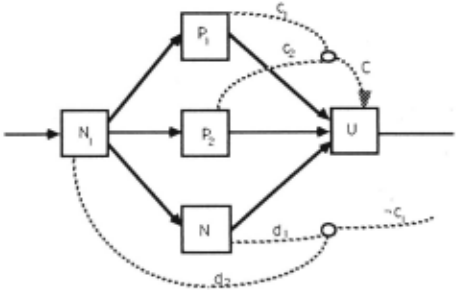
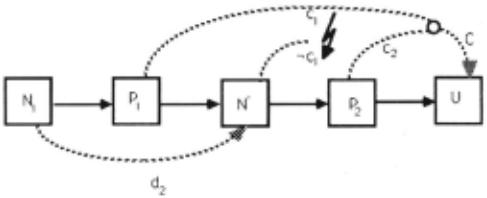
Consider as an example the plan shown in figure 3, where P= { P1 , P2 } is a general producer of C with sup porting conditions setS= { c1 , c2 } and there is a general dependency V between P and U concerning C. There is a conflict between 1J and N = {N, Nt} for the following reasons. V generally encloses N EN by P1 with enclosure <',the transitive closure of< u{(P1 , N)} . Moreover, N is guaranteed to be an element of a general producer of -,c1 . We can check the latter in the following way. We replace N by another node N' that is identical to N but has d2 as an additional precondition. We then have to find an extension <" of <' such that the resulting de pendency V' concerning d2 is not in general conflict with some node, in particular not with P1 . (Of course, possi bly <"=<'; the two step construction of<" is just for clarity.) A possible transformation of the example plan is shown in figure 4.
This intuition can be generalized to the following def inition.
Definition 3.4 (General Conflict) Let IT={O,<) be a plan, P= {Pt, . . . , Pp}, V={P,C,U,S,IT) a general dependency, and Nc;, 0 .
Then {V ,N) is a general conflict between V and N iff 3<'c;,Ox0 3iE{1, ... ,p} 3NEN:
- V generally encloses N with <' by P; ,
- N is a general producer of -,c; with supporting con ditions set {dt , . . . , dn}
- there is <"c;, OxO such that <"2<' and the general dependency
where (0', <') is the plan resulting from replacing the node NEO by N' with elements of {dt, .. . ,dn} \Post(N) as additional preconditions in (0, <').
Assuming finite node sets, general conflicts are well defined.
The types of conflicts can be generalized from section 2.1 accordingly, respecting the single nodes involved in a general conflict and their relative positions in a plan. There are , of course, combination types of basic conflicts forming one single general conflict. In addition, there can be combination types of the basic conflict types with respect to some general dependency (where some nodes of N are ordered with respect to some of the P; and others are not).
Note that the concept of general conflict-different from Chapman's (1987] modal truth criterion-permits handling effects of "synergy" . In synergy cases one can not assume locality, it is true, but conditions are pro duced or destroyed by sets of nodes working together in the way required for detecting general conflicts.
What, then, are the assumptions under which the con cept of general conflict makes sense? Obviously, we give up the locality assumptions, but we still employ a weak ened version of the STRIPS assumption, for we still have to compute all the possible effects of every operator:
Operator descriptions define functions from states of application to sets of states containing at least every possible resulting state .
This is also true for abstract operators, and so we have rediscovered a special case of the problems
(Wilkins, 1986] has reported for these . Theoretically, there is a loophole for managing conflicts in plans involv ing abstract operators anyway: consider every expansion into elementary operators. But this introduces just the sort of complexity one wanted to avoid by using abstract operators.
When giving up the original STRIPS assumption, we cannot detect everything one might intuitively call a con flict in some plan. This is, however, a general limitation of conflict detection: you cannot expect to know the ex act effects and side effects of an operator of which you do not know what it actually does!
3.2 Handling General Conflicts
As to the practical effects of the generalized conflict def inition, detecting conflicts works as before, but using definition 3.4 now; conflict resolution is analogous to the simple case, where combination types of general conflicts are resolved like combinations of elementary types. So, conflict handling remains the same, it is just more com plex.
But how much more complex is it?
When, in the simple case of conflict, one has to check all single nodes enclosed by some dependency for possi bly destroying and not restoring its single condition, then one now has to check every subset of the set of nodes or dered not after the user with at least one node enclosed by at least one branch of a general dependency. Checking now means checking the postconditions of all the nodes to be consistent with every supporting conditions set. In short: we cannot any more restrict conflict detection to the area enclosed by the dependency involved, but have to consider the whole part of the plan not definitely after the user.
Although there may be strategies for reducing the complexity of the consistency checking (the work nec essary for the different proofs is highly overlapping, sug gesting the use of some context management mechanism like an ATMS) it seems obvious that handling general conflicts thoroughly is practically infeasible. So, we have identified another decision point where domain depen dent knowledge must come in when giving up the locality assumption or the STRIPS assumption:
- given a plan, decide which dependencies to examine for being in general conflict; given a general depen dency to examine, decide which nodes in the rest of the plan to check for being in general conflict with it.
4 Conclusion
We have sketched a theory of conflict handling in non linear plans. Starting from the concepts described in the literature for the simple case of single producers and single destroyers under the STRIPS and locality assump tions, we have sketched the problems arising when con sidering conflict handling for the general case, and we have sketched some solution ideas. But there is a gen eral caveat : woe to the reckless conflict handler who is not equipped whith the appropriate domain knowledge!
Acknowledgements
Thanks to Tom Gordon and Uli Junker for comments on earlier versions of this paper.
@inproceedings{ijcai1989p150,
  title     = {Towards a Theory of Conflict Detection and Resolution in Nonlinear Plans},
  author    = {Hertzberg, Joachim and Horz, Alexander},
  booktitle = {Proceedings of the Eleventh International Joint Conference on
               Artificial Intelligence, {IJCAI-89}},
  publisher = {International Joint Conferences on Artificial Intelligence},
  editor    = {N. S. Sridharan},
  pages     = {937--941},
  year      = {1989},
  month     = {8},
  note      = {Planning, Scheduling, Reasoning About Actions},
  url       = {https://ijcai.org/proceedings/1989/150},
}
TY - CPAPER TI - Towards a Theory of Conflict Detection and Resolution in Nonlinear Plans AU - Hertzberg, Joachim AU - Horz, Alexander T2 - Proceedings of the Eleventh International Joint Conference on Artificial Intelligence, IJCAI-89 PB - International Joint Conferences on Artificial Intelligence PY - 1989 SP - 937 EP - 941 UR - https://ijcai.org/proceedings/1989/150 ER -Copied
Machine-readable versions of this paper, for tools and AI agents:





