
On the Discovery of Mathematical Theorems
Proceedings of the Tenth International Joint Conference on Artificial Intelligence. Knowledge Acquisition. Pages 194-196.
© 1987 International Joint Conferences on Artificial Intelligence
Abstract
The Graph Theorist, GT , is a system which performs mathematical research in graph theory. This paper focuses upon GT's ability to conjecture and prove mathematical theorems from the definitions in its input knowledge base. Each class of graphs is defined in an algebraic notation with a semantic interpretation that is a stylized algorithm to generate the class correctly and completely. From a knowledge base of such concept definitions, GT is able to conjecture and prove such theorems as "The set of acyclic, connected graphs is precisely the set of trees" and "There is no odd-regular graph on an odd number of vertices." Conjecture and proof are driven both by examples (specific graphs) and by definitional form (algorithms).
- Bondy,J. and Murty,U., Graph Theory with Applications, New York, North-Holland, 1976.
- Epstein,S.L., "Knowledge Representation in Mathematics: A Case Study in Graph Theory," Ph.D. dissertation, Rutgers University, 1983.
- Epstein,S.L., "Languages for Problem Solving in Graph Theory," in The Role of Language in Problem Solving 2", J.C. Boudreaux, B.W. Hamill and R.N. Jernigan, eds., North-Hol- land, 1987, pp.261-300.
- Epstein,S.L., "Learning and Discovery -One System's Search for Mathematical Knowledge," in preparation.
- Harary,F., Graph Theory, Reading, MA, Addison-Wesley, 1972.
- Lenat,D.B., "AM: An Artificial Intelligence Approach to Discovery in Mathematics," Ph.D. dissertation, Stanford University, 1976.
- Lenat,D.B., "Why AM and EURISKO Appear to Work," Artificial Intelligence, Volume 23, Number 3, August 1984, pp.269-294.
- Michalski,R.S., "Understanding the Nature of Learning: Issues and Research Directions," in Machine Learning: An Artificial Intelligence Approach, Volume II, R.S. Michalski, J.G. Carbonell and T.M. Mitchell, eds., Palo Alto, Tioga, 1986, pp.3-2S.
- Michalski,R.S. and R.E. Stepp, "Learning from Ob- servation: Conceptual Clustering," in Machine Learning: An Artificial Intelligence Approach, R.S. Michalski, J.G. Carbonell and T.M. Mitchell, eds., Palo Alto, Tioga 1983, pp.331-363.
- Michener,E.R., "Understanding Understanding Math- ematics," Technical Report AI MEM0-488, MIT, August, 1978.
- Ore,O., American Mathematical Society Colloquium Publications, Volume 38: Theory of Graphs, Providence, Rl, American Mathematical Society, 1962.
- Ritchie,G.D. and F.K. Hanna, "AM: A Case Study in AI Methodology," Artificial Intelligence, Volume 23, Number 3, August 1984, pp.269-294.
References were extracted automatically from the PDF and may contain errors.
Full text extracted automatically from the PDF; figures, tables and equations may differ. The PDF is the version of record.
1. Introduction
The Graph Theorist, GT, is a knowledge-intensive, domain specific learning system which uses algorithmic class descrip tions to discover and prove relations among mathematical concepts, i.e., theorems, in graph theory. Although it primarily exemplifies theory-driven discovery, where search heuristics postulate and test the validity of conjectures, it also infers explanations for factual input about key graphs as a data-driven system would.
Mathematical discovery includes the creation of new math ematical concepts, the conjecture of relations among concepts and the proof or disproof of such conjectures: Thus far, AI discovery in mathematics has focused attention primarily on the deductive proof of mathematical theorems using a predi cate calculus representation. The notable exception has been Lenat's AM(Len76]. AM generated mathematical objects and observed statistical regularities in their classification. When the experimental evidence warranted it, AM would conjecture relations among classes. Discovery in AM was driven not only by empirical evidence but also by 243 heuristic rules which originated the generation of examples and new concepts, and evaluated the results. . Later it was generally recognized(Len84,Rit] that the path of discovery was pro nouncedly affected by the programming language itself.
In this sense, AM may be said to model some intuition on the part of the research mathematician as to a representation language (LISP) well-suited for exploration in a particular direction (number theory). AM's results indicate that, if knowledge about a domain can be semantically encoded into the class definition, then it can be harnessed to drive math ematical discovery. GT encodes the semantics of graph theory into class definitions in a more transparent and flexible fashion, one which supports both inductive and deductive reasoning. These semantics subsequently motivate both conjecture and proof.
2. Concept Description in GT
The material in this section describes the application of a theoretical formulation detailed rigorously in (Eps83] and summarized in (Eps87]. The treatment here is informal and Selector descriptions may be empty, i.e., need not constrain binding at all. In the example of Figure I, the selector for ACYCLIC is read "where y is in the vertex set, and x and z are not in the vertex set."
The semantic interpretation of such a three-part definition for a graph property p is a single, uniform algorithm called a p-generator. A p-generator capitalizes on the underlying commonality of its class, the view of the set P as one or more prototypes (seeds) which can be methodically trans formed (under f and u) to produce exactly those graphs in the class. The p-generator may be thought of as an automaton which is started by the input of any graph in seed set S. ACYCLIC, for example, would require K 1 . The p generator then iterates an undetermined number of times. On each iteration the selector u chooses vertices and/or edges with respect to the current graph G, and then the operator modifies G, using those choices, to produce a new G. ACYCLIC, on each iteration, either adds a new vertex x to the graph, or adds a new vertex z and an edge from an old vertex y to z.
Thus the algorithm for generating the class P of graphs is
Accept G E S
Output G
Until u fails do
G +- fu(G)
Output G
Halt
Under all possible initial choices from S and all possible iterations of f subject to u, the output of this algorithm is precisely P, that is, if the superscript i denotes "iterate i times,"
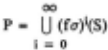
The graphs in Figure 2 illustrate several possible iterations of the definition of ACYCLIC; each pictured graph is output by the algorithm and is acyclic. The definition generates the infinite class of acyclic graphs; it will never halt because bindings for the variables in u can be found on each iteration.
The content of the following three general texts is taken as graph theory: [Ore], a classical development in elegant
mathematical fashion; [Har], a broad overview of topics presented as definitions and theorems; and (Bon], an algorith mic approach. What evidence is there that p-generators exist for every P in U, or at least for every interesting P in graph theory? At this writing, more than 40 properties of varying difficulty have been selected from the three benchmark texts and described correctly and completely as p generators[Eps83]. The use of p-generators as property def initions entails several kinds of non-determinism. Any graph in the seed set is an acceptable input; any binding satisfying u is valid; any term in f suffices for an iteration. In addi tion, many different sequences of iterations will construct isomorphic graphs. This ostensible indefiniteness and redundancy is tolerated because the property definitions preserve detail in a concise and flexible format.
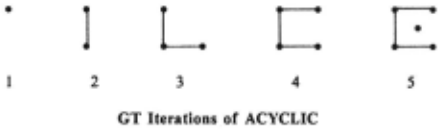
FIGURE 2
3. Relations between Concepts In GT
Inductive inference from examples does not preserve truth, only falsity[Mic83]. Although research mathematicians devote much time to example generation, and infer conjectures about relations among ideas based on these examples, inductive inference is only a tool. Rarely is a conjecture considered a result worthy of publication, and then only when extensive attempts at proof and disproof have failed. Mathematicians prefer to explore in the context of certainty; for them a conjecture should be proved or disproved relatively soon after it arises. GT, therefore, constructs both conjectures and proofs.
Graph theory, as it appears in the three benchmark texts cited above, is primarily about graph properties and the rela tions among them. Conjectures and theorems in graph theory frequently take one of the following forms:
| INITIAL FORMULATION | AFTER EXECUTION | |
| Property-name: Number-of-seeds: Seed-set: Function: Sigma: Origin: Examples: Extremal-cases: Delta-pairs: Subsumes: Not-shown-to-subsume: Subsumed-by: Not-shown-subsumed-by: Merger-created.,-with: Merger-explored-with: Is-equivalent-to: Not-shown-equivalent-to: | ACYCLIC I {Kl} Ax+ Ay•A• y E V, x,z fl. V input {Kl} {Kl} ((I 0)(1 I)) nil nil nil nil nil nil nil nil | ACYCLIC I (Kl} Ax+ Ay•A• y E V, x,z fl. V input (ACYCLIC-3, ACYCLIC-2, K 1 } (Kl} ((I 0){1 I)) (ACYCLIC-MERGED-WITH-CONNECTED CHAIN TREE) (CONNECTED EQUIV -CONNECTED) {IS-A-GRAPH) (ACYCLIC-MERGED-WITH-CONNECTED CONNECTED TREE EQUIV -CONNECTED CHAIN) (CONNECTED) (CHAIN TREE) nil (CHAIN TREE CONNECTED EQUIV -CONNECTED |
IS-A-GRAPH)
GT Representation of ACYCLIC
FIGURE 1
- TYPE I: If a graph has property p, then it has property q.
- TYPE 2: A graph has property p if and only if it has property q.
- TYPE 3: If a g~aph has property p and property q, then it has property r.
- TYPE 4: It is not possible for a graph to have both property p and property q.
GT has two fundamental procedures for manipulating graph properties to prove such theorems. The first procedure tests for subsumption. Property p for class P subsumes property q for class Q if and only if Q is a subset of P, i.e., every graph with property q also has property p, so that q is a special case of p. Theorem type I is a statement that q subsumes p. Theorem type 2 is a statement that p and q are equivalent, i.e., that p subsumes q and q subsumes p. The second procedure constructs mergers. The merger of a property p for class P with a property q for class Q results in a new property representing PnQ, the set of graphs with both properties. Theorem type 3 is a statement that property r subsumes the merger of p and q. Theorem type 4 is a statement that the merger of p and q is empty, i.e., that no graph can have both properties simultaneously.
3.1 Proof of Subsumptlon
At this writing, GT has only one method of proving subsumption. Given property p 1 · <f 1 ,S 1 ,cr 1 >, property p 2 · <f2,S2,cr2>, and a conjecture that p 1 subsumes p 2 , GT attempts to show that:
- f2 is subsumed by f1, i.e., f 2 is a special case of f 1 ·
- Every graph in S 2 has property p 1 ·
- u2 is subsumed by o-1, i.e., cr2 is more restrictive than 0"1.
(Extended definitions for operator and selector subsumption appear in [Eps83].) Because there are usually only a few known seeds, GT checks the list of examples for p 1 against S2. If any graph G in S2 is not known to have p 1 , GT generates a limited number of new examples of p 1 and searches for G there. Because seed graphs are extremal cases, and because a natural metric exists on most GT definitions, the search is readily controlled and usually successful. (Alternative techniques exist for infinite seed sets and certain other situations.) Matching for the sub sumption testing of the operators and selectors is done by a recursive backtracking algorithm which generates a restricted set of candidates.
The following example illustrates the subsumption procedure. For
and
and the conjecture "ACYCLIC subsumes TREE," GT must show that K1, the seed for TREE, is an acyclic graph and also that, under some matching, the ACYCLIC operator "covers" the TREE operator while satisfying the TREE selection constraints. First, K 1 is on the list of acyclic graphs because it is the seed for ACYCLIC. Second, the matcher notes that every term in the TREE operator ApqAq (there is only one in this example) is covered by some term, namely Ay 0 A., in the ACYCLIC operator. Finally, the matcher observes that under the matching of p with y and q with z, the selector constraints (that p is in V and q is not) are enforced. Thus GT proves that ACYCLIC subsumes TREE or, more formally, "Every tree is an acyclic graph."
3.2 Proofs Involvln& Mer&ers
GT currently has four algorithms for merger. Given property p1 = <f1,S1,u1> and property p 2 · <f 2 ,S 2 ,cr 2 >, GT attempts to construct the merger p · <f,S,cr> of p 1 and p 2 · The first three algorithms are f~irly str~ightforward:
- · If p1 subsumes p 2 , the merger is simply p 2 · When f 1 subsumes f 2 and every seed in S 2 · has property p1, the merger is <f 2 ,S 2 ,cr>, where u IS o- 1 and o-2, eliminating any references ·to variables not in f,.
- When f1 subsumes f2, o-1 subsumes o- 2 , and S is non empty, the merger is <f 2 ,S,u 2 >, where
The fourth algorithm addresses the more interesting cases which do not fit these categories. Here GT examines how the number of vertices and the number of edges change as the p-generator iterates. GT uses this information in heuristic attempts to create a hybrid generator which satisfies both definitions. (A more detailed . description of these merger techniques, with examples, appears in [Eps].)
s · {G 1 o e S2 n P1} u {G 1 o e S1 n P2}.
Some of the most interesting of GT's proofs are merger failures. Consider, for example, GT's discovery that a graph which is odd-regular (every vertex of degree d, and d is odd) cannot have an odd number of vertices. When no common seed is evident, GT generates some examples to expand its list of graphs with an odd number of vertices, seeking one which is odd-regular. When this effort fails, GT considers the possibility that there is no common seed and examines the changes to m and n wrought by the operators. GT recognizes that ODD-NUMBER-OF-VERTICES begins with one vertex and adds two vertices at a time, so that n is always odd, but that ODD-REGULAR begins with an even number of vertices (the seed is K2) and adds an even number of vertices at a time, so that n is always even. This disparity is the reason GT gives in its proof: there . can never be a seed for the merger, and thus the property has no example, i.e., is impossible.
4. Conjecture
A mathematician presented with non-empty classes P and Q from a universe U is trained to explore potential relations between the classes by examining whether or not each of PnQ, P - Q and Q - P is empty. GT models this strategy with conjectures about subsumption and merger. The standard mathematical quest~ons, and their GT equivalents are
- Is P a subset of Q? GT explores this by a conjecture that q subsumes p.
- Is P a superset of Q? GT explores this by a con jecture that p subsumes q.
- Is P equal (equivalent) to Q? GT explores this by two conjectures, that p subsumes q and that q sub sumes p,
- Are P and Q disjoint (mutually exclusive)? GT explores this by a suggestion to merge p and q.
Thus the theorems that GT conjectures are statements about set-theoretic relations between classes of graphs. Given the four theorem types in Section 3 and a knowledge base of k properties, there are potentially 2k(k+ I) projects (proposals for exploration) on the first pass, i.e., before newly-created properties participate in project formulation. How does GT limit search through such a space? The human mathematician has two primary sources of evidence on which to base project formulation: examples and definitions. GT is capable of reasoning both from p-generator definitions and from specific graphs, either seeds or generated examples.
Subset/superset conjectures are based upon both seeds and definitions. For any pair of properties p and q, GT seeks:
- similarity in the seed sets for p and q (in decreasing order of significance: equal sets, one a subset of the other, a non-null intersection)
- seeds of property p which are known to have the property q
- similarity between the operators for p and q (i.e., which primitives are employed and in what groupings)
The strong focus on seeds is justified both by their role as prototypes. and by efficiency; seeds tend to be small and few in number.
Before GT's heuristics explore the third mathematical ques tion, the equivalence of p and q, they require that the two associated subsumptions have been either proved or conjec tured. Alternative definitions (characterizaJions) of classes are common in mathematics because they support conjecture and, therefore, research. GT demonstrates such use of alternative definitions. Consider, for example, the class of graphs known as chains. (A chain is a· connected graph in which two nodes have degree one and all others have degree two.) GT has two dif(erent definitions of chain. Based on the operators, one suggests that a chain may be a cycle, and the other suggests that a chain may be a tree. GT formu lates and investigates both conjectures, and discovers that the first is incorrect and the second correct.
Conjectures about disjointness are really conjectures that a merger will fail. Thus a conjecture in GT about the disjoint ness of p and q is expressed as a plan to merge p and q. If the seed sets for p and q are disjoint, the possibility of the disjointness of P and Q will be conjectured in the form of a plan to attempt the merger of p and q.
5. Summary of Re.sults and Future Work
According to Michalski's characterization of learning sys tems[Mic86], GT learns both by observation (of its input ex amples and definitions) and by discovery (upon construction of new examples and properties). GT inductively infers conjectures from examples and definitions, and also proves deductively from the same definitions. Figure I displays the ACYCLIC frame both before and after one of GT's runs. No specific tasks were input, only the general directive to explore the knowledge base. GT formulated its own conjec tures and then attempted to construct proofs for them based on the structure of the definitions. The modifications to the representation for ACYCLIC constitute learning as defined in [Mic86]. Clearly GT learns how ACYCLIC relates to other concepts and constructs and stores additional examples of acyclic graphs. GT learns about graph theory by conjec turing and exploring simple relations among graph properties.
GT is able to conjecture theorems in graph theory. Conjecture is driven by extremal examples and definitions. Example-driven discovery is based upon prototypical ·graphs (seeds) which are extremal cases of individual properties and therefore likely to be rich in associations. Definition-driven discovery focuses upon the transformations which change one graph with a property into another graph with the same property. The requirement that · a definition be complete effectively limits such transformations to minimal changes. (For example, a connected graph may be transformed by adding a new vertex with one edge to an old vertex. Requiring that the new vertex be connected to more than one old vertex would create a different, more restricted, set of graphs.) The minimality of these changes and the limited vocabulary of operator primitives makes relations between the transformations in the definitions more readily apparent.
GT is able to prove theorems in graph theory which it has conjectured. Proofs rely heavily on a procedure to test for subsumption and a procedure for merger to represent graphs with more than one property. Running on a Symbolics 3675 in Symbolics Common Lisp, GT successfully conjectures and proves, among other theorems, the following:
- Every tree is acyclic.
- Every tree is connected.
- The set of acyclic, connected graphs is precisely the
- set of trees.
- There are no odd-regular graphs on an odd number of vertices.
Although GT is described as domain-specific, it offers domain-independent lessons as well. The richness of the semantic network GT constructs is due to extensive ex ploration. Thus, rather than a burden, exhaustive search is one of GT's strengths. In the META-DENDRAL tradition, GT can afford exhaustive search because its representation is highly-controlled. The design of the language for graph property definitions engineers GT for success, because it capitalizes on the inherent similarities within object classes and captures t)!.Jl commonalities underlying class definitions.
Plans for C.T's future development are based upon the power and flexibility of the p-generator representation. Within the discovery framework described here, plans exist to extend the p-generator language for the representation of directed graphs and, eventually for labelled graphs. These extensions will also provide a testbed for the study of performance under representational shifts. Work is under way to use additional example-based reasoning, particularly counterexamples, to evaluate the agenda and guide search. Thus discovery will derive additional data-driven support, while maintaining its theory-driven component. GT's knowledge base will be expanded with more concepts gleaned from the benchmark texts. Mathematicians studying interest ing sets of graph properties are invited to submit them to GT. The shell of GT is a domain-independent research tool for recursive property description. Applications of this shell to mathematical domains other than graph theory are currently under study.
Ac:knowledaements: The author thanks N.S. Sridharan and Virginia Teller for their assistance and support in this research and its presentation.
@inproceedings{ijcai1987p37,
  title     = {On the Discovery of Mathematical Theorems},
  author    = {Epstein, Susan L.},
  booktitle = {Proceedings of the Tenth International Joint Conference on
               Artificial Intelligence, {IJCAI-87}},
  publisher = {International Joint Conferences on Artificial Intelligence},
  editor    = {John McDermott},
  pages     = {194--196},
  year      = {1987},
  note      = {Knowledge Acquisition},
  url       = {https://ijcai.org/proceedings/1987/37},
}
TY - CPAPER TI - On the Discovery of Mathematical Theorems AU - Epstein, Susan L. T2 - Proceedings of the Tenth International Joint Conference on Artificial Intelligence, IJCAI-87 PB - International Joint Conferences on Artificial Intelligence PY - 1987 SP - 194 EP - 196 UR - https://ijcai.org/proceedings/1987/37 ER -Copied
Machine-readable versions of this paper, for tools and AI agents:





