
A Representation for Natural Category Systems
Proceedings of the Tenth International Joint Conference on Artificial Intelligence. Cognitive Modeling. Pages 140-145.
© 1987 International Joint Conferences on Artificial Intelligence
Abstract
Most AI systems model and represent natural concepts and categories using uniform taxonomies, in which no level in the taxonomy is distinguished. We present a representation of natural taxonomies based on the theory that human category systems are non-uniform. There is a basic level which forms the core of a taxonomy; both higher and lower levels of abstraction are less important and less useful. Empirical evidence for this theory is discussed, as are the linguistic and processing implications of this theory for an artificial intelligence/natural language processing system. Among these implications are: (1) when there is no context effect, basic level names should be used; (2) systems should identify objects as members of their basic level categories more rapidly than as members of their superordinate or subordinate categories. We present our implemen-tation of this theory in SNePS. a semantic network processing system which includes an ATN parser-generator, demonstrating how this design allows our system to model human performance in the natural language generation of the most appropriate category name for an object. The ability of our system to acquire classificational information from natural language sentences is also demonstrated.
- Ashcraft, M. H. (1978), "Property Norms for Typical and Atypical Items from 17 Categories: A Description and Description and Discussion," Memory and Cognition, vol. 6, pp. 227-232.
- Berlin, B. (1978), "Ethnobiological Classification," Cognition and Categorization (Hillsdale, NJ: Lawrence Erlbaum Asoo- ciates) pp. 9-27.
- Bobrow, D. G., Winograd, T. (1977a), " Experience with KRL-o, One Cycle of a Knowledge Representation Language," IJCAI-77, vol. 1, pp. 213-222.
- Bobrow, D. G., Winograd, T. (1977b), "An Overview of KRL, a Knowledge Representation Language," Cognitive Science, vol. 1:1, pp. 3-46.
- Bobrow, D. G., Winograd, T. (1979), "KRL: Another Per- spective," Cognitive Science, vol. 3, pp. 29-42.
- Brachman, R. J. (1979), "On the Epistemological Status of Semantic Networks," Associative Networks: Representation and Use of Knowledge by Computers (New York: Academic Press), Edited by N. V. Findler, pp. 3-50.
- Brachman, R. 1~ Fikes R. E., Levesque, H. J. (1983), "KRYPTON: A Functional Approach to Knowledge Representation," IEEE Computer, vol. 16, pp. 67-73.
- Brachman, R. J~ Schmolze, J~ (1984), "An Overview of the KL-QNE Knowledge Representation System," Fair- child Technical Report Number 655, (Palo Alto, CA: Fair- child Laboratory for Artificial Intelligence Research), Sep- tember 1984.
- Brachman, R. J., (1985), ""! Lied About the Trees" Or, Defaults and Definitions in Knowledge Representation," The Al Magazine, (Fall 1985), pp. 80-93.
- Brown, C. H~ Kolar, J., Torrey, B. J~ Truong-Quang, T~ Volkman, P. (1976), "Some General Principles of Biologi- cal and Non-Biological Folk Classification," Am. Hthnol., vol. 3, pp. 73-85.
- Brown, R. (1958), "How Shall a Thing lle C..alled?," Psychol. Rev., vol. 65, pp. 14-21.
- Cantor, N ~ Mischel, W. (1979), "Prototypes in Person Per- ception," Adv. Exp. Soc. Psychol., vol. 12, pp. 3-52.
- Carlson, G. N. (1982), ''Generic Terms and Generic Sen- tences," J ou.rnal of Philosophical Logic, vol. II, pp. 145- 181.
- Collins, A. M., Quillian M. R., (1970), "Does Category Size Affect Categorization Time?," Journal of Verbal Learn- ing and Verbal Behavior, vol. 9, pp. 432-438.
- IS)
- Delgrande, J. P~ (1986), "A Propositional Logic for Natural Kinds," Proc. Canadian Con f. on AI -86, pp. 44- 48.
- Fahlman, S. E., (1979), NETL: A System for Represent- ing and Using Real-World K1WWkdge (Cambridge, MA: MIT Press).
- Gascpnig, J., (1979), "Preliminary Performance Analysis of the PROSPECTOR Consultant System for Mineral Exploration," 1 JCAJ., vol. 6, pp. 308-310. IJCAI
- Hunn, F-. (1976), "Toward a Perceptual Model of Folk Biological Classification," Am. Hthnol~ vol. 3, pp. 508-524.
- Jackendoff, R.; (1983), Semantics and Cognition (Cam- bridge, MA: The MIT Press).
- Kitts, D. B~ Kitts, D. J., ( 1979 ), "Biological Species as Natural Kinds," Philosophy of Science, vol. 46, pp. 613- 622.
- Lehnert, W ., Wilks, Y ~ (1979), "A Critical Perspective on KRL," Cognitive Science, vol. 3, pp: 1-28.
- Melle, W. van, Shortliffe, E. H., Buchanan, B. G., (1981), "EMYCIN: A Domain-independent System that Aids in Constructing Knowlege-Based Consultation Programs," Machine lntelUgence, Infotech State of the Art Report, vol. 9:3. 146 COGNITIVE MODELING (23)
- Mervis, C.~ Rosch, E., (1981), "Categorization of Natural Objects," Ann. Rev. Psychol~ vol. 32, pp. 89-115.
- Quillian, M. R~ (1%7), "Word Concepts: A Theory and Simulation of Some Basic Semantic Capabilities," Behavioral Science, vol. 12, pp. 41Q-430.
- Quillian, M. R~ (1%8), "Semantic Memory," Semantic Information Processing (Cambridge, MA: MIT Press),
- Editor, M. Minsky.
- Quillian, M. R~ (1969), "The Teachable Language Comprehender: A Simulation Program and Theory of Language," Communications of the ACM, vol. 12, pp. 459-476. .
- Rosch, E., Mervis, C. B~ Gray, W. D., Johnson, D. M., Boyes-Braem, P., (1976), "Basic Objects in Natural C..ategories," Cognitive Psychology, vol. 8, pp. 382-439.
- Rosch, E., Lloyd, II. II., (1978), C,ognition and Categoriza- tion (Hillsdale, NJ: Lawrence Erlbaum Associates).
- Shapiro, S. C., (1978), "Path-Based and Node-Based Infer- ence in Semantic Networks," TIN LAP-2: Theoretical 1 ssues in Natural Language Processing (New York: ACM), Editor, D. Waltz. pp. 219-225.
- Shapiro, S. C. (1979), "The SNePS Semantic Network Pro- cessing System," Associative Networks (New York: Academic Press), Editor, N.V. Findler, pp. 179-203.
- Shapiro, S. C~ (1981), "CCCCI: A Deductive Semantic Net- work Program for Solving Microbiology . Unknowns," Technical Report Number 173, (Buffalo: SUNY Buffalo Dept. of Computer Science).
- Shapiro, S. C~ (1982), "Generalized Augmented Transition Networks Grammars for Generation from Semantic Net- works," Amer. Jcxunal ofComp. Ling~ vol. 8, pp. 12-25.
- Shapiro, S. C~ Rapaport, W. J~ (1986), "SNePS Considered as a Fully Intensional Propositional Semantic Network," Proc. AAAl-86, vol. 1, pp. 278-283.
- Smith, E. E., Medin, D. L., (1981), Categories and C ,on- cepts (Cambridge, MA: Harvard Un iversity Press).
- Sondheimer, N. K., Nebel, B. (1986), "A Logical-Form and Knowledge-Base Design for Natural I..anguage Genera- tion," AAM -86, vol. 1, pp. 612-618.
- Tversky, A., Gati, I~ (1978), "Studies of Similarity," Cog- nition and Categorization (Hillsdale, NJ: Lawrence Erl- baum Associates), pp. 81-95.
- Wegner, P~ (1986), ''The Object-Driented Classification Paradigm," Technical Report No. CS-86-11, (Providence, Rl: Brown University Dept. of Computer Science).
- Woods, W~ (1978), "Semantics and Quantification in Natural Language Question Answering," Advances in Computers (New York: Academic Press), Editor, M. C. Youvits, vol. 17, pp. 2-87.
References were extracted automatically from the PDF and may contain errors.
Full text extracted automatically from the PDF; figures, tables and equations may differ. The PDF is the version of record.
1. INTRODUCTION.
Knowledge-base systems typically model and represent natural concepts and categories using uni form inheritance networks [Quillian 1967, 1968, 1969; Collins & Quillian 1970; Fahlman 1979] or frame systems [Brachman 1983; Brachman & Schmolze 1984! We will present a representation of natural taxonomies based on the theory that human category systems are non-uniform, i.e., not all levels of abstraction are equally important or useful. This theory is supported by a substantial body of empirical evidence from the fields of psychology, anthropology, and linguistics [Rosch et' al. 1976, 1978; Mervis & Rosch 1981; Berlin 1978; C. H. Brown et al. 1976; Tversky 1978; Hunn 1976; Cantor et al. 1979; Smith
2.1. Empirical Evidence.
The following summarizes some of Rosch's empirical evidence supporting the existence of a basic level which forms the core of a taxonomy. [Rosch et al. 1976, 1978; Mervis & Rosch 1981!
2.1.1. Attributes of Objects.
When subjects were asked to list attributes of basic, superordinate, and subordinate level objects, very few attributes were listed for superordinate categories, a great number of attributes were listed for , basic categories, and an insignificant number of addi tional attributes were listed for subordinate level categories. This result supports the theory that the basic level is the most inclusive or general level at which the objects of a category possess a large number of attributes in common. Attributes appear to be clustered a.t the basic level.
2.1.2. Object Recognition.
Experiments using averaged shapes, obtained by superimposing outlines of objects to form normalized shapes, showed that the basic level is the most inclusive level at )Nhich the averaged shape of an object can be recognized. That is, basic objects (e.g., chairs, dogs) were the most general objects that could be identified from these shapes; superordinate objects (e.g., furniture, animals} could not be identified from averaged shapes. This suggests that basic level objects, are the most inclusive categories for which a concrete mental image of the category as a whole can be formed. We can form an image of a cat or dog which reflects the average members of the class, however, we cannot form an image of a mammal that reflects the appearance of the class as a whole.
2.1.3. Object Names -Categorization.
Studies of picture verification have demonstrated that objects are first recognized as members of their basic level category. When subjects were shown pic tures of objects, the basic level name was the name chosen for an object. With additional processing time, subjects were able to categorize objects at their subor dinate and superordinate levels. Thus, subjects knew
the subordinate and superordinate names of objects, but categorized objects first at the basic level. Rosch further states that basic level objects are the first categorizations made during perception of the environment, as well as the categories most named, and most necessary in language.
2.1.4. Development of Categories.
Basic level objects are not only the first categories learned by children, they also appear to be formed
I
I
I
differently from categories at other levels. That is, basic categories are not learned explicitly by acquiring a definition or deductive rule, but rather are learned implicitly by exposure to multiple instances of the category, i.e., they are formed inductively. This is often called the acquisition of types through ostensive definitions [Jackendoff 1983t Categories subordinate and superordinate to this level are often formed by the acquisition of a deductive rule [Berlin 1978t for example, the concept mammal might be learned in terms of a rule which lists attributes such as: warm blooded; body usually covered with hair; female gives milk to young.
2.1.5. Summary of Empirical Evidence.
Thus, recent categorization research provides a great deal of empirical evidence supporting the impor tance of basic level categories in a taxonomy, and the non-uniformity of human category systems. Basic level categories are the first categories developed, they are formed differently than non-basic categories, they are the most used and useful categories, and therefore, they must be distinguished from non-basic categories in some way.
3. REPRESENTATION AND USE OF CATEGORIES IN AN AI/NLP SYSTEM.
If an artificial intelligence/natural language pro cessing (AI/NLP) system modeling human category systems must be able to distinguish basic level categories from non-basic categories, an important issue to be considered is how and where to make the distinction. Basic level objects are used in two kinds of categorization: "ordinary" categorization, i.e., the classification of an individual in a class, and generic categorization, i.e., categorization involving two classes or types. It seems clear that since basic level categories are formed early in life, they are formed via ordinary categorization. The teaching of these names is limited to the presentation of examples and counter-examples. Thus, a child may learn the basic level name 'dog', as someone points to Rover and says 'dog'. Therefore, our system makes the distinction between basic and non-basic levels in the representa tions for ordinary categorization, i.e., in the individual/class relations. The case frame used for this form of categorization of a basic level object is:
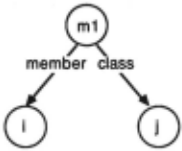
6 '8
Figure 1
Here ml represents the proposition that the individual represented by i is a member of the basic level category represented by j. "Rover is a dog" is represented as follows:
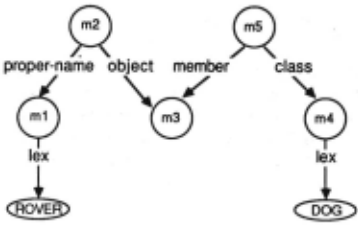
[See Shapiro & Rapaport 1986 for the syntax and semantics of other constructs.]
Since non~basic categories are formed later than basic categories, and are formed in the course of the investigation of underlying principles rather than ostensive features, we use a slightly more complex case frame to represent membership in a non-basic level category.
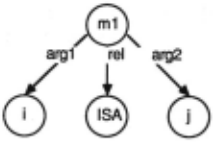
Here ml represents the proposition that the individual represented by i is a member of the non-basic category represented by j. "Rover is a mammal" is represented as follows:
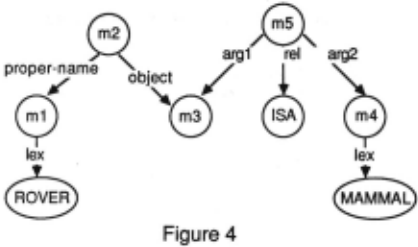
These case frames in SNePS are the built-in syn tactic structures of our modeled minds. The use of the member/clA.ss case frame reflects the basic or primitive nature of categorization in basic categories, whereas the use of the argllrellarg2 case frame treats membership in non-basic categories as an ordi nary binary relation. Thus, our system distinguishes two cases of ordinary categorization: one representa tion is used when the class membership involves a basic level category, another representation when the class membership involves a non-basic category.
In addition to this ordinary categorization, a sys tem must, of course, be able to represent generic categorization, i.e., class/class relations, such as "Dogs are mammals". These relations are represented using a subclass/superclass case frame.
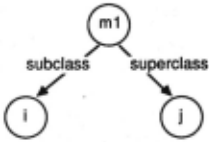
Here ml represents the proposition that the class of i's are a subclass of the class of j's. "Dogs are mammals" is represented as follows:
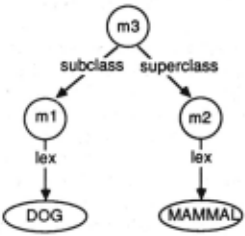
Likewise, "collies are dogs" is represented as follows:
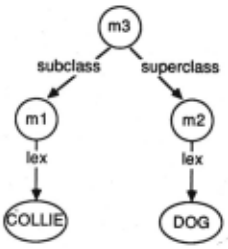
Thus, we build a traditional uniform type hierar chy of class/class relations. We see no reason to dis tinguish any relations in the hierarchy, since we find no evidence that generic categorization sentences such as "collies are dogs", "dogs are mammals", "mammals are vertebrates", require different underlying representations. {It is noteworthy that there are no class/class relations between two basic level categories.)
Since an ability to form abstract concepts is required for generic categorization, this categorization occurs at a later stage of development than does ordi nary categorization of basic level objects. Therefore, the type hierarchy, which is formed after basic level concepts are formed, is not the appropriate place to make the distinction between basic and non-basic categories. In summary, a single representation is used
for class/class relations, but two distinct representa tions are used for individual/class relations.
KRL-0 [Bobrow & Winograd 1977a, 1977b, 1979] is, to our knowledge, the only other AI system to dis tinguish basic and non-basic levels in the representa tion of taxonomies. KRL-o used units to represent both classes and individuals. Three distinct levels of abstraction were used in the representation of classes or types in units: a basic level, an abstract level, and a specialization level. Bobrow and Winograd stated that they did not, however, find an appropriate way to use these unit categorization levels for classes, and removed unit categorization from KRL-1 [Bobrow & Winograd 1979, p. 41! Although not precisely specified in their papers, Bobrow and Winograd appear to have made distinctions among the levels of abstrac tion in the type hierarchy of frames only, not in the individual/class relationships. We could not find any evidence that distinctions were made in the units representing individuals [Bol)row & Winograd 1977a p. 231
4. INHERITANCE AND LINGUISTIC IMPUCA TIONS.
4.1. Inheritance.
One of the organizational principles to which most semantic networks and frame systems adhere is that of storing properties in the hierarchy at the place covering the maximal subset of nodes sharing them. This is an efficient organizational scheme in which properties do not have to be replicated at ~ifferent places in the network, for they are inherited by nodes below the ones in which they are stored. This princi ple fits in well with the theory of cognitive economy, for one can gain a great deal of information from a category system organized in this way, while conserv ing resources.
Categorization research studies, however, do not support this principle of organization. As stated above, properties appear to be clustered at the basic level, not at the level covering the maximal subset of nodes. This means that there is not a great deal of inheritance of properties taking place in the type hierarchy. Instead most inheritance occurs at the individual level, i.e., from the basic level category to the individual. Thus, Rover inherits attributes from the basic level category dog.
4.2. Linguistic Implications.
Perhaps the most dramatic enhancement to our system resulting from our distinguishing basic and non-basic level categories is our ability to model human performance by choosing the most appropriate category name for an object. Systems using uniform taxonomies have to make arbitrary word choice deci sions. For example, the NIGEL generator [Sondheimer et al. 1986] generates as specific a term as possible. However, we know from human · categorization research that in the absence of a specific context that would lead one to use a non-basic level name for an object, the basic level name should be used.
Figure 8 shows a dialog with our system illus trating our ability to model human performance in this respect:
atn paraer initialization
: Lucy petted a yellow animal
I understand that Lucy petted a yellow animal
: The animal wu a dog
I understand that the yellow animal is a dog
: The dog wu a c:ollie
I understand that the yellow dog is a collie
: What did Lucy pet
Lucy petted a yellow dog
: Aend (end atn paraer)
Figure 8
Since the basic level name is the most useful and most used name, the most appropriate answer to the question "What did Lucy pet?" is not the specializa tion "collie" or the superordinate level name "mam mal", but the basic level name "dog".
The dialog in Figure 9 demonstrates that the basic level name is chosen regardless of the order in which categories are mentioned.
atn parser initialization
- : Mary petted a dog
I understand that Mary petted a dog
- : The dog is a mammal
- I understand that the dog is a mammal
- : The dog was a labrador
- I understand that the dog is a labrador
- : What did Mary pet Mary petted a dog
- : Jane petted a manx
- I understand that Jane petted a manx
- : The manx is a cat
I understand that the manx is a cat
- : A cat is a mammal
- I understand that cats are mammals
- : Mammals are animals I understand that mammals are animals
- : Who petted an animal Mary petted a dog and Jane petted a cat
: Aend (end atn parser)
Figure 9
Thus, Figures 8 and 9 show that word choice decisions are not made arbitrarily. Our system does not simply choose the most or least specific name of an object, or the category name mentioned either :first or most recently in the dialog. Rather, the most appropriate name for an object, its basic level name, is used.
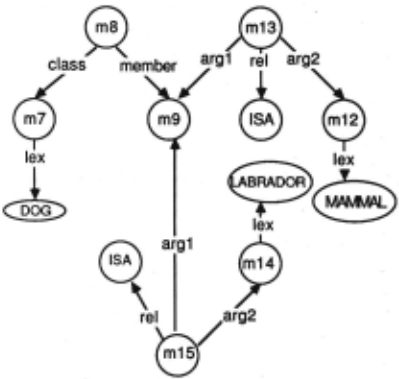
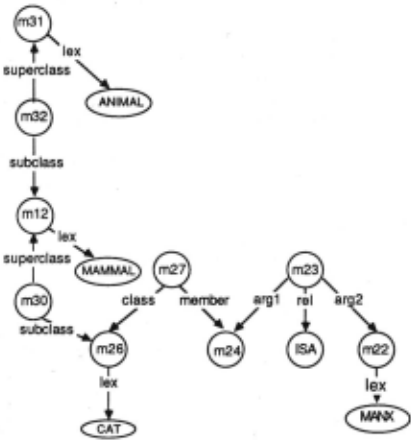
Figure 9 also shows the use of both ordinary categorization information and generic categorization information. The :first three sentences show ordinary categorization, i.e., the multiple classifications of an individual as dog, mammal, and collie. Figure 10 shows part of the network built following the input of these sentences. Node m9 represents the individual classified as a dog, mammal, and collie. The basic level name, dog, is chosen to answer the question "What did Mary pet".
Figure 11 shows part of the network constructed from the input of the last :five sentences in the dialog. Node m24 is the individual classified both as a cat and manx. The last group of sentences in Figure 9 also includes two generic categorizations: "A cat is a mam mal" and "Mammals are animals". A type hierarchy is constructed from this input. Answering the ques tion "Who petted an animal" requires · inferencing using the type hierarchy. Our system has inheritance rules which make this inferencing possible. [See Shapiro 1978, and Shapiro & Rapaport 1986 for exam ples of these rules.]
S. PROCESSING IMPLICATIONS.
The non-uniformity of human category systems also has implications for a processing model for categorization. We would like to use our system to model classification problem solving. This form of problem solving is the basis for many expert systems, e.g., PROSPECfOR [Gauschnig 19801 EMYCIN [van Melle 19791 and COCCI [Shapiro 1981] are knowlege-base systems that specialize in forms of classification problems.
Category research has established that objects can be identified as members of their basic level category more rapidly than as members of their superordinate or subordinate categories. A possible processing model for our implementation, compatible with Rosch's empirical evidence and the current general processing assumptions about categorization involving featural models [Smith & Medin 1981] such as ours is the fol lowing. An object is first identified or recognized as a member of its basic class, since properties or attributes are clustered at the basic level. Because of this bun dling of attributes at the basic level, this processing involving feature matching can be performed quickly. Categorization of an object as a member of its subordi nate classes requires additional processing time, because additional features must be matched, some of which are much less salient than the features for categorizing an object at the basic level. Categoriza tion of an object as a member of its superordinate classes requires inferencing using the type hierarchy. We use path-based inference to accomplish this [Shapiro & Rapaport 1986, Shapiro 19781 Performing this inferencing, of course, requires additional process ing time.
We are also interested in modeling the effect of expertise on the classification system, since Rosch [1976] found that expertise affects which level of abstraction is considered to be the basic level, as well as the amount of information stored at the basic and subordinate levels. For example, an airplane mechanic participating in her studies did not treat airplane as a basic level category, but further differentiated air planes to form basic level categories. His list of attri butes for types of airplanes was much more lengthy than those of other subjects, and he used attributes ignored by others. His visual view of airplanes also differed from those of other subjects, since his canoni cal view of airplanes was of the undersides and the engines, rather than of the top and side images. Although it seems clear that the effects of expertise will be confined to small, specific parts of the taxon omy, the effects of expertise on the classification sys tem need to be studied further. We believe that our system is flexible enough to accomodate the effects of expertise on the organization of the system.
6. CONCLUSIONS.
We have incorporated principles of categorization derived from several years of research in our AIINLP system. We distinguish one level, the basic level, as the core of our taxonomies, using a representation for membership in basic categories distinct from that used for membership in non-basic categories. This allows our system to model human performance in the gen eration of appropriate names for objects: when there is no context effect, the basic level name is used. The use of distinct representations and storing of attri butes at the basic level also will allow us to model the additional processing time necessary to categorize an object at a non-basic level.
@inproceedings{ijcai1987p27,
  title     = {A Representation for Natural Category Systems},
  author    = {Peters, Sandra L. and Shapiro, Stuart C.},
  booktitle = {Proceedings of the Tenth International Joint Conference on
               Artificial Intelligence, {IJCAI-87}},
  publisher = {International Joint Conferences on Artificial Intelligence},
  editor    = {John McDermott},
  pages     = {140--145},
  year      = {1987},
  note      = {Cognitive Modeling},
  url       = {https://ijcai.org/proceedings/1987/27},
}
TY - CPAPER TI - A Representation for Natural Category Systems AU - Peters, Sandra L. AU - Shapiro, Stuart C. T2 - Proceedings of the Tenth International Joint Conference on Artificial Intelligence, IJCAI-87 PB - International Joint Conferences on Artificial Intelligence PY - 1987 SP - 140 EP - 145 UR - https://ijcai.org/proceedings/1987/27 ER -Copied
Machine-readable versions of this paper, for tools and AI agents:





