
Understanding New Metaphors
Proceedings of the Tenth International Joint Conference on Artificial Intelligence. Cognitive Modeling. Pages 137-138.
© 1987 International Joint Conferences on Artificial Intelligence
Abstract
Metaphors are widespread in natural language. Most natural language processing systems have failed to adequately deal with this issue. A two part approach to this problem involving a Metaphoric Lexicon and a dynamic extension system is described. The extension mechanism operates by analogically mapping previously understood mappings to account for new uses based on known regularities in the English metaphor system. A system based on this approach has been applied to the UNIX domain. Results indicate that this domain exhibits all the predicted regularities and that understanding new senses is possible using these regularities
- Carbonell, J.G. (1980). Metaphor: A key to extensible semantic analysis. In Proceedings of the Third Annual Conference of the Cognitive Science Society (pp. 292- 295).
- Berkeley, CA.
- DeJong, G.F. & Waltz, D.L. (1983). Understanding novel language. Computers and Mathematics with Applica- tions, 9, 131-147 . .
- Fillmore, C. (1982). Frame semantics. In Linguistics in the Morning Calm (pp. 111-137). Hanshin, Korea: Linguis- tics Society of Korea.
- Genmer, D. & Stuart, P. (1983). Metaphor as structure map- ping: What develops (Technical Report No. 5479). Cambridge, MA: Bolt, Beranek and Newman.
- Hobbs, J. (1979). Metaphor, metaphor schemata, and selec- tive inferencing (Technical Note No. 204). Menlo Park, CA: SRI International.
- Jacobs, P. (1985). A knowledge-based approach to language production. Doctoral Dissertation, Computer Science Division, University of California, Berkeley, CA.
- Lakoff, G. & Johnson, M. (1980). Metaphors We Live By. Chicago, IL: University of Chicago Press.
- Martin, J. (1986). Views from a kill. In Proceedings of the 8th National Conference of the Cognitive Science Society (pp. 728-733). Amherst, MA: Lawrence Erl- baum Associates.
- Martin, J. (1986). Representing and acquiring knowledge about metaphors. In Proceedings of the 3rd Workshop on Theoretical Issues in Conceptual Information Pro- cessing (pp. 49-54). Philadelphia, PA.
- Martin, J. (1987). The acquisition of polysemy. To appear in, Proceedings of the Fourth International Workshop on Machine Learning. Irvine, CA: Morgan Kaufmann.
- Norvig, P. (1986). A unified theory of inference for text understanding. Doctoral Dissertation, Computer Sci- ence Division, University of California, Berkeley, CA.
- Russell, S.W. (1976). Computer understanding of metaphori- cally used verbs. American Journal of Computational Linguistics, 44, 45-56.
- Wilensky, R., Arens, Y., & Chin, D. (1984). Talking to UNIX in english: An overview of UC. Communications of the ACM, 27, 574-593.
- Wilensky, R. (1986). Some problems and proposals for knowledge representation (Technical Report No. UCB/CSD 86/294). Berkeley, CA: University of Cali- fornia, Berkeley, Computer Science Division.
- Wilks, Y. (1975). Preference semantics. In E. Keenan, (Ed.), The formal semantics of natural language Cambridge, England: Cambridge University Press.
- Wilks, Y. (1978). Making preferences more active. Artificial Intelligence, II, 197-223.
- Winston, P. (1978). Learning by creating transfer frames. Artificial Intelligence, 10, 147-172.
- Winston, P. (1980). Learning and reasoning by analogy. Communications of the ACM, 23,689-703.
References were extracted automatically from the PDF and may contain errors.
Full text extracted automatically from the PDF; figures, tables and equations may differ. The PDF is the version of record.
1. Introduction
Metaphors are widespread in natural language. They are a conventional part of the language and are easily under stood through the application of specific knowledge. Meta phors only become a problem when the hearer does not pos sess knowledge of the metaphor underlying the utterance. Therefore a natural language processing system must have specific knowledge about the conventional metaphors in the language to analyze and generate metaphors. In addition it must have a means of dynamically extending that knowledge when a new use is encountered. In this paper I describe a system that can perform this task. Given a base of knowledge about the conventional metaphors of English and an instance of a usage not covered by that knowledge, it can dynamically discern the new meaning and extend the knowledge base to cover this new use.
The approach is based on several observations. The first is that almost all instances of metaphors are specific instances of a small set of abstract conceptual metaphors (see Lakoff 1980). The second observation is that the specific lexicalized conventional metaphors of English exhibit several systematic regularities. The regularities inherent in the metaphorical system are exploited by the metaphor extension algorithm in an attempt to process new metaphors. The basic assumption is that the new metaphor is conven tional and can be expected to fit into the known set of meta phors in a predictable way. The approach is knowledge based in that it requires knowledge about the conventional metaphors of English, knowledge about the regularities exhi bited by those metaphors and knowledge about the concep tual domains that they are applied to.
· This resean:h wu lpCllliOied in part by lhe Defmse Advance Research Projecu Aaency (DOD), AJPO 0n1er No. 4031, Molliloced by Nan! lllectnlnic Sy11em Command under c-ract No. N00039.C.m:!S, and by a GTE l..abocatoriel Fellowship.
Understanding New Metaphors
James H. Martin
Berkeley Artificial Intelligence Research Computer Science Division University of California Berkeley, California 94720
2. Related Research
Previous approaches have fallen into two distinct classes. The first approach attempts to compute the meaning of the metaphor from knolwedge about the literal language of the metaphor and conceptual knowledge of the target domain. The work of Russell (1974), Wilks (1975, 1978), Winston (1979) Carbonell (1981), DeJong and Waltz (1983), and Gentner (1983) exemplify this approach. The other approach attempts to represent knowledge about con ventional . metaphors. The various structured mapping approaches Carbonell (1981), Jacobs (1985), Norvig(1986), Martin (1986) all assert that the processing of metaphors involves the application of pre-stored knowledge structures representing conventional metaphors. Most . of these approaches were inspired by the work of Lakoff and Johnson (1980), which showed that metaphor was a widespread mechanism for structuring the lexicon.
3. Processing New Metaphors
When I use the term New Metaphor I am referring to the situation where an utterance is not understood because of the presence of a metaphor about which the system has no knowledge. (For the moment I draw no distinction between a metaphor which is actually a conventional part of English but about which the system has no knowledge and a metaphor which is actually a novel use). It is the task of the Metaphor Extension System to determine if a metaphor is in fact present and if so to determine its meaning.
The metaphor extension approach relies on the existence of two sources of knowledge to perform its task. The first is an abstraction hierarchy of mappings that represents the set of abstract conventional metaphors in English. When a new use is encountered the system first checks to see if this use might be an instance of an abstract metaphor. If so it then attempts to ascertain the meaning of this new instance.
The second source of knowledge I call the Metaphoric Lexicon. This is a lexicon which explicitly represents the polysemous senses of ordinary English words that have a metaphoric basis. The word senses represented in the Meta phoric Lexicon can be seen as individual lexicalized instan tiations of the abstract metaphors described above. The meta phor extension approach relies on the fact that the Meta phoric Lexicon is not a random set of idiomatic phrases. Rather, the lexicon exhibits a small set of regularities. This is the basis for the extension system. The system attempts to relate a new use to one of the known uses via one these regu larities. In the following sections I describe each regularity in the lexicon and show how it can be used for learning.
3.1. Metaphorical Frame Semantics
Frame semantics is an approach to lexical semantics proposed by Fillmore (1982). The aspect of this approach that is relevant here is the notion that groups of words are mutually defined with respect to a single semantic frame. The words from a given semantic frame have a well defined set of relationships to one another. Consider Fillmore's example of the commercial transaction frame. The words buy, sell and cost among others are defined with respect to this frame.
Metaphorical Frame Semantics asserts that when multi ple terms from the same semantic frame are used metaphori cally, they will retain an equivalent relationship to each other as they had in the literal semantic frame. For example if the 'word enter used metaphorically then the metaphorical use of the word exit will have a meaning which is in the same rela tionship (ie. opposite action) to the metaphorical use of enter as in the literal meaning. This can be exploited for learning in the following way. When a new use is encountered search for words from the same semantic frame that are used meta phorically in the same way as the current use. If one is found then the base relationship can be used to find or create the new meaning.
3.2. Conceptual Closeness
Concepwal Closeness asserts that cond:pts that are similar will tend to undergo the same metaphors. Polysemous verb senses are sub-categorized according to the kind of direct object they prefer. The metaphorical meanings of these verbs will tend to apply to objects that are similar. Consider the following examples with the verb take.
John took a walk with Mary. John took a hike with Mary.
·-John took a cruise with Mary.
Conceptual Closeness refers to the closeness in the categori zation of the concepts referred to by the words walk, hike
and cruise.
When a new use is encountered one can look to see if any known sense of this verb applies to an object known to be similar to the current object. If so then map the meaning of the known sense to the new sense based on the connection between the objects.
3.3. Metaphorical Coherence
Single concepts tend to be structured by a number of distinct metaphors. Metaphorical Coherence refers to the "ways that the various metaphors used to structure a single concept relate to one another. This regularity can be viewed as analogous version of Conceptual Closeness. With Concepetual Closeness we are interested in the relationships among various closely related target concepts undergoing the same metaphor. With Metaphorical Coherence we are interested in the relationships among various metaphors used to structure one concept. Consider the following examples from Lakoff and Johnson (1980).
Our marriage just ran out of gas.
Their relationship is on the rocks.
Their marriage is off the tracks.
Each of these reflect a structuring of the concept love with a particular kind of journey. In particular the notion that the a failure to make progress in the journey corresponds to prob lems with the relationship. However distinct sub-types of the journey metaphors are used in each example; they are the car trip, railroad and sea voyage frames.
Metaphorical Coherence can be used to understand new usages in a manner similar to Conceptual Closeness; If you hear a new metaphor look to see if the same target concept is structured via a metaphor that is known to cohere with the currently postulated metaphor. The relationship between the two metaphors and the previously understood mapping is used to create a new mapping for the current target.
4. Algorithm and Implementation
The system was applied to the UNIX domain to test the theory. Consider the following examples:
You can get into the editor by typing emacs to the shell.
You can kill a process by typing AC. My editor just died, how can i save the buffers? Run your file through spell to fix the spelling.
The italiciZed words in these examples are common English words with many polysemous senses. The theory predicts that the meanings of these words in the UNIX domain will be related to their other polysemous senses by one or more of the known regularities. The system was implemented and tested as a component of the UNIX Consultant system (Wilensky 1984). Knowledge about UNIX and the Meta phoric Lexicon were represented using the KODIAK (Wilen sky 1986) knowledge representation system - an extended semantic network language.
The learning heuristics described in section three are implemented as a two way breadth first search through the KODIAK network. One search spreads out from the source concept as specified by the given verb. The other startS out from the target concept as indicated by the object of the verb. When these two searches intersect the resulting path is checked against three known path types that represent the three major regularities described above. This algorithm is specifically looking for a path through the network from the source to the target domain across some VIEW representing a known metaphor. A VIEW is a structured KODIAK link that is used to represent non-hierarchical metaphoric map pings. This path is then used to analogically map the mean ing of the previous use to the current situation. See Martin (1987) for details on the representation of the Metaphoric Lexicon.
Once a path has been selected a procedure . specific to the path type is applied. This procedure produces both the meaning of the new use and new VIEW mappings to represent this new use. The way that the previous mapping is transferred to the new use is dependent on the type of the path. One procedure type is defined for each regularity.
S. An Example
In this section an example of Metaphorical Frame Semantics will be described. The path found will be shown, and the final processing to find the new meaning is described.
Consider the following question given to UC:
How can I get out of lisp?
The initial state of the knowledge base contains the following information: knowledge of containers, knowledge about lisp and computer processes in general, and a previously under stood mapping defining what getting into lisp means. The metaphor extension system starts a search and finds the path show in Figure 1.
This path corresponds to the type associated with frame semantics. It represents a connection from the source concept exit-action to enter-action via the frame relation
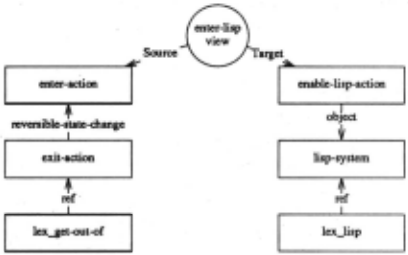
reversible-state-change. The path continues from enter-action across the VIEW link to the concept enable-lisp-use which is connected directly to the concept lisp-system which is the original target con cept. This VIEW represents the knowledge about what the phrase getting into lisp means.
The next step is to apply the relation reversible-state change to the concept enable-lisp-use. The process of applying a frame relation to a new domain has two possi ble results. It may simply find a concept already existing in the target domain or it may actually have to create one of the correct type. Here the system finds the initial concept disable-lisp-usa. This concept is used as the mean ing of the new metaphor. Finally a new VIEW is created representing the new use of exit lisp to mean disable.
6. Conclusions
The key to the success of this system was in the size of initial lexicon. Given a sufficient initial lexicon, knowledge about conventional metaphors, and knowledge about the UNIX domain, the system was able ascertain the meaning of new metaphorical uses. The learning mechanism works basi cally by analogically mapping previously understood meta phorical mappings. The basis for the success of this approach is the fact the set of conventional metaphors in English is not random. The small set of regularities that it exhibits makes a system based on incremental extension reasonable. Future work is concentrating on issues of representation of the Lexi con and generalization of highly specific mappings to more abstract senses.
- Carbonell, J.G. (1980). Metaphor: A key to extensible semantic analysis. In Proceedings of the Third Annual Conference of the Cognitive Science Society (pp. 292295). Berkeley, CA.
- DeJong, G.F. & Waltz, D.L. (1983). Understanding novel language. Computers and Mathematics with Applica tions, 9, 131-147 . .
- Fillmore, C. (1982). Frame semantics. In Linguistics in the Morning Calm (pp. 111-137). Hanshin, Korea: Linguis tics Society of Korea.
- Genmer, D. & Stuart, P. (1983). Metaphor as structure map ping: What develops (Technical Report No. 5479). Cambridge, MA: Bolt, Beranek and Newman.
- Hobbs, J. (1979). Metaphor, metaphor schemata, and selec tive inferencing (Technical Note No. 204). Menlo Park, CA: SRI International. ·
- Jacobs, P. (1985). A knowledge-based approach to language production. Doctoral Dissertation, Computer Science Division, University of California, Berkeley, CA.
- Lakoff, G. & Johnson, M. (1980). Metaphors We Live By. Chicago, IL: University of Chicago Press.
- Martin, J. (1986). Views from a kill. In Proceedings of the 8th National Conference of the Cognitive Science Society (pp. 728-733). Amherst, MA: Lawrence Erl baum Associates.
- Martin, J. (1986). Representing and acquiring knowledge about metaphors. In Proceedings of the 3rd Workshop on Theoretical Issues in Conceptual Information Pro cessing (pp. 49-54). Philadelphia, PA.
- Martin, J. (1987). The acquisition of polysemy. To appear in, Proceedings of the Fourth International Workshop on Machine Learning. Irvine, CA: Morgan Kaufmann.
- Norvig, P. (1986). A unified theory of inference for text understanding. Doctoral Dissertation, Computer Sci ence Division, University of California, Berkeley, CA.
- Russell, S.W. (1976). Computer understanding of metaphori cally used verbs. American Journal of Computational Linguistics, 44, 45-56.
- Wilensky, R., Arens, Y., & Chin, D. (1984). Talking to UNIX in english: An overview of UC. Communications of the ACM, 27, 574-593.
- Wilensky, R. (1986). Some problems and proposals for knowledge representation (Technical Report No. UCB/CSD 86/294). Berkeley, CA: University of Cali fornia, Berkeley, Computer Science Division.
- Wilks, Y. (1975). Preference semantics. In E. Keenan, (Ed.), The formal semantics of natural language Cambridge, England: Cambridge University Press.
- Wilks, Y. (1978). Making preferences more active. Artificial Intelligence, II, 197-223.
- Winston, P. (1978). Learning by creating transfer frames. Artificial Intelligence, 10, 147-172.
- Winston, P. (1980). Learning and reasoning by analogy. Communications of the ACM, 23,689-703.
@inproceedings{ijcai1987p26,
  title     = {Understanding New Metaphors},
  author    = {Martin, James H.},
  booktitle = {Proceedings of the Tenth International Joint Conference on
               Artificial Intelligence, {IJCAI-87}},
  publisher = {International Joint Conferences on Artificial Intelligence},
  editor    = {John McDermott},
  pages     = {137--138},
  year      = {1987},
  note      = {Cognitive Modeling},
  url       = {https://ijcai.org/proceedings/1987/26},
}
TY - CPAPER TI - Understanding New Metaphors AU - Martin, James H. T2 - Proceedings of the Tenth International Joint Conference on Artificial Intelligence, IJCAI-87 PB - International Joint Conferences on Artificial Intelligence PY - 1987 SP - 137 EP - 138 UR - https://ijcai.org/proceedings/1987/26 ER -Copied
Machine-readable versions of this paper, for tools and AI agents:





