
Towards Continuous Process Supervision
Proceedings of the Tenth International Joint Conference on Artificial Intelligence. Reasoning. Pages 1086-1088.
© 1987 International Joint Conferences on Artificial Intelligence
Abstract
This paper provides a contribution to qualitative reasoning for continuous process supervision. Tools for formalizing empirical knowledge of continuous processes and a naive reasoning naturally integrating perception are proposed. A new paradigm emerges : maintenance of a single instantaneous and possibly partial understanding of a physical system during its evolution. This understanding in closed loop includes prediction and truth maintenance of whole histories of evolution at the data sampling rate. This technique relies on both deep and empirical knowledge, using mainly intuitive notions like order of magnitude of non-negligible quantity, gain, delay and duration . Our approach is compared to existing work in qualitative physics basically focused on qualitative calculus of classical physics formalization.
- and Bobrow 84
- J. de Kleer and D. G. Bobrow. Qualitative reasoning with higher-order deriva- tives. In AAAI, pages 86-91, 1984.
- Stephane Feray-Beaumont. Automatique Qual- itative {in French). Technical Report, Labora- toire d'Automatique de Grenoble, 1986.
- K. D. Forbus. Interpreting measurements of physical systems. In AAAI, pages 113-117, 1986.
- B. Kuipers. The limits of qualitative simu- lation. In IJCAI, pages 128-136, 1985. IJCAI
- Raiman 86]
- Raiman. Order of magnitude reasoning. In AAAI, pages 10Q-104, 1986.
- Sussman and Steele 80
- G.J. Sussman and G.L. Steele Jr. Constraints: a language for expressing almost-hierarchical descriptions. Artificial In- telligence, 14{1):1-39, 1980.
- B. Williams. Doing time: putting quali- tative reasoning on firmer ground. In AAAI, pages 105-112, 1986.
- C81oud
References were extracted automatically from the PDF and may contain errors.
Full text extracted automatically from the PDF; figures, tables and equations may differ. The PDF is the version of record.
I Introduction
This paper addresses the problem of supervising complex continuous processes and presents a new qul\litative ap proach, based on well-known principles of control the ory. This approach can be compared to existing work in qualitative physics in the same sense as control theory can be compared to physics. The goal of control the ory is to provide tools to control discrete and continuous processes. Within this framework, the fundamental laws governing physical system behavior are not taken into ac count. Roughly speaking, a control theory based model of a physical system has only to provide the ability to find out corrective actions when disturbances occur. But an important limitation of control theory is that only the well functioning process is modeled. Thus severe disturbances or material faults can lead to unpredictible and dangerous evolutions. This is why skilled operators still supervise controlled continuous processes. Our work is a first step towards computer aided supervision of continuous pro cesses. This automated closed loop reasoning is mainly based on dynamic prediction. An operator must be able to predict how evolutions can propagate through the entire process. Moreover, this prediction must be com pared to the real evolution over time. Non-significant dif ferences must be integrated into already predicted histo ries, whereas deep contradictions must lead to corrective actions which may include diagnosis.
An application in progress is helping operators to achieve supervision of an existing continuous process. But let us take a simple example from everyday life. Cooking a sauce is a simple empirical process that can be handled with out a complex physical model. The cook has empirically identified as essential some perceived parameters like gas flow and temperature. This description is sufficient to supervise the cooking process :
- Qualitative reasoning based on order of magni tude of evolutions allows rough prediction. For example, the response time before sauce boiling can be evaluated at one time to five minutes from the given gas flow. If an electrical cooker is used, its thermal inertia must be taken into account.
- Such a simple approach would not be effective with out continuous perception. First, the qualitative predictions result are approximate. The response time before boiling may be re-evaluated from sen sor informations as cooking progresses. Second, dis turbances may occur. The cook may want to add water. This new influence on the sauce tempera ture must be integrated to the current prediction.
Section II first underlines the limitations of existing work in Qualitative Physics for continuous process super vision. Section III emphasizes the importance of encoding empirical knowledge of continuous processes. Relevant Supervision Variables (RSVs) are the basic objects of our representation. Evolution constraints describe how evolutions propagate between variables over time. Section IV presents a constraint propagation technique allowing a single and possibly partial future evolution of the controlled system to be inferred from an initial set of measured evolutions.
II Limitations of existing work
Most existing work in Qualitative Physics (QP) proceeds in the spirit of quantitative physics. Qualitative calculus applied to classical physical laws permits a large range of physical behaviors to be explained and predicted. We argue that, as physical laws are not the basis of process models used for control, qualitative physics suffers from severe limitations for process supervision. These limita tions can be summarized by the two following points :
- Low level formalization.
QP simulation techniques apply a qualitative cal culus to physical variables. This calculus bases op erations (plus, minus, derivation, etc) on truth ta bles, operand variables taking their values in (de creasing, steady, increasing). As qualitative cal culus is not powerful enough (for example X + Y = Z cannot be solved if X increases and Y de creases), the real future behavior of a physical sys tem usually cannot be predicted given initial con ditions, as described by B. Kuipers [Kuipers 85]. Only a hypothesis graph of behaviors can be ob tained in the general case. Better qualitative tech niques, like J. de Kleer's "qualitative reasoning with higher-order derivatives" [deKleer and Bobrow 84] or 0. Raiman's "order of magnitude reasoning" [Raiman 86] do not completely get rid of indetermi nations. Our problem is that continuous processes are complex physical systems. Completely model ing a system such as a refinery may be tedious. Moreover, a model using sophisticated mathemat ical tools may not be tractable by qualitative calcu lus. And last but not least, generating an hypothesis tree through a large model leads to a combinatorial issue.
- Envisioning is not synthetic enough for supervision. QP defines envisionment as the graph describ ing all possible behaviors given some initial con ditions. But an envisionment may contain im possible behaviors, due to the formalization prob lems described above (this point is underlined by B. Kuipers). As continuous processes are complex physical systems, we doubt the explanation capa bility of a system using envisionment. The latter would provide a huge quantity of behaviors includ ing impossible solutions. On the opposite, the goal of computer aided supervision is to give operators a few relevant pieces of information. Information overflow already is the primary cause of panic. Fur thermore, envisionment cannot enable preventive actions in general cases because operators would not know which behavior is to be avoided.
These inadequacies follow from the difference of approach between physics and control theory. However, the need of including qualitative techniques in closed loops has re cently been illustrated by K. D. Forbus [Forbus 86] and B. Williams [Williams 86].
III Modeling processes
A. Relevant Supervision Variables
A skilled operator uses a simple mental model of the pro cess. This model includes key parameters and production constraints. Key parameters may be physical parameters like temperatures, pressures, etc, or actions like feedback control regulator set-points, valves, etc. Production con straints are more elaborate concepts. They summarize re lations to be maintained between key parameters in order to meet production quality standards. These supervision parameters and constraints are encoded in our model as elementary components, which we call Relevant Super vision Variables (RSVs). RSVs are linked in a "causal" network. The semantics of an RSV is essentially captured in its relations with neighbour RSVs. In other words, an RSV X exists in a model only if it is relevant to the super vision of the entire process. An additional local seman tics is provided by typing RSVs, in order to distinguish actions, feedback controlled variables, equilibrium vari ables, etc. Note that such perceptive and interpretative background would be blurred in a description according to classical physics. Let us come back to the sauce cook ing example. A simple supervision model of this process could include the following RSVs: D 111 , for gas flow, and Vmizing which is a measure of how energetically the cook mixes the sauce, are actions; T,4 uc· stands for sauce temperature; Qhomogeneitv characterizes a constraint to satisfy during the cooking to obtain a good sauce.
We assume, as a first approximation, that each sensing of the supervised process is a measurement of some su pervision parameter. The corresponding RSV X takes its values in two spaces. One of them is the Quantity Space (QS) of Qualitative Physics (in the sense of B. Kuipers [Kuipers 85]). The other is a quantification of the con tinuous range of the parameter; the discretization step of which can be defined as the minimum amount of per ceived evolution of X which allows deductions about the state of the process or its future evolutions. In the cook ing example, T,4 uc· can continuously evolve from lO"C to 100"0. A discretization step may be 10°0, if it is the min imum perceived change allowing the cook to deduce a new evolution. And a QS for T, 4 uc· could be ( liquid-phase, boiling-point, vapor-phase), the boiling point taking its value on the discretized scale. In our application to con tinuous process supervision, control during normal work ing consists in maintaining relevant physical parameters in a single qualitative state, centered around a nominal value.
B. Evolution constraints
An evolution constraint from variable X to variable Y is a representation of how an evolution of X can be propagated as a partial influence on Y. It is composed of a qualitative transfer function, describing. the nature of the rela tion linking X and Y, and empirical data such as values of gain, delay, and response time. Given a linear evolu tion of variable X, an evolution constraint infers a partial influence on variable Y.
1. Background representation of time
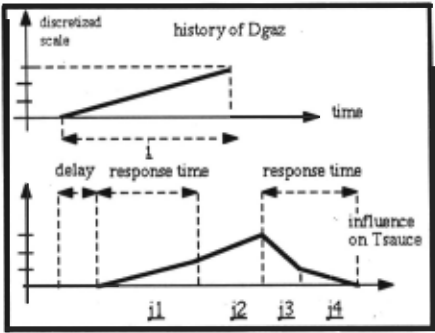
The formalism we use to represent temporal evolutions is based on numerically defined intervals. An elemen tary evolution is a linear evolution of an RSV over an interval. An evolution constraint infers a partial influ ence on an RSV Y from an elementary evolution of a RSV X over an interval i . This partial influence is a set S = {(j1, · ·· ,j,.), n ~ 1} of elementary evolutions of Y over consecutive intervals j1· The important notion of delay is given by the difference between the beginnings of the intervals i and 3"1· Moreover the duration of the propa gated influence is equal to the duration of the elementary evolution, increased by the response time of the con straint . The response time is defined as the time required for the response to a step evolution to settle within a given percentage of the final value.
2. Qualitative transfer function
A qualitative transfer function is a qualitative encoding of linear control theory models. Using a limited number of simple parameters, including the times of beginning and ending, the initial and final values, it characterizes the matched evolution of X during the interval i . Ac cording to the nature of this evolution, a mixed quanti tative/qualitative reasoning is performed. It makes use of the essential notion of gain, describing how orders of magnitude are propagated via the constraint. From the gain, the initial value and the slope of the considered evo lution, descriptive tokens are deduced for the propagated influence. Then, according to temporal informations, this evolution is detailed into a number of linear evolutions over intervals j, of S.
Figure 1 gives an example of an evolution inference between the two variables Dga· and T.auce· This is the case of the qualitative transfer function describing an in creasing relationship. The matched evolution of Dga· is a linear increase over an interval i. As the gain of the constraint is moderate, the order of magnitude of the in fluence on T,auce is the same as that of the evolution of Dga· (influences can also be amplified or weakened; if the gain is exactly known, it may be numerically expressed) . More precisely the influence is composed of four linear evolutions. The last two describe the cooling of the sauce. This is the damping of the initial condition given by the final value of the influence (the end of j 2 in the example). No hypothesis of the future evolution of Dga· is needed because only the effects over time of the elementary evolution are propagated.
An important advantage of our representation is that feedback loops can be easily encoded. Indeed, an empir ical representation of a feedback loop should reflect an integrated comprehension of the phenomenon, on the op posite of a low level representation relying on heayy com putations. Modeling a feedback regulator itself would lead to a computational issue, if based on a low level mod eling and simulation. For any feedback controlled vari able V, we automatically introduce an intermediate vari able V.umm which summarizes all influences coming into the control loop. Its behavior is then described by an evolution constraint which integrates the expected global behavior. Likewise n-valued equilibria can be encoded. A justification based on control theory of this important part of the work is given in [Feray 86] .
IV Dynamic Prediction
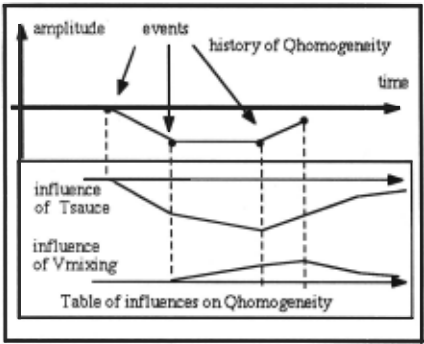
Continuous process supervision is essentially based on the ability to predict how evolutions can propagate through the entire process. This section describes a method for solving this general problem. To each RSV X, we attach an evolution history and a recording-table of influences. A history of X is a contiguous sequence of linear evolutions, each supported by an open interval]ehel+l[, so that the total evolution of X over the history is continuous. The evolution change dates e1 are called events. Influences propagated on X by evolution constraints have the same form as a history. All influences propagated on X over time are integrated in the history of X and recorded in a table. Each influence is justified by a particular variable evolution from which it has been inferred.
Starting from a set of measured initial evolutions, the propagation algorithm has to build a single prediction of the future evolution. The prediction is performed from present date up to a predefined horizon, based on a simu lation approach. The principle of the algorithm is to step through time, event by event, for each variable. One step consists in closing an elementary evolution over an inter val ]e, e1+1[ in the history of a variable X, as described in figure 2. The evolution of X during this interval is computed from the recorded influences. Influences are presently numerically combined, independently of the al gorithm. Symbolic facts like orders of magnitude of evo lutions and changes of values in the quantity space are extracted. From the computed evolution, influences are deduced through evolution constraints in the future of causally linked variables. The control of the algorithm guarantees that computed evolutions are complete, i.e. no influence can be forgotten. The algorithm stops either when each history has been integrated up to the horizon date, or when the initial evolutions have completely been propagated. A classical limitation of this kind of propaga tion technique is that it can only solve triangular systems, as described by G. J. Sussman [Sussman and Steele 80].
In the above algorithm, nothing prevents an evolu tion of infinitely small duration from being propagated, although this would be non-sense in naive reasoning. For this reason, a temporal granularity has been introduced. Its effect is a careful aggregation of too close events as influences are propagated. The results of the predic tion are compared to the real evolution over time. Non significant differences are integrated into previously pre dicted histories. When a measured evolution differs from the predicted one, all deduced influences are computed once again by recursive stepping through justifications. This truth maintenance of histories is achieved as a new prediction proceeds, at the data sampling rate.
V Conclusion
We have presented in this article a first approach to computer aided supervision of continuous processes. The importance of encoding empirical knowledge of processes has been emphasized. Supervision models use Relevant Supervision Variables as basic objects. By using orders of magnitude the evolution constraints describe how evolu tions propagate over variables. Dynamic prediction allows to infer a single future evolution of the controlled system from sampled sets of measured parameters.
Our future work will address two problems. First the comparison process, which decides if observed differ ences between prediction and real evolution are signifi cant, must be improved. It has to be reliable because any dangerous evolution must be detected. The second prob lem is more fundamental : the current model may become obsolete as equipment fails. In this case the model should be dynamically updated.
Acknowledgments
This paper benefited greatly from discussions with S. Gen til, Y. Descotte, A. Lux, and from the useful comments of J-C. Latombe, Y. Lagoude and J-P. Tsang.
@inproceedings{ijcai1987p221,
  title     = {Towards Continuous Process Supervision},
  author    = {Caloud, Philippe},
  booktitle = {Proceedings of the Tenth International Joint Conference on
               Artificial Intelligence, {IJCAI-87}},
  publisher = {International Joint Conferences on Artificial Intelligence},
  editor    = {John McDermott},
  pages     = {1086--1088},
  year      = {1987},
  note      = {Reasoning},
  url       = {https://ijcai.org/proceedings/1987/221},
}
TY - CPAPER TI - Towards Continuous Process Supervision AU - Caloud, Philippe T2 - Proceedings of the Tenth International Joint Conference on Artificial Intelligence, IJCAI-87 PB - International Joint Conferences on Artificial Intelligence PY - 1987 SP - 1086 EP - 1088 UR - https://ijcai.org/proceedings/1987/221 ER -Copied
Machine-readable versions of this paper, for tools and AI agents:





