
Naive Mechanics Comprehension and Invention in EDISON
Proceedings of the Tenth International Joint Conference on Artificial Intelligence. Natural Language. Pages 696-698.
© 1987 International Joint Conferences on Artificial Intelligence
Abstract
This ~~r briefly reports on the current architecture and status of EDISON, a computer mode_l l?eing designed to . ( 1) understand natural language descnpttons of mechanical devices and (2) generate novel device representations through heuristic strategies of mutation and analogy. The representational constructs in EDISON must support both of these tasks and include: goal/plan informatton, _spatial relationship!!, forces, motion, contact1 regions, constrrunts on (al)d principle~ on device operatio~. levels of abstraction, and nruve mectiarucs dependencies and mferences.
- Dyer, M. G. In•Depth Understanding. MIT Press, Cambridge, MA. 1983.
- Dyer, M. and Flowers, M. Toward Automating Design Invention. Proceedings of AUTOFACT 6 Conference. Anaheim, CA. 1984.
- Dyer, M.G., Flowers, M. and Hodges, J. EDISON: An Engineering Design Invention System Operating Naively. International Journal of Artificial Intelligence in Engineering. Vol. 1, No. 1, pp. 3644, 1986.
- Dyer, M. G., Flowers, M. and Hodges, J. Computer Comprehension of Mechanical Device Descriptions. In J. Gero (ed) K110wledge-Based SJstems in Engineering and Architecture, Addison-Wesley, Reading, MA (m press).
- Forbus, K. Qualitative Process Theory. Artificial Intelligence. 24, 85- 168, 1983.
- Forbus, K. Chapter 5. Formal Theories of the Commonsense World. Ablex. pp.l85-226, 1985.
- Forbus, K. Invited Talk. AAA/-86, Phila. PA, 1986.
- Hayes, P. The Second Naive Physics Manifesto. In Brachman & Levesque (eds). Readings in K110wledge RepresenJation.
- Morgan Kaufmann, Los Altos, CA. 1985.
- Kolodner, J. Retrieval and Organizational Strategies in ConceptUGl Memory: A Computer Model. LEA, Hillsdale, NJ. 1984.
- Lehnert, W. The ProcessofQuestionAnswering. LEA, Hillsdale, NJ. 1978.
- Lenat, D. AM: An ATtificiallntelUgence Approach to Discovery in MathemaJics as Heuristic Search. Stanford Univ. PhD. Palo Alto, CA. 1976.
- Lenat, D. EURISKO: A Program thai Learns New Heuristics and Domain Concepts. ArtifiCial Intelligence. 21(2,1), 61-98, 1983.
- Minsky, M. A Framework for Representing Knowledge. In Johnson-.
- Laird and Wason (eds). Thinldng: Readings in Cognitive Science. Cambridge Univ. Press, MA. 1977.
- Rieger, C. An Organization of Knowled$e for Problem Solving and Language Comprehension. 1975. Reprinted m Brachman and Levesque (eds). Readings in KIWWledge RepreunJation. Morgan Kaufmann, Los Altos, CA. 1985.
- Schank, R. Dynamic Memory. Cambridge Univ. Press, Cambridge, England, 1982.
- Wasserman, K. and Lebowitz, M. Representing Complex Physical Objects. Cognition and Brain Theory. Vol. 6, No. 3, 259-285, 1983.
- Weiss, H. Machines and How They Work. T. Y. Crowell. 1983.
References were extracted automatically from the PDF and may contain errors.
Full text extracted automatically from the PDF; figures, tables and equations may differ. The PDF is the version of record.
1. Introduction
The EDISON research pr.Qject was created to explore processes of comprehension (lJyer, Flowers & Hodges in press) and invention (.!)yer, Flowers & Hod~s 1986) m the naive mech~cs domain. (Dyer & Flowers 1984). Thes.e t~sks r~uire basic research m areas of: memory orgamzatiOn disambiguation, inference, learning, problem solving and representation of knowledge. Our afproac~ h_as ~en to 6ui_ld a prototype process model and to tes the hm1tattons of vanous comprebension and invention heuristics, along with the representational constructs over which they operate.
2. EDISON Architecture
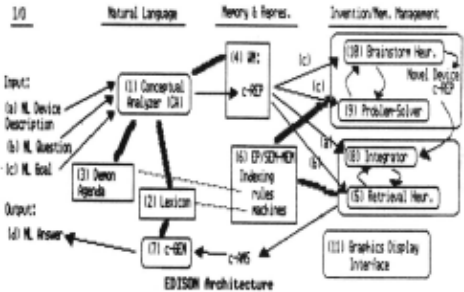
The current EDISON system is comQ<>sed of eleven elements, shown in fi_gure 1 below. In this llgure, thin lines with arrows indicate tile flow of input/informatton through the system,i_thin (dotted) lines without arrows indicate semantic hnks oetween knowledge structures; thick lines indicate knowledge access between knowledge bases (squares) and interpretation subsystems (squares witn rounded comers).
· I his research is supported in part by an ONR grant (N00014-86-K061S) to the first two authors. Early exploratory research in this area was supported in part by an mM Faculty Development Award to the first author, and by a grant from the Hughes AI Center.
When a design goal specification is input, the c-REP is passed to the invention management sybsysfem. If the ~Qal is to create a novel device of a given cype, then the c-REP is handed directly to the bramstormin~ component (10). Brainstorming consists of heuristics which attempt to create novel devices, by two general strategies: (1) mutatwn, where a given device representation is altered or combined with other device components, or (2) analogy, where a device representation is generalized and another mechanism is recalled (from a different context) which shares features at an abstract level with the given device. The recalled device is then adapted to the target context.
If the goal specification includes a number of constraints the c-REP IS passed first to the problem-solving component ol the invention management sul:isystem ((9) figure 1 ). The problem-solver attempts to apply mechamcs rules and principles to satisfy mechanics constraints. When the problem solver cannot recall a solution from memory, it calls up<?n the brainstorming heuristics to invent a device. For each device invented, constraint satisfaction is applied.
All novel devices (whether from comprehension or invention) are placed in EP-MEM. Although EDISON currently cannot generate natural langua_ge descriptions of arb if!¥>' devices, the graphics interface ( 11) does display a graphical representation of the semantic relationsliips constructed to represent a device in memory.
3. Naive Mechanics Representation
. A naive mechanics representation (NMR) must support CQmprehension, problem so1ving, learning, and mvention. The NMR used by EDISON is not finalized) but the general app~oach is .that of represe~ting ~echamcal areas, Torcesi motions, objects, and relatiOns m terms of conceptua · dependencies, along with associated inference rules.
3.1. NMR Requires Goals/Plans for Problem Solving
Consider the nail clipper in figure 2. Most people, after looking at this figure for a momen~ realize that this particular nail clipper simply will not work. 1t then takes them a moment. longer to realize (in exact detail) why it will fail. This comprehension process often requires that they re-examine· exactly how a bug-free nail clipper actually functions.
EDISON must be able (1) to receive a conceptual. representation of a nail clipper, (2) recognize it as a nail clipper, either from a Iaber,. or by comparing th~ input representatiOn w1th knowledge m memory, and (3) realize that this representation has a 'bug' and understand how the bug interferes with the function of the device.
In order to spot device errors, EDISON must be able to analyze each component in terms of the goals its use accomplishes. In story understanding and invention domains, the relevant goals are those of the characters and include hunger, health preservation, achievement of social status, fincfmg an agent, etc. In the naive mechanics domain, goals involve physical transformations, such as connection and separation. For instance, the nail clipper achieves the goal of separating a nail into two objects: tlie remaining nail and the nail clippmg. In story domains, goals are achieved through the execution oT plans and a number of plans may exist which are able to achieve a single goal. Likewise, in the naive mechanics domain, goals are also achieved through abstract plans, but here realized though the operation of physical devices. For example, the goal of separation can be realized e.g., by shear;mg, ~licing1 ripping, or C\ltting. The cutting pefforme~ by a nail clipper mvo1ves forcmg two wedge-shaped objects against boffi sides of the object to be cut. There are many problems to be solved here, mcluding: where separation is to occur and how the cutting edges are to be attached (i.e. alignment), and how the cutting edges are to be removed after cutting has occurred (answer: use a spring). But the main problem is how enough force is to be accessed, i.e. the goal of attaining mechanical advantage (Weiss 1983), which can be realize<f by a number of plans, mvolving the use of various devices. In figure 2, a lever is selected. Here, however, the lever has been attached incorrectly, so that force is being applied only_ to part 1, rather than to both parts 1 and 2. The solution of. the !Jl~ern nail clip~r (figure 3) is actually rather elegant, smce 1t mvolves attaching tfie lever to a post that is surik through the center of part 1 ana attached to part 2.
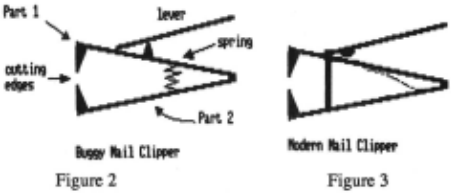
In addition, in the modern nail clipper solves one other 'bug' (i.e. that the lever must be pulled upward in the buggy qtse) by modifying the lever to have a protrusion on the same s1de.
Notice that one can understand the function of the modern nail c~ipper and ~etect mistakes within the ~uggy nail !=lip~r, all w1thout havmg to understand the pnnc1ple behmd the mechanical advantage of the lever. One need only know that levers realize mechanical advantage. The principle behind this a~vantage, simply stated, is that one moves a greater distance with a constant force F to produce a greater force F' over a shorter distance (i.e. the same principle of the inclined plane). Although the principle behind a device may not be neceSS!lfY. to !Jnders.tand the device's operation, it can_be importa!lt during mvent10n. Thus, a complete representatiOn of a nail clipper must include the following information:
goal: separation, plan: cut device: wedges forced against obj. goal: meChanical advantage, p1an: lever device: post w/ one-sided lever
3.2. NMR Requires Spatial 'Gestalt' Structures for Comprehension
In addition to the functional relations described above, a NMR must include the spatial orientation of each compc;ment in the device and its connectivity and orientation (.Lehnert 1978) with respect to other components. Consider the following text:
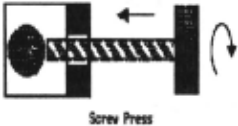
Turn the screw to apply force and deform the object.
When mechanical engineers read this text, they tend to form a mental image of the spatial relation of the object to the screw. Furthermore, they fill in missing information in the text to make the text coherent. As a result, they can answer questions about information not directly supplied m the text:
§ : Where is the object in relation to the screw? : What holds the screw? :What holds the object as the screw moves?
The supplied information comes from their general knowledge of what a screw looks like and how it is used to apply force or form a connection. In the case of applying force ~me spatial gestalt is depicted in fi~ure 4. Notice friat the object IS placed at one el)~ or the sc~ew instead, say) along a side of the sc~w). In additiOn, there IS a ramework 10r holding both the object and the screw, along the direction the screw will move ff turned clockwise.
. For . the J!ail · clipper, this spatial/configurational mfot:matio~ con.ststs of .flie parts of the nail clip~r, their relative one~tat10ns, regtons of parts where connectivity or other constramts hold, ani:i the nature of those constraints.
3.3. NMR Requires Process Information for Prediction
Mechanical devices move and their components move. The mc;>Vement of each component is a function of the connection of one component to another, the nature of the component materials/sha~s~ and the nature of the forces between them (Forbus 1983,. For example, if a stringS is attache!i to a fre~ object 0 and the string is pulled, then 0 will move m the direction of the pu~l once the string is taut; however, on~ CaJ!n9t push: on a strmg and expect 0 to move. In contr~t, tf a ngtd r<>4 ts connectea to 0, Then pushing on the rod will transrrut motion to 0 .
In the nail clip~r case, process information consists of a sequence of the motions performed by the nail clipper as a result of tl!e connectivity of the parts of the nail clipper and forces apphed to those parts.
3.4. Limits of NMR in EDISON
<;up-ently EDIS9N . does . not have any capability of exarrunmg vtsual or tcomc devtce representations. Thus any M>atial or connectivity information is hand-coded into memory frobably ~e ~ost diffic;ult rep).'esentational and reasoning tasks m mechamcs mvolve kinematics (Forbus 1986) especially the interrelations among forc~s . and 3~dimensional 'obJect shapes. In general we are avotding this very difficult class of proDl.ems. 'we want to see wliat comprehension and invention f¥ks EpiSON call perform w!~out ~ serious theory of kinematics. We beheve the remammg 1 stm:Rler world of basic connectors and motions is still extremety challenging.
4. Status of NL Comprehension in EDISON
Currently the n.aturallanguage subsystem of EDISON can handle 1_ust a feyt; smgle-sentence length texts. A sample text (Dyer, Flowers, Hodges in press) read by EDISON is:
TO.Y GUN: An object is pushed into a barrel against a spnng, compressing the spnng until it catches 01i a bigger.
The EDISON lexicon contains mappings from words such as "push" and "pull" to ex:Rectations (demons) for the dirCction an4 source of file f<?,rce, a~~mg with the object to be moved. Objec;ts, such as barrel , are r.epresented in terms of contamment and constr:amts on motion. The term "against" is repre~ented jn terms' of both SP.atial proximity (e.R. "the l'am~ng .. ~gamst the \Yall") and force (e.g. X 'PROPEL 0 ag111;n,st Y ) · . Some 9bjects, such. as springs, are re]:)resented as pnnutive devtces~ wtth attach¢ mference rules. E. g,_, if one pushes on a spnng, the spnng will push back. "Trigger" serves as ~ .. e!labhng!disabling device for release of a force. Note that tt m TOY GUN could refer to the spring barrel fi!bj~t, ,pr et;ttire gun. . Howeve~, syn~ctic constraintS prefer spnng while semantic constramts disallow both the barrel and tl:te entire device as the ~ferept of "it". In some toy guns the trigger c~tch~s on the.spnng; ~n others, on the object (e.g. where the object IS a plastic darf wtth a notch at the end).
. The ability for EDISON to build a complete representation of the text depends on (1) what EDISON already knows in memory about toy guns, (2) what EDISON already knows about l)arrels~.springs, triggers and objects in general and (3) what ~DIS9N alreai:iy kriows the ~op-1evel golil of the devtce · to be (m thts case, to propel the object m a gtven direction) In general, mechanical device descriptions are difficult · for people to read ~nless. they already kriow something about the Cievtce under. discusstO!l, or lqi~w how to read (and have access to) .a vt~ual drawmg COI\tatmng the ge~talt conl!g_uration of known 1com!= el~ments inaking up the dev1ce. In EDISON's case, the d!awmg 1s represented as a hand-coded conceptual representation already present m memory.
5. Status of Invention in EDISON
. q.urently, EDISON is caJ)able of (re)inventing the swmgmg bar r~m door (figure ?A) througb the process of applytnR ~P.Crations to, and ~tennR features of, a standard door. fu tfiis case, one way of arrivfug at a bar room door is to apply the CUT operation to the door srab to alter the number of slaos and then apply problem solving to attach the free standing slab via hmges to the other side of the door frame.
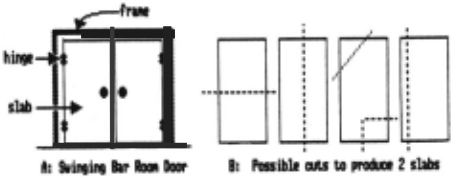
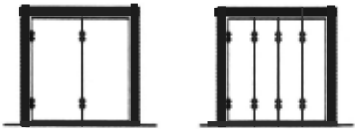
Even in this simple invention scenario the possibility space is huge; e.g. the slab can be cut in numerous ways and the PQSition of a hinge can conceivably be anywhere on the surface of the slab (fiR~ 5B). However,~hinRe constraints reduce this space to positions along the edge of the slab. Still, various strange bar room doors result if the hinges are placed at the top or bo1tom of the free-standing slab (figure 6). In addition an 'accordian' door can result ifhinges are used to attach the free standing slab to the other slab (figure 7: left).
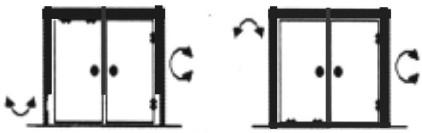
Figure 6
At this pc,>int EDISON is incapable of making use of this serendipitous invention to realize tfiat (1) the cut operation can !>e u&e9 several times to reduce the size of eacli slab while mcreasmR the number of slabs, and thus cover the same o~n area while reducing the width of the door when open (figure 7: nght) and (2) the Slabs can be attached to a runner so that the door effectively slides open rather than swings open.
5.1. Ingenuity, Problem Solving and Experience
Two issues of importance for invention are (1) recognition ·Of ingenuity in a vast search ~pace of uninteresting and/or usel~ss dev1ces and (2) tradeoffs between efficient problem solvmg through effective use of memory and role of experience in 'bramstorrning' for novel (or possibly overlooked) patterns.
~an_ge in the fundamen~ !II.Otion of an object is one heunstic m EDISON for recogmzmg that a truly novel design has been discovered. Thus, file invention of a slidin_g door thrOI.!&.h mutation of a swinging door should be recogmzed by EDISON as an event of sigmficance .
EDISON maintains devices in ~isodic memory. If the problem solver solves each new problem by simply recalling a past solution, then inventiveness will dirrunish as the num6er of devices grows. However, with human inventors, such as Thomas Edison, the acquisition of a novel device serves as a platform for coming up with more devices. Such inventors use proce~ses of analogy and. adaptation to apply kpowledg~ in one aomam to create a devtce m another -domam. In this wayt growth in episodic memocy increases the potential o mventiveness rather than dirrunishes it A simple example is that of inventing a new nut cracker by adapting the mechanism of the nail clipper (figure 8A).
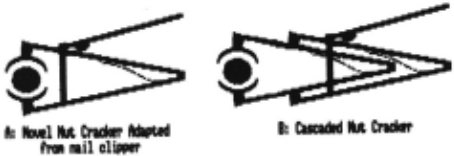
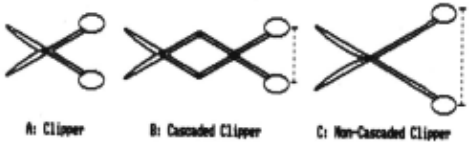
The issue of ingenuity is illustrated in figure 8B, where the nail clipper mechanism has been pointlessly complicated. However, cascaded operations can result in novel and useful devices. Consider the rose clipper in figure 9B. This design allows one to cut at a ~ter disfance witfiout having to greaOy increase the movemenl of the handles (figure 9C).
5.2. Failure, Serendipity, and Abstraction in an Inventive Memory
What is the role of failure in memory? Schank ( 1982) has argued that failures are important because learninR occurs at fmlure points. Over (1983) has shown t}lat plan failures represented at an abstract level serve as an mdexmg structure to cross-contextual memories. If every trivially bad design is stored in EDISON's episodic memory, then problem-solving efficiency m;ty suffer, as a result of recall of bad designs. However, if failures are never stored in memory, then EDISON will be doomed to re~t its mistakes. Therefore, along with design successes EDISON must store design failures. This means that EDISON must generalize specific failures wherever possible and store the abstracted negative desi~ experiences in episodic memory. However, sometimes it is incorrect (from a brainstorming point of view) to avoid exploring a ~sibility space because of past failure. Why would an area blocked by past failure be wOrth re-exploration1 Often, new mechanical devices, principles, materials, etc. become available since the time that des1gn area or apPfOOCh was abandoned. So a robust invention system must know when to re-explore an area because of new invention in potentially related area. These tradeoffs between efficient problem solving and invention, are topics ot current research.
As with · the cascaded clippers, a mutation which fails to satisfy a goal in current focus may end up serving_ another design goal. Consider the last cut sllown in figure 5.8, which ~u.ces a l~ided bar room door and a~ to be a design of little value. However, such doors do eXlst In refrigera~ors 1 the freezer door is often of less width in comparison to lhe fooa door. Thus, an invention may not achieve an active design goal, but turn out to be of use for another desiRD context An mventor can only make use of serendipitous effects if a large number of design goals are concurrently active in memory.
6. Relation to Work of Others
The overall approach toward naive physics in EDISON is inspired by Hayes,e.R. (Hayes 1985). The need and utility of an ~1sodic memory or device exemplars is taken from (Schank 11)82) and (KolOdner 1984) and their general work on episodic memory organization. The use of heuristics of invention and heuristtcs to assess interestin~ess of concepts (here, device ingenuity) are inspired from -Lenat's work on invention in mathematics and geometry (Lenat 1976, 1983).
The representation constructs in EDISON share features with those of Lehnert's object primitives for comprehension of stories involving_ the use of objects, described in (Lehnert 1978); Rieger's CSA representational scheme to represent such objects as flush toillettes and light bulbs @ieger 1975) and the work of Forbus on qualitative processes (Forl>us 1983, 1985). The natural lang_uage comprehension component shares ~resentational s1milarities with the representations of pliy~_ical objects read by the patent abstract conceptual analyzer ofWasserman and LebOwitz (1983).
7. Conclusions
Naive mechanics com_prehension and invention can be modeled in tenns or symbolic manipulations on representational constructs. Device comprehens1on consists of accessing conceptually dependent representations and -combining them fo form larger coherent structures. Device invention consists of altering device representations through goal/plan analysisb constraint satisfaction, feature mutation, and ~esses of a straction and analogy. While the resulting approach lacks the detailed numericausimulation capabilities of mathematical models typically used in mechanical engineerptg, it provi~c;s the potentiill capability of ~odeling t}le e~gmeer's cogmttve processes of comprehens10n ana mventton.
@inproceedings{ijcai1987p138,
  title     = {Naive Mechanics Comprehension and Invention in EDISON},
  author    = {Dyer, Michael G. and Flowers, Margot and Hodges, Jack},
  booktitle = {Proceedings of the Tenth International Joint Conference on
               Artificial Intelligence, {IJCAI-87}},
  publisher = {International Joint Conferences on Artificial Intelligence},
  editor    = {John McDermott},
  pages     = {696--698},
  year      = {1987},
  note      = {Natural Language},
  url       = {https://ijcai.org/proceedings/1987/138},
}
TY - CPAPER TI - Naive Mechanics Comprehension and Invention in EDISON AU - Dyer, Michael G. AU - Flowers, Margot AU - Hodges, Jack T2 - Proceedings of the Tenth International Joint Conference on Artificial Intelligence, IJCAI-87 PB - International Joint Conferences on Artificial Intelligence PY - 1987 SP - 696 EP - 698 UR - https://ijcai.org/proceedings/1987/138 ER -Copied
Machine-readable versions of this paper, for tools and AI agents:





