
An Equipment Model and its Role in the Interpretation of Noun Phrases
Proceedings of the Tenth International Joint Conference on Artificial Intelligence. Natural Language. Pages 692-694.
© 1987 International Joint Conferences on Artificial Intelligence
Abstract
For natural language understanding systems designed for domains including relatively complex equipment, it is not sufficient to use general knowledge about this equipment. We show problems which can be solved only if the system has access to a detailed equipment model. We discuss the structure of such models in some detail and, in particular, the mixed static/dynamic nature of the model. As an illustration, we describe parts of a simulation model for an air compressor. Finally, we demonstrate how to find referents in this model for noun phrases.
- Finin, 1986)
- T . W. Finin. Constraining the interpretation of nominal compounds in a limited context. In R. Gr- ishman and R. Kittredge, editors, Analyzing Lang• uage in a Re3tricted Domain, Lawrence Erlbaum Assoc., Hillsdale, NJ, 1986.
- Grishman et a/., 1986)
- Ralph Grishman, Tomasz Ksiezyk, and Ngo Thanh Nhan. Model-ba3ed Analy3i3 of Me33ages about Eq• uipment. PROTEUS Project Memorandum 2. New York Uni- versity, 1986.
- Hollan et al., 1984) J. Hollan, E. Hutchins, and L. Weitz- man. Steamer: an interactive inspectable simulation- based training system. AI Magazine , 5(2):15-27, Summer 1984.
- Joskowicz et al., 1987) Leo Joskowicz, Ralph Grishman, and Tomasz Ksiezyk. Cau3al and Temporal Relation3 in Equipment Me3Mge3. PROTEUS Project Memo- randum 8, New York University, February 1987.
- Palmer et al., 1986)
- M. Palmer. D. Dahl, R. Schiffman, L. Hirschman, M. Linebarger, and J. Dowding. Recov- ering implicit information. In 24th Annual Meeting of the ACL, pages 10-19, 1986.
References were extracted automatically from the PDF and may contain errors.
Full text extracted automatically from the PDF; figures, tables and equations may differ. The PDF is the version of record.
I. Introduction
The work presented here is part of PROTEUS* (PROto type TExt Understanding System), currently under devel opment at the Courant Institute of Mathematical Sciences, New York University. ·· The objective of our research is to understand short natural language texts about equip ment. Our texts at present are CASualty REPorts (CAS REPs) which describe failures of equipment installed on Navy ships. Our initial domain is the starting air system for propulsion gas turbines. A typical CASREP consists of several sentences, for example:
Unable to maintain lube oil pressure to SAC [Starting Air Compre.Mor] . Disengaged immedi ately after alarm. Metal particles in oil sample and strainer.
It is widely accepted among researchers that in order to create natural language understanding systems robust enough for practical application, it is necessary to pro vide them with a lot of common-sense and domain-specific knowledge. However, so far, there is no consensus as to what is the best way of choosing, organizing and using such knowledge.
The novelty of the approach presented here is that , besides general knowledge about equipment, we also use a quite extensive simulation model for the specific piece of equipment which the texts deal with. We see the following merits of having a simulation model:
*This research was supported in part by the Defense Advanced Research Projects Agency under contract N00014-85-K-0163 from the Office of Naval Research and the National Science Foundation under grant DCR-85-01843.
··This work is being done in collaboration with Unisys Defense Systems (formerly the System Development Corp.) as part of the DARPA Stra.tegic Computing Program.
- The model provides us with a reliable background against which we can che~k the correctness of the un derstanding process on several levels: finding referents of noun phrases. assigning semantic cases to verbs, es tablishing causal relationships between individual sen tences of the text.
- The requirements of simulation help us to decide what kind of knowledge about the equipment should be in cluded in the model, how it could best be organized and which inferences it should be possible to make. It appears that the information needed for simulation largely coincides with that necessary for language un derstanding.
- The ability to simulate the behavior of a piece of equipment provides a very nice verification method of the understanding process at the level of interaction with a user - a dynamic graphical interface provides the user with insight into the way his input has been understood by the system.
In the remainder of this paper we shall address three issues: Why is a detailed equipment model needed? How should such a model be structured and, in particular, what balance should we strike between a static model and one created dynamically as the text requires? How should a noun phrase analyzer be organized to utilize such a model, and how is it affected by this static/dynamic balance?
II. Need for a Model
In many natural language processing systems, the domain knowledge consists of general information about the ob jects and operations in the domain. In the equipment do main, this would include knowledge of the possible states and actions of equipment components, such as valves, pumps, and gears. It is clear. however, that such knowl edge is not sufficient for a complete understanding of the CASREP messages we are studying.
One feature of technical texts is the heavy use of nom inal compounds. It seems that their average length is pro portional to the complexity of the discourse domain. In the domain of the starting air system. examples like stripped lube oil pump drive gear are bv no means seldom occurrences.
The problem with nominal compounds is their ambi guity. The syntactic analysis is of almost no help here. Even using semantic ( selectional) constraints, as in [Finin. 1986], substantial ambiguity often remains. When we know that the nominal compounds refer to objects existing in the svstem. and have access to a model of the system, we can i-mpose much tighter constraints, thus reducing the ambiguity.
The need for an equipment model is ewn more evident when we consider the analysis of a multi-sentence text such as
Starting air regulating valve failed.
Unable to consistently start nr 1b turbine.
(thi~ is an excerpt from an actual CASREP). In the start ing air system (our initial domain) there are three differ ent valves regulating starting air. Two questions might be posed in connection with this short text: ( 1) which of the three valves was meant in the first sentence'? (2) could the failure of the mlve mentioned in the first sentence be the cause of the trouble reported in the second sentence?
The general knowledge of equipment may tell us a lot about failures . such as: if a machinery element fails , then it is inoperative, or if an element is inoperative, then the element of which it is part is probably inoperative as well. etc. Unfortunately, such knowledge is not enough: there is no way to answer these two questions (not only for an artificial understanding system. but even for us, humans) without access to rather detailed knowledge about how various elements of the given piece of equipment are inter connected and how they work as an ensemble. In our case we could hypothesize (using general knowledge about text structures) that there is a causal relationship between the fact s stated in the two sentences. To test this, we would have to consider each of the three valves in turn and check how its inoperative state could affect the starting of the specific (i.e. nr 1b) turbine. To perform these tests we would need a simulation model. If one of the three valves, when inoperative, would make the turbine starting unre liable then we could claim that this valve is the proper refere~t for the starting air regulating valve mentioned in the first sentence. This finding would let us also answer question (2) affirmatively.
The above two considerations demonstrate that in cases where the domain is very specialized and complicated (a typical situation for real-life equipment), language un derstanding systems should be provided not only with gen eral knowledge about the equipment but also have access to its model.
III. PROTEUS structure
PROTEUS consists of a syntactic analyzer, a semantic analyzer and a discourse analyzer. The semantic an alyzer translates the regularized syntactic analysis into a predicate-argument structure. As part of the seman tic analysis. the noun phrase analyzer (described below) identifies elements of the equipment model correspond ing to the referents of noun phrases. The discourse an alyzer[Joskowicz et al.. 1987] , using the equipment model, identifies implicit causal and temporal relations in themes sage. [Grishman et al., 1986] describes the overall organi zation of PROTEUS. The system is implemented on Sym bolics LISP machines.
IV. Simulation Model
A. Structure of the simulation models
The target domains for PROTEUS are equipment ·units (El-): complex technical systems which accomplish phys ical tasks on demand. These tasks are carried out as se rial and parallel combinations of simpler tasks, which are performed by constituent EUs of the main equipment unit. Often these simpler tasks can be decomposed further, leading to a hierarchy of tasks and EU s. . .
The EUs transmit their effects through vanous me di&, such as gases, liquids. mechanical movement . and elec tric current. These media travel from one EU to another through conduits appropriate to the different types of me dia.
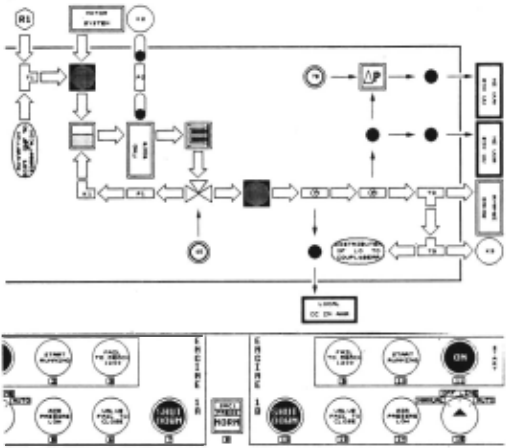
PROTEUS models have the structure of a set of tran sition networks. They consist of nodes connected by di rected linb. The nodes correspond to the constituent EUs of the system; the links to the conduits connecting the EUs. The hierarchical structure of the EUs is reflected in the hierarchical structure of the networks. To represent the internal structure of an EU, we have the corresponding node point to another network in the model.
Associated with each link is a working-substance (WS). These WSs correspond to the media entering and leaving an EU (for example, the rotary motion provided to a pump and the fluid entering and leaving the pump). We can think of the WSs associated with links entering and leaving a node as the input and output data of the node.
Associated with the nodes, links, and working sub stances are properties, recording the structure, function and (time-dependent) state of the system elements.
One design criterion for our models is that they make possible the qualitative simulation of the modeled EUs (in most cases a precise quantitative simulation is not required for language understanding). The model includes time dependent values for the states of modeled components and functions which determine the state and outputs of the nodes. Simulation is performed by an event-driven algorithm which is triggered by an external event (such as operator action or reported failure) and continues until a stable state is reached.
We have implemented the model by defining proto types for the various types of components (valves, ge.ar boxes, etc.) and then assembling a system as a collection of instances of these prototypes (implemented in Flavors). Information about each type of component is stored in the prototype, so that only information specific to a particular component need be stored in the instance. For example, in the case of a gearbox, the information about its func tion (speed change) should be stored in the prototype. and onlv the ratio of this change should reside in the instance of ~ s~eci~c gearbox. The 'library' of prototypes should greatly s1mphfy the creation of new equipment models within the system.
B. Level of detail
How detailed a model should we construct? A first re sponse might be to include everything which potentially may be referred to in the reports. This, howe,·er. seems impractical. Consider a typical sentence from <>ne of the reports:
lnYestigation revealed a broken tooth on the huh ring gear.
Considering that there are several different gears in our starting air system and each of them has many teeth which are very much alike, it's obvious that creating a separate description for each of them wouldn't be reasonable. The same remark is true for balls bearings or for connecting elements like screws, bolts or pins. On the other hand information about the tooth conveyed in the above sen~ tence cannot go unnoticed. The solution we accepted for such elements is not to include their descriptions in the model on a permanent basis but to keep open the possi bility to create and add them to the model if such a need ari~es during the analysis. A rule of thumb for deciding whether a particular element deserves a permanent place in the model can be formulated as a question: How much information specific to this element is necessarv to solve understanding problems, like finding referents ~r makin~ inferences'!
If there is substantial specific information, the element is included as part of the permanent model. On the other hand, if all the needed information can be derived from the larger unit of which this element is a part (the gear of tooth on gear) , and this larger unit is always mentioned in clt-scriptions of the part , then the element can be added to thf' model dynamically when it is mentioned in a message.
C. An example: the starting air system
As onr initial domain we have chosen the ''starting air system'' used for starting gas turbines on Navy ships. The model consists of 15 networks with a total of about 175 nodes. One of these networks is shown in Fig. 1. This figJire is a Symbolics screen image generated by PROTEUS from the model networks. Some parts of the display are dynamic: gears rotate, oil moves as visible particles. etc. This provides a direct visual presentation of the system's understanding of a message (oil may stop flowin11; or a gear rotating) . The dynamic displays are achieved-as a ~ide effect of the simulation used for understanding purposes.
V. Noun Phrase Analysis
A. The role of noun phrase analysis
The goal of the Noun Phrase Analyzer (:-.JPA) is to convert a noun phrase into a set of referents that mav be used by subsequent stages of the system. To accom~lish this it uses the equipment model two ways. First , the model is used to confirm possible relations between noun ~hrase ~onstituents (for example, that there is a gear which IS an adJacent part to a pump). Second, the ·model proYides a set of referents for the phrase.
The NPA com·erts from the linguistic representation to one in terms of domain predicates. The interface be tween the NPA and the model is called the Model Query Processor (MQP). The MQP evaluates the domain predi cates relative to the equipment model, and creates internal representations for EUs when needed. Major equipment units are part of the static model; others must be created dynamically.
B. The Analysis Procedure
The NPA fetches a semantic class and various other fea tures for each word in the noun phrase. Constituents are combined bottom-up based on a set of rules stated in terms of these classes. These rules identify relationships of the form (Pred Arg-1 Arg-2 .. . ) where Pred is a predicate of the domain and the Arg·i are constituents of the noun phrase. We have analyzed a corpus of 38 sentences and identified a set of 13 predicates for analyzing noun phrases:
adjacent-to alarm couple driYe lube made-of mea sure name operate-on part-of regulate start loca tion
.\lost current systems validate the application of these !·ules through such selectional checks (constraints on the argument classes of each predicate) [Finin, 1986) We per form such checks, then go a step further and check for the existence of the specific relation between specific entities. This is done through the MQP. The MQP is first invoked for each word to obtain its internal representation in the model, and then for each proposed predicate to verify the existence of the corresponding relation in the model. If the relation exists, the :viQP returns the representation for the !wad constituent of the relation.
For post-nominal modifiers the predicate is strongly indicated by the preposition, and arguments (the head noun and the object of the preposition are explicit and dP!imited). Pre-nominal modifiers are more difficult. The problem is to decide what predicates should be used and what are the arguments of these predicates. Both the pred icates as well as their arguments may be given explicitly or implicitly. Examples are: temperature regulating valve (the predicate and both its arguments are explicit) , drive gear · (the predicate and one of its arguments are explicit , the other argument , the object of DRIVE, is implicit) , pump ,<haft (the predicate, PART-OF, is implicit, both of its ar guments are explicit). The NPA considers the semantic features of the items, together with order constraints, to match the items with arguments of some canonical predi cate. A match is considered successful, if it is possible to identify some (not necessarily all) of the arguments of the predicate among the modifiers. For verification purposes, it is assumed that the empty arguments match anything. OncP a matching canonical predicate has been found and as many of their arguments matched with the modifiers as possible. the ~PA poses a verification query to the model.
In many cases the noun phrase does not determine a unique entity. so a set is returned. Context and de fault information are used to resolve such references. This is handled by the Reference Resolution Module. following [Palmer P.t rd., 1986) .
C. Model Query Processor
We ha\'e observed the mixed static/dynamic characteristic of our representation. Since the other modules are de signed to be independent of the model representation, this distinction m1,1st be hidden by the MQP. We discuss here only queries posed by the NPA, i.e. requests for the rep resentation of a word, and predicate verification queries.
The main EUs are recorded permanently in the equip ment model. For words corresponding to these El 7 s, the :\IQP contains pointers to all the nodes in the model to which the word may refer (for example, the entry for pump will point to all pumps in the model). However, two classes of ECs are ~reated dynamically by the MQP. The first class consists of components too small to justify including in the model ( eg. connecting pin in pump drive a33embly or tooth of hub gear.) The second class involves aggregates of el ements which are described in the text and treated as a unit but do not correspond to a single unit in the model hierarchy. There are several examples in our corpus, such as the coupling from die3el to SAC lube oil p-1Lmp.
The predicate verification queries must also distin guish between static and dynamically created EUS. Where all the arguments are statically modeled, the MQP need only check the model attribute corresponding to the pred icate. When dynamically created, the MQP will generally have to modify theargument to reflect the constraint ex pressed by the predicate. For example, in verifying (part of clutch SAC) , where both d1£tch and SAC are statically modeled, we check the PART-OF role of clutch: Whereas. in verifying (part-of tooth gear), with tooth dynamically created, we fill the PART-OF role of tooth.
VI. Future Work
In addition to noun phrase analysis, the equipment model is used heavily in discourse analysis - identifying implicit causal and temporal relations. We have developed a pre liminary implementation of discourse analysis [Joskowicz et a/., 1987) but much work remains to be done, particu larly regarding time dependencies. We also intend to de velop tools for the more efficient acquisition of equipment models , and to study techniques for dealing with gaps in the domain model.
The initial motivation for PROTEUS was text un derstanding for subsequent querying, summarization. and trend analysis. Our use of a detailed equipment model similar to that employed in simulation systems ( eg. STEAMER[Hollan et a/. , 1984)) and diagnostic systems suggests that PROTEUS is also useful as an interface to such systems.
@inproceedings{ijcai1987p137,
  title     = {An Equipment Model and its Role in the Interpretation of Noun Phrases},
  author    = {Ksiezyk, Tomasz and Grishman, Ralph and Sterling, John},
  booktitle = {Proceedings of the Tenth International Joint Conference on
               Artificial Intelligence, {IJCAI-87}},
  publisher = {International Joint Conferences on Artificial Intelligence},
  editor    = {John McDermott},
  pages     = {692--694},
  year      = {1987},
  note      = {Natural Language},
  url       = {https://ijcai.org/proceedings/1987/137},
}
TY - CPAPER TI - An Equipment Model and its Role in the Interpretation of Noun Phrases AU - Ksiezyk, Tomasz AU - Grishman, Ralph AU - Sterling, John T2 - Proceedings of the Tenth International Joint Conference on Artificial Intelligence, IJCAI-87 PB - International Joint Conferences on Artificial Intelligence PY - 1987 SP - 692 EP - 694 UR - https://ijcai.org/proceedings/1987/137 ER -Copied
Machine-readable versions of this paper, for tools and AI agents:





