
Combining Prediction, Syntactic Analysis and Semantic Analysis in Chinese Sentence Analysis
Proceedings of the Tenth International Joint Conference on Artificial Intelligence. Natural Language. Pages 679-680.
© 1987 International Joint Conferences on Artificial Intelligence
Abstract
This paper describes a system for the analysis of Chinese language that incorporates several heuristic techniques for reducing ambiguities. Heuristic knowledge about "characteristic" words is used to predict a partial syntactic structure of sentence . before doing global analysis. More than one prediction may ·exist , the system chooses the best combination of compatible partial predictions. Backtracking is evoked if a contradiction is later detected, producing a different choice of predictions. Semantic constraints are used for translating phrase structure into case structure. Rules are written to independent modules for word classes. An object-oriented scheme organizes the rules in to layers, according to their priorities of application . A preference score is calculated at each step of processing, giving a synthetic evaluation of both syntactic plausibility and semantic plausibility. The scores of partial results steer a priority-driven parser towards the most plausible sentence structure, instead of generating all the possible results and afterwards making the choice . An experimental system based on these techniques has been built and tested on over one hundred sentences selected from published material. The results were very successful. The number of trees required to be produced in order to obtain a correct analysis was typically reduced from several hundred to under ten .
- Yang, Y., Nishida, T. and Doshita, S. Use of Heuristic Knowledge in Chinese Language Analysis, COLING 84.
- Yang, Y., Doshita, S. & Nishida, T. { 1985}, Partial Con- straints in Chinese Analysis, IJCAI 85. IJCAI
- Feng, Z. Multiple-labeled and Multiple-branched Tree Graph Analysis Method of Chinese Sentence, in Proceed- ings of 1983 International Conference of Chinese Informa- tion Processing (ICCIP}, Beijing, 1983.
- Fan, J. and Xu, Z. The Application of Augmented Transi- tion Network Theory to Chinese U nderstanding_an experi- mental model of man-machine dialogue by Chinese language, Language Study, Vol. 1, China, 1981.
- Huang, X. A Bidirectional Chinese Grammar in A Machine Translation System, New Mexico State University CRL memo, 1986.
- Yang
References were extracted automatically from the PDF and may contain errors.
Full text extracted automatically from the PDF; figures, tables and equations may differ. The PDF is the version of record.
1. INTRODUCllON
The studies concerned with automatic analysis of Chinese language have been done mostly in the 1980's. A number of systems have been built. For example, Fan and Xu [1981] used an ATN grammar in a prototype Chinese understanding system. Feng [1983] experimented with translation of Chinese text on the GETA system. Huang [1986] built a system that performed a bidirectional transla tion between English and Chinese . In these studies, how ever, the emphasis was not on resolving ambiguities.
Phrase structure analysis of Chinese runs immediately into an explosive growth of possible structures because there are very few morphological variations of word roots to indi cate category or sentence structure . We must find a way to introduce both syntactic and semantic constraints as early as possible in order to restrict the growth of ambiguities.
The Chinese analysis system presented here is charac terized by two heuristic approaches to disambiguation : predicting syntactic structure from the presence of charac teristic words, and evaluating the plausibility of possible results by semantic preferences on case structures. The basic principles of these two approaches were pre sen ted in two papers by the current author [Yang, 1984, 1985] . The emphasis here is on incorporating these approaches into an effective analysis system.
2. PROCESSING FLOW AND CONTROL METIIOD
This system consists of four major components which perform segmentation, preprocessing, phrase structure analysis, and case structure analysis. These are illustrated in figure 1 and explained below.
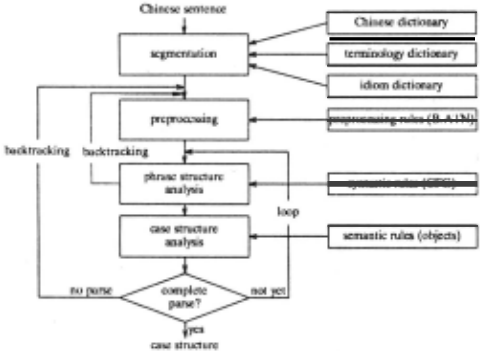
The segmentation component translates the input string of characters to a string of words . (This is not trivial because it is customary to write Chinese words without spaces between them, but this is not the focus of this paper.)
The preprocessing makes a partial prediction of the phrase structure according to the appearance of characteristic words in the sentence. More than one prediction (of partial structures) may be obtained, a preference scheme is used to choose the best combination of compatible predictions.
The phrase structure is built by a context free ( CF) parser, following the prediction from preprocessing. The parser first does local analysis on the parts where partial structures are predicted to be exist, then composes the par tial results into a global structures. In case there is no struc ture is found as predicted, backtracking (to preprocessing) occurs for the next prediction. Since the context free analysis is restricted on the partial structures, the com bina torial growth of possible results is effectively reduced .
The case structure is derived from the phrase structure, according to the semantic constraints associated with words. The relationship between words or component structures is identified by case labels on the case structure, and the semantic consistency between the components is measured by preference scores.
The phrase structure analysis and the case structure analysis work in an interactive way. The phrase structure is built bottom-up. The semantic analysis is evoked each time when a partial syntactic structure (a phrase) is obtained, giv ing the corresponding case structure. The partial result in such an approach is a combination of a phrase structure (partial), ita case structure, and a preference score which is a synthetic evaluation of both the syntactic and the semantic plausibility. For each cycle of the syntactic and semantic analysis in the bottom-up process, the parser looks at the set of partial results, chooses the one with highest preference score, and expands further analysis from this piece. The other partial results are saved, so the searching direction can be adjusted each time the preference of partial results is changed during the analysis . The above process continues until a complete parse is found . The priority-driven parsing arrives directly more plausible structures first, without trying all the possibilities and then comparing them.
3. USAGE OF HEURlS'ITC KNOWLEDGE
1} Handling Prediction Rules in Preprocessing
The characteristic words used in preprocessing are a subset (about 200 words) of Chinese functional words, such as prepositions, locative particles, auxiliary words, modifier verbs, etc. They are frequently used and give hints of the sentence structure when they appear, but their use is often optional.
Knowledge about the appearance of characteristic words is written to prediction rules of partial syntactic structures. There are sets of rules for groups of characteristic words with similar functions . Approximately 40 A TNs were writr ten, each expressing the rules for a group of related charac teristic words.
The preprocessing is done in the following steps.
- extract fragments (partial predictions) by applying the rules of the characteristic words which appear in the sentence, and calculate the plausibility score for each fragment, according to its type, length, or the number of the recognizable characteristic words it contains,
- detect the conflict between fragments by checking their types and locations (to see if they overlap),
- construct the "most likely" combination of compatible fragments , according to the scores of fragments,
- backtrack for the next combination when a prediction is rejected in the subsequent analysis .
2) Semantic Processing
Semantic processing is used to analyze the roles of component phrases, and represent the relationship on a case structure . More than one case structure may be derived from a phrase structure . The semantic analysiS gives each of the case structures a preference score by checking the semantic consistency between components.
Consider, as an example , a sentence "tH~-=f;'ffi!L~!-fml*lW-=f ." (" small child laugh he be one big fatso") which means that "Small children laugh at him for being a big fatso ." This sentence shows a sequence NP1-V-NP2-V-NP3 which is a compound sentence pattern called "Serial Verb Construction" (SVC) in Chinese gram mar. Syntactic analysis can not recognize which verb in the SVC string is the predicate of the sentence , the "laugh" or the "be"; or where the embedded clause should be located on, the NP1-V-NP2, the NP2-V-NP3, or the V-NP3? That is because there is no morphological variation , like the "for" or the "-ing" in English, to indicate the structure of such a sentence. This ambiguity can be resolved only· when the meaning of words is considered.
This system does not distinguish SVC sequences by phrase structures, but maps them to different case structures (seven types) according to the semantic consistency. Figure 2 shows two possible case structures for the above sentence.
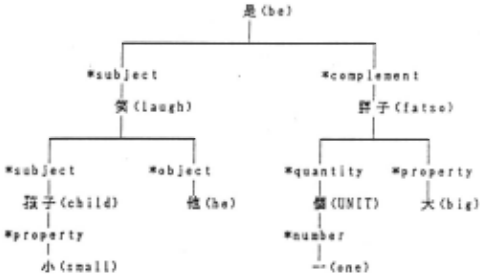
The fact that small children laugh at him is a big fatso.
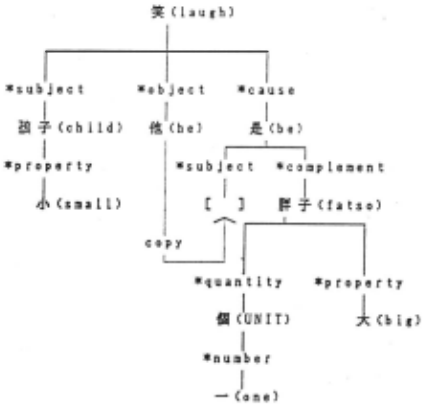
"*": case label,
( j : absent component In calculating the semantic plausibility of the two case structures, constraints between verbs and their subject, object and/or the subordinate clause are checked . In the first structure, the predicate "SHI4" {be} has a. embedded clause ("small children laugh at him"} as its subject. This structure is semantic unlikely because the subject, a clause, does not match the complement "fatso", a HUMAN. The preference for this matching is a negative score of "-1". In the second structure, the main clause "small children laugh at him" is modified by subordinate clause "he is a big fatso" which causes the previous event to happen . The semantic constraint for such a structure is that the predicate of the caused event should be an emotional verb. "laugh" is such a verb, and so a positive score of "+ 1" is added for this evaluation . On the other hand, the semantic checking for the subordinate clause brings another "+ 1" because both the subject "he" and the complement "fatso" belong to the semantic category HUMAN. The partial scores are added together and the correct structure {the second one} has higher score .
Figure £ The two possible case structures for a Chinese sentence
Semantic constraints used are written into separate modules of rules for different word groups. Different sets of semantic groups are chosen according to the linguistic phenomena where the ambiguities occur. Seven verb classes, for example, are used for analyzing SVC sentences. They are named CAUSATIVE, EMOTIONAL, POSSES SIVE, NARRATIVE, SPECIAL-I, SPECIAL-II and NOR MAL, and each of them corresponds to one type of case structures. About sixty classes are used for nouns.
The modules of semantic rules are organized into a hierarchy according to their operational properties. In semantic processing, an object-oriented scheme applies these modules, called objects, by searching along the hierarchy. Word specific rules are tried first if they are given; other wise, their parent objects are applied, and so on .
Object-oriented systems usually work by sending a message to an object which returns one message as its result. In a natural language analysis system, we need to deal with multiple possibilities during parsing. This system sup ports a mechanism to send a message to more than one object and then return all of the possible results of objects. Also, more than one parent object is allowed for an object, for nondeterministic search . '
4. EXPERIMENTAL RFSUL 'IS
A experimental system (written in Lisp) was built to test the above methods . The system contained an 800 word dictionary for the syntactic analysis, 37 ATNs, for prepro cessing, about 210 CFG rules of the phrase structure gram mar, and about 1,100 "objects" (including word specific objects) for the semantic analysis. {The priority-driven mechanism is designed but not coded in yet, because it is not absolutely necessary in the stage of testing the main methods, and there should be no technical difficulty in implementing such a search when necessary.)
Over one hundred sentences taken from a Chinese physics textbook, scientific papers, grammar books, etc., were chosen for testing the components of the system. The preprocessing gave the correct result as its first choice 94% of the time. The syntactic analysis subsystem was separately tested with the same set of sentences (the preprocessing was not used to restrict the syntactic possibilities}, and the correct phrase structure was obtained for 83% of the time. A subset of these sentences was used to test the whole sys tem, the correct result was the first choice for 14 out of 20 sentences and the second choice for the remaining 6.
A typical example shows the parsing efficiency of this system. In analyzing the following sentence: ~~w~mn~~~~~~~5~man~~~~~·. ·
{ "In the perfect situation without friction the object will keep moving at a constant speed.'), preprocessing reduced the syn tactic ambiguities from 552 possibilities (trees) in to 8. These 8 syntactic structures were interpreted into 18 case structures. Using their preference scores, the correct result was obtained as the first choice.
5. SUMMARY
This paper described the technique for buiding a Chinese analysis system which combines segmentation, preprocessing, phrase structure analysis and case structure analysis.
This system applies two heuristic approaches for ambi guity resolution: predicting partial syntactic structure by characteristic words and introducing semantic constraints in translating the phrase structure to the case structure . Knowledge needed for this analysis is formalized in indepen dent modules for each approach and managed as an integrated process. Interactions between the preprocessing, the syntactic analysis and the semantic analysis, make it easy to introduce constraints as early as possible, and thus efficiently reduce the growth of ambiguities. The preference scheme makes it possible to use incomplete knowledge in partial analyses, and make a synthetic evaluation for the glo bal structure by summing the partial scores.
In conclusion, these methods should be useful for natural language analysis, where ambiguity raises a serious problem, and complex linguistic information must be managed efficiently.
ACKNOWLEDGEMEN'IS
I would like to thank the mem hers of Doshita's Laboratory at Kyoto University and the Computing Research Laboratory at New Mexico State University for their help and fruitful discussions.
@inproceedings{ijcai1987p134,
  title     = {Combining Prediction, Syntactic Analysis and Semantic Analysis in Chinese Sentence Analysis},
  author    = {Yang, Yiming},
  booktitle = {Proceedings of the Tenth International Joint Conference on
               Artificial Intelligence, {IJCAI-87}},
  publisher = {International Joint Conferences on Artificial Intelligence},
  editor    = {John McDermott},
  pages     = {679--680},
  year      = {1987},
  note      = {Natural Language},
  url       = {https://ijcai.org/proceedings/1987/134},
}
TY - CPAPER TI - Combining Prediction, Syntactic Analysis and Semantic Analysis in Chinese Sentence Analysis AU - Yang, Yiming T2 - Proceedings of the Tenth International Joint Conference on Artificial Intelligence, IJCAI-87 PB - International Joint Conferences on Artificial Intelligence PY - 1987 SP - 679 EP - 680 UR - https://ijcai.org/proceedings/1987/134 ER -Copied
Machine-readable versions of this paper, for tools and AI agents:





