
A Knowledge Framework for Natural Language Analysis
Proceedings of the Tenth International Joint Conference on Artificial Intelligence. Natural Language. Pages 675-677.
© 1987 International Joint Conferences on Artificial Intelligence
Abstract
Recent research in language analysis and language generation has highlighted the role of knowledge representation in both processes. Certain knowledge representation foundations, such as structured inheritance networks and feature- based linguistic representations, have proved useful in a variety of language processing tasks. Augmentations to this common framework, however, are required to handle particular issues, such as the ROLE RELATIONSHIP problem: the task of determining how roles, or slots, of a given frame, are filled based on knowledge about other roles. Three knowledge structures are discussed that address this problem. The semantic interpreter of an analyzer called TRUMP (TRansportable Understanding Mechanism Package) uses these structures to determine the fillers of roles effectively without requiring excessive specialized information about each frame.
- [Becker, 1975] J. Becker. The phrasal lexicon. In Theo- retical Issues in Natural Language Processing, Cam- bridge, Massachusetts, 1975.
- [Bobrow and Webber, 1980] R. Bobrow and B. Webber. Knowledge representation for syntactic/semantic pro- cessing. In Proceedings of the National Conference on Artificial Intelligence, Palo Alto, California, 1980.
- [Brachman and Schmolze, 1985] R. Brachman and J. Schmolze. An overview of the KL-ONE. knowledge representation system. Cognitive Science , 9(2), 1985.
- [Chafe, 1968] W . L. Chafe. Idiomaticity as an anomaly in the Chomskyan paradigm. foundations of language, 6(1 ), 1968.
- [Charniak et al., 1983] E. Charniak, M. Gavin, and J. Hendler. The FRA1L/NASL reference manual. Tech- nical Report CS-83-06, Brown University Department of Computer Science, 1983.
- [Hirst, 1987] G. Hirst. Semantic Interpretation and the Resolution of Ambiguity. Cambridge University Press , Cambridge, England, 1987.
- [Jacobs, 1985] P. Jacobs. A Knowledge-Ba11ed Approach to Language Production. PhD thesis, University of California, Berkeley, 1985.
- [Jacobs, 1986] P. Jacobs. Language analysis in not-so- limited domains. In Proceedings of the Fall Joint Comput er Conference, Dallas, Texas, 1986.
- [Jacobs and Rau, 1985] P. Jacobs and L. Rau. Ace: as- sociating language with meaning. In T. O'Shea, ed- itor, Advance11 in Artificial Intelligence, North Hol- land, Amsterdam, 1985.
- [Lytinen, 1984] S. Lytinen. The Organization of Knowl- edge in a Multi-lingual, Integrated Parser. •PhD the- sis, Yale University, 1984.
- [Sondheimer and Nebel, 1986] N. Sondheimer and B. Nebel. A logical form and knowledge-base design for natural language generation. In Proceedings of the Fifth National Conference on Artificial Intelligence , Philadelphia, 1986.
- [Sondheimer et al., 1984] N. Sondheimer, R. Weischedel, and R. Bobrow. Semantic interpretation using KL- ONE. In Proceedings of the Tenth International Conference on Computational Linguistic11, Palo Alto, 1984.
- [Wilensky, 1986] R. Wilensky. Knowledge representation- a critique and a proposal. In J. Kolodner and C. Ries- beck, editors, Experience, Memory, and Reasoning, Lawrence Erlbaum Associates, Hillsdale, New Jersey, 1986.
- [Wilks, 1978] Y. Wilks. Making preferences more active. Artificial Intelligence, 11, 1978.
References were extracted automatically from the PDF and may contain errors.
Full text extracted automatically from the PDF; figures, tables and equations may differ. The PDF is the version of record.
I. Introduction
A variety of work in language analysis [Bobrow and Web ber, 1980, Sondheimer et al., 1984, Lytinen, 1984, Hirst, 1987] and language generation [Jacobs, 1985, Sondheimer and Nebel, 1986] exploits some STRUCTURED knowledge representation. A structured representation is one in which entities, or FRAMES, and their slots, or ROLES, may be re lated to more abstract objects and roles, as in KL-ONE [Brachman and Schmolze, 1985], FRAIL [Charniak et al., 1983], or KODIAK [Wilensky, 1986]. The main advantage of structured representations for natural language is that knowledge about how a given frame or role is expressed lin guistically may be taken as default knowledge about the expression of more specific frames and roles.
SEMANTIC INTERPRETATION is the part of the lan guage analysis process that consists of constructing a cor rect, complete representation of the content of a natural language input. The task is difficult because there are no hard and fast rules about the relationship between lin guistic structure and underlying meaning. For example, consider the following inputs:
- (1a) Frank was sent the message by Jones.
- (lb) The message was sent Frank by Jones.
- (1c) The job was sent to the line printer by Jones.
- (2a) How many arguments does the command take?
- (2b) 'Rm' gives you the names of your files.
Sentences (la-c) illustrate distinct senses of the verb "send", even in the computer domain, as well as the prob lem of determining the role of Frank in the British En glish of (1b ), structurally identical to (1a). (2a) and (2b) demonstrate metaphorical senses of "take" and. "give", metaphorical because a command operating upon argu ments is not actively taking them, and printing a list of files is not really giving because you don't receive anything. Practically, we want to avoid representing the senses as giving or taking because the other concepts involved vi olate constraints or SELECTIONAL RESTRICTIONS on the roles they would play: Commands are not suited to being giver3 or taker3 as they are not animate. A variety of work in linguistics and AI [Chafe, 1968, Becker, 1975, Wilks, 1978] has argued that metaphors such as these may be the rule as much as the exception.
A major problem in interpreting sentences such as the above is the following:
- The Role Relation3hip Problem: The problem of de termining, for a given candidate frame, what the conceptual fillers are of the roles of that frame given a combination of abstract and specialized lin~ guistic knowledge. In (la-c) candidate frames are 3ending-electronic-mail and tran3mi33ion-to-printing device; in (2a) candidates include command-execution and command-producing-output. The semantic inter preter must determine, for example, that Frank fills the 3ource role and Jones the addre33ee of the 3ending electronic-mail event in (la) or that the arguments mentioned in (2b) fill the input role of the command. This problem is important because it should not be neceBBary to specify, for each potential frame, the ex tensive knowledge required to fill the roles of that frame appropriately.
This paper describes how the features of a represen tation called AcE apply to the problem described above. The representation is used both by the KING gener ator [Jacobs, 1985) and a language analyzer, TRUMP (TRansportable Understanding Mechanism Package) [Ja cobs, 1986], in a variety of applications.
II. The Ace Framework
Ace is a set of tools originally designed to promote extensi bility by encoding knowledge about language in a uniform manner [Jacobs and Rau, 1985]. As with some of the work with KL-ONE [Bobrow and Webber, 1980, Sondheimer et al., 1984], the idea of Ace is to use the same structured representation, KODIAK [Wilensky, 1986], for both lin guistic and conceptual structures, but the representation is augmented by having explicit structures that tie together linguistic and conceptual roles.
The discussion that follows considers the Ace knowl edge structures used in representing these role relation ships and how these structures can be used to determine appropriate role fillers in linguistic processing.
A. Linguistic Relations
Linguistic relations in Ace represent the linguistic struc tures to which conceptual roles are associated. These rela tions are organized hierarchically, so that often the syntac tic realization of a linguistic relation derives from a more abstract category, while its meaning is represented at a more specific level.
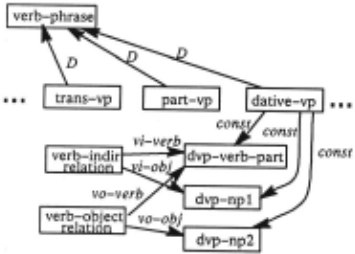
Figure 1 shows the Ace representation of two linguistic relations applicable to the examples discussed here. The "D" link in these figures stands for DOMINATE, the KO DIAK term for subsumption, or "a-k-o". Common rela tions such as verb-indir-relation and verb-object-relation are associated with syntactic structures; since these re lations might appear in a range of surface forms, the as sociation of linguistic and conceptual information to the relations adds flexibility to the system.
B. The REF Association
Linguistic relations provide a hierarchy of linguistic roles that are associated with conceptual interpretations. The explicit link between linguistic and conceptual structures is accomplished using REF. Having explicit knowledge about linguistic expression makes it easier to use the same knowl edge for both analysis and generation and promotes the interaction between abstract and more specialized linguis tic knowledge. For example, the relationship between the indirect object and the conceptual recipient is a high-level REF association that may combine with particular knowl edge about verbs of a more concrete nature.
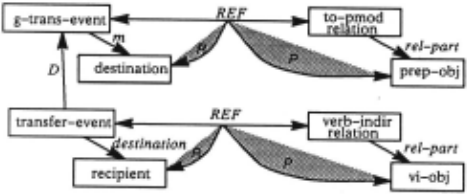
Two important REF relationships in Ace are illus trated in Figure 2. The association of the to-pmod relation at the level of g-trans-event for "generalized trans fer events", a higher level than the verb-indir-relation, rep resents the knowledge that the object of the preposition "to" describes a more general role, destination, than the recipitlnt described by the indirect object of a verb. Gen eralized transfer events include physical transfers as well, while in transfer events the recipient must abstractly re ceive the transferred object.
REF addresses the role relationship problem by pro viding a general means of associating linguistic and con ceptual roles. Unlike systems such as Hirst's [Hirst, 1987], such relationships are often derivable from the knowledge structures in the network rather than being required ex plicitly for each word/sense template. For example, the relationship between the indirect object of the verb "sell" and the customer role is derived from the ROLE-PLAY between indirect-object and recipient and the fact that the customer plays a recipient role in the transfer of merchan dise ( cf. [Jacobs, 1985]). With the preposition "to", as in "sold the book to Fred", the role of customer is filled by virtue of its ROLE-PLAY relationship with the destination role.
C. The VIEW Association
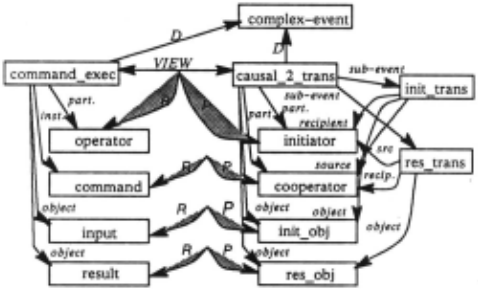
The VIEW association is similar to REF, except that it represents metaphorical relationships rather than associa tions between linguistic and conceptual roles. For exam ple, there is a broad class of English "transfer" expressions such as "give a kiss", "take a punch", and "get a back rub". The generalization here may be captured as a conceptual relationship, namely being acted upon is often viewed as a transfer, in which the patient of the activity is viewed as the recipient.
The example of "taking arguments" is similar, in that commands do not really "give" or "take" or "get" any thing, but the language is extremely consistent in describing them as if they did. Figure 3 shows a VIEW re lationship used to handle expressions like "getting argu ments", "taking arguments", and "giving back a result". This representation has been slightly abbreviated due to its complexity; in reality the common manner of describ ing the complex command-execution event belongs to a broader class of metaphors along with "The frosting takes two cups of sugar" . The VIEW as illustrated, however, encompasses quite a range of expressions. The power of this VIEW comes from the ROLE-PLAYs that capture the consistency of the metaphorical expressions, such as that relating command to cooperator and thereby to the source role of an initial transfer in an exchange ( causaL2-trans ). VIEW thus provides a tool for handling numerous role re lationships that otherwise would be enumerated as special cases in the system.
III. The TRUMP Analyzer
TRUMP (TRansportable Understanding Mecha nism Package) [Jacobs, 1986) is a natural language system designed for use in a variety of domains. The theoretical basis of the system is that the Ace knowledge base design makes it possible for a core of linguistic knowledge to be exploited across domains.
The algorithm that TRUMP uses to perform linguistic analysis consists of the following mechanisms: ( 1) A syn tactic parser, which identifies linguistic constituents and instantiates linguistic relations that are tied to matched structures, (2) A mapping mechanism, which produces conceptual structures by following VIEW and REF links from these instantiated linguistic structures, and (3) A phase called concretion, which finds the most specific frame suggested by other information and fills out the roles of that frame. For more details of this process, the reader is referred to [Jacobs, 1986).
Figure 4 is a sketch of the operation of the TRUMP
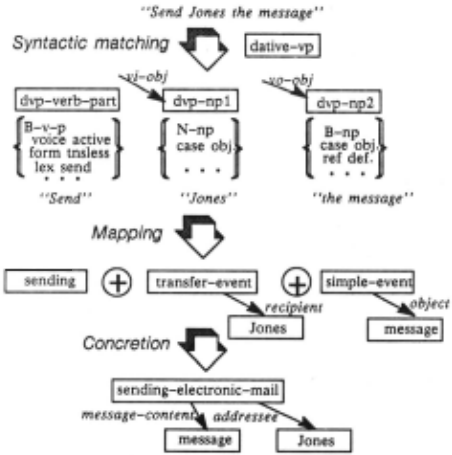
system, showing the results of the syntactic, mapping, and concretion processes. The application of role relationships is a major part of the work done by the semantic inter preter, or phases (2) and (3) above. When a linguistic structure is mapped, the interpreter must find the role in the resulting concept that appropriately corresponds to the linguistic role. Often this involves following a chain of ROLE-PLAY associations, and occasionally it does not completely specify the resulting role. For example, in "John gave Mary a kiss", versus "John gave Mary's cheek a kiss," the semantic interpreter correctly determines that the linguistic indirect object may express either the surface being kissed or the person being kissed. The semantic con straints on these roles favor the more likely interpretation.
TRUMP currently consists of about 5,000 lines of Common Lisp code, including the parser, semantic inter preter, knowledge base manipulation, and lexical acquisi tion mechanisms. The "core" Ace knowledge base consists of several hundred linguistic entries with about a thou sand concepts, but this is not large enough to select a new domain without coding a fair amount of new knowledge. The system is currently being used, experimentally, in four drastically different natural language projects. While we are far from having a program that can easily function within a new application area, the exercise is proving useful in identifying natural language tools that do apply across domains.
IV. Relation to other Systems
Three knowledge-based systems are especially similar in design to TRUMP. These are the KL-ONE based work described by Sondheimer, Weischedel and Bobrow (Sond heimer et al., 1984], the Absity program of Hirst (Hirst , 1987], and Lytinen's MOPTRANS (Lytinen, 1984].
The KL-ONE based work is closest in knowledge base design to TRUMP, as the systems use similar, uniform rep resentational frameworks for both the linguistic "syntax anomy" and the conceptual knowledge base. The trans lation rules of this system, corresponding closely to the REF associations of Ace, can also be applied through in heritance, thus facilitating the use of generalized role. re lationships. These rules, however, are not expressed m a declarative form; thus it is not as clear how they would ap ply to language generation, and it proves difficult to handle metaphorical expressions.
Hirst's system also applies a similar knowledge orga nization but for theoretical reasons Hirst does not allow , .. role relationships to be inherited in his system, requmng case-role specifications for each word sense. The "Polaroid words" in Hirst's system correspond closely to the concre tion mechanism of TRUMP, in that roles are filled and more specific frames activated as more information propa gates from the linguistic mechanism of the system.
Lytinen's MOPTRANS system is similar to TRUMP not only in the organization of knowledge structures (MOPs) but also in the choice of some of the higher l:vel frames that are used to derive specialized interpretations via frame selection. MOPs, however, do not really sup port structured inheritance: although constraints and pro totypes may be assigned at the concept/role level, a role or slot of a particular frame cannot derive from multiple roles. Thus, as in Absity, much of the knowledge used to handle role relationships must be handled at a very specific level. Also, this knowledge is attached to the individual MOPs, rather than being declaratively represented.
V. Summary and Conclusion
The ROLE RELATIONSHIP problem in semantic interpreta tion is the task of appropriately filling out the roles or slots of a candidate frame. Three knowledge structures of Ace-LINGUISTIC RELATIONS, REF ASSOCIATIONS, and VIEW ASSOCIATIONS-help to alleviate this problem by providing a hierarchy of linguistic structures and explicit role relationships that include metaphorical expressions. These structures are particularly useful in choosing among candidate concepts and in appropriately filling the roles of selected concepts. They combine with a representation such as KODIAK or KL-ONE to form an enriched frame work for language processing. The TRUMP language anal ysis system supports the application of this core knowledge about language across domains.
@inproceedings{ijcai1987p133,
  title     = {A Knowledge Framework for Natural Language Analysis},
  author    = {Jacobs, Paul S.},
  booktitle = {Proceedings of the Tenth International Joint Conference on
               Artificial Intelligence, {IJCAI-87}},
  publisher = {International Joint Conferences on Artificial Intelligence},
  editor    = {John McDermott},
  pages     = {675--677},
  year      = {1987},
  note      = {Natural Language},
  url       = {https://ijcai.org/proceedings/1987/133},
}
TY - CPAPER TI - A Knowledge Framework for Natural Language Analysis AU - Jacobs, Paul S. T2 - Proceedings of the Tenth International Joint Conference on Artificial Intelligence, IJCAI-87 PB - International Joint Conferences on Artificial Intelligence PY - 1987 SP - 675 EP - 677 UR - https://ijcai.org/proceedings/1987/133 ER -Copied
Machine-readable versions of this paper, for tools and AI agents:





