
Incremental Interpretation and Combinatory Categorial Grammar
Proceedings of the Tenth International Joint Conference on Artificial Intelligence. Natural Language. Pages 661-662.
© 1987 International Joint Conferences on Artificial Intelligence
Abstract
The paper is organised around a particular problem of anaphotic definite reference. A solution to this problem requires sentence processing which allows semantic representations to be evaluated incrementally, as a phrase is read from left to right. The paper shows how a proposal made by Mellish (I985), to regard incremental semantic evaluation as a constraint satisfaction task, can provide a natural solution to the problem of reference. The incorporation of Combinatory Categorial Grammar allows a straightforward relationship to be stated between the incrementally assembled syntactic and semantic representations.
- Ades, A. and Steedman, M. J. (1982) On the Order of Words. Linguistics and Philosophy, 4, 517-518.
- Altmann, G. (1987) Modularity and Interaction in Sentence Processing. In Garfield, J. (ed.) Modularity in Knowledge Representation and Natural Language Processing. Cambridge, Mass.: Bradford/MIT Press.
- Haddock, N. J., Klein, E. and Morrill, G. (eds.) (1987) Categorial Grammar, Unification Grammar, and Parsing. Technical Report No. EUCCS/WP-1, Centre for Cognitive Science, University of Edinburgh, 1987.
- Hirst, G. (1983) Semantic Interpretation against Ambiguity. Technical Report No. CS-83-25, Dept. of Computer Science, Brown University, 1983.
- Mackworth, A. K. (1977) Consistency in Networks of Relations. Artificial Intelligence, 8, 99-118.
- Mellish, C. S. (1985) Computer Interpretation of Natural Language Descriptions. Chichester: Ellis Horwood.
- Pareschi, R. and Steedman, M. J. (1987) A Lazy Way to Chart- Parse with Extended Categorial Grammars. In Proceedings of the 25th Annual Meeting of the Association for Computational Linguistics, 1987.
- Steedman, M. J. (1985) Dependency and Coordination in the Grammar of Dutch and English. Language, 61, 523-568.
- Steedman, M. J. (1987) Combinatory Grammars and Human Language Processing. In Garfield, J. (ed.) Modularity in Knowledge Representation and Natural Language Processing. Cambridge, Mass.: Bradford/MIT Press.
- Winograd, T. (1972) Understanding Natural Language. New York: Academic Press.
- Haddock
References were extracted automatically from the PDF and may contain errors.
Full text extracted automatically from the PDF; figures, tables and equations may differ. The PDF is the version of record.
INCREMENTAL INTERPRETATION AND COMBINATORY CATEGORIAL GRAMMAR
Nicholas J. Haddock Department of Artificial Intelligence and Centre for Cognitive Science, University of Edinburgh, Edinburgh EH8 9LW, U.K.
a hearer incrementally evaluates a semantic representation - · after each word, say - the empty hat in the scene will never teally be considered a viable candidate for the inner NP. When the word rabbit is reached, a hearer can collect together in his mind the set of rabbits in the context. After the preposition, this set can be refined to contain only rabbits which are in something and, most importantly, the hearer can start thinking about another set of objects, those which have rabbits in them. There is only one hat in this new set and so by the time the inner NP is pro cessed a definite determiner sounds natural. How can we pin this idea down in more explicit. computational terms?
II REFERENCE AND CONSTRAINT SATISFACTION
Mellish (I985) has proposed that the general process of incremental reference evaluation, sketched above, can be directly expressed by a constraint satisfaction algorithm of the kind presented by Mackworth (I977). Consider the following predi cates, which may arise from the fragment the rabbit in (ignoring the determiner):
- rabbit(ei) in(ei,e2)
Constraint satisfaction involves determining, for each of the vari ables e 1 and e2, the entities in the discourse which satisfy the predicates, and collecting these into candidate sets for each vari able. (We shall refer to these variables as extension variables.) Given the context provided for (1) above, this operation will label ei with the set {R2,R3} and e2 with {HI,BI}. The advan tage of the scheme is at once clear: satisfying the constraints in (3) determines a candidate set for e2 as well as ei, and so the reference of any NP which follows the fragment is already partially-evaluated. This offers a natural solution to the problem of non-compositionality exhibited in (I); a solution which is difficult to obtain in compositional semantic systems.
The following treatment of our problematic phrase illus trates two significant improvements on Mellish's own account of anaphoric definite reference. First, the phrase is evaluated strictly word-by-word, in left-to-right order; there is linguistic, psycho logical and intuitive support for this general position (Steedman (I987)). In contrast, Mellish's system would evaluate the two nouns before considering the preposition which relates them. Second, the relationship between syntactic and semantic descrip tions is made explicit. Mellish himself points out that his system "lacked precision" on this issue (Mellish 1985:114).
ill THEMODEL
The model sees syntax as controlling the way in which semantic representations are combined. And the goal is to pro-
ABSTRACT
The paper is organised around a particular problem of ana photic definite reference. A solution to this problem requires sen tence processing which allows semantic representations to be evaluated incrementally, as a phrase is read from left to right. The paper shows how a proposal made by Mellish (I985), to regard incremental semantic evaluation as a constraint satisfaction task, can provide a natural solution to the problem of reference. The incorporation of Combinatory Categorial Grammar allows a straightforward relationship to be stated between the incremen tally assembled syntactic and semantic representations.
I INTRODUCTION
The concern of this paper is to show how a computational model of incremental interpretation suggests a solution to a par ticular problem of definite reference. Suppose we have a context in which there are three rabbits (RI, R2, and R3), two hats (HI and H2) and one box (B I), where one rabbit is in a hat and one is in the box:
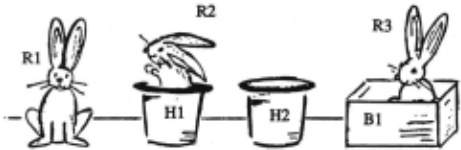
If bo.th speaker and hearer are aware of this context, the second rabbit. R2, can be referred to by means of the following complex NP:
(I) the rabbit in the hat
This expression can be uttered without any previous talk of rab bits or hats. What is interesting about it is the use of the definite determiner in the inner, simple NP, the hat. As a whole, the expression in (I) sounds perfectly natural, and so suggests that a unique hat is identifiable to the hearer. But given that there are two hats, and not one, in the scene, why is the definite permissi ble? Any compositional accounts of NP semantics, including those of Winograd (1972) and Hirst (1983), would judge (I) to be infelicitous. Such theories would require the somewhat convo luted version in (2), if a definite is to be used at all to specify the hat.
(2) the rabbit in the hat with a rabbit in it
A semantics organised around the criterion of incremental interpretation should have less trouble with (1). If we assume that vide an incremental semantics, so that a phrase receives its interpretation in stages, after each word is read. If this process is to accord with the rules of syntax, then the grammar too must be incremental.
A framework which might be helpful in this respect is Combinatory Categorial Grammar (Ades and Steedman (1982), Steedman (1985)). Like all categorial grammars, Combinatory Grammar employs a rule of function application to combine functions and arguments:
(4) X/Y + Y ~ X
Steedman adds further combinatory rules, including function composition:
(5) X!Y + yrz ~ xrz
As we shall see, function composition is especially relevant to the issue of incrementation because it allows "incomplete" consti tuents, such as the rabbit in or you can believe that I like, to be elegantly described.
How can a constraint-based semantics be tailored to a sys tem of combinatory grammar? Suppose we associate a constraint with each nominal word and an extension variable with its category. The noun box could have the following entry in the lexicon:
(6) box := Ne 7 : box(e7)
Box is defined(":=") as being anN linked to the variable e7. The identity of this variable is arbitrary; all that matters is that each word in the string is given a novel extension variable, to avoid unintended name clashes. The definition above associates a con straint with the noun, indicating that any value assumed by e7 must name a box in the context. Function categories differ only in that they are coupled to mappings between variables. Consider the category for a determiner, NP/N: given a noun to the right, this yields an NP. With semantics attached, the definite deter miner appears as:
(7) the := NPel/Nel : unique(el)
This simply states that the variable associated with the noun is the same as the one associated with the NP, el. This ensures that the constraint arising from the determiner, unique( el ), will res trict the set of candidates that apply to the noun, whatever they tum out to be.
The combination rules of the grammar have responsibility for relating these representations to each other. In relating the above determiner and noun, for instance, the variables e1 and e7 should be identified, because they are really both about the same set of candidate entities. Thus, in addition to the usual cancella tion in the syntax, the rules of application and composition must equate extension variables. This is achieved by imposing a con straint of equality on the variables concerned, and the application of the to box appears as the reduction in (8).
The constraint of equality expresses the fact that the candidates for el must be the same as those for e7; all constraints which apply to e1 must also apply to e7, and vice versa.
Let us now go back to the phrase in (1), and consider the representations bestowed upon its component parts. Prepositions are functions taking an NP argument on their right to form another function, which must modify a noun on the left. They are therefore categorised as (N\N)/NP, where the leftward application of the inner function is indicated by a backward slash '\'. Because of its relational standing, in maps between two distinct extension variables:
(9) in := (Ne 3 \Ne 3 )/NP e4 : in(e3,e4)
Thus, e3 will be identified with the variable of the head noun and related to e4, which represents the prepositional object.
Any noun is form-class ambiguous between its primitive category, N, and a type-raised category, N/(N\N), a function over noun-modifying functions. Type-raising gives a noun like rabbit the opportunity to compose with in, categorised as (N\N)/NP. Note that this operation simply alters the noun's syntactic status, and does not complicate the semantics:
The means by which the parser decides between the two noun categories is beyond the scope of the present paper; Suffice it to say that the choice is made in accordance with "The Principle of Referential Failure" of Altmann (1987). In the following analysis of (1), we will assume the type-raised version of rabbit, which expects modifying material, and the primitive version of hat, which closes the whole NP.
The constraint arising from a definite article, introduced above as unique( el), is different in kind to the constraints arising from rabbit, hat and in. It is defined as follows:
( 11) unique( eN) is true iff the candidate set for eN is singleton
Whereas a constraint like rabbit{eN) is a predicate over the par ticular discourse entities which make up the set for eN, unique( eN) is a predicate over the set as a whole. As such, unique( eN) is a "meta-constraint": it makes a check on the degree to which a given candidate set is constrained. There is another aspect of (11) which distinguishes it from the rest. Whereas rabbit(eN) has its effect as soon as the word rabbit is read, the constraint in (11) is only enforced when the NP corresponding to the variable eN is syntactically closed.
Finally, a note on parsing. The input string is processed by a non-deterministic variant of a shift-reduce parser, working from left to right in the string and reducing whenever it can. The details of the algorithm are omitted from the following trace, and the interested reader is referred to Pareschi and Steedman (1987), and Haddock et al. (1987) for further discussion of parsing issues.
IV THE RABBIT IN THE HAT
The table in (12) indicates the successive states of the sys tem as it reads each of the five words in (1) and makes a combi nation with the previous constituent.
The first move in processing the phrase is to read the category of the initial determiner, NPel/Nel' and add its condi tion to the constraint satisfaction process (CSP). This simply asserts that el is expected to have a single candidate, when the corresponding NP is closed. (Notice that the constraint is labelled with an asterisk in (12a), because it applies only at the time of syntactic closure.) The second word is now read, as defined in (10). This places a condition of rabbitness on the variable e2, which at present is unconnected to el. The addition of rabbit(e2) prompts the CSP to search for suitable values for e2 in the con text, and it finds three entities fitting the description: R 1, R2 and R3. The two categories can now be combined, using composi tion. This cancels N~;J and N 2 , producing the category in (12b). A constraint of equality arise~ from the reduction, meaning that e 1 and e2 are treated as alternative names for the same set.
The preposition (defined in (9)) is now processed, introduc ing two new variables to the CSP. Satisfying the relation therefore produces two new sets of candidates: one for all containing objects (e4) and one for all objects contained (e3). The subse quent composition with the category in (12b) matches e3 with e2. This removes the first rabbit, Rl , from the set for el (which equals e2) as Rl is not contained in anything. (12c) records the current category and present state of the CSP. Notice that the second hat, H2, is not included in the set of candidates from which the inner NP must later take its reference, because it does not contain R2 or R3.
The second determiner is read, with ihe category NP 5 /N 5 . Reducing the-rabbit-in with the does nothing to further re~e ffie set of containing objects, but the system now expects this partic ular set to be a singleton when the phrase is complete. As (12d) indicates, the incremental evaluation of the rabbit in the has created two distinct sets of candidates, for the two NPs in the phrase. The variables el, e2 and e3 all denote the set {R2,R3}. holding possible referents for the complex NP, while e4 and e5 specify { H l,B 1 } for the inner phrase.
The final noun introduces the category Ne6 and adds the constraint hat(e6) to the CSP. The rule of application is used for the first time, closing the phrase, and producing the final category in (12e). Identifying e6 with e5 eliminates the box, Bl, and con strains each candidate for el (= e2 = e3) to be in the remaining hat, HI. So R3 goes out. We are left with two singleton sets, thus ensuring the success of the two checks for definiteness. The conditions unique(e5) and unique(el) are indeed enforced at this stage, because both the simple NP (corresponding to e5) and the complex NP (corresponding to el) have been closed by the appli cation to hat.
| (12) | Category | Constraints | Extensions |
| a. | NPel/Nel | *unique( e 1) | |
| b. | NP el/(Ne2\Ne2) | rabbit(e2) el = e2 | el : {Rl,R2,R3} |
| c. | NPel/NPe4 | in(e3,e4) e2 = e3 | e1: {R2,R3} e4: {Hl,Bl} |
| d. | NPel/Ne5 | *unique(e5) e4 = e5 | el: {R2,R3} e4: {H1,Bl} |
| e. | NPel | hat(e6) e5 = e6 | el : {R2} e4 : {HI} |
V CONCLUSION
A number of aspects of the present research have been put to one side in this paper. Nothing has been said about the treat ment of sentences, in contrast to noun phrases, and little on the way in which certain structural ambiguities are resolved by refer ence to the context. Oearly there are phenomena for which the account sketched above is overly simple. Nonetheless, it is encouraging that a system of incremental evaluation can provide a solution to an instance of anaphora which poses a problem for more conventional approaches.
ACKNOWLEDGEMENTS
I wish to thank Marl<: Steedman and Henry Thompson for the supervision of this project. The work has also benefitted from the comments of: Gerry Altmann, Einar Jowsey, Ewan Klein, Colin Matheson, Chris Mellish, and Remo Pareschi. I am grateful to Jo Calder, Robert Dale, Jon Oberlander, and the two reviewers for reading and commenting on earlier versions of this paper. The work reported here was supported by SERC research quota award 83317765.
@inproceedings{ijcai1987p130,
  title     = {Incremental Interpretation and Combinatory Categorial Grammar},
  author    = {Haddock, Nicholas J.},
  booktitle = {Proceedings of the Tenth International Joint Conference on
               Artificial Intelligence, {IJCAI-87}},
  publisher = {International Joint Conferences on Artificial Intelligence},
  editor    = {John McDermott},
  pages     = {661--662},
  year      = {1987},
  note      = {Natural Language},
  url       = {https://ijcai.org/proceedings/1987/130},
}
TY - CPAPER TI - Incremental Interpretation and Combinatory Categorial Grammar AU - Haddock, Nicholas J. T2 - Proceedings of the Tenth International Joint Conference on Artificial Intelligence, IJCAI-87 PB - International Joint Conferences on Artificial Intelligence PY - 1987 SP - 661 EP - 662 UR - https://ijcai.org/proceedings/1987/130 ER -Copied
Machine-readable versions of this paper, for tools and AI agents:
 Welcome
 Future Conferences
 AI Journal Division
 IJCAI Proceedings
 About IJCAI
 IJCAI Awards