
Combining Discourse Strategies to Generate Descriptions to Users Along a Naive/Expert Spectrum
Proceedings of the Tenth International Joint Conference on Artificial Intelligence. Natural Language. Pages 626-631.
© 1987 International Joint Conferences on Artificial Intelligence
Abstract
A question answerin$ system that provides access to a large amount of data will be most useful if it can tailor its answer to each user. In particular, a user's level of knowledge about the domain of discourse is an important factor in this tailoring. In previous work we determined that a user's level of domain knowledge affects the kind of information provided in an answer to a user's question as opposed to just the amount of information, as was previously proposed. We also explained how two distinct discourse strategies could be used to generate texts aimed at naive and expert users. Users are not necessarily truly expert or fully na1ve however, but can be anywhere along a knowledge spectrum whose extremes are nlllve and expert. In this work, we show how our generation system, TAILOR, can use information about a user's level of expertise to combine several discourse strategies in a single text, choosing the most appropriate at each point in the generation process, in order to generate texts for users anywhere along the knowledge spectrum. TAILOR's ability to combine discourse strategies based on a user model allows for the generation of a wider variety of texts and the most appropriate one for the user.
- Encyclopedia of Chemical Techology. 1978 Kirk and Othmer, E4s; John Wiley & Sons, New York, NY 1978.
- Kay, Martin. Functional Grammar. In Proceedings of the 5th meeting of the Berkeley Linguistics Society. Berkeley Linguistics Society, 1979.
- Kukich, K. Explanation Structures in XSEL. In Proceedings of the 23rd Annual Meeting of the Association for Computational Linguistics. Association for Computational Linguistics, Chicago, Illinois, 1985.
- Lebowitz, M. RESEARCHER: An Overview. In Proceedings of the Third National Conference on Artificial Intelligence. American Association of Artificial Intelligence, Washington, DC, 1983.
- Lebowitz, M. RESEARCHER: An experimental intelligent information system. In Proceedings of the Ninth International Joint Conference on Artificial Intelligence, pages 858-862. Los Angeles, 1985.
- Mann, W.C. Discourse Structures for Text Generation. In Proceedings of COUNG '84. Association for Computational Linguistics, Stanford, Ca., July, 1984.
- McCoy, K. F. The ROMPER System: Responding to Object-Related Misconceptions Using Perspective. In Proceedings of the 24th Annual Meeting of the ACL. Association of Computational Linguistics, New York City, New York, June, 1986. 632 NATURALLANGUAGE
- McKeown, K. R. Generating Natural Language Text in Response to Questions About Database Structure. PhD thesis, University of Pennsylvania, May, 1982. Also a Technical report, No MS-CIS-82-05, University of Pennsylvania, 1982.
- McKeown, K.R. Text Generation: Using Discourse Strategies and Focus Constraints to Generate Natural Language Text. Cambridge University Press, Cambridge, England, 1985. [McKeown and Paris 87]
- McKeown, K. R. and Paris, C. L. Functional Unification Grammar Revisited. In Proceedings of the 25th Annual Meeting of the ACL. Association of Computational Linguistics, Palo Alto, California, 1987.
- Paris, C. L. Description Strategies for Naive and Expert Users. In Proceedings of the 23rdAnnual Meeting of the Association for Computational Linguistics. Chicago, 1985.
- Paris, C. L. Tailoring Object Descriptions to the User's Level of Expertise. To Appear in the Computational Linguistics Journal, Special Issue on User Modelling, 1987. Paper presented at the International Workshop on User Modelling, August 1986, Maria Laach, West Germany.
- Paris and K wee 85] Paris, C. L. and Kwce TL. Guide to the Unification Process and its Implementation; Progress Repon on Extending the Grammar. Technical Report, Computer Science Department, Columbia University, New York, NY 10027, 1985.
- Paris and McKeown 87
- Paris, C. L. and McKeown, K. R. Discourse Strategies for Describing Complex Physical Objects. In G. Kempen (editor), Natural Language Generation: Recent Advances in Artificial Intelligence, Psychology, and Linguistics. Kluwer Academic Publishers, Boston!Dordrecht, 1987. Paper presented at the Third International Workshop on Natural Language Generation, August 1986, Nijmegen, The Netherlands.
- Wallis and Shortliffe 82
- Wallis, J.W. and Shortliffe, E.H. Explanatory Power for Medical Expert Systems: Studies in the Representation of Causal Relationships for Clinical Consultation. Technical Report STAN-CS-82-923, Stanford
- UniverSity, 1982. Heuristics programming Project. Department of Medecine and Computer Science.
- Weiner
- Weiner, J. BLAH, a System that Explains its Reasoning. Artificial Intelligence Journal, 15:19-48, 1980.
- Woods, W. An Experimental Parsing System for Transition Network Grammars. In Rustin R. (editor), Natural Language Processing. Algorithtnics Press, New York, 1973.
References were extracted automatically from the PDF and may contain errors.
Full text extracted automatically from the PDF; figures, tables and equations may differ. The PDF is the version of record.
I Introduction
A question answering system that pro':id~s acces.s to. a large amount of data will be most useful if 1t can tailor 1ts answer to each user. In particular, a user's level of knowledge about the domain of discourse is an impo~t factor in this tailoring. The answer should not PI'?Vlde information that is obvious to the user. However, 1f the answer assumes knowledge that the user does not have, it may be very hard for the user to understand the answer. In previous work [Paris 85], we determined that a user's level of domain knowledge affects the kind of information provided in an answer· to a user's question as opposed to just the amount of information, as was previously proposed [Wallis and Shortliffe 82]. We also explained how two ~stinct discourse strategies could be used to generate texts IUmed at naive and expert users [Paris 85; Paris 87]. Users are not necessarily truly expert or fully naive however, but can fall anywhere along a knowledge spectrum whose extremes !1fe na1ve and expert. In this work, we show how a generation system can use the information contcl;ined.in a us~r model to combine several discourse strategies m a smgle text, choosing the most appropriate at each point in the generation process, in order to generate texts for users anywhere along this knowledge spectrum.
·we have done our analysis with respect to requests for descriptions.
system in choosing facts that the user understands and does not already know (and cannot easily infer), thereby improving the resulting answer.
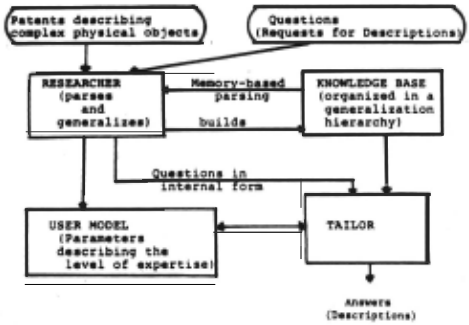
In this domain, we found that a description aimed at an "expert"·· user contained mainly structural information (i.e., information about subparts of objects and their attributes) while a description aimed at a "naive" user contained chiefly process information (i.e., information explaining how the object performs its function). These differences can be characterized in terms of two distinct discourse strategies:
- The Constituency Schema, one of the textual structures posited by McKeown [McKeown 82]. In her work on natural language generation, McKeown studied the problems of what to say and how to organize it coherently. Standard combinations of propositions were encoded as schemas that are associated with a particular discourse situation. The constituency schema is one such schema and is used to describe an object in terms of its subparts and their properties. This schema is .summarized in Figure 2. This
- Identify the item as a member of some generic class.
- Present the constituents of the item to be defined.
- Present characteristic information about each constituent in turn.
- Present additional information about the item to be defined.
Figure 1: The Constituency Schema
·· An expert user is one that is knowledgeable about the domain of the knowledge base, while a naive user is one who is not. We defme "knowing'' an object to mean knowing about the existence of the object, its purpose and how this purpose is achieved. Thus knowing an object means understanding the functionality of the object and the mechanical processes associated with it Note that knowing about an object does not necessarily mean, however, knowing all the subparts of the object or all the properties associated with these subparts.
strategy is most appropriate when a user is an expert in the domain of the knowledj:e base, since s/he will be able to infer how the parts of an obJect work together in order to perform the object function. It is then not necessary to include the process information associated with the object.
- The Process Trace, which follows the links between events in the underlying knowledge base in order to trace through the process information that explains the function of the object. A precise formulation of this strategy has been developed in [Paris and McKeown 87]. It is summarized in Figure 3. The process trace strategy is most aP\'I'Opriate when the user is a novice with respect to the donuun of the knowledge base, since such a user would not have enough · knowledge to infer the processes linking the parts of the object from the parts and their properties only.
[For each object, given a chain of causal link]:
- Follow the next .causal link
- {Mention an important side link)
- {Give attributive information about a part just introduced)
- {Follow substeps if there are any)
- Go back to (1) .
[This process can be repeated for each subpart of the object]
Figure 3: The Process Trace
m Choosing and combining strategies based on a user model
T All..OR can choose either the constituency schema or the process trace to provide a description. The decision cannot be based on the question type since both strategies can be used to provide an answer to a request for a description. It is instead based on the user's level of expertise. Based on this information, the system can decide whether to provide mainly structural information (using the constituency schema strategy) for an expert user or to provide a process description for a naive user.
Description of the microphone
User Model: expert
Based on the user model, the system decides on the constituency schema strategy.
The microphone changes soundwaves into current. The microphone has an aluminium disc-shaped diaphragm, and a doubly-resonant system to broaden the response. The diaphragm is clamped at its edges. The system has a button, and a cavity.
Figure 4: Example of a description
Examples of descriptions generated with the two strategies given the corresponding user models are shown in Figures 4 and 5. In both figures, the description given is that of a microphone. In Figure 4, after identifying the microphone as a member of a superordinate class, its parts and their properties are given. In Figure 5, the text follows the causal links associated in the knowledge base in order to explain how the microphone works.
Description of the microphone
User Model: expert Based on the user model, the system decides on the process strategy.
The microphone changes soundwaves into current A person speaking into the microphone causes the soundwaves to hit the diaphragm of the microphone. The diaphragm is aluminium, and disc-shaped. The soundwaves hitting the diaphragm causes the diaphragm to vibrate. The sound wave _intensity increasing causes the diaphragm to spring forward. The diaphragm springing forward causes the granules to compress. The granules compressing causes the resistance of the granules to reduce. The resistance reducing causes the current to increase. The sound wave _intensity reducing causes the diaphragm to spring backward. The diaphragm springing backward causes the granules to decompress. The granules decompressing causes the resistance to increase. The resistance increasing causes the current to reduce. The diaphragm vibrating causes the current to vary. The current varies like the intensity varies.
Figure 5: Example of a description
Since the knowledge base contains many different objects, most users will be neither fully naive nor truly expert with respect to the knowledge base. "Naive" and "expert" are the extremes of a knowledge spectrum, and most users will be at intermediate points in the spectrum. Such users may have local expenise about some objects in the knowledge base and not others. Hence it is not sufficient for the user model to indicate whether a user is naive or expert. The user model must distinguish more precisely the user's level of domain knowledge about separate sub-areas of the knowledge base and individual objects. Finally, the user model must also contain information about whether the user is knowledgeable about the basic concepts that may be involved in a process description. For example, in our domain, such concepts include electricity and magnetism.
If a user has local expertise about some parts of an object and not others, a complete process trace (including a process trace for every part) is unnecessary. On the other hand, providing a description based only on the constituency schema may not be totally understandable. For such users, we use both strategies to produce a description, using the constituency schema for the known parts and the process trace for the new ones.
As an example, suppose we are providing a description of an elevator to a user who knows how a motor functions, but not how an elevator works. In describing the elevator to this user it is necessary to first describe how the parts of the elevator are related, using the process trace strategy. If a long description is desired, the individual parts must be described in turn. It should not be necessary to fully explain what the motor does, as the user already knows about it. The constituency schema strategy can thus be used to describe the motor. For the other parts, however, the process strategy is still appropriate in order to explain their mechanism.
Our analysis of naturally occurring texts confirmed that several strategies can be used to generate a text. We found example of texts that combine the constituency schema and the process trace to generate descriptions aimed at users with intermediate levels of domain knowledge. Consider the text shown in Figure 6, taken from [Chemical 78]. The description starts with the constituency schema strategy but ends with a process trace: the ''ir [Infra red] spectrometer'' is flrst described in terms of its parts; each part is then described in turn (depth-attributive); finally, the authors revert to a process trace to describe the "thermocouple detector," assuming it is unknown to the reader. To fully understand this text, the reader must already know (or be able to infer information) about their spectrometer's purpose, the "ir radiation," the "monochromator" and the purpose of a spectrometer.
(1) The ir spectrometer consists of three essential features: a source of ir radiation, a monochromator and a detector. (2) The primary sources or' ir radiation are the Globar and Nemst glower. (3) The Globar is a silicon carbide rod heated to 1200 degrees C. (4) The Nernst glower is a rod containing a mixture of yttrium, zirconium, and erbium oxides that is heated elecuically to 15000 degrees C. (5) Earlier ir spectrometers contained prism monochromators but today gratings are used almost exclusively. (6) Most detectors in modem spectrometers operate on the thermocouple principle. (7) Two dissimilar metal wires are connected to form a junction. (8) Incident radiation causes a temperature rise at the junction and the difference in the temperature between head and tail causes a flow of current in the wires which is proponional to the intensity of the radiation.
- Constituency (parts)
- 2-4. Depth attributive for their radiation (properties)
- 5,6. Depth attributive for the monochromators
- Depth atuibutive for the thermocouple spectrometer
- Process trace for the thermocouple principle.
Figure 6: Text from the Encyclopedia of Chemical Technology
We can now present the decision algorithm employed by TAILOR to decide which strategy must be used to begin generating a description. If the user is not an expert but has local expertise about the object to be described, the constituency schema can be used initially. If the user knows about nearly all of the functional parts of the objects, the constituency schema can still be used, provided that the process trace is used when details about the unknown parts need to be given. The decision algorithm is described in Figure 7.
To be able to combine the two strategies to generate a description, we must specify the points at which it is possible to switch strategy. Any time an object is introduced and needs to be described, the system can provide either structural infonnation (using the constituency schema) or functional information (using the process trace). This gives the following decision points in the strategies:
Is the user an upert user?
Yes: Use constituency schema
No : Is the user a Mivt user?
Yes: Use process trace
No : Is the object in the user model (i.e., does the user
have local expertise about this object?)
Yes: Use constituency schema
No : Look at all the functional pans of the objects. If the user has local expertise about all but one of these parts, use the constituency schema; Else use process trace.
Figure 7: The decision algorithm
· Within the constituency schema:
- after identifying an object as a member of some generic class, we can provide a process trace for the prototypical object of this class.
- after mentioning the parts of an object, the constituency schema dictates to provide structural information for each subpart. Instead, we could provide a functional description of one or more of the parts. This has been done in the Encyclopedia of Chemical Technology text, for example.
- ·Within the process trace:
- when a part is introduced while traversing the causal links, the process strategy dictates to include attributes of this part (to describe it). Here, we could choose to describe the part more fully using the constituency schema instead.
- When the subparts have to be described, the constituency schema can be used to provide structural information about them instead of including functional information.
Figure 8 summarizes the two strategies in their simplest form; the decision points are denoted by "switch."
| Constituency Schema | |
|---|---|
| -Give the superordinate Switch? | - Next causal link |
| - List the parts Switch? | - Attributes of a part Switch? |
| - or information about the parts | - Substeps |
| - Properties | - Back to next causal link |
Figure 8: The two strategies and their decision points
While we could generate all the possible combinations allowed by the decision points, some combinations are better than others. We have accounted for these preferences using heuristics that decide when to mix the strategies. These heuristics limit the texts we can produce by eliminating some combinations that produce inappropriate texts given the users' knowledge about the domain. The heuristics examine the user model to see what items are known to the user (or what items have a superordinate known to the user), and decide whether it is appropriate to continue with the same strategy or to switch. The decision test is essentially the same as the one used to choose the initial strategy.
Figure 9 shows an example of a text generated by TAILOR by combining the two strategies. Based on the user model that indicates local expertise about loudspeaker, TAILOR chooses the constituency schema. It first identifies the telephone by providing its purpose and then introduces its parts. Structural information is then provided about each of the parts, except for the transmitter, because the transmitter plays an important role in the function of a telephone and the user model shows no local expertise about it. Thus TAILOR chooses to provide process information for the transmitter, switching momentarily to the process trace strategy.
Description of the telephone
User Model: Local Expertise: Loudspeaker
Thl! ttkpho111! lias two main fwu:tioMI part: thi! transmitter (an instance of a mtcropho111!) and thi! rtutver (an instanct of thl! loudspeak.l!r ). Becaust thl! user lcnows one of thl! two parts of thl! tekpho111!, thl! system dl!ctdl!s on thl! constttwncy schl!ma strattgy at first. Howtwr, bl!fou providing structural Information abouJ each subparts, thi! system coiiSKits thi! user modi!/ and dl!ctdl!s to switch strategy to dl!scribl! thi! transmitttr sinct thi! user lias 110 local expi!rtise abquJ it.
The telephone changes soundwaves into soundwaves. The telephone has a various-shaped housing, a transmitter that changes soundwaves into current, a curly-shaped cord, a line, a receiver to change current into sound waves, and a dialing_ mechanism. The transmitter is a microphone. A person speaking into the microphone causes the soundwaves to hit the diaphragm of the microphone. The soundwaves hitting the diaphragm causes the diaphragm to vibrate. The diaphragm vibrating causes the current to vary. The current varies like the intensity varies. The receiver is a loudspeaker with a small aluminium diaphragm. The housing contains the transmitter. The housing contains the. receiver. The housing is connected to the dialing mechanism by the cord. The line connects the dialing_ mechanism to the ;.all.
Figure 9: A description generated by mixing the two strategies
IV TAILOR system and the implementation of the strategies
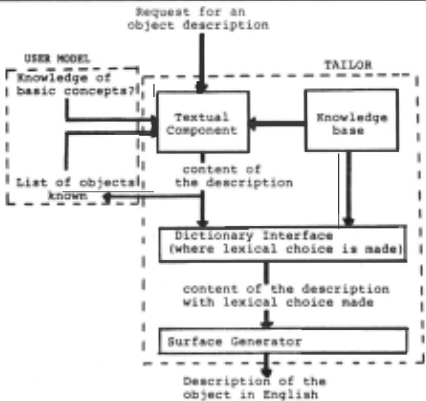
A top-level diagram of TAILOR is shown in Figure 10. Input to TAILOR includes: (1) a request for the description of an object, and (2) the level of expertise of the user, which is either naive/expert for users at the ends of the knowledge spectrum, or, for users with intermediate levels of expertise, a set of parameters that describe the user's level of knowledge about the domain, including:
- whether the user knows (or does not know) the basic underlying concepts that are important in the domain of the knowledge base.
- the specific objects the user knows in the domain.
The textual component of the system decides what to include in the description. It examines the knowledge base and chooses appropriate facts, guided by the user model and the discourse strategies. The output of the textual component is a conceptual representation of the content of the description. This represen~tion is. passed through. an interface which ~akes lextc~ . chmces ~or the v3!l.ous concepts included m the descnpt10n. 'I!te mterface u~h~s the focus of a proposition and the past dtscourse to gutde Its decision process. Finally, a surface generator constructs English sentences. The surface generator is based on the generator used by [McKeown 85] in the TEXT system. This generator unifies the input with a functional grammar [Kay 79] to produce English sentences. We have extended and improved the performance of this program, and augmented the functional grammar it uses [Paris and K wee 85; McKeown and Paris 87).
Strategy Implementation
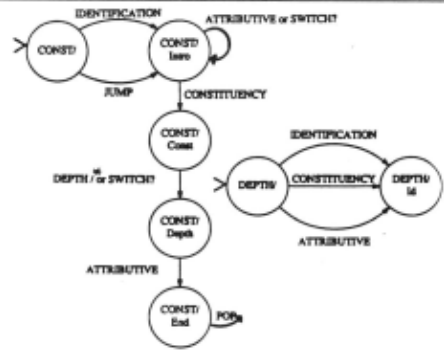
The constituency schema and the process trace strategies are implemented using an augmented transition network (A TN) [Woods 73). The arcs joining the various nodes in the network dictate what information is to be retrieved from the knowledge base, under what conditions (the arcs contain a test), and which node to go next.
In the constituency schema, shown in Figure 11, the arcs correspond to the predicates of the schema. (See [Paris 85; Paris and McKeown 87] for details about traversing the ATN, and [McKeown 85) for details of a similar system.) These predicates, which are enumerated below, define the type of information to be retrieved from the database.
- The identification predicate represents the more general concept of which the present object is an instance.
- The constituency predicate gives the components of an entity, if there are any.
- The attributive predicate provides different attributes of a part (such as its shape or material).
- The cause-effect predicate that provides some causal relations between entities or relations.
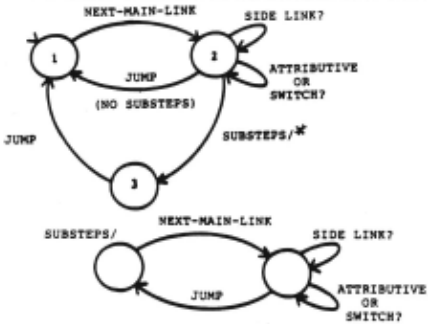
For the process trace, shown in Figure 12, the arcs are not predicates per se, but dictate how to trace the knowledge base to form an answer, mainly by following the causal links in the knowledge base . . The arcs are:
- Next-main-link: this arc dictates to follow the next link on the main path. The main path is the sequence of events that is performed in order for an object to achieve its function.
- Side-link?: A side-link is a link that is not part of the main path, but comes off an event on the main path. This arc tests to see whether there is a side link caused by an event at this point. The decision to mention the side link is based on the importance of that link ....
- Attributive: This arc is similar to the attributive predicate in the constituency schema. If information about a part just introduced is available in the knowledge base, this arc will be taken.
- Substeps?: If an event consists of several substeps, the substeps are traced first. ···· To traverse the substeps, the subroutine substep, shown in Figure 12, is called for each substep. This subroutine is very similar to the main graph, but does not allow for a further decomposition of events.
By representing the two strategies in the same format, we immediately obtain the control structures necessary to switch strategies, since it is possible to jump from a node in one part of the network to a node in a different part. The decision points are marked as special tests (Switch?) on the arcs joining nodes, as shown in Figures 11 and 12.
···In a complex knowledge base, there can be different kinds of links between processes, including causal links, temporal links or analogical links. Some links are more important to mention than others. Since only the most important links are mentioned, links have to be given importance weights. (See [Paris and McKeown 87] for details.)
····Note that we can also choose to not follow the substeps in order to generate a shorter description. This factor is incorporated into the test of the arc.
TAILOR uses the decision process described earlier to decide on which strategy to employ. This test is invoked before beginning generation and at any point in the schema when it is possible to switch strategies. The process of stepping through the A 1N and switching strategy is shown in Figure 13. (The corresponding generated text was shown in Figure 9.) Note that to avoid generating very long texts, substeps are omitted when the process trace is chosen to describe a subpart.
For each object of the knowledge base, TAILOR can currently generate descriptions aimed at expert and naive users, and texts that combine the two strategies for users who are along the knowledge spectrum and only know a few objects.
V Further work
We are investigating extensions of the tests used in the decision process. Such extensions might include checking on the length of the discourse and the number of parts to avoid generating overwhelmingly ·long texts, or taking the generalization hierarchy into consideration. Furthermore, we are extending our work to examine the recursive use of both strategies. Currently, T All..OR does not call the constituency schema recursively more than once (i.e., the constituency schema can be called recursively for each subpart of the top level object being described, but not for the components of these subparts). Similarly, the process .is traced only ~me level down, that is only the top-level relations are broken mto substeps. This kind of recursion however could occur as deeply as the knowledge base allows for. We think that such a level of detail is appropriate onl~ if the .user asks .for a longer description. We are plannmg on 1mplementing a mechanism that would allow the users to request such a description. The problem of depth on the process ,trace al~o needs to be studied further. We expect the users doma1n knowledge, in particular knowledge about basic concepts~ to play a role in determining the depth needed: at s?me pomt, one cannot subdivide the processes any further 1f the user does not know basic underlying concepts as the process explanation will cease to be understandable. For example,
Uaer Model : Local J:xpertiae: Loud.apeaker Stepping through the Conatituency Sch- to deacrU>. ; a TELEPHONJ:. SWitching to the llrcoeaa Traoe to ; deacrU>. the 'l'RAHIDIJ:'l'TER. Applying the pred.icatea to 'l'II:LEIIHORE: Id.entificat.iOft pred.icate: DEVICIC uaed.-for: ohanqe aound.wavea .into aound.wavea Conatituency pred.icate: DIALING MECHANISM 'l'RAHSKIT'l'ER uaed.-for: change aound.wavea into current LINJ: CORD JUIICICIVD. uaed-for: ohanqe ourrent into aoundwavea HOUSING propertiea: color: varioua, ahapa: varioua Need. to awitch to proceaa trace for the 'l'RAHSKIT'l'ER Introd.uctiOft: Id.entificat.iOft pred.icate: KICROIIHONJ: cauaal link (1) : (K-CAUSES) relatea the two relatiOfta: [ONE] 11-SIIJ:AU-IHTO ['l'RAHSKI'l'TER] [SOO'HOWAVES] II-HITS [DIAPHRAGM] cauaal link (2) : (K-CAUSES} relatea the two relatiOfta: [SOO'HOWAVES] II-HITS [DIAPJIRAGK] [DIAPJIRAGK] II-VIBRATES [Subatepa omitted.] cauaal link (3) : (K-CAUSES} relatea the two relatiOfta: [DIAPHRAGM] P-VIBRA'l'ES [CO'RJUIINT] 11-VlUUES Side Link (4) : (K-EQUIV1LENT- TO} relatea the two ralationa: [CO'RJUIIHT] 11-VlUUES [SOO'HOWAVE-IHTEHSITY] 11-VlUUES Returninq to the conatituency ach-: Applying the pred.icatea to JUIICEIVI:R: Id.antitication: :RECii:IWR ia a LOO'OSPJ:AD:R d.ifference: amall aluminiUIII d.iaphragm Applying the pred.icatea to HOUSING: Attributive: HOUSING r-containa 'l'RAHSKI'l'TER HOUSING r-containa :RECii:IWR
HOUSING r-connected.-to DIALING MECHANISM by CORD -
Applying the pred.iaatea to LINE:
Attributive: DIALING MECHANISM r-conneated.-to WALL
- by LINE
Figure 13: Switching strategy
explaining how a disc drive works in terms of current and magnetism will not be informative if the user does not understand these terms. The process explanation, in such a case, should be kept at a higher level. The depth of the knowledge base itself may also affect the depth of the description, as parts or processes may be considered too minor to be mentioned beyond a certain threshold.
VI Conclusions
In this paper we have shown how a user model can determine which of several discourse strategies to usc in generating a description of physical objects. We have also shown how to mix several strategies to generate a single text, using information about a user's local expertise about the domain of discourse to decide when to switch strategy. Finally we presented TAILOR, a program that generates descriptions tailored to users along the knowledge spectrum going from naive to expert. TAll..OR uses two distinct discourse strategies, and, based on the user's level of expertise, decides which one to use and when to switch strategy during the generation process.
Acknowledgments
Many thanks go to Kathy McKeown and Michael Lebowitz for helping in both the research and the writing of this paper, and to Kwee TjoeLiong for his initial work on the functional grammar.
This research was supported in part by the Defense Advanced Research Projects Agency under contract N00039-84-C-0165, and the National Science Foundation grant ISI-84-51438.
@inproceedings{ijcai1987p124,
  title     = {Combining Discourse Strategies to Generate Descriptions to Users Along a Naive/Expert Spectrum},
  author    = {Paris, Cecile},
  booktitle = {Proceedings of the Tenth International Joint Conference on
               Artificial Intelligence, {IJCAI-87}},
  publisher = {International Joint Conferences on Artificial Intelligence},
  editor    = {John McDermott},
  pages     = {626--631},
  year      = {1987},
  note      = {Natural Language},
  url       = {https://ijcai.org/proceedings/1987/124},
}
TY - CPAPER TI - Combining Discourse Strategies to Generate Descriptions to Users Along a Naive/Expert Spectrum AU - Paris, Cecile T2 - Proceedings of the Tenth International Joint Conference on Artificial Intelligence, IJCAI-87 PB - International Joint Conferences on Artificial Intelligence PY - 1987 SP - 626 EP - 631 UR - https://ijcai.org/proceedings/1987/124 ER -Copied
Machine-readable versions of this paper, for tools and AI agents:





