
A Multi-Attribute Approach to Knowledge Representation for Loan Granting
Proceedings of the Tenth International Joint Conference on Artificial Intelligence. Knowledge Representation. Pages 588-590.
© 1987 International Joint Conferences on Artificial Intelligence
Abstract
The complexity of financial declalon-maklng problema Ia auch that automation of the reaaonlng procesa by conventional approachea Ia often Incomplete or Inadequate. Thill paper deacrlbea CREDEX. a knowledge-baaed system which Ia being developed to aaslat bank-loan offlcera In interpreting and evaluating the activitlea of firma applying for a loan. CREDEX ia written In SNARK. It lntegratea ahallow and deep knowledge through a multi-level atructure driven by a meta-expert. The ayatem bullda on psychological reaearch on information processing and handles risk assessment through a combination of four multi-attribute models.
- Aucoin. M .. and B. Micha. "Systeme Expert pour I'Aide au Diagnostic d'Entreprise" In Colloque SIAD 85. AFCET. Paris. Oct. 1g95, pp. 7g-99.
- Bettman. J.R .. An Information Processing Theory of Consumer Choice. Reading. MA: Addison-Wesley. 1979.
- Bourgine. P .. and J.L. Lauriere. "Mise sous Forme Declarative du Logiciel ALICE a I'Aide du Moteur d'lnference SNARK". Publication 58. LAFDRIA. Universite Paris VI. 1985. pp. 153-166.
- Brehmer. B.. H. Jungermann. P. Laurens. and G. Seven. New Directions in Research on Decision- Making. Amsterdam: North Holland. 1ga6.
- Buchanan. B.G .. and E.H. Shortliffe. Rule-Based Expert Systems: the MYCIN Experiments of the Stanford Heuristic Programming Project. Reading. MA : Addison-Wesley. 1984.
- Chandrasekaran. B.. and S. Mittel. "Deep versus Compiled Knowledge Approaches to Diagnostic Problem-Solving" In Coombs (ed). Developments in Expert Systems. Academic Press. 1 984. pp. 23-34.
- Dude. R.D .. and R. Reboh. "AI and Decision-Making: the PROSPECTOR Experience" In W. Reitman (ed). Artificial Intelligence Applications for Business.
- Norwood. N.J.: Ablex Publishing. 1984. pp. 111-147.
- B Dungan. C .. "A Model of an Audit Judgment in the Form of an Expert system". Ph. D. Dissertation. University of Illinois. 1983.
- Einhorn. H.J.. and R.M. Hogarth. "Behavorial Decision Theory : Processes of Judgment and Choice". Annual Rev iew of Psychology. 32. 1981.
- Farreny. H.. and H. Prada. "Default and Inexact Reasoning with Possibility Degrees". IEEE Trans. on systems. Man and Cybernetics. 1986.
- Fink. P.. "Control and Integration of Diverse Knowledge in a Diagnostic Expert System" In Proc. IJCAJ-85. Los Angeles. 1985. pp. 426-431. IJCAI
- Fox. M.S.. "Knowledge Representation for Deci- sion Support". in Methlie and Sprague (eds). Know- ledge Representation for Decision Support syStBriis. Amsterdam : North-Holland. 1984. pp. 3-26.
- Friis. M.W •• "Artificial Intelligence Systems: Some Banks Have Them. Other Will". ABA Banking Journal. 77: 6. June 1985. pp. 203-208.
- Hart. P.E.. "Financial Expert Systems" In Proc. AAAI-86. Philadelphia. August 1986. p. 1150.
- Hogarth. R.M.. Judgment and Choice: the Psy- chology of Decision. Chichester: John Wiley & Sons. 1980.
- Hwang. C.L.. and K. Yoon. Multiple Attribute Decision-Making. Methods and Application. Berlin: Springer-Verlag. 1981.
- Kahneman. D .. P. Slavic. and A. Tversky. Judgment under Uncertainty: Heuristics and Biases. New York: Cambridge University Press. 1982.
- B Kerschberg. L.. and J. Dickinson. "FINE X. an Expert Support System for Financial Analysis" In Proc. 5th Intern. Worshop on Expert Systems and Their Applications. Avignon. France 1985. pp. 9 1 9-942.
- Lauriere. J.L.. "SNARK. a Language to Repre- sent Declarative Knowledge and an Inference Engine which Uses Heuristics" In Proc. IFIF-86. pp. 811-816 20 Lenat. 0.. R. Davis. J. Doyle. M. Genesereth. I. Goldstein. and H. Schrobe. "Reasoning about Reasoning" In Hayes-Roth F.. D.A. Waterman. and D.B. Lenat (eds). Building Expert systems. Reading. MA: Addison-Wesley. pp. 219-239.
- Michaelsen. R.H .. "A Knowledge-Based System for Individual Income and Transfer Tax Planning". Ph.D. Dissertation. University of Illinois. 1982.
- Nisbett. R.E.. and L. Ross. Human Inference Strategies and Shortcomings in Social Judgment. Englewood Cliffs. N.J.: Prentice-Hall. 1980.
- Reboh. R .. and T. Risch. "SYNTELL-TM: Know- ledge Programming Using Functional Representation". In Proc. AAAI-86. Philadelphia. August 1 986. pp. 1 003-1 007.
- Shafer G .. A Mathematical Theory of Evidence. Princeton : Princeton University Press. 1976.
References were extracted automatically from the PDF and may contain errors.
Full text extracted automatically from the PDF; figures, tables and equations may differ. The PDF is the version of record.
A MULTI-ATTRIBUTE APPROACH TO KNOWLEDGE
REPRESENTATION FOR LOAN GRANTING
Suzanne PINSON Departement lnformatlque. Unlveralte Paris 11. Q2 rue d'Aaaaa. 75270 PARIS CEDEX Oil. France and LAFORIA. CNRS. Unlveralte Perla VI. If place Juaaleu. 75230 PARIS CEDEX 05, France
ABSTRACT
The complexity of financial declalon-maklng problema Ia auch that automation of the reaaonlng procesa by conventional approachea Ia often Incomplete or Inadequate. Thill paper deacrlbea CREDEX. a knowledge-baaed system which Ia being developed to aaslat bank-loan offlcera In interpreting and evaluating the activitlea of firma applying for a loan. CREDEX ia written In SNARK. It lntegratea ahallow and deep knowledge through a multi-level atructure driven by a meta-expert. The ayatem bullda on psychological reaearch on information processing and handles risk assessment through a combination of four multi-attribute models.
I INTRODUCTION
This paper describes a knowledge-based system, CREDEX [Credit Expert) which is aimed at helping bank-loan officers assess the degree of risk Inherent to small business loans.
A variety of knowledge-based systems have been developed to model such financial decisions as evaluation of clients' allowances for bad debts [e.g. Dungan 1 g93], estate planning [e.g. Michaelsen 1 g82). interpretation of ratios from a company's income statement and balance sheet [e.g. Kerschberg and Dickinson 1 g95; Aucoin and Micha 1 g95], More recent systems developed by banking institutions and consulting companies include Financial Advisor [Palladian). Plan Power [APEX). Personal Financial Planner [Arthur D. Little). Lending Advisor [Syntell igence], just to name a few [see Friis 1 g95],
Although these models provide considerable insight into the financial evaluation problem. they have not fully addressed some of the difficulties encountered in domains requ1r1ng complex risk assessment [Hart 1 986; Reboh end Risch 1 g86). Whereas existing models have traditionally formalized uncertainty assessment through the use of probabilistic approaches [Buchanan and Shortliffe 1 98'1: Dude and Reboh 1 98'1). experience has proven that domain experts are usually unable to provide certainty factors [Nisbett and Ross 1980: Buchanan and Shortliffe 1 98'1). Rather they seem to use information processing rules that depart from the probabilistic research paradigm [Einhorn end Hogarth 1981; Kahneman et al 1 982).
Another difficulty has to do with the fact that loan officers. as well as any human experts, combine two dif~erent kinds of knowledge [Chendrasekeren end Mittel 1 98'1). "Shallow". "surface" knowledge conalata of almple heurlat lca and experiential rules which allow financial experta to accept or reject a loan requeat. "Deep" knowledge correaponda to a more detailed and deeper underatandlng of those characterlatlca of the applicant firm which determine the level of risk Involved In grant ing the requested loan. As Indicated by Fink [ 1 985], deep knowledge · ··· ·eme to require a different approach to repra.ntatlon than a ·t or functional primitives. ·
A good deal of research in cognitive psychology and decision science suggests evidence for whet might be called ph-d evaluation strategies. A phased strategy is one in which en initial phase of evaluating the sub-domains of the applicant firm is followed by a secondary choice phase where a coml;lination of multi-attribute aggregat ion rules are applied [Hwang end Yong 1 g91; Brehmer et el 1g86).
The unique feature of CREDEX ere its multi-stage deduction and judgment process driven by a meta-expert end its use of ·multi-attribute information processing models.
II CREDEX ARCHITECTURE OVERVIEW
CREDEX is composed of three types of independent experts [see Fig. 1 J :
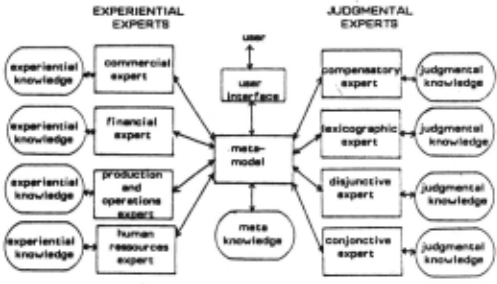
- the experiential experts which infer the weaknesses and strengths of each function or subdomain of the applicant firm and generate "elementary" risk scores:
- the judgmental experts which use multi-attribute information processing models to first aggregate the "elementary" risk scores for each subdomain and then yield an overall risk score for the firm requesting a loan:
- The meta-expert which controls the whole reasoning process.
In its curent form. CREDEX contains four independent. experiential experts corresponding to the commercial. production and operations. human resources and financial functions. respectively. To shorten the interactive process with the user. the meta-expert requests only basic information about the company. More specific information is asked by each experiental expert whenever needed in the reasoning process.
Ill UNCERTAINTY HANDLING
Contrary to MYCIN-Iike systems where certainty factors are used. uncertainty is formalized in CREDEX as a degree of risk measured on a five-point inter val scale (very high. high. average. low. very low). As indicated earlier. loan officers find it difficult to give certainty factors as well as other types of coefficients which have been suggested in the lite rature (e.g. Farreny and Prade 1 986: Shafer 1 976). In CREDEX. the level of risk involved in each loan requested is determined through a multi-step process using the factual information provided by the experi ential experts:
- . Each major function or subdomain j of the company is assigned a weight gj on a seven-:-point interval scale (from "very important" to "not really important"). This weight measures how important the function is perceived to be in making up the overall riskiness of the loan. The gj's are either interactively given by the user or inferred by the meta-model as a function of the bank policy Band the loan officer L: gj · f(B.LJ.
- . Within each function j. weights Wij are assigned to the function's characteristics by the weighting rules of the experiential expert. These weights represent the perceived importance - on a three-point interval scale - of each characteristic in determining Rj. i.e. the partial risk attached to function j.
- Each function can be further broken down in sub functions for which elementary risks rkj can be calculated following the same procedure as above. To illustrate. the commercial function can be de composed into such subfunctions as the products and clients functions. Similarly. each subfunction can be further analyzed at a more detailed level. say. at the level of each product.
IV KNOWLEDGE REPRESENTATION
CREDEX is a rule-based system. It uses SNARK (Lauriere 1 986) as inference engine. The knowledge is represented as first-order predicate logic. The rule bases of each expert are expressed through binary relations of the form R(x)<op>(y). where (x) and (y) are instanciated by the facts of the working memory and then propagated in the conclusions of the rules. This formalism makes the working memory isomorphic to a semantic network where inheritance properties. default values. transitivity are defined by rules. In the work ing memory objects and associations between objects are represented as triples <object relation value> where "relation" and "value" can also be objects. This representation is close to the schema one of SRL (Fox 1984). The simplicity of the representation results in a very high-speed interpreter. Furthermore. SNARK allows metaknowledge primitives to dynamically activate. hold back and examine tasks considered as subsets of rules. Demons can be used to give absolute priority to a task or to divert flow of control when exceptional conditions arise.
A. The Meta-Expert
The meta-expert (Lenat et al 1 983) has been designed to direct the entire problem-solving process. More specifically. it manages the agenda of tasks. creates the data structure used by experts to communicate. interacts with the user and stops the reasoning process whenever the information sought has been obtained. Figure 2 shows part of the semantic network used by experts for exchanging informations. This network involves n registers. one for each function. Each register contains the following relations: weight of the function and a measure of the partial risk attached to it as well as the elementary judgments related to the subfunctions. It is dynamically updated during the reasoning process of the experiential experts and aggregated by the judgmental experts.
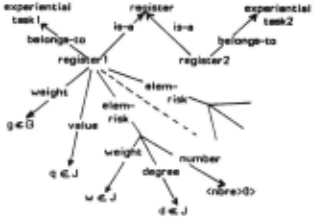
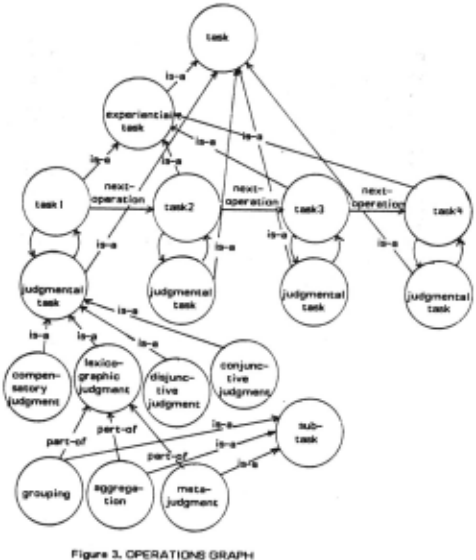
Figure 3 depicts the operations scheduled by the meta-expert using its metaknowledge. Knowledge of the firm's components (functions. subfunctions ... J is represented as a hierarchical structure. The experiential experts and the correspondig tasks are activated on the basis of their weights gj - the most important task being triggered first. The judgmental experts are activated following activation of the corresponding experiential experts. Some of the tasks are decomposed into subtasks to allow focal isation of the reasoning process. The meta-rule which controls the agenda is a "super-demon" which has the top priority whereas the activation/disactivation rule is a local "anti-demon" (Bourgine and Lauriere 1 985). i.e. a rule which is used only when no other task-related rules can be triggered.
B. Experiential Experts
Each experiential expert has its own knowledge base. Its working memory contains the description of the applicant firm's functions in the form of a semantic network. The interesting feature of CREDEX is that it allows to analyze time-varying data over a flexible period of time. For example. the financial ratio debt/sales called FF/CAHT is represented as:
(FF/CAHT (IS-A RATIO) (WEIGHT IMPORTANT) (VALUE $001) (VALUE $0021 (INCREASE $003) (EVOLUTION $004)($001 (DATE t1) (VAL v1)
($002 (DATE t2l (VAL v2l
($003 (VAL a%) (START-TIME t1l (END-TIME t2ll
($004 (TREND UP) (START-TIME t1l (END-TIME t2lll
Four different kind of rules are used: a) weighting rules: b) computation rules for deriving numerical values: c) temporal rules for inferring the evolution of the firm performance ratios: and d) assessment rules for arriving at the firm's strengths and weaknesses.
C. Judgmental Experts
The judgmental experts combine the elementary risk scores rkj to yield a partial risk for each func tion. and then an overall risk. In CREDEX. four types of judgmental experts are available to the meta-expert to select from. They are the linear additive model. the lexicographic model. the conjunctive model. and the disjunctive model. · These models have received the most attention in the psychological literature on decision theory. attitude formation and clinical judgment (Hogarth. 1980). Each model implies a completely different evaluation process:
- In a linear additive model. weights are assigned to the importance of each attribute and ratings assigned to the entity under study according to how satisfactorily it possesses this attribute. All the attribute values are collapsed into a single score by some additive weighting function.
- The lexicographic model assumes that the analyst considers the attributes in a sequential fashion. The attributes are first ordered in importance. The analyst first looks at the most important attribute. If he/she cannot reach a conclusion. he/she considers the second most important attribute. and so on.
- . The disjunctive model is called a maximum .evalu ation function since the entity is judged on its best ability. regardless of its other attributes. In other words. the evaluation of an entity depends on its maximum attribute value. Applied to risk analysis. the model would mean that the evaluation is completed as soon as a very low level of partial risk is inferred.
- The idea behind the conjunctive model is that a loan. so as to be accepted. must have a certain maximum value on each relevant attribute. This implies a multiple cutoff procedure and a dichotomy between acceptable and non-acceptable loans on all attributes. In order to obtain a degree of risk. it is necessary to combine the conjunctive model with the I inear weighting model.
Psychological research on usage of these different information processing models suggests the existence of task and individual difference factors (Bettman 1 g79; Hogarth 1 980) such as time pressure. task familiarity. reliability of data. amount of information available. In the current version of CREDEX. the meta-expert chooses among the four information processing models on the basis of the following criteria: amount of money requested. reliability of data available and familiarity with the applicant firm. More research on this is under way.
V CONCLUSION
CREDEX exhibits a way of providing a flexible control over the management of different kinds of experts that embody the diverse types of knowledge about financial risk evaluation problems. With the meta expert. numerous control strategies. obtained from different analysts or banks. can be integrated into a single system. The concept of phased evaluation strategy as well as the use of multi-attribute infor mation processing models allow to handle uncertain ty and ' contradictory data for risk assessment in a completely declarative way. Future work will include efforts to generalize the analysis on time varying data. Also under scrutiny are top-level control strategies with respect to exactly when to use each of the judgmental experts. It is a difficult problem since it involves the question of which information processing strategies are actually used rather than reported - by individuals when confronted with eva luation tasks. Empirical research on this issue is sparse. and more theoretical work is obviously called for.
- Aucoin. M .. and B. Micha. "Systeme Expert pour I'Aide au Diagnostic d'Entreprise" In Colloque SIAD 85. AFCET. Paris. Oct. 1g95, pp. 7g-99.
- 2 Bettman. J.R .. An Information Processing Theory of Consumer Choice. Reading. MA: Addison-Wesley. 1979.
- 3 Bourgine. P .. and J.L. Lauriere. "Mise sous Forme Declarative du Logiciel ALICE a I'Aide du Moteur d'lnference SNARK". Publication 58. LAFDRIA. Universite Paris VI. 1985. pp. 153-166.
- 4 Brehmer. B.. H. Jungermann. P. Laurens. and G. Seven. New Directions in Research on Decision Making. Amsterdam: North Holland. 1ga6.
- 5 Buchanan. B.G .. and E.H. Shortliffe. Rule-Based Expert Systems: the MYCIN Experiments of the Stanford Heuristic Programming Project. Reading. MA: Addison-Wesley. 1984.
- 6 Chandrasekaran. B.. and S. Mittel. "Deep versus Compiled Knowledge Approaches to Diagnostic Problem-Solving" In Coombs (ed). Developments in Expert Systems. Academic Press. 1 984. pp. 23-34.
- 7 Dude. R.D .. and R. Reboh. "AI and Decision-Making: the PROSPECTOR Experience" In W. Reitman (ed). Artificial Intelligence Applications for Business. Norwood. N.J.: Ablex Publishing. 1984. pp. 111-147.
- B Dungan. C .. "A Model of an Audit Judgment in the Form of an Expert system". Ph. D. Dissertation. University of Illinois. 1983.
- 9 Einhorn. H.J.. and R.M. Hogarth. "Behavorial Decision Theory : Processes of Judgment and Choice". Annual Rev iew of Psychology. 32. 1981.
- 10 Farreny. H.. and H. Prada. "Default and Inexact Reasoning with Possibility Degrees". IEEE Trans. on systems. Man and Cybernetics. 1986.
- 11 Fink. P.. "Control and Integration of Diverse Knowledge in a Diagnostic Expert System" In Proc. IJCAJ-85. Los Angeles. 1985. pp. 426-431.
- 12 Fox. M.S.. "Knowledge Representation for Deci sion Support". in Methlie and Sprague (eds). Know ledge Representation for Decision Support syStBriis. Amsterdam: North-Holland. 1984. pp. 3-26.
- 13 Friis. M.W ·· "Artificial Intelligence Systems: Some Banks Have Them. Other Will". ABA Banking Journal. 77: 6. June 1985. pp. 203-208.
- 14 Hart. P.E.. "Financial Expert Systems" In Proc. AAAI-86. Philadelphia. August 1986. p. 1150.
- 15 Hogarth. R.M.. Judgment and Choice: the Psy chology of Decision. Chichester: John Wiley & Sons. 1980.
- 16 Hwang. C.L.. and K. Yoon. Multiple Attribute Decision-Making. Methods and Application. Berlin: Springer-Verlag. 1981.
- 17 Kahneman. D .. P. Slavic. and A. Tversky. Judgment under Uncertainty: Heuristics and Biases. New York: Cambridge University Press. 1982.
- 1 B Kerschberg. L.. and J. Dickinson. "FINE X. an Expert Support System for Financial Analysis" In Proc. 5th Intern. Worshop on Expert Systems and Their Applications. Avignon. France 1985. pp. 9 1 9-942.
- 19 Lauriere. J.L.. "SNARK. a Language to Repre sent Declarative Knowledge and an Inference Engine which Uses Heuristics" In Proc. IFIF-86. pp. 811-816
- 20 Lenat. 0.. R. Davis. J. Doyle. M. Genesereth. I. Goldstein. and H. Schrobe. "Reasoning about Reasoning" In Hayes-Roth F.. D.A. Waterman. and D.B. Lenat (eds). Building Expert systems. Reading. MA: Addison-Wesley. pp. 219-239.
- 21 Michaelsen. R.H .. "A Knowledge-Based System for Individual Income and Transfer Tax Planning". Ph.D. Dissertation. University of Illinois. 1982.
- 22 Nisbett. R.E.. and L. Ross. Human Inference Strategies and Shortcomings in Social Judgment. Englewood Cliffs. N.J.: Prentice-Hall. 1980.
- 23 Reboh. R .. and T. Risch. "SYNTELL-TM: Know ledge Programming Using Functional Representation". In Proc. AAAI-86. Philadelphia. August 1 986. pp. 1 003-1 007.
- 24 Shafer G .. A Mathematical Theory of Evidence. Princeton: Princeton University Press. 1976.
@inproceedings{ijcai1987p116,
  title     = {A Multi-Attribute Approach to Knowledge Representation for Loan Granting},
  author    = {Pinson, Suzanne},
  booktitle = {Proceedings of the Tenth International Joint Conference on
               Artificial Intelligence, {IJCAI-87}},
  publisher = {International Joint Conferences on Artificial Intelligence},
  editor    = {John McDermott},
  pages     = {588--590},
  year      = {1987},
  note      = {Knowledge Representation},
  url       = {https://ijcai.org/proceedings/1987/116},
}
TY - CPAPER TI - A Multi-Attribute Approach to Knowledge Representation for Loan Granting AU - Pinson, Suzanne T2 - Proceedings of the Tenth International Joint Conference on Artificial Intelligence, IJCAI-87 PB - International Joint Conferences on Artificial Intelligence PY - 1987 SP - 588 EP - 590 UR - https://ijcai.org/proceedings/1987/116 ER -Copied
Machine-readable versions of this paper, for tools and AI agents:





