
Repair Strategies in a Diagnostic Expert System
Proceedings of the Tenth International Joint Conference on Artificial Intelligence. Knowledge Representation. Pages 531-533.
© 1987 International Joint Conferences on Artificial Intelligence
Abstract
Successful machine diagnosis consists not only of sound diagnostic reasoning, but also the selection of appropriate repairs, sequencing the repairs correctly, interactively validating the success of each repair, and performing follow-on diagnosis in case of repair failure. We discuss some of the issues involved In formulating a repair strategy for an expert system, review some aspects of expert human behavior with respect to repair strategy In a complex domain, and finally describe an Implementation of a repair strategy in the TEST diagnostic shell.
- Ali, M., D. A. Scharnhorst. Sensor-based Fault Diagnosis in a Flight Expert System. In Proceedings of the Second Conference on AI Applications. 1985.
- Bennett 81
- Bennett, J.S. DART: An Expert System for Computer Fault Diagnosis. In Proceedings IJCAI-81. 1981 .
- Bylander 83
- Bylander, T., S. Mittal, B. Chandrasekaran. CSRL: A Language for Expert Systems for Diagnosis. In Proceedings IJCAI-83. 1983. IJCAI
- Clancey
- Clancey, W. Details of the Revised Therapy Algorithm. In Buchanan, B.G., Shortliffe, E.H. (editor), Rule Based Expert Systems. Addison Wesley, 1984.
- Fink 84
- Fink, P.K., J.C. Lusth, J.W. Duran. A General Expert System Design for Diagnostic Problem Solving. In IEEE Workshop on Principles of Knowledge Based Systems. 1984.
- Hofmann 86)
- Hofmann, M., J. Caviedes, J. Bourne, G. Beale, A. Brodersen. Building Expert Systems for Repair Domains. Expert Systems 3(1 ):4-11 , January, 1986.
- Kahn, G. MUD, a drilling fluids consultant. Technical Report, Dept. of Computer Science, Carnegie-Mellon University, 1985.
- Kahn 87a)
- Kahn, G., A. Kepner, J. Pepper. TEST, a Model-Driven Application Shell. In Proceedings AAAI-87. 1987.
- Kahn 87b) Kahn, G. S. From Application Shell to Knowledge Acquisition System. In Proceedings IJCAI-87. 1987. IJCAI
- Maletz, M. C. An Architecture for Consideration of Multiple Faults. In Proceedings of the Second Conference on AI Applications. 1985.
- Pepper, J. and G. Kahn. Knowledge Craft: an Environment for Rapid Prototyping of Expert Systems. In Proceedings of the SME Conference on AI for the Automotive Industry. March, 1986.
- Pepper, J., D. Mullins. Artificial Intelligence Applied to Audio Systems Diagnosis. In Proceedings of the tnt'/ Congress on Transportation Electronics. 1986.
- Strandberg 85
- Strandberg, C., I. Abrarnovich, D. Mitchell, K. Prill. Page-1: A Troubleshooting Aid for Nonimpact Page Printing Systems. In Proceedings of the Second Conference on AI Applications. 1985.
- Tedesco 86
- Tedesco, L. S. Service Bay Diagnostic System. In Proceedings of the International Congress on Transportation Electronics. 1986.
References were extracted automatically from the PDF and may contain errors.
Full text extracted automatically from the PDF; figures, tables and equations may differ. The PDF is the version of record.
1. INTRODUCTION
Diagnostic applications remain the most heavily explored area of expert systems technology, but little attention has been given to the selection, sequencing and interactive verification of repairs. These aspects of diagnostic behavior, collectively referred to in this paper as repair strategy, are critical to the success of a real world machine diagnosis expert system.
Typically, repair strategy is seen as a straightforward selection keyed to a successful diagnostic conclusion ([Bennett 81, Bylander 83, Fink 84, Ali 85, Maletz 85, Strandberg 85] and others). In a few cases, supplementary repair or treatment modules have been developed to provide customized or special case recommendations [Clancey 84, Kahn 85]. However, apart from possibly [Hofmann 86), none of this work has attempted to formulate an approach which permits the degree of integration of diagnosis and repair tasks required to effectively troubleshoot faults in complex machines.
TEST (Troubleshooting Expert System Tool), as reported in this paper, recognizes a larger class of integration issues than earlier work, and provides a representation more easily customized to differences in repair strategy, even within the same application domain. TEST is an application independent diagnostic problem-solver which operates on domain-specific knowledge bases. Work on TEST began late in 1985, and there are now several applications in progress, the largest being Ford Motor Company's Service Bay Diagnostic System [Tedesco 86]. Other applications include factory floor machine diagnosis, online diagnosis. And third, the ~iagnosis addre~se~ by t~e repair may be incorrect. Th1s last reason, m1sd1agnos1s, can result from errors in domain knowledge or faulty evidence gained during diagnosis. Or a diagnosis may be partially correct, but the effectiveness of the repair masked by co-occurring problems that have yet to be identified. Until all causes for the failu~e are identified and repaired, the UUT remains in a failed condition.
Hypothesized diagnosis. Sometimes repairs are made on the basis of a hypothesized diagnosis, because it is difficult or impossible to acquire direct confirming evidence. The hypothesized diagnosis is then confirmed by the repair itself, or discarded in favor of a new diagnosis. For example, one car diagnosis heuristic states that "to fix certain fuel pressure problems, replace the fuel pump. Afterwards, do a fuel pressure test, and if the test fails, conclude a bad fuel pressure regulator'. In this example, the conclusion is hypothesized, then either confirmed or replaced by another conclusion as a result of evidence obtained during the repair.
A hypothesized diagnosis can also result from a repair in cases where a previously confirmed diagnosis is proven to be correct but inadequate. As an example, another car repair heuristic states that "for a no-start, if you find that the battery posts are corroded but cleaning the posts does not solve the problem, it must be due to a fault in the charging system". In this case, the correct repair was made for a properly diagnosed condition, but performing the repair revealed that the condition was not severe enough to cause the problem.
3. TEST'S REPAIR STRATEGY
Because the repair strategies discussed in the previous section are an integral part of human expert diagnostic behavior, it is desirable to include similar capabilities in .expert systems. In this section we provide an overview of TEST, and discuss its repair stratgies in detail. (More complete discussions of the TEST architecture are given in [Kahn 87a], [Kahn 87b], and [Pepper 86b].)
3.1. Overview of TEST
TEST provides a domain-independent problem solver, together with a library of schematic prototypes which constitute the structure within which domain specific knowledge bases must be built. A TEST knowledge base consists of a highly interconnected network of schemata, each of which is an instance of a schematic prototype.
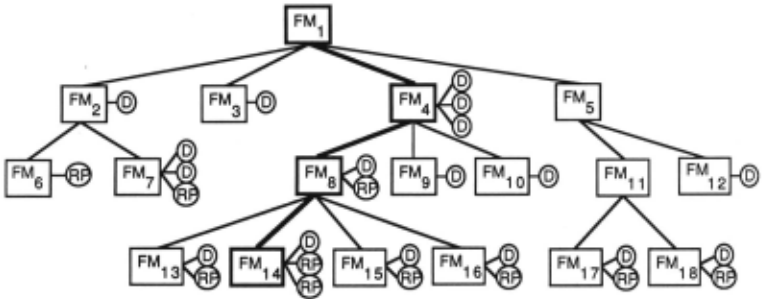
Failure-mode is the most important schematic prototype. Each failure-mode represents a deviation of the UUT from its standard of correct performance. The failure-modes in a knowledge base are linked in a hierarchy ranging from top-level failure-modes called concerns through intermediate-level failure-modes down to leaf-level failure-modes (see Figure 1 ). Typically intermediate-level failure-modes are functional or subsystem faults, and leaf-level failure-modes are component faults. Failure-modes are interconnected via due-to and always-leads-to relations. Domain information which affects the behavior of the diagnostic interpreter or the repair strategy is attached as slot values to failure-modes, or other schemata as appropriate.
In addition to failure-modes, the knowledge base contains datum schemata which represent evidence collection actions such as tests, questions and sensor data acquisition functions. Failure-modes are linked to datums by has-tests relations, with meta-information attached to the relation indicating how · evidence acquired from the datum(s) is used to confirm/disconfirm the failure-mode. Mechanisms exist to disjunctively and conjunctively combine datums. There are also schemata to represent repairs, documentation, exception conditions, and many other kinds of supporting Information.
The TEST problem-solver begins by focusing on an observed or suspected failure-mode. If the failure-mode has occurred or if its status remains unknown, its possible causes are Investigated to see if they have occurred. The search process is guided by an underlying representation of the order in which diagnostic experts explore possible causes for ide~tified failure-modes. Heuristic rules can be inserted 1n the knowledge base to modify search behavior as runtime information is acquired. Diagnosis proceeds until a leaf failure-mode is confirmed, and control is passed to the repair strategy.
3.2. TEST's repair strategy
TEST queues all confirmed failure-modes that require repair, and by default, repairs them in the reverse order that they are identified. Thus, lower-level, component failures are generally repaired before the higher-level conditions they caused.
Repairs are attached to failure-modes via a has-repairs relation. If a failure-mode has links to multiple repairs, they are ordered from most desireable to least according to a domain expert's prior judgement. This ordering Incorporates possible tradeoffs between cost and goodness of repair. If the ordering is dependent on runtime Information or UUT configuration, this is represented by reorder rules which attach to the has-repairs relation and dynamically modify the ordering if their conditions are met.
Once a repair is selected, the repair strategy module leads the technician through the steps of the repair and its subsequent validation. Validation generally consists of checking two failure-modes - the failure which has the repair attached to it and the original concern that triggered the diagnosis -to see whether they still occur.
After performing a repair and validation, the repair strategy selects one of four different sub-strategies, according to an algorithm shown below. TEST follows the selected sub-strategy, modified as necessary to reflect domain-specific exception information provided in the knowledge base.
IF leaf failure-mode has a direct test THEN IF leaf failure-mode is still bad THEN sub-strategy · BAD REPAIR ELSE IF the original concern is fixed THEN sub-strategy · SUCCESS ELSE sub-strategy · MISDIAGNOSIS ELSE {no direct teat for leaf failure-mode} IF original concern is fixed THEN sub-strategy · SUCCESS ELSE sub-strategy · UNKNOWN PROBLEM
The first sub-strategy is for a known bad repair, one which fails to fix the failure-mode directly associated with it. The follow-on diagnostic issues are trivial in this case. TEST knows that regardless of the status of the original concern the leaf failure-mode is still broken. The technician is instructed to check that the replacement parts are good, that they are the proper parts called for by the repair schema, and that they are installed correctly. If the repair still fails, TEST tries to prescribe an alternate repair. If that fails, TEST presumes an error in the knowledge base, either the wrong repair associated with the leaf failure-mode or the wrong method for confirming the failure, and halts.
In the second sub-strategy, success, the repair has fixed the original concern. This is the desired outcome, and causes the repair strategy to halt. Note that the repair strategy does not differentiate between situations where (1) both the leaf failure-mode and the original concern are known to be fixed, and (2) the status of the leaf failure-mode Is unknown (eg., not directly testable) but the concern is known to be fixed. This models a heuristic provided by human experts: if the UUT is broken before performing the repair and works afterwards, one can reasonably conclude that the repair fixed all the causes of the original problem.
In the third sub-strategy, misdiagnosis, the repair fixed the leaf failure-mode, but did not fix the original concern. As discussed earlier, this can result from a domain knowledge error, other co-occuring problems or diagnostic reasoning based on faulty evidence. Si~ce TEST cannot tell if its own knowledge base is in error, it adopts a strategy to discover co-occurring problems if any, and also verify the evidence gained during the first diagnostic pass.
The last sub-strategy, the unknown problem or "broken black box", is the most difficult. A repair has been made, but the original concern Is not fixed and there is no direct test for the repaired component. Thus it Is Impossible to tell If the repair was ·performed correctly, or to confirm the cau~al relation between the component repaired and the original concern. Further, the repair may have succeeded but its success masked by additional co-occuring failures. For this case; TEST uses a heuristic from the automotive domain which states "if you do something to fix a black box and it doesn't work, repeat the repair before trying anything else." This approach is not entirely satisfying, and clearly has the potential for incurring needless expense in certain cases. But human experts consistently preferred to simply repeat the repair before taking the trouble to go back and verify the diagnosis.
At the completion of any of these four sub-strategies, TEST moves on to repair the next known failure-mode in a similar manner.
3.3. Customizing TEST's repair strategy
The repair strategies as described above may be modified or overridden by specifying exception Information in the knowledge base. Exception information is used to modify how a repair's success is verified, how follow-on diagnosis is performed subsequent to repair failure, and the sequencing of multiple repairs.
Verification. As noted earlier, TEST generally verifies repair by checking for the occurrence of two failure-modes: the leaf node directly associated with the repair, and the original concern. But there may be domain-specific reasons to check additional failure modes, either on the causal chain connecting the two or outside it. Certain repairs may have possible negative side-effects, or certain intermediate failure-modes may have cheap, accurate tests which are more desireable than rechecking the original concern. In other cases, repairs may be trivial and it may be unnecessary to verify them afterwards. TEST provides mechanisms for representing all these exceptions, and for modifying the repair strategy's behavior accordingly.
Alternative diagnosis. If a repair fails, the default strategies described in section 3 can be modified to prune search in domain-specific ways. A domain expert can indicate certain conclusions that can be automatically drawn from specific tests performed as follow-up to a repair (eg, "if there is no leak in the primary vacuum chamber, and if after replacing the vacuum pump the result of the vacuum test is FAIL, then conclude a leak in the secondary vacuum chamber'1. A domain expert can also modify TEST's rather simplistic default behavior of clearing the knowledge base of all evidence after a repair, by specifying which kinds of evidence are likely to be unaffected by certain changes in the UUT's state.
Sequencing. As noted earlier, the default behavior is for TEST to repair failure-modes in the reverse order that they were confirmed. This can be overridden in cases where a repair is needed in order to continue with diagnosis (eg., an empty radiator must be refilled to locate a leak).
4. CONCLUSIONS
We have shown that a diagnostic expert system can be made significantly more powerful by extending its capabilities into the process of repair selection, sequencing and verification. TEST's repair strategy is a step in that direction. It provides mechanisms in the diagnostic problem-solver for performing default repair strategies, and provides a schematic representation model which permits modification of the repair strategy in domain-specific ways.
TEST succeeds in capturing much of the repair behavior of expert technicians, but it is limited in several ways. Since its knowledge is based on a troubleshooting model, it lacks understanding of the deep structure of the UUT and cannot predict how a repair will affect the reliability of evidence gained prior to that repair, nor can it reason about likely side-effects of repairs. TEST does not currently support temporal representation of evidence, hence it cannot represent or reason about changes to test results or failure-modes over time. And we have not yet fully integrated the repair strategy with TESTs belief maintenance and explanation facilities. As TEST matures with field experience, we expect to correct these problems as required by the user community.
We have only begun to understand the Issues of integrating repair strategy with diagnostic reasoning. We are continuing to refine our model . of repair behavior, and look forward to the eventual emergence of a sound theory of repair strategy In troubleshooting expert systems.
@inproceedings{ijcai1987p106,
  title     = {Repair Strategies in a Diagnostic Expert System},
  author    = {Pepper, Jeff and Kahn, Gary S.},
  booktitle = {Proceedings of the Tenth International Joint Conference on
               Artificial Intelligence, {IJCAI-87}},
  publisher = {International Joint Conferences on Artificial Intelligence},
  editor    = {John McDermott},
  pages     = {531--533},
  year      = {1987},
  note      = {Knowledge Representation},
  url       = {https://ijcai.org/proceedings/1987/106},
}
TY - CPAPER TI - Repair Strategies in a Diagnostic Expert System AU - Pepper, Jeff AU - Kahn, Gary S. T2 - Proceedings of the Tenth International Joint Conference on Artificial Intelligence, IJCAI-87 PB - International Joint Conferences on Artificial Intelligence PY - 1987 SP - 531 EP - 533 UR - https://ijcai.org/proceedings/1987/106 ER -Copied
Machine-readable versions of this paper, for tools and AI agents:





