
From Application Shell to Knowledge Acquisition System
Proceedings of the Tenth International Joint Conference on Artificial Intelligence. Knowledge Acquisition. Pages 355-357.
© 1987 International Joint Conferences on Artificial Intelligence
Abstract
The TEST (Troubleshooting Expert System Tool) architecture greatly aided the development of TOE:: (TEST Devefopment Environment). In particular, the choice of a schematic as opposed to rule-based representation led to a knowledge base characterized by the use of domain-familiar concepts, and sufficient conceptual structure to facilitate several TOE features, includmg knowledge base development through both directeainterviews and the direct manipulation of icons; multiple knowledge-based browsing strategies; heuristic error analysis; and easily-understood debugging techniques.
- Bennett, James S. "Roget: A Knowledge-Based System for Acquiring the Conceptual Structure of a Diagnostic Expert System". Journal of Automated Reasoning 1(1) (1985).
- Boose, J. Personal Construct Theory and the Transfer of Human Expertise. Proceedings of the National Conference on Artificial Intelligence, Austin, Texas, 1984.
- Clancey, William J. "From Guidon to Neomycin and Heracles in Twenty Short Lessons". AI Magazine 7(3) (Summer 1986).
- Kahn, G.S., Nowlan, S., McDermott, J. MORE: An Intelligent Knowledge Acquisition Tool. Proceedings of International Joint Conference on Artificial Intelligence, 1985.
- Kahn, G.S. TEST: A Model-Driven Application Shell. Proceedings of AAAI-87, 1987.
- Marcus, S., McDermott, J., Wang, J. Knowledge Acquisition for Constructive Systems. Proceedings of International Joint Conference on Artificial Intelligence, 1985. IJCAI
References were extracted automatically from the PDF and may contain errors.
Full text extracted automatically from the PDF; figures, tables and equations may differ. The PDF is the version of record.
1. Introduction
TEST1 (Troubleshooting Expert System Tool) is an application shell, providing a domain-independent diagnostic problem-solver together with a library of schematic prototypes. These prototypes constitute the object types and the structure required b~ each domain specific TEST knowledge base. Several TEST applications, including those aimed at diagnosing engine problems, VAXNMS performance, and factory floor machine failures are currently in development or field test.
Application shells allow developers to focus on knowledge acquisition, rather than on knowledge base design and problem-solving control issues of typically greater complexity. However, it is still a time-consuming process to interv1ew experts and code a knowledge base. For this reason, several systems, including ROGET [11, ETS [21, and more recently, MORE [4], and SALT [6], have looked at ways to interrogate experts under the assumption that a chosen underlying architecture can solve the problems of interest. .
TOE (TEST Development Environment) similarly enables knowled9e engineers and trained domain experts to interactively build knowledge bases that can be used by TEST. TOE provides several advantages in comparison to MORE. In particular, it uses a problem solvmg strategy that is more comprehensible to troubleshooting technicians in the manufacturing and customer serv1ce domains. It also addresses the need for knowledge acquisition systems to conform to the domain expert's desire to provide information as it comes to mind. Lacking this capability, MORE struck users as rigid and tedious in its interrogation technique.
1TEST is an internal name used at Carnegie Group Inc. TEST is implemented in Knowledge Cralttm.
an air conditioner. At the bottom of the hierarchy are failure-modes of individual components, e.g. a broken cooling unit. Intermediate failure-modes typically represent functional failures which are causal consequences of component failures. Many levels of intermediate failure-modes are common.
Failure-modes can be confirmed or rejected based on particular outcomes of tests. ·Tests are distinct nodes in the network. Other conceptual objects within TEST are decision-points, test-procedures{ repair procedures, rules, and parts, among others. 5] Each of these concepts has an obvious mapping into the troubleshooting domain. Rules in TEST represent a variety of contrngent actions rather than evidence/belief propositions alone, as is typical in Mycin-like diagnostic systems.
2.2. Using Direct Manipulation
TOE provides a straightforward mechanism for creating knowledge bases. Within a workbench environment, icons representing TESTs domain-familiar objects are easily moved into a representation of the knowledge base. A failure-mode icon, for instance, may be manually linked to another indicating that it is a cause of the latter problem.
Networks built in this way may also be edited as copy, move, and delete operations are available. Icon placement invokes prompts from TOE for information that requires keyboard entry, such as failure-modes names. Icons representing failure-modes and other key objects are located along the right edge of editing windows [see figure 2-W through which the knowledge base may be viewed. hile experienced users tend to use direct manipulation of graRhic items as the preferred method, novice users of TOE rely heavily on system-directed interrogation techniques, descrrbed further below. Developers may move freely between system- and user-directed modes of operation.
Since the mapping between information provided and the underlying representation is direct, the system avoids the difficult problem of interpreting user intent when a mapping is required between inputs and internal representations. As the objects manrpulated are the very objects that will appear in the knowledge base, there Is similarly no issue of the developer being mystified as to the results of providing information to TOE.
A key problem for direct-manipulation techniques is that of determining and displayin9 relevant objects and object relations in a manner that s focused around the needs of the users task. Within TOE, TEST provides a natural tripartite representational structure for constraining the display and manipulation of the knowledge base.
Primary, secondary, and tertiary information can be distinguished within a TEST knowledge base. The primary core of a TEST knowledge base Is a failure mode tree, as described above. Other secondary information in the knowledge base -- including tests, repairs, and rules associated with the selected failure mOde -· is clustered around each failure-mode. At the tertiary level, each of these objects has itself numerous attributes providing further descriptive and control Information.
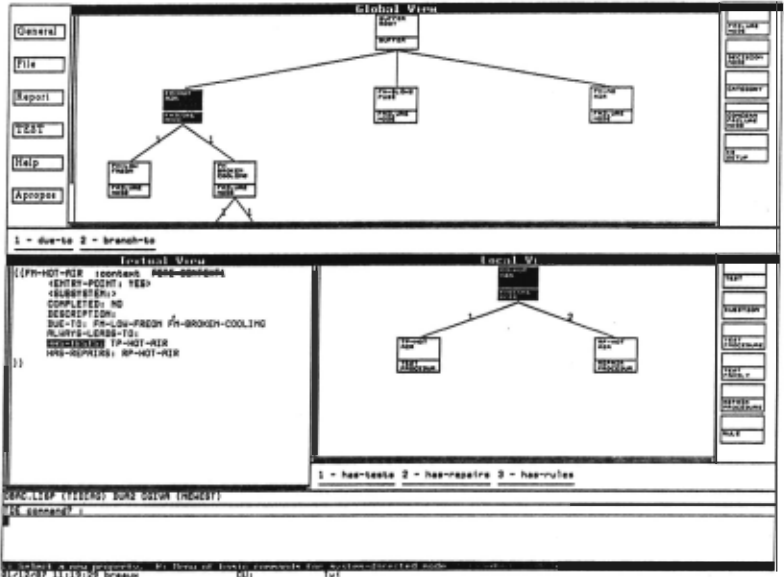
TOE takes advantage of this tripartite division. A global view or window provides a filtered perspective of the knowledge base. Here failure-mOdes and the causal relations between them are displayed. A second window gives the user a local perspective into the secondary nodes clustered around a selected failure mode. Finally, objects selected within these windows can b~ displayed with their full attributive detail in a third window. (See figure 2-1)
Figure 2-1 shows three views into a knowledge base regarding air condition failures. In the global view, the failure-mode hierarchy Is displayed. The hot-air failure-mode is shown to be due-to low-freon or a broken-cooling-unit. The hot-air failure-mode has been selected for further examination. Consequently, secondary information local to it is displayed in the lower rig11t. It is shown to have an associated test: If other secondarv information, such as repairs or rules, had been associated with the failure-mode they would be displayed here as well. All attributes of the selected object are displayed in a structured text-editing window to the lower left. The knowledge base Is extended simply by moving more icons mto the appropriate window and/or by responding to prompts associated w!th attribute fields displayed in the text-editing object w1ndow.
2.3. Guiding Novice Users
TOE also exploits the inherent tripartite structure of a TEST knowledge base to provide guidance to developers. Each perspective delineates a natural line of interrogation. Before asking detailed questions, TOE will first ffesh out the overall structure of the knowledge base as reflected in the global window. It will then seek to fill in detail at the level reflected in the local view. Finally, as necessary, TOE will ~cle through the attribute slots of each object, completing the full picture. For example, TOE would have asked first about potentially observable air conditioner problems that would signify some kind of malfunction. For each of these, it would attempt to find out their possible causes, as they would be considered by a technician engaged in troubleshc;>oting the initial concern. For each of these failure-modes TOE would inquire about associated diagnostic tests and repairs. It would then attempt to get additional attributive information on the reported failure-modes, repairs, and tests, as required.
As information is provided in response to prompts, TOE represents it graphically. Thus, the user can both see the system's interpretation of the information provided and follow the developing context in which further questions are asked.
3. Knowledge-Base Modification
In addition to facilities for building up a knowledge base, as described above, TOE offers further editing support. As developers make enhancements to pre existing systems, they need special tools to help avoid errors wh1ch frequentry lead to flawed knowledge bases. Typical errors include redundancy, incompleteness, and inc:~nsistency. TOE .helps by providing the user with the ab1hty to browse qUickly for mformat1on already in the knowledge base, and by detecting certain kinds of hard or suspected errors.
The explicit representation of causal and classificatory mformation in TEST enables approaches that would be precluded by classical rule-based diagnostic systems.
3.1. Browsing
Object classification, relational networks, and the maintenance of back-pointers within TEST enables multiple search techniques as well as efficient retrieval. As a result, TOE can offer developers string search network browsing, and schematic pattern matching: Browsing facilities, such as these, are required when the user wants to confirm that a new (to be added) failure-mode is not already in the knowledge base, find a similar failure-mode wh1ch can be copied and edited to create the new object, or simply understand the content of what is already there. In a large knowledge base, it is impractical to browse without a means of directing attention to relevant segments of data.
Within TOE, string search is used to match against the names of knowlecge base objects. Search of this kind Is constrained by allowing the user to specify the type (class) of object (failure-mode, test, etc.). Network browsi~ IS used to examine objects within the knowle e base that are in a s ecified relation to a specifl object (e.g. 'has-test 'vo~age-meter) . Pattern matching is used to find objects w1th attribute values specified in the search template. In addition, inverse links maintained in the knowledge base enable TOE to quickly point users to parts of the knowledge base that may be Impacted by their modifications.
3.2. Error Warnings
When developing a knowledge base, the user may unknowingly duplicate a failure-mode by using a different name to refer to one already known. While this can't be entirely prevented, the availability of richly structured information in a TEST knowledge base enables TOE to use heuristics to identify suspects. TOE, for instance, monitors for failure-modes which have similar causes and consequents, or those that share the same test and repair procedure. Isomorphic nodes within the knowledge-base network are typically unexpected and thus constitute grounds for susp1cion.
TOE monitors for several other kinds of errors, as well. Of particular interest are objects that are not properly linked into the knowledge base. In addition, failure-modes without causal, test, or repair information are noticed. Violations of type restrictions associated with the attribute slots of each TEST object are also flagged.
4. Debugging Support
The TEST knowledge base is used directly by the diagnostic problem-solver (the TEST interpreter). As a result, debugging is facilitated. For one, it is easy to move between editing and execution, as it is unnecessary to compile the knowledge base into a special form. Secondly, it is easier to step, trace, modify and explain the program in resP.ect to the use of the knowledge base than it would be 1f compilation into a runtime representation had been required.
In order to ease debugging by non-programmers, the TEST problem-solver 1s designed to use the knowledge base in much the way an informed technician would proceed with fault-Isolation. This again is made possible by structuring problem-solving around the high-order concepts represented in the knowledge base. The troubleshooting task proceeds by focusing on an observed or suspectec::l failure-mode. An attempt is made to determine whether the failure-mode has occurred in the unit under test. If the failure-mode has occurred, or if its status remains unknown, then the possible causes of the failure-mode are investigated to see if they have occurred. The search process is guided by an underlying representation of the order in which diagnostic experts explore possible causes for identified failure-modes. Heuristic rules may be inserted in the knowledge base to modify search behavior as runtime information is acquired.
4.1. Debugging Techniques
In debugging knowled!Je-based systems, it is desirable to have access dunng execution to everything the system has already concluc::led or come to know, as well as to its current hypotheses, planned tests, and queries. This allows the developer to notice when the system failed to conclude inferable information, is preparing to determine needless information, or acted mcorrectly on known information. The TEST interpreter can prov1de this information on demand as the entire knowledge base is at its disposal.
In order to get at information at the right time, it is necessary to allow brea.kpoints at conceptually relevant junctures. Within the TOE environment, it is desirable to pause as !)articular failure-modes become the focus of attention. Since the problem-solver uses the knowledge base directly, developers can set breakpoints simply by toggling desired failure-modes.
5. Conclusion
The TEST architecture greatly aided the development of TOE. In particular, the choice of a schematic as opposed to rule-based representation led to a knowledge base characterized by the use of domain-familiar concepts, and sufficient conceptual structure to facilitate several TOE features. While much of TOE has been implemented, there is still much to do. During its continued development, users will be evaluating evolving prototypes. Because knowledge engineering needs cannot be fully predicted, we expect to learn of many new requirements for TOE and perhaps TEST.
6. Acknowledgments
Edwin H. Breaux, Peter DeKierk, Robert L. Joseph, AI Kepner, and Jeff Pepper contributed to the development of ideas presented in this paper. Many others have also been involved in the implementation of TEST and TOE.
@inproceedings{ijcai1987p73,
  title     = {From Application Shell to Knowledge Acquisition System},
  author    = {Kahn, Gary S.},
  booktitle = {Proceedings of the Tenth International Joint Conference on
               Artificial Intelligence, {IJCAI-87}},
  publisher = {International Joint Conferences on Artificial Intelligence},
  editor    = {John McDermott},
  pages     = {355--357},
  year      = {1987},
  note      = {Knowledge Acquisition},
  url       = {https://ijcai.org/proceedings/1987/73},
}
TY - CPAPER TI - From Application Shell to Knowledge Acquisition System AU - Kahn, Gary S. T2 - Proceedings of the Tenth International Joint Conference on Artificial Intelligence, IJCAI-87 PB - International Joint Conferences on Artificial Intelligence PY - 1987 SP - 355 EP - 357 UR - https://ijcai.org/proceedings/1987/73 ER -Copied
Machine-readable versions of this paper, for tools and AI agents:





