
A Procedural Logic
Proceedings of the Ninth International Joint Conference on Artificial Intelligence. Knowledge Representation. Pages 516-522.
© 1985 International Joint Conferences on Artificial Intelligence
Abstract
Much of our commonsense knowledge about the real world is concerned with the way things are done. This knowledge is often in the form of procedures or sequences of actions for achieving particular goals. In this paper, a formalism is presented for representing such knowledge based on the notion of process. A declarative semantics for the representation is given, which allows a user to state facts about the effects of doing things in the problem domain of interest. An operational semantics is also provided, which shows how this knowledge can be used to achieve given goals or to form intentions regarding their achievement. The formalism also serves as an executable program specification language suitable for constructing complex systems.
- Allen, J . F., "A General Model of Action and Time," Computer Science Report TR 97, University of Rochester, Rochester, New York (1981).
- Allen, J .F., "Maintaining I(nowledge about Tempo- ral Intervals," Comm. ACM, Vol. 26, pp. 832-843 (1983).
- Davidson, D., Actions and Events, Clarendon Press, Oxford (1980} .
- Doyle, J ., "A Truth Maintenance System," Artificial Intelligence Vol. 12, No.3 (1979).
- Fikes, R. E., and Nilsson, N. J., "STRIPS: A New Approach to the Application of Theorem Proving to Problem Solving," Artificial Intelligence Vol. 2, pp. 189-208 (1971}. IJCAI
- Georgeff, M. P. and Bonollo, U., "Procedural Ex- pert Systems," Proceedings of the Eighth Interna- tional Joint Conference on Artificial Intelligence, Karlsruhe, West Germany (1983}.
- Georgeff, M. P., "A Theory of Action for Multia- gent Planning," Proceedinga of the Fourth National Conference on Artificial Intelligence, Austin, Texas {1984).
- Georgeff, M.P. and Lansky, A.L., "Practical Rea- soning Using Procedural I(nowledge," forthcoming Technical Note, Artificial Intelligence Center, SRI International, Menlo Park, California (1985).
- Georgeff, M.P., and Lansky, A.L., "A Procedu- ral Logic: Declarative and Procedural Semantics," forthcoming Technical Note, Artificial Intelligence Center, SRI International, Menlo Park, California (1985) .
- Hendrix, G.G., "Modeling Simultaneous Actions and Continuous Processes," Artificial Intelligence, Vol. 4, pp. 145-180 {1973) .
- Hoare, C.A.R., Brookes, S.D., and Roscoe, A.W. "A Theory of Communicating Sequential Processes," Technical Monograph PRG-16, Oxford University Computing Laboratory, Oxford , England .
- Kowalski , R. , Logic for Problem Solving, No rth Hol- land Publishing Company, New York , New York (1979) .
- McCarthy, J ., "Programs with Common Sense," in Semantic Information Processing, M. Minsky (ed .), MIT Press, Cambridge, Massachusetts (1968}.
- McCarthy, J., and Hayes, P.J., "Some Philosophi- cal Problems from the Standpoint of Artificial In- telligence, in Machine Intelligence 4, pp. 463-502 (1969).
- McDermott , D., "A Temporal Logic for Reason- ing about Plans and Processes," Computer Science Research Report 196, Yale University, New Haven , Connecticut (1981).
- Moore, R.C., "Reasoning about Knowledge and Ac- tion," Technical Note 191, Artificial Intelligence Center, SRI International, Menlo Park, California (1980) . IJCAI
- Nilsson, N.J ., "Triangle Tables: A Proposal for a Robot Programming Language", Technical Note 347, Artificial Intelligence Center, SRI International, Menlo Park, California (1985).
- Rosenschein, S.J., "Plan Synthesis: A Logical Per- spective," Proceedings of the Seventh International Joint Conference on Artificial Intelligence, pp. 331- 337 (1981). IJCAI
- Sacerdoti, E.D. A Structure for Plans and Be- haviour, Elsevier North Holland Publishing Com- pany, New York, New York (1977).
- Stetik, M. "Planning with Constraints," Artificial Intelligence, Vol. 16, pp. 111-140 (1981) .
- Tate, A. "Goal Structure-Capturing the Intent of Plans," Proceeding• of the Sixth European Confer- ence on Artificial Intelligence, pp. 273-276 (1984) .
- Vere, S., "Planning in Time: Windows and Dura- tions for Activities and Goals," Jet Propulsion Lab- oratory, Pasadena, California (1981).
- Wilkins, D.E., "Domain Independent Planning: Representation and Plan Generation," Artificial In- telligence, Vol. 22, pp. 269-301 (1984}.
References were extracted automatically from the PDF and may contain errors.
Full text extracted automatically from the PDF; figures, tables and equations may differ. The PDF is the version of record.
1 Introduction
Active intelligent systems need to be able to represent and reason about actions and how those actions can be com bined to achieve given goals. Much of this knowledge is in the form of sequences of actions or "procedures" for ac complishing these goals. For example, knowledge about kicking a football, performing a certain dance movement, cooking a roast dinner, solving Rubik's cube, or diagnosing an engine malfunction, is primarily procedural in nature.
Within AI, there have been two approaches to the prob lem of action and practical reasoning, with a somewhat poor connection between them. In the first category, there is work on theories of action - i.e., on what constitutes an action per se [1, 10, 15]. This research has focused mainly on problems in natural-language understanding concerned with the meaning of action sentences. Second, there is
· Also affiliated with the Center for the Study of Lancuace and In formation at Stanford Unlveralty.
This research has been made ponlble In part by a clft from the System Development Foundation, by the Office of Naval Research under Contracts N00014-80..C-0296 and N00014-85-C-0251, and by the National Aeronautic· and Space Administration under Contract NAS2-11864. The views and conclusions contained In this paper are those of the authors and should not be interpreted as representative of the official policies, either expressed or implied, of the Office of Naval Research, NASA, or the United States government.
A PROCEDURAL LOGIC
Michael P. Georgeff · Amy L. Lansky Pierre Bessiere
Artificial Intelligence Center SRI International Menlo Park, California
work on planning- i.e., the problem of constructing a plan by searching for a sequence of actions that will yield a given goal [2, 5, 18 - 23]. Surprisingly, almost no work has been done in AI concerning the execution of preformed plans or procedures- yet this is the almost universal way in which humans go about their day-to-day tasks, and probably the only way other creatures do so. To actually search the space of possible future courses of action, which is the ba sis of planning, is relatively rare.
In attacking this problem, we first have to identify what it is that humans or other active systems do when per forming a complex action. We postulate that such sys tems have some representation of a procedure for achieving given goals, or reacting to particular events, and that they can reason about and execute this procedure to achieve their aims. Just as we might view intelligent systems as having "beliefs" about the world, we consider these sys tems to have "procedures" for acting in the world. And, just as for theories of belief, the problem here is to provide abstract models for these "mental entities." We call these abstract models processes.
There are two aims to our work. One is to develop a the ory suitable for building active intelligent agents. In that regard, the theory presented in this paper models only the simplest kind of agent - one with no preserved beliefs and with limited reasoning abilities. We define a declarative semantics for our formalism, as well as an operational se mantics. Together these provide a suitable semantics for simple action sentences in natural language and a method of practical reasoning about how to accomplish given goals.
The other aim is to provide a basis for the design of im proved programming languages- in particular, languages that allow users to represent their knowledge about the behavior of systems declaratively, are amenable to veri fication, and operationally are flexible and responsive to environmental changes. In this sense, our work can be viewed as the basis for executable specification languages.
It is important to point out that the theory presented here is not just another variant of the standard logics for describing dynamic behaviors. In particular, there is no existing logic (temporal, dynamic or interval-based) known to us that can both (I) express the same complexity of action as the formalism proposed here (which can handle sequencing, conditional selection, nondeterministic choice, iteration, and hierarchical abstraction), and (2) be used to automatically generate behaviors for achieving goals and to form plans. In this sense, the approach here offers the same kind of advantages as Prolog, but in a dynamic rather than static domain: it can be viewed as a logic describing properties of behaviors, or it can be used as a programming language for generating behaviors to achieve given goals.
Furthermore, the model we use is based on nondeter ministic procedures. This nondeterminism is essential for providing the kind of flexibility exhibited by intelligent sys· tems. The model also allows for action failures and tests with side effects, both of which are necessary for handling most real-world domains. Such a model would be very cumbersome to describe in any of the standard temporal or dynamic logics - indeed, we know of none that have attempted to do so.
A system based on the proposed representation has been implemented and is currently being used for an intelligent robot and for fault isolation and diagnosis on the space shuttle. An early version of an implemented system is de scribed in Georgeff and Bonollo [6] and the latest work in Georgelf and Lansky [8]. The more recent work includes many capabilities not decribed in this paper, including a database of preserved "beliefs" and more powerful reason· ing abilities represented as metalevel processes.
2 Processes and Actions
Most previous work in representing actions has been based on state change models [5, 13, 18] . However, existing mod· els can describe only a limited class of actions and are too weak to be used in dealing with multiagent or dynamic worlds.
Some attempts have recently been made to provide a better underlying theory for actions. McDermott [15] con· siders an action or event to be a set of sequences of states, and describes a temporal logic for reasoning about such actions and events. Allen [1] also considers an action to be a set of sequences of states, and specifies an action by de· scribing the relat.ion;;hips among the intervals over which the action's conditions and effects are assumed to hold. However, while it is possible to state arbitrary properties of actions and events, it is not obvious how one could use these logics to achieve, or form intentions to achieve, one's goals. 1
Our notion of action is essentially the same as that of McDermott and Allen; namely, we consider actions to be sets of sequences of world states. However, in modeling in telligent agents, it is convenient to consider not only states of the external world, but also various "mental entities," such as beliefs, goals and intentions. In the same way, it is important to be able to model not only the actions that oc cur in the real world, but the internal mental "procedures" that agents use to generate their external behaviors. We will call these entities processes (see [7] and, for some early work based on similar ideas, [10]}.
1 Allen ]2] proposes a method of forming plans that is based on his representation of actions. However, he does not use the temporal logic directly, and actions are restricted to a particularly simple form (e.g., they do not include conditionals).
We assume that, at any given instant, the world is in a particular world state. A process is some abstract mecha nism that can be executed to generate a sequence of world states, called a behavior of the process. The set of all be haviors of a process constitutes the action (or action type) generated by the process. In this paper we restrict our attention to sequential (nonconcurrent) processes.
Each process is modeled by a labeled transition network, with distinguished start and finish nodes. The nodes of the network are called control points, and are labeled with state conditions. These conditions can be viewed as rep resenting constraints on possible world states. Each arc of the network is labeled by a goal, which can be considered to represent a particular type of behavior to be achieved. 2 Associated with each network is a purpose, which is the goal that will be achieved if the process is successfully ex ecuted.
A process is executed in the following manner. At any moment during execution, the process is at a given control point c. An outgoing arc a may be traversed if ( 1) the cur rent state of the world satisfies the state condition labeling c and (2) the goal labeling a is successfully achieved. If no outgoing arc from c can be traversed, process execution fails. Execution begins with control at the initial control point and succeeds if control reaches the final control point.
In some ways, a process may be viewed as just a con venient way of specifying actions. However, processes also allow us to make a distinction that is critical for practi cal reasoning - we can distinguish between behaviors that are successful executions of the process and those that are unsuccessful (or have failed) . Since actions often fail to achieve their intended goals, it is important to be able to reason explicitly about the consequences of action failure. We thus need t.o be able to represent the behaviors that correspond to failed actions as well as successful ones. This is particulary important if the model is to be extended to handle multiagent and dynamic environments (e.g., see [11]). Similal'iy, in natural-language understanding, it is important to have a denotation for action sentences (such as "he was painting a picture") that allows for action fail ure, even in mid-performance ("he was painting a picture when kilbl by light.uinl{" ).
The notion of action failure also allows us to represent
2 In Section 6 we show how a goal to achieve a given state can be represented as a type of behavior.
PURPOSE: (KILL $PERSON)
tests on world states as actions, without the introduction of knowledge or belief structures (cf. [16]). To test whether a particular condition is true, one need simply perform an action that can only succeed when the condition is in· deed true. (Of course, action failure cannot, in general, be equated with the falsity of the condition being tested.)
3 Process Descriptions
In this section we develop a formalism for describing pro· ceases and for reasoning about the behaviors they generate. Each process description consists of a purpose description and a body. The body is a network isomorphic to the net· work of the described process. The state conditions label· ing the control points of the underlying process are mod· eled by expressions which have as their denotation world states; the goals labeling the arcs of the underlying process are modeled by expressions whose denotations are behav· iors (sequences of world states). The purpose description also denotes a set of behaviors.
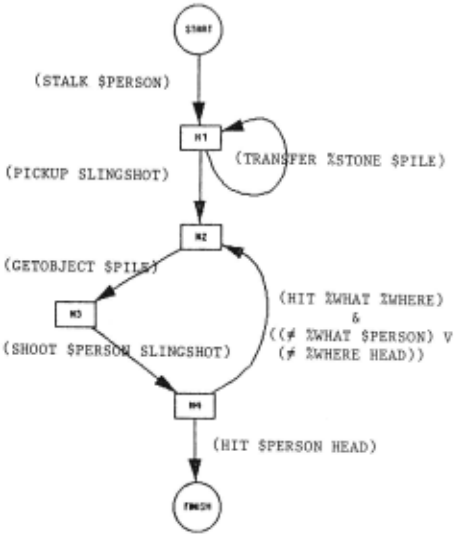
A typical process description using the formalism is shown in Figure l. It describes a procedure for killing someone with a slingshot.
The process involves gathering stones, placing them in a pile, getting a slingshot, and then repeatedly taking up a stone and shooting it until the foe ($person) is hit on the head. In this particular domain, hitting someone on the head with a stone hurled by a slingshot always results in that person's death. The procedure is nondeterminis tic and allows agents to gather as many stones as they wish, limited only by their ability to continue gathering them. The procedure is not guaranteed to be successful - it may fail if any one of the actions labeling the arcs of the network fails. However, if there are only a finite num ber of gatherable stones, the procedure is guaranteed to terminate.
It is important to note how the process description cap tures implicit knowledge of the problem domain. This knowledge is of two kinds: one concerning the validity of the killing procedure, the other heuristic. For exam ple, hitting a person on the head with an object propelled from a slingshot will not always kill them (e.g., if it's a cotton ball), but will if it's a stone (in this particular do main). Thus, the validity of the conclusion depends criti cally on the first part of the procedure, which ensures that only stones are placed in the pile. (Strictly, the proce dure should also ensure that the pile is initially empty or contains nothing but stones.)
The procedure also captures heuristic knowledge in that earlier actions may make subsequent actions more likely to succeed. For example, the slingshot may require a certain size and weight of stone; however, instead of this being represented as an explicit precondition of the shooting ac tion, it is represented implicitly by the context established by the procedure. In this case, the assumption is that any stone that can possibly be gathered will most likely pos sess the appropriate characteristics. Note that this does not affect the validity of the procedure; if a stone does not have the necessary properties, the action of shooting the slingshot will fail.
We now give a definition of the formalism. A process description is a tuple
where
- S is a [possibly infinite] set of state descriptions
- F is a [possibly infinite] set of action descriptions
- N is a set of nodes
- E is a set of arcs
- 6 : N X E -+ N is the process control function
- nr E N is the initial node
- NF C N is a set of final nodes
- C : N -+ S associates a state description with each node
- A : E __. F associates an action description with each arc
- G is an action description called the purpose of the process.
The state descriptions labeling the nodes are called {par tial} correctness assertions; the one labeling the initial node is called the precondition of the process. The action descriptions labeling the arcs are called goal assertions.
We choose predicate calculus as the state description language. A state description can be viewed as denoting a set of states; namely, those in which it is true. We distin guish between local and global variables. Informally, the interpretation of a local variable is fixed in the interval during which a given arc is transitted, but can otherwise vary. A global variable, on the other hand, has a fixed interpretation during the execution of the entire process. (Local variables are needed especially in loops where it is necessary to identify different elements from one iteration to the next) . A state description is any formula in this calculus in which all global variables are free and all local variables are bound. In the example of Figure 1, global variables are prefixed by $ and local variables, assumed to be existentially quantified, by %. All correctness assertions are assumed to be true.
An action description consists of an action predicate ap plied to an n-tuple of terms. Action descriptions denote action types or sets of state sequences. That is, an expres sion like "walk (a, b)" is considered to denote the set of walking actions from point a to b. Any sequence of states satisfies the action description if it is in the set so denoted. In Section 6 we augment the action description language to include various temporal operators.
4 Declarative Semantics
The declarative semantics of process descriptions is in· tended to describe what is true about the underlying sys· tern of processes and the world in which they operate. Such a semantics says nothing about how such knowledge could be used to achieve particular goals - rather, it simply allows one to state facta about certain behaviors.
On an intuitive level, the declarative semantics is straightforward. The intended meaning of a process de· scription P is that every behavior that satisfies the goal and correctness assertions for some path through the net also satisfies the purpose of P. Alternatively, one may view the body of P as denoting a set of behaviors - namely, those that satisfy the goal and correctness assertions for some path through the net. Then the intended meaning of P is that each behavior in the set satisfies the purpoae of P.
Unfortunately, allowing only simple paths through the net will not do. For example, if a node has multiple out going arcs, we need to allow several of these arcs to be tried until one is found successful. This is exactly the sort of behavior required of any useful conditional plan or pro gram; if a test on one branch of a conditional fails (returns false), it is necessary to try other branches of the condi tional. The problem in this case is that an attempted test may change the state of the world. Thus, paths through the network must allow behaviors that explicitly include failed attempts at realizing tests and actions as well as successful ones.
A formal definition of the semantics of process descrip tions is given in [9]; here we will simply give an informal outline. The approach is similar to that used for most temporal logics. We first consider single states. A state s consists of a set of elements from a domain D together with relations and functions defined over these elements. Assuming a fixed interpretation for each constant symbol in the language, a state interpretation I assigns to each variable in the language an element of D, to each n-ary predicate symbol an n-ary relation in D, and to each n adic function symbol an n·adic function in D. The truth value of a state assertion w in a state s with respect to a state interpretation I is defined in the standard way (vari ables ranging over elements of D). We can also view was denoting the set of states in which w is true.
While state interpretations may vary from state to state in the course of a behavior, the interpretation of global variables must remain the same. For a process description P, a global variable assignment a is defined to be an as signment of an element in D to each global variable in P. Similarly, for each arc in P, we have a local variable as signment /3 that associates a value with each local variable used by the goal assertion of that arc. In the course of a behavior satisfying the goal assertion, its local variables may take on at most one value. A state interpretation I is said to be consistent with a given a (or /3) if the assign ment to global (local) variables in I is the same as their assignment in a (/3). Note that we do not require a fixed interpretation for predicate symbols or function symbols over the sequence of states in a behavior. We define a proce11 instance to be a process description together with consistent global and local variable assignments.
Following the discussion above, we consider the set of behaviors denoted by the body of a process instance as falling into either of two classes, one of which we will call the succeBB set of the process instance and the other the failure set. The success set represents all those behaviors that constitute successful executions of the underlying pro cess; the failure set represents all those executions that fail somewhere along the way.
Let P be a set of process instances and let n be a node in a process instance P. An element Q of P is said to be applicable to an arc a emanating from n if its purpose is included in the set of behaviours described by the goal assertion of a.
The allowed behaviors starting at node n are those in which each applicable process instance at n is tried at most once until one succeeds or they all fail. 3 Let succ(n, a) be the set of behaviors consisting of some arbitrary number of unsuccessful attempts by applicable process instances (at most one per process instance) on the arcs emanating from n, followed by a behavior of an applicable process instance that succeeds for some arc a. Each of these at tempts, both successful and unsuccessful, must begin in a state that satisfies the correctness assertion at node n. Similarly, let fail(n) be the set of all behaviors that fail to reach a successor node of n, i.e., behaviors consisting of failed attempts of all applicable processes. In this case, an attempt may fail because it cannot satisfy the correct ness assertion at node n, or because the applicable process instance itself fails .
The success and failure sets for a node n, denoted S(n) and F(n) respectively, are then defined recursively as fol lows: 4
- If n is a final node, then S(n) is the set of states satisfying the correctness assertion at n and F(n) is the set of states that fail to satisfy the correctness assertion at n.
The success and failure sets of a process description P are then taken to be the success and failure sets, respec tively, of the initial node of P. The semantics of P is that any behavior in the success set of P satisfies the purpose of P.
As an example, consider the process networks shown in Figure 2 where the arcs are labeled with applicable process instances. For a process instance P, Jet (P) denote the set of its successful behaviors, and (P)F the set of its failed behaviors. Then the success and failure sets for each of the process networks in Figure 2 are as follows:
5 The decision to try each process instance at most once allow· us to realize the control constructs of standard programming language·; various alternatives are possible without substantially affecting the results presented here.
4 If w, = ,,, ... ,k and w~ = 'k· .. ·'ft· then w,.w~ = ,,, ... ,k-l· Bk, Bk+l, ··· 'ft· This operation is extended to sell of sequences In the usual way. Note 'hat this formulaUon allow· a alngle atate to satisfy a sequence of goals.
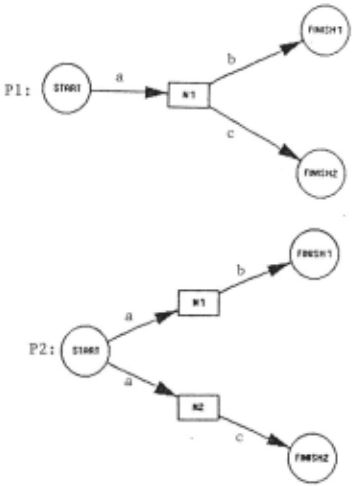
Notice that backtracking upon failure occurs only up to the current node being exited, and no farther.
Because process descriptions can be recursive, and be cause loops in process networks introduce self-reference into the definitions of S and F given above, a formal spec ification of the semantics of process descriptions requires a fixed-point construction. That is, for a given set of process instances P = P1 ··· Pn, we need to define a transforma tion T that maps n-tuples of pairs of success and failure sets into additional such n-tuples. The definition of T is based on the definition of success and failure sets given above. If one assumes a set of primitive tests and actions, the least fixed point of T applied to these primitives can be taken as the denotation of P1 · · · Pn.
5 Operational Semantics
Process descriptions provide a way of describing the effects of actions in some dynamic problem domain. But how can a system or "agent" use this knowledge to achieve its goals? That is, we currently have a knowledge representation that allows us to state certain properties about actions and what behaviors constitute what actions. We have not explained, however, how an agent's wanting something can provide a rationale for or cause an agent to act in a certain way. This is the basis of so-called practical reasoning [3J.
One way to view the causal connection between reason· ing and action is as an interpreter that takes knowledge about actions and goals as input and as a result performs certain acts in the world. An abstract representation of such an interpreter may be considered to be the operational semantics of the knowledge representation language.
If a system is to be able to achieve its goals, it must be able to bring about certain actions, and thus be able to affect the course of behavior. Thus, we assume a system with certain effector capabilities. The actions that the sys· tern can effect simply by choosing to do so will be called primitive actions. The system must also be able to sense the world to the extent of determining the success or fail· ure of the primitive actions. In addition, we assume the system has sensor capabilities for detecting satisfaction of all correctness assertions.
The system tries to achieve its goals by applying the following interpreter to applicable process instances. The interpreter works by exploring paths from a given node n in a process description P in a depth-first manner. To transit an arc, it unifies the corresponding arc assertion with the purposes of the set of all process descriptions, and executes those that unify, one at a time, until one ter· minates satisfactorily. If none of the matching processes terminate successfully, and all leaving arcs fail, the execu tion of P fails . At each node, we verify that the correctness assertion (c-assertion) is satisfied.
function successful (P n) if (is-end-node n) then if (satisfied ( c-assertion n)) then return true else return false else arc-set := (outgoing-arcs n) pr-a-set := (processes-that-unify arc-set) do until (empty pr-a-set) if (not (satisfied (c-assertion n))) then return false pr-a := (randomly-delete pr-a-set) pr := (process pr·a) a := (arc pr·a) if (successful pr (start-node pr)) then return (successful P (terminating-node a)) end-do return false end-functionThe function processes-that-unify takes a set of arcs and returns the set of processes that unify with some arc in the set, along with the specific arc with which each uni fies. The functions process and arc select out the process instance and corresponding arc from each element of this set. The function randomly-delete selects an element from a set, destructively modifying the set as it does so. The order in which selections are made is called the selection rule. The function return returns from the enclosing func tion, not just the enclosing do. The initial system goal is represented by a process description with a single arc labeled with the goal.
Note that, if this theory were to form the basis of the reasoning capabilities of some real-world agent, we would probably want process descriptions to be invoked on the basis of particular facts becoming known as well as be cause particular goals have been established. A suitable organization for such a system would be to have a list of all applicable process descriptions- some goal-invoked and others fact-invoked -and at each stage of processing select one of these for execution [8]. The above recursive imple· mentation would have to be modified, but the semantics would remain essentially the same.
Of course, it is important that the operational and declarative semantics be consistent with each other. The declarative semantics defines a set of behaviors for each process instance. The operational semantics also defines a set of behaviors for each process instance, but this set depends on the selection rule utilized in the above algo· rithm. Let (P)o be the set of successful behaviors for a process instance P as given by the declarative semantics, and let (P)o,n be the set of successful behaviors for P as given by the operational semantics for selection rule R. It is not difficult to show that
This means that any behavior generated by the interpreter given above will satisfy the declarative semantics. How· ever, the inclusion, in general, is strict. That is, the in terpreter may not achieve some given goal even when, ac cording to the declarative semantics, there exists a way to achieve it . But , assuming that all correctness assertions are directly testable, we do have the following:
If a behavior 8 is in (P) 0 , there exists a selection rule R such that 8 is in (P)o,R·
This is the best one can really hope for when any par ticular selection may cause some possibly irreversible ac tion. It means that, provided you are smart enough to choose the right selection rule, the above interpreter will achieve a goal if it is at all achievable. This highlights the importance of reasoning about the selection of applicable processes in any practical implementation (see also [8]). It also means that one can reliably plan to achieve goals and be guaranteed of finding a finite plan if one exists.
6 Action Descriptions
So far, action descriptions have been restricted to simple action predicates. However, it is desirable to also allow a class of action descriptions that relate to conditions on world states.
We thus extend the action description language to in clude actions that achieve a given world state p (repre sented as !p), actions to test for p (?p), and actions that preserve p (#p). We define these action descriptions more formally as follows.
We assume a fixed domain D and a fixed interpretation for constant symbols. Let w be a state assertion, (1 an action description of the above form, and S = s1, ·· · s,. a behavior. Assume fixed global and local variable assign ments and let all local interpretations I be consistent with them. We then have the following truth rules:
- !w is true in S if, for some local interpretation /, w is true in s,. .
- ?w is true in S if, for some local interpretation /, w is true in s1·
- #w is true in S if, for all i, 1 ~ i ~ n, there exist local interpretations Is such that w is true of all states in S or ...,w is true in all states in S.
To make effective use of such action descriptions we can use proof rules of the kind given below. We will use the notation (P) ((1) to mean that every successful behaviour associated with the process description P satisfies the tem poral assertion (1, (P) F denotes failed behaviors. The symbols ";" and "I" represent sequential composition and [nondeterministic] branching, respectively.
Some typical proof rules are as follows:
Conjunctive Testing
Conjunctive Achievement
Disjunctive Testing
Disjunctive Achievement
Note that these proof rules are not the only ones, nor are they the strongest, that could be used. For example, in the rule for conjunctive achievement, we need not require that p be unaffected by (P2}; all we need do is regress the goal !p through (P2} and set this as the goal of (P1}. However, since in most real-world cases it is difficult to regress conditions through processes, the rules given above prove to be most practical.
The declarative semantics with this extension to the lan guage is standard. The operational semantics simply re quires that the interpreter be modified to allow application of the proof rules when necessary.
7 Conclusions
This paper has presented a simple model for action and a means for representing knowledge about procedures. We have indicated the importance of reasoning about processes rather than simply histories· or state sequences. A declara tive semantics for the representation was provided that al lows a user to specify facts about behaviors independently of context. We have also given an operational semantics that shows how these facts can be used by an agent to achieve (or form intentions to achieve) its goals.
This knowledge representation can also be used for plan ning. Indeed, the operators of many standard planning systems (such as NOAH [19], DEVISER [22] and SIPE [23]) can be viewed as restricted forms of process descrip tions. The fact that any behavior allowed by the declar ative semantics can also be found using the operational semantics means that a planning algorithm that tried all possible selection rules would be "complete" - that is, it would find a solution if one existed.
By modifying the formalism so that failure sets allow full backtracking, single-state theorem proving of Horn clauses becomes a special case. This modification would also include as a special case the realization of "backtrack ing through triangle tables," as proposed by Nilsson [17] . However, such modifications present practical problems of verification and efficiency, and would appear useful only in some special cases.
In some ways, the declarative semantics is surprisingly complex and would seem to indicate some undesirable properties of the representation. Most of these difficulties arise from the need to model failed as well as successful be haviors. Of course, if we could fully specify necessary cor rectness conditions independently of context, and test for them, failed behaviors would become irrelevant for practi cal reasoning; we could always test to make sure conditions were true when needed. But experience with programming languages, and indeed the real world, shows that this can often be impractical if not impossible.
The formalism presented here can also be viewed as an executable specification language - that is, as a program· ming language that allows a user to directly describe the behaviors desired of the system being constructed. The fact that the language has a denotational semantics allows facts about the behavior of the system to be independently stated and verified. The operational semantics provides a means for directly executing these specifications to obtain the desired behavior. In this sense the language has much in common with Prolog, except that it applies to dynamic domains instead of static domains.
The system modeled in this paper has no database, and thus no storage for knowledge or beliefs. We have a practical implementation of a system that includes such a database, but have yet to formalize it. This introduces all the standard planning issues, such as the frame prob lem [14] and consistency maintenance [4]. We also need to investigate concurrency, and extend the model to deal with it. The notion of process failure and correctness assertions play a particularly important part when multiple agents or dynamic environments are allowed, and bear some rela tionship to formalisms for concurrent program verification. Some work in this direction is described by Georgeff [7].
@inproceedings{ijcai1985p99,
  title     = {A Procedural Logic},
  author    = {Georgeff, Michael P. and Lansky, Amy L. and Bessière, Pierre},
  booktitle = {Proceedings of the Ninth International Joint Conference on
               Artificial Intelligence, {IJCAI-85}},
  publisher = {International Joint Conferences on Artificial Intelligence},
  editor    = {Aravind Joshi},
  pages     = {516--522},
  year      = {1985},
  note      = {Knowledge Representation},
  url       = {https://ijcai.org/proceedings/1985/99},
}
TY - CPAPER TI - A Procedural Logic AU - Georgeff, Michael P. AU - Lansky, Amy L. AU - Bessière, Pierre T2 - Proceedings of the Ninth International Joint Conference on Artificial Intelligence, IJCAI-85 PB - International Joint Conferences on Artificial Intelligence PY - 1985 SP - 516 EP - 522 UR - https://ijcai.org/proceedings/1985/99 ER -Copied
Machine-readable versions of this paper, for tools and AI agents:





