
Using Situation Descriptions and Russellian Attitudes for Representing Beliefs and Wants
Proceedings of the Ninth International Joint Conference on Artificial Intelligence. Knowledge Representation. Pages 513-514.
© 1985 International Joint Conferences on Artificial Intelligence
Abstract
A representation sc heme for arbitrary beliefs and wants of an agent in respect to a situation, as well as to arbitrary beliefs and wants of other agents, is presented. The representation makes use of elementary situation descriptions (which are formulated in KL-ONE and delimitated by partitions), and acceptance attitudes in respect to these descriptions, or to attitudes thereabout. The scheme forms the representational base of VIE-DPM, the user modelling component of the German-language dialogue system VIE-LANG.
- Appelt, D. E. (1982): Planning Natural-Language Utterances to Satisfy Multiple Goals. TN 259, SRI International, Menlo Park, CA.
- Brachman, R. (1978): A Structural Paradigm for Representing Knowledge . BBN TR 3605, Cambr., MA.
- Buchberger, E. and H. Horacek (in press): VIE- GEN: A Generator for German Texts. In: L. Bole and D. D. McDonald, eds.: Natural Language Gen- eration Systems. Berlin: Springer.
- Cohen, P.R. (1978): On Knowing What to Say: Planning Speech Acts. TR-118, Dept. of Computer Science, Univ. of Toronto, Cda.
- Horn, W . , E. Buchberger and H. Trost (1982): Database Access in LISP. Proc. ECAI-82 (Discus- sion papers), 33-4.
- Kobsa, A. (1985): User Modelling in a Natural- Language Dialogue System. To appear in 'Compu- tational Linguistics', Special Issue on User Modelling.
- Kobsa, A. (1985) : Using Situation Descriptions and Russellian Attitudes for Representing Be- liefs and Wants. Report No. 85-02, Dept. of Med. Cybernetics and AI, Univ. of Vienna, Austria.
- Kobsa, A. (1985): VIE-DPM: Ein Benutzermodell in einem natUrlichsprachigen Dialogsystem. Ph.D. Thesis, Techn. Univ. of Vienna, Austria.
- Konolige, K. (1981): A First-Order Formalization of Knowledge and Action for a Multi-Agent Plan- ning System. In: J. E. Hayes et al., eds.: Machine Intelligence 10. Chichester : E. Horwood.
- Moore, R. C. (1980) : Reasoning about Knowledge and Action. TN 191, SRI Intern., Menlo Park, CA.
- Russell, B. (1940) : An Inquiry into Meaning and Truth. London: George Allen & Unwin .
- Russell, B. (1948): Human Knowledge: Its Scope and Limits. London: George Allen & Unwin.
- Soulhi, S. (1984): Representing Knowledge about Knowledge and Mutual Knowledge. COLING-84, 194-9
- Steinacker, I. (1984): VIE-PAR, ein semantisch gesteuerter Parser zur Analyse dt. Satze in ei- nem sprachverst. System . Ph.D. Thesis, TU Vienna
- Trost, H., E. Buchberger, I. Steinacker and R. Trappl (1983): VIE-LANG: A German Language Dia- logue System. Cybernetics & Systems li• 343-57.
References were extracted automatically from the PDF and may contain errors.
Full text extracted automatically from the PDF; figures, tables and equations may differ. The PDF is the version of record.
1. Introduction
Three detailled proposals have been made up to now for representing a system 's assumptions about the beliefs and wants of another agent: In the "syntactic approach" [9], belief of an agent is equated with derivability in a first-order object-language theory of the agent. In the "semantic approach" [10, 1], knowledge and wants are equated with accessibility relations between possible worlds. Finally, in the "partition approach" [4], beliefs and wants of an agent are equated with the presence of representation structures in specific nested belief and want spaces reserved for the respective agent.
In the field of epistemic logi c, beliefs and wants of an agent have originally been regarded as "propositional attitudes", i.e. attitudes of the agent in respect to certain propositions about the world [11,12]. In this paper, a new representation scheme for beliefs and wants will be presented which is based on a similar idea, and which also integrates aspects of the partition approach. The proposed scheme forms the representational base for the user modelling component VIE-DPM [6,8], which is part of the German-language dialogue system VIE-LANG [15]. Our representation for beliefs and wants is thus fully integrated into a natural-language environment.
2. Situations and situation descriptions
In our representation scheme, basic beliefs and wants of an agent (i.e. beliefs and wants which do not concern other agents' beliefs and wants) are regarded as attitudes which the agent holds in respect to situation descriptions, either of the current Sonderforschungsbereich Dept. of Computer Science Universitat des Saarlandes D-66 Saarbrucken, W. GERMANY
The research reported here has been supported by the Austrian Ministry of Science (contract No. 607-001). I am indebted to Stuart S. Shap iro for his comments on an earlier version of this paper.
situation, or in the case of wants, of a situation which is aspired by the agent. A situation, as we define it, is a set of individuals and relations between individuals. The former will be denoted by 'i ' , ' i 1' , etc., the latter by 'r', 'r1' , etc. If there is a relation r ( i1, i2) in the situation, the pair (r, i2) is called an attribute of i1.
For describing situat ions, a description lan guage is needed. In our representation, the individu alized level of the KL-ONE formalism [2] is used for this purpose. Minor re-interpretations have been nec essary in order to adjust this scheme to the specific needs of belief and want representation. We assume the reader to be roughly familiar with the KL-ONE philosophy, so that we can restrict ourselves to ex plicating the role of KL-ONE in our own representa tion scheme.
Fig.1 shows a very simplified example of our re presentation, expressed in the usual network nota tion. Layer A forms its conceptual level, layer Bits individualized level. For our purposes, it suffices to regard the former as consisting of general con cepts, and general attribute descriptions associated with general concepts. General concepts can be re garded as one-place predicates which apply to indi viduals. Fig.1 exemplifies, that more and less spe cific concepts can be ordered in a superconcept hier archy. A general attribute description consists of a role (for our purposes, a one-place predicate apply ing to relations) and a value restriction concept for role fillers. The latter can itself posses associated attribute descriptions, etc. More advanced aspects of KL -ONE's general level will not be considered here, since they are not as important for belief represen tation.
Structures of the individualized level are created by assigning individualized concepts and in dividualized attribute descriptions to their general counterparts. Through this process of individualiza tion, elementary situation descriptions are created: The individualization of the general concept c into the individualized concept ic expresses that an individual i exists in the situation to which c applies. The individualization of the general role gr into the individualized role ir expresses that the relation r exists in the situation, to which gr applies. In both cases, ic and ir are said to designate thi s individual or relation, respectively.
In Fig.1, the general layer has been individual ized three times. Each substructure expresses the following elementary descriptions: individuals I1-I6 exist in the situation, to which the predicates 'OBJTRANS', 'JOHN', 'MARY' ('SUE'), 'BOOK', 'USER' and 'SYSTEM' apply, respectively (the latter has been left out in the central and right-hand substructure).
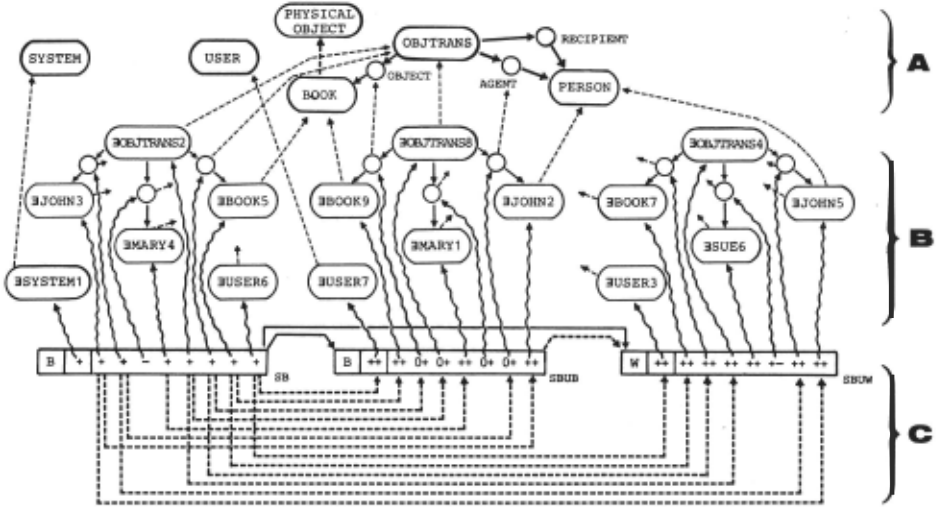
Moreover, relations exist between I1 and I2, I1 and I3, and I1 and I4, to which the predicates 'AGENT', 'RECIPIENT' and 'OBJECT' apply, respectively.
It is important to mention that, apart from being the language used for situation descriptions, structures of the individualized level also serve two other purposes in the VIE-LANG system. They are the target structures for the parser [14], which individualizes general concepts and attribute descriptions that are addressed by input words. Moreover, they are the starting point for the NL generator of the system [3]. This threefold usage of individualized structures facilitates the transfor mation of a user's input into assumptions about his beliefs and wants, the transformation of beliefs of the system into system replies, etc. [6,8].
3. Single acceptance attitudes for representing basic beliefs and wants
In VIE-DPM, basic beliefs of an agent (i.e. beliefs about the current situation) are represented by des cribing the situation from the agent's point of v~ The descriptions are expressed by individualized KL-ONE structures, the agents position is captured by indicating the acceptance attitude which the agent holds in respect to these situation descriptions. Acceptance attitudes may take the values '+', '-' and '0' (actually we use a continuous range of values). They are applied to the elementary situation descrip tions, i.e. to the individualized concepts and roles.
When applied to the individualized concept ic, the valuations '+', '-' and '0' express that the respective agent accepts that I does not accept, that I is uncertain whether ic denotes an individual in the current situation (i.e., that/whether there is an individual in the situation to which the predicate of the general concept of ic applies). When applied to the individualized role ir of an individualized attribute description, '+', '-' and '0' express that the respective agent accepts that I does not accept, that I is uncertain, whether such a relation as is described by ir exists in the situation. These inter pretations are observed by all access and inference procedures.
An example is given in the left side of Fig.1 (part B), where the agent (in this case, the system) accepts everything but the individualized role between the individualized concepts labelled '30BJTRANS1' and '3MARY4'. This means that the agent (in our case, the system) does not accept that there is a relation between I1 and I3, to which the predicate RECIPIENT applies. Thus, though it believes that John gives somebody a book, it does not believe that Mary is the recipient .
Basic wants of an agent are represented in VIE-DPM by describing the situation which is aspired by the agent . The acceptance attitudes can then be employed in a similar way: when applied to an individualized concept or role in such a description, the valuations'+', '-' and '0' express that the respective agent accepts, that I does not accept, that I is indifferent to whether the individualized concept or role should designate an individual or a relation in that situation. For instance, when regarded as a description of an aspired situation, the left side of Fig.1/B expresses that the agent wants John to give a book to anybody but Sue.
By using individualized concepts which possess no attribute descriptions, or only attribute descriptions with very general role fillers, it is furthermore possible to represent basic "unsaturated" beliefs and wants. An example for the former is that an agent believes that I does not believe that I is uncertain whether there is an x so that p(x), and for the latter that an agent wants that I does not want that I is indifferent to whether it should be the case that there is an x so that p(x). Examples for such beliefs and wants include, e.g., that a believes that John gives something to Mary, or that a wants that someone should give a book to Mary.
4. Partitions and multiple acceptance attitudes for representing beliefs and wants in respect to beliefs and wants
To allow for a parallel representation of both an agent's basic beliefs and wants, and his/her beliefs and wants in respect to beliefs and wants of other a gents, the individualized level of our representation is separated into partitions. So-called "contexts" have been introduced which tie together either the (hypothesized) basic beliefs of an agent, or his/her (hypothesized) basic wants. Beliefs and wants of an agent in respect to beliefs and wants of other agents are then represented through context hierarchies.
Fig.1 shows a simplified example with three contexts: context SB contains the system's beliefs about the current situation, SBUB- the system's beliefs about the user's beliefs about the situation, and SBUW the system's beliefs about the basic ~ants of the user.
SBUB and SBUW contain not only single, but dou bl e acceptance attitudes. The additional valuation expresses the attitude of the modelling agent in re spect to the valuation of the modelled agent with re gard to the particular situation description. The meaning of this additional acceptance attitude de pends on the type of superordinated context. If this is a belief context, the valuations'+', '-'and '0' express that the modelling agent accepts that I does not accept that I is uncertain whether the modelled agent assigns the particular acceptance attitude to the particular situation description. If the super ordinated context is a want context, these additional valuations express that the modelling agent accepts that I does not accept that I is indifferent to whether it should be the case that the modelled agent assigns the particular acceptance attitude to the particular description.
Fig.1 gives an example for the former. In each attitude pair, the left value specifies the attitude of the modelling agent, and the right one that of the modelled agent. SBUB expresses that S is uncertain whether U believes that John gives Mary a book. (Just for comparison: the belief of S, that U is uncertain whether ... would be expressed by reversing the '0+' pairs.) SBUW expresses that S believes that the user wants John to give the book to anybody but Sue.
The nesting of belief and want contexts can ob viously be arbitrarily extended, if necessary. Triple acceptance attitudes are then assigned to descrip ti ons on the third level, quadruple to descriptions on the fourth level, etc. Thus arbitrarily nested beliefs and wants in respect to beliefs and wants of other agents (such as that S wants that U believes that a does not believe p) can be expressed in the representation scheme. It is also possible to repre sent arbitrary "reflexive" belief and want nestings, i.e. constellations in which the modelled agent of a lower context is identical with the modelling agent of a superordinated context.
6. Discussion
The representation system of VIE-DPM has been com pletely implemented in an index-sequential data base, which is accessible through Interlisp [5]. It should be noted that, due to a lack of space, only a small portion of our representation could be described in this paper. More advanced topics, such as the re presentation of "knowing (wanting to know) whether", "knowing (wanting to know) the x so that p(x)", as well as the representation of "or-beliefs", mutual beliefs and infinite-reflexive beliefs (a generaliza tion of mutual beliefs) have been described in [7,8]. All these beliefs are arbitrarily combinable, and in principle there is no limit to the possible depth of nesting. These characteristics are particularly important in the field of user modelling. Though the usual depth of embedding is not excessive in this field (it hardly ever goes beyond the levels 3-5), the diversity of belief and want combinations which can arise even in normal communication is quite impressive [6,8].
Our representation demonstrates that, when advo cating the partition approach for the representation of basic beliefs and wants, one is not compelled to also introduce additional sub-partitions for not beliefs and "or-beliefs", as was done by [4]. Thus the doubts of [10,13] concerning the feasibility and efficiency of multi-partition processing do not apply to our proposal.
@inproceedings{ijcai1985p98,
  title     = {Using Situation Descriptions and Russellian Attitudes for Representing Beliefs and Wants},
  author    = {Kobsa, Alfred},
  booktitle = {Proceedings of the Ninth International Joint Conference on
               Artificial Intelligence, {IJCAI-85}},
  publisher = {International Joint Conferences on Artificial Intelligence},
  editor    = {Aravind Joshi},
  pages     = {513--514},
  year      = {1985},
  note      = {Knowledge Representation},
  url       = {https://ijcai.org/proceedings/1985/98},
}
TY - CPAPER TI - Using Situation Descriptions and Russellian Attitudes for Representing Beliefs and Wants AU - Kobsa, Alfred T2 - Proceedings of the Ninth International Joint Conference on Artificial Intelligence, IJCAI-85 PB - International Joint Conferences on Artificial Intelligence PY - 1985 SP - 513 EP - 514 UR - https://ijcai.org/proceedings/1985/98 ER -Copied
Machine-readable versions of this paper, for tools and AI agents:





