
The Architecture of the FAIM-1 Symbolic Multiprocessing System
Proceedings of the Ninth International Joint Conference on Artificial Intelligence. AI Architectures. Pages 32-37.
© 1985 International Joint Conferences on Artificial Intelligence
Abstract
The FAIM-1 is an ultra-conclllTent symbolic multipr<>cessor which attempts to significantly improve the performance of AI systems. The system includes a language in which concurrent AI application programs can he written, a machine which provides direct hardware support for the language, and a resource allocation mechanism which maps programs onto the machine in ord er to exploit the program's con c urrency in an effic ient mann er at run-tllne. The paper provides a brief synopsis of the nature of the language and resource allocation mechanism, hut is primarily concerned with the description of the physical architecture of the machine. The architecture is consistent with high performance VLSI implementation and packaging technology, and is easily extended to include arbitrary numbers of processors.
- [Bell and Newell, 1971] C. G. Bell and A. Newell. Computer Structures: Readings and Examples. McGraw-Hill, 1971.
- [Brunvand, 1984] E. Brunvand. Context Addressable Memory for Symbolic Processing Systems. Masters Thesis, Univer- sity of Utah, Dept. of Computer Science, August 1984.
- [Clocksin and Mellish, 1981] W. F . Clocksin and C. S. Mellish. Programming in Prolog . Springer-Verlag, 1981.
- [Conery and Kibler, 1981] J . S. Conery, D . F. Kibler. Parallel Interpretation of Logic Programs. Functional Programming Languages and Computer Architecture, October 1981, 163- 171.
- [DeGroot, 1984] D. DeGroot. Restricted AND-Parallelism. Pro- ceedings of the International Conference on Fifth Generation Computer Systems 1984, Institute for New Generation Com- puter Technology, 1984, pp. 471-478.
- [Gurwitz, 1984] R. Gurwitz. The Butterfly Multiprocessor. Talk presented at the 1984 ACM National Convention, San Fran- cisco, October, 1984.
- [Hillis, 1981] D . Hillis. ~The Connection Machine• (Computer Architecture for the New Wave). AI Memo 646, M.I.T. Ar- tificial Intelligence Laboratory, 1981.
- [Hinton et al., 1984] G . Hinton, T J . Sejnowski and D . H. Ackley. Boltzmann Machines: Constraint Satisfaction Networks that Learn. CMU-CS-84-119, Carnegie Mellon University, May 84.
- [INMOS, 1984] INMOS Limited. IMS T~2~ Transputer Refer- ence Manual. INMOS Limited, 1984.
- [Kirkpatrick et al., 1984] S. Kirkpatrick, C . D . Gelatt, and M. P. Vecchi. Optimization by Simulated Annealing. Science 220, 1984, pp. 671-680.
- [Gordon et al., 1985] D. Gordon, I. Koren and G . M. Silberman . Fault-Tolerance in VLSI Hexagonal Arrays. Preprint.
- [Martin, 1981] A. J. Martin . The Torus: An Exercise in Con - structing a Surface. Proceedings of the Second Caltech Con- ference on VLSI, 1981, pp. 527-538.
- [Patterson and Sequin, 1981] D. A. Patterson, C . H . Seguin. RISC 1: A Reduced Instruction Set Computer. Proceedings of the Eighth International Symposium on Computer Architec- ture, 1981, pp. 443-458.
- [Przybylski et al., 1984] S. A . Pryzybylski, T . R . Gross, J. L. Hennessy, N. P. Jouppi, C . Rowen . Organization and VLSI Implementation of MIPS. Journal of VLSI and Computer Sys- tems, Vol. 1, Number 2, 1984, pp. 170-208.
- [Rees et al., 1984] J . A. Rees, N. I. Adams, J. R. Meehan The T Manual. Yale University, Fourth Edition, 1984.
- [Seitz, 1984] C. L. Seitz. The Cosmic Cube. To appear CACM.
- [Seitz, 1979] C . L. Seitz . System Timing . In Introduction to VLSI Systems, Chapter 7, McGraw-Hill, 1979.
- [Shapiro, 1983] E . Shapiro. A Subset of Concurrent Prolog and its Interpreter. TR-003, Institute for New Generation Com- puter Technology, , 1983.
- [Smith, 1982] A. J . Smith . Cache Memories . Computing Surveys 14, 3, 1982, pp. 473-530.
- [Stolfo, 1983] S. J . Stolfo, et al. Architecture and Applications of DADO, A Large-Scale Parallel Computer for Artificial In- telligence . Proceedings of the Eighth International Joint Con- ference on Artificial Intelligence, Karlsruhe, West Germany, August, 1983, pp. 850-854. IJCAI
- [Stopper, 1985] H. Stopper. A Wafer with Electrically Pro- grammable Interconnections . Proceedings of the 1985 IEEE International Solid-State Circuits Conference, 1985, pp. 268-269.
- [Symbolics, 1984] Symbolics, Inc. it Symbolics 3600 Technical Summary. Symbolics, 1984.
References were extracted automatically from the PDF and may contain errors.
Full text extracted automatically from the PDF; figures, tables and equations may differ. The PDF is the version of record.
I Introduction
The goal of the FAIM-1 machine is to provide a high per formance symbolic multiprocessor, one hundred or more times faster than current machines in common use (e.g., a Symbolics 3670) to meet the voracious computational demands of future Artificial Intelligence applications. This implies a real machine - one that works, is affordable and that people can program. Such a machine should entice researchers into the area of dis tributed AI problem solving and encourage its widespread use in the research community. It is hoped that such usage will fa cilitate development of the necessary expertise to make sophis ticated, cost-effective machine intelligence applications practical. The FAIM-1 is also an architecture which is conveniently extensi ble, both in terms of scale (number of processors) and for future improvements to incorporate the benefits of new technology and systems ideas.
The system's functionality is primarily motivated from the top by the needs of AI symbolic computation, but the system struc ture is also restricted by the need to produce a high-performance, cost-effective system in an available technology. We feel that it is necessary to provide a consistent system which is designed from first principles to meet the needs of AI applications rather than adopting an ad hoc combination of systems ideas and com ponents that were developed for sequential, primarily numeric applications. Such a system must also be complete enough to permit viable use and evaluation. The FAIM-1 system therefore includes a language, programming environment, architecture (a hardware prototype is under development), and a resource al location mechanism. The focus of this paper is to describe the physical architecture of the FAIM-1 system. A brief synopsis of the language and resource allocation strategy will be presented in order to provide some perspective for the architecture in the context of the overall system.
The design of the FAIM-1 system is intended to exploit con currency at all levels of the system, and to pursue technological performance mechanisms in the implementation of the prototype hardware.
II Language and Resource Allocation
A. The OIL Language
OIL (Our Intermediate Language) can be viewed both as the kernel of a high level, concurrent, AI symbolic programming lan guage and as the machine language for the FAIM-1 multiprocess ing system. The design of OIL was primarily influenced by cur rent AI programming practices. Commonly used are languages for knowledge representation, logic programming, object-oriented programming, production rules, procedural code, etc. Future complex AI applications may require several (or all) of these programming styles. Emulating one programming style within another is inefficient, and therefore a need exists for a better lin guistic mechanism that efficiently supports many of the major styles. OIL can be viewed as a blend of object-oriented, logic, and procedural programming semantics into a single and inter nally consistent linguistic framework. Effort has been made to retain as much as possible from existing and familiar AI program ming languages. Some modifications to familiar mechanisms have been incorporated into OIL which were primarily induced by the need to provide concurrent semantics where possible.
An OIL program is a collection of objects that communicate by sending messages. Each object is viewed semantically as an independent and therefore potentially concurrent program mod ule. The communication structure explicitly indicates the level of concurrency represented by the program. An OIL object consists of some local state information (local variables and data struc tures) and several ports through which messages are sent and received in FIFO order. A behavior, associated with each port , describes what the object does in response to a message. The behavior is a program, that may modify the local state and/or send messages to other objects . Atomic OIL objects are of two distinct types: logical and procedural.
Logical behaviors are written in a declarative style that is es sentially a parallel version of Prolog (Clocksin and Mellish, 1981]. Numerous parallel logic programming semantics are being inves tigated within the research community. OIL logical behaviors are semantically OR-parallel, restricted AND-parallel (DeGroot, 1984]logic programs.
Procedural behaviors are written imperatively in a parallel lexically scoped dialect of LISP based on the language T (Rees et al., 1984] . Behaviors can be nested heterogeneously to form other objects to permit control to pass between declarative and imperative behaviors.
The programmer may also annotate the OIL code with prag mas which are used to provide information about the dynamic aspects of how the code may behave at run time. These program mer supplied hints are used by the static resource allocator in an attempt to properly partition the concurrency extant in the pro gram onto the physical resources of the machine . The goal of this activity is to maximize the benefit of concurrent operation at run time. This pragma information gives the programmer optional t.:ontrol over some aspects of the allocation strategy. Pragmas, as the name implies, are purely pragmatic information and are therefore orthogonal to the functional correctness of the program itself. If no pragma information is supplied, the program will still run although perhaps not efficiently.
B. Resource Allocation
Given a program that is a collection of concurrent tasks and a machine composed of a number of processors on which to run the program, there is an inherent problem of how to allocate the tasks onto the physical resources in an efficient manner. In sys tems such as the Cosmic Cube (Seitz, 1984] the burden of task allocation is left for the programmer; for certain highly regu lar cases this is neither a complex nor difficult task. In general however, it is important that the task structure reflect the pro grammer's organization of the solution and be independent of the machine architecture. Efficient task allocation is a critical prob lem that must be solved if advan~ed, highly concurrent machine systems are to mature and be truly useful. Several mechanisms have been studied, but generally three main options exist:
- Programmed resource allocation relies on a smart pro grammer to write specific load modules for each individual processing element (PE) . The disadvantage is that the task may be complex and the solution non-intuitive. An ad ditional problem is that such code does not port to new machine structures, and therefore effectively returns to the dark ages of machine dependent programming. The ad vantage is that in many cases the programmer knows the optimal allocation better than any automatic mechanism.
- Dynamic resource allocation employs a smart operating system to observe how load is distributed in the system. If an inefficient allocation exists, then the operating system re distributes some of the load from busy processors to lightly loaded or idle processors. The advantage of this mechanism is that if the load changes rapidly, then neither the pro grammed nor the static mechanisms can adapt properly. The drawback is that the overhead of dynamic allocation must be paid at runtime and therefore can decrease system performance.
- Static resource allocation relies on a smart compiler to an alyze the program text and to partition the resulting object
code into a set of cooperating, concurrent subtasks that conform to the grain size of the PE's and their interconnec tion topology. The primary advantage of this mechanism is that it does not directly increase the programmer's burden and also does not diminish the run-time performance of the system. The primary disadvantages are that the compiler based resource allocator can be very complex, and if the program exhibits highly dynamic behavior, then the result may be far from optimal.
Since the major goal of the FAIM-1 system is very high per formance, the focus for resource allocation strategies is on static methods. Aspects of both the programmed and dynamic meth ods exist in that pragmas are both a way in which the program mer can influence allocation decisions, and a mechanism by which predictions about dynamic run-time behavior can be specified. Due to the highly dynamic nature of many AI application pro grams, some form of additional dynamic load balancing support will also need to be provided by the run-time kernel. However, our present interest is to experiment with how far we can push static methods. The FAIM-1 static resource allocation decisions are made in a post-compiler process called the Allocator.
The intermediate compiled code and the associated pragmas are passed to the allocator by the OIL compiler. The alloca tor then performs a dataflow analysis on the procedural code, a communication connectivity analysis on the program objects, and an inference connectivity analysis on the logical behaviors to produce a directed-program graph. This graph is then manipu lated into a more abstract graph form which encapsulates much of the program graph detail. This intermediate graph form is then embedded into the machine graph representing the physical machine resources via a simulated annealing process (Kirkpatrick et al., 1984] . While optimal graph embedding is in general an NP hard problem, the method used here fortunately is not concerned with an optimal allocation and runs in polynomial time in order to find an adequate allocation partition.
III FAIM-1 System Architecture
The primary purpose of the FAIM-1 architecture is the ef ficient, high-performance execution of OIL programs. The ob jective is accomplished by supporting, directly in hardware, the computational model on which OIL is based .
The FAIM-1 is a multiprocessor system consisting of a number of identical processing elements, called Hectogons (the result of an inside joke with no other interesting meaning), interconnected by a communication network. Each Hectogon is a complete, self timed computer capable of sequentially executing any compiled OIL program that can be stored in its local memory. Hecto gons communicate with each other via messages which are sent through communication ports. Note the similarity between this model and the organization of an OIL program. Each Hectogon has 6 ports that may potentially be concurrently active. Com munication lines run between ports on different Hectogons; the exact configuration of connections is called the communication topology.
A Hectogon is composed of 6 self-timed (Seitz, 1979] subsys tems - named the FRISC, ISM, CxAM, SPUN, SRAM, and Post Office. Three of these subsystems (ISM, CxAM, SRAM) are specialized memory systems that provide intelligent storage , the Post Office supports inter-Hectogon communication, the FRISC element is the processor, and unification support is provided by the SPUN element . For the initial 19 processor FAIM-1 proto type, four of the subsystems are being implemented as custom CMOS VLSI components and the other two (SPUN and SRAM)
subsystems are being constructed from commercially available components.
One of the key features of this design is to experiment with the utility of specialized storage subsystems to relieve the processor from much of the storage management duties which are typi cally very time consuming in AI applications. These intelligent memory components permit a higher level of processor memory interaction, which inherently alleviates the classic memory bot tleneck of conventional Von Neumann architectures.
Each of the 6 subsystems can be be viewed as concurrent sys tem modules, and as an ensemble they support a considerable level of concurrent activity within the confines of a single process ing element. Larger grain concurrency, corresponding to parallel program tasks, is exploited by distributing the tasks across mul tiple processing elements.
A. Communication Topology
The FAIM-1 communication topology is divided into two lev els. At the bottom level, Hectogon elements are wired together to form a processing surface. At the top level, an arbitrary num ber of processing surfaces are connected together to produce a multiple surface instance of a FAIM-1 system. A processing sur face is a planar hexagonal mesh structure and Hectogons which are on the edges of the plane are called peripheral. When a con nection leaves the surface from a peripheral Hectogon's ports, it is routed to a simple 3-ported switch. One of the remaining ports of the switch is used for connection to an adjacent surface while the other is wrapped around to a switch on the opposite edge of the same hexagonal surface. Figure 1 shows a 19 processor surface, with the switches and wrap lines on one axis only. The switches and wrap lines have been omitted on the other two axes for clarity. This wrapped, hexagonal mesh is a 3-axis variant of a twisted toroidal topology [Martin, 1981]. This particular variant has a communication diameter of N-1 where N is the number of processors on an edge of the surface and each wrap is twisted N-1 increments on each axis. The N-1 twist creates a provably optimal switching diameter and can be supported by a rather simple routing algorithm which scales to permit multiple sur faces to be interconnected as well. This N-1 twist topology can also be viewed as a uniform hexagonal mesh of processors which covers the surface of a sphere.
Hex Display with One Wrapped Axis
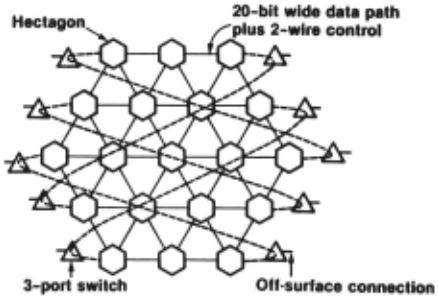
The wrap lines reduce the maximum communication distance between elements on the surface. It is hoped that the resource allocation strategy will be able to allocate tasks onto this sur face such that a high degree of communication locality will be achieved. However, it is unlikely that strict locality can be effi ciently achieved for highly dynamic AI programs. Therefo.re re ducing worst-case communication times between non-local pro cessing elements (by reducing communication distance) is also important.
Multiple FAIM-1 surfaces can be arbitrarily tessellated in a planar array, by connecting the adjacent Hectogon off-surface switch wires. Figure 2 illustrates this multi-surface interconnec tion plan. In this figure, Hectogons on the same .surface have similar textures. The switches and wrap lines have been omitted for clarity. The tiling of a plane with several processor surfaces produces a large number of peripheral ports that can be attached to non-Hectogon devices. This is useful for I/0 purposes, pro viding a large number of connections to secondary storage units or a host processor. By varying the surface size and the number of surfaces that are connected together it is possible to produce a system containing any desired number of processors.
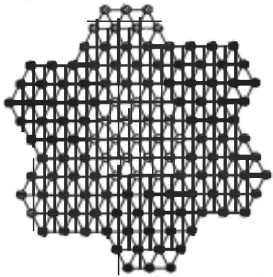
The primary advantage in using a hex communication topology is that it is easily extensible. The periphery of a processing sur face forms a regular hexagon. In the 19 processor instance, each peripheral edge contains 3 processing elements. This particular configuration is therefore called an E-3 surface. An interesting artifact of this surface configuration, is that up to an E-7 sur face, the number of processing elements on a surface is a prime number. This can be exploited during surface initialization to concurrently determine individual Hectogon status and identity.
A secondary advantage of the surface topology is that the on surface wiring scheme is strictly planar and therefore amenable to wafer-scale packaging, either as a hybrid or a full wafer-scale integration design. We do not anticipate using wafer-scale in tegration in the near term due to the inherent problems asso ciated with yield induced component failures. However, immer sion cooled, hybrid wafer-scale packaging [Stopper, 1985] is an attractive option. In general it will be important for future high performance architectures to be amenable to fabrication in mod ern circuit and packaging technology. Namely it does not make sense for multiprocessor architectures which exploit concurrency for increased performance to sacrifice an order of magnitude in speed due to a poor choice of implementation technology.
Fault tolerance is an important aspect of any highly replicated multiprocessor architecture, since the probability of at least one processor being down increases with the number of processors in the system. Homogeneous multiprocessor architectures intrinsi cally contain redundant elements which could be used to support fault tolerant behavior. Unfortunately most of these architec tures to date have not utilized this feature, and have by default become fault intolerant. Koren [Gordon et al., 1985] has shown that hexagonal mesh structures are particularly attractive fault tolerant topologies. In addition, communication fault tolerance is enhanced in a hex mesh topology because each element has a number of paths by which it may send messages to any particular destination.
B. Poat Office
Hectogons conununicate with each other by sending messages. The Post Office subsystem is a highly concurrent, autonomous communications controller. It is responsible for the physical de livery of messages which are sent between communicating Hec togons. Initially messages are created by the FRISC and linked into the DELIVERABLE-MESSAGES list stored in the SRAM. The Post Office can independently access this structure and route individual messages to their intended destinations.
Messages are variable length structures and contain two sub fields : a list of destinations, and the message body. A destination is a relative address which indicates the physical offset of the re ceiving Hectogon in the hexagonal mesh. Physically, FAIM-1 Post Offices form an independent packet routing network on the hexagonal mesh topology. Messages are therefore decomposed by the Post Office into a series of fixed length packets. Each packet contains a destination and a packet body. Routing of individ ual packets is done separately and recomposition of a message from a collection of packets is done by the receiving Post Office. This implies that packet arrival at the destination Post Office is inherently unordered, since several physical routing paths may be used for member packets of a particular message . While this increases the level of responsibility in the receiving Post Office, it permits congestion delays to be avoided dynamically in the switching topology.
Routing decisions are made algorithmically in the Post Office by a finite state machine as follows :
- H the destination is one of the neighboring Hectogons, then the packet is sent out on the appropriate port if it is avail able . H the port is not available, then the Post Office waits until it is. This model assumes that ports do not fail and can be easily generalized to permit a more lenient failure model.
- H the destination is not a local neighbor then the packet is sent out on any port which reduces the Manhattan dis tance to the destination. H no such port is available after a time specified by a CRITICAL-TIME parameter, then the packet is sent out to the first available port. This ran domized routing after a critical time permits messages to be routed around areas of congestion. Simulation results demonstrate that this mechanism permits congested areas to be gradually dissipated by spreading the communication load over a wider spectrum of the physical communication resources.
Upon receipt of a packet, the receiving Post Office determines if the packet has arrived at its destination. Hit has, the packet is stored into the appropriate location in the SRAM. H this packet completes the receipt of a message then the FRISC is interrupted by the Post Office to handle the received message. H the local Hectogon is not the final destination then the packet is forwarded using the routing algorithm described above. The final word of each packet contains a CRC which is monitored by the receiving Post Office to validate packet integrity during transmission. H the CRC check indicates that a transmission error has occurred, the receiving Post Office signals the sender to retransmit the last packet.
Physically the Post Office is composed of the following com ponents:
- The Packet Buffer Pool is a multiported storage module consisting of a set of packet buffers.
- The External Controller is a finite state machine which makes routing decisions, manages the packet buffer pool, and connects port controllers to packet buffers .
- The Port Controllers (there are six - one for each Hecto gon port), are responsible for receiving a packet and placing it in the assigned packet buffer (vice versa for output). They also perform bus master nomination duties and control the asynchronous handshaking of the bus wires used to asyn chronously control word transmissions during packet trans fer . The port controllers are also responsible for checking the CRC codes and signalling retransmission when neces sary.
- The Internal Controller performs DMA accesses between the SRAM and the packet buffer pool. It is responsible for packetizing and depacketizing messages . The internal con troller interrupts the FRISC when a complete message has been received and has been composed in the SRAM. The in ternal controller contains a MAIL-TABLE which is used to store target addresses in the SRAM for incoming messages, and to indicate which packets of a particular message have been received. A similar table is maintained for STREAM communications which require that the order in which mes sages are sent will be the order in which they are handled by the receiving program object .
Potentially the Post Office can keep all 6 external Hectogon ports active concurrently, freeing the FRISC element from using its cycles on communication overhead. This is a significant im provement over designs such as the Transputer [INMOS, 1984] which steals processor cycles to drive the ports and where only one of the four ports can be active at any particular time. In addition the hardware support for the routing algorithm is inte grated into the architecture and does not have to be part of the run-time kernel.
C. Instruction Stream Memory
The Instruction Stream Memory (ISM) is a specialized high speed instruction delivery subsystem. In the FAIM-1, the locus of control for instruction delivery resides solely in the ISM. The ISM provides storage for the FRISC object code, and provides the control to decide what instruction should be executed next and delivers it to the FRISC.
The instruction stream can be viewed as a sequence of instruc tions broken by calls or jumps, both of which may be conditional. Modern programming practices tend to produce relatively short instruction sequences that correspond to small procedures. The role of either a jump or call is to select a next instruction that is not in lexical order. Since the jump and call instructions are seen by the ISM before they are evaluated, the ISM can predict when one will appear and plan for it in advance . The use of specialized hardware to enhance instruction delivery is certainly not new; branch prediction and instruction prefetch have been used to im prove performance in many conventional architectures. Most of these systems (for example the scoreboards in the IBM System 360/91 [Bell and Newell, 1971], translation look aside buffers, and instruction caches [Smith, 1982]) increase speed by interpos ing a piece of specialized hardware between the memory and the processor.
The ISM takes this approach a step further. It provides a spe cialized instruction memory rather than merely placing a spe cialized interface in front of a conventional memory. The obvious disadvantage is that the ISM is only useful for storing instruc tions, and therefore the ISM cannot serve multiple storage roles as in conventional systems. The advantages, however are numer ous:
- The ISM can be tuned for its sole function of high-speed instruction delivery.
- The processor complexity can be reduced .
- Code density can be increased since jumps and calls are removed from the code stream.
- A separate parallel data path for instruction delivery can be used.
- Operational concurrency is increased, since the ISM and FRISC can operate as concurrently cooperating partners.
- A more flexible interrupt and trap structure is permitted.
The code density issue is an important one since the power of the FAIM-1 machine is derived primarily from the high level of replication of processing elements that the architecture sup ports, and not from the power of the individual processor de sign. In order to permit high replication levels it is necessary that the size of the individual processor be small. Therefore the amount of storage available to each Hectogon is much less than that typically associated with conventional main frame ar chitectures. The reduced storage size provides significant moti vation to any mechanism which can improve code density, hence the removal of branch instructions and the use of a stack based micro-architecture for the FRISC element are steps in the right direction.
The current ISM design attempts to improve performance by capitalizing on the fact that instruction access patterns are not random. Hence the use of RAM memory for instruction storage is both slow and unnecessarily complex. The ISM essentially performs instruction prefetch of all instruction paths that can be taken with the exception of interrupt and trap sequences, and has them ready for delivery at the time they are needed.
Physically the ISM organizes its storage into a set of tracks, each of which contains 16 instruction packets. An individual packet is 6 bits long. The FRISC instruction format permits two types of instruction lengths. Short instructions are a sin gle packet and long instructions are formed as a pair of packets. The ISM decodes the instructions and sends properly formatted instructions over the 12 bit wide instruction bus. Hence it dy namically delivers a code stream of the right length instructions from a packed array of stored instruction packets. This reduces the amount of dead storage caused by fragmentation that might be incurred by permitting multiple instruction lengths. A track is viewed as a linear sequence of instructions which terminate by a jump or call instruction, or by the physical end of the track. If sequential object code segments are longer than one track, they are continued on the next track. If they terminate by a call or jump then each track header contains a tag indicating where the call or jump target is located. This tag replaces what would nor mally be jump and call opcodes in the instruction stream. Since 2-way conditional call/jump structures are supported, two pos sible targets exist. One will always be located on the next track and the other will point to what is termed the remote track.
Three track buffers are connected to the instruction output bus, they are the current, remote, and next track buffers. In structions are delivered from the current track buffer. Concurrent with the delivery of the first instruction, the current track buffer tag is examined to determine the address of the appropri ate remote track. The next and remote track buffers are then loaded. Since the machine is a completely asynchronous system, there is no way to determine the exact synchronization of these activities. However, in normal operation (no trap or interrupt occurs), two instructions are delivered from the current track buffer while the remote and next track buffers are loaded. This corresponds to full prefetch of both possible branch targets. If the branch does not occur in the first two instruction times of the current track then no delay will occur on either a call or a jump.
When a conditional branch is taken, due to the two stage pipeline of the processor, the condition line will not be valid until two stage times after the branch instruction. The strategy used is similar to the delayed branch technique used in the MIPS machine [Przybylski et al., 1984], i.e. to insert non-condition modifying instructions in the code stream in order to prevent dead-time in the evaluation pipeline. Since most of the FRISC instructions do not modify the condition Hags, this is typically fairly easy.
The communication between the FRISC and ISM units is self timed, and controlled by a 4 cycle request/acknowledge protocol. Typically the ISM is ready with the next instruction long before the FRISC has completed evaluation of the previous one. The ISM also fields interrupts and traps and provides the proper in struction streams in these cases. In the case of a trap or interrupt, a 2 stage delay occurs since this is the only case when the ISM cannot predict where the desired instruction will be in advance and prefetching is therefore not possible.
In cases where a context switch between user processes is nec essary the ISM can predict this case and prefetch the desired code as well as preset the appropriate status bits in the FRISC to create the context switch. It is noteworthy that not only does the ISM execute certain control instructions such as branch and call, but it also makes up instructions that are not in the code stream in order to initialize the processor status word when con text switching is performed. For testability, it is possible for the FRISC to read or write any packet in the ISM.
While implementation details have been suppressed here for brevity, it is interesting to note that the ISM is a significant performance enhancement over traditional instruction delivery mechanisms. It also uses instruction bus bandwidth more effi ciently, and is a design that would not be economical if built from commercially available components. The ISM is being fab ricated as a 64 pin custom CMOS component, where each part contains storage for 2K instruction packets. These parts can be cascaded with no performance penalty into a group of up to 32 ISM chips to form the instruction storage and delivery subsys tem for a particular Hectogon. The maximum amount of code storage per Hectogon is therefore 64K short instructions.
D. The FRISC and SRAM
The FRISC {for Fanatically Reduced Instruction Set Com puter) is a specialized processor which supports the operations of OIL and coordinates the other Hectogon subsystems. It is also designed to be an efficient multitasking evaluation engine. Inter nally the FRISC contains a 20 bit wide data-path {4 tag bits, and 16 data bits), and is essentially a stack machine. Parallel tag hardware permits tag based traps to be used in order to op timize main line instruction streams for the common case. This is similar to the mechanism used in other high speed symbolic uniprocessor architectures such as the Symbolics 3600 [Symbol ics, 1984). This approach makes complex microprogramming sup port for the most general case unnecessary, and removes a level of control indirection which improves the overall performance of the FRISC element [Patterson and Sequin, 1981].
The instruction set is tailored to support OIL user programs. Altogether, the FRISC supports 64 basic instructions, corre sponding to OIL functions such as UNIFY, CAR, etc. Inte ger arithmetic is supported by the ALU, but multiplication and division are performed iteratively using MULTIPLY-STEP and DIVIDE-STEP instructions. It is also interesting to examine the functions that are not in the FRISC instruction set. Jump and Call opcodes are absent since they are handled directly by the ISM. Also missing are complex string search instructions since they are supported directly by the CxAM.
The FRISC is actually composed of two processors, the eval uation or E processor and the switching or S processor. The S processor is responsible for manipulating the run-list and load ing/unloading shadow registers to permit rapid context switch ing. This considerably increases the physical complexity of the FRISC element but provides high performance direct hardware support for multitasking. The goal is to keep as much of the FAIM-l's physical resources active as the process structure war rants. For example if a task initiates a CxAM search it will block and another task can be executed in overlap fashion pending ar rival of the answers from the CxAM. The S processor is actually a small finite state machine with a couple of index registers which permit it to drive the data paths in the E processor and access the SRAM.
In theE processor, all of the primary registers in the data-path exist in triplicate, one register for each of the three contexts that the hardware supports: USERO, USER!, and KERNEL. The status word indicates which set of shadow registers are active for the current process. The primary registers are the Index Register, Frame Pointer, Stack Pointer, Stack Top, Stack Next, and the Stack Buffer. The stack buffer acts as a stack cache, and is actually 16 words deep. The stack buffer has its own memory controller which attempts to keep the buffer half full. This implies that a sequence of pops or pushes will not typically need immediate access to the SRAM memory bus. Non-shadowed registers include the Q register used during multiply and divide step loops, and the memory data and address registers. The ALU takes sources from two internal busses, one of which can be shifted prior to the ALU. Results from the ALU pass through a barrel shifter and are posted on ~ result bus which is used to deliver the result to the selected target. This shift arrangement facilitates the arithmetic and bit field manipulation instructions of the FRISC instruction set.
The FRISC views most data structures as objects; a conven tional paged memory with a small finite-state machine attached to each page (collectively called the SRAM) provides an object oriented memory system for the FRISC. The SRAM (Structure RAM) stores all procedural data structures, as well as logical variable bindings and the bodies of logical rules in list form. The SRAM's atomic addressable entity is a word, which is composed of two portions: a 4-bit tag and a 16-bit data field. Multiple word objects (e .g. simple vectors, bignums, or continuations) are represented as a structure containing one or more header words followed by indexable data fields . The tag bits support the common dynamic data types allowed in many AI languages. Using the data tag bits, the SRAM can (concurrently with other FRISC computation) follow a pointer chain to retrieve an object requested by the FRISC.
The close connectivity between the FRISC and its small SRAM removes the usual. performance gap between registers and pri mary memory. In our case, registers have at most a 2:1 speed advantage over memory, so the complexity of a general register architecture is not easily justified. Stack architectures are a more natural fit as a compiler target, providing improved instruction code density, reduced data path complexity, and faster context switches. The resulting simple data path and simple instruction set is a candidate for straightforward control implementation.
E. Context Addressable Memory
The Context Addressable Memory (CxAM) is a highly paral lel associative storage subsystem capable of searching for and re trieving structured data. Pattern matching and associative stor age accesses are common operations in many AI applications. The CxAM provides direct hardware support for this important activity. Rule headers for logical OIL behaviors, and procedural data structures which are associatively accessed are stored in the CxAM.
In previous systems, a variety of hashing schemes have been used in lieu of CAM components. This choice makes sense in traditional architectures where the "smart processor with big, dumb memory" partition is cast in concrete. The typical CAM does not provide sufficient associative support for AI match func tions, since they match either tag bits or single word contents . In FAIM-1, the CxAM can match structures as well as slot contents.
The structure of both entries and queries in the CxAM is a LISP S-expression. Each slot therefore can either be a structure or an atom. Atoms can be symbols, numbers, variables, or don't cares. Semantically, variables are treated as don't cares by the CxAM. The inclusion of variables as atom types for the CxAM is based on FAIM-1's support of logic programming. The retrieval and setting of logical variable bindings is supported elsewhere in the Hectogon.
The CxAM responds to four commands: Find Match, Give Match, Delete Structure, and Add Structure . The Find and Give functions are optimized for speed, while the Delete and Add func tions are implemented with more concern for minin1izing circuit area than performance. The frequency of Find and Give is much higher during program execution than that for Delete and Add. The CxAM also manages its own free space and removes garbage automatically, thereby freeing the FRISC element to process user instructions rather than manage storage.
Physically the CxAM consists of a storage area and a number of parallel search engines which share a multiported query buffer which contains the pattern to be matched. Each search engine concurrently searches a subset of the storage area. A complete and very detailed exposition of this device, implemented as a custom CMOS component, can be found in [Brunvand, 1984] .
F. Streamed Pipeline Unifier
The Streamed Pipelined UNifier (SPUN) provides direct hard ware support for unification of logical OIL behaviors. The CxAM can be used to find the next rule or set of rules to be tried, but the CxAM does not perform full unification since its match func tion does not consider variable bindings. The SPUN unit takes the query and the streamed set of matched structures from the CxAM, detects which variable bindings still need to be matched, fetches bindings in the current context from the SRAM, and com pletes the unification. This may entail binding a variable, in which case the SPUN unit must post this binding back in the SRAM. It may also entail starting another subgoal unification, in which case the present state must be stacked, and a new query must be presented to the CxAM.
IV Conclusions
In this paper, we have presented an architectural overview for the design of a highly parallel symbolic processor known as FAIM-1. In general there have been two approaches taken in the design of similar systems. The first is to build concurrent processing ensembles out of conventional processor and memory components as has been done for the Cosmic Cube[Seitz, 1984], Butterfl.y[Gurwitz, 1984], and DADO[Stolfo, 1983] systems. In general we feel that to truly achieve a new generation of viable symbolic processors which are a major performance improvement over existing systems, it will be necessary to significantly reallo cate the transistor budget to support tasks which are specific to the domain of symbolic processing. This is not possible by merely assembling old components in new ways. The other approach is to experiment with radical new models of computation which are inherently highly parallel as is the case with the Connec tion[Hillis, 1981] and Boltzmann[Hinton et al., 1984] machines. The problem with this approach is that the ways in which we solve problems must change radically as well, and the incorpora tion of 30 years of expertise in programming is all but impossible in the short term. We feel that both approaches are viable: the first in the short term and the second in the long term. The FAIM-1 design attempts to fill the gap by providing a rather dif ferent but specialized architecture for performance, while requir ing only a small change in programming practice to incorporate concurrency.
V Acknowledgments
The FAIM-1 system is the result of a wide variety of ideas from a number of project members, and does not represent the sole ef fort of the authors. Key contributions have also been made by: Judy Anderson, Allan Schiffman, Shimon Cohen, Ken Stevens, Ian Robinson, Mike Deering, Marty Tenenbaum, Dick Lyon, Erik Brunvand, Bill Coates, Bill Athas, Dan Carnese, Barak Pearl mutter, Bob Bon, John Conery, Alvin DeSpain, and Gary Lind strom.
@inproceedings{ijcai1985p8,
  title     = {The Architecture of the FAIM-1 Symbolic Multiprocessing System},
  author    = {Davis, Alan L. and Robison, Shane V.},
  booktitle = {Proceedings of the Ninth International Joint Conference on
               Artificial Intelligence, {IJCAI-85}},
  publisher = {International Joint Conferences on Artificial Intelligence},
  editor    = {Aravind Joshi},
  pages     = {32--37},
  year      = {1985},
  note      = {AI Architectures},
  url       = {https://ijcai.org/proceedings/1985/8},
}
TY - CPAPER TI - The Architecture of the FAIM-1 Symbolic Multiprocessing System AU - Davis, Alan L. AU - Robison, Shane V. T2 - Proceedings of the Ninth International Joint Conference on Artificial Intelligence, IJCAI-85 PB - International Joint Conferences on Artificial Intelligence PY - 1985 SP - 32 EP - 37 UR - https://ijcai.org/proceedings/1985/8 ER -Copied
Machine-readable versions of this paper, for tools and AI agents:





