
A Fault Detection and Isolation Method Applied to Liquid Oxygen Loading for the Space Shuttle
Proceedings of the Ninth International Joint Conference on Artificial Intelligence. Expert Systems. Pages 414-415.
© 1985 International Joint Conferences on Artificial Intelligence
Abstract
Process-monitoring and fault lo catio n techniqu es have been developed at the Kennedy Space Center in a domain of mixed med ia control in NASA's Space Shuttl e Launch Processing System. An intuitively appealing diagno stic technique and representation of the system's str ucture and function were formulated in coop e ration with system engineers . Functional relationships that d ete rmine the consistency of sensor me asurements are represented by sy mbolic expressions e mb edded in frames. Functional relationships are st or e d in exactly one place, so they must be inverted to de termine hypoth etica l values for possibly faulty objects. Propagating thes e hypoth e ti cal sta tes to other se n sors permits the lo cation of faults. Standard sy mbolic inv ersion techniques have be e n ex t en d e d to include con diti onal functions. A demonstration system is operating, and lts evaluaticn will soon use live data from th e firing rooms a t KSC.
- Davis, R . "Diagnostic Reasoning Based on Structure a n d Behavior. " Artificial Intelligence 24:1 -3, 1984, 347-410.
- de Kl eer, in Circuit Intelligence J. "Causal and Teleological Reasoning Recognition, " TR-529, Artific i al Laboratory, MIT, Cambridge, MA, 1979.
- Delaune, C . I., E . A. Searl, and J. R. Jamie s on " A Monitor and Diagnosis Program for the Shuttle Liquid Oxygen Loading Operation." Proc. First Annual Workshop on Robotics and Expert Systems, Johnson Space Center, Houston, TX, June 1985.
- Genesereth, N. R. "The Use Descriptions in Automate Diagnosis . " Intelligence 24:1-3, 1984, 4 11-436. of Design Artificial
- Jamieson, J. R., E. A. Searl, and C. !.Delaune "NASA's LOX Expert System." Proc . ~ Inst. of Aeronautics and Astronautics, Computers in Aerospace y, New Orleans, LA, 1984.
- New, E. "Schematic Generation for NASA's LOX Expert System. " Proc. First Annual ~orksh~ on Robotics and Expert Systems, Johnson Space Cent e r, Houston, TX, June 1985.
- Roberts, R. B., and I. P. Goldstein "The FRL Nanual, " Artificial Intelligence Laboratory, ~1 e mo 409, MIT, Cambridge, MA, September 1977.
- Searl, E. A., J. R. Delaune . . "Process ~1onitoring the Kennedy Space Center. " press, 1985.
- Jamieson, and C . I. and Fault Location at SIGART Newsletter, in
References were extracted automatically from the PDF and may contain errors.
Full text extracted automatically from the PDF; figures, tables and equations may differ. The PDF is the version of record.
A FAULT DETECTION AND ISOLATION HETHOD APPLIED TO LIQUID OXYGEN LOADING FOR THE SPACE SHUTTLE
Ethan A. Searl SCARL @ ECL The ~litre Corporation Bedford, HA 01730
ABSTRACT
Process-monitoring and fault location techniques have been developed at the Kennedy Space Center in a domain of mixed med ia control in NASA's Space Shuttl e Launch Processing System. An intuitively appealing diagnostic technique and representation of the system's structure and function were formulated in coope ration with system engineers . Functional relationships that determine the consistency of sensor measurements are represented by symbolic expressions embedded in frames. Functional relationships are stored in exactly one place, so they must be inverted to de termine hypothetica l values for possibly faulty objects. Propagating thes e hypothe tical states to other sensors permits the location of faults. Standard symbolic inversion techniques have been ext ended to include conditional functions. A demonstration system is operating, and lts evaluaticn will soon use live data from the firing
rooms a t KSC.
John R. Jamieson NASA, KSC, SE-FSD Kennedy Space Center, FL 32899
Carl I. Delaune NASA, KSC, SC-LPS-II Kennedy Space Center, FL 32899
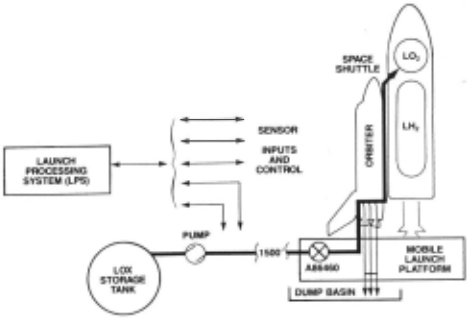
The Space Shuttle's external tank is loaded with 140,000 gallons of liquid oxygen (LOX) from a million gallon storage tank (Figure 1) about 3.5 miles from controlling computers at the Launch Control Center. This critical operation begins six to eight hours before l aunch and must continue t o within seconds of ignition. NASA's automated Launch Processing System controls this process and monitors sensor readings such as temperature, pressures, and valve posi tions, checking that they are each within some specified range. If anything goes wrong, a few experts mus t analyze the problem and determine whether to stop the process , leafing through 200 pages of schematics. A delay in troubleshooting could abort the Shuttle f light.
This is the first application of artif ic ial intelligence s ponsored by the Kennedy Space Center (KSC). An experimental system called LES (the LOX Expert System) has been constructed to aid in monitoring the LOX Loading process, and diagnosing faults . This domain, its history, and further detai ls of i t s representation are described more fully elsewhere (Jamieson, 1984; Delaune, 1985). For more complete description of diagnosis me thods, knowledge representation, and f unctiona l invers ion techniqu~s, see (Searl, 1985).
II DEFINITIONS AND ASSUNPTIONS
First of all, it is assumed that : (a) Time between failures is long compared to diagnosi s time, ruling out simultaneous failures (which
I INTRODUCTION
There is growing interest in the use of structure and function to assimilate observations of compl ex systems and deduce the causes o f unexpected behavior. The LOX Expert System (LES) is an experimental system built to process sensor data to detect and locate faults in a system without feedback, and built from objects withou.t state. Its diagnostic techniques and knowledge representation are designed to be transparent to system users (engineers). By symbolically inverting functional relationships, LES need store each relationship only once. We consider this necessary for maintaining large and complex knowledge bases .
Host previous work has been done in domains of electronic circuitry and digital logic (e . g., Davis, 1984; de K1eer, 1979; Genesereth, 1984), where there are relatively few sensors per active component but the unit under test may be readily taken out of service for diagnostic intervention. The method described here has been applied to a domain of discrete and analog devices with a mixture of electronic, pneumatic, hydraulic, and mechanical control. The domain is rich in sensors and it is LES' goal to determine whether a perceived fault makes it necessary to stop operations, by looking at presently available information .
historically do not Transient behaviors deliberate changes Intermittent faults the diagnostic time. happen in this domain). (b) can be ignored by waiting for of state to stabilize . (c) have cycle times longer than
A complex physical system is represented as a network of functional relationships. Any measurement that gives information about the state of the system is either consistent or discrepant. Consistent measurements agree with their adjacent network components, while discrepant measurements do not. The inputs to this network are commands, and the outputs are sensors. One may treat commands as constraints which propagate through the network to determine an expectation value that describes what an object's state be. Similarly, one may treat a sensor as a constraint which determines a hypothetical value that describes what the object's state is implied to be by that observation. In LES, hypothetical values are derived from both sensors and commands.
Given a sensor discrepancy, each object is:
- incapable of being the cause and so innocent,
- demonstrably the cause and thus the culprit,
- otherwise a suspect.
The OD (Original Discrepancy) is the first discrepancy noticed after a period of untroubled operation. A given sensor's siblings are those other sensors that depend in any way upon any of the commands that control it.
III LES
LES' knowledge base includes most of the LOX portion of the Launch Processing System at KSC. This domain includes analog and discrete commands and sensors, and other objects (transducers, relays, solenoids, valves, LOX pressures and temperatures, etc.) whose state the system is designed to control or sense. These are represented using the Frame Representation Language (FRL) (Roberts, 1977). A frame describes each replaceable component with its type, its value (for commands and sensors), and the units and tolerance of i ts output where appropriate.
Three slots (SOURCE, SOURCE - PATH and STATUS) express how the component is controlled: SOURCE points to the source of energy (e .g. , a power bus or pressure line) . The Boolean SOURCE - PATH expression determines whether the path from source to component is turned on or off. This is sufficient for discrete components, but an analog obj ec t also needs a STATUS to quantify its state when the SOURCE - PATH is on.
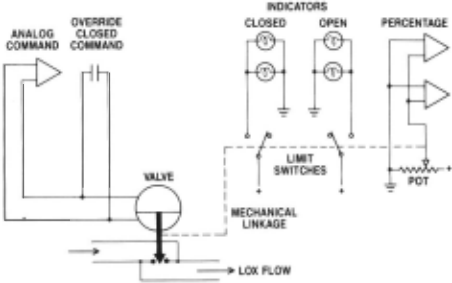
Figure 2 shows a simplified schematic for controlling an analog valve . The potentiometer (P£~)'s STATUS expression simply points to the valve, since it should directly refl ect the valve 's position . The valve 's SOURCE - PATH expression is true if the override c l osed switch is OFF and the analog command i s ON. The va l ve 's STATUS expression gives percentage open . The closed limit switch is discrete, and its SOURCE - PATH expression is (LESSP valve 7), meaning t hat t h is switch is expected to be ON whenever the valve is less than 7 percent open.
Fault detection is invoked wheneve r a command or sensor value is received, whether from user input, a test fil e , or a port. If the received va l ue is from a sensor, then the sensor's expectation value is computed by evaluating its SOURCE-PATH and STATUS expressions. Its controlling objects are evaluated recursively until objects are found bearing known values, which in LES are a l ways commands. This expectation value is compared with the value received, and ~he sensor is marked consistent or discrepant accord1ngly.
If the received value resets a command , then all sensors affected by the command are tested against their expectations.
The suspects and relevant commands are the objects and commands visited while deriving the expectation value. This dynamic search produces the benefit (also enj oyed by (Genesereth, 1984)'s proof techniques) that when an object ' s controllers are " switched out," they and their related commands and sensors never appear and are implicitly cleared.
LES obtains considerable computational savings by storing expectation values in the frames, and resetting them only when commands are changed. This also gives LES a limited facility for handling components whose state depends upon history as well as current commands .
The current user interface is a " live" version of parts of NASA's e lectromechanical schematics . Most of these can be generated automatically from the database (New, 1985), and all can be generated as block diagrams. The user moves about by naming or mousing components . Sensors and commands display their current values with any discrepancies highlighted. Values can be moused for instructional or testing purposes, and several object types are animated to indicate their expectation values.
LES resides primarily in a dedicated Symbolics 3600 which lives in the Launch Control Center a t KSC. Test data now comes from an adjacent PC, but will soon come from a "Common Data Buffer" containing the control system's most complete and current status. Software in the Firing Room will filter the data, sending only data exhibiting "significant" change (!'!!:!Y change for discrete measurements, and a few percent for analogs). It is anticipated that a 9600 baud serial port can handle such filtered data. By summer of 1985, LES should have begun active testing during simulated and actual Shuttle launches. Diagnoses now take
10 - 40 seconds.
IV THE DIAGNOSTIC ~lETHOD
The diagnoser is invoked when a discrepancy (the OD) has been noticed. Suspects, commands, and siblings of the OD are located. An attempt is now made to derive a hypothetical value for each suspect from the OD. A suspect is innocent if any one of the following four criteria is true:
- The suspect controls the OD only through objects known to be innocent.
- No hypothetical value can be established for the suspect because the functional dependency of OD upon suspect cannot be inverted.
- The suspect 's hypothetical value agrees with its expectation value.
- The assumption that the suspect actually has its hypothetical value does not cause all sensors to become consistent.
These criteria are listed in order of application, but 4 is the core of the algorithm.
Computing a hypothetical value means understanding what the OD's measurement is telling us about the state of one of the suspects. Such information is implicit in the SOURCE-PATH/STATUS dependence of sensor upon suspect, but, believing it i mportant to represent such relationships uniquely, we do not store these reverse dependencies explicitly. Instead, we have automated the inversion of sensor - upon-suspect dependencies.
Arithmetic functions present no special problems, but LES' STATUS/SOURCE - PATH expressions may include conditional operators like MAX, OR, AND, IF or even COND, which are not invertible in the standard sense. Nevertheless, it is possible to invert them using conditional tests. For example, if the status of x is (AND (STATUS z) (STATUS y)), then LES in effect solves for y as
y (COND ((STATUS z) (STATUS x))
(T '*INNOCENT*)).
The token '''INNOCENT''' is passed back to the diagnoser telling it to declare y innocent (by
criterion 2, above).
V RHlARKS
The first application domain for the method described here is a good fit with the assumptions listed in Section II.
LES ' representation scheme for structural and functional relationships seems to have advantages in compactness, perspicuity, and in suppressing unneeded detail . This could be important to an engineer attempting to analyze the network's functionality under stressful conditions. LES' methods are now being considered for experimental development in other prelaunch activities at KSC, some of which have proven more expensively troublesome than LOX loading, if not so critical in the final countdown .
ACKNOWLED�~1ENTS
This work is funded by the Advanced Project Office of theKennedy Space Center. The authors wish to thank Dona Lethbridge, Richard Brown, Caroline Wardle, Judy Clapp, and Skip Saunders for their helpful comments.
@inproceedings{ijcai1985p79,
  title     = {A Fault Detection and Isolation Method Applied to Liquid Oxygen Loading for the Space Shuttle},
  author    = {Scarl, Ethan A. and Jamieson, John R. and Delaune, Carl I.},
  booktitle = {Proceedings of the Ninth International Joint Conference on
               Artificial Intelligence, {IJCAI-85}},
  publisher = {International Joint Conferences on Artificial Intelligence},
  editor    = {Aravind Joshi},
  pages     = {414--415},
  year      = {1985},
  note      = {Expert Systems},
  url       = {https://ijcai.org/proceedings/1985/79},
}
TY - CPAPER TI - A Fault Detection and Isolation Method Applied to Liquid Oxygen Loading for the Space Shuttle AU - Scarl, Ethan A. AU - Jamieson, John R. AU - Delaune, Carl I. T2 - Proceedings of the Ninth International Joint Conference on Artificial Intelligence, IJCAI-85 PB - International Joint Conferences on Artificial Intelligence PY - 1985 SP - 414 EP - 415 UR - https://ijcai.org/proceedings/1985/79 ER -Copied
Machine-readable versions of this paper, for tools and AI agents:
 Welcome
 Future Conferences
 AI Journal Division
 IJCAI Proceedings
 About IJCAI
 IJCAI Awards